Introduction
Aging influences the decoding of social and emotional cues, with older adults being worse than younger adults in labeling some types of emotional expression from faces, bodies, and voices. Age-related cognitive decline such as reduced information processing speed or executive control might contribute to these changes, given that these cognitive resources are essential to social perception tasks (Phillips, Channon, Tunstall, Hedenstrom, & Lyons, Reference Phillips, Channon, Tunstall, Hedenstrom and Lyons2008). Age differences in social perception may also be related to changing neural systems with age (Ruffman, Henry, Livingstone, & Phillips, Reference Ruffman, Henry, Livingstone and Phillips2008).
It is, therefore, unsurprising that in recent years there has been growing interest in how emotional information is processed in older adults with dementia and mild cognitive impairment (MCI). Dementia is an umbrella term that refers to disorders characterized by cognitive and functional decline, with most dementias progressive and neurodegenerative. The most common type of dementia is Alzheimer's disease (AD), accounting for the majority of cases worldwide. MCI is defined as cognitive decline greater than expected for an individual's age and education level, but which does not cause functional impairment (Petersen, Reference Petersen2004, Reference Petersen2007).
In AD, the earliest structural changes are seen in entorhinal and hippocampal regions, while the earliest functional changes emerge in the inferior parietal lobules and precuneus (Schroeter, Stein, Maslowski, & Neumann, Reference Schroeter, Stein, Maslowski and Neumann2009). However, Schroeter et al. also present evidence for later (but still early) changes in anterior cingulate cortex and the inferior frontal junction area, and these have been linked to the attentional and executive control difficulties typically evident at initial diagnosis (Amieva, Phillips, Della Sala, & Henry, Reference Amieva, Phillips, Della Sala and Henry2004). Schroeter et al. (Reference Schroeter, Stein, Maslowski and Neumann2009) also identified early neural changes in the anterior medial frontal cortex (BA 9/32), medial temporal and amygdale, and linked these to the social cognitive difficulties often seen in AD. Other studies also show that in the most common dementing disorders of old age, relatively early neural changes are evident in key structures implicated in social cognitive function (Rosen et al., Reference Rosen, Wilson, Schauer, Allison, Gorno-Tempini, Pace-Savitsky and Miller2006; Sollberger et al., Reference Sollberger, Stanley, Wilson, Gyurak, Beckman, Growdon and Rankin2009).
With respect to MCI, in a recent systematic review of 162 studies, Stephan et al. (Reference Stephan, Hunter, Harris, Llewellyn, Siervo, Matthews and Brayne2011) noted that MCI is associated with numerous neuropathological changes such as neurochemical deficits, cellular injury, and oxidative stress, in addition to the histopathological hallmarks of AD. Stephan et al. (Reference Stephan, Hunter, Harris, Llewellyn, Siervo, Matthews and Brayne2011) note that while the latter neural changes are most commonly found in memory-related regions, the hippocampus and the visual association cortex, some studies have also identified neuritic plaques in neocortical regions, and neurofibrillary tangles in the amygdalae. Social cognitive difficulties might therefore not only be a feature of dementia, but also be evident in MCI.
In the social perception literature specifically, most MCI and dementia studies have focused on basic facial affect, and in particular, the ability to decode the basic facial expressions of happiness, sadness, anger, fear, surprise, and disgust. Deficits in facial affect recognition are typically identified in dementia (e.g., Henry et al., Reference Henry, Ruffman, McDonald, Peek O'Leary, Phillips, Brodaty and Rendell2008; Rosen et al., Reference Rosen, Wilson, Schauer, Allison, Gorno-Tempini, Pace-Savitsky and Miller2006) and relate to broader aspects of well-being and social behavior (Phillips, Scott, Henry, Mowat, & Bell, Reference Phillips, Scott, Henry, Mowat and Bell2010). MCI studies have typically yielded more mixed results, but most evidence suggests that basic facial affect recognition is also disrupted in this group (Teng, Lu, & Cummings, Reference Teng, Lu and Cummings2007; Weiss et al., Reference Weiss, Kohler, Vonbank, Stadelmann, Kemmler, Hinterhuber and Marksteiner2008).
Most MCI and dementia studies of facial affect recognition to date have used static stimuli, and specifically, posed photographs of faces. However, we also detect many cues to emotional states from body posture and the dynamics of a moving body. Individuals with dementia continue to use nonverbal behavior in their daily social interactions (Hubbard, Cook, Tester, & Downs, Reference Hubbard, Cook, Tester and Downs2002), but although gestural frequency is equivalent to non-clinical controls, gestural clarity is reduced (Glosser, Wiley, & Barnoski, Reference Glosser, Wiley and Barnoski1998), suggesting that there may be some impairment in the use of body communication signals. However, no MCI or dementia study to date has assessed the ability to decode emotions from body movements.
The most widely used method to explore perception of body movement is the use of point light animations. Point light walkers represent human motion by presenting moving lights located on the joints of a human figure as they perform an action or act out an emotion. Such stimuli lack cues to color, contour, and texture, and so the influence of these perceptual factors can be minimized. The few studies which have used these stimuli in the context of normal adult aging indicate that older adults are less accurate than younger adults at inferring affective state from motion cues (see, e.g., Insch, Bull, Phillips, Allen, & Slessor, Reference Insch, Bull, Phillips, Allen and Slessor2012; Ruffman, Dittrich, & Sullivan, Reference Ruffman, Dittrich and Sullivan2009).
Since individuals with MCI and dementia exhibit deficits recognizing affective states from facial cues, it seems likely that they will also have difficulties recognizing nonverbal affective behaviors. However, motion perception deficits have also been identified in dementia (Gilmore, Wenk, Naylor, & Koss, Reference Gilmore, Wenk, Naylor and Koss1994; Rizzo & Nawrot, Reference Rizzo and Nawrot1998). We will therefore use control tasks to ascertain whether any observed deficits in decoding emotions from point-light animations reflect specific difficulties recognizing emotion or more general difficulties with the perception of biological motion. To do this, in addition to a task in which point-light walkers depict emotional states, two control tasks will be included, one in which point-light walkers depict non-emotional actions such as cycling and driving and the second comprising static facial emotion stimuli. Of primary interest will be to assess whether the perception of biological motion is disrupted in MCI and dementia, and second, whether any observed deficits are disproportionate for the emotion (relative to the action) variant of the task. Performance on measures of processing speed, semantic memory, and visuospatial processing will also be assessed as each of these cognitive abilities are likely to be implicated in biomotion perception, are disrupted in MCI and dementia, and consequently might potentially contribute to any observed group effects identified in this capacity.
Method
Participants
The majority of participants were recruited from a large epidemiological study of aging (the Sydney Memory and Aging Study, MAS), which commenced approximately three years before the current study, and which included a total of 1037 community living research participants at baseline (Wave 1). For MAS, presence of dementia (but not MCI) was an exclusionary criterion at baseline. Some participants excluded from MAS for this reason at baseline were, however, subsequently recruited into the present study. Other participants initially diagnosed as healthy or MCI at baseline were diagnosed with dementia at the 2-year follow-up assessment. However, because the number of cases progressing to dementia within this time-span was relatively low, nine additional cases were also recruited from a Memory Disorders Clinic (see, Thompson, Brodaty, Trollor, & Sachdev, Reference Thompson, Brodaty, Trollor and Sachdev2010). The same diagnostic criteria were applied to participants recruited from MAS and those recruited from the Clinic.
All participants in the control group had MMSE scores of 27 or higher, and did not have an impairment of 1.5 SDs below age based norms on neuropsychological tests from a standardized battery. Consensus MCI and dementia classifications were made using the most recent international criteria (Winblad et al., Reference Winblad, Palmer, Kivipelto, Jelic, Fratiglioni, Wahlund and Petersen2004) by specialist clinicians, derived from a panel of geriatric psychiatrists, neuropsychiatrists, clinical neuropsychologists, and clinical psychologists. Participants were classified as having MCI if there was a participant or informant cognitive complaint; there was cognitive impairment on objective testing; they were not demented (Diagnostic and Statistical Manual of Mental Disorders, Fourth Revision criteria) and they had normal function or minimal impairment in instrumental activities of daily living. Cognitive impairment was defined as a test performance 1.5 SD or more below published normative values (age and education matched where possible). Participants were considered impaired in a domain if at least one measure in the domain was impaired (Fischer et al., Reference Fischer, Jungwirth, Zehetmayer, Weissgram, Hoenigschnabl, Gelpi and Tragl2007; Lopez et al., Reference Lopez, Jagust, DeKosky, Becker, Fitzpatrick, Dulberg and Kuller2003). Participants were further classified into MCI subtypes depending on the type of cognitive impairment (Petersen, Reference Petersen2004).
Of 100 participants, 26 met criteria for dementia, 36 met criteria for MCI, and 38 were controls without cognitive impairment. Since more than a third of the participants with dementia received their diagnosis as part of the initial exclusionary criteria applied to MAS, specific dementia sub-typing was unfortunately not available for these individuals. However, sub-typing for the majority of participants with MCI was available (8 amnestic single-domain, 3 amnestic multi-domain, and 22 non-amnestic cases). These diagnostic groupings are not explored in this study as the groups would be too small for meaningful analysis. All participants had adequate eyesight, hearing and English language ability, and an informant with whom they had at least weekly contact. Participants were excluded if they had a previous diagnosis of psychiatric or neurological illness.
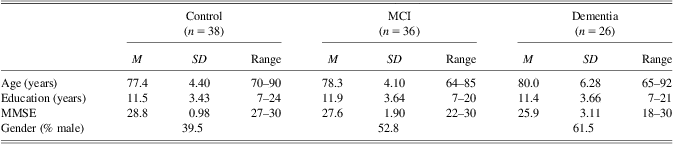
Demographic characteristics are presented in Table 1. The three groups did not differ in age, F(2,97) = 2.17, p = .120, ηp2 = .04, years of education, F(2,96) = 0.15, p = .858, ηp2 < .01, or gender, χ2(2, N = 100) = 3.18, p = .204; φ = .18. As can be seen in Table 1, Mini Mental State Examination scores indicate that dementia participants were in the mild stage of illness. However, the three groups’ MMSE scores differed, F(2,96) = 14.61, p < .001, ηp2 = .23, with post hoc Tukey tests showing that the MCI and dementia groups scored more poorly than controls, ps = .022 and <.001, respectively, and also differed from one another (p = .002).
Demographic information for control, MCI, and dementia participants
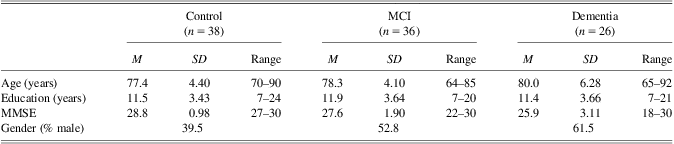
Note. MMSE = Mini-Mental State Examination.
Materials and Procedure
Ethics approval was obtained from South Eastern Sydney Illawara Area Health Service. All data was obtained in compliance with the regulations of this ethics committee as well as those of the University of New South Wales.
Biological motion
Twenty-four point light animations were presented to participants, at a viewing distance of approximately 60 cm, on a laptop computer. These animations consisted of 12 actions which were crawling, cycling, drinking, driving, jumping, playing pool, a tennis serve, rowing, saluting, sawing, sweeping, and digging (Vanrie & Verfaillie, Reference Vanrie and Verfaillie2004). Twelve different actions were chosen to increase the difficulty of the action task and reduce the risk of ceiling performance, a common problem in previous studies using point-light displays. The remaining 12 stimuli portrayed the emotions anger, fear, sadness, and happiness, by a whole-body point light figure (Heberlein, Adolphs, Tranel, & Damasio, Reference Heberlein, Adolphs, Tranel and Damasio2004). To illustrate how emotion may be conveyed via point light motion, for one of the clips depicting sadness, the point light walker is shown to move slowly across the screen, head bowed, and arms hanging loosely. In contrast, one of the clips depicting happiness shows a point light walker moving far more energetically, with head held high and pumping the air with their fists in a rhythmic manner. Participants were told that the emotions may appear more than once. Stimuli within each block (action vs. emotion) were pseudo-randomized and then presented in the same order with the order of block presentation counterbalanced across participants. For the emotion variant of the task, participants were shown the words “angry,” “afraid,” “happy,” and “sad,” and asked to select which of these emotions best described the emotion portrayed by the point-light walker. For the action variant, participants were required to generate responses on their own, with correct and incorrect responses for this condition specified by Vanrie and Verfaille (2004). The dependent variable was the number of actions/emotions reported correctly (max = 12 in each).
Static facial affect recognition
This measure consisted of 36 black and white photographs from the standard set of Ekman and Friesen's (Reference Ekman and Friesen1976) Pictures of Facial Affect. The expressions depicted were fear, surprise, anger, disgust, happiness and sadness, which were displayed by four different individuals (two male and two female). The order of the photographs was randomized, and each was presented on a computer screen. The task was to say aloud the emotion that best described the facial expression shown, and performance was assessed in terms of overall percentage accuracy.
Background neuropsychological assessment
To index processing speed, the Trail Making Test Part A (TMTA, Reitan & Wolfson, Reference Reitan and Wolfson1985) and Digit Symbol (Wechsler, 1997) tests were used. For the former, participants were required to quickly draw lines to connect a series of numbers consecutively, with the time taken to complete this task the dependent measure. For Digit Symbol, participants were given 120 s to fill in the symbols corresponding to rows of printed numbers. The number of correctly paired symbols was the score. To index semantic memory, the 30-item version of the Boston Naming Test (BNT, Kaplan, Goodglass, & Weintraub, Reference Kaplan, Goodglass and Weintraub1983) was used, with participants asked to correctly name each of 30 line drawings, graded in difficulty. To index visuospatial processing, Block Design (Wechsler, 1997) and the Benton Visual Retention Test (BVRT, Sivan & Spreen, Reference Sivan and Spreen1996) were used. Block Design requires participants to arrange blocks into several pre-specified patterns. For the BVRT, participants were presented with fifteen geometric designs, with number of correct designs subsequently recognized the dependent measure. Because these neuropsychological measures were administered as part of Wave 2 of MAS, results for these particular assessments were not available for the nine dementia participants initially excluded from MAS at baseline.
Results
Biological Motion Tasks
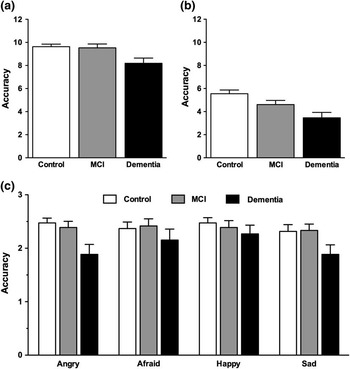
Figure 1 shows participants’ total performance on the two biomotion tasks: the emotion task (1A) and the action task (1B). A repeated measures analysis of variance (ANOVA) was conducted with the between-subjects variable of group (control, MCI, and dementia) and the within subjects-variable of task (emotion, action). There was an overall effect of group, F(2,97) = 8.58, p < .001, ηp2 = .15. Post hoc Tukey tests showed that this reflected poorer performance from the dementia group relative to both the control (p < .001) and MCI participants (p = .014); control and MCI participants did not differ (p = .382). There was also a main effect of task, F(1,101) = 409.1, p < .001, ηp2 = .81, with performance better on the emotion (M = 9.22, SD = 1.96) relative to the action task (M = 4.67, SD = 2.28). There was no interaction between group and task, F(2,97) = 1.42, p = .247, ηp2 = .028.
Participants’ performance on the biomotion tasks; (A) accuracy on the emotion-biomotion task; (B) accuracy on the action-biomotion task, and (C) accuracy recognizing each of the four emotions depicted in the emotion-biomotion task. Error bars indicate SE of the mean.

To assess whether there was any evidence for differential impairment across the emotions on the biological motion task, a repeated measures ANOVA was conducted with the between-subjects variable of group (control, MCI, dementia) and the within-subjects variable of emotion (angry, afraid, happy, sad). There was a main effect of group, F(2,97)=5.23, p = .007, ηp2 = .10, but no main effect of emotion, F(3,291) = 1.41 p = .242, ηp2 = .014, and no interaction between emotion and group F(6,291) = 0.69, p = .660, ηp2 = .01. Thus, within and between groups there were no differences in the accuracy of recognizing different emotions from biomotion stimuli (see Figure 1C).
Static Facial Affect Recognition
Participants’ scores on the measures of facial affect recognition were also analyzed with ANOVA, and revealed a main effect of group, F(2,81) = 8.41, p < .001, ηp2 = .17. Post hoc Tukey tests showed that both the MCI (M = 27.0; SD = 2.92) and the dementia (M = 25.3; SD = 3.97) group performed more poorly than the control group (M = 28.8; SD = 2.60); ps = .050 and<.001, respectively, but did not differ from one another ( p = .131).
Background Neuropsychological Assessment
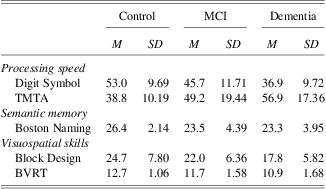
Table 2 reports participants’ performance on the background neuropsychological assessment. The three groups differed significantly on all measures, Digit Symbol, F(2,84) = 13.63, p < .001, ηp2 = .25; TMTA, F(2,85) = 8.33, p < .001, ηp2 = .16; BNT, F(2,86) = 7.99, p = .001, ηp2 = .16; Block Design, F(2,86) = 5.99, p = .004, ηp2 = .12; BVRT, F(2,86) = 8.09, p = .001, ηp2 = .16. Follow-up pair-wise comparisons revealed that for the Digit Symbol, control participants performed better than MCI and dementia participants, with scores for the MCI group also higher than for those with dementia (all ps < .05). For TMTA, the BNT and the BVRT, control participants outperformed individuals with MCI and dementia (all ps < .05), but there was no difference between the two clinical groups. For Block Design, controls performed better than the dementia group ( p < .05), but did not differ from those with MCI. MCI participants however performed better than the dementia group ( p < .05).
Neuropsychological characteristics of control, MCI, and dementia participants
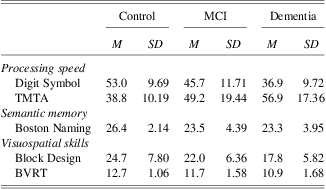
Note. TMTA = Part A of the Trail Making Test; BVRT = Benton Visual Recognition Test; N for the background neuropsychological assessments is 37 for the healthy control group, but ranges from 34 to 35 for the MCI group, and 15 to 17 for the dementia group due to some participants failing to complete all assessments. For all measures except for the TMT-A (which refers to time in seconds to complete the task), higher scores are indicative of better function.
Correlates of Biological Motion and Static Facial Affect Recognition
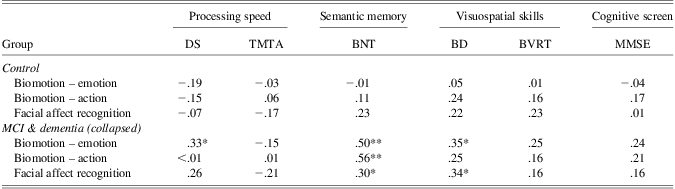
Correlations between neuropsychological test performance and MMSE scores with biomotion and facial affect recognition are presented in Table 3, separately for the control and clinical participants. For these analyses, participants in the MCI and dementia subgroups were treated as a single group, owing to the relatively small number of dementia participants completing the background neuropsychological assessment.
Correlations between each of the neuropsychological measures and cognitive screen with performance on the biomotion and facial affect recognition measures
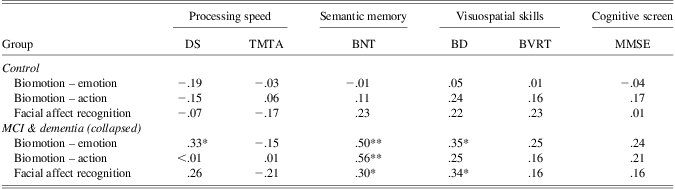
Note. DS = Digit Symbol; TMTA = Trail Making Test Part A; BNT = Boston Naming Test; BD = Block Design; BVRT = Benton Visual Recognition Test; MMSE = Mini Mental State Examination.
tp < .10.
*p < .05.
**p < .01
It can be seen that in the control group, none of the cognitive assessments was related to performance on any of the recognition tasks. However, in the clinical group, semantic memory as indexed by the BNT was significantly correlated with performance on all three recognition tasks. The magnitude of these correlations was moderate for the measure of facial affect recognition (r = .30), but large for both of the biomotion tasks (rs = .50 and .56 for the emotion and action variants, respectively). One of the visuospatial measures (Block Design) was also significantly correlated with the recognition of emotion from biomotion stimuli and static faces. One of the measures of processing speed (Digit Symbol) was also significantly correlated with the recognition of emotion from biomotion stimuli.
Discussion
The present study provides novel insights into how specific aspects of social cognition are affected in abnormal adult aging. First, while prior research suggests that there may be some impairment in the display of body communication signals in those with dementia (Glosser et al., Reference Glosser, Wiley and Barnoski1998), the present data indicate that these difficulties extend to the capacity to make inferences from others’ non-verbal bodily cues. These results therefore align with earlier studies showing that visual motion processing is disrupted in dementia (Gilmore et al., Reference Gilmore, Wenk, Naylor and Koss1994; Rizzo & Nawrot, Reference Rizzo and Nawrot1998), but also builds on this literature by showing for the first time that this extends to the recognition of socially relevant biological motion. However, since the magnitude of this difficulty was equivalent for tasks depicting actions and tasks depicting emotions, this appears to reflect a generalized deficit processing non-verbal motion cues.
It is of note that the ability to recognize an action was found to be more difficult than the identification of an emotion, and this was true irrespective of cognitive status. One possibility is that the recognition of actions and emotions from biomotion stimuli rely differentially on the provision of contextual information. Thus, while both biomotion assessments effectively “isolate” biological motion from contextual cues, in the action variant of the measure, most of the videos require the participant to incorporate a “prop” into their interpretation, for example, a bike (for riding), a car (for driving), a brush (for sweeping). Participants are therefore required to mentally include contextual information into their judgment of the action taking place to successfully complete the task, a requirement that is not needed to solve the emotion videos. In addition, the affective qualities of stimuli tend to be processed without extensive conscious cognitive processing, suggesting that this occurs very early in information processing, even before cognitive operations such as categorization (Murphy, Reference Murphy2001). As such, when compared with the recognition of actions, recognition of emotions may have a primacy bias.
The second finding of note was that the MCI group was not impaired on either biomotion task, despite showing difficulties with the decoding of facial emotions. As noted previously, the finding of MCI-related difficulties on the measure of facial affect recognition is consistent with the broader MCI literature (Teng et al., Reference Teng, Lu and Cummings2007; Weiss et al., Reference Weiss, Kohler, Vonbank, Stadelmann, Kemmler, Hinterhuber and Marksteiner2008) which (as in the present study) used static photographs of posed facial expressions. While such stimuli are standardized and well validated, they also have obvious limitations: in particular, the emotions are posed and static. In everyday life, cues to emotion are often subtle and fleeting, and this can best be captured through looking at dynamic information. The present results – showing that individuals with MCI do not differ from controls in their ability to decode emotions from dynamic point-light stimuli suggest a potentially important difference between the perception of emotion cues from static versus dynamic stimuli.
The third finding to emerge was that there were specific neuropsychological contributions to biomotion and facial affect recognition in the clinical, but not the control group. Specifically, for the clinical group, there was some evidence for visuospatial and processing speed difficulties to be related to performance on at least some of the recognition tasks. However, in particular, the results indicated that problems accessing semantic representations contribute to the difficulties decoding biomotion cues. This is consistent with other evidence showing that the inference of attributes from biological motion involves the perception of stimuli which is then compared to prior knowledge and expectancies (see e.g., Heberlein et al., Reference Heberlein, Adolphs, Tranel and Damasio2004). Interestingly, semantic memory difficulties as indexed by the BNT contributed equivalently to the difficulties decoding emotion and action variants, despite the fact that participants were only required to select one of four options for the emotion task, but generate 12 different potential options for the action task. Moreover, semantic memory difficulties were also moderately correlated with performance on the static measure of emotion recognition. Taken together, these results suggest that for each of these measures accuracy of interpretation is at least partially reliant on the ability to access semantic memories containing exposure to similar stimuli (Kveraga, Ghuman, & Bar, Reference Kveraga, Ghuman and Bar2007).
Caveats and Future Directions
Despite converging evidence showing that dynamic relative to static cues are more ecologically valid, in many ways the biomotion measure used in the present study is quite artificial. This is because, as noted earlier, it isolates biological motion cues from the contextual information that is usually present in real-life situations to assist with the recognition of action and emotion (e.g., playing tennis with a racquet and ball or crying at a funeral). Additionally, the biomotion measure isolates action recognition from emotion recognition, yet in social interaction these capacities are often inter-related. Consequently, it is possible that in everyday life the provision of additional contextual support might help disambiguate biological motion cues. Indeed, Henry et al. (2008) showed that participants with AD had greater difficulty decoding static expressions of facial affect relative to a more ecologically valid measure that involved dynamic displays of facial expressions, in conjunction with paralinguistic and body movement cues.
Thus, individuals with dementia might particularly benefit from the availability of multimodal information when interpreting emotions because this matches everyday experiences of emotional information more closely. Also, having multiple channels of information provides a greater level of redundancy, which might help to attenuate declines in the speed or efficiency of processing emotional information in dementia. Consequently, while the results of the present study are important in showing that individuals with dementia are impaired at processing biomotion cues to action and to emotion, further research is needed before it can be concluded that these difficulties are sufficient to influence everyday interpersonal interactions and well-being in this cohort.
Finally, an important issue for future research is the extent to which biomotion perception differs as a function of dementia subtype. In the present study, information relating to specific diagnoses was not available. However, it would be of considerable interest to assess how threat perception is affected in dementias that vary with respect to their relative impact on the key structures thought to be implicated in this aspect of emotional processing. In particular, frontotemporal lobar degeneration is associated with marked tissue loss in frontal and temporal structures. Relative to other dementia subtypes, this group is characterized by greater impairments in virtually all facets of social and emotional processing (Wittenberg et al., Reference Wittenberg, Possin, Rascovsky, Rankin, Miller and Dramer2008). Consequently, it may be anticipated that this dementia group might differ quantitatively (and possibly also qualitatively) from other dementia subtypes in their capacity to decode emotion cues from biomotion stimuli. This remains an important issue for future research.
Nevertheless, in recent years there has been particular interest in the potential role of mixed disease in the pathogenesis of cognitive impairment and dementia. This is unsurprising given that in several autopsy studies, it has been shown that mixed brain pathologies account for many of the dementia cases in community-dwelling older adults, with estimates typically around 30–40%, but in one study as high as 86% (Schneider, Arvanitakis, Bang, & Bennett, Reference Schneider, Arvanitakis, Bang and Bennett2007). The present study is therefore important in providing further clarification about how specific aspects of social cognitive function are affected in MCI and early dementia, more broadly.
Acknowledgments
This research study was supported by a Discovery Project Grant from the Australian Research Council awarded to the first author. There were no financial or other relationships that could be interpreted as a conflict of interest affecting this manuscript.