Sometime between around 687 and 700, a distraught father brought his raving son, in a wagon, to the island of Lindisfarne, where the holy relics of Saint Cuthbert were kept. According to the author of the Life of Cuthbert, the boy, wearied by the torments of a demon, was prone to succumb to bouts of screaming, weeping, and self-mutilation. A priest named Tydi had been unable to put the demon to flight, so he advised the father to transport his son to the relics. At that point, “Many people despaired of being able to secure any remedy for the miserable boy, but a certain man of good and pure faith who was moved to pity, placing his trust in God and entreating the help of St. Cuthbert, blessed some holy water and sprinkled in it some dirt from the ditch in which had been poured the bath water of the body of our holy bishop after his death. Once the boy tried the holy water, he desisted from his babbling that night.”Footnote 1
Almost a thousand years later, an Essex teenager named Katheren Malpas was likewise adjudged to be sorely afflicted by demons. According to the testimony her grandparents gave in Star Chamber, Katheren's torments began on Candlemas Eve, 1621, presaged by several bouts of hideous screaming that left her lame. Over the subsequent months, Katheren often appeared to succumb to terrible fits that seemed all the more horrifying to those who saw her, by virtue of their violence and the fact that they rendered her completely insensible. According to her mother, Katheren's condition was such that she
would drawe her hands togeath[e]r at other tymes … woulde holde her in her heade & make her heade shake as though she were trobled w[i]th the palsey & divers tymes when the fitts tok her she would fome att the mouth & shrike verie fearfully att other tymes it would draw her belly flatt to her backe & woulde drawe downe her shoulder bones & some tymes when the fitt did tak her her legges woulde turne backwards & be verie stiffe & at other tymes she woulde be stretched out & be soe stiffe that her whuole woulde not bend w[i]th out breakeinge.Footnote 2
On the evidence of these strange and wondrous torments, Katheren's family asserted that she was the victim of demons who had taken physical possession of her body.
Although separated by almost a millennium, these two cases struck contemporaries as terrifying, in part at least because they participated in a venerable discourse about possession, whose metaphysical reality was firmly anchored in the New Testament.Footnote 3 According to the account in Mark's gospel, demoniacs would most typically manifest their appalling malady through a course of strange and violent fits: they would tear at themselves and collapse to the ground, often wallowing or foaming at the mouth. Some, the evangelist further notes, were so sorely afflicted by their possessors that they were moved to suicide, attempting to put an end to their torments by throwing themselves into fire or water (Mark 9:17–29). To this repertoire of symptoms, Luke adds that other demoniacs were able to demonstrate unusually great strength in the course of their fits (Luke 8:27–33). Finally, the possessed were often able to exhibit preternatural knowledge: both the Gadarene and the Capernaum demoniacs (Mark 1:24; cf. Luke 4:33–34; Matt. 8:29; Luke 8:28) were able unprompted to recognize Christ's divinity. Given its fundamental position in premodern Christian cultures, in outlining the basic symptoms and pathology diagnostic of demon possession, scripture provided English people with a seemingly secure and unambiguous explanatory category that could be deployed to account for a set of disturbing and otherwise inexplicable symptoms.
Nevertheless, despite the unassailable position of scripture in premodern culture, the form and content of possession, as it was conceived in general and enacted in particular, came to diverge significantly over the subsequent centuries from the scriptural archetype. Consequently, possession cannot be construed as a physical manifestation of a particular strand of biblicism, nor can it be treated as a static ontological category with a fixed and stable meaning. Certainly, these biblically adduced symptoms helped define the parameters within which premodern possessions were enacted and suggested the terms under which their remedies might be sought. However, historians of medicine have long emphasized the importance of the link between affliction and the social and cultural lens through which a patient's ailment is perceived. For them, disease is not just a biological event, a cluster of symptoms or behaviors that manifest themselves nastily on the body of an unfortunate. Rather, it has an important social component, since those features of a condition that are deemed symptoms, the significance with which they are invested, and the relationships posited to exist between them are a result of a process of rationalization that is a function of the beliefs and values of the culture inhabited by those deemed socially competent to effect a diagnosis.Footnote 4 In this context, as a product of a continuing series of negotiations between the putative demoniac and those who saw him or her, instances of possession were inextricably bound up with the wider intellectual, social, and political discourses through which such instances were viewed. These discourses as they are constructed historically map out the space where possession has explanatory power, but by subsuming the particular symptoms of an apparent possession into the resultant epistemological frame, they also help fix the significance of the case and, in so doing, translate it into culturally significant information. As the relationship between these discourses is renegotiated over successive historical moments and the location of possession within this framework comes to be replotted as its axes shift, the nature, significance, and explanatory power of possession is reconfigured accordingly. Thus, despite the fact that scripture described a largely unambiguous set of behaviors as constituting possession, this model was expanded and adapted over time to embody and reflect the cultural priorities of the age.
As a cultural product, particular instances of apparent possession can serve as important microhistorical sites for the recovery of popular and learned mentalité. In recent years, there have been a few studies dealing with cases of demonic possession based heavily upon contemporary legal records. These have gone some way in reconstructing the intellectual apparatus and social dynamics that colluded in manufacturing the perception of possession within a particular historical and social context.Footnote 5 This present study, however, aims to take a much broader chronological sweep in order to examine the idea and construction of possession in one place at two distinct and historically disparate moments: Anglo-Saxon and early modern England. Certainly, comparing two cross sections cut laterally through the fabric of history poses some methodological difficulties. In the first place, the very different nature of the extant historical record in these two periods makes comparisons problematic. The material that survives for the Anglo-Saxon period is decidedly limited due to low literacy and limited text production; by contrast, the early modern period is copiously documented. But second, where Anglo-Saxon records exist, they have no immediate analogue in terms of either form or genre in the later period. The sources in both periods were written in different contexts and ordered toward different final causes. But while like-for-like comparisons between the sources in the two periods may be impossible, by treating each period as a discrete unit, with its own particular types of evidence proper to it, it should be possible to reconstruct the broad contours of possession as well as its content, form, and social significance at these two historical instances.
Despite these methodological problems, there is much to justify a comparison between these two periods, for both see the question of possession, its discernment, and its remedy tied up with the politics of knowledge production. In both eras, an insecure church tried to counter what it cast as the superstition of an idolatrous competitor. The ability to diagnose possession and treat it is a deeply contested issue because of its potential propaganda value to the proponents of the various groups competing for religious ascendancy. Moreover, precisely because of its contested nature, both moments endeavor to anchor possession in contemporary constructions of authority—scriptural, textual, empirical, hierarchical, and parochial—co-opting them to underscore the religious and ideological position of those recording and interpreting the apparent events. Yet despite this similarity of context, its construction and significance in popular and learned physics and metaphysics varied significantly between these two moments, perhaps most notably in its relationship to contemporary conceptions of witchcraft. In this respect, despite the continuous tendency in both periods to situate apparent instances of possession within the context of the scriptural paradigm, in practice possession proved far from a category of unambiguous significance. Not only did the core of diagnostic symptoms differ radically during these two historical moments, but so too did the explanatory power of the concept. Indeed, what becomes clear in this present study is that as an ontological category for a body of symptoms and behaviors, possession proved distinctly malleable and decidedly polysemous, shifting in response to the prevailing cultural and epistemological winds.
Anglo-Saxon Possessions
In reconstructing the context and character of Anglo-Saxon conceptions of possession and the attendant problem of its remedy, scholars are at the mercy of those few documents, promulgated almost exclusively within monastic scriptoria, that have survived through the centuries. These sources offer tantalizing glimpses into often alien worldviews, from which coherent pictures can be only tentatively and speculatively crafted.
For Anglo-Saxons, possession was deployed to explain a broad category of afflictions. Beyond physical possession of a person by a sentient spirit or demon, they considered a great variety of ills, disorders, and other physical and environmental misfortunes to constitute the work of demons in an abstract sense. Consequently, Anglo-Saxon medical books do not distinguish clearly between demonic possession of a person and disease agents such as worms, the sudden stabbing or internal pains they dubbed elf-shot, poisons, or other putative pathogens: at some level, all can be construed as external assaults and forms of the “devil's tribulations” (deofles costunga). As external assaults, they can be expelled through some form of adjuration. Indeed, some, like the late tenth- or early eleventh-century Lacnunga book, suggest the possibility of a purgative capable of putting any sort of unpleasant possessing agent to flight. Thoroughly blending an array of old pagan elements with a series of Christian motifs, the book's “Nine Herbs Charm” invokes the herb stiðe as a universal that could expel almost any sort of demonically orchestrated affliction: “It dashes against poison, it expels evil things; it casts out poison. This is the herb that fought against the worm. It is powerful against poison; it is powerful against the ‘on-flyer’; it is powerful against the malignant things that fare throughout the land.”Footnote 6 Another verse charm against elf-shot in the same collection directly addresses the “shot” to be expelled and commands: “Out, little spear!”Footnote 7 These adjurations are not conceptually distinct from the darts of demons protected against by the Lorica of Gildas: “That the foul demons may not fling their darts into my sides, as they so often do.”Footnote 8 In this sense, Anglo-Saxon nosology seems to have built upon that of first-century Palestine, albeit, as it was known to them, refracted through the lens of scripture. Christ reifies diseases as sentient beings, casting them out largely without distinction: for instance, Luke describes him as “rebuking” the spirit in the Capernaum demoniac (“a man who had the spirit of an unclean demon”) with the same word (ɛπɛτιμησɛν) used to describe him “rebuking” a fever to depart and “rebuking” the wind to calm.Footnote 9
Although possession was a category broadly applied to account for many different sorts of affliction in this period, it is difficult to reconstruct the precise nature and extent to which demon possession, understood as the physical possession of a person, was a diagnosis deployed among the Anglo-Saxons. Several historical and hagiographical works of the period state flatly that “many people were cured” at a given saint's tomb, with demoniacs sometimes mentioned along with those suffering from other infirmities. It is not possible, however, to substantiate these cursory references by means of independent records—there are not yet the meticulously compiled registries and miracle lists such as those later kept at popular healing shrines and already starting to appear on the continent.Footnote 10 In fact, given the highly stylized nature of hagiography as a genre, it is not clear whether such remarks can be taken as literal descriptions or whether they should, more cautiously, be considered static literary tropes, consciously crafted to mirror the accounts of the afflicted furnished by scripture and by continental models.
The Anglo-Saxon understanding of the Bible was in essence “processed”: it was conditioned largely by the early Christian tradition of commentary literature and homilies and by a host of apocryphal narratives that made their way very early into a number of monastic book collections. In this respect, works by writers such as Jerome, Sulpicius Severus, Gregory the Great, Venantius Fortunatus, and other continental authorities were just as influential on the Anglo-Saxon understanding of possession as the letter of the Bible itself. The filters through which Christianity was bequeathed to the Anglo-Saxons can be seen in some of the works most commonly appearing in Anglo-Saxon manuscripts: for instance, Augustine's commentaries on the Psalms and on the Gospel of John; Gregory's Homilies on the Gospels, Morals on the Book of Job, and Pastoral Care; Isidore's Etymologies and Synonyms; and the homilies of Paul the Deacon. Through such an authority as Isidore, for example, Anglo-Saxons learned that the demons once enjoyed “heavenly bodies” but that after their fall from heaven they were turned into “aerial” beings—not of pure air, but of thick or murky air, which would serve as a prison to them until the time of the Second Coming.Footnote 11 This extrabiblical conceptualization was very influential in determining how demons were portrayed in Anglo-Saxon art, theology, and homiletics.
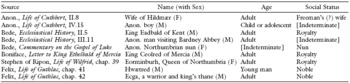
So great is the literary dependence on continental forerunners that the vast majority of references in the Anglo-Saxon documentary record that relate to demon possession or exorcism are simply retellings of events that happened not in England but on the continent—and usually, a number of centuries earlier. Thus, the prolific homilist and hagiographer Ælfric relates lively stories, such as that of three workmen becoming possessed in his Passion of St. Maur and that of Apollinaris casting a demon out of a nobleman's wife in the Passion of St. Apollinaris, but here he is simply translating into English the stories he finds in his source texts.Footnote 12 When these accounts of possessions and exorcisms that occurred in other times and places are subtracted from the documentary corpus, the pool of diagnosed cases of possession in Anglo-Saxon England shrinks considerably. In fact, there are only nine references to cases of demon possession for the entire Anglo-Saxon period that provide any demographic details or particulars whatsoever (sex, age, social status, symptoms, etc.). Moreover, these are generally to be found in ecclesiastical accounts that stress the dispossession of these tormented souls.
The first thing to note in table 1 is that all of these cases hail temporally from either the seventh or the early eighth century and geographically from Northumbria and Anglia. To some extent, this is clearly a product of the fact that there is an increase in literary activity overall in that time and place, a movement generally dubbed the Northumbrian Renaissance, but it is significant that there is almost no mention of native demon possession in subsequent periods of Anglo-Saxon literary activity. For instance, there is no mention of possession in the literary, historical, and pastoral writings promulgated under Alfred in the ninth century or under the prolific monastic reformers of the tenth and eleventh centuries. Indeed, this early window of exorcism activity is the only one from pre-Conquest England that can be discussed in any detail and the only one that can be situated into a particular cultural milieu.
—Known Possession Cases from Anglo-Saxon England

The nine cases in table 1 in which demon possession is diagnosed adhere closely to a fairly specific profile, and the literary contexts in which they appear reveal a small range of recurring themes and anxieties. This can offer a fairly safe idea, if not of the extent to which possession and exorcism played a role in the conversion of the countryside or in the ongoing life and experiences of Anglo-Saxons, at least of the construction of demon possession as an ontological category in the minds of contemporary authors. While the Anglo-Saxon cases built on continental models, they differ from them in several important respects: Jerome, for instance, refers to demoniacs levitating in the air; Gregory of Tours mentions people who are possessed by multiple demons as well as a single demon possessing multiple people; and Einhard has a possessed German girl speaking in Latin, although she could not have known any. In continental cases like these, demoniacs dance through the church, announce the approach of invading armies, and exit the demoniacs in the shapes of animals or small black men. Compared with these spectacles, Anglo-Saxon possession cases are notably subdued.
In fact, the majority of recorded symptoms in the Anglo-Saxon cases, like those described in scripture, closely mimic a handful of well-known neurological and muscle-control disorders, such as epilepsy. In the anonymous Life of Cuthbert (ca. 699–705), Hildmær's wife gnashes her teeth and lets out tearful groans.Footnote 13 She is “shamefully broken, dirty with her own spittle.”Footnote 14 Bede's account of the visitor to Bardney Abbey in his Ecclesiastical History (731) likewise portrays a sufferer “crying out, gnashing his teeth, foaming at the mouth, and flinging his limbs about.”Footnote 15 The erratic and uncontrollable muscle motion is apparently the condition's most salient characteristic: when he is cured, Bede relates, he “drew all his limbs back in peacefully.”Footnote 16 Stephen of Ripon's Life of Wilfrid (ca. 710–20) reports that Queen Eorminburh is suddenly taken with some sort of demon, which manifests in all her limbs being contracted and folded together.Footnote 17 Finally, in Felix of Crowland's Life of Guthlac (ca. 730–40), a youth named Hwætred is possessed by a wretched spirit, which results in compulsive self-mutilation: he “lacerated his own limbs with wood, iron, and with his own nails and teeth as much as he could.”Footnote 18 He bites and strikes at anyone else who comes close also, even killing three people with an axe, which suggests that what is being described is a transient psychotic episode. Such destructive behavior also appears in the anonymous Life of Cuthbert, in which a man's son is “wearied by a demon” because he screams out, weeps, and mutilates his own body.Footnote 19 He fills many with horror at the sound of his shouting and crying out.Footnote 20 The broad profile of physical descriptors, then, concerning the “raving” of these demoniacs, aligns them with neuropathological conditions of limb paralysis or convulsions, sporadic fits, stroke, compulsive self-mutilation, or random, violent out-lashes.
Since ancient times, of course, such convulsive disorders—inexplicable and frightening to onlookers in premodern societies—have been explained in cultures worldwide through recourse to indwelling demons. It is these neurological conditions, in fact, that compose possession more generally; that is, in societies in which possession behavior is widespread and is used to express a broad range of individual, social, religious, and political dissatisfactions, demoniacs still return to the baseline physiological core of immediate behaviors such as falling, convulsing, foaming at the mouth, and screaming. The Anglo-Saxon sources are notable in adhering very closely to this physiological core and are relatively devoid of more cultural symptoms. As with demon possession in early medieval accounts as a whole, demoniacs in Anglo-Saxon sources are generally treated with the same empathy and pity accorded to unfortunate sufferers of other illnesses.
That said, the pathology of some Anglo-Saxon cases, as they are described in the sources, does sometimes diverge in some important respects from scriptural models. Scripture, for instance, has Christ cast out demons by means of the spirit or finger of God (Matt. 12:28; cf. Luke 11:20). Bede, however, states that the possessed often cannot be exorcized properly until they openly confess:
In our time the priests, who know how to cast out demons through the grace [or “gift”] of exorcism, usually maintain that patients cannot be cured unless they openly reveal through confession everything they endured from the evil spirits in visions, sounds, tastes, tactile sensations, or through any senses whatsoever either physically or mentally—especially when, appearing to men as women or to women dressed as men (which demons the Gauls call Dusi), they pretend to desire sexual intercourse with them and (an unspeakable marvel for an incorporeal spirit!) to consummate with them in the flesh. And they advise that the demon's name—that by which he says he is known—and the ways in which they devised their mutual pact of passion by oaths, should be brought out.
This may seem like a fable, but it is true insofar as there is the most notable testimony of many people that a certain priest in my vicinity related that he began to cure a certain holy woman from a demon, but as long as the matter lay concealed, there was nothing he could do for her. When she confessed what phantasm was troubling her, however, he quickly drove it out through prayers and other necessary kinds of purifications, and, applying consecrated salt with medical zeal, he cured the woman's body from the ulcers that had been brought about by the demon's influence.Footnote 21
This insistence on the active role of the demoniac in helping to allow the exorcism to succeed is at odds with the majority of New Testament exempla in which the demoniac is depicted simply as a passive victim, unable to assist in the cure. But this divergence from the model laid out in scripture is significant, for it suggests that Anglo-Saxon modes of dispossession were becoming reconfigured to more closely mirror the dynamic between patient and exorcist depicted in continental exorcism narratives. Furthermore, there are literary uses of possession unknown in scripture: in Stephen of Ripon's Life of Wilfrid, the queen is seized with a demon as direct punishment for King Ecgfrith's imprisonment of Wilfrid. As soon as the king has the bishop released, the queen is cured. Possession appears here as divine punishment (in a third party, no less) rather than as unfortunate affliction, again unlike possession accounts in the New Testament. In this sense, those who wrote of possession and its remedy, at least, seem to have appropriated elements from the broader intellectual culture they inhabited to reconfigure elements of possession and exorcism in such a way as to cause them to see both diagnosis and remedy as dynamic processes. Reworked under the weight of these models, the person of the demoniac seems to have been reconstrued to take an active part in the process of treatment. What seems to be emerging here, then, is a hermeneutic circle. In one hemisphere, the symptoms manifested by the demoniac situate her condition within the category of possession as it is understood through the filter of a host of authorities. In the other, the preconditioned expectations of those who treat the demoniac define the parameters under which particular possessions could be enacted by virtue of their role in diagnosis and treatment.
A significant facet of the recorded cases of demon possession for Anglo-Saxon England is that, even though the narratives are recorded in ecclesiastical documents, particularly saints’ lives, priestly adjuration is not necessarily the weapon of choice in combating the inhabiting demons. Indeed, these sources draw significant attention to the failure of formal exorcisms. The anonymous Life of Cuthbert states that Tydi was “incapable of putting the demon to flight”; instead, it was the relics of Cuthbert that proved effective.Footnote 22 Bede likewise reports that the relics of Oswald cure the demoniac, after the priest's exorcisms fail; “the priest recited exorcisms and did everything he could to assuage the miserable man's ravings. However hard he tried, though, he was unable to make any headway.”Footnote 23 As J. M. Wallace-Hadrill notes, the failure of formal exorcism “was a serious matter at a time when the Church had to demonstrate the efficacy of its procedures to a semi-pagan population.”Footnote 24 Although the corpus of possession cases is admittedly limited, this suggests that the geography of power in the Anglo-Saxon church was still heterogeneous. Instead of curative power being construed as distributed homogeneously through the ecclesiastical hierarchy, it seems to have been popularly invested at local sites, especially through charismatic individuals and (after their deaths) the places associated with them. Over time, some of these sites would become powerful ecclesiastical centers in their own right, while others would fade into obscurity. The ability to draw demoniacs—and people with other illnesses—became an increasingly important factor in a site's economic success, especially after the Conquest, when greater political stability allowed for more reliable pilgrimage routes throughout the island.
In the seventh century, Northumbria had been deeply contested territory, for it was the meeting point of the two distinct missionary campaigns in England: the Irish, from Iona to the north, and the Roman, from Canterbury to the south. Moreover, there is some evidence that parts of the north of England had resisted Christian conversion longer than other areas while they were under Roman occupation, and their modes of spirituality had blended with local Celtic paganism differently. Thus, the region was still something of a battlefield between these three competing worldviews.Footnote 25 And so, written within living memory of the conversion of many pagan regions in England on one hand and the Synod of Whitby on the other, Bede's Ecclesiastical History at times reflects some of the anxieties of the new Roman faith as it attempted to gain a solid foothold in the land. Bede paints the Christianization of England in epic terms, with missionaries perpetually on the verge of violent martyrdom, braving new regions to talk sense into benighted pagan kings and their entourages. The populace was steeped in traditions that were hard to break: “Some, in their mortal hour, turning from the sacraments of the faith in which they had been instructed, rushed to the fraudulent relief of idolatry, as though they could fend off a blow from God the Maker by means of incantations, amulets, or any other secrets of demonic craft.”Footnote 26 But in some respects the Northumbrian church was poorly prepared to deal with these potential relapses of the populace into paganism. Indeed, Bede wrote in a letter to Bishop Ecgbert that many areas of Northumbria did not receive a priest's visit for years at a time.Footnote 27 If priests were scarce, bishops—the principal ecclesiastical authorities for England at the time—were virtually as distant as the gods themselves to most rural Anglo-Saxons.
In this climate, it was the local saints who could often serve as mediators. These were holy individuals of humble backgrounds, close to the lower orders and often outside metropolitan politics and the entrenching authority structures within the church. Valorizing local saints as mediators allowed the nascent English church to satisfy the need for spiritual guidance at the local level, through example and through miraculous healings, without fully asking the populace to submit unquestioningly to a church that could potentially be perceived as foreign, aloof, and bureaucratic—a church whose very language was incomprehensible to the Anglo-Saxons. In this light, it is hardly surprising that the cases of possession in Anglo-Saxon England are associated primarily with these regions of recent conversion, for in places like Northumbria there was still a tension between those members of the community who had fully accepted the new Roman faith and those who had not. The act of confession, not yet a sacrament at this time but nonetheless a powerful symbolic act of submission, served to gauge the trust local Anglo-Saxons were willing to place in representatives of the church. Subjects were not necessarily made to confess their own sins in this context, but rather to divulge their private thoughts to the church representative and to participate openly in the dialogue that invariably places the “confessor” in a dominant position. Thus, in the anonymous Life of Cuthbert, Hildmær learns that he must confide in Cuthbert the true nature of his wife's illness; he cannot hope for effective help so long as he tries to keep anything hidden from the man of God. Bede also emphasizes that exorcism will not work unless it is accompanied by true and full confession: “Patients cannot be cured unless they openly reveal through confession everything they endured from the evil spirits.”Footnote 28 As Bede retells the story of Hildmær's wife in the Ecclesiastical History, the man is afraid to confide in Cuthbert for fear that the holy man will think his wife is not a good Christian: “He was afraid that when Cuthbert found her possessed, he would begin to suspect that she had only served God with feigned rather than whole faith.”Footnote 29 The obstinate King Ceolred of Mercia is portrayed by Boniface as dying in his demonic ravings, possessed by a spirit, “without penance or confession.”Footnote 30 In this light, by linking dispossession with the act of confession in the Roman manner, possession becomes consistently associated with the potential for a relapse in faith or a failure to adopt Christianity wholly, and trust in a man of God or a representative of the church is closely associated with the chance of a successful cure.
While linking confession and dispossession helped the Roman Church to deepen its toehold in the north, it also faced a strong challenge to its power over the wider issue of the practice of the adjuration of other physical afflictions. With disease configured as a possessing agent with a particular profile, the new church clashed with other, much older curative practices. To local populations, such inherited remedies were likely not construed in particularly religious terms and could easily be reworked to blend Christian “demon” constructs with native “elves” or “poisons” and to incorporate holy water and Pater nosters on the one hand with iron taboos and lore regarding the four cardinal points on the other. Indeed, from the point of view of a supplicant seeking relief from whatever authority figures were closest at hand, whether an “exorcism” of a demon or illness came from a local healer using herbs and incantations or whether it came from a priest using more ecclesiastically sanctioned means, such as formal exorcism, probably meant very little. They may have found themselves caught in a clash between different sorts of specialized knowledge and different sorts of specialized healers: traditional healers who would have dealt with illness-possession and clerical healers whose understanding came from continental textual traditions. Possession is one site where the tension between the two could be played out—played out physically between the practitioners but also played out by proxy as a battle for authority and allegiance in the countryside. Village priests—many of them only semiliterate in Latin, having memorized most of their necessary services, and not in regular, meaningful contact with ecclesiastical centers—would probably have shared many of the hybrid beliefs of their friends and neighbors.Footnote 31 But to Anglo-Saxon reformers of the tenth and eleventh centuries, however, such folkloric practices were highly suspicious and struck them as too reliant on pre-Christian beliefs and customs: increasingly, they came to configure such popular remedies and adjurations as witchcraft.
It is in this context that clerical writers, often relying on continental models for their penitential, legal, and canon codes, vilified what they considered superstitious customs and heathenish practices. Unfortunately, given the highly generic nature of the sources, it is very difficult to determine, for the most part, to what extent any given practice mentioned represented a living tradition in Anglo-Saxon England or to what extent clerics were rather perpetuating fossilized passages in a literary tradition.Footnote 32 Alfred's ninth-century laws, following Exodus 22:18, call for the death of sorcerers: “Those women who habitually associate with spell-casters and illusionists and witches, do not let them live.”Footnote 33 In the late tenth and eleventh centuries, law codes such as 6 Æthelred (chap. 7) and 2 Cnut (chap. 4) call for driving “witches or diviners” into exile.Footnote 34 But what is clear is that witchcraft is inextricably woven in with conceptions of heathenism and idolatry here. The Old English Penitential, for instance, warns against curing children with the use of witchcraft, “because that is a great heathenism.”Footnote 35 Love phylacteries (such as placing something enchanted in someone's food or drink to excite their affections) are prohibited in the same penitential, and a gnomic verse found in MS Cotton Tiberius B.i implies that such practices were sufficiently current to gain proverbial status: “A woman, a virgin, seeks out her object of affection through secret skill to secure him in marriage, if she does not care about her position among people.”Footnote 36
The hostility toward witchcraft in Anglo-Saxon sources thus comes from orthodox reformers and is mostly limited to curtailing and controlling possible survivals of pagan customs. The areas of Viking settlement in the east allowed for a fresh injection of pagan beliefs there in the late ninth and tenth centuries, keeping this tension alive in the eyes of Anglo-Saxon ecclesiastical authorities. The two principal roles that Ælfric ascribes to “witches” are healing and divining or soothsaying.Footnote 37 Audrey Meaney notes that these are relatively innocuous forms of witchcraft; Ælfric does not make reference to harmful magic directed against a neighbor or rival.Footnote 38 There appear to be remedies against such spells or witchcraft in the Anglo-Saxon medical books, as in the Leechbook (II.1): a recipe is prescribed for a variety of conditions or foes, including the devil's temptations (or “tribulations”; the meaning of costnunga is uncertain here), “night-goers,” enchantment, and “evil spell-craft.”Footnote 39 Thus, while the documentary record is much less complete and precise than we might wish, there seems to be sufficient evidence to allow that healing, hurting, and divining magic—practices that the clergy labeled “superstitions” and associated with idolatry—were active to some extent among the general Anglo-Saxon populace throughout the period. Since these practices are known from the earliest historical sources, are virtually ubiquitous across the globe, and have survived well into modern and even contemporary times, there is little surprise in this, except to note the already gendered nature of witchcraft even at this early period. It seems to be women who are singled out to a certain extent for suspicion and repression, especially in their role as herb-lore keepers and local healers.
As we have seen, given that many pathogens in Anglo-Saxon medicine were vaguely conceived as worms, poisons, elf-shot, or other noxious agents that invaded the body, local healing often took the form of lay exorcism (in a broad sense of the term) to expel these disease agents. This was not conceptually distinct from liturgical exorcism as performed by officially ordained exorcists or priests in any rigorous sense.Footnote 40 In Bald's Leechbook, there is explicit liturgical exorcism language in a charm for ælf-sogoþa (meaning uncertain, though at the end of the passage the recipe is also said to be good for “every assault of the devil”): “Deus omnipotens, pater domini nostri Iesu Christi … expelle a famulo tuo .N” (Omnipotent Lord, Father of Our Lord Jesus Christ … cast out from your servant N…).Footnote 41 However, the various levels of ecclesiastical authority took steps to ensure that the church could monitor and regulate such local practices. For instance, many of the rites that did make their way into the books produced at scriptoria require the participation of a priest. Clearly, these represent attempts by the church to assimilate traditional modes of healing into more acceptable forms. Thus, a recipe against ælf-cynne (elvenkind), “night goers,” and those who have intercourse with the devil requires placing the herbal mixture in a vessel under an altar; a recipe to expel ælf-adle (elf sickness) calls for lichen to be scraped from a cross and dipped in a font of holy water and for Latin masses to be sung over it. A subsequent recipe for ælf-sogoþa requires consecrated oil and the ability to write a short passage.Footnote 42 In his homily for St. Bartholomew's Day, Ælfric demonstrates the fine line the clergy sometimes walked in evaluating local practices. He assimilates the outward form of the ritual but argues that its efficacy comes from the power of God:
If a Christian person who is afflicted with anything similar to this wishes to seek his health through illicit means or through wicked spells or through any witchcraft, then he is like the heathens who gave offerings in devil-worship for their bodies’ health, and thus wasted their souls. … It is not permitted to any Christian to seek his health from any stone, nor from any tree, unless it is the holy cross, nor from any location, unless it is the holy house of God. He who does anything else, surely he is practicing idolatry (hæþen-gyld). … Wise Augustine said that it is safe for someone to use medicinal herbs, but he denounces it as illicit sorcery if someone binds the herbs to himself unless he is applying them to a sore. Nonetheless, we should not put our faith in medicinal herbs, but in the almighty creator who gave the herbs power. No one must sing spells over an herb, but must bless it with God's words and then (he may) use it.Footnote 43
For Ælfric, then, it is the power of God in the herbs that causes the adjuration, not any ritual or incantation associated with them. In this sense, he has assimilated much of the outward form and content of these popular rituals but rejected the notion that the witch's spell made them effective; instead, the occult powers God has placed in creation caused these rituals to work. Few village priests would be likely to observe or even understand such conceptual distinctions; the thorough blending of pre-Christian ritual with Christian elements in the medical recipes is the result of conceptual overlap and hybridization. It is evident, however, that church representatives insisted that the church became a part of such rituals, to reinforce their presence in the community and to emphasize that divine power can only be properly accessed through the church and its officially sanctioned rituals.
To be sure, the small corpus of Anglo-Saxon possession cases cannot be interpreted outside the body of the documents that contain them, and these emerge from long-established generic traditions. But what is clear is that possession was a deeply contested locus in seventh- and early eighth-century England. On one hand, possession seems to have been configured in terms of missionary and priestly expectations, derived from scriptural and exegetical models, mapped onto the bodies of people who were likely subject to a number of psychiatric or neurological afflictions. But on the other hand, the issue of possession's remedy was a deeply troubling one to the young church, for, as practiced in the countryside, it clearly seemed to embrace elements that could only be described as heathenism and idolatry. By coding these traditional rites as witchcraft, the church attempted to marginalize these practices, asserting by extension the authenticity and veracity of their own forms of adjuration. In this way, the extant instances of possession provide a rare window into a moment of transition in terms of the construction of ecclesiastical power and presence in the countryside. Possession may be especially prevalent in the newly converted areas of north and central England—or, at least, it struck contemporaries as particularly worthy of documentation in those areas—when the authority of the church, in the face of relapsing nobles and pre-Christian traditions deeply rooted in the countryside, was not yet strongly established. Possession and its attendant exorcisms thus served as points of tension, venting crises of authority between peasant and priest and perhaps also between pagan (or semipagan) and Christian.
Early Modern Possessions
While diagnosed instances of possession seem to have been comparatively rare in Anglo-Saxon England, with the content of the discourse conforming closely to that delineated by scripture, this is clearly not the case for the period between the middle of the sixteenth and seventeenth centuries. During this period of profound religious and political ferment, the frequency of cases of possession seems to have increased in both absolute and relative terms. Of course, with the expansion of literacy and the coming of the printing press, this later period is far better documented than that of the Anglo-Saxon age. But this impression is no illusion divined by historians through the distorting lens of a much more expansive historical record, for the increased frequency of instances of possession was widely noted and commented upon at the time. As the character of M. B. lamented in George Gifford's 1593 Dialogue concerning Witches and Witchcraftes, the situation was such that “there be many examples in many places, and daylie it is seene, that the devill is driven out of some possessed.”Footnote 44 Likewise, in their polemical 1601 Dialogicall Discourses of Spirits and Divels, the Anglican preachers John Deacon and John Walker constructed the argument of the character Exorcistes for the reality of possession upon “common experience”; for Exorcistes, the overwhelming quantity of experiential, empirical data proved the phenomenon.Footnote 45
This new concern with possession is a function of a broader diabolization of English society that Nathan Johnstone has recently argued took place in the second half of the sixteenth century. To Elizabethan and Jacobean Protestants, Johnstone argues, the devil's power was no abstract theological issue; it was a demonstrable reality and an immediate threat. To be sure, the power of the devil was something that could be perceived in the world, but crucially, it was also something the godly felt and could identify in their conscience, for it was there that the devil most effectively assailed them, tempting them by means of ungodly thoughts. Such was the power of the devil that to the godly, life was a constant struggle to resist his temptation and his incessant attempts to subvert their consciences from the inside; in such an anxious climate, then, their most important weapon was rigorous introspection.Footnote 46 This is important for two reasons. First, with the devil perceived as immediate and active, the godly were especially adept at reading any sign manifest in the physical world as a token of the demonic. But second, with this new emphasis on the internal subversion of the individual, possession could be configured as a particularly extreme form of demonic invasion, with the devil subverting not just the conscience but the physical body as well.Footnote 47
This diabolization of the mentalité of the godly is reflected in the literature of the period, for reports describing apparent demoniacs are common in a host of different sorts of texts. Most colorfully, such narratives were a favorite of the pulp press. In general, modern scholars have been prepared to treat these pamphlet accounts of possessions fairly sympathetically.Footnote 48 However, this is methodologically problematic, for such an approach ignores the fact that the majority of these works have a clear didactic purpose. They were intended either as exempla of the devil's power or to prove such ideologically charged notions as the rectitude or falsity of Catholicism, of the more extreme forms of Protestantism, or even of the moderate position the state church was attempting to plot. In this respect, what is important to the authors of such accounts is not the particular minutiae of what actually happened, for these are just trivia; rather, they are concerned with the wider truth that the events signify—that is to say, their focus is squarely set upon the final cause of the account. Under such a view of history in the res scriptae sense of the term, it was safe to embellish accounts as long as the embellishments were edifying, remained in the spirit of truth, underscored the theme of the narrative, and represented the kind of thing that could have happened. In permitting historical detail to be subsumed to the putative final cause of a work, such authors were following a rhetorical strategy of sound classical precedent. Quintilian, for instance, argued that it was wholly licit to embellish an account with fictitious incidents of the type that commonly occur, in order to amplify the final cause of a work.Footnote 49 In this respect, it is nigh on impossible to determine the extent to which the specific details in an account of a particular possession are accurate, if they have been embellished by the author in order to underscore what he knows really to be happening, or if they have been added to highlight the overarching purpose of the account.Footnote 50 But while the details of the pathology of the particular possessions they purport to describe may well have been manipulated to serve didactic or propagandistic ends, in order to ensure that the accounts had the intended effects on their putative readers, they must have coincided to a large degree with a more general, socially understood discourse about possession. Had they not done so, all but the most credulous would have been inclined to dismiss them out of hand as patently absurd. In this sense, even leaving aside the issue of dissemination, they can be treated as broadly indicative of their author's conception of their intended audience's idea of the nature of possession.
In some contexts, however, it is possible to go further and to recover the specific symptoms manifested by a demoniac to a more certain degree. Precisely because the issue of possession was widely understood to be deeply invested in the religious politics of the day, some demonologists, propagandists, and polemicists went to great lengths to compound the apparent authenticity of their accounts—and, by extension, their arguments—by reproducing an array of official and semiofficial documents. Samuel Harsnett, for instance, chaplain to the bishop of London at the turn of the century, bolstered the authority of his various treatises attacking certain Puritan and Catholic exorcists by appending transcriptions of the confessions given at law of the putative demoniacs involved.Footnote 51
While some of these confessions were likely extracted under duress as Harsnett's Puritan opponents argued quite vehemently, these accounts can be juxtaposed against the trial records of a number of youths adjudged to have counterfeited possession for their own nefarious ends. The most important and detailed of these are the Star Chamber pleadings in the cases of Anne Gunter in 1606 and Katheren Malpas in 1622. These cases are obvious instances in which the tension proved irreconcilable between the particular possession as enacted and the wider discourse of possession in which the participants sought to situate their imposture. But also they provide a unique insight into the would-be demoniac's understanding of her neighbors’ perceptions of the nature and content of possession, divested from any wider didactic agenda.
Despite the fact that these three types of sources emanated from different social contexts and were targeted at different audiences and ordered toward different ends, all point to the emergence of a widely accepted and understood discourse of possession, the content and significance of which were broadly comprehended across the social strata. Indeed, the playwright Ben Jonson thought that the essential features of the discourse were sufficiently well known that he could rely upon his audience's understanding of it for comedic effect in his 1607 Volpone and his 1616 Devil Is an Ass.Footnote 52
In Volpone, the title character tries to instruct Voltore on how to simulate possession. He advises him to “stop your wind hard, and swell” and then calls out the symptoms he is meant to display:
In the Devil Is an Ass, the character of Fitz-dottrel embellishes even this corpus of symptoms in his counterfeited possession, for he exhibits a strange rising in his belly that other characters are unable to suppress.Footnote 54 Despite the fact that the majority of the symptoms that Jonson presents as diagnostic have no grounding in the sacred page, it is quite clear from the various printed accounts of demoniacs from the 1570s forth that all of these new nonscriptural symptoms had become integral to both the discourse of possession and its particular enactments.Footnote 55 Indeed, the Puritan minister George More, in his 1600 account of the possession of seven youths in the Starkie family, argued that while the demoniacs manifested a few symptoms unique to themselves, he accepted that they were possessed on the basis of the fact that they shared eighteen rare and strange symptoms in common, the majority of which had little or no scriptural precedent. These included “straung visions, and fearfull apparitions” of the devil; hearing hideous voices; senselessness to the extent that they could feel no pain even if “you should plucke an eare from the head, or an arme from the bodie”; peculiar swellings in their bodies “to a wonderfull huge bignes”; “marveilous sore heaving and lifting, as if their heartes would burst”; disfigurement of the face; “a fearfull thrusting out of their tongues with a most uglie distorting of their mouthes”; blasphemy; delighting in “filthie & unsavorie speeches”; an inability to eat; and the stiffening of various parts of their bodies so they were “inflexible, or verie hard to be bended.”Footnote 56 To Harsnett, the addition of this body of extrascriptural symptoms was absurd: why do those who concern themselves with demoniacs not form their diagnosis on the basis of symptoms with biblical precedent that are contrary to nature—like breaking chains?Footnote 57 To an anonymous defender of John Darrel, the controversial Puritan exorcist of the 1580s and 1590s, the situation was precisely the reverse: God had increased the number of signs of possession because most of those fixed by scripture were too easy to simulate.Footnote 58
Yet the expansion of the corpus of symptoms requisite to possession is highly significant, for it underscores its profoundly dynamic construction and the social nature of diagnosis. Far from being a particular enactment of a series of fixed behaviors bounded by the parameters defined by scripture, the content of possession was progressively renegotiated through a mutually informing dynamic between the would-be demoniac and his or her audience. To be sure, once the demoniac's condition was identified, he or she was expected to manifest certain signs and particular behaviors. That is to say, the act of diagnosis situated the demoniac within a culturally authored script that structured his or her subsequent behavior and suggested a symptomology that could be read as diagnostic of his or her inner condition. But with the fact of possession proven in the mind of the demoniac's spectators through the process of diagnosis, were he or she to stray beyond the bounds of the script and to step outside what was commonly perceived to be the appropriate manifestation or progression of the condition, at the prompting of the audience, certain popularly sanctioned tests might be initiated in order to bring the would-be demoniac back into character, thereby resituating the particulars of the performance within the context of the broader discourse of possession.Footnote 59 While it is impossible to prove, it is quite likely that some of the godly who found themselves suffering from the onset of a sudden and inexplicable ailment trawled their conscience for signs of the intervention of the devil and engaged in an analogous dialogue with their bodies. This caused them to reframe their wholly real physical afflictions into the context of possession, with the result that they began increasingly to manifest the requisite pathology of the condition. Certainly, Gifford thought that this was sometimes the case, for he noted that if “a man feareth hee is bewitched, it troubleth al the powers of his mind, and that distempereth his bodie, maketh great alterations in it, and bringeth sundrie griefes.”Footnote 60 In this sense, then, the content of any diagnosed possession was a product of a series of negotiations between demoniac and audience. The content of a possession is socially created and, as such, reflects not a metaphysical core of beliefs but the specific beliefs of the people involved in its performance and diagnosis at a specific instance.
That said, it is also clear that the content, pathology, and significance of possession to both audience and demoniac were conditioned by the printed descriptions of particularly notorious or colorful cases that were common by the latter part of the sixteenth century. Indeed, some of these texts helped transform the fits and trances of particular demoniacs into national events. Deacon and Walker, for instance, noted that while the controversy over the apparent possession of William Sommers had initially been confined just to the city of Nottingham, it soon became “so publikely reported in Print” with rumors flying such that they “doe mightilie over-runne the whole Realme.”Footnote 61 According to Harsnett, the possession even came to form the subject of a popular ballad.Footnote 62
A number of demoniacs had access to such accounts at crucial periods immediately prior to or during their afflictions, and they shaped their fits—either consciously or unconsciously—to conform to these precedents. This is noticeable, for instance, in the Sommers case. According to Sommers's confession, as reproduced by Harsnett, after he first began to throw his fits, Sommers was visited by Mr. Evans, a local curate, and his clerk, John Sherratt. According to Sommers's testimony, Sherratt spent much of his time with him describing the possession of the Throckmorton children in Huntington that had taken place a decade earlier “and having a printed booke thereof, hee declared to M. Evans in my hearing, the manner of the fits that M. Throgmortons [sic] children had.” To this, Sommers added significantly, “I learned something more then I knew before.”Footnote 63 And when Sommers proceeded to recraft his possession along the lines of the book's description, Evans and Sherratt summoned Mr. Aldridge, a local preacher, who “being greatly afraid when he saw me in my fits, he gave it out for a certainty I was possessed.”Footnote 64 The book Sherratt produced was almost certainly the 1593 The most strange and admirable discoverie of the three Witches of Warboys. Similarly, Brian Gunter, Anne's father and the architect of his daughter's imposture, was accused of having this text along with “other bookes of lyke argument” brought to his house so that Anne might read or have them read to her and embellish her fits accordingly.Footnote 65 To Sommers and Gunter, then, these texts served as epitomes of empirical data that they could appropriate, with the whole functioning as a framework upon which to plot the course of their putative afflictions. To their audiences, however, these texts functioned in precisely the opposite way, for they helped establish the normative bounds of the discourse of possession against which particular possessions should be evaluated. Thus, as in the case of Anglo-Saxon possessions, the dynamic among would-be demoniac, audience, and texts operated as a mutually authenticating hermeneutic circle: the symptoms manifested by the demoniac confirmed the expectations of the audience, which were themselves a product of its members’ encounters with the demonic both in person and on the page; thus conditioned, the expectations of the audience define the parameters under which particular possessions could be enacted.
The collusion of demoniac, audience, and text also goes some way in explaining early modern reconfiguring of possession as a species of popular witchcraft belief. This was not a product of its interaction with academic demonology, for the construction of learned witchcraft belief tended to focus upon the pact a witch was believed to make with the devil, a feature that is absent from popular notions of witchcraft until later.Footnote 66 Instead, witch belief, as it developed in the context of popular culture, centered upon the problem of maleficium—that is, the causing of physical injury or death of people or animals by occult means. In this respect, then, it accounted for physical misfortune and harm, making the apparently random vicissitudes of fate appear ordered and, more ominously, suggested a means to redress them.
Because of this emphasis on the concrete and manifest harm done by witches as opposed to their material or formal cause, there was in practice little distinction drawn between the effects of malevolent witchcraft and demonic possession.Footnote 67 Although technically obsession and possession were different things, the ways they manifested themselves in the body of the afflicted were identical: both resulted in illness and wasting. In popular discourse, the two categories of affliction were conflated, with both classified as bewitchment.Footnote 68 However, the construction of this identity served to reconfigure possession in a profound and dramatic way through the second half of the sixteenth century and make possession a species of the broader discourse associated with witchcraft belief, with sometimes deadly consequences.
Because English witches were generally thought to feed and nurture familiars who performed malevolent and obsessive acts for them, these creatures became stock characters in particular possessions and their narratives, often taking on the role of the demon as he subsisted outside the body of his victim. In many cases, these familiars were visible to the naked eye. But to witches hoping to bewitch with impunity, their familiars had an awkward—and potentially lethal—tendency to identify their owners when placed under the duress of an attempted dispossession. Ultimately, this is a notion that traces its pedigree back to scripture, where Christ asked an unclean spirit his name (Mark 5:9). However, by the sixteenth century, this had developed into a doctrine that allowed the full-fledged interrogation of a possessing demon. While theologically this is rather dubious, for, as scripture makes clear, there is no truth in the devil (John 8:44), its proponents argued that under such circumstances, a possessing demon was constrained by the power of God to speak only the truth, with the result that his identification of his mistress could be accepted uncritically.Footnote 69 Assimilated into possession, then, the demoniac's identification of the witch responsible for his or her torments increasingly became something of a sine qua non in the enactment of possession.
This assimilation is apparent as early as the last quarter of the sixteenth century. In 1574, for instance, Rachael Pinder's possessing demon was asked to identify the witch who sent him into her, and he obligingly singled out a certain Joane Thorneton.Footnote 70 More telling, however, is the case of Richard Mainy. Mainy was one of the youths manipulated by a number of Jesuits in Denham into believing that he was possessed so that he might be publicly exorcized. According to the testimony of Frauncis Williams, another of the victims of the scheme, in the course of his fits Mainy exclaimed that a certain Goodwife White was responsible for sending the evil spirits that tormented Frauncis and her sister.Footnote 71 Given that the success of a fraud is contingent upon how well it conforms to popular expectations, that Mainy—or the Jesuits—situated his counterfeit possession in the context of witch belief suggests that at the very least they were endeavoring to capitalize and exploit a current within popular epistemology. Had this nexus been an innovation, the possessions would not have been popularly construed as authentic, and four or five thousand souls would not have been reconciled to the pope as a result of seeing or hearing about their public exorcism.Footnote 72
Predictably, once possession was linked to witch belief, witches were found lurking behind the torments of almost every demoniac, with the identification of the witch comprising a pivotal moment in the demonic fit. All of the demoniacs to whom Darrel ministered, for instance, were able to name the witch apparently culpable for their torments.Footnote 73 Sommers went further; although he himself claimed to have been possessed by a demon sent by a woman of Derbyshire—or, in another account, by a woman of Worcestershire—he declared that he had had visions of seven hitherto unknown witches otherwise unconnected to his possession. On his word—or that of his demon—these men and women were jailed while the mayor of Nottingham made inquiries throughout the town for evidence against them.Footnote 74 While the identification of the tormenting witch was an integral component of the enactment of a possession, the idea was also sufficiently entrenched within possession discourse that the ability of the demoniac to name the architect of his or her suffering was popularly construed as an integral component of the condition's diagnosis. For his part, Brian Gunter sought to capitalize on this fact in forcing his daughter to feign possession, for the goal of the imposture was to accuse certain local women of witchcraft, bringing them in peril of their lives. In many respects, it was the perception that this was a crucial element in the social diagnosis of possession that was behind the collapse of the Malpas imposture. According to Katheren's testimony, she and her grandparents orchestrated their scheme in order to capitalize on their neighbors’ charity. While the family had only a very limited success in this capacity, despite the many persons of quality who visited Katheren, they worked hard to try to situate her simulated torments within the context of their comprehension of possession.Footnote 75 Accordingly, Katheren had little choice but to name the witch responsible for her fits and trances, even though doing so brought the imposture to the attention of the authorities, eventually even to the king, and caused the whole charade to collapse.Footnote 76
The assimilation of possession into witch belief also meant that the various tests that were popularly used to identify witches could likewise be reconfigured to establish the link between an apparent demoniac and his or her tormentor. But the effect of these tests on a demoniac as they were applied to the body of an accused witch were, of course, double, for establishing the occult link between the two parties not only helped to confirm the diagnosis of the apparent possession in the minds of those who saw him or her but also proved the culpability of the witch. After Alice Gooderidge was identified as the architect of Thomas Darling's possession, for instance, she was brought to his chamber, in which Darling immediately fell into a “marvellous sore fit.”Footnote 77 Some of those present then persuaded the boy to scratch the witch, a test that, the author of the pamphlet account of the possession declared, was “commonly received as an approved meanes to discry þe witch, and procure ease to the bewitched.”Footnote 78 Likewise, once the Throckmorton children settled upon Mother Samuel as the witch responsible for their torments, their spirits were calmed and their fits subsided when they found themselves in the presence of the unfortunate old crone—indeed, this test was tried some twenty times in the space of an hour, each time with the same effect.Footnote 79
But this assimilation had another important effect on the content of particular possessions, for the dynamic believed to underlie specific cases was increasingly reshaped by popular belief to conform to the model proper to English witchcraft accusations more generally. In particular, possession came frequently to be constructed around the so-called “charity refused” model that sees witchcraft as a response to a perceived social slight. In this model, an economically vulnerable member of a community is refused a modicum of charity from her neighbor and leaves, muttering ominously. When later some misfortune befalls the neighbor, she situates it in the context of this speech and construes it as a consequence of witchcraft.Footnote 80 While classically this model is associated with maleficium, in practice the link between possession and witchcraft meant that it was also deployed to account for the torments of a demoniac. Joan Jorden's possession, for instance, was deemed a consequence of the fact that she had refused to give Doll Barthram some of her master's goods.Footnote 81 Similarly, Samuel Pacy implied that his daughter's possession was caused after Amy Duny had been refused herrings at his door three times in a single day; on the final occasion, Amy went away grumbling, at which his daughter was overtaken by a series of violent fits that left her “Shreeking out in a most dreadful manner like unto a Whelp.”Footnote 82
In his analysis of late Tudor and early Stuart witchcraft cases in Essex, Alan Macfarlane points out that the “charity refused” model of witch accusations recast the person who had breached neighborly norms into the role of victim, thereby freeing her from guilt.Footnote 83 The situation in terms of possession, however, is slightly different. In order to avoid Manichaeism, most authorities were at pains to stress that the devil must be an instrument of God.Footnote 84 But if this is the case, then possession can only occur with the explicit approval of the Lord. And, as the Lord is just, this means that such an affliction must be warranted. Therefore, possession must be construed as a sign of egregious sin on the part of the demoniac and dispossession an impious attempt to flout divine justice. However, adding a witch to the equation recasts the demoniac as a victim, a creature to whom the appropriate reaction is empathy. It is no longer the demoniac who is responsible for his or her condition; rather, it is a consequence of the action of a witch. In this respect, the introduction of a witch frees both God and the demoniac from culpability, transferring the formal cause of the affliction to the witch.
Nevertheless, the kind of witch who was invariably implicated in possession cases tended to be the weather-beaten old crone of popular stereotype, a woman at the economic and social fringes of society, often with a general reputation for witchery. Alice Gooderidge, for instance, was typical: she was about sixty and already held “in great suspition of manie to bee a daper in those divellish practises,” even before Thomas Darling leveled his accusations against her. Her position was not helped by the fact that her mother had been before the Justice of the Peace on suspicion of witchcraft offenses four or five times.Footnote 85 Likewise, Elizabeth Gregory had a reputation as a notorious scold, a vile curser, and a blasphemer even before she was implicated by Anne Gunter, while Agnes Pepwell, another of the witches Gunter accused, was widely reputed among her neighbors to be the kind of woman who could cause such an affliction.Footnote 86
In this sense, possession was fed and nurtured by popular anxieties about witchcraft. Indeed, the very fact that so many witches inhabited the shadows and byways of every town and village, as the character of Samuel in Gifford's Dialogue argued, tended to increase the likelihood that any particular apparent possession might be deemed authentic.Footnote 87 The result, as Samuel frets, is a demonized landscape into which any particular thing could be subsumed and recast as an object of fear: “When I goe but into my closes, I am afraide, for I see nowe and then a Hare; which my conscience giveth me is a witch, or some witches spirite, shee stareth so uppon me. And sometime I see an ugly weasell runne through my yard, and there is a foule great catte sometimes in my Barne, which I have no liking unto.”Footnote 88 Samuel's position may be overanxious, but the real empirical evidence of demonic intervention that people saw in the world—through the machinations of witches and in their conscience—readily caused many to see traces of the devil's action in the most mundane phenomena. Reasoning from the premise of the power and immediacy of the devil and the concomitant notion of the relative distance of humanity from God, many of the godly were quite ready to subsume the peculiar behavior of various youths they saw into the discourse of possession. Contemporaries were well aware of this problem. As the “plaine Countrey Minister” Richard Bernard counseled his would-be grand jurymen in 1627, “when people come to see such supposed to be possessed by a Divell or Divels; some are filled with fancyfull imaginations, some are possessed with feare; so as they at first time on a sudden, thinke they heare and see more then they doe, and so make very strange relations without truth, if they take not time, & come againe, and againe, to see and consider with judgment, and with mature deliberation such deceiveable resemblances.”Footnote 89 Bernard's advice aside, to the godly the danger in viewing the things of the world lay not in being too ready to see the hand of the devil at work; it lay in being lulled into complacency.
While it is enacted, then, possession subsumed into the context of witch belief tends both to strengthen the hermeneutic circle and to broaden its circumference. Now, instead of hinging upon the dynamic among demoniac, audience, and text, the circle turns upon a mutually reinforcing dynamic between the demon and witch: the testimony of the possessing demon garnered from the mouth of his victim confirmed and compounded popular anxieties about certain local women commonly construed to be witches; the subsequent examination of these accused witches then authenticated the veracity of the original diagnosis. Removed from the fallible realm of human interaction and recast into that of the preternatural, this new circle sees apparent possessions function as particular pieces of empirical data that point to the reality of witchcraft, while the reality of witchcraft serves as a universal premise from which the authenticity of a particular case of possession can readily be deduced. In this sense, then, witchcraft discourse becomes integral to the diagnosis of possession.
But this linking of possession and witchcraft had a further important consequence, for it entwined possession and its diagnosis with the law. While, under the 1563 witchcraft statute, murder by occult means was punishable by death, bewitchment and maleficium resulted only in one year's imprisonment upon first offense. Nevertheless, the fact that possession was entangled in the vines of the law by virtue of its association with witchcraft had at least three significant and far-reaching consequences. First, one or more apparent possessions could serve as tangible, physical evidence at law against an accused witch. Second, in the event of a conviction against the witch, the authenticity of the possession would become an unassailable legal fact. And third, if legal authorities could root out a witch and therefore cure possession, secular institutions could challenge the religious claim to cast out demons.
These factors all came together in the case of Alice and John Samuel along with their daughter Agnes in 1593. According to the pamphlet account, three indictments were laid against the members of the Samuel family: one for bewitching to death the wife of a local notable, a certain Lady Cromwell; the other two for bewitching various children of the Throckmorton family.Footnote 90 Of these, only the former should have warranted death under the Elizabethan witchcraft statute. Nevertheless, the nature of the evidence that was taken to implicate the three Samuels in the murder is important. Certainly, the court had two separate confessions from Alice Samuel, who was nearly eighty years old at the time, but in these she admitted only to bewitching the Throckmorton children and not to murder by occult means.Footnote 91 Instead, the court relied heavily upon the apparent possessions of the children as evidence. This was gathered both formally and informally. On the day of the assizes, Joan Throckmorton traveled to Huntington and lodged at an inn. There she fell into her usual course of fits in front of a large audience. Seduced by the strangeness of the fits, these people then interrogated Agnes Samuel, who was also present. But whenever Agnes uttered the word “God,” Joan's fits grew worse. At one point, the audience demanded that she recite the Lord's Prayer. But as she did so, Joan became so afflicted that the audience bade Agnes stop. At various times throughout the day, some five hundred people tried a hundred times to have Alice say to Joan, “God help you.” Predictably, this had no effect upon the demoniac. Later that evening, Joan met Justice Fenner, who was to preside at the trial, but while they strolled in the garden, Joan again fell into a fit. At this, Joan's father told the judge that if Agnes would recite the adjuration “as I am a Witch, and a worse Witch then [sic] my mother, and did consent to the death of the Lady Cromwel, so I charge the divil to let mistresse Joan Throckmorton come out of her fit at this present,” his daughter's fits would end.Footnote 92 This was a reference to a prophecy that one of the possessing demons had made through the mouth of Joan some six weeks earlier.Footnote 93 Understandably, perhaps, Agnes was loath to recite an adjuration that was also an admission of a felony before a judge, but after the formula had been repeated by a number of the crowd, including Fenner himself, Agnes had little choice. The result was wholly predictable: Joan wiped her eyes, came out of her fit, and made a polite curtsy to the judge.Footnote 94 In this way, the occult relationship between Agnes and Joan was established informally by the judge on the basis of the verbal testimony of a demon and the empirical evidence of his reaction to the accused witch.
When the trial eventually began the next day, Joan, having relapsed into one of her fits, was brought before the judge, apparently devoid of her senses. She was questioned, but although her eyes were open her possessing demon would not suffer her to reply. Instead of participating as a witness at the trial, then, she was recast, quite literally, into a body of evidence in her own right. As a result, the judge had John Samuel brought into court and forced him to recite an adjuration similar to that he had had Agnes pronounce the previous evening. Once again, the demoniac's fits promptly abated, with the result that the nexus between her and the witch was established formally as a piece of empirical evidence. Yet despite the fact there was nothing directly implicating any of the three Samuels in the death of Lady Cromwell other than the fact that all seemed to be witches, they were convicted of her murder and sentenced to be hanged. With the possession of the Throckmortons now authenticated as a legal fact, the execution of the witches had the added value of serving as a dispossession. And true to their part in the cultural script, the Throckmorton children were cured. As the pamphlet account concludes, “if any bee desirous to know the present estate of these children, how they are and have bin since the death of these parties: you shall understand, that since their day of execution, not any one of them have had any fit at all, neither yet grudging or complayning of any such thing.”Footnote 95
To the Elizabethan state struggling to find an acceptable middle way between Catholicism and the Protestantism of the godly (the Puritans), the authentication of possession by means of the law by virtue of its link with witchcraft was a decidedly awkward development. In this capacity, the cases of the Starkie family possessions and that of Mary Glover are particularly illustrative. In the former, seven children in the Starkie family became possessed and accused a cunning man named Edmund Hartley of being the architect of their misery. The chronology of this possession is curious, for Hartley met the children for the first time after they had apparently become possessed; he had, in fact, been hired by their father, Nicholas Starkie, to cure them. Nevertheless, Hartley was indicted for bewitching them and convicted, at which he declared, “They could finde no lawe to hange him.” In response, Nicholas Starkie conveniently recalled that Hartley had at one point tried to engage him in conjuring evil spirits—and for this he was hanged.Footnote 96 But to Darrel and his supporters, the “apprehe[n]ding, examining, imprisoning, indighting, condemning, & executing” of Hartley was part of a number of proofs that pointed to the reality of the children's possession.Footnote 97 Accordingly, the clearly observable fact that all but one of the afflicted were restored to their proper condition by means of dispossession through prayer and fasting was also proof that God favored the Puritan agenda and advocated a faster and more comprehensive reform of the church in England.Footnote 98 As an unsettling corollary, Darrel and his supporters pointed out to their critics that if the demoniacs he had dispossessed were actually counterfeits, then the sentences imposed upon Hartley and Gooderidge must have been patently unjust, “to the publique and perpetuall preiudice of those her Maiesties Courts of Assises.”Footnote 99
The official church suffered a second defeat in the propaganda wars against the Puritans with the possession of Mary Glover. In the spring of 1602, Mary began to display all the usual features of possession after an encounter with a certain Elizabeth Jackson. At Jackson's trial that December, Doctor Edward Jorden and John Argent tried to argue that Mary's condition was the result of a wholly natural affliction, although they were unable to offer definitive proof of this by curing the girl. Like Joan Throckmorton, Mary was not treated as a witness at the trial of her accused tormentor. Instead, brought into court in one of her fits, she was a crucial piece of empirical evidence to be examined. And again, mirroring the procedure in the Throckmorton case, Judge Anderson along with an array of other notables decided to visit Mary in her chambers. There they tested the reality of her possession by evaluating her senselessness and by gauging her response to the presence of Elizabeth Jackson.Footnote 100 In his subsequent charge to the jury, Anderson argued that the conclusions of Argent and Jorden amounted to mere supposition. Instead, the fact of witchcraft and the reaction of Glover to the tests to which she had been subjected were unassailable points of evidence that clearly implied Jackson's guilt. With Mary's possession established as a fact at law, she was publicly dispossessed by means of prayer and fasting by a circle of Puritans. For the more godly Protestants in their battle against the state church, this proved that theirs was the authentic brand of the faith.Footnote 101
The controversy over the possibility and the means of dispossession in the late sixteenth and early seventeenth centuries was sketched by D. P. Walker in 1981 and does not need reiterating here.Footnote 102 What is clear, however, is that because of its value as propaganda, early modern possession was heavily contested territory. The structures upon which its authenticity was anchored—scripture, networks of authority, popular witch belief, and, increasingly, the law—made it difficult to assail. Although medical discourse eventually came to assimilate most of these behaviors into other explanatory discourses, to do so, it would have to snap the hermeneutic circle that privileged preternatural notions of causation and shift the burden of proof in favor of nature.
Historical Continuities and Contingencies
Despite the fact that the essential features of possession and its remedy were clearly delineated in the pages of the most important authority of the premodern age, in neither Anglo-Saxon nor early modern England did possession function as a clear and distinct explanatory category. To be sure, the handful of detailed Anglo-Saxon diagnosed cases indicates that its pathology tended to be construed as following very closely that mapped by scripture and that of a number of serious organic conditions that affect muscle control and behavior that have been variously interpreted as forms of spirit possession in many cultures around the world.Footnote 103 However, it seems that the Anglo-Saxons of Northumbria and Anglia had access to a relatively open marketplace of possible remedies for possession, each premised upon different interpretations of the relationship between the natural and preternatural and, by extension, implying the precedence of different configurations of power in the here and now. In this capacity, the attempt by the practitioners of the Roman Church to graft their conception of confession onto various earlier forms of adjuration represents an attempt to co-opt those deemed possessed into the church's wonder-working apparatus, while simultaneously recasting their more venerable competitors in the world of magical healing as witches, associating them with heathenism, paganism, and idolatry. Witchcraft, then, is conceived as distinct from possession, plotted along a different epistemological trajectory toward a different end.
Broadly speaking, much the same dynamic seems to have been at work in early modern possessions. Once again, the reconfiguring of possession beyond the bounds of scripture is a function of the relative difficulty the official church experienced in asserting itself in the context of an array of competing alternatives. With authority in the realm of diagnosing and curing preternatural affliction popularly divested along a spectrum running between Catholics and the hotter sort of Protestants, and with a litany of cunning folk dotted along at every point of the way, representatives of the state church such as Samuel Harsnett found it almost impossible to reconfigure possession as a single, manageable, ontological category with discrete explanatory power. Indeed, the assimilation of many of the elements of witch belief into the social diagnosis of possession only underscored the relative weakness of the state church in this aspect of the politics of knowledge production. In contradistinction to the Anglo-Saxon situation, here it was the enemies of the official religion who appropriated witch belief as appended to possession in order to have the afflictions of particular demoniacs established as facts at law, to the great chagrin of Harsnett and his ilk. In this way, the blame for possession behavior was shifted from willful (but invisible) demons to witches, who purportedly summoned and controlled the demons. This is precisely the reverse of the trend Peter Brown has traced in Late Antique Rome, where—with the rise of Christianity—sorcery faded as a Roman social evil, and demon possession quickly became widespread: “If there is misfortune,” Brown argues, “it is divorced from a human reference and the blame is pinned firmly on the ‘spiritual powers of evil.’”Footnote 104 In this sense, early modern possession marks a return to situating conflict laterally and directly among humans, rather than diverting it to the spiritual realm.
In both instances, then, possession is intimately linked to questions of spiritual leadership in a relatively open market of ideas and so is a locus at which a host of political, social, and intellectual tensions are tightly knotted together. But while in the Anglo-Saxon case the evidence suggests that the Roman Church's annexation of possession was just the beginning of a process that saw it establish its power as an institution homogeneously across the country, in early modern England the official church was unable to compete in the sphere of preternatural relief. While in the short term configuring possession as a product of human conflict between witch and demoniac proved a defeat in the propaganda wars, shifting the realm of debate into the courts ensured that it was left to a highly educated and increasingly skeptical coterie of judges to assess the authenticity of any supernatural link between witch and bewitched. Although the effect of this skepticism was slow to trickle down the legal hierarchy, seventeenth-century judges were not always as credulous as Judge Anderson. Indeed, it was only when the realm of diagnosis shifted from community to the law courts that Katheren Malpas's crude tricks and trances were unmasked for what they were.