Implications
In the current broiler production system, there is a mismatch between maternal and offspring feeding levels. Broiler breeders are raised on a restricted diet. In contrast, their offspring, the broilers, are fed ad libitum. The results of this study indicate that this mismatch in nutritional environment not only results in potential economic loss due to reduced body mass (carcass weight) and increased abdominal fat weight (reduced feed efficiency), but also harms the welfare of the mothers because of the stress resulting from feed restriction. Large-scale testing of the new concept is required before it can be implemented in commercial husbandry.
Introduction
The effect of maternal environment on offspring development, the so-called maternal effect, is considered a directional and purposeful force that helps shape the phenotype of the offspring (Mousseau and Fox, Reference Mousseau and Fox1998; Bateson et al., Reference Bateson, Barker, Clutton-Brock, Deb, D'Udine, Foley, Gluckman, Godfrey, Kirkwood, Lahr, McNamara, Metcalfe, Monaghan, Spencer and Sultan2004). A mismatch in the maternal and offspring environment would result in suboptimal development of the offspring. A clear example of the potential negative consequences of such a mismatch in the maternal–offspring environment is the increased risk for health problems related to metabolic dysfunction (e.g. Barker, Reference Barker1998; Roseboom et al., Reference Roseboom, De Rooij and Painter2006). Poor maternal nutrition results in low birth weight of the offspring. Subsequent food abundance in the offspring's environment results in a compensatory growth trajectory (Fagerberg et al., Reference Fagerberg, Bondjers and Nilsson2004), and in increased risk for developing type 2 diabetes, obesity, hypertension and renal dysfunction (e.g. Barker, Reference Barker1998; Phillips, Reference Phillips2006; Cleal et al., Reference Cleal, Poore, Boullin, Khan, Chau, Hambridge, Torrens, Newman, Poston, Noakes, Hanson and Green2007).
Most of the research pertaining to the consequences of a mismatch in the maternal–offspring nutritional environment is related to mammals, but not so much to birds. Typical of mammals is the extended period of intensive contact between the mother and her early developing offspring in utero. This extended period of close contact and exchange of information makes it more difficult to clearly distinguish between the maternal and the offspring environment. In addition, fluctuation in the maternal environment during pregnancy will result in multiple, and possibly contradicting, cues to the developing offspring, thereby further complicating the interpretation of the results. In egg-laying species, such as birds, the maternal environmental influence stops at the moment of laying, especially when the effect of brooding is negligible, as could be achieved by using an artificial incubator. This makes the bird an ideal species to study the effects of food restriction around conception on the development of the offspring.
The objective of this study was to create a proof of principle in birds that maternal nutritional restriction before conception influences development of the offspring, and that a mismatch in the maternal–offspring environment has negative consequences for the offspring. The broiler was used as an experimental animal because its current husbandry system involves a mismatch in the nutritional environment between mother (restricted feeding) and offspring (ad libitum feeding). This mismatch could possibly contribute to the cardiovascular problems observed in some fast-growing broilers.
Material and methods
The experiment had a two-by-two factorial design: two dietary treatments of the mothers and, per mother treatment, two dietary treatments of the offspring. The aim was to achieve a matching and a mismatching treatment in the offspring group as compared to the treatment in the mother group. The experimental protocols were approved by the Animal Use and Care Committee of Wageningen University, The Netherlands.
Hens
In total 480 60-week-old hens of a purebred line of broilers (Cobb Europe) were assigned to one of two feeding strategies: more (A) or less (R) than their original diet. The food contained 16% crude protein (CP) and 4.1% crude fat, and had an energy value of 11.41 MJ/kg. The feeding strategies were applied for 5 weeks: 4 weeks before conception, to assure that the fertilized eggs all had developed during maternal food restriction or abundance, and 1 week after conception to collect the eggs for brooding. The aim was to have an as large as possible difference in feed intake between both groups of hens while making sure that the additional fed hens still managed to eat all their feed, and the restricted hens continued to lay and did not start to molt. To achieve this difference, a stepwise approach was chosen. During the first 2 weeks, the difference in feed intake was limited to 28% (i.e. 156 g/day v. 112 g/day). Thereafter, the difference was increased to 35.5% (i.e. 166 g/day v. 107 g/day) in week 3 and 41% (i.e. 172 g/day v. 102 g/day) in weeks 4 and 5. This 172 g/day feeding was approximately equal to ad libitum feeding. The hens were housed in individual cages and fed using a feeding chain. Hens could reach to eat from their neighbor's portion, and therefore the diets were averages per hen on the feeding chain, with some fluctuations between neighboring hens. In week 5, the hens were inseminated twice, with 3 days in between, with mixed semen of a fast-growing purebred sire line. Eggs were collected and stored on a daily basis for 7 days.
Eggs
A total of 828 eggs of the ad libitum-fed hens and 702 of the restricted hens were collected and, after 7 days of egg collection and storage, placed in the incubator at 1500 h. The eggs were incubated at an eggshell temperature of 37.8°C and a relative humidity of approximately 50%. The eggshell temperature was recorded on one egg in the center of each incubator tray by attaching a thermistor with heat-conducting paste (Schaffner Holding AG, Luterbach, Switzerland) and covered with regular sellotape (Lourens et al., Reference Lourens, Van den Brand, Meijerhof and Kemp2005). On day 19 of incubation, the eggs were candled and non-fertilized eggs were removed. The remaining eggs were transferred to hatching crates for each hen treatment separately. These were put in a single acclimatized room at 37°C and 60% humidity. The first check for hatched chicks was on day 20, 1500 h, then at 2300 h, 700 h on day 21, and at 1500 h the last chicks were hatched. The first 624 chicks that hatched and appeared healthy were assigned to the experiment. The sex of the chicks was not determined at hatch.
Chicks
During the checks for hatched chicks, the chicks that were assigned to the experiment were weighed, their navel was scored 1 (completely closed), 2 (0 to 2 mm, opening remaining) or 3 (>2 mm, opening remaining), referring to what extent the navel was closed, and the chicks were tagged through the neck skin using Swiftacks (http://www.nrgco.com/uk/identification.htm) with a unique ID number to allow individual recognition. After tagging, the chicks were collected and transferred to their pens. As per the feeding strategy of the hens, chicks were randomly allocated to their pens, which were filled (13 chicks) before the chicks were allocated to the next pen. Therefore, within the pen, the chicks were mostly of the same age. The sex of the chicks was not determined at this stage.
Housing
The chicks were housed in four climate controlled stalls, each containing 12 floor pens of 1 × 1.8 m, four drinking nipples and one feeding trough, and from week 2 onward, two feeding troughs to allow sufficient feeding space. The light regime was 16 h light and 8 h dark. Wood shavings were used as floor covering. Wet stains were removed and additional fresh shavings were supplied. Each pen housed 13 chicks. In case of mortality, the chicks were not replaced. Each of the four treatments was represented three times in each stall, and pen treatments were alternated in a fixed order. Initially, the temperature and humidity were regulated according to an available scheme, and later adjusted downward according to chick behavior (i.e. huddling and panting).
Treatments
The chicks were fed ad libitum until 1 day after all chicks had hatched. In the evening of day 1, the food was removed from the restricted pens. Then, for each feeding level of their mothers, the chicks were fed either ad libitum or restricted to 70% of ad libitum for a period of 6 weeks. The same batch of feed was used for the duration of the experiment. It contained 20.4% CP, 7.08% crude fat and had an energy value of 10.40 MJ/kg. In Table 1, there is an overview of the abbreviations used for the maternal–offspring diet combination, and of the number of males and females assigned to each of the treatments. To be able to prepare weighed portions per pen in advance, an estimation of ad libitum intake had to be made. This was done by comparing the daily feed intake of the ad libitum chicks during the first 10 days of the experiment to the portions described on a daily food intake chart (Wallenstein Feed & Supply Ltd, www.wfs.ca/intake_chart.html, visited 5 November 2009). The ad libitum chicks appeared to be eating approximately 5% more than mentioned on the intake chart and this percentage remained stable across the 10 days. Owing to this stable difference during the consecutive 10 days for labor-saving purposes, it was decided to use the chart to predict ad libitum feed intake, and to stop recording ad libitum food intake. Since the sex of the chicks was not available, a predicted pen average was used to determine the daily diet for the restricted chicks at pen level. In addition, after the sex was determined by comb size and color, all restricted pens were fed an equal amount of diet, irrespective of the sex ratio in the pen. Food was supplied once a day and sufficient feeding space was made available so that all the chicks could eat simultaneously. Restricted diets were geared to the number of chicks in the pen and adjusted when mortality occurred. Water was supplied ad libitum to all chicks at all times.
Abbreviations used for the maternal–offspring diet combination, and of the number of males and females assigned to each of the treatments

M = males; F = females.
aNumber of M and F per treatment, determined at slaughter. There were 10 missing values for sex due to mortality before slaughter (eight) and two birds were not slaughtered and removed from the experiment because of extreme growth retardation.
Chick measurements
The chicks were weighed individually at the start of the experiment (2 days old) and every week until slaughter. Weighing days were days 2, 7, 14, 21, 28, 35 and at slaughter. Growth on a weekly basis of the chicks was determined by subtracting two subsequent weighings.
The chicks were slaughtered in four batches when they were 6 weeks of age (41, 42, 43 and 44 days of age). On each slaughter day, at least two pens per treatment were slaughtered and the pens originated from each of the four stalls. For logistic reasons, at days 41 and 44 ten pens, and at days 42 and 43 fourteen pens were slaughtered per day. Chicks with a body weight (BW) below four times the standard deviation of the population were considered outliers, were not slaughtered, and were removed from the data (two chicks). The chicks were killed by decapitation and approximately 5 ml of blood was collected in EDTA-coated tubes, which was used to fill a capillary that was centrifuged to determine the packed cell volume or hematocrit level. Then the chest was opened and the condition of the heart was judged for signs of ascites. Chicks with no fluid around the heart were assigned score 1; little fluid, score 2; a lot of fluid, score 3; and fluid in the abdomen, score 4. The heart was removed and stored in the freezer (−18°C). Abdominal fat was removed and weighed. The tarsus length of the left leg of each chick was measured three times using a sliding caliper.
At 2 months after slaughter (for logistic reasons), the hearts were defrosted. The ventricles were separated from the atria, and fat was removed. Both the left and right ventricle were separated and weighed, and the ratio between the right ventricular and total ventricular weight was determined.
Statistical analyses
Hatching time, hatch weight and navel quality were analyzed using a generalized linear model (Proc GLM, Statistical Analysis Systems Institute (SAS), 2003) with maternal feeding level, and sex as a fixed effect in the model. Preliminary analyses showed that hatching time had no effect on hatch weight, and there was no clear trend in the effect of hatching time on navel quality. Hatch weight and navel quality were therefore not corrected for hatching time.
Preliminary results showed that navel quality had no significant effect on BW at day 2 or at a later age (P = 0.07 at day 2 and P = 0.54 at slaughter) or on any of the slaughter traits, and was therefore not included in the analyses. Preliminary analyses also showed that the variance for most growth and BW-related traits was different for males and females and for restricted and ad libitum chicks. Analyzing the data as one set and correcting for sex and offspring diet would favor the group with the largest variance. An effect that may be significant in a group with a smaller variance would not be noticed. The data were therefore divided into four sets: ad libitum males, ad libitum females, restricted males and restricted females. Growth and BW were analyzed using a GLM (Proc Mixed, SAS, 2003) with the effect of maternal feeding level as fixed, sex ratio in the pen as covariate and the effect of pen as random in the model. Even though chicks that are small at hatch generally grow to smaller adult size than chicks that are large at hatch (Wilson, Reference Wilson1991), hatch weight was not included in the model. This is because correcting for hatch weight would discard the effect of maternal nutrition that may exist on offspring development before hatch. Including hatch weight in the model, however, would allow conclusions on the effect of maternal nutrition in the post-hatch period alone. Preliminary analyses showed that in the post-hatch period the effect of maternal nutrition was significant for the same traits as for the pre-hatch period, though the effects were slightly smaller. To focus on the effect of maternal nutrition on the total period of chick development, it was decided not to also show these results. The data collected at slaughter were analyzed with the same model as the growth and BW data, except that the day of slaughter was included as a fixed effect in the model.
Results
Hatching
In the eggs from the ad libitum-fed hens, 82% had proof of fertilization on day 19 of incubation, and 95% of those hatched, resulting in 78% of the eggs producing a chick. In all, 85% of eggs from hens on a restricted diet had proof of fertilization, and 89% of those hatched, resulting in 75.5% of the eggs producing a chick. Maternal nutrition did not have an influence on fertilization and hatching results.
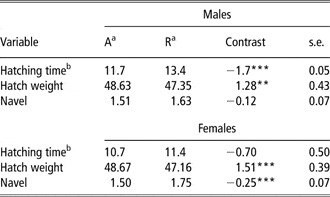
The estimated contrasts for maternal nutrition for hatch weight, navel quality and batch of hatch for male and female chicks are given in Table 2. There were 8 h in between two batches of hatch (i.e. moments of chick collection). The chicks of restricted mothers hatched later than the chicks of ad libitum mothers, but the difference was very small (∼1.2 h; P = 0.002, not shown in the table). The female chicks of restricted mothers hatched approximately 1.7 h earlier than male chicks (P = 0.0008). In chicks of ad libitum mothers, female chicks hatched approximately 0.7 h earlier than males, but this was not significant (P = 0.18). Chicks by ad libitum mothers were significantly heavier at hatch than chicks of restricted mothers, and the effect was larger in female chicks (1.51 g; P = 0.0001) than in male chicks (1.28 g; P = 0.0028). Female chicks of restricted mothers also had poorer navel quality than those of ad libitum mothers (score 1.50 ad libitum v. 1.75 restricted; P = 0.0002). This effect was not present in the males. Ignoring the effect of maternal diets, lower hatch weights were associated with better navels. Female chicks with a fully closed navel at hatch were 1.73 g lighter than those with >2 mm opening remaining (P < 0.0001; not shown in table). This relationship between navel quality and hatch weight was not present in the male chicks (P = 0.076; not shown in table).
Least squares means and estimated contrasts (with s.e.) of maternal nutrition for hatch weight, navel score and batch of hatch in male and female chicks

aLeast squares means per maternal diet group: A is ad libitum, R is restricted to 60% of ad libitum.
bNumber of hours after the first check on day 20 at 1500 h.
BW and growth
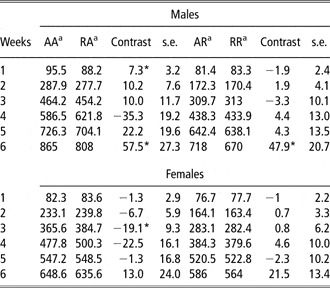
Mortality during the experiment was low: eight of the 624 chicks died or were euthanized in the first few days due to insufficient navel quality or general weakness, and eight chicks died later. The cause of death of these chicks was not clear. Of the chicks that died in week 1, four had restricted mothers and four had ad libitum mothers. Of the chicks that died later in the experiment, two were in group AA, two in AR, three in RA and one in RR. The estimated least squares means for weekly growth, and the contrasts of maternal diet in ad libitum and restricted chicks are given in Table 3. In week 1, AA males grew faster (P = 0.026) than RA males. This effect was not present in the females. In week 3, RA females grew faster than AA females (P = 0.042). In the males, this difference occurred in week 4, though it was not significant (P = 0.068). This effect disappeared in weeks 4 and 5, respectively. In week 6, AA male chicks again grew faster than RA males (P = 0.037). This effect was not present in the female chicks. In the restricted chicks, there was no difference in the growth of chicks of ad libitum or restricted mothers until week 6. In week 6, male AR chicks grew significantly faster than RR males (P = 0.022). This trend, though not significant (P = 0.109), was also present in the female chicks.
Least squares means and estimated contrasts (with s.e.) for maternal nutrition for growth (in g/week) in male and female ad libitum and restricted chicks

aLeast squares means per maternal diet × chick diet group in which AA is ad libitum maternal and chick diet, RA is restricted maternal (60% of ad libitum) and ad libitum chick diet, AR is ad libitum maternal and restricted chick (70% of ad libitum) diet, and RR is restricted maternal and chick diet.
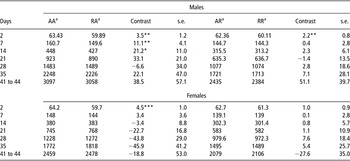
The estimated least squares means for BW on the first day of the treatment (day 2 after hatch) and subsequent weeks, and the contrasts of maternal diet in ad libitum and restricted chicks are given in Table 4. On day 2, the AA chicks were heavier than the RA chicks (males: P = 0.0033; females: P < 0.0001). This contrast was also present on day 7 (P = 0.0075) in the males, but not in the females. In the restricted chicks, AR male chicks were heavier on day 2 than RR chicks (P = 0.0087); this effect was not present in the females.
Least squares means and estimated contrasts (with s.e.) for maternal nutrition for body weight (in g) in male and female ad libitum and restricted chicks

aLeast squares means per maternal diet × chick diet group in which AA is ad libitum maternal and chick diet, RA is restricted maternal (60% of ad libitum) and ad libitum chick diet, AR is ad libitum maternal and restricted chick (70% of ad libitum) diet, and RR is restricted maternal and chick diet.
Metabolic effect at adolescent age
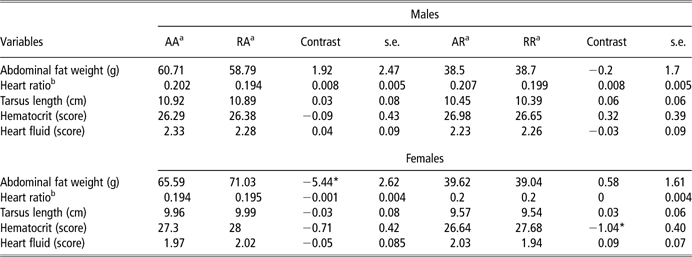
The estimated least squares means for abdominal fat weight, tarsus length, ratio of left to total ventricular weight, hematocrit levels and score for fluid around the heart, and the contrasts of maternal diet in ad libitum and restricted chicks at 41 to 44 days of age are given in Table 5. Female RA chicks had significantly more abdominal fat (5.43 g; P = 0.044) at slaughter than AA females. There was no effect of maternal diet on abdominal fat weight in the ad libitum males or in the restricted chicks. Hematocrit levels of RR females were significantly higher (1.04; P = 0.010) than those of AR females. Maternal diet had no significant effect on hematocrit levels in the restricted males or in the ad libitum chicks (males and females). Maternal diet also had no effect on the tarsus length, heart ratio or fluid around the heart. There was no relationship between hematocrit and heart fluid score in either males or females (P > 0.4; result not shown in the table), a measure of cardiovascular problems.
Least squares means and estimated contrasts (with s.e.) of maternal nutrition for traits measured at slaughter (days 41 to 44 of age) in male and female ad libitum and restricted chicks
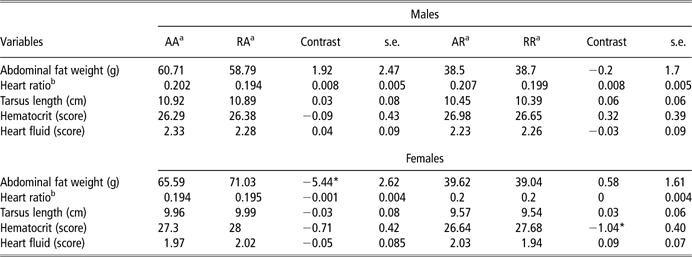
aLeast squares means per maternal diet × chick diet group in which AA is ad libitum maternal and chick diet, RA is restricted maternal (60% of ad libitum) and ad libitum chick diet, AR is ad libitum maternal and restricted chick (70% of ad libitum) diet, and RR is restricted maternal and chick diet.
bHeart ratio = ratio of left ventricular over total heart weight.
Discussion
The results of this study in broilers indicate that offspring of mothers that were restricted in their food intake before and around conception may grow to a lower adult weight than chicks of ad libitum mothers. This becomes especially apparent in the restricted chicks where in week 6, even though they were on the same diet, males of ad libitum mothers grew significantly faster than males of restricted mothers. In addition, in the ad libitum chicks, in week 6 males of ad libitum mothers grew faster than those of restricted mothers. Such division in growth trajectory between the offspring of ad libitum v. restricted mothers seems to point toward a pre-programmed future difference in adult size due to a change in statue and/or muscle mass. In this study, there seems to be no difference in skeletal development, measured by tarsus length (Table 5). There is, however, a change in BW most likely due to a change in muscle mass. Muscle is the largest organ in the body and is heavier than fat because of the water fraction. It is also an energy-demanding organ (e.g. responsible for 18% of CO2 production in dairy cattle; Baldwin et al., Reference Baldwin, Forsberg and Hu1985). A smaller muscle mass would therefore substantially increase metabolic efficiency and would allow a larger proportion of the expectedly poor resources to be allocated to other functions such as reproductive effort. Indeed, maternal food restriction before conception results in a reduction in the number of myosin type 2 fibers in sheep (Zhu et al., Reference Zhu, Ford, Nathanielsz and Du2004; Quigley et al., Reference Quigley, Kleemann, Kakar, Owens, Nattrass, Maddocks and Walker2005) and pigs (Dwyer et al., Reference Dwyer, Stickland and Fletcher1994), and in the muscle mass later in life in sheep (Zhu et al., Reference Zhu, Ford, Means, Hess, Nathanielsz and Du2006), humans (Gale et al., Reference Gale, Martyn, Kellingray, Eastell and Cooper2001), rats (Desai et al., Reference Desai, Crowther, Lucas and Hales1996) and pigs (Dwyer et al., Reference Dwyer, Stickland and Fletcher1994). In contrast, the ad libitum maternal environment may have provided a cue to develop to a heavier adult weight. For males (and possibly for females), being heavier would have a competitive advantage and as the environment is expected to be rich, increased maintenance costs are not an issue. Even though muscle development was not measured in this study, these results in mammals suggest that the difference in growth in the males of ad libitum and restricted mothers in week 6 is due to a difference in muscle development. This would imply that chicks with a mismatched rich maternal–poor offspring nutritional environment would be at a disadvantage. The chicks in this study were slaughtered prematurely and therefore fitness could not be determined, but the results of comparable studies in mice (Ozanne and Hales, Reference Ozanne and Hales2005) suggest that this will indeed be the case.
Ad libitum female chicks of restricted, but not ad libitum, mothers grew faster in week 3 (P = 0.042), and ad libitum male chicks of restricted mothers in week 4, though not significantly (P = 0.068). This accelerated growth in offspring of restricted mothers in a rich nutritional environment has also been observed in mammals (Vickers et al., Reference Vickers, Breier, Cutfield, Hofman and Gluckman2000; Ozanne and Hales, Reference Ozanne and Hales2004; Ford et al., Reference Ford, Hess, Schwope, Nijland, Gilbert, Vonnahme, Means, Han and Nathanielsz2007). One reason for this accelerated growth could be that the ad libitum offspring of restricted mothers are ‘programmed’ to grow according to the expected poor food availability. A certain proportion of nutrient intake may be destined for growth. However, if the food suddenly is abundant, food intake will be higher than in the expected poor environment and that is likely to result in an adjustment of the growth trajectory. By analogy, offspring of restricted mothers might have had an even further increased food intake because in rats, offspring of under-fed mothers (30% of ad libitum) had an elevated food intake from early postnatal age onward (Vickers et al., Reference Vickers, Breier, Cutfield, Hofman and Gluckman2000). The rapid growth at early age, also called compensatory growth because offspring of restricted mothers usually have a lower birth/hatch weight, is associated with earlier onset of puberty (Dos Santos Silva et al., Reference Dos Santos Silva, De Stavola, Mann, Kuh, Hardy and Wadsworth2002; Coe and Shirtcliff, Reference Coe and Shirtcliff2004; Karaolis-Danckert et al., Reference Karaolis-Danckert, Buyken, Sonntag and Kroke2009). This potentially longer period of reproduction may compensate for the potentially lower number of offspring per reproduction cycle that has been reported for the reproductive performance of offspring of restricted mothers (Gorman and Nager, Reference Gorman and Nager2004). In this study, the chicks were slaughtered prematurely and no records of onset of puberty or reproductive performance are available.
The compensatory growth in ad libitum chicks of restricted mothers also suggests that they will reach their adult size at an earlier age than those of ad libitum mothers, and that further food intake would result in deposition of fat, rather than muscle growth. This indeed seems to be the case in the RA females, who have approximately 8% more abdominal fat than AA females (P = 0.044). The fact that this effect is not apparent in males is most likely because males grow longer and to a higher adult weight and the chicks were slaughtered before their muscle growth shifted toward fat deposition.
Current experimental setup
In this study, broilers were used as experimental animals. Broilers have been heavily selected for many generations, especially for muscle growth. The quantitative differences between treatments of this study may therefore not represent other bird populations. The trend in the results, however, most likely will do so because, as discussed earlier, the results of various mammalian studies in wild and domesticated populations show a very similar trend in the effect of restricted maternal and subsequent abundant offspring nutrition on offspring development.
There is evidence that not only the offspring of restricted mothers, but also those of obese mothers, have an increased risk of becoming obese themselves if they are in a rich nutritional environment (Shankar et al., Reference Shankar, Harell, Liu, Gilchrist, Ronis and Badger2008; Metges, Reference Metges2009), and develop cardiovascular health problems (Samuelsson et al., Reference Samuelsson, Matthews, Argenton, Christie, McConnell, Jansen, Piersma, Ozanne, Fernandez Twinn, Remacle, Rowlerson, Poston and Taylor2008). Half of the hens in this study were fed an increased diet during 4 weeks before insemination, and during subsequent egg collection. In the last 2 weeks before insemination, the hens were even fed approximately ad libitum, which may have resulted in overweight hens. Before the start of the experiment, the hens were fed restricted to approximately 85% of ad libitum intake, the standard commercial diet of broiler mothers. The body condition of the hens was not recorded but these hens had already been laying eggs for approximately 39 weeks, which makes it likely that the body condition was rather poor at the start of the experiment. Thirty hens per feeding group were weighed once a week to have an idea on BW change (results not shown). The restricted hens lost 7.0% of their initial BW, whereas the ad libitum hens gained 10.5% of their initial BW during the 5 weeks of the feeding regimes. This most likely is not enough to make the ad libitum hens obese. However, if they were obese, this could have introduced some confounding in the results.
A type of maternal effect in which mothers may pass on information about the environment to their offspring is the so-called anticipatory maternal effects (AMEs; Marshall and Uller, Reference Marshall and Uller2007). This maternal environment could be recent, but also related to long-term maternal (lifetime) experience. The type of AME that is generally discussed in the literature as a maternal effect usually represents a short-term effect. However, there are indications that long-term effects may be very influential as well. An important example of a type of long-term AME is the maternal immune system, based on which the offspring develops an important part of its immune system (Lemke et al., Reference Lemke, Coutinho and Lange2004; Hasselquist and Nilsson, Reference Hasselquist and Nilsson2009). Another example may be the maternal lifetime dietary history, which may have a stronger effect on offspring number and size than the diet during the mother's reproductive life (Taborsky, Reference Taborsky2006a and Reference Taborsky2006b), but this is not always the case (Howie et al., Reference Howie, Sloboda, Kamal and Vickers2009). If the environment of the mother during her early life, for example, represented by nutritional quality, is very different from the environment around conception, there may be some conflict between the effects of long- and short-term AME. A poor early environment may lead to poor growth, for example, which may have consequences for the type of environmental clue that is passed on to the offspring, even if the environment around conception is optimal. The broiler hens used in the experiment were commercially raised, which means that they were restricted to approximately 55% of ad libitum intake during the adolescent phase from 6 to 15 weeks of age. It is possible that the short-term AME of the 4 weeks of maternal diets before conception in this study would be (partly) outclassed by the possibly long-term effect of severe maternal food restriction at an early age.
In summary, the results of this study show that maternal food restriction before conception has a negative influence on the offspring's BW at 6 weeks of age. This most likely can be explained by a lower muscle mass. Ad libitum feeding in these offspring results in increased abdominal fat in the female chicks. These results have not been shown in birds before and suggest a common mechanism in mammals and birds in response to a mismatch in the maternal–offspring nutritional environment.
Acknowledgements
The authors wish to thank Lisette Kogelman for assistance during the experiment and Cobb Europe for provision of the animals and eggs.