Introduction
The Silurian Period was a complex interval characterized by elevated tectonic activity and rapid sea level fluctuations. Consequently, Silurian lithologic sequences in South China are commonly discontinuous (Rong and Chen, Reference Rong, Chen, Zhang, Chen and Palmer2003; Chen et al., Reference Chen, Fan, Chen, Tang and Hou2014; Rong et al., Reference Rong, Wang, Zhan, Fan, Huang, Tang, Li, Zhang, Wu, Wang and Wei2019). Llandovery strata are relatively well developed (Chen and Rong, Reference Chen and Rong1996), while Wenlock successions are found only sporadically in a few areas (Rong et al., Reference Rong, Wang, Zhan, Fan, Huang, Tang, Li, Zhang, Wu, Wang and Wei2019; Wang et al., Reference Wang, Rong, Tang, Huang, Zhang and Zhao2021). Although the Ludlow and Prídolí strata are widely distributed in South China, little information is available due to severe weathering or insufficient research (Tang et al., Reference Tang, Huang, Wang, Xu and Wang2010; Wang et al., Reference Wang, Rong, Xu, Wang and Wang2010, Reference Wang, Zhang, Xu, Jiang and Tang2011, Reference Wang, Tang, Zhang, Liu, Zhang, Yan, Wang, Huang and Zhan2017, Reference Wang, Tang, Zhang, Zhang, Huang and Rong2018; Rong et al., Reference Rong, Wang, Zhan, Fan, Huang, Tang, Li, Zhang, Wu, Wang and Wei2019). Thus, limited information is available for stratigraphic correlation of the upper Silurian across the region.
Silurian strata in Guangyuan, Sichuan Province are well developed and have been studied extensively (Chen et al., Reference Chen, Rong, Wu, Deng, Wang, Xu, Qiu, Geng, Chen, Hu, Wang and Li1991; Wan et al., Reference Wan, Jin, Chen, Qian and Ye1991; Jin et al., Reference Jin, Wan, Ye, Chen, Qian and Yi1992; Tang et al., Reference Tang, Huang, Wang, Xu and Wang2010; Wang et al., Reference Wang, Tang, Zhang, Liu, Zhang, Yan, Wang, Huang and Zhan2017). The Chejiaba Formation is unconformably sandwiched between the Llandovery Ningqiang Formation and the Devonian Yuntaiguan Formation, making dating the unit difficult. Conodonts (e.g., Ozarkodina snajdri [Walliser, Reference Walliser1964]) and chitinozoans (Angochitina sp. and Sphaerochitina sp.) in the Chejiaba Formation suggest a Ludlow age, but more work is needed to confirm this (Tang et al., Reference Tang, Huang, Wang, Xu and Wang2010; Wang, Reference Wang2013).
Discovery of the brachiopod Atrypoidea in the Chejiaba Formation may further clarify the age of this unit. This atrypide genus has a wide distribution in the Silurian Period (with suspect reports of occurrences in the Devonian), but is particularly abundant in Ludlow and Prídolí strata (Copper, Reference Copper1977, Reference Copper2004; Jones and Rong, Reference Jones and Rong1982). With 67 species listed, the rapid evolution of the genus, in conjunction with is wide distribution, makes it a useful fossil for biostratigraphic correlation and constraining stratigraphic age.
This paper is the first report of Atrypoidea foxi (Jones, Reference Jones1974) (in situ preservation) from the Chejiaba Formation. Globally, Atrypoidea foxi has been found only in Ludlow and Prídolí strata, confirming the Ludlow age suggested by microfossils, but perhaps indicating a broader time of deposition. This has important implications for correlation of Ludlow and Prídolí strata in South China that are bound by unconformities, which makes dating difficult, especially in areas where the stratigraphic sequences are sporadically distributed.
Materials and methods
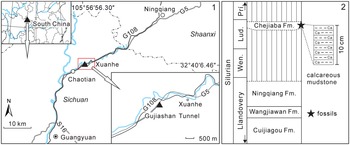
The research area is located near Gujiashan Tunnel, Chaotian Town, Guangyuan City, Sichuan Province (32°40′6.46″N, 105°56′56.30″E) (Fig. 1). The reconstruction of National Highway G108 and Expressway G5 exposed many new outcrops in this area that have not been previously studied for fossils. Fossils were collected by Prof. Yi Wang of the Nanjing Institute of Geology and Palaeontology (NIGP) from calcareous mudstones in the Chejiaba Formation. Serial sections were made using acetate film with acetone.
Simplified geographic map and Silurian stratigraphy of northern Sichuan, South China. (1) Map showing the location where brachiopod fossils were discovered. (2) Stratigraphic distribution of Atrypoidea foxi (Jones, Reference Jones1974) in the Chejiaba Formation at Chaotian, Guangyuan City, Sichuan, South China. The unit producing fossils is nearly 10 cm thick.

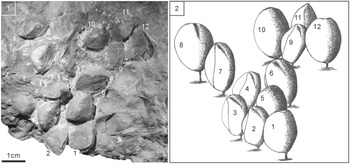
All specimens are conjoined and most of them were found in situ, clustered together, with beaks down (Fig. 2.1). We reconstructed its original life orientation exactly according to its preservation status based on a bulk of specimens (Fig. 2.2). Although there are many records of the genus, few in situ occurrences of Atrypoidea are known, and this is the first in situ occurrence of these shells documented from South China.
Atrypoidea foxi (Jones, Reference Jones1974) from the Chejiaba Formation at Chaotian, Sichuan Province, preserved in situ with the beak down and anterior commissure upright (BHR2001–2012) (1), and their ecological reconstruction (2).

Repositories and institutional abbreviations
All figured specimens are housed in the Nanjing Institute of Geology and Palaeontology (NIGP), Chinese Academy of Sciences and State Key Laboratory of Palaeobiology and Stratigraphy sample collection, Nanjing Institute of Geology and Palaeontology (BHR).
Systematic paleontology
Subphylum Rhynchonelliformea Williams et al., Reference Williams, Carlson, Brunton, Holmer and Popov1996
Class Rhynchonellata Williams et al., Reference Williams, Carlson, Brunton, Holmer and Popov1996
Order Atrypida Rzhonsnitskaya, Reference Rzhonsnitskaya and Sarytcheva1960
Suborder Lissatrypidina Copper, Reference Copper1996
Family Lissatrypidae Twenhofel, Reference Twenhofel1914
Genus Atrypoidea Mitchell and Dun, Reference Mitchell and Dun1920
Type species
Meristina (?) australis Dun, Reference Dun1904; Molong Limestone (Ludlow), Silurian, New South Wales, Australia.
Diagnosis
Medium to large, wide to elongate, biconvex to dorsibiconvex, usually prominently uniplicate; shell smooth, with small apical to transapical foramen and obscured deltidial region; both ventral and dorsal valves thickened posteriorly, with muscle scars weakly incised; solid teeth, dental plates absent; relatively slender hinge, socket plates, small crural bases; ventrally positioned jugal processes with bulky jugal plates; dorsal-dorsolateral spiralia with 5–13 whorls; dorsal septum absent.
Occurrence
Atrypoidea is known from the Llandovery (China, Russia, and Canada), Wenlock (China, Czech Republic, Australia, Altai, Urals, and Canada), Ludlow–Prídolí (worldwide), and ?Lower Devonian (Czech Republic, South Tienshan, and North Urals).
Remarks
Three genera (Atrypella Kozlowski, Reference Kozlowski1929; Globatrypa Mizens and Sapelnikov in Mizens, Reference Mizens1985; and Lingatrypa Mizens, Reference Mizens1985) were listed as synonyms of Atrypoidea in Copper (Reference Copper and Kaesler2002). Although Lissatrypella Sapelnikov and Mizens, Reference Sapelnikov and Mizens1982, was treated as subgenus in Copper (Reference Copper and Kaesler2002), little difference can be detected between Atrypoidea (Atrypoidea) and Atrypoidea (Lissatrypella). Here, we consider that Lissatrypella could be a synonym of Atrypoidea rather than its subgenus.
A better understanding of the geographical and chronological distribution of genus Atrypoidea will clarify its stratigraphic significance. The validity of some species is questionable, and the genus is in need of careful review to determine whether many of the species are synonymous. Some of the synonyms have already been identified, such as A. phoca (Salter, Reference Salter1852) and A. scheii (Holtedahl, Reference Holtedahl1914) (Jones, Reference Jones1974, Reference Jones1981; Rong et al., Reference Rong, Zhang and Chen1987); A. qujingensis Wang, Rong, and Yang, Reference Rong and Yang1980, A. dorsoconvexa Wang, Rong, and Yang, Reference Rong and Yang1980, and A. foxi (Jones, Reference Jones1974) (Jones and Rong, Reference Jones and Rong1982; Rong et al., Reference Rong, Zhang and Chen1987).
In this study, 67 species, 14 subspecies, and 23 forma, cf., aff., or var. species in total are listed (see details in Appendices 1, 2), partly based on summary work by Copper (Reference Copper1977, Reference Copper2004), supplemented with much new information, such as the horizon or distribution of 15 species. In addition, 12 species, together with 8 subspecies and 10 forma, cf., or aff. species, are newly added (see below for major contribution of this study).
Atrypoidea bailongjiangensis Fu, Reference Fu1982, from Prídolí rocks of Gansu, China, still was recognized as a valid species by Copper (Reference Copper2004), instead of being considered the same as A. polaris bailongjiangensis (Fu, Reference Fu1982) based on its similarities in size, shape, and degree of convexity with A. polaris Jones and Packard, Reference Jones and Packard1980, from the Prídolí, Arctic Canada (Rong et al., Reference Rong, Zhang and Chen1987), which supported by this study. Atrypoidea camelina pavdensis (Mizens, Reference Mizens1977) was regarded as subspecies of A. camelina (von Buch, Reference von Buch1840) by Copper (Reference Copper2004), but was treated as valid species A. pavdensis (Mizens, Reference Mizens1977) by Breivel and Breivel (Reference Breivel and Breivel1988). It is listed as a valid species in this study.
Atrypoidea lentiformis (Wang, Reference Wang1956) came from the Xiushan Formation of South China. The Xiushan Formation previously was thought to have been deposited over the Wenlock–?Ludlow (Wang, et al., Reference Wang, Rong and Yang1980; Copper, Reference Copper2004), but has been revised as Telychian in age with updated information (Rong et al., Reference Rong, Wang, Zhan, Fan, Huang, Tang, Li, Zhang, Wu, Wang and Wei2019). Glassia obovata var. magna Grabau, Reference Grabau1925, from the Lojoping Formation, South China, was re-assigned to Lissatrypa by Rong and Yang (Reference Rong and Yang1981).
Cooper (Reference Copper1977, Reference Copper2004) listed some forma species as subspecies without additional information, for example, listing A. scheii forma concinna (Oradovskaya, Reference Oradovskaya, Nikolaev, Oradovskaya, Preobrazhenskii, Abushik, Myagkova, Obut, Sobolevskaya and Kovekhor1975) as A. scheii concinna (Oradovskaya, Reference Oradovskaya, Nikolaev, Oradovskaya, Preobrazhenskii, Abushik, Myagkova, Obut, Sobolevskaya and Kovekhor1975), similar to A. scheii forma gibbera (Nikiforova, Reference Nikiforova and Cherkesova1970), A. elongata forma lata Sapelnikov and Mizens, Reference Sapelnikov and Mizens1982, A. phoca forma paracamelina (Nikiforova, Reference Nikiforova and Cherkesova1970), A. phoca forma subscheii (Nikiforova, Reference Nikiforova and Cherkesova1970), A. phoca forma typica (Nikiforova, Reference Nikiforova and Cherkesova1970) and A. scheii forma typica (Nikiforova, Reference Nikiforova and Cherkesova1970). In addition, A. insigne forma grebensis (Nikiforova, Reference Nikiforova and Cherkesova1970) was revised into A. insigne var. grebensis (Nikiforova, Reference Nikiforova and Cherkesova1970) by Copper (Reference Copper2004), and A. insigne (Nikiforova, Reference Nikiforova and Cherkesova1970) together with A. modesta (Nikiforova, Reference Nikiforova and Cherkesova1970) were listed as subspecies A. insigne insigne (Nikiforova, Reference Nikiforova and Cherkesova1970) and A. modesta modesta (Nikiforova, Reference Nikiforova and Cherkesova1970), respectively, by Copper (Reference Copper1977) without explanation. Here, we reinstate them with data from the original article.
Atrypoidea foxi (Jones, Reference Jones1974)
Figures 3, 4
- Reference Kirk and Amsden1952
Atrypella scheii (Holtedahl, Reference Holtedahl1914); Kirk and Amsden, p. 58, pl. 7, figs. 12–22.
- Reference Rong, Xu and Yang1974
Atrypella lentiformis (Wang, Reference Wang1956); Rong et al., p. 205, pl. 96, figs. 18, 23.
- Reference Jones1974
Atrypella foxi Jones, p. 968, pls. 1, 2.
- Reference Jones1979b
Atrypoidea foxi; Jones, p. 2208, pl. 1, figs. 22–48.
- Reference Wang, Rong and Yang1980
Atrypoidea qujingensis Wang, Rong, and Yang, p. 112, pl. 1, figs. 1–16; pl. 2, figs. 12, 13; pl. 3, figs. 6–9, 11, 12, 14, 16, 17; pl. 4, figs. 1, 5.
- Reference Wang, Rong and Yang1980
Atrypoidea dorsoconvexa Wang, Rong, and Yang, p. 112, pl. 2, figs. 1–11, 14–17; pl. 3, figs. 10, 13; pl. 4, figs. 1, 6, 8, 9.
- Reference Jones and Rong1982
Atrypella foxi; Jones and Rong, p. 924, pl. 1, figs. 1–36.
- Reference Rong, Su, Li, Li, Rong and Dong1985
Atrypoidea foxi; Rong et al., p. 40, pl. 3, figs. 1–4.
- Reference Fang, Fang, Jiang, Fan, Cao and Li1985
Atrypoidea qujingensis; Fang, p. 57, pl. 5, fig. 4.
- Reference Fang, Fang, Jiang, Fan, Cao and Li1985
Atrypoidea dorsoconvexa; Fang, p. 57, pl. 5, fig. 5.
- Reference Wang1995
Atrypella foxi; Wang, p. 744.
- Reference Zhou and Huang2018
Atrypoidea foxi; Zhou and Huang, p. 59, text figs. 11–14.
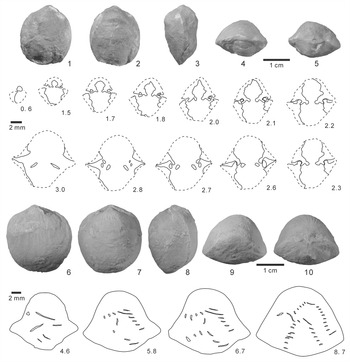
Atrypoidea foxi (Jones, Reference Jones1974), Chejiaba Formation, Ludlow, Chaotian, Guangyuan City, Sichuan, South China. (1–5) NIGP 179419, ventral, dorsal, lateral, anterior, and posterior views of articulated shell with its serial sections. (6–10) NIGP 179420, ventral, dorsal, lateral, anterior, and posterior views of articulated shell with its serial sections. Numbers on serial sections are mm from poster end of shell.

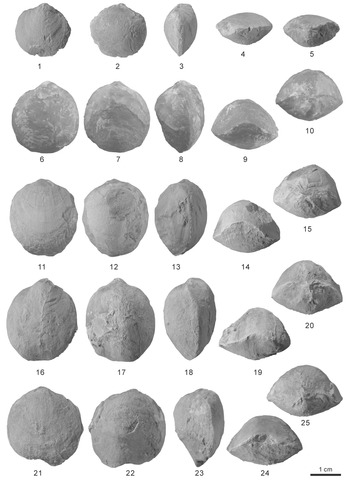
Atrypoidea foxi (Jones, Reference Jones1974), Chejiaba Formation, Ludlow, Chaotian, Guangyuan City, Sichuan, South China. (1–5) NIGP 179421, ventral, dorsal, lateral, anterior, and posterior views of articulated shell. (6–10) NIGP 179422, ventral, dorsal, lateral, anterior, and posterior views of articulated shell. (11–15) NIGP 179423, ventral, dorsal, lateral, anterior, and posterior views of articulated shell. (16–20) NIGP 179424, ventral, dorsal, lateral, anterior, and posterior views of articulated shell. (21–25) NIGP 179425, ventral, dorsal, lateral, anterior, and posterior views of articulated shell.

Type specimen
Holotype: solid articulate shell, G.S.C. 34636 (Geological Survey of Canada), from Read Bay Formation, Ludlow, Somerset Island, Arctic Canada (Jones, Reference Jones1974, p. 968, pl. 1, fig. 1a–c).
Occurrence
The fossils in this manuscript were collected from the Chejiaba Formation (Ludlow), Guangyuan City, Sichuan Province, South China, and form the basis for the description below.
Description
Shell smooth with a few faint growth lines; medium-sized, subcircular to slightly elongate, biconvex to dorsibiconvex; width 17.3–27.9 mm (average 25 mm), length 17.1–23.2 mm (average 22.3 mm), thickness 11.1–18.6 mm (average 16.4 mm); average length/width ratio 1.1. Teeth strong, dental plates absent. Hinge plates developed, extending ventrally. Spiralia dorsally directed (sometimes broken and misplaced), with ~10 whorls. Anterior commissure of the small individual is nearly straight, while fully grown shells are uniplicate.
Materials
Twenty-three articulated shells. NIGP 179419–179425; BHR 2001–2016.
Remarks
Lissatrypa scheii Holtedahl, Reference Holtedahl1914, was established based on the fossils from Ludlow strata of Ellesmere Island, Arctic Canada. Holtedahl (Reference Holtedahl1924) later claimed that Lissatrypa scheii Holtedahl, Reference Holtedahl1914, was a variety of Lissatrypa phoca (Salter, Reference Salter1852). Kirk and Amsden (Reference Kirk and Amsden1952) thought fossils from the upper Silurian in southeastern Alaska were L. scheii Holtedahl, Reference Holtedahl1914, and placed it into the genus Atrypella as A. scheii (Holtedahl, Reference Holtedahl1914). However, the characters designated A. scheii (Holtedahl, Reference Holtedahl1914) by Kirk and Amsden (Reference Kirk and Amsden1952) are different from those identified by Holtedahl (Reference Holtedahl1914) in the originally named L. scheii. Jones (Reference Jones1974) concluded that A. scheii is a subjective junior synonym of A. phoca. Consequently, a new species, A. foxi, was established and A. scheii (Holtedahl, Reference Holtedahl1914) of Kirk and Amsden (Reference Kirk and Amsden1952) was considered as a synonym of the former by Jones (Reference Jones1974). In his study of Atrypoidea from New South Wales, Australia, Copper (Reference Copper1977) compared the similarities in internal and external morphological characteristics of Atrypoidea and Atrypella and treated the two genera as synonyms, discarding Atrypella.
Protathyris lentiformis Wang, Reference Wang1956, was erected based on fossils from Telychian rocks in Daguan, NE Yunnan, South China. Rong et al. (Reference Rong, Xu and Yang1974) thought the specimens from the Miaokao Formation in the Qujing and Daguan areas of Yunnan and the fossils of Wang (Reference Wang1956) were the same species (but they actually are not) and synonymized Protathyris lentiformis Wang, Reference Wang1956, with Atrypella lentiformis (Wang, Reference Wang1956). Two new species of Atrypoidea, A. qujingensis Wang, Rong, and Yang, Reference Rong and Yang1980, and A. dorsoconvexa Wang, Rong, and Yang, Reference Rong and Yang1980, were established. Atrypella lentiformis (Wang, Reference Wang1956) of Rong et al. (Reference Rong, Xu and Yang1974) is different from Protathyris lentiformis in Wang (Reference Wang1956), and was redefined as A. qujingensis by Wang et al. (Reference Wang, Rong and Yang1980). Atrypoidea lentiformis (Wang, Reference Wang1956) is preserved and refers to Telychian Atrypoidea of South China. Jones and Rong (Reference Jones and Rong1982) compared the Atrypoidea fauna of Canada and South China using a quantitative approach and determined both A. qujingensis Wang, Rong, and Yang, Reference Wang, Rong and Yang1980, and A. dorsoconvexa Wang, Rong, and Yang, Reference Wang, Rong and Yang1980, should be synonymized under Atrypoidea foxi (Jones, Reference Jones1974).
Discussion
Range and distribution worldwide
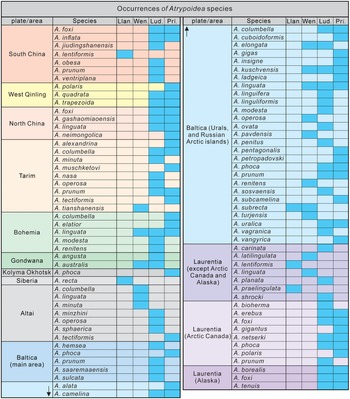
The origin of Atrypoidea is still unclear. Llandovery species include Atrypoidea lentiformis (Wang, Reference Wang1956), Atrypoidea praelingulata Jin, Caldwell, and Norford, Reference Jin, Caldwell and Norford1993, Atrypoidea recta (Nikiforova in Nikiforova and Andreeva, Reference Nikiforova and Andreeva1961), and Atrypoidea subrecta (Mizens, Reference Mizens1977) (see Fig. 5). Atrypoidea lentiformis (Wang, Reference Wang1956) has been found in Telychian strata in South China (Wang, Reference Wang1956; Sheng, Reference Sheng1975; Wang et al., Reference Wang, Rong and Yang1980) and Canada (Jin et al., Reference Jin, Caldwell and Norford1993). Atrypoidea praelingulata Jin, Caldwell, and Norford, Reference Jin, Caldwell and Norford1993, was described from the Attawapiskat Formation (Telychian) of Hudson Bay Lowlands, Canada. Atrypoidea subrecta (Mizens, Reference Mizens1977) came from Telychian strata in the Urals. Atrypoidea recta (Nikiforova in Nikiforova and Andreeva, Reference Nikiforova and Andreeva1961) was reported from Aeronian strata of Siberia, making it the earliest recorded species of the genus worldwide. This may indicate that Atrypoidea may have originated in Siberia before dispersing to other plates later in the Silurian.
Global and stratigraphic (Llandovery– Prídolí) occurrences of species of Atrypoidea (based on data in Appendix 1). Dark blue means present.

Globally, there are few species in the Llandovery and Wenlock, but by the Ludlow and Prídolí, the genus had diversified considerably (Figs. 6, 7). Thirteen species occur only in China, the Czech Republic, Australia, Altai, the Urals, and Canada in the Wenlock, and the genus became cosmopolitan subsequently with as many as 42 species in the Ludlow and 32 species in the Prídolí.
Spindle diagram of Atrypoidea species distribution from Llandovery– Prídolí (based on data in Appendix 1).

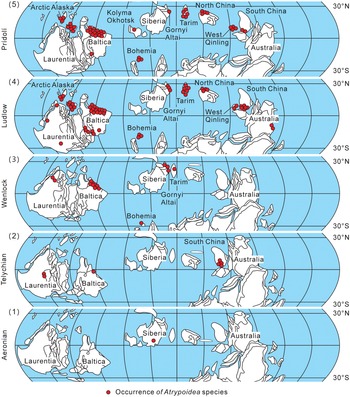
Distribution of Atrypoidea on Silurian geographical reconstructions at (1) Aeronian, (2) Telychian, (3) Wenlock, (4) Ludlow, and (5) Prídolí (Torsvik and Cocks, Reference Torsvik and Cocks2017; Rong et al., Reference Rong, Wang, Zhan, Fan, Huang, Tang, Li, Zhang, Wu, Wang and Wei2019). Based on the data in Appendix 1.

Atrypoidea has been reported from the Devonian of the Czech Republic (Barrande, Reference Barrande1879; Walmsley et al., Reference Walmsley, Aldridge and Austin1974), North Urals (Khodalevich and Bogoyavlenskaya, Reference Khodalevich, Bogoyavlenskaya and Martinsson1977), and South Tienshan (Biske et al., Reference Biske, Gorianov, Rzonsnickaja and Martinsson1977; Wang, Reference Wang1988). Walmsley et al. (Reference Walmsley, Aldridge and Austin1974) noted Lissatrypa linguata (von Buch, Reference von Buch1834) from the Devonian of Bohemia, but this has been revised to Cryptatrypa and Dubaria by Smith and Johnson (Reference Smith and Johnson1977). Atrypa cephe Barrande, Reference Barrande1879, Atrypa fugitiva Barrande, Reference Barrande1879, and Atrypa linguata var. columbella Barrande, Reference Barrande1879, from the Devonian of the Prague Basin may not be Atrypoidea either (Copper, Reference Copper2004).
Atrypoidea aff. A. scheii (Holtedahl, Reference Holtedahl1914) is listed in a faunal list (without description and figures) by Biske et al. (Reference Biske, Gorianov, Rzonsnickaja and Martinsson1977) from the base of the Kunjak Formation, ?Lower Devonian, Isfara River Basin, South Tienshan. The other fossils from this assemblage do not definitively indicate a Devonian age. Both Atrypoidea cf. A. columbella (Barrande, Reference Barrande1847) and Atrypoidea minuta (Kulkov, Reference Kulkov1967) from the Albishmebrak Formation (Early Devonian), South Tienshan, were mentioned by Wang (Reference Wang1988) and Atrypoidea fossils from North Urals were referred to by Rong et al. (Reference Rong, Zhang and Chen1987) with no description or figures.
As noted above, although there are reports of Devonian species of the genus, most are only known from records lacking detailed stratigraphic information, or the identification is questionable. To date, we know of no definitive occurrence of Atrypoidea in the Devonian (Smith and Johnson, Reference Smith and Johnson1977; Rong et al., Reference Rong, Zhang and Chen1987; Copper, Reference Copper2004). The youngest species may be Atrypoidea elatior Havlícěk and Štorch, Reference Havlícěk and Štorch1990, from the upper Prídolí of the Prague Basin, Czech Republic, or Atrypoidea polaris modica Rong, Zhang, and Chen, Reference Rong, Zhang and Chen1987, from the top of the Yanglugou Formation (upper Prídolí) in Tewo, Gansu and Zoige, Sichuan, China.
The geographical distribution of Atrypoidea species (Fig. 7) was mainly confined to epeiric seas in low latitudes, indicating that they preferred relatively warmer tropical environments typical of most atrypides (e.g., Copper, Reference Copper1977; Huang et al., Reference Huang, Jin and Rong2018).
Range and distribution in China
Atrypoidea have been found in Telychian, Wenlock, Ludlow, and Prídolí rocks in China, although the distribution of each species varies (Fig. 8). Atrypoidea lentiformis (Wang, Reference Wang1956) is distributed throughout the Xiushan Formation (Telychian) and its contemporaneous strata, including small collections from Shiqian (NE Guizhou, Wang et al., Reference Wang, Rong and Yang1980), Xiushan and Wuxi (Chongqing, field work), Butuo (South Sichuan, field work), and Ningqiang (South Shaanxi, Chen et al., Reference Chen, Rong, Wu, Deng, Wang, Xu, Qiu, Geng, Chen, Hu, Wang and Li1991), and larger collections from Changning and Gongxian (South Sichuan, Wang et al., Reference Wang, Rong and Yang1980), Guangyuan (North Sichuan, Sheng, Reference Sheng1975; three species therein were revised as A. lentiformis by Wang et al., Reference Wang, Rong and Yang1980), Daguan and Yanjin (NE Yunnan, Wang et al., Reference Wang, Rong and Yang1980). Atrypoidea lentiformis from the bottom of the Xiushan Formation in Wuxi, Chongqing, is the earliest one in China (Fig. 8).
Occurrence of Atrypoidea in Silurian sequence of China. Aero. = Aeronian; Xiaxi. = Xiaxishancun; Yulun. = Yulungssu; Miaok. = Miaokao; Caidiw. = Caidiwan; Daluz. = Daluzhai; Sifen. = Sifengya; Huang. = Huanggexi; Chejia. = Chejiaba; Ningq. = Ningqiang; Wangj. = Wangjiawan; Cuijiag. = Cuijiagou; Lungm. = Lungmachi; Huixin. =Huixingshao; Jiann. = Jiannigou; Chagan. = Chaganhebu; Xibi. = Xibiehe; Batea. = Bateaobao; Aertengk. = Aertengkesi; Keketiek. = Keketiekedaban.

Due to the influence of the Kwangsian Orogeny, Wenlock strata are largely absent in South China (Chen et al., Reference Chen, Fan, Chen, Tang and Hou2014; Rong et al., Reference Rong, Wang, Zhan, Fan, Huang, Tang, Li, Zhang, Wu, Wang and Wei2019), so the fossil record for this interval is sparse. However, in contrast to South China, the Wenlock is developed in other blocks of China, and there is only one Wenlock species in China, Atrypoidea tianshanensis Rong and Zhang in Wang et al., Reference Wang, Zhang, Rong, Wang and Cai2001, on the Tarim block (Fig. 8).
In South China, earlier records of Atrypoidea from the Ludlow and Prídolí were limited to eastern Yunnan (Wang et al., Reference Wang, Rong and Yang1980; Wang, Reference Wang1995; Zhou and Huang, Reference Zhou and Huang2018) and Maowen, Sichuan, including A. foxi (Jones, Reference Jones1974), A. inflata (Fang, Reference Fang1974), A. obesa Fang, Reference Fang, Fang, Jiang, Fan, Cao and Li1985, A. ventriplana Wang, Rong, and Yang, Reference Rong and Yang1980, A. jiudingshanensis Tong, Reference Tong1984, and A. prunum (Dalman, Reference Dalman1828). Atrypoidea foxi (Jones, Reference Jones1974) is especially abundant, often forming an enrichment layer. The discovery of A. foxi (Jones, Reference Jones1974) in the Chejiaba Formation is not only the first discovery in northern Sichuan, but also the first outside Yunnan in South China.
In other blocks, eight species were collected from Ludlow–Prídolí strata. Atrypoidea polaris modica Rong, Zhang, and Chen, Reference Rong, Zhang and Chen1987, from the top of the Yanglugou Formation of the Tewo and Zoige region, is the last occurrence of Atrypoidea in China.
Conclusions
In this paper, the global occurrences of 67 species of the Atrypoidea together with its earliest species, A. recta from the Aeronian of Siberia, are summarized. In Llandovery and Wenlock times, the distribution of Atrypoidea is limited, and only a few species are known. Through the rest of the Silurian, the genus rapidly diversified and became nearly cosmopolitan in distribution. Although there are some reports of Devonian Atrypoidea, there is no convincing record at present of the genus after the end of the Silurian. Atrypoidea elatior or A. polaris modica from the upper Prídolí should be the youngest species. Atrypoidea lived in circum-tropical areas throughout their geologic life, indicating their preference for warm water.
This great diversity and wide distribution make Atrypoidea a useful biostratigraphic tool. Atrypoidea foxi only appears in Ludlow–Prídolí globally, supporting the Ludlow age of the Chejiaba Formation. Atrypoidea foxi is of practical significance for the rapid recognition of Ludlow and Prídolí strata during field survey in South China.
Acknowledgments
We are grateful to Prof. Y. Wang (Nanjing Institute of Geology and Palaeontology, NIGP) for providing the fossils studied herein, H. Zhou and post-doctoral fellow Y. Zhang (NIGP) for their help in making serial sections of specimens, R. Li (Brandon University, Canada) and C. Sproat (University of Saskatchewan, Canada) for improving the text of an early draft of the manuscript. Financial support for this work comes from the Strategic Priority Research Program of the Chinese Academy of Sciences (Grant No. XDB26000000).
Declaration of competing interests
The authors declare no competing interests.
Appendix 1: 67 species and 14 sub-specific taxa of Atrypoidea based on summary work by Copper (Reference Copper1977, Reference Copper2004) and the present study.
+species whose horizon or distribution is supplemented; ** newly added species; * newly added subspecies.
1+ Atrypoidea australis (Dun, Reference Dun1904); Wenlock–Ludlow: New South Wales, Australia (Strusz, Reference Strusz1984, Reference Strusz2007, Reference Strusz2013, Reference Strusz2017; Strusz and Percival, Reference Strusz and Percival2018).
2 Atrypoidea alata (Nikiforova, Reference Nikiforova and Cherkesova1970); upper Prídolí: Vaigach, Russia.
3** Atrypoidea alexandrina Nikiforova in Menakova, Reference Menakova and Dzhalilov1991; Prídolí: Tajikistan.
4 Atrypoidea angusta Mitchell and Dun, Reference Mitchell and Dun1920; Ludlow: New South Wales, Australia.
5 Atrypoidea bioherma Jones and Narbonne, Reference Jones and Narbonne1984; middle Ludlow: Somerset Island, Arctic Canada.
6 Atrypoidea borealis (Kirk and Amsden, Reference Kirk and Amsden1952); Ludlow–Prídolí: Southeast Alaska (Copper, Reference Copper1977).
7 Atrypoidea camelina (von Buch, Reference von Buch1840); Prídolí: eastern slopes of central Urals (Breivel and Breivel, Reference Breivel and Breivel1988).
7.1* Atrypoidea camelina camelina (von Buch, Reference von Buch1840); Prídolí: eastern slopes of northern and central Urals (Sapelnikov and Mizens, Reference Sapelnikov and Mizens1982).
7.2 Atrypoidea camelina karpovensis (Nikiforova, Reference Nikiforova and Cherkesova1970); Prídolí: Vaigach, Russia.
7.3 Atrypoidea camelina penitus (Khodalevich, Reference Khodalevich1939); Ludlow: eastern slopes of northern and central Urals (Sapelnikov and Mizens, Reference Sapelnikov and Mizens1982).
7.4* Atrypoidea camelina scheii (Holtedahl, Reference Holtedahl1914); Prídolí: eastern slopes of northern and central Urals (Sapelnikov and Mizens, Reference Sapelnikov and Mizens1982).
8 Atrypoidea carinata (Johnson in Johnson and Reso, Reference Johnson and Reso1964); Ludlow: Nevada.
9** Atrypoidea columbella (Barrande, Reference Barrande1847); Wenlock: Altai (Kulkov, Reference Kulkov1967); Ludlow: eastern slopes of Urals (Breivel and Breivel, Reference Breivel and Breivel1988); Prídolí: Prague Basin and Urals (Havlícěk and Štorch, Reference Havlícěk and Štorch1990); Ludlow–Prídolí: South Tienshan, border area between Tajikistan and Kirgizstan (Wang, Reference Wang1988).
10+ Atrypoidea cuboidoformis (Khodalevich, Reference Khodalevich1939); Prídolí: Urals (Breivel and Breivel, Reference Breivel and Breivel1988).
11 Atrypoidea elatior Havlícěk and Štorch, Reference Havlícěk and Štorch1990; Prídolí: Prague Basin.
12** Atrypoidea elongata elongata (Khodalevich, Reference Khodalevich1939); Wenlock–Ludlow: eastern slopes of northern and central Urals.
13+ Atrypoidea erebus Jones, Reference Jones1979a; Ludlow–Prídolí: Arctic Canada (Jones, Reference Jones1979b).
14+ Atrypoidea foxi (Jones, Reference Jones1974); Ludlow–Prídolí: Arctic Canada (Jones, Reference Jones1979b), Southeast Alaska (Kirk and Amsden, Reference Kirk and Amsden1952), Yunnan, South China (Rong et al., Reference Rong, Xu and Yang1974; Wang et al., Reference Wang, Rong and Yang1980; Jones and Rong, Reference Jones and Rong1982; Fang, Reference Fang, Fang, Jiang, Fan, Cao and Li1985; Wang, Reference Wang1995; Zhou and Huang, Reference Zhou and Huang2018), Inner Mongolia, North China (Rong et al., Reference Rong, Su, Li, Li, Rong and Dong1985).
15 Atrypoidea gashaomiaoensis Rong, Su, and Li, Reference Rong, Su, Li, Li, Rong and Dong1985; Ludlow–Prídolí: Inner Mongolia, North China.
16 Atrypoidea gigantus Jones, Reference Jones1981; Prídolí: Arctic Canada.
17 Atrypoidea gigas (Khodalevich, Reference Khodalevich1939); Prídolí: North Urals.
18 Atrypoidea globa (Tschernyschew, Reference Tschernyschew1885); unknown: western slopes of Urals.
19 Atrypoidea hemsea Copper, Reference Copper2004; Ludlow: Gotland.
20 Atrypoidea inflata (Fang, Reference Fang1974); Ludlow–Prídolí: Qujing, Yunnan, South China (Rong and Yang, Reference Rong and Yang1980; Wang et al., Reference Wang, Rong and Yang1980; Fang, Reference Fang, Fang, Jiang, Fan, Cao and Li1985).
21 Atrypoidea insigne (Nikiforova, Reference Nikiforova and Cherkesova1970); Prídolí: Vaigach, Russia.
22 Atrypoidea jiudingshanensis Tong, Reference Tong1984; Ludlow: Maowen, Sichuan, South China.
23+ Atrypoidea kuschvensis (Tschernyschew, Reference Tschernyschew1893); Wenlock–Prídolí: eastern slopes of Urals (Sapelnikov and Mizens, Reference Sapelnikov and Mizens1982).
24 Atrypoidea ladgeica Beznosova, Reference Beznosova1977; Prídolí: North Urals.
25** Atrypoidea latilingulata Jin and Chatterton, Reference Jin and Chatterton1997; Wenlock: Avalanche Lake area, southwestern District of Mackenzie, Canada.
26 Atrypoidea lentiformis (Wang, Reference Wang1956); Telychian: Yunnan, Sichuan, Shaanxi and Guizhou, South China (Wang et al., Reference Wang, Rong and Yang1980), Hudson Bay Lowlands, Canada (Jin et al., Reference Jin, Caldwell and Norford1993).
27+ Atrypoidea linguata (von Buch, Reference von Buch1834); Wenlock: Avalanche Lake area, southwestern District of Mackenzie, Canada (Jin and Chatterton, Reference Jin and Chatterton1997), eastern slopes of Urals (Breivel and Breivel, Reference Breivel and Breivel1988), Altai (Kulkov, Reference Kulkov1967); Ludlow: Prague Basin (Havlícěk and Štorch, Reference Havlícěk and Štorch1990); Ludlow–Prídolí: Bohemia (Walmsley et al., Reference Walmsley, Aldridge and Austin1974), Inner Mongolia, North China (Su, Reference Su1976).
27.1* Atrypoidea linguata linguata (von Buch, Reference von Buch1834); Wenlock–Ludlow: Barrandien, Czech Republic (Sapelnikov and Mizens, Reference Sapelnikov and Mizens1982).
27.2* Atrypoidea linguata operosa (Kulkov, Reference Kulkov1967); Ludlow–Prídolí: eastern slopes of northern and central Urals (Sapelnikov and Mizens, Reference Sapelnikov and Mizens1982).
27.3* Atrypoidea linguata turjensis (Khodalevich, Reference Khodalevich1939); Wenlock: eastern slopes of northern and central Urals (Sapelnikov and Mizens, Reference Sapelnikov and Mizens1982).
28 Atrypoidea linguifera (Khodalevich, Reference Khodalevich1939); Ludlow: North Urals.
29** Atrypoidea linguliformis Breivel and Breivel, Reference Breivel and Breivel1988; Ludlow: eastern slopes of Urals.
30** Atrypoidea minuta (Kulkov, Reference Kulkov1967); Wenlock: Altai; Ludlow: South Tienshan in Xinjiang, China (Wang, Reference Wang1988).
31 Atrypoidea minzhini Rozman, Reference Rozman1988; Ludlow: Gobi Altai, Mongolia.
32 Atrypoidea modesta (Nikiforova, Reference Nikiforova and Cherkesova1970); Ludlow: Vaigach, Russia; Ludlow: Prague Basin (Havlícěk and Štorch, Reference Havlícěk and Štorch1990).
32.1 Atrypoidea modesta postmodesta (Nikiforova, Reference Nikiforova and Cherkesova1970). Ludlow: Vaigach, Russia.
33** Atrypoidea muschketovi (Nikiforova, Reference Nikiforova1937); Prídolí: Central Asia.
34 Atrypoidea nasa (Nikiforova, Reference Nikiforova1949); Ludlow: Kirgizstan.
35 Atrypoidea neimongolica Hou and Zhao in Su, Reference Su1976; Prídolí: Inner Mongolia, North China (Rong et al., Reference Rong, Su, Li, Li, Rong and Dong1985).
36+ Atrypoidea netserki Jones, Reference Jones1981; Ludlow–Prídolí: Arctic Canada (Smith and Johnson, Reference Smith and Johnson1977).
37 Atrypoidea obesa Fang, Reference Fang, Fang, Jiang, Fan, Cao and Li1985; Ludlow: Qujing, Yunnan, South China.
38+ Atrypoidea operosa (Kulkov, Reference Kulkov1967); Wenlock: eastern slopes of Urals (Breivel and Breivel, Reference Breivel and Breivel1988); Ludlow: central Altai (Kulkov, Reference Kulkov1967), South Tienshan in Xinjiang, China (Wang et al., Reference Wang, Zhang, Rong, Wang and Cai2001).
39** Atrypoidea ovata Breivel and Breivel, Reference Breivel and Breivel1988; Ludlow: eastern slopes of Urals.
40 Atrypoidea pavdensis (Mizens, Reference Mizens1977); Wenlock: eastern slopes of northern and central Urals (Sapelnikov and Mizens, Reference Sapelnikov and Mizens1982; Breivel and Breivel, Reference Breivel and Breivel1988).
41 Atrypoidea penitus (Khodalevich, Reference Khodalevich1939); Ludlow: Urals.
41.1 Atrypoidea penitus elongata (Khodalevich, Reference Khodalevich1939); Ludlow: Isov region, Urals.
42 Atrypoidea pentagonalis Beznosova and Mizens, Reference Beznosova and Mizens1980; Prídolí: Urals.
43** Atrypoidea petropadovski Breivel and Breivel, Reference Breivel and Breivel1988; Prídolí: eastern slopes of Urals.
44+ Atrypoidea phoca (Salter, Reference Salter1852); Ludlow–Prídolí: Arctic Canada (Holtedahl, Reference Holtedahl1914; Jones, Reference Jones1974, Reference Jones1979b, Reference Jones1981; Rong et al., Reference Rong, Zhang and Chen1987); Prídolí: Latvia (Paškevičius, Reference Paškevičius1973), Northeast Eurasia (Baranov, Reference Baranov2015).
44.1* Atrypoidea scheii fossula (Nikiforova, Reference Nikiforova and Cherkesova1970); Prídolí: Vaigach, Russia.
44.2* Atrypoidea scheii gibbera (Nikiforova, Reference Nikiforova and Cherkesova1970); Prídolí: Vaigach, Russia.
45 Atrypoidea planata Perry, Reference Perry1984; Ludlow: Yukon, Canada.
46+ Atrypoidea polaris Jones and Packard, Reference Jones and Packard1980; Prídolí: Arctic Canada.
46.1 Atrypoidea polaris bailongjiangensis (Fu, Reference Fu1982); Prídolí: Tewo, Gansu, China (Rong et al., Reference Rong, Zhang and Chen1987).
46.2 Atrypoidea polaris modica Rong, Zhang, and Chen, Reference Rong, Zhang and Chen1987; Prídolí: Tewo, Gansu and Zoige, Sichuan, China (Fu, Reference Fu1982).
47 Atrypoidea praelingulata Jin, Caldwell, and Norford, Reference Jin, Caldwell and Norford1993; Telychian: Hudson Bay Lowlands, Canada.
48+ Atrypoidea prunum (Dalman, Reference Dalman1828); Ludlow: Gotland (Dalman, Reference Dalman1828; Hisinger, Reference Hisinger1828; Gagel, Reference Gagel1890; Copper, Reference Copper1977, Reference Copper2004), Estonia (Copper, Reference Copper1977, Reference Copper2004; Kaljo and Rubel, Reference Kaljo, Rubel, Kaljo and Klaamann1982), Podolia (Nikiforova et al., Reference Nikiforova, Modzalevskaya and Bassett1985), Arctic Canada (Copper, Reference Copper1977), Maowen, Sichuan, China (Tong, Reference Tong1984); Ludlow–Prídolí: Tajikistan (Menakova, Reference Menakova and Dzhalilov1991).
48.1* Atrypoidea prunum gigas (Khodalevich, Reference Khodalevich1939); Ludlow–Prídolí: eastern slopes of northern and central Urals (Sapelnikov and Mizens, Reference Sapelnikov and Mizens1982).
49 Atrypoidea quadrata Fu, Reference Fu1982; Ludlow–Prídolí: Tewo, Gansu, China.
50** Atrypoidea recta (Nikiforova in Nikiforova and Andreeva, Reference Nikiforova and Andreeva1961); Aeronian: Moyero River Basin, Northwest Siberia (Havlícěk and Štorch, Reference Havlícěk and Štorch1990).
51+ Atrypoidea renitens (Barrande, Reference Barrande1879); Wenlock: eastern slopes of northern and central Urals (Sapelnikov and Mizens, Reference Sapelnikov and Mizens1982); Ludlow: Prague Basin (Havlícěk and Štorch, Reference Havlícěk and Štorch1990).
52 Atrypoidea saaremaaensis Copper and Rubel in Copper, Reference Copper1977; Ludlow: Estonia.
53 Atrypoidea shrocki (Cooper, Reference Cooper1942); Ludlow: Indiana, USA.
54 Atrypoidea sphaerica (Sapelnikov, Reference Sapelnikov1956); Ludlow: Altai.
55** Atrypoidea sosvaensis Breivel and Breivel, Reference Breivel and Breivel1988; Ludlow: eastern slopes of Urals.
56+ Atrypoidea subcamelina (de Verneuil, Reference Verneuil, Murchison, de Verneuil and Keyserling1845); Prídolí: eastern slopes of Urals (Breivel and Breivel, Reference Breivel and Breivel1988).
57+ Atrypoidea subrecta (Mizens, Reference Mizens1977); Telychian–Wenlock: eastern slopes of northern and central Urals (Sapelnikov and Mizens, Reference Sapelnikov and Mizens1982; Breivel and Breivel, Reference Breivel and Breivel1988).
58 Atrypoidea sulcata (Lindström, Reference Lindström1861); Ludlow: Gotland (Gagel, Reference Gagel1890; Bassett and Cocks, Reference Bassett and Cocks1974; Copper, Reference Copper2004).
59** Atrypoidea tectiformis (Tschernyschew, Reference Tschernyschew1893); Prídolí: Central Asia (Nikiforova, Reference Nikiforova1937), Urala, Altai (Nikiforova, Reference Nikiforova1937).
60 Atrypoidea tenuis (Kirk and Amsden, Reference Kirk and Amsden1952); Ludlow–Prídolí: Southeast Alaska.
61 Atrypoidea tianshanensis Rong and Zhang in Wang et al., Reference Wang, Zhang, Rong, Wang and Cai2001; Wenlock: South Tienshan in Xinjiang, China.
62 Atrypoidea trapezoida Fu, Reference Fu1982; Ludlow–Prídolí: Tewo, Gansu, China.
63 Atrypoidea turjensis (Khodalevich, Reference Khodalevich1939); Wenlock: eastern slopes of northern and central Urals.
64+ Atrypoidea uralica (Khodalevich, Reference Khodalevich1939); Ludlow–Prídolí: eastern slopes of northern and central Urals (Sapelnikov and Mizens, Reference Sapelnikov and Mizens1982; Breivel and Breivel, Reference Breivel and Breivel1988).
65 Atrypoidea vagranica (Khodalevich, Reference Khodalevich1939); Ludlow: Urals.
66 Atrypoidea vangyrica Beznosova and Mizens, Reference Beznosova and Mizens1980; Prídolí: Urals.
67 Atrypoidea ventriplana Wang, Rong, and Yang, Reference Rong and Yang1980; Ludlow: Qujing, Yunnan, South China.
Appendix 2: 23 sub-specific taxa of Atrypoidea based on summary work by Copper (Reference Copper1977, Reference Copper2004)
* newly added forma, cf., or aff. species.
1* Atrypoidea cf. A. columbella (Barrande, Reference Barrande1847); Ludlow–Prídolí: South Tienshan in Xinjiang, China (Wang, Reference Wang1988; Wang et al., Reference Wang, Zhang, Rong, Wang and Cai2001).
2* Atrypoidea linguata forma columbella (Barrande, Reference Barrande1847); Wenlock–Prídolí: eastern slopes of northern and central Urals (Sapelnikov and Mizens, Reference Sapelnikov and Mizens1982).
3 Atrypoidea linguata var. columbella (Barrande, Reference Barrande1847); Prídolí: Prague Basin.
4 Atrypoidea scheii forma concinna (Oradovskaya, Reference Oradovskaya, Nikolaev, Oradovskaya, Preobrazhenskii, Abushik, Myagkova, Obut, Sobolevskaya and Kovekhor1975); Ludlow–Prídolí: Kolyma River Basin, NE Russia.
5 Atrypoidea scheii forma crassa (Modzalevskaya, Reference Modzalevskaya1981); Prídolí: Chernyshev Range, Prepolar Urals.
6 Atrypoidea scheii forma fossula (Beznosova and Mizens, Reference Beznosova and Mizens1980); Prídolí: Foma-Yu River, Urals.
7 Atrypoidea scheii forma gibbera (Nikiforova, Reference Nikiforova and Cherkesova1970); Prídolí: Vaigach, Russia.
8 Atrypoidea insigne forma grebensis (Nikiforova, Reference Nikiforova and Cherkesova1970); upper Prídolí: Vaigach, Russia.
9* Atrypoidea cf. A. karpovensis (Nikiforova, Reference Nikiforova and Cherkesova1970); Prídolí: Zoige, Sichuan, China (Rong et al., Reference Rong, Zhang and Chen1987).
10* Atrypoidea cf. A. kuschvensis (Tschernyschew, Reference Tschernyschew1893); Prídolí: Vaigach, Russia (Nikiforova, Reference Nikiforova and Cherkesova1970).
11 Atrypoidea elongata forma lata Sapelnikov and Mizens, Reference Sapelnikov and Mizens1982; Prídolí: eastern slopes of northern and central Urals.
12* Atrypoidea aff. A. linguifera (Khodalevich, Reference Khodalevich1939); Ludlow: eastern slopes of Urals (Breivel and Breivel, Reference Breivel and Breivel1988).
13* Atrypoidea elongata forma linguifera (Khodalevich, Reference Khodalevich1939); Ludlow: eastern slopes of northern and central Urals (Sapelnikov and Mizens, Reference Sapelnikov and Mizens1982).
14 Atrypoidea phoca forma longa (Nikiforova, Reference Nikiforova and Cherkesova1970); Prídolí: Vaigach, Russia.
15* Atrypoidea phoca forma media (Nikiforova, Reference Nikiforova and Cherkesova1970); Prídolí: Vaigach, Russia.
16 Atrypoidea phoca forma paracamelina (Nikiforova, Reference Nikiforova and Cherkesova1970); Prídolí: Vaigach, Russia.
17* Atrypoidea cf. A. phoca (Salter, Reference Salter1852); Ludlow: South Tienshan in Xinjiang, China (Wang et al., Reference Wang, Zhang, Rong, Wang and Cai2001); Ludlow–Prídolí: Inner Mongolia, North China (Rong et al., Reference Rong, Su, Li, Li, Rong and Dong1985).
18* Atrypoidea ex gr. phoca (Salter, Reference Salter1852); Ludlow–Prídolí: Lithuania (Musteikis and Modzalevskaya, Reference Musteikis and Modzalevskaya2002), Russian Arctic islands (Musteikis and Modzalevskaya, Reference Musteikis and Modzalevskaya2002), northern and central Urals (Musteikis and Modzalevskaya, Reference Musteikis and Modzalevskaya2002); Prídolí: Podolia (Ukraine) (Musteikis and Modzalevskaya, Reference Musteikis and Modzalevskaya2002), Byelorussia (Musteikis and Modzalevskaya, Reference Musteikis and Modzalevskaya2002).
19* Atrypoidea modesta forma postmodesta (Nikiforova, Reference Nikiforova and Cherkesova1970); Ludlow: Vaigach, Russia.
20 Atrypoidea phoca forma subscheii (Nikiforova, Reference Nikiforova and Cherkesova1970); Prídolí: Vaigach, Russia.
21 Atrypoidea scheii forma superma (Modzalevskaya, Reference Modzalevskaya1981); Prídolí: Chernyshev Range, Prepolar Urals.
22 Atrypoidea phoca forma typica (Nikiforova, Reference Nikiforova and Cherkesova1970); Prídolí: Vaigach, Russia.
23 Atrypoidea scheii forma typica (Nikiforova, Reference Nikiforova and Cherkesova1970); Prídolí: Vaigach, Russia.