INTRODUCTION
The older adult population in the United States is growing rapidly, and the prevalence of disorders of aging, including Alzheimer’s disease (AD) and related disorders, is also increasing (Alzheimer’s Association, 2018). A hallmark of AD is gradual and progressive loss of independence in the ability to perform various instrumental activities of daily living (IADLs) such as driving, cooking, and managing appointments. Additionally, subtle changes in functional abilities are evident among individuals with prodromal AD, including mild cognitive impairment (MCI; Marshall et al., 2001; Schmitter-Edgecombe, McAlister, & Weakley, Reference Schmitter–Edgecombe, McAlister and Weakley2012; Schmitter-Edgecombe & Parsey, Reference Schmitter-Edgecombe and Parsey2014) and “pre-MCI” (Lau, Parikh, Harvey, Huang, & Farias, Reference Lau, Parikh, Harvey, Huang and Farias2015; McAlister & Schmitter-Edgecombe, Reference McAlister and Schmitter-Edgecombe2016; Tomaszewski Farias et al., Reference Tomaszewski Farias, Chou, Harvey, Mungas, Reed and DeCarli2013; Tomaszewski Farias et al., Reference Tomaszewski Farias, Lau, Harvey, Denny, Barba and Mefford2017). Understanding the factors that contribute to the rate of decline in functional abilities is important, particularly to inform the development of interventions to support and prolong independence.
Cognitive impairment clearly plays a major role in the development of functional impairment and disability (Freedman, Martin, & Schoeni, Reference Freedman, Martin and Schoeni2002). In particular, greater deficits in executive functioning and episodic memory have been most strongly and consistently associated with worse everyday functioning among older adults (Pereira, Yassuda, Oliveira, & Forlenza, Reference Pereira, Yassuda, Oliveira and Forlenza2008; Tomaszewski Farias et al., Reference Tomaszewski Farias, Cahn-Weiner, Harvey, Reed, Mungas, Kramer and Chui2009). However, cognitive test performance typically only accounts for about a third or less of the variance in functional abilities (see McAlister, Schmitter-Edgecombe, & Lamb, Reference McAlister, Schmitter-Edgecombe and Lamb2016; Royall et al., Reference Royall, Lauterbach, Kaufer, Malloy, Coburn and Black2007), and some individuals with substantial cognitive impairment maintain a good level of independence in IADLs, while others with less cognitive impairment are more functionally disabled. Thus, it is clear that there are other non-cognitive factors that contribute to the maintenance of functional abilities. The degree to which one utilizes compensatory strategies in their everyday life is likely to promote a higher level of functioning.
Although there is a rich rehabilitation literature describing various compensation strategies that help individuals accommodate for cognitive and functional deficits ( Ciceron et al. Reference Cicerone, Dahlberg, Malec, Langenbahn, Felicetti, Kneipp, Ellmo, Kalmar, Giacino, Harley and Laatsch2005), a lack of reliable tools to measure such strategies has hindered the study of compensation. Two memory-based compensation measures have developed with older adults in mind: the Multifactorial Memory Questionnaire, Memory Strategies Scale (MMQ-MSS; Troyer & Rich, Reference Troyer and Rich2002) and the Memory Compensation Questionnaire (MCQ; de Frias & Dixon, Reference de Frias and Dixon2005). Although helpful, MMQ-MSS and MCQ have a number of limitations. First, both were designed as self-report measures. Informant ratings, however, can be valuable particularly when an individual is starting to have cognitive difficulties that reduce ones’ insight or awareness. MMQ-MSS and MCQ include strategies that rely on the recruitment of others for assistance, which may not represent a compensation strategy as much as a loss of independence. Further, they focus solely on memory compensation rather than a broad array of compensation strategies (including those that support various executive functions). Finally, MMQ-MSS and MCQ do not examine compensation explicitly within the context of completing IADLs (e.g., transportation, cooking).
With these limitations in mind, we previously reported on a new assessment tool designed to measure a broad range of compensatory strategies used within the context of competing IADLs (the Everyday Compensation scale (EComp); Tomaszewski Farias et al., Reference Tomaszewski Farias, Schmitter-Edgecombe, Weakley, Harvey, Denny, Barba, Gravano, Giovannetti and Willis2018). Using this initial version of EComp, we showed that greater strategy use was associated with a higher level of functional independence, and this effect was independent of the degree of cognitive impairment present. That is, regardless of the cognitive status, the more individuals utilized compensation strategies, the better their level of everyday function. These initial findings provide early support for the usefulness of EComp.
The primary purpose of the current paper was to describe the further refinement and validation of EComp. The original/pilot version of EComp (Tomaszewski Farias et al., Reference Tomaszewski Farias, Schmitter-Edgecombe, Weakley, Harvey, Denny, Barba, Gravano, Giovannetti and Willis2018) was further refined in order to reduce the number of questions thereby optimizing (a) the efficiency (reduce the time commitment on the part of the responder) and (b) the psychometric properties of the test (deleting items with poor variance or content validity). Confirmatory factor analysis (CFA) was used to examine the factor structure of EComp and whether compensation is best represented as a unidimensional or multidimensional construct. Based on previous work (de Frias & Dixon, Reference de Frias and Dixon2005), we anticipated finding evidence of a multidimensional structure including compensation-specific categories (e.g., external strategies, taking more time to complete tasks). We also expected that older adults would vary in terms of their routine engagement in IADLs due to physical limitations, division of labor (e.g., minimal involvement in finances), etc. Thus, we also examined the variance attributable to individual IADL domains. We next examined the relationship between compensatory strategy use on EComp and diagnosis (normal cognition, MCI, dementia) and how compensation relates to change in cognition and functional abilities over time (convergent and predictive validity). We hypothesized that greater compensation would be present among individuals with normal cognition or MCI as compared to dementia, and that greater compensation would be associated with a slower rate of decline in cognitive and functional abilities.
METHOD
Instrument Development
The goals of developing EComp were two-fold. First, we sought to comprehensively assess cognitive and behaviorally based compensation strategies that support both everyday memory and everyday executive abilities (i.e., strategies that rely on enhanced organization, planning, prioritization, self-monitoring, and use of routines). A second goal was to measure compensation strategies used explicitly in the context of completing common IADLs critical to the maintenance of functional independence. As previously described (Tomaszewski Farias et al., Reference Tomaszewski Farias, Schmitter-Edgecombe, Weakley, Harvey, Denny, Barba, Gravano, Giovannetti and Willis2018), an initial pool of possible items was developed first by surveying existing measures and reviewing relevant literature. Additionally, experts (authors S.T.F., J.G., A.W., M.S.W., T.G. and an independent rater who was not an author) in cognitive aging and rehabilitation generated items thought to support memory and executive functioning and that represent compensation-specific categories identified in the literature: external strategies (e.g., calendars), internal strategies (e.g., mnemonics), environmental strategies (e.g., visual cues), organizational strategies (e.g., additional structure), planning strategies (e.g., approaching a problem ahead of time), routinization strategies (e.g., habit formation), simplification strategies (e.g., reducing task complexity), reducing distractions (e.g., avoiding interfering information), and increasing time/effort (e.g., allocating more time to tasks). A total of 70 items were initially developed and covered six IADL-specific domains: appointments, shopping, cooking, finances, transportation, and medication. Each item measured how often the individual utilized a given strategy in their daily life using a four-point scale: 0 = never, 1 = rarely, 2 = sometimes, 3 = frequently, 4 = always. A response choice indicating that the rater “could not say/strategy was not applicable” was also included.
Further refinement of the initial 70 items included multiple steps. First, experts independently rated items based on importance/utility to the maintenance of IADL independence (content validity) on a three-point scale (1 = low, 2 = moderate, 3 = high utility). They also categorized what type of compensation they believed each item reflected (e.g., external, internal, environmental, organizational, etc.). Descriptive statistics on these ratings were compiled and the experts collectively reviewed and discussed items with poor ratings. Items were deleted if they were deemed to have low utility or had poor agreement in terms of type of compensation to ensure content validity of the scale. Items were further deleted or revised if they showed poor response variability; specifically, items were deleted if there as a high frequency (>25%) of “could not say/strategy was not applicable” responses. Disagreements were settled through consensus. These processes retained 41 items and this version of EComp was used in the current validation study. Of those that were removed, nine were removed due to poor response variability, six were removed because they were internal strategies that were likely to not be reliably rated by informants, nine were removed because they could not be identified as a specific compensation type (e.g., avoid left-hand turns, shop at same store), and five were removed secondary to low utility (i.e., cook same meals each week, shop frequently). A table of all deleted items can be found in online supplementary materials. In order to have the items well distributed across the types of compensation, based on theoretical grounds and expert consensus, the items were collapsed into four compensation-specific categories for subsequent factor analysis: External/Environmental, Organizational/Planning, Routine/Simplification/Reducing Distraction, and Increased Time/Effort.
Participants
Participants were part of a longitudinal research cohort at the University of California, Davis Alzheimer’s Disease Center (UCD ADC) previously described (e.g., Early et al., Reference Early, Widaman, Harvey, Beckett, Park, Farias, Reed, DeCarli and Mungas2013; Hinton et al., Reference Hinton, Carter, Reed, Beckett, Lara, DeCarli and Mungas2010; Mungas et al., Reference Mungas, Beckett, Harvey, Tomaszewski Farias, Reed, Carmichael, Olichney, Miller and DeCarli2010). All participants were living within the community (not in a nursing home or other institution). Exclusion criteria included unstable major medical illness, severe/debilitating psychiatric disorder, or another existing neurologic condition (e.g., idiopathic Parkinson’s disease). Participants received annual clinical evaluations that included neurological exam, neuroimaging, lab work, and neuropsychological testing. Annual diagnosis was categorized as normal cognition, MCI, or dementia according to standard clinical criteria (Morris et al., Reference Morris, Weintraub, Chui, Cummings, DeCarli, Ferris, Foster, Galasko, Graff-Radford, Peskind and Beekly2006). Neuropsychological and everyday functional tests used to make clinical diagnoses were separate from the neuropsychological tests used as variables in the current study. All participants provided written informed consent, and involvement was approved by institutional review boards at the University of California, Davis.
Procedure
EComp was administered to an informant (e.g., spouse, adult child) during participants’ annual visit. Cognitive and functional measures described below are routinely administered as part of each annual visit.
Instruments
Cognitive function
Neuropsychological functioning was assessed using the Spanish and English Neuropsychological Assessment Scales battery (SENAS; Mungas, Reed, Crane, Haan, & González., Reference Mungas, Reed, Crane, Haan and González2004; Mungas, Reed, Haan, & González, Reference Mungas, Reed, Haan and González2005). This study used two composite indices from SENAS: episodic memory and executive function. The Episodic Memory Index is derived from a multi-trial word list-learning test. The Executive Function Index is constructed from component tasks of verbal fluency and working memory. These measures do not have appreciable floor or ceiling effects for participants in this sample and have linear measurement properties across a broad ability range (Mungas et al., Reference Mungas, Reed, Crane, Haan and González2004).
Everyday function
Everyday function was assessed using two instruments to capture the full range and breadth of functional abilities. The Everyday Cognition (ECog) scale (Tomaszewski Farias et al., Reference Tomaszewski Farias, Mungas, Reed, Cahn-Weiner, Jagust, Baynes and DeCarli2008) is a 39-item informant-based questionnaire designed specifically to be sensitive to mild functional limitations that predate the loss of independence and has been shown to be relevant to functional changes associated with MCI (Lau et al., Reference Lau, Parikh, Harvey, Huang and Farias2015; Rog et al., Reference Rog, Park, Harvey, Huang, Mackin and Farias2014; Tomaszewski Farias et al., Reference Tomaszewski Farias, Lau, Harvey, Denny, Barba and Mefford2017). It has been shown to have good content, convergent and discriminant, and external validity (Tomaszewski Farias et al., Reference Tomaszewski Farias, Mungas, Reed, Cahn-Weiner, Jagust, Baynes and DeCarli2008). On each item of the ECog scale, informants were asked to assess the participant’s current level of everyday functioning in comparison to their own baseline. Each item on ECog is rated on a four-point scale (1 = better or no change, to 4 = consistently much worse). The total score was calculated by summing all completed items and dividing by the number of items completed to get an average (this allows for missing items, but at least half needed to be completed to calculate a score), with higher scores reflecting worse everyday cognition.
Everyday function was also assessed using the Instrumental Activities of Daily Living Scale (Lawton & Brody, Reference Lawton and Brody1969), which is a widely used informant-based measure used to rate participants’ abilities across eight IADLs (i.e., telephone use, shopping, cooking, housework, laundry, transportation, medication management, and finances). Each item was rated as follows: 0 = can complete the task independently, 1 = the task requires some assistance, 2 = the task must now be completed by someone else. Level of IADL independence was measured via a summary total score (e.g., the average rating across the items that were rated; if fewer than half of the items were rated, the total score was missing). Higher scores reflect greater dependence on caregivers.
Analyses
CFA was used to test whether the EComp factor structure was best represented as a unidimensional or multidimensional model. Items varied along two major dimensions, IADL-specific and compensation-specific domains. We tested three a priori models to explain covariance among items. We first used a single general factor to account for intercorrelations among all items. This model essentially tested for a strong general compensation dimension that did not vary by IADL-specific or compensation-specific domains. The second model was a bifactor model (Holzinger & Swineford, Reference Holzinger and Swineford1937; Jennrich & Bentler, Reference Jennrich and Bentler2011) that had a general compensation type factor but added six IADL-specific factors (i.e., Appointments, Cooking, Medications, Transportation, Shopping, Finances) to account for residual intercorrelation due to within-IADL domain similarities of items. The general factor was uncorrelated with IADL-specific factors in this model, and IADL factors represent specific methods factors. In the third model, we examined whether adding four compensation-specific factors (External/Environmental, Organizational/Planning, Routine/Simplification/Reducing Distraction, and Increased time) to the IADL-specific factors improved model fit over the bifactor model with a single general factor and six IADL-specific factors. In sum, competing models were as follows: (1) a single general compensation factor model; (2) seven-factor model including a single general compensation factor and six IADL-specific factors; (3) 10-factor model including four compensation-specific factors and six IADL-specific factors.
The Mplus application (Muthen & Muthen, Reference Muthén and Muthén2007) was used, and EComp items were modeled as categorical indicators of latent factors. This approach assumes that there is a latent continuous variable underlying each categorical variable, with the categories defined by threshold or cut-off values related to the underlying continuous variable. Latent continuous variables are assumed to have a multivariate normal distribution. Thresholds are estimated along factor loadings, which, like traditional loadings for continuous variables, relate the continuous variable underlying the categorical variables to latent factors. There is no single accepted criterion index to judge model fit, so we report several goodness-of-fit indices identified by Hu and Bentler (Reference Hu and Bentler1998) for continuous indicators and by Yu (Reference Yu2002) for categorical indicators. These indices included the comparative fit index (CFI; Bentler, Reference Bentler1990), the root mean square error of approximation (RMSEA; Cudeck & Browne, Reference Cudeck and Browne1983), and the Tucker-Lewis index (TLI; Tucker & Lewis, Reference Tucker and Lewis1973). CFI and TLI measure the fit of the model relative to the null model. CFI incorporates a correction for model complexity, and TLI takes the degrees of freedom into account. RMSEA takes model parsimony into account, which is important because goodness-of-fit values can sometimes be artificially inflated as the number of parameters in the model is increased. Guidelines for the interpretation of these indices are similar for analyses involving continuous and categorical indicators. TLI and CFI range from 0 (poor fit) to 1 (perfect fit); values ≥.95 are indicative of a good model fit. RMSEA values .06–.08 are considered to reflect adequate fit, and values >.08 indicate good fit. A mean and variance-adjusted weighted least squares estimator (WLSMV; Muthen, Reference Muthén, Bollen and Long1993) was used for all analyses.
Models were estimated in the following order. Loadings of all items on a single, common, primary dimension were freely estimated with the variance of the latent dimension constrained to unity. Then, IADL-specific factors were added to test the relative ability of a secondary factor structure to account for residual intercorrelation of items. IADL-specific factors were constrained to be uncorrelated with the primary general factor and to have variances of 1.0, but intercorrelations of secondary, domain-specific factors were freely estimated. Lastly, to test the hypotheses of specific overarching types of compensation, a 10-bifactor model (four compensatory strategies by six IADL-specific) was fit and compared to the seven-bifactor (one general compensation by six IADL-specific) model. Competing secondary factor models were not nested, but relative fit was evaluated using fit indices and residual correlations. Factor scores were generated from the model that was chosen as providing the best fit, and these factor scores were then used as variables in subsequent analyses; individuals missing more than half of the individual EComp items were excluded from these analyses (n = 33).
Simple bivariate correlation coefficients were used to characterize the strength of association of EComp with demographic variables (age, education, gender). Linear regression was used to assess differences in compensation between diagnostic groups after adjusting for age and education. To test the hypotheses about how compensation use was associated with the level and change in episodic memory or executive function, mixed effects models were used in which time was centered at the time of EComp assessment. Annual research visits and associated data points prior to that assessment were used (with negative time) to get a better estimate of slope. These models included person-specific random intercepts and slopes to account for between-person variability in level and change not accounted for by compensation use or demographics (age, education, gender). Similar models were used to assess associations between compensation and average IADL score. Model assumptions for both linear regression and mixed effects models were checked and met by the data. To evaluate the association between compensation and total ECog, we rescaled ECog scores to fall between 0 (no impairment reported) and 1 (worst impairment possible) (see Tomaszewski Farias et al., Reference Tomaszewski Farias, Chou, Harvey, Mungas, Reed and DeCarli2013 for more details). This ECog impairment index represents the proportion of impairment reported and was analyzed using generalized linear mixed models with a logistic link. As for the linear mixed effects models, these models centered time at the time of EComp assessment and included person-specific random effects. Positive coefficients for predictors indicate an increase in the log “odds,” which implies an increase in impairment proportion (and overall worse functioning). All analyses were conducted using SAS software, version 9.4 and a p-value <.05 was considered statistically significant.
RESULTS
Sample Characteristics
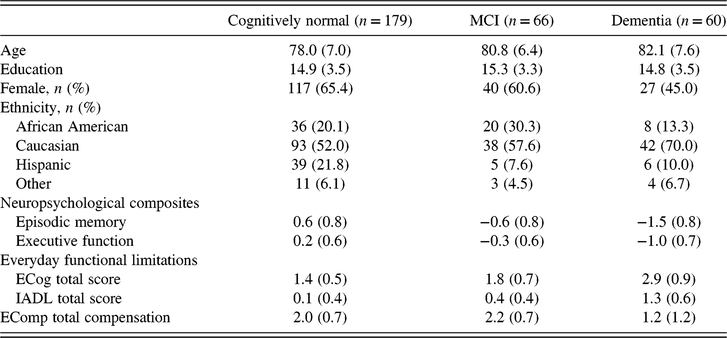
Participants were 305 older adults with an average age of 79.4 (standard deviation (SD) = 7.2), and had an average of 15.0 years (SD = 3.4) of education; although average education was fairly high, it ranged from 0 to 20 years within the sample with 27.9% having less than a high school education. Table 1 presents baseline demographic information by diagnostic group (cognitively normal, MCI, dementia) as well as average EComp, neuropsychological, and ECog scores. The majority of informants were either a spouse (48.0%) or adult child (32.8%). Informants spent 79.5 (SD = 68.4) hours per week on average with each participant.
Participant characteristics

Note: Means and standard deviations presented unless otherwise stated. Neuropsychological scores are expressed as z-scores with a mean of 0 and standard deviation of 1. Episodic memory is available for 170 cognitively normal, 59 MCI, and 34 dementia. Executive function is available for 176 cognitively normal, 65 MCI, and 41 dementia. ECog = Everyday Cognition (Tomaszewski Farias et al., Reference Tomaszewski Farias, Mungas, Reed, Cahn-Weiner, Jagust, Baynes and DeCarli2008); higher ECog represents worse everyday cognition. EComp = Everyday Compensation (Tomaszewski Farias et al., Reference Tomaszewski Farias, Schmitter-Edgecombe, Weakley, Harvey, Denny, Barba, Gravano, Giovannetti and Willis2018). The EComp score is the average score across all items, and a higher score represents more compensation.
Factor Structure
Table 2 presents the fit indices for the three models evaluated. All three models yielded a significant chi-square statistic, indicating a less-than-perfect fit by this metric. However, the chi-square statistic has a tendency to overstate significance in large samples (N > 200) suggestive of a poor model fit (Bollen, Reference Bollen1989). For this reason, the model fit was primarily evaluated using fit indices and residual correlations. The one-factor model (one general compensation factor) did not fit well. The seven-factor model that included a general compensation factor and six IADL-specific factors and the 10-factor model that included four compensatory-specific and six IADL-specific factors both fit well. The 7- and 10-factor models were near identical in TLI, CFI, and RMSEA fit indices; so consequently, the seven-factor model (one compensation and six IADL-specific) was selected as the best model for parsimony. Additional review of the 10-factor model showed very high intercorrelations among the proposed compensatory-specific strategies (r’s > .90), suggesting these factors were not very distinct from one another, further supporting the seven-factor model.
Relative fit of indices for the models tested

* Values significant at p < .05.
CFI = comparative fit index, df = degree of freedom, RMSEA = root mean square error of approximation, TLI = Tucker-Lewis Index. TLI and CFI range from 0 (poor fit) to 1 (perfect fit); values ≥.95 are indicative of a good model fit. RMSEA values .06–.08 are considered to reflect adequate fit; values >.08 indicate good fit.
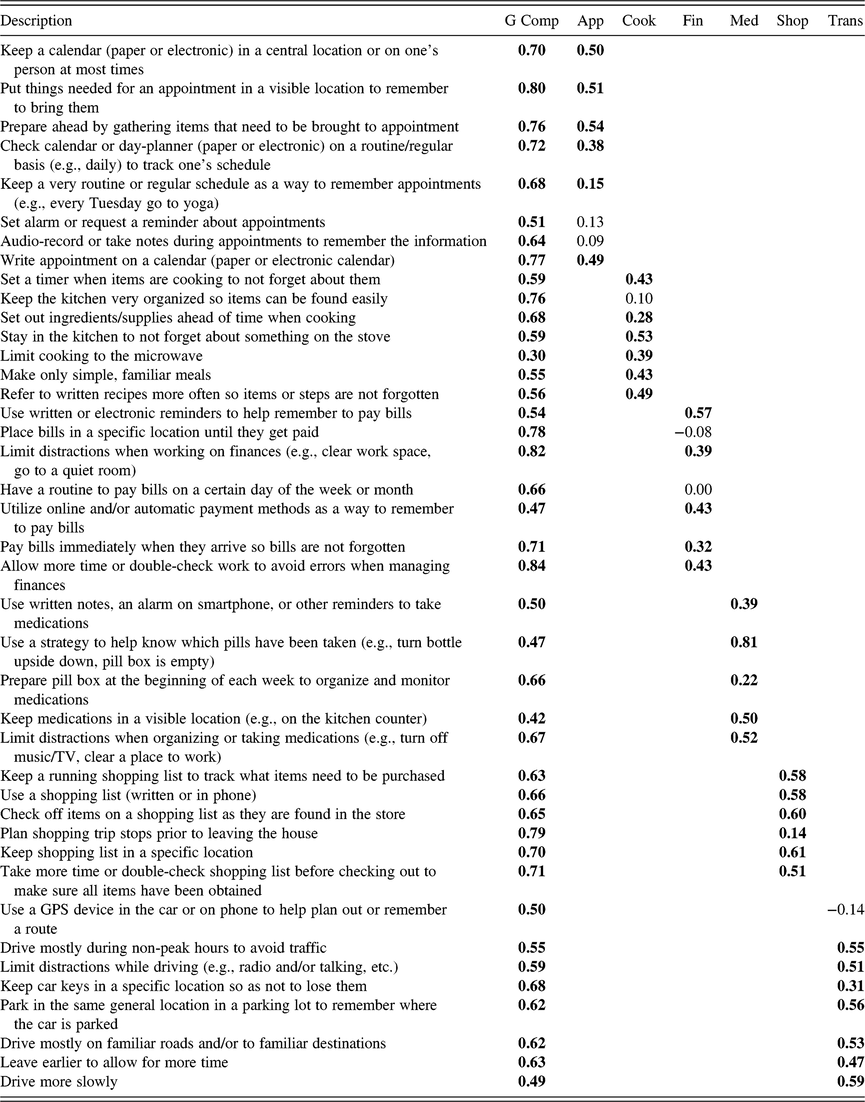
Figure 1 presents a diagrammatic representation of the final model. Table 3 shows standardized factor loadings for the final model that include the general factor plus the six IADL-specific factors (seven-factor model). Standardized loadings of individual items on the general compensation factor ranged from 0.30 to 0.84 (average = 0.63), and therefore accounted for substantial variance in all items (9–71%). The majority of items showed standardized loadings on IADL factors that exceeded .30, a generally accepted threshold for a salient loading (McDonald, Reference McDonald1999). The subsequent analyses (below) focus on the general compensation factor (which is not specific to any given IADL domain) and how it relates to demographic factors, cognition, and everyday function.
Diagram showing significant loadings and factor correlations. App = appointments; Trans = transportation; specific questions for each factor loading are presented in Table 3.

Factor loadings for the seven-factor model

Note: Factor loadings statistically significant at p < .05 presented in bold. G Comp = general compensation factor; App = appointments; Cook = cooking; Fin = finances; Med = medications; Shop = shopping; Trans = transportation.
Demographic Correlates
The EComp general factor score was not associated with age (r = −0.1, p = .9) or education (r = −0.02, p = .7), but females tended to use more compensation strategies than males. We further split the sample according to whether or not the participants completed high school and found no difference in the EComp general factor score between these groups (<12 years: mean = 0.002, SD = 0.96; ≥12 years: mean = −0.05, SD = 0.96; d = 0.05; p = 0.7).
Compensation Effects on Diagnosis, Cognition, and Everyday Functioning
The EComp general factor score differed by diagnostic group (p < .001). Although compensation did not significantly differ between MCI (mean = 0.2, SD = 0.8) and cognitively normal groups (mean = 0.2, SD = 0.7; d = 0; p = .9), individuals with dementia (mean = −0.9, SD = 1.3) used compensation strategies less than both the MCI (d = 0.27; p < .001) and cognitively normal (d = 0.28; p < .001) groups.
A subset of participants had longitudinal cognitive and EComp data (225 with episodic memory and EComp, and 230 with executive function and EComp) over an average of 5.8 years (SD = 3.8). In models adjusted for age, education, and gender, the general compensation factor score was significantly associated with both baseline and change in episodic memory and executive function. Specifically, higher general compensation factor scores (more compensation use) were associated with stronger episodic memory and executive function (β = 0.37, SE = 0.06, p < .001; and β = 0.23, SE = 0.04, p < .001, respectively) and less decline over time (β = 0.017, SE = 0.007, p = .01; and β = 0.023, SE = 0.004, p < .001, respectively).
We further considered the association between compensation and functional change, measured by ECog and IADL measures. We had longitudinal ECog on 234 participants over an average of 6.4 years (SD = 3.7) and longitudinal IADL on 196 participants over an average of 5.8 years (SD = 3.1). Using the ECog and IADL score, a higher general compensation was associated with less functional impairment (β = −0.87, SE = 0.08, p < .001; and β = −0.39, SE = 0.03, p < .001, respectively) and slower functional decline (β = −0.04, SE = 0.004, p < .001, respectively). When also including cognition as a predictor of level and change in ECog and IADL score in the model, EComp remained associated with concurrent level of ECog and IADL score (less functional impairment) (p < .001), and change over time for IADL score (β = −0.02, SE = 0.004, p < .001) but not ECog (p > .05). That is, greater general compensation was associated with slower subsequent decline in IADL impairment independent of the level of cognitive impairment.
DISCUSSION
Functional independence is a major priority for older adults (Zissimopoulos, Crimmins, & Clair, Reference Zissimopoulos, Crimmins and Clair2015), and understanding factors contributing to better everyday function is important. Compensation is one possible factor that may enhance functional independence and buffer effects of cognitive decline on everyday function. However, research examining the efficacy of compensation is limited by a lack of assessment tools to measure compensation broadly and explicitly in the context of IADLs. To address this limitation, EComp was previously piloted by our group (Tomaszewski Farias et al., Reference Tomaszewski Farias, Schmitter-Edgecombe, Weakley, Harvey, Denny, Barba, Gravano, Giovannetti and Willis2018). Preliminary results indicate that greater compensation is associated with better functional ability, independent of the degree of cognitive impairment (Tomaszewski Farias et al., Reference Tomaszewski Farias, Schmitter-Edgecombe, Weakley, Harvey, Denny, Barba, Gravano, Giovannetti and Willis2018). Using a refined EComp (described here), we sought to rigorously examine its psychometric properties and utility.
Previous theoretical models of compensation and some limited empirical work suggest that people utilize different types of compensation. As such, we first examined whether compensation was best described as a unitary or multidimensional construct. Modeling EComp as a single, unidimensional construct did not produce good model fit. However, we suspect that this may be due to variability in the degree to which individuals engage in the six IADL domains covered by EComp (e.g., spouse manages finances by tradition). Therefore, we next tested a bifactor model to delineate both a general compensation factor as well as IADL-specific factors. This model fit the data well, suggesting that after accounting for the degree of variability in IADL engagement, compensation was well represented by a general compensation factor. We then compared this model with another bifactor model in which compensation was modeled as four, a priori-defined types of compensation (use of external aids, organizational and planning strategies, simplification strategies, and allowing more time and effort), while also accounting for variance attributable to IADL engagement. This model showed no improvement in fit over the previous, simpler model. Furthermore, there was considerable multicollinearity among the compensation factors (r’s > .90), suggesting that the strategies were not very distinct. Based on these findings, we concluded that a general compensation factor, while accounting for variance attributable to IADL engagement, was the most parsimonious approach.
Our identification of primarily a general compensation factor differs somewhat from that of de Frias and Dixon (Reference de Frias and Dixon2005) who reported support for multiple types of compensation (external, internal, reliance, time, and effort) using MCQ. Differences across studies may be due to the content covered by each instrument. EComp was organized according to IADL domains, whereas MCQ was not. Additionally, strategies measured by EComp were meant to broadly cover memory- and executively-based compensation strategies, while MCQ measured strategies specific to memory support. Finally, EComp was used as an informant-based measure, and MCQ relied on self-report.
We next examined the association between demographic factors and compensation. The EComp general factor score was not associated with age or education. Similar results have been found with MMQ-MSS (Troyer & Rich, Reference Troyer and Rich2002). Women in our sample had a tendency to use more compensation strategies than men. Dixon et al. (Reference Dixon, de Frias and Bäckman2001) described an interaction effect with gender and age on compensation use. Specifically, they found that older men tended to use help from others as a form of compensation more than women did. We excluded help as a form of compensation from our questionnaire, considering it more related to a loss of independence than a form of compensation.
Next, we examined the association between cognitive function and compensation. Diagnosis (normal cognition, MCI, or dementia) was associated with compensation to some degree. Specifically, those diagnosed with dementia compensated less than individuals with either normal cognition or MCI, supporting the construct validity of EComp. However, compensation use did not differ across the latter two groups. These findings are in line with research examining real-world compensation behavior (Aronov et al., Reference Aronov, Rabin, Fogel, Chi, Kann, Abdelhak and Zimmerman2015). Further, individuals with MCI have been observed to use the same number of external (but fewer internal) strategies as healthy controls on neuropsychological tests of retrospective and prospective memory (Hutchens et al., Reference Hutchens, Kinsella, Ong, Pike, Parsons, Storey, Ames, Saling, Mullaly, Rand and Clare2012). However, our finding differs somewhat from other informant report measures that include reliance on others as a form of compensation (Schmitter-Edgecombe, Parsey & Lamb, Reference Schmitter-Edgecombe, Parsey and Lamb2014). Therefore, like any construct, how studies define or examine compensation may result in reported differences.
Next we examined the association between general compensation and episodic memory and executive function performance. We found greater compensation was related to better memory and executive function when measured concurrently. Such findings are not surprising since greater cognitive resources should enable better and more consistent use of compensation strategies. The additional finding that a greater compensation was associated with a subsequent slower rate of decline in cognition (both memory and executive function) is interesting. One possible interpretation is that greater use of compensation has a protective effect against cognitive decline. An alternate explanation is that better baseline cognitive function is associated with both greater compensation use and less cognitive decline, and that the link between cognitive decline and compensation is mediated by cognitive status. Intervention studies examining whether compensation training can positively impact subsequent cognitive trajectories will be critical for answering this difficult causality question.
Finally, and arguably most important, we examined the degree to which greater compensation is associated with better concurrent functional abilities and rate of functional change over time. Using two separate measures of everyday function (ECog which measures everyday cognitive abilities, and a more traditional IADL measure), greater compensation was associated with a higher level of functional abilities and was associated with a slower rate of functional decline. Additionally, even when accounting for the degree of memory and executive impairment, greater compensation was associated with fewer functional difficulties (on both the ECog and IADL measure) and slower rate of IADL decline. These latter findings are particularly notable because they suggest that even in individuals who have some degree of cognitive impairment, greater compensation may prolong functional independence. This finding is important as prolonging independence likely translates into better quality of life and less economic and caregiver burden.
Because compensation has an effect on functional abilities independent of cognition, it has considerable potential as a target of intervention. In fact, there is emerging evidence that teaching various compensation strategies may help mitigate functional decline (Chudoba, Sawaqdeh, Dahmen, Brown, & Schmitter-Edgecombe, under review; Greenaway, Duncan, & Smith, Reference Greenaway, Duncan and Smith2013; Schmitter-Edgecombe & Dyck, Reference Schmitter-Edgecombe and Dyck2014; Troyer, Murphy, Anderson, Moscovitch, & Craik, Reference Troyer, Murphy, Anderson, Moscovitch and Craik2008). EComp is well poised to measure the malleability of compensation through directed intervention/rehabilitation, and we have found it to be sensitive to change in relation to a compensatory training intervention (Denny, Barbra, & Tomaszewski-Farias, Reference Denny, Barbra and Tomaszewski-Farias2017; Denny & Tomaszewski Farias, Reference Denny and Tomaszewski-Farias2017).
As with any study, there are limitations. First, measurement of compensation was based on knowledgeable informant report, which is subject to a range of biases including variables such as caregiver burden (Dassel & Schmitt, Reference Dassel and Schmitt2008; Richardson, Nadler, & Malloy, Reference Richardson, Nadler and Malloy1995; Tomaszewski Farias et al., Reference Tomaszewski Farias, Mungas, Reed, Harvey, Cahn-Weiner and DeCarli2006). Further, outside observers may not be aware of or recognize all of the strategies that an individual is engaging in while completing daily activities. This could also vary by the type of relationship between informant and participant. In this study, informants included spouses, adult children, and friends. Preliminary analysis (not shown) suggests that accounting for relationship type did not alter results, but more work in this area is needed. Further, it will be important in the future to investigate self-reported compensation use and how it compares to informant report. Future work should also compare informant and self-reported compensation to more objective and real-world measures of compensation. Recent preliminary data suggest that subjective and objective measures of compensation are related (Chudoba et al., Reference Chudoba, Weakley and Schmitter-Edgecombe2018). Our analyses may also have been limited by the measure of executive function used. Executive functions encompass a number of disparate abilities, many of which were not captured by our composite measure (e.g., problem solving). Finally, since greater compensation use is associated with slower rate of functional and cognitive decline, examination of whether it forestalls diagnostic progression (e.g., conversion from MCI to dementia) will be important.
In summary, the degree to which older adults utilize compensatory strategies likely has important implications for functional independence over time, even in the face of declining cognition. EComp is a new tool that is likely to prove useful in measuring, and hence better understanding, how the use of compensation strategies impacts various outcomes. The presented factor analysis is an extension of our previous findings using a simple summary score (Tomaszewski et al., Reference Tomaszewski Farias, Schmitter-Edgecombe, Weakley, Harvey, Denny, Barba, Gravano, Giovannetti and Willis2018). Given that a general factor emerged in the current analysis, it is reasonable to use the simple summary score in future analyses if engagement in all IADLs measures is confirmed. Overall, EComp may serve as a useful outcome measure in interventions that aim to teach or otherwise improve compensation among various clinical groups.
Conflict of Interest
The authors declare no potential conflicts of interest with respect to the research, authorship, and/or publication of this article.
Funding
The authors disclosed receipt of the following financial support for the research, authorship, and/or publication of this article. This article was supported by grants from the National Institute on Aging: AG10129.
SUPPLEMENTARY MATERIALS
To view supplementary material for this article, please visit https://doi.org/10.1017/S135561771900119X