1. INTRODUCTION
In a context where Europe is experiencing one of the most critical refugee crises of the post WWII era, researching how immigrant learners acquire a second language (L2) is more vital than ever. Syria is one of the main countries of origin of the asylum requests in France (3249 in 2017).Footnote 1 These immigrants are faced with many new life challenges, the most crucial of which is learning French for a better integration and adaptation to their new environment and culture. Learning how to speak and write French in a relatively short time is a major concern for asylum seekers and refugees since it is the first condition of their access to training, work and accommodation. The acquisition of French for these individuals can take place in numerous ways, including the possibility to enrol in French courses at French universities. Indeed, since September 2017, the number of immigrants from the Middle East who have filed for asylum in France and have been allowed to enrol in such courses has risen constantly.Footnote 2 In order to serve this population, it is urgent to contribute to facilitating their integration in the French university and in the host society in general. In fact, understanding the needs of this relatively new learner profile at the university and being able to respond to those needs would make learning and teaching experiences more enjoyable and teaching practices more efficient. Additionally, investigating the processes underlying French language acquisition by Syrian immigrants would certainly contribute to better understanding of second language acquisition (SLA) in general and the acquisition of French by Arabic speakers, in particular.
This article aims at discussing a number of methodological considerations that arose in a pilot studyFootnote 3 conducted as part of a bigger project SOFRA: Approche SOcioculturelle et psychologique de l’acquisition du FRAnçais par des demandeurs d’asile syriens. These considerations are related to conducting interviews with Syrian beginner and intermediate learners of French L2. In particular, we examine how the interviewer asked questions in semi-structured interviews and we discuss the methodological problems that learners’ responses reveal about the interview protocol. The aim of this study is to improve the interview schedule and data collection procedure of the main study and to collect a coherent set of valuable data that offers the possibilities to examine at the same time the singularities of learners’ trajectories, but also the communalities of learning and sociocultural experiences across individuals. Additionally, given the specificities and lack of research on the targeted population, our findings may help researchers who would like to collect qualitative data with comparable learner profiles anticipate similar difficulties when designing their research protocols.
The SOFRA project sets out to longitudinally examine the relationships between the development of French as a L2 by Syrian refugees and asylum seekersFootnote 4 enrolled in French language courses at a French university and the dynamics of their sociocultural adaptation in the host society. As such, it aims to contribute to reconsidering ‘disadvantaged’ learners and to conducting ‘socially-relevant’ SLA research to help these individuals face the considerable challenges related to SLA and therefore support their participation in the economic and social life of their new community (Young-Scholten, Reference Young-Scholten2013).
In exploring links between the development of L2 acquisition and the social context, the project is informed by sociocultural theory. Having its origins in the writings of Vygotsky and his colleagues, sociocultural theory refers to human learning and developmental processes in general, and argues that learning generally happens ‘through participation in cultural, linguistic and historically formed settings’ (Lantolf and Thorne, Reference Lantolf, Thorne, VanPatten and Williams2007, p. 197). When applied to SLA, the proponents of sociocultural theory argue that language acquisition does not take place only in the learner’s mind but also in interaction with the social context (Lantolf, Reference Lantolf2000; Ushioda, Reference Ushioda, Little, Ridley and Ushioda2003; Lantolf and Thorne, Reference Lantolf, Thorne, VanPatten and Williams2007; Lantolf et al., Reference Lantolf, Thorne, Poehner, van Patten and Williams2015) and that SLA is in itself a social process in which learners are socially and culturally situated and engage in cultural activities mobilizing cultural and semiotic tools (Tarone, Reference Tarone2007).
The relationship between SLA and the social context has not always been taken into account in mainstream SLA research (cf. Véronique, Reference Véronique, Herschensohn and Young-Scholten2013 for an overview). Using an integrated research perspective, where non-linguistic variables are considered on the same level as linguistic development, is all the more important for studying SLA in migration contexts given the special profile of learners, which has rarely received attention in SLA research (van Tubergen, Reference van Tubergen2010). More generally, there has been, in the last decades, a notable shift in interest from ‘disadvantaged’ L2 learners and uneducated immigrant adults in naturalistic contexts (as in projects from the 1970s and 1980s, like the ESF ProjectFootnote 5 (Perdue, Reference Perdue1993a, Reference Perdue1993b)) to focusing almost exclusively on educated, middle class learners (Young-Scholten, Reference Young-Scholten2013). This resulted in a shift in SLA research scope and perspectives, as a number of ‘language-external factors’ were left unaddressed (Young-Scholten, Reference Young-Scholten2013: 441).
Given the growing number of learners who develop linguistic skills in difficult psychological conditions (Mann and Fazil, Reference Mann and Fazil2006); and whose language acquisition is dependent on both their professional and social integration (Adami and André, Reference Adami and André2015), there is a growing need for ‘socially relevant’ SLA research that is capable of addressing non-linguistic variables that are decisive to language acquisition. Indeed, we share the concern of Véronique (Reference Véronique, Herschensohn and Young-Scholten2013: 270) that ‘[a]dult learners who may have suffered from social and psychological trauma due to the circumstances of their lives (economic migration, political asylum, etc.) cannot be sliced into neat components for the sake of elegant research’. The integrated approach adopted in this project aims to report on learning conditions, and learners’ access to culturally meaningful practices within the target language community, including in the classroom (Norton and Toohey, Reference Norton and Toohey2011). The adoption of an integrated approach presents a set of methodological challenges as discussed in Hulstijn et al. (Reference Hulstijn, Young, Ortega, Bigelow, DeKeyser, Ellis, Lantolf, Mackey and Talmy2014). In fact, establishing a causal link between data gathered through qualitative methods on social context and L2 development (investigated using predominantly quantitative methods) has been difficult to obtain. Furthermore, it presupposes intersecting approaches that have different orientations (Mackey, in Hulstijn et al. (Reference Hulstijn, Young, Ortega, Bigelow, DeKeyser, Ellis, Lantolf, Mackey and Talmy2014)) and developing a methodology that speaks to different strands (Young, in Hulstijn et al. (Reference Hulstijn, Young, Ortega, Bigelow, DeKeyser, Ellis, Lantolf, Mackey and Talmy2014); Firth and Wagner, Reference Firth and Wagner1997)).
In this article, we focus on the methodological considerations related to the collection of qualitative data gathered through interviewing in the SOFRA pilot study. In this exploratory phase, we set out to examine to what extent the non-linguistic variables that are identified in the literature and that we are interested in pertain to the researched population. Furthermore, we wanted to become familiar with the world in which the respondents live to acquire a better knowledge of the language they use and the interpretations they can give to the language we use during the interview.
2. THE PILOT STUDY
2.1. The targeted non-linguistic variables
Given that language use is an important mediational tool (Vygotsky, Reference Vygotsky1986), and that language learning is a social practice (Lantolf et al., Reference Lantolf, Thorne, Poehner, van Patten and Williams2015) and a result of ‘a relational engagement among participants of a community’ (Miller and Kubota, Reference Miller, Kubota, Herschensohn and Young-Scholten2013, p. 234); it is essential to examine how learners interact with people and artefacts from their new environment in order to understand language learning and development. In the pilot study, we set out to gather qualitative data on the following non-linguistic variables: (a) learners’ access to and participation in culturally organised activities and communicative events, (b) learners’ attitudes towards their new language and environment, and (c) learners’ relationships with their country of origin and their first language (L1).
Indeed, we intended to gather information on learners’ opportunities for interaction in the target language as well as their exposure to input in French. Furthermore, by studying those aspects, we hoped to gain insights into learners’ involvement in the host community and learn about the extent to which they have managed to develop ‘insider identities’ and legitimacy (Norton and Gao, Reference Norton and Gao2008; Early and Norton, Reference Early and Norton2012; Norton, Reference Norton2013). Moreover, focusing on how learners feel about their new environment and how they speak about the new culture and the people of the community they interact with is essential to understanding their learning experience, as well as their investment in learning the language and adaptation to the new context (Norton Peirce, Reference Norton Peirce1995; Darvin and Norton, Reference Darvin and Norton2015). SLA research on attitudes has generally shown an interrelation between positive attitudes and the development of L2 proficiency (Gardner, Reference Gardner1985; Oroujlou and Vahedi, Reference Oroujlou and Vahedi2011; Zeinivand et al., Reference Zeinivand, Azizifar and Gowhary2015) and learners’ disposition to learn (Ushioda and Dörnyei, Reference Ushioda and Dörnyei2017). Finally, we consider that information about the way in which individuals relate to their country of origin and L1 for this specific learner profile, given the similar conditions of forced migration that they have all undergone, may contribute to understanding how the participants adapt to their new environment.
2.2. Testing an interview protocol
In any type of research, the choice of data elicitation instruments is dependent on the type of data needed, hence on the research question asked as well as on the theoretical approach adopted (Mackey and Gass, Reference Mackey and Gass2005).
Research interested in understanding language development in relation to sociocultural context draws almost exclusively on qualitative data and narratives collected through qualitative methods, namely interviewing, diary writing or journaling (e.g. Norton, Reference Norton2013; Pavlenko, Reference Pavlenko, Blackledge, Piller and Teutsch-Dwyer2001). In our project, we assume that in order to analyse SLA by Syrian asylum seekers and refugees based on a sociocultural approach, we need to understand how they relate to the community in which they are living and of which they wish to be part. Furthermore, following the work of Norton (Norton, Reference Norton2000; Norton and Toohey, Reference Norton and Toohey2011; Early and Norton, Reference Early and Norton2012; Norton, Reference Norton2013), it is important in examining SLA to understand the world as the learners understand it. For those reasons, we rely on the learners’ representations and understanding of their new environment, as expressed in their own discourse. The data elicitation instrument chosen for those purposes is therefore interviewing.
Interviewing is a widely-used technique in qualitative research, and there are different types of interviews that can be described on a continuum ranging from the fully structured to the completely unstructured (Bell, Reference Bell2005; Mackey and Gass, Reference Mackey and Gass2005). Structured interviews are a rigid type of interview that are comparable to questionnaires, as the researcher sticks to a prepared set of questions, thus allowing to compare the participants’ answers. Semi-structured interviews are based on an interview schedule or guide, but allow for digressions and more freedom of both the interviewer and the respondents. The last type is unstructured interviews, where the interviewer develops and adapts the questions to the respondents. Although no question list is used, the interviewer has to prepare a list of items s/he needs to cover. While unstructured interviews can be more appropriate in preliminary studies, most studies using interviews rely on the semi-structured type, which both allows freedom to the respondents and ensures that the important topics are addressed (Bell, Reference Bell2005).
Overall, given their interactive nature, interviews constitute a flexible tool that allows the researcher to adjust to the respondent and to elicit additional data in case there is need to clarify or to complete initial answers. Nevertheless, this data collection method can also have drawbacks. For instance, the researcher’s subjectivity may interfere with the way the data are collected and interpreted. Moreover, participants may provide information that they believe is wanted or expected by the researcher, through what is termed ‘the halo effect’ (Mackey and Gass, Reference Mackey and Gass2005). Additionally, the questions asked may be inappropriate to certain cultural contexts. The interviewing process and the particularity of the conversation can be challenging for our respondents given that generally, ‘the context of a linguistic encounter contains a tension – that between the uniqueness of a particular interaction and the shared constraints and principles of the society through which communication is mediated’ (Bremer et al., Reference Bremer, Broeder, Roberts, Simonot, Vasseur and Perdue1993).
Finally, in order to elicit valuable data, the interviewer needs to develop good interviewing skills in order to face the different methodological challenges involved in conducting interviews: to know how to play with two very different language registers: the language of research that is used to codify reality and communicate the results to the scientific community, and the language used by respondents; to react in case of silence; and to guide the interview while letting the interviewee speak (Romelaer, Reference Romelaer, Roussel and Wacheux2005; Creswell, Reference Creswell2014).
The literature on research methods and data collection techniques offers a number of suggestions to help the researchers maximise their chances of gathering relevant rich data (e.g., Bell, Reference Bell2005; Mackey and Gass, Reference Mackey and Gass2005). These include suggestions to build a positive and reassuring relationship between the interviewer and the interviewee, to prepare efficient questions that would elicit valuable data and to develop skills in anticipating and solving communication problems. However, as stated by Chaudron (Reference Chaudron2003, p. 773), ‘[s]urprisingly, in most of this literature, there is little description of exactly what sort of protocols, guidelines, questions, or procedures are employed’. Aware of the potential pitfalls involved in conducting interviews, as well as the added challenge of conducting them with Syrian asylum seekers and refugees who have predominantly low L2 proficiency skills, we planned to pilot test out data collection protocol as the first stage of the SOFRA project.
3. OBJECTIVES, RESEARCH QUESTIONS AND HYPOTHESES OF THE PILOT STUDY
Pilot testing consists of conducting ‘small-scale trial of the proposed procedures, materials, and methods’, with the aim of uncovering any problems, before testing and then finalising the materials and methods used in the main study (Mackey and Gass, Reference Mackey and Gass2005, p. 43). Pilot testing is therefore considered crucial in any type of research to avoid ending up with useless and non-valuable data.
We aim in this article to discuss the viability of the different methodological choices made for collecting data through semi-guided interviews. We focus on the nine participants’ understanding of the questions asked during the semi-structured interviews, addressing in particular the following questions:
1) What are the questions that were difficult to understand by the respondents and what are those that elicited off-topic answers?
2) What are the interviewer’s strategies when faced with different problems throughout the interviews?
We hypothesise, based on learners’ L2 proficiency and the specificities of the language task (Perdue, Reference Perdue1993b), that problems of understanding of interviewer’s questions would occur. Also, given the heterogeneity of questions types, it is expected that the relevance of interviewees’ responses would vary depending on how the questions are structured and formulated. More precisely, negotiation for meaning and ‘struggle to make meaning’ (Perdue, Reference Perdue1993b: 254) would be more frequent with open-ended questions.
The article concludes with a discussion on how the pilot study helped inform the design of the interview schedule for the main data collection phase within the SOFRA project.
4. PILOT STUDY METHODOLOGY
4.1. Participants
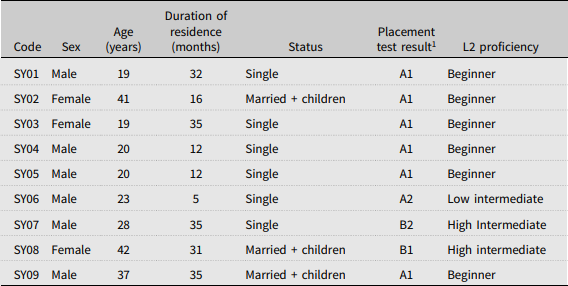
The participants in the pilot study are nine Syrian adults, who have migrated to France, and who were enrolled in French language classes in the Department of FLE (Français Langue Etrangère) at a French university the year of data collection. All the learners came to France under the same conditions, benefiting from the assistance of the University of Toulouse. They share the same migration experiences and hosting conditions. Table 1 gives details about participants’ profiles.
Participants

1 The placement test is ELAO (http://www.elaotest.eu/edu/assmt) which allows to evaluate language proficiency using the Common European Framework of Reference (Council of Europe, 2001).
Most of the informants had a beginner’s level before they enrolled at the French department. The interviews were conducted six months after enrolment. However, the informants had only benefited from one month of instruction when they were interviewed. In fact, soon after they had started French courses, the students and personnel at the University of Toulouse went on strike. All teaching and pedagogical activities had to cease as the university was blocked and access to the campus was limited.
4.2. General description of the dataset
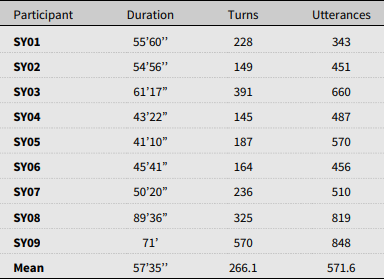
Table 2 describes the dataset in terms of duration of the recordings and corpus size (in the form of the number of turns and utterances).
The data set
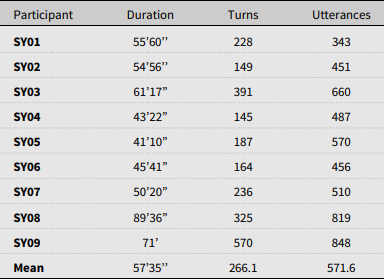
Overall, the interviews lasted less than an hour, and contained an average of 266 turns and 572 utterances.
4.3. Data collection procedure
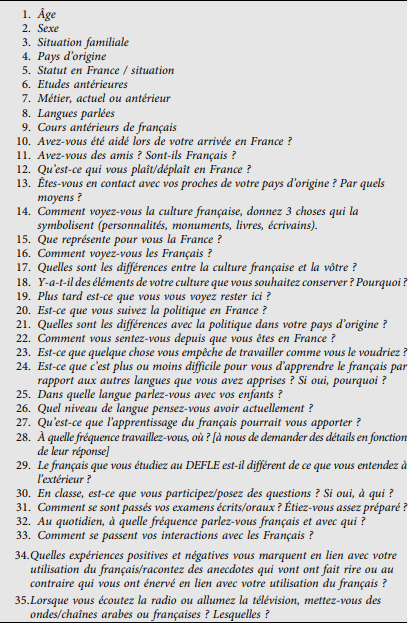
Semi-structured interviews were conducted by the researcher (female, bilingual French/ Arabic) with each participant in person and were video-recorded. An interview schedule of 35 questions was used (see Appendix 1). The semi-structured type of interview was chosen to allow the respondent to talk about what was of central significance to them (Bell, Reference Bell2005) and also to facilitate the interviewer moving easily from one topic to another, paying attention to the flow of the conversation and to the relevance of the respondents’ answers.
We have chosen French as the language of the interviews in order to be able to conduct different types of analyses using software that is not possible to use for Arabic languages (e.g., lexicometric software), and also to analyse the learners’ conversational abilities in the L2. Possibilities of translating the questions in Arabic or English were offered. Furthermore, all the documents presented to the participants, namely the participants’ agreement and the presentation of the project’s objectives, were trilingual (in French, Arabic and English). However, opportunities to switch to the L1 or to English were minimally taken and all the participants chose to hear and answer all questions in French. Some of the participants even reported that the interview was an opportunity for them to speak French and that similar opportunities were rare, especially at the time of the social movement, where access to the university was impossible.
4.4. Interview schedule
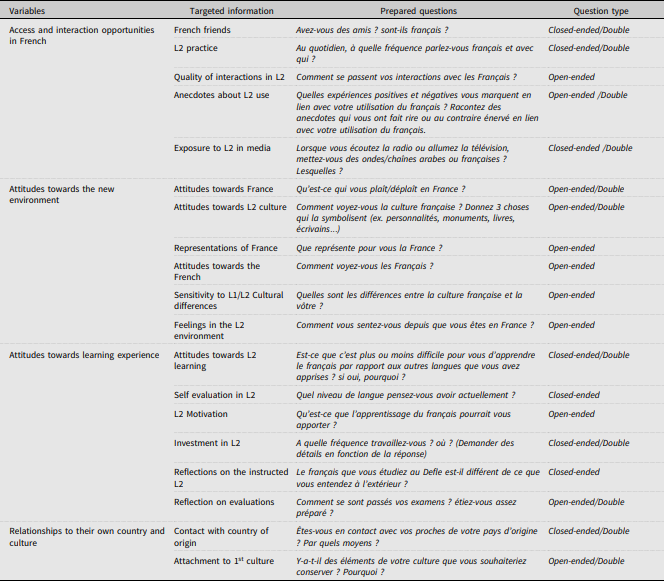
The interview schedule contained 35 questions (Appendix 1). Among other things, these questions elicited information about (a) learners’ access to French language and culture and interaction opportunities in the target language; (b) their attitudes towards the new language, their learning experience and new environment as well as their (c) relationship to their culture. We focus, in this article, on only the 19 questions which targeted those three topics (see Table 3). The category (b) was divided into two subcategories: attitudes towards the new culture and environment and attitudes/comments about learning experience.
Questions used in the data subset

Furthermore, in order to easily refer to the listed questions throughout the analyses, each one of them was summarized in the column Targeted information. Finally, a description of each question type is provided in the last column, in terms of complexity (simple or double) and in terms of type of answer required (open-ended or closed-ended). Simple questions focus on only one aspect of the topic addressed. Double questions, however, target two different pieces of information. They are written using two question marks in the interview schedule (Table 3). Four categories of prepared questions were distinguished Open-ended (n=5); Closed-ended (n=2); Open-ended/Double (n=6) and Closed-ended/Double (n=6). These question categories will be used in the analysis of the interviews.
4.5. Data transcription, coding and analysis
The interviews were entirely transcribed in CHAT format using the software CLAN (MacWhinney, Reference MacWhinney2000). The transcriptions were overall orthographic, except for words and chunks that did not correspond to what would be expected in the context of the utterance. These were transcribed phonetically and coded using CHAT conventions. In the examples provided in this article, @u is affixed to such instances.
Respondents’ turns were divided into utterances to have comparable data units across interviews. An utterance is the smallest meaningful speech unit. Most learner utterances are organized around a finite verb, although some are structured with a non-finite verb form/base form or even without a verb (Klein and Perdue, Reference Klein and Perdue1992).
The dataset based on the 19 questions listed in Table 3 was divided into subparts. For each interview, 19 data files were created, each of which contained the turns used to respond to one of the 19 questions. The dataset analysed in the current article thus corresponds to a total of 171 CHAT files.
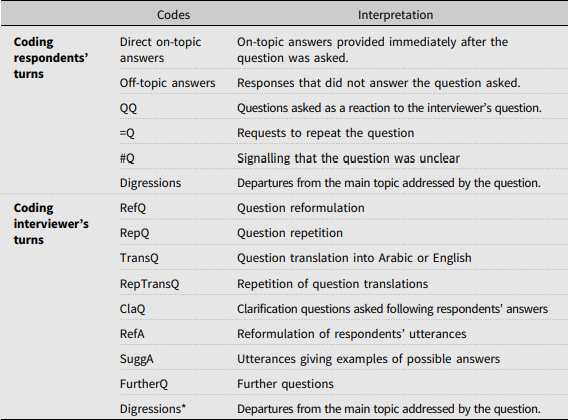
As a reminder, our objective in interview piloting was to test the interview protocol to ensure that interviews conducted in the main study will allow us to gather coherent, complete, valuable and comparable data across all participants. In order to achieve that, each of the planned questions should be easily understood by each participant and should spontaneously elicit on-topic answers. Furthermore, risks of bias and data variation are two major concerns and have to be avoided. Therefore, we examined how the interviewer actually asked each question and how the interviewee responded. The aim is to assess if the question was clear enough and adapted to the participant’s profile and to examine, in case of difficulties, the interviewer’s reactions and attempts to clarify the question and obtain the most relevant answer possible. Indeed, we elaborated a bottom-up coding scheme to analyse conversations in the different files in terms of the apparent clarity of the questions from the respondents’ perspectives and the relevance of answers from the point of view of the interviewer (whether they were on-topic or off-topic). Parts of conversations that did not directly relate to the pre-set list of questions were coded as digressions. Table 4 presents the information coded in the interviewer’s and the respondents’ speech.
Coding of interviews

* The interviewer’s digressions will not be addressed in the analysis.
5. RESULTS
5.1. Clarity and reception of the questions from the point of view of the respondents
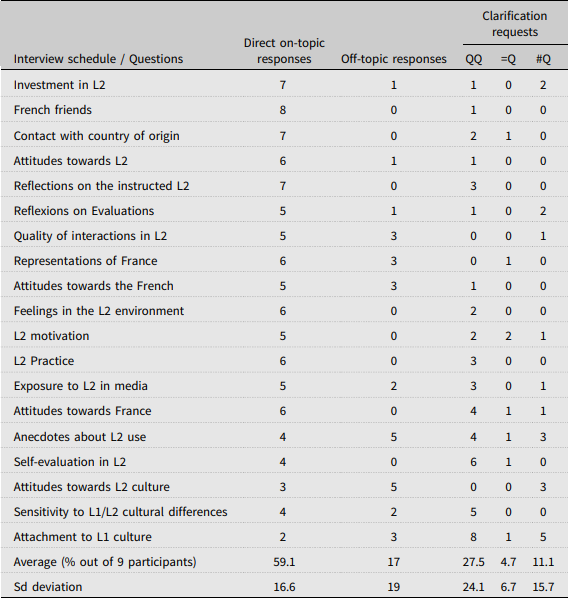
One of the most important characteristics of a good interview is that it is constructed using questions that are clear enough to yield the best and most relevant responses. Therefore, we wanted in this pilot study to check the validity and clarity of the questions asked during the interviews, in particular examining how the different respondents reacted to each one of them. We therefore reflected on whether the prepared set of questions was really adapted to the respondents, looking at instances where they were apparently unclear, ambiguous and needed explanations and reformulations by the interviewer. Table 5 summarizes the reactions of the respondents to the different questions asked. These reactions are classified in terms of whether the respondents gave:
(a) on-topic and direct responses to the interviewer’s question (Direct on-topic responses);
(b) on-topic responses given after seeking further clarifications, a category which was further subdivided into asking questions in their own words (QQ), asking the researcher to repeat the question (=Q), or saying that the question was unclear and that they did not understand it (#Q); and finally
(c) off-topic responses; which revealed that the question was misunderstood.
Respondents’ reactions to questions

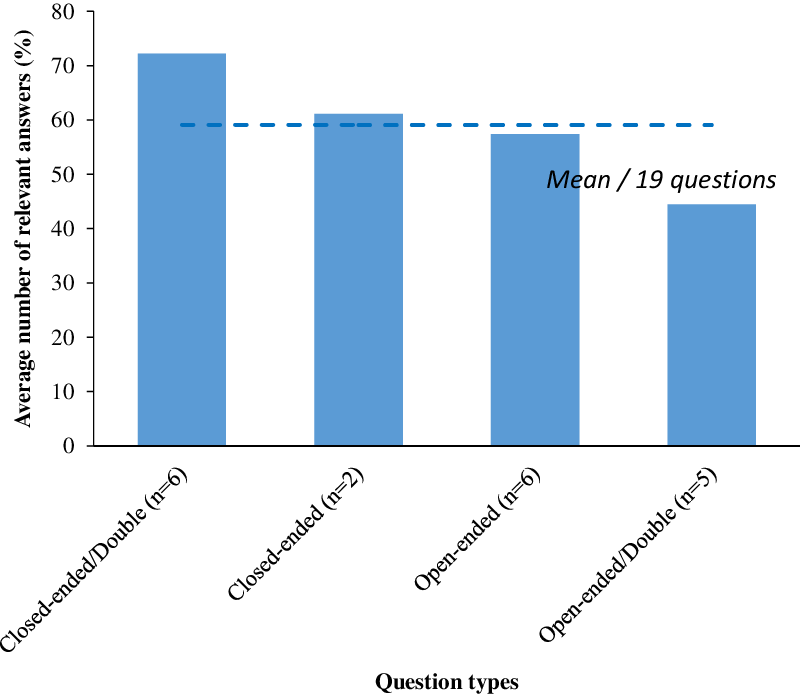
Overall, on average, only about 59% of all responses were on-topic and provided immediately after hearing the question. About 23% (nearly ¼ of the questions) of all responses were given following clarifications requests. The remaining 17% of the answers provided were off-topic. The high standard deviation (15.4%) of average relevant answers reveals large discrepancies across questions. As Figure 1 shows, these differences can be interpreted in relation to the types of questions asked:
Closed-ended questions are those that yield relevant answers more often than open-ended questions. For our interview type, closed-ended questions were meant as triggers to address certain topics. For example, the question Avez-vous des amis? Sont-ils français? was meant to yield information about the respondents’ social life and give elements about their involvement with the target language community. However, when the respondent’s answer was limited to “oui j’ai des amis et ils sont français”, the answer is considered as relevant even though it is unsatisfactory to the interviewer. Furthermore, closed-ended (simple or double) questions were generally formulated using words that are available in the respondents’ input (e.g., amis, parler français, contact, pays d’origine, niveau de langue). Consequently, clarification requests were rare with this question type. Conversely, open-ended questions were longer and contained unknown words. Indeed, some turned out to be confusing and difficult to understand, due to unsuitable vocabulary (e.g., éléments, conserver), which explains the numerous clarification requests formulated by the respondents. The example in (1) shows a clarification request to the question ‘Attachment to L1 culture’, which was particularly challenging for the respondents.
1)


Distribution of average number of on-topic answers per question type.

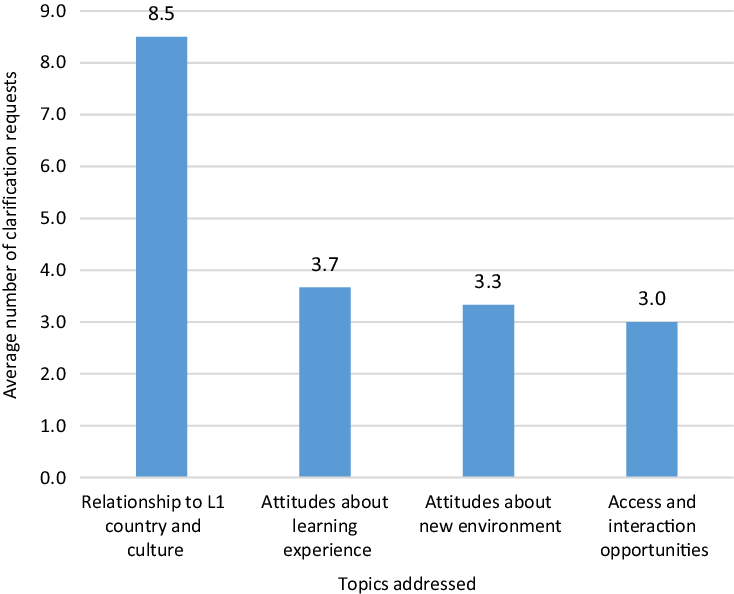
In addition, questions addressing topics related to the present were those that were more likely to be easily understood by the participants (e.g., ‘Attitudes towards the new environment’, ‘Attitudes towards L2 learning’). Conversely, those which were related to the past (e.g., ‘Attachment to L1 culture’), or made links between the past and the present seemed to require more clarifications. Additionally, nearly all the questions related to cultural/intercultural sensitivity were less likely to receive relevant answers (see Figure 2).
Average number of clarification requests in terms of the topics addressed.

Furthermore, most of the off-topic answers occur with the questions ‘Anecdotes about L2 use’ and ‘Attitudes towards L2 culture’. These are the lengthiest and most complex of all the questions. They were also those that were the most frequently reformulated, repeated and explained. Question wording can explain why these two questions were particularly problematic. In fact, clarification requests concerning the words anecdote and énervé were frequent and clarification attempts were sometimes unsuccessful as in (2).
2)

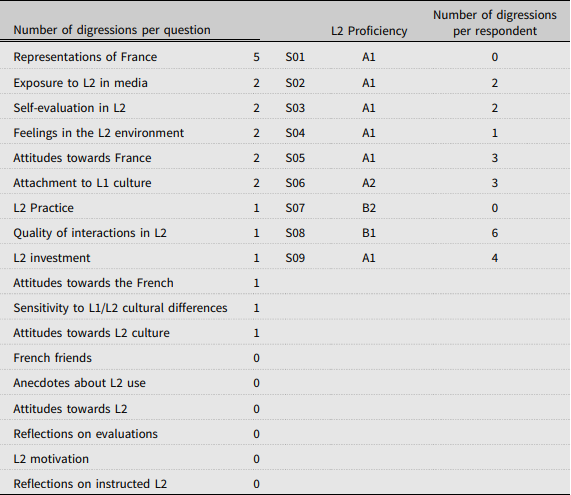
Moreover, we examined cases where the respondents digressed from the topics addressed by the questions. Digressions are participants’ utterance(s) that were not produced as an answer to the question and that had no direct relationship with the question asked. Digressions are not to be confused with off-topic answers, where the respondents clearly fail to understand the question despite the interviewer’s reformulation and clarification attempts. They are of importance in our investigation because they can help us see what is of particular importance to the learners. Furthermore, they help to understand whether in the list of prepared questions there are redundant questions. Table 6 presents frequencies of respondents’ digressions. These are not very frequent in the interviews.
Respondents’ digressions

Digressions do not occur with all the interview questions. Indeed, six out of the 19 questions were answered by all the participants without departing from the main topic. Overall, respondents’ digressions are very limited, which could be interpreted in relation to the low L2 proficiency of most of the respondents. In (3), SY09 deviates from the question about his representation of the host country to talk about why he likes the French language.
3)

It is hypothesized here that the digression may stem from an ambiguity related to the word ‘France’ and possibly the proximity with the words le français and langue *français. The respondent manages on his own to adjust to the question asked and provide a more appropriate answer: oui mais pour France…
Similarly, (4), SY02 answers the question and departs from the topic to make comparisons between France and Syria. Clearly, the question about ‘Representations of France’ can possibly elicit information about cultural differences between the country of origin and the new environment. This information is also yielded by the question ‘Sensitivity to L1/L2 cultural differences’.
4)

5.2 Clarity and reception of the questions from the point of view of the interviewer
5.2.1. Interviewer’s clarification attempts
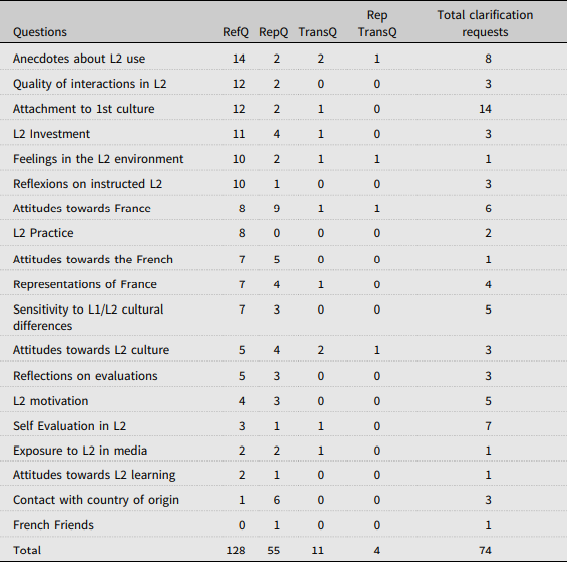
As a reminder, we analysed the way in which the questions were asked by the interviewer in order to examine their formulation across interviews as well as the strategies used to cope with comprehension problems. In particular, we looked at cases where she had to reformulate (RefQ), repeat (RepQ), translate them once (TransQ) or twice (Rep TransQ). Table 7 gives details about the frequencies of each type per question (all respondents). Additionally, the table presents in the last column the total number of respondents’ clarification requests per question (presented above in Table 5).
Analysis of interviewer’s questions

First of all, the interviewer very rarely had recourse to translation to further clarify the questions (11 translations and four translation repetitions in the dataset). As a matter of fact, the participants never asked the interviewer to translate the question into another language (L1 or English) even though they knew that it was possible. The interviewer had recourse to translation when reformulations were not efficient (as in [2] above). The interviewer reformulated the questions when needed (128 reformulations). However, frequencies of the respondents’ clarification requests presented in the last column of Table 7 suggest that the questions that are most frequently reformulated are not necessarily those for which the participants asked for clarifications. Additionally, the researcher, overall, provides more clarifications than requested.
Indeed, only some of the interviewer’s repetitions, reformulations, and translations were induced by the respondents’ explicit clarification requests. She also produced self-initiated repairs and reformulated in multiple manners when she saw that the respondent did not understand the question as in (5), where the interviewer reformulates the question many times preceding the respondent’s overt clarification requests.
5)

The interviewer’s reformulations were either explicitly requested or induced by implicit indications from the respondents that the question was not understood, either through nonverbal behaviour, gesture, facial expression, or as a result of a lengthened reaction time etc. Respondents’ difficulties can be interpreted with relation to their linguistic abilities in the L2, but also attributed to the wording of questions. In fact, many of interviewer’s reformulations are produced immediately after asking the question, and repeatedly for the same questions with many participants. For instance, the question about the ‘Quality of interactions in L2’ (worded as follows in the interview schedule: Comment se passent vos interactions avec les Français?) is frequently followed by reformulations. In addition, it is differently worded with each respondent. Indeed, in (6) the interviewer introduces in the question’s reformulation an element – comment vous vivez l’expérience ? – which reorients the conversation from speaking about factual information concerning L2 interactions to focusing on the respondents’ feelings about the experience, resulting in the use of adjectives such as (facile, pas difficile) in the respondent’s answers.
6)

Furthermore, the interviewer sometimes gives examples to help the respondent understand the question. In (7), while reformulating, she also provided suggestions of possible and somehow expected answers. These suggestions clearly influenced the way the respondent answered.
7)

5.2.2. Interviewer’s reactions to responses
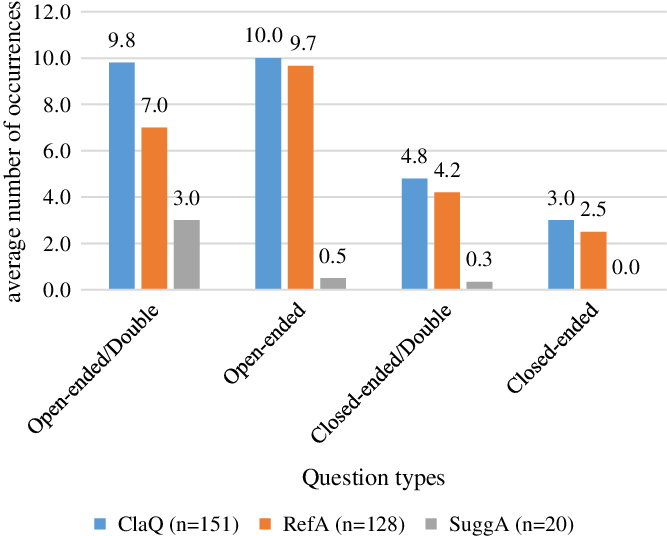
Interviewer’s turns in a semi-structured interview can serve different purposes: to signal to the interviewee that s/he can continue talking by saying ‘oui’, for example; to summarize what has just been said, to ask for more clarifications and depth, to refocus the conversation when the respondent departs from the topic addressed or to ask further questions that are not planned in the interview schedule (Romelaer, Reference Romelaer, Roussel and Wacheux2005). We examined the way the interviewer reacted to the different types of responses provided by the participants. These reactions were reformulations (RefA) to clarify the content of what has been said or to rephrase what the respondent is struggling to say using more ‘understandable’ words, as in (8).
8)

The interviewer also asked clarification questions about what was said (ClaQ) in order to clarify the content of the respondent’s speech as in (9).
9)

Lastly, the interviewer suggested possible answers (SuggA). Even though these suggestions were generally produced as a reaction to off-topic answers, and were therefore meant to further clarify the content of the question asked, they can be considered as instances of bias that affect the respondents’ answers.
The distribution of all reactions per question types is presented in Figure 3. Open-ended questions are those which were more frequently followed up by unclear answers which required reformulations and clarifying questions by the interviewer. SuggA were more often produced with open-ended/double questions like ‘Anecdotes about L2 use’, ‘Attitudes towards L2 culture’ or ‘Attachment to 1st culture’, which further suggests that those questions need to be reconsidered, and reworded to suit our respondents’ L2 skills.
Interviewer’s reactions to respondents’ answers.

6. DISCUSSION OF RESULTS
Our findings confirm that pilot testing is crucial (Mackey and Gass, Reference Mackey and Gass2005). It revealed a number of promising findings: Firstly, nearly all the participants who were solicited were willing to participate in the study and considered it as an opportunity to practice their French. In fact, they were all willing to answer the questions in their L2, and their answers show that despite the linguistic difficulties that were at times felt, the participants’ attitudes remained very positive throughout the interviews.
However, pilot testing also revealed that despite being prepared to conduct the interviews, and the care with which we had prepared the interview schedule, we had not always achieved our goals. These goals are also shared by researchers who would like to gather qualitative data through interviewing, as argued by Bell (Reference Bell2005, p. 14):
[w]hichever method of information gathering is selected, the aim is to obtain answers to the same questions from a large number of individuals to enable the researcher not only to describe but also to compare, to relate one characteristic to another and to demonstrate that certain features exist in certain categories.
We failed to obtain on-topic answers to all the prepared questions: some answers were irrelevant as they were off-topic, others were redundant, and overall, comprehension problems were recurrent. Interviewers’ reformulations, self-initiated repairs and clarification strategies were not well anticipated, and therefore, they were not systematic.
In fact, despite the wealth of information and richness of the data collected, the multiple clarification requests explicitly formulated by the participants as well as the need felt by the interviewer to rephrase, repeat and clarify the questions has revealed a number of methodological problems. These have to be solved in order to reach our goals in the main study: to maximize the coherence of the data and to be able to examine the uniqueness of learners’ experiences and at the same time the communalities of learning and sociocultural experiences across individuals.
To sum up, a number of methodological pitfalls could be avoided thanks to pilot testing. These concern (a) interview schedule and question wording, (b) interview conducting and problem-solving strategies, and (c) adaptability of the data collection type and procedure to the targeted population.
6.1. Interview schedule and question wording
The most outstanding result is that many aspects of the interview schedule and question wording needed to be entirely reviewed for the main study, given all the observed difficulties to access meaning and respond to the questions asked.
First, interviewees’ responses and digressions have shown that many different questions in the interview schedule elicited similar content. For example, the three questions on ‘Attitudes about L2 culture’, ‘Attitudes about France’ and ‘Sensitivity to L1/L2 cultural differences’ frequently yielded comparisons of L1 and L2 environments by many respondents. Being actively engaged in adapting to a new environment, acquiring a L2 culture and restructuring their conceptual system (Lantolf, Reference Lantolf and Hinkel1999), it seems natural that attitudes towards that new environment may be expressed through comparisons with the well-known environment. It is obvious that the three questions need to be rephrased, simplified and refocused to avoid redundancy.
In addition, many questions were complicated and unclear because of the way in which they were formulated (e.g. the question on ‘Attitudes towards the French culture’) or because they are in reality multiple questions (what was referred to as double questions in the analyses). The problem with double questions is that in some of the interviews, the interviewer chose to ask each part of the double question separately. In others, she chose to ask both parts from the outset. This lack of systematicity increased the data heterogeneity. Additionally, the interviewer had at times to remind the respondent of the part of the question that was left unanswered. Indeed, most question repetitions occurred with double questions partly because the questions were so complex that the respondents answered them only partially. According to Bell (Reference Bell2005, p. 141), double questions should be avoided in questionnaires as they can make interpretation difficult. Even though our interviews are semi-structured and allow a certain flexibility in question asking, we intend, in the main study, to avoid this question type with the targeted L2 learners in order to reduce question complexity. Furthermore, closed-ended questions were also problematic as going beyond a yes/no answer was highly dependent on the respondent. If the answer is judged as unsatisfactory by the interviewer, she has to ask further questions, and those questions also affect the quality of the gathered data (Romelaer, Reference Romelaer, Roussel and Wacheux2005) and are likely to make data interpretation difficult. Moreover, the lack of clarity of the questions was also due to the use of complex and unfamiliar words (e.g., the word anecdotes in the question related to ‘Anecdotes about L2 use’), or of ambiguous vocabulary (e.g., travailler in the question on ‘Investment in L2’).
6.2 Interview conducting and problem-solving strategies
Our findings presented in section 5 confirm that the interviewer has to cope throughout the interviews with different types of problems. In the pilot study, these included problems related to the participants’ L2 proficiency level and the capacity to anticipate lack of understanding. Without pretesting the different questions, it is quite difficult for the researcher to anticipate some of the potential comprehension problems.
To cope with the communication and comprehension problems, the interviewer used repetitions, reformulations and translations. Translations, which were minimally used as the participants rarely asked for them, were not always efficient in solving understanding problems. Reformulations were the most frequently used strategy to cope with perceived understanding difficulties. While helping to clarify the questions, they added to the heterogeneity of the data collected. In fact, many interviewer reformulations resulted in changes in the questions’ orientation and scope, which consequently influenced the responses. Furthermore, while reformulating and repeating answers ensure the flow of the conversation, some of the interviewer’s turns suggested possible answers to the respondents. These instances of bias show what the interviewer consciously or unconsciously would like to see in the data based on her research questions and objectives (Romelaer, Reference Romelaer, Roussel and Wacheux2005). What is vital in qualitative research, however, is that the researcher manages to keep ‘a focus on learning the meaning that the participants hold about the problem or issue, not the meaning that the researchers bring to the research or that writers express in the literature’ (Creswell, Reference Creswell2014, p. 234). Interviewer’s subjectivity is evidently a problem and it can be hard to overcome as Bell (Reference Bell2005, p. 168) suggests :
Interviewing is not easy and many researchers have found it difficult to strike the balance between complete objectivity and trying to put the interviewee at ease. It is difficult to know how these difficulties can be overcome, though honesty about the purpose of the research and integrity in the conduct of the interview will all help.
Moreover, an interviewer’s reaction to respondents’ speech with expressions like oui and d’accord may also affect the neutrality that is expected in an interview. According to Romelaer (Reference Romelaer, Roussel and Wacheux2005, p. 116), ‘les ‘oui…’ ne doivent pas pouvoir être interprétés comme signifiant l’approbation donnée par l’interviewer aux propos du répondant, ou son étonnement sur les informations qu’il recueille.’ These types of reactions, even though they are meant to encourage the participants, may also influence the respondents and produce the halo effect; i.e., ‘trying to please the researcher by giving the answers or responses they think are expected’ (Mackey and Gass, Reference Mackey and Gass2005, p. 117).
7. CONCLUSIONS
To sum up, these observations confirm that interviewing is challenging, and a ‘skill’ as put by Mackey and Gass (Reference Mackey and Gass2005). Conducting effective semi-structured interviews requires practice and training. Pilot testing was fruitful, as it left us with a number of guidelines that are attuned to our population. Furthermore, it allowed us to uncover problems related to question wording and choice of items in the interview list. We could also assess the way the interviews were conducted and decide on the following measures that have been taken in the main study:
1. Extra careful attention was given to the wording of each question in order to avoid ambiguity and imprecision and consequently limit the respondents’ need for reformulations and focus on giving relevant answers.
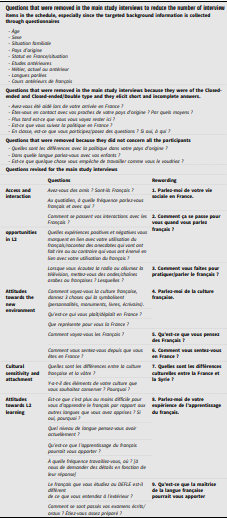
2. All background information questions were removed from the interview schedule. These questions were meant to collect information about the participants and to engage in a warm-up phase before talking about attitudes and opinions. These are no longer needed as part of the main interviews, as the participants are met before to complete other linguistic tasks. This helps to shorten the interview and to make it a more agreeable experience for the participants. Indeed, an hour-long interview in a L2 for language learners can be exhausting. In addition, the other closed-ended questions were also transformed into open questions in the main study. Finally, double questions were simplified so that each question referred to only one type of information and concept. All questions asked in the main study are open-ended and asked in a neutral and flexible way. For instance, to elicit data on ‘Attitudes towards L2 culture’, the question is reworded as follows: Parlez-moi de la culture française. Similar question wording is used in other questions (see Appendix 2) to facilitate talking about attitudes and opinions.
3. The interviewer should not be carried away by the flow of the conversation. As stated by Bell (Reference Bell2005, p. 161): ‘an interview is more than just an interesting conversation. You need certain information and methods have to be devised to obtain that information, if at all possible’. In case the questions are unclear to the participants, clarifications attempts should be anticipated beforehand, not spontaneously formulated. According to Romelaer (Reference Romelaer, Roussel and Wacheux2005, p. 118), ‘la maîtrise des reformulations est un art difficile. D’abord elle impose une capacité d’attention très importante, ensuite, elle exige de savoir intervenir sans introduire de biais dans toute la mesure du possible’. Given these challenges, for each question, several alternative carefully worded reformulations should be prepared and included in the interview schedule. Additionally, a list of prompts should also be prepared for every question to obtain the most relevant answers possible.
4. The interviewer needs to be careful when reacting to the respondents’ answers. Expressing approval should be minimal. Reformulation of answers should neither add extra information to what the informant has said nor should it influence this.
5. The participants’ L1 should not be completely discarded, as questions about feelings and opinions can be difficult to answer with a low L2 proficiency, even if the respondents are able to understand them. Indeed, open-ended questions require learners to engage in independent thinking (e.g. on attitudes) and they are generally not the type of questions that they are used to in university setting (Long and Sato, Reference Long and Sato1983)Footnote 6 nor in administrative formalities. As such, the interview schedule of the main study contains questions in both languages. French L2 is used in the beginning of the interview then questions in Syrian Arabic are asked (e.g., a question on feelings about their life in France).
To sum up, in spite of the available literature on the way interviews should be conducted in general, the existing instructions and guidelines on how to conduct semi-structured interviews lacked precision and examples and were therefore insufficient for us in order to completely achieve our goals at the piloting phase. Additionally, every interview experience is unique because it is conducted with some specific research objectives and a special group of individuals. Also, every interview conducted with a different individual is also unique and presents the interviewer with a new set of challenges. The challenges encountered with the Syrian refugees and asylum seekers are numerous. The interviewer should be well-trained and prepared for all these types of problems and anticipate solutions to them. A good interview is one in which the respondents feel confident, speak freely and feel the need to tackle issues that are of major significance to them. Furthermore, our main objective is to be able to ask clear and completely accessible questions that elicit identical types of information from all respondents, generating a coherent set of on-topic and comparable data across individuals. For this reason, the interview type used in the main study is situated somewhere in between the rigidly structured type and the completely unstructured type of the continuum. Questions need to be open, clear, unambiguous, simply worded and identically asked to all the respondents while at the same time allowing freedom and flexibility to both the interviewer and respondents.
Appendix 1. Pilot study interview schedule

Appendix 2. Interview schedule reviewed*
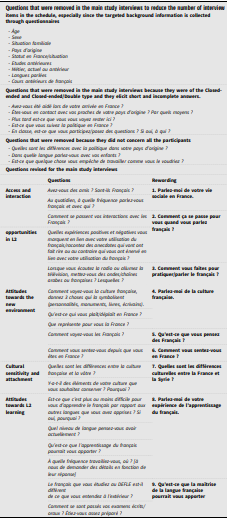
*Only questions of the pilot study interview schedule are discussed here. The additional questions asked (e.g., questions in Syrian Arabic were not included).