To Rubén Lisker Youkowitzky (1929–2015), in memory of his long and fruitful career
1. Introduction
In this paper we examine two different strategies for assessing human genetic variation that have been used to study Mexican populations over the past six decades. We make a distinction between an approach that incorporates multiple disciplinary resources into sampling design and interpretation, from one that privileges pragmatic considerations over more robust multidisciplinary analysis. These choices have consequences for social, demographic, and biomedical practices, and also for accounts of genetic variation in human populations. While the former strategy unpacks fine-grained genetic variation – favoring precision and realism, the latter tends to flatten individual differences and historical depth in lieu of generalization. The three cases we analyze – the work of Rubén Lisker in the 1960s, INMEGEN's mapping of Mexican genomic diversity between 2004 and 2009, and the analysis of Native American variation by Andrés Moreno and his colleagues in contemporary research – reveal evolving meanings of mestizaje (admixture), nation, and health in Mexico as related to research strategies. While previous historical and social anthropological research has examined how social categories such as race, ethnicity, and nation are co-produced with genomic research of Mexican (especially mestizo) populations (Wade et al. Reference Wade, Beltrán, Restrepo and Ventura Santos2014; López Beltrán Reference López Beltrán2013), this essay focuses on sampling procedures, data production techniques and interpretation, rather than on categories, as key elements of research strategies that produce different accounts of human variation.
Mexico is an appealing site of knowledge production regarding human variation. There has been a long held interest – going back to the nineteenth century – in studying the anthropological and medical characteristics of Mexico's varied ethnic groups. The range of methods applied to characterize and classify populations is broad: besides physical anthropological studies centered on craniometric and morphological analyses, physiology and medicine have also played a role. For instance, between 1920 and 1940, foreign expeditions from France and the United States joined local efforts to perform metabolic surveys of indigenous (Otomí and Maya) groups (Vargas-Domínguez Reference Vargas-Domínguez2015). During the first decades of the twentieth century similar investigations took place in a context where non-reproductive eugenics ideas were dominant (Stepan Reference Stepan1991; Saade Reference Saade and Beltran2011). Studies of Mexican populations have, almost invariably, presupposed the dichotomous categorization that classified Mexicans as either indigenous (native) or mestizo (product of the mixture between native groups and Spanish conquistadores) as a methodological orientation (López-Beltrán and García-Deister Reference López-Beltrán and García-Deister2013). This dichotomous presupposition is deeply embedded in nation-building narratives of mestizaje; moreover, throughout the twentieth century this representation of the Mexican population became part of public policies regarding health care, demographic management, and intervention (Urías Horcasitas Reference Urías Horcasitas2007; Suárez-Díaz and Barahona Reference Suárez-Díaz, Barahona, Müller-Ville, Ramsden and Gausemeier2013; Vargas-Domínguez Reference Vargas-Domínguez2015).
Previous analyses have focused on knowledge practices about Mexican populations in two different moments marked by the use of novel techniques: the introduction of gel electrophoresis in the 1960s, and the introduction of large-scale human genomics in the early twenty-first century. Rubén Lisker's research on the genetic hematological traits of Mexican indigenous populations using gel electrophoresis has been analyzed at the intersection of Cold War international health and education programs, and the indigenista policies of the post-Revolutionary regime (Suárez-Díaz Reference Suárez-Díaz2014b). On this account, Lisker's contributions to the genetic knowledge of Amerindian populations emerge among the rich environment characterized by postwar internationalization of science and public health-care programs, and the cultural anthropological infrastructure of indigenista programs in Mexico.
Other authors have examined the creation of Mexico's National Institute for Genomic Medicine (INMEGEN) as a result of the World Health Organization's invitation to apply sequencing technologies to the management of metabolic diseases that affect a large proportion of the Mexican population (López Beltrán, García Deister, and Rios Sandoval Reference López Beltrán, Deister, Sandoval, Wade, Beltran, Eduardo and Santos2014). The project of mapping the genetic diversity of the Mexican mestizo population in order to reduce the cost of public health resonated with the post-Revolutionary expression of mestizo pride. In both cases, the intimate correlation between existing national narratives and policy goals has been shown to result in either relatively disruptive genetic representations of Mexican populations (Lisker's case), or in corroboration of nationalistic narratives of mestizaje and nation (the case of INMEGEN), both of which we explore in more detail in the next section.
The present essay builds upon this previous literature, but it digs deeper into the epistemological commitments that accompany sampling design, choice of technologies, analysis, and interpretation of genetic data. Inspired in Richard Levins’ classical account of “strategies of model building” in population biology, we describe those commitments and choices as “strategies” for studying human genetic variation (Levins Reference Levins1966). As we show in this paper, different research strategies, which we denominate the “unpacking” and the “flattening” approaches, have been at work in different research moments since post-WWII.
In the following sections we introduce the different contexts where these strategies have been put to work. The introduction of new technologies, such as polyacrylamide gel (or zone) electrophoresis in the 1960s, and the algorithms and techniques implemented in genomic studies in twenty-first-century biomedical research, opened new avenues for the examination of human variation in Mexican populations. These technologies have worked as part of disciplinary and social-political ecologies, which we argue define the two general strategies: unpacking and flattening.
We claim that by incorporating multiple epistemological resources, the first strategy is capable of unpacking layers of individual genetic difference. Whereas the use of methods that focus on large continental difference without acknowledging individual variation and historical depth results in a flattening approach. The latter perspective has been frequently used in the social sciences to obtain knowledge about Third World countries. The theory of economic development and its varied programs starting in the 1950s is a good example of a flattening perspective within the social sciences (Escobar Reference Escobar1994; Wang Reference Wang and Dongen2015). It resulted in outstanding programs such as the Green Revolution, which began in Mexico in the 1940s, and was applied in Asian countries after WWII (Cullather Reference Cullather2010) with little consideration of the cultural, economic, and historic differences across all these settings.Footnote 1 As we will argue here, the flattening perspective has also been implemented within the natural sciences. In contrast to it, attention to demographic history and the inclusion of historical narratives of pre- and post-colonial times as epistemological and methodological decisions, is crucial for unpacking human genetic variation.
Though ours is clearly a meta-scientific analysis, it does not pretend to be of the normative kind. Our aim is not to assign differential value to each of the strategies we describe, but rather to identify the epistemological commitments and practical consequences of each. As Levins rightly pointed out fifty years ago, scientists are forced to make pragmatic choices in order to simplify (model) the complexity of population biology (population genetics being one of its main branches); they are forced to achieve “the overlapping but not identical goals of understanding, predicting, and modifying nature” (Levins Reference Levins1966, 422). To that end, he claimed, different strategies of model building have evolved that sacrifice either realism, precision, or generality so as to arrive at legitimate simplifications of natural populations.Footnote 2 Levins, of course, was writing about the construction of mathematical models, whereas we adopt his pragmatic analysis to illuminate a more general type of scientific engagement with the study of human populations. In our case, representations amount to much more than mathematical models, or measurements of genetic frequencies. As we claimed above, the study of Mexican populations has produced and reinforced powerful narratives of race, nation building, and gender. It has also produced data that have informed public polices, both in the context of Cold War health campaigns, and in today's biomedicine. Thus, our goal is to illuminate not only the different accounts of human variation produced by different strategies, but also the impact they have had on biomedical policies and actions, and what they reveal about the evolving meanings of mestizaje, nation, and public health in Mexico.
2. Understanding and Intervening Mexican Populations in Two Different Moments
After the Mexican Revolution (1910-1929), the prevailing indigenista policies that aimed to integrate the indigenous population to the modern “mestizo nation” favored a much more detailed study of, and intervention on, the dozens of native groups inhabiting the national territory. The post-Revolutionary regime (1929-1940) promoted several disciplines whose ultimate purpose was the knowledge and management of human populations. Thus, for instance, cultural anthropology became applied anthropology in the hands of the Mexican governments, which encouraged knowledge of the linguistic genealogy and history of Mexico's diverse ethnic groups. Simultaneously, new methods and technologies from physical anthropology and medicine were implemented to account for the variety of Mexican peoples (Urías Horcasitas Reference Urías Horcasitas2007; Suárez-Díaz Reference Suárez-Díaz2014b).
These multiple disciplinary engagements with indigenous, but also unruly poor mestizo populations of the urban centers, reached a peak between the mid-1940s and the early 1950s, with the creation of different public health care institutions, and the Instituto Nacional Indigenista, whose main explicit goals remained the integration of marginal groups to the modernizing nation, by means of education and health services. These developments have been the subject of detailed historical research, showing the energetic commitment of the period's governments, in a relatively favorable context of economic growth (Urías Horcasitas Reference Urías Horcasitas2007; Stern Reference Stern, Katzew and Deans-Smith2009; Agostini Reference Agostini, Tinajero and Freeman2013; García-Murcia Reference García-Murcia2013; Suárez-Díaz and Barahona Reference Suárez-Díaz, Barahona, Müller-Ville, Ramsden and Gausemeier2013; Vargas-Domínguez Reference Vargas-Domínguez2015).
As Edna Suárez-Díaz (Reference Suárez-Díaz2014b) has claimed, local interest in the study and management of human diversity intersected with the post-World War II emphasis on the study of populations in contradistinction to the previous human typological approach to human races (Maio Reference Maio2007; Lipphardt Reference Lipphardt2012; Gil-Riaño Reference Gil-Riaño2014). To this, we need to add a growing research environment where the growth of experimental biology and biomedicine was largely dependent on epistemological access to the molecular level through new laboratory technologies, especially those that analyzed blood molecules involved in diseases (Kay Reference Kay1993; De Chadarevian and Kamminga Reference De Chadarevian and Kamminga1998; Strasser Reference Strasser2002; Bangham Reference Bangham2014).
Coupled with the indigenista policies and institutions that had been created in Mexico, such interests were now framed within the rising field of theoretical population genetics. New and old technologies were introduced in the study of human populations around the world, and Mexican scientists soon joined the ranks of international collaborations. Especially indigenous populations, which were generally characterized as isolated “inbred”Footnote 3 groups, provided the ideal setting for studies in human populations genetics (Lindee and Ventura Santos Reference Lindee and Ventura Santos2012; Lipphardt Reference Lipphardt2012; de Souza and Ventura Santos Reference de Souza and Ventura Santos2014). Moreover, Cold War anxieties resulted in two broad general concerns that incentivized the study of indigenous populations around the world. On the one hand, the effects of radiation and atomic fallout on human populations required precise measurements of increased rates of mutation, which in turn depended on measurements of basal mutation rates to be found in “primitive” or isolated inbred populations (Ventura Santos Reference Ventura Santos2002; Lipphardt Reference Lipphardt2012; Lindee and Ventura Santos Reference Lindee and Ventura Santos2012; de Souza and Ventura Santos Reference de Souza and Ventura Santos2014; Suárez-Díaz Reference Suárez-Díaz2014b). Questions regarding atomic fallout and its impact on populations, though used as an excuse to obtain funding, did not materialize in Mexican research projects. Nevertheless, it was a driving cause of research in other Latin American populations (de Souza and Ventura Santos Reference de Souza and Ventura Santos2014), and the promotion of networks of human geneticists in the region (Suárez-Díaz Reference Suárez-Díaz2014b).
A second Cold War concern did have consequences for the study of Mexican populations. This was the intervention of national and multilateral agencies in public health programs, especially in the Third World, amongst fears of communism in the rural areas of Asia, Africa, and Latin America. One such program was the Malaria Eradication Campaign, which started in Mexico in 1956 (Cueto Reference Cueto2007).
It is this highly interconnected set of conditions which laid the ground for Rubén Lisker's education as a physician (specialized in hematology and genetics in the United States), and our framing of his research on genetic variation in indigenous populations within the malaria eradication campaign.
Due to geographic proximity between Mexico and the US, and their historically shared populations, epidemics and migration have overrun national borders and imposed a shared public health agenda (Stern Reference Stern, Appelbaum, Macpherson and Rosemblatt2003; Stern Reference Stern, Katzew and Deans-Smith2009; Birn Reference Birn2006; Birn and Necochea López Reference Birn and López2011). The contemporary cases that we analyze emerge at the intersection of new powerful trends in biomedicine and epidemiological transition, that is, the replacement of infectious diseases by chronic conditions (such as high blood pressure, obesity, asthma, or diabetes), and resonate with long-held concerns with public health management on both sides of the Mexico-US border.
The cases we examine in this paper could be analyzed from a history of pharmacogenetics and pharmacogenomics perspective. Historical-sociological analyses in this direction have been important to understand both the geneticization and the racialization of biomedicine mainly in US and UK contexts (Duster Reference Duster2003a; Duster Reference Duster, Goodman, Heath and Lindee2003b; Fullwiley Reference Fullwiley2008; Bliss Reference Bliss2011), as well as the research agendas, industrial structures, and ethical discourses surrounding the promises and expectations of pharmacogenomics (Hedgecoe and Martin Reference Hedgecoe and Martin2003; Fortun Reference Fortun2008), but – as we claimed – they have left the strategies and technologies for studying genetic variation mostly unexamined.Footnote 4 Instead of focusing on the uses of pharmacogenetics and pharmacogenomics previously studied by other authors (Meyer Reference Meyer1990; Kalow Reference Kalow1990; Nebert Reference Nebert1997; Weber Reference Weber2001; Kaplan and Junien Reference Kaplan and Junien2000), we focus on the strategies for assessing the genetic variation upon which such developments are based, in the specific case of Mexico, from the postwar to the present. During a seminar that Andrés Moreno gave at UNAM's Institute for Philosophical Investigations on 19 October 2010, he said: “Step zero is to understand the diversity of the population; step one is to search for gene-disease associations.” As students of science and technology, our step zero is to figure out how scientists’ understanding of human variation is achieved, and how their choice of methods, questions, and tools affects its quantification and qualification.Footnote 5
3. Unpacking Variation in Post-WWII Research
As mentioned above, the intersection of local and international contexts in post-WWII research on human populations provided a complex environment with different kinds of stimulus to investigate genetic variation in Mexican indigenous populations. The education and career of Rubén Lisker (born 1931 in New York, died 2015 in Mexico City) illustrate the shaping forces of mid-century biomedicine and national priorities. His continued exchanges with laboratories and colleagues in the United States were possible thanks to bilateral agreements and national agencies, including the US Public Health Service, the National Science Foundation, and the Ministry of Health in Mexico (Suárez-Díaz Reference Suárez-Díaz2014b).
Lisker benefitted from these exchanges by incorporating the newest technologies and approaches to the study of anthropological and medical genetics. During the first decade after WWII serology and protein chemistry had provided the main ways to access the study of variation within and between human populations (Marks Reference Marks1996; Mazumdar Reference Mazumdar2002; Hagen Reference Hagen2010; Strasser Reference Strasser2010; Suárez-Díaz Reference Suárez-Díaz2014a). But in the early 1960s the development of polyacrylamide gel electrophoresis opened the possibility for inexpensive, easy ways to analyze protein variants in terms of its electric charge and molecular weight (molecular sieving was a contemporary name for this procedure) (Chiang Reference Chiang2009, 513).
The impact of gel electrophoresis (for short) in population genetics cannot be overstated. Michael Dietrich, with others, has called it “the electrophoretic revolution.” By the mid-1960s several research teams in the United States and Europe used gel electrophoresis to produce relevant data for the theoretical debate regarding the amount of variation (polymorphisms) present in natural populations. Gel electrophoresis analysis was simultaneously applied in public health related problems, in particular the detection of blood protein anomalies with consequences for African-American populations in southern United States, and the National Campaign for the Eradication of Malaria in Mexico, beginning in 1956 (Cueto Reference Cueto2007; Suárez-Díaz Reference Suárez-Díaz2014b). The global uses of electrophoresis aligned well with Lisker's local research expectations, and Mexico's public health and indigenous policies. In 1948 the Instituto Nacional Indigenista (INI) had been created, triggering administrative infrastructures (like the first Coordinating Centers in the southern states of Chiapas and Oaxaca), and promoting the study of cultural and social anthropology. Tellingly, Lisker arrived at the question of genetic variation in indigenous populations after the finding of a G6PD (glucose-6-phosphate dehydrogenase) deficiency in a patient at his Mexico City hospital clinic; this group of genetic anomalies could have serious implications in the treatment of malaria (see below).Footnote 6
However, Lisker's strategy for the study of indigenous populations reveals a far more complex picture than one strictly focused on genetic analysis and new technologies. He incorporated disciplinary insights and interpretative tools from outside genetics and medicine that came from the humanities: linguistic and cultural anthropology, and the history of pre-colonial and colonial populations.
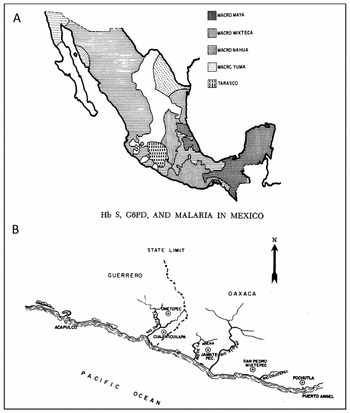
Early on Lisker recognized the importance of an adequate sampling design. As he pointed out often, linguistic classification criteria gave order and meaning to his genetic and serological data. He came across the glotto-chronologic technique developed by Morris (Mauricio) Swadesh in 1959, an American social anthropologist who worked at the National University of Mexico and the Escuela Nacional de Antropología e Historia (Lisker, personal communication with Edna Suárez-Díaz, June 2012).Footnote 7 Though he was convinced of the social historical nature of language's evolution, Swadesh's comparative method assigned lexico-statistical comparative measures, which he carefully curated to eliminate random similarities, thanks to detailed fieldwork and an encyclopedic knowledge of ancient languages. In 1958 he became the first to introduce “computational linguistics” into Latin American research.Footnote 8 With his method, Swadesh was able to classify the nearly 50 languages spoken in Mexico into five major groups: Tarasco, Macro-Mixteca, Macro-Maya, Macro-Nahua (or Macro-Nawa), and Macro-Yuma, whose distribution spans almost all of the Mexican territory. Using Swadesh's classification Lisker designed a sampling strategy that would give meaning to his data: to take blood samples of several representatives of each major linguistic group.
Resulting from his blood-sampling trips (1962-1966), Lisker and his research team published a long series of nineteen papers on the genetic hematological traits of the “Indian Tribes” of Mexico where he approached two different kinds of questions. The first was the distribution of blood-group antigens (Rodríguez et al. Reference Rodríguez, De Rodríguez, Loria and Lisker1963; Cordova, Lisker, and Loria Reference Cordova, Lisker and Loria1967). His results unpacked an unsuspected amount of genetic variation in “Amerindians” who had previously been depicted as a single homogenous population covering from the Navajos in North America, to the peoples of Tierra del Fuego in Arthur Mourant's exhaustive blood groups distribution maps (Mourant Reference Mourant1954; Bangham Reference Bangham2014). Lisker's work provided a fine-grained representation of inter-population genetic variation, and his detailed measurements of genetic and blood group frequencies remained unsurpassed until recently (see next section).
A second kind of question required him to incorporate the use of gel electrophoresis to locate the presence of abnormal hemoglobins and G6PD deficiencies in Mexican populations. This research fit with the international campaign of malaria eradication, a “health intervention” program characteristic of the Cold War.Footnote 9 The eradication program included indoor spraying of DDT and drug treatment with primaquine, a derivative of quinine (Cueto Reference Cueto2007). The problem with this treatment was that primaquine and other artificial antimalarial drugs were known to have a deadly hemorrhagic effect on individuals carrying a certain genetic trait that produced a deficiency of the blood enzyme G6PD. Lisker was aware of Arno Motulsky's reflections on the consequences of applying population genetics to public health:
Since a given gene may be more frequent in certain ethnic groups, any drug reaction that is more frequently observed in a given racial group, when other environmental variables are equal, will usually have a genetic basis. Investigations on drug reactions therefore should include careful notation of the ethnic or racial extraction of the patient. (Motulsky Reference Motulsky1957, 836–37)
Indeed, Motulsky had relied on G6PD deficiency as one of his main examples of the pharmacogenetics approach. Because of its relevance for malaria treatment, by the mid-1960s the various genetic deficiencies associated with this enzyme had caught the attention of the World Health Organization, and of many researchers around the world (Suárez-Díaz Reference Suárez-Díaz2014b). As Lisker stated, the detection of individuals with G6PD deficiency was seen as “a preliminary step before deciding on the desirability of a mass primaquine treatment” (Lisker, Loria, and Cordova Reference Lisker, Loria and Cordova1965). In 1962 Lisker reported that two individuals from the Oaxacan coast (sampled at the indigenista Coordinating Center) had G6PD deficiency. Building upon social anthropologist Gonzalo Aguirre Beltrán's work on the history of slave trading, and the migration of early colonial populations, he concluded that this was “probably explainable by Negro admixture in the past” (Lisker et al. Reference Lisker, Loria, Gonzales-Llaven and Guillermo1962, 78).
The Malaria Eradication Campaign provided him with resources to perform a more extensive survey to test the alternative hypothesis that the enzyme deficiency and the possible presence of hemoglobin S (HbS, responsible for sickle-cell anemia) were the result of natural selection against malaria, as was thought to occur in African populations. So, in a first stage Lisker and his group sampled 1,931 adult males for the enzyme anomaly and the presence of HbS in the Pacific coast (Lisker, Loria, and Cordova Reference Lisker, Loria and Cordova1965; Lisker, Loria, Ibarra, and Sanchez Reference Lisker and Loria1965). They found that hemolytic anemia was not common in Mexican indigenous populations, but again they concluded that the enzyme's deficiency was correlated not with a biological cause (natural selection) but with a historical event: the establishment of African slaves in a town known as Cuijinicuilapa in the southern state of Guerrero, during the sixteenth and seventeenth centuries. Using other blood markers, including some found with higher frequencies in African populations (such as the V antigen), and others of Indo-American origin (such as the Diego group), Lisker and his colleagues estimated “that in Cuijinicuilapa 56 percent of the genes are Negroid” (Lisker, Loria, and Cordova Reference Lisker, Loria and Cordova1965, 185) as calculated by the Berstein formula (1931) used to estimate ancestral genetic contributions to a hybrid population. Lisker's team came to the conclusion that genetic variation was due to ancestry and demographic history, and not to the biological adaptation of indigenous groups to malaria.
This survey of the Pacific coast was followed by more extensive surveys. Using Swadesh's method again, Lisker and his colleagues widened their sampling to 16 different indigenous groups – Nahua, Tarahumara, Yaqui, Tarasco, Mixteco, Mazateco, Zapoteco, Chinanteco, Popoloco, Maya, Tzeltal-Tzoltzil, Chol, Chontal, Totonaco, Huasteco and Mixe (Lisker, Zarate, and Loria Reference Lisker, Zarate and Loria1966). This time, Lisker and his team obtained 2,000 blood samples, and the results again were “indicative of mixture of Mexican Indians or Mestizos with Negroes in this area” (ibid., 826). Later, Lisker's group extended the study to the Mexican Indians living on the east coast; they sampled more than 100 males in five villages in the states of Tabasco, Veracruz, and Campeche. The results concerning HbS and G6PD deficiency ”revealed variable frequencies of the two traits, apparently in relation to different degrees of Negro admixture" (Lisker, Córdova, and Zárate Reference Lisker, Córdova and Zárate1969, 349).
The recognition of African ancestry as constitutive of the Mexican population was not common in the 1960s. Lisker's research had originated under the assumption (embedded in the indigenista policies and infrastructure, but also the ideology of the mestizo nation) that the Mexican population originated in a dichotomous racial structure. The incorporation of historical accounts of early colonial populations (Aguirre Beltrán's works) shaped his overall interpretation of genetic results, and subordinated the role of biological to historical and demographic factors. Lisker's papers provide a rich historical context, where migration from different African tribes and demographic catastrophes during colonial times are responsible for a three-way constitution of Mexican indigenous communities (African, Native American, and Spanish-European). Despite contemporary perceptions, that may trivialize this finding, this has been one of Lisker's major contributions in the study of Mexican populations. Linguistic tools and classifications, and the history of early colonial populations were incorporated in a research strategy that unpacked large amounts of genetic variation between and within Mexican indigenous groups, which in turn provided room for inclusion of African ancestry and challenged the dichotomous composition of the Mexican population (see fig. 1).
A) The five major Mexican linguistic groups, incorporated in Ruben Lisker's sampling method. B) The so-called “Costa Chica,” in the Mexican Pacific Coast; surveys for sickle cell hemoglobin (HbS), G6PD deficiency, and the distribution of malaria were part of Lisker's participation at the “National Campaign for the Eradication of Malaria” (Campaña Nacional de Erradicación del Paludismo) between 1965 and 1966. Modified from Lisker, Zarate, and Loria Reference Lisker, Zarate and Loria1966.

4. Flattening Variation at the Turn of the Twenty-First Century
In 2002 the World Health Organization invited Mexico and other member countries to apply the newly available sequencing technologies and genomic tools to the management of metabolic diseases. Particular attention was given to those that affect a large percentage of the population and generate the highest national public health cost. Like other medical doctors and geneticists, Rubén Lisker was supportive of the idea of applying new technologies to the study of Mexican populations if these were set to benefit their health care, and the project to create an institution devoted to this effort was to be set in motion. Lisker participated in the Consortium for the Creation of the National Institute for Genomic Medicine, which had the backing of other eminent Mexican physicians such as Juan Ramón de la Fuente (former secretariat of health and rector of the National University of Mexico at that time) and Julio Frenk (secretariat of health at that time, and current dean of Harvard's School of Public Health), and corporate figures such as pharmaceutical magnate Antonio López de Silanes.
INMEGEN was created in 2004. Gerardo Jiménez-Sánchez, a young pediatrician-geneticist who had graduated from Johns Hopkins, received Lisker's support – among the majority of the Consortium – to lead the Institute and project. The first results of its main project, the Mexican Genome Diversity Project (MGDP), were published in the Proceedings of the National Academy of Sciences in May 2009 (Silva-Zolezzi et al. Reference Silva-Zolezzi, Hidalgo-Miranda, Estrada-Gil, Carlos, Fernandez-Lopez and Uribe-Figueroa2009). However, by August 2010, Lisker's assessment of INMEGEN's work and results was hardly constructive:
The new results do not contradict what we did years ago with plasmatic proteins, blood groups, and enzymes . . . but this is where the strength of the [2009] publication resides. Molecular biology is enamored with what it is capable of doing – massive genotyping, nuclear markers, and association studies – but it neglects sampling. Sampling is critical. (Personal communication with García-Deister and López-Beltrán, 24 August, 2010)
The MGDP aimed to describe the genetic heterogeneity and the specific genetic characteristics of the Mexican population, and to further explore gene–disease associations (Jimenez-Sanchez, Childs, and Valle Reference Jimenez-Sanchez, Childs and Valle2001). However, in contrast to Lisker's sampling protocols of the 1960s, during the project only two sets of samples were sought: indígenas and mestizos, which represented Amerindian and admixed Amerindian-European populations, respectively.Footnote 10 Mestizos were sampled throughout 2005 and 2006 in the states of Sonora and Zacatecas in the north, Guanajuato in the center, Guerrero and Veracruz in the Pacific and Gulf coasts, and Yucatán in the southeast. Samples from a single Zapotec indigenous group from northern Oaxaca were incorporated into the analysis (upon the request of PNAS reviewers) to serve as a reference point for assessing Amerindian genetic ancestry. INMEGEN's publication sought to establish a basic reference database for Mexican Genomic Medicine by analyzing the genomic variation of Mexican Mestizos. Scientists identified 86 genetic variants (SNPs) exclusive to the Mexican population, that is, variants that are not (or had not, at the time of publication, found to be) shared with other population groups. Admixture analysis of the Mexican Mestizo population confirmed the received historical narrative of Spanish and Indigenous ancestry with marginal African genetic elements in some parts of the country. In this narrative, Spanish men mated with Indigenous women, establishing the main genetic structure of the Mexican mestizo or admixed Mexican, while the African root can be found especially in the states of Guerrero and Veracruz, where slaves had been introduced. Not surprisingly, self-defined Mestizos and Zapotecos were confirmed as genetic Mestizos and Zapotecos, respectively, statistically reiterating those categories.
In each of the six states named above, blood was drawn from self-defined Mestizos aged 18 years or older, and whose family did not have a history of migration for at least two generations. The fact that the definition of the sampling locations was contingent on the political cartography of Mexico (the federal states) raised some methodological concerns. For example, biologist and philosopher of science Fabrizzio Guerrero McManus published a critical opinion piece in the newspaper La Crónica de Hoy, where he asked:
How did the authors infer that these six states are representative of the bulk of the Mexican population? And more particularly, how did they arrive at the idea that 300 students of public universities in six states are good representatives of “LOS MESTIZOS”? . . . Can we believe that 30 modern Zapotecs are representative of our entire indigenous past? Isn't this tacitly assuming that before the arrival of the Spaniards all that was in Mexico was one great homogeneous indigenous population? (Guerrero McManus Reference Guerrero McManus2009)
To preempt this kind of critique, INMEGEN scientists had written, “Even though participants in our study came from regions corresponding to modern political divisions, they represent different demographic dynamics, human settlement patterns, and Amerindian population densities” (Silva-Zolezzi et al. Reference Silva-Zolezzi, Hidalgo-Miranda, Estrada-Gil, Carlos, Fernandez-Lopez and Uribe-Figueroa2009, 86155).
INMEGEN'S sampling strategy retooled a nationalist ideology inherited from the Revolutionary period, which officially represented the national population in terms of either Indian or mestizo (López Beltrán, García Deister, and Ríos Sandoval Reference López Beltrán, Deister, Sandoval, Wade, Beltran, Eduardo and Santos2014). The MGDP quantified the average ancestry of Mexicans as: 53 percent Amerindian, 42 percent European, and 5 percent African. But it claimed that the percentage of European ancestry decreases from north to south, while the coastal populations of Guerrero and Veracruz present the highest percentage of African ancestry. These results, which were branded as the “Map of the Mexican Genome,” also received criticism concerning the methodological nationalism implied in the conflation of population genomics and national identity (López-Beltrán and García-Deister Reference López-Beltrán and García-Deister2013). In the publication, Lisker's bedside book during the 1960s (i.e., Aguirre Beltrán's La población negra de México), and his own work on the genetic structure of the Mexican population, are both cited as confirmation sources of the observed differences in Amerindian, European, and African ancestry across the territory.
More recent assessments (Moreno and Sandoval Reference Moreno and Sandoval2013) of INMEGEN's first results point out that the study was designed only to be able to distinguish between ancestral differences at the continental level, which yields very robust results but has the associated effect of flattening the variation of the sampled population. Differentiation among continental groups is generally higher than any sub-continental difference, so it does not really matter which, specifically, are taken to be the reference ancestral populations, as long as a sample is analyzed for the contribution of three divergent continental groups (ibid. 2013). “If you want to go further and explore sub-continental structure, then inclusion of a more diverse population panel becomes critical” (ibid., 206). As Lisker had predicted, sampling is a crucial process in the adoption and utilization of strategies for assessing human variation.
The flattening of variation was also a direct consequence of INMEGEN's emphasis on studying mestizos. When the mestizo sample population was defined, very specific characteristics were sought in the candidates included in the study; a particular definition of “mestizo” was instrumented that was itself flat. In other words, had INMEGEN's objective been to measure genetic variation within the Mexican population, it would have needed to sample a higher number of different sub-continental populations. On the other hand, their results do establish a base-line to Mexican genomic diversity Footnote 11 and were quite successful at finding what they were looking for. While Lisker's work was a fine-scale assessment of sub-continental variation using pre-genome era techniques, INMEGEN's work was the first genomic – yet low-resolution – survey in Mexico at the continental level.
5. Unpacking Variation in Contemporary Research
In November 2010, Xavier Soberón substituted Gerardo Jiménez-Sánchez as director general of INMEGEN. This change in directorship brought along a change in perspective. If during the early days of INMEGEN, “anthropological questions” were avoided while those with a “strong biomedical focus” were promoted, by 2010 a tension between these two kinds of questions ensued.Footnote 12 “Xavier Soberón had already proved himself as a professor of biomedicine and prominent director of UNAM's Institute of Biotechnology. He used his connections to recruit a number of university researchers from diverse fields (anthropology, medicine, biology) as scientific advisors” (López Beltrán, García Deister, and Rios Sandoval Reference López Beltrán, Deister, Sandoval, Wade, Beltran, Eduardo and Santos2014, 173). Some of these advisors insisted on the relevance of Mexico's demographic history for understanding biomedical traits, which was the main justification for the existence of INMEGEN. This tension became particularly visible during the meetings held in relation to a collaborative project between INMEGEN and Carlos Bustamante's population genetics laboratory at Stanford University's School of Medicine, in which one of us was present. INMEGEN scientists, especially those who had been previously involved in the MGDP, insisted on the need to narrow the focus of the investigations by favoring “biomedical questions.” But Andrés Moreno (a Mexican population geneticist who was a postdoctoral researcher at Stanford at that time) insisted on the relevance of asking “anthropological questions,” of questioning given categorizations of population diversity, and on the need to develop methods to assess regional and individual ancestry variation – all of this in order to arrive at information useful for biomedical purposes. For Moreno, the anthropological and the biomedical questions were necessarily intertwined. This view was a consequence of his training in both medical genetics and human evolutionary genetics, and also of his familiarity with demographic history and the methods of physical anthropology.Footnote 13
Moreno visited Mexico on several occasions between 2010 and 2013, a period during which INMEGEN scientists also traveled to Stanford. Over the time these meetings were held, more and more collaborators – based in Mexico and in the US – of the “Native American Diversity Project” (as Moreno colloquially dubbed it), enrolled. The number of samples reached one thousand, and the number of subpopulations represented in those samples reached thirty-one (twenty indigenous and eleven mestizo populations). This alone marked a stark difference with Silva-Zolezzi et al.’s approach. The paper, titled “The genetics of Mexico recapitulates Native American substructure and affects biomedical traits,” was published in Science in June 2014; forty authors signed it.
The Stanford project made use of local ancestry inference, a set of procedures that aimed to uncover the ancestral genetic background of the genome not only as a whole, but chromosome by chromosome. In Mexicans, the genome was expected to come mostly “from the Native American (NAT) component rather than the European (EUR) or African (AFR) components” (Moreno-Estrada et al. Reference Moreno-Estrada, Gignoux, Fernandez-Lopez, Martin Sikora, Contreras and Acuna-Alonzo2014 supp. mat., 10). These procedures analyze regions of the genome to statistically determine the geographic region of origin of a given genetic variant. In this particular case, ADMIXTUREFootnote 14 (Alexander, Novembre, and Lange Reference Alexander, Novembre and Lange2009) reported three origins as the best explanation for the genomes under study. Furthermore, the NAT component was analyzed in depth to detect the different origins of that part of the genomes using three reference populations: Tepehuanos, Nahuas, and Mayas. To determine the alleged origin of a genotype it is necessary to assume two things: a) that a certain amount of genetic information, including its variations, can be assigned to a particular genetic background, and b) that it is different enough from other backgrounds to make it traceable. The method, thus, allowed a “zooming” effect to interrogate the Native American populations.
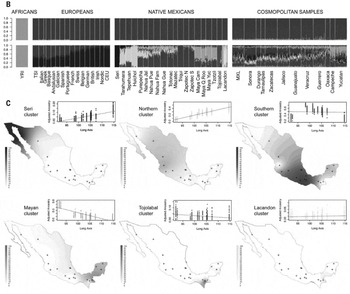
Despite having applied the dichotomous Indian-mestizo categories to differentiate between sample populations (as did researchers before them), the interpretation of results, based on “local ancestry scan” (LAS), meant that Stanford researchers made use of an analytic-interpretative tool that statistically sought to trace the origins of phased genotypes (Moreno-Estrada et al. Reference Moreno-Estrada, Gignoux, Fernandez-Lopez, Martin Sikora, Contreras and Acuna-Alonzo2014).Footnote 15 With Moreno's insistence on looking into the demographic history of Mexican populations, LAS revealed unprecedented genetic variation nationwide, mirroring a complex geographical map of Mexico (see fig. 2).
Parts B and C of figure 2 from (Moreno-Estrada et al. Reference Moreno-Estrada, Gignoux, Fernandez-Lopez, Martin Sikora, Contreras and Acuna-Alonzo2014, 1282), depicting in panel B the . . . Global ancestry proportions at K = 3 (top) and K = 9 (bottom) estimated with ADMIXTURE, including African, European, Native Mexican, and cosmopolitan Mexican samples. . . . Panel C presents the interpolation maps showing the spatial distribution of the six native components identified at K = 9.

The genetic variation of mestizo and indigenous populations was unpacked by means of an analysis of sub-continental ancestry, that is, analysis of the genetic variation within each ancestral (continental) population. For this in-depth inquiry, Moreno and colleagues had developed – in a previous analysis of Caribbean populations – what they called Ancestry Specific Principal Component Analysis (ASPCA),Footnote 16 a tool used to reconstruct the sub-continental origins of Native American, European, and African haplotypes by testing different demographic scenarios (Moreno-Estrada et al. Reference Moreno-Estrada, Gravel, Zakharia, McCauley, Byrnes, Gignoux and Ortiz-Tello2013). This tool – which is extremely sensitive to sub-continental genetic components – allowed an interpretation that took into account the myriad Transatlantic and inter-American migrations that affected Caribbean populations. Thus, in their historical and genetic narrative Native American populations from Central America, Yucatan, and inland Amazonia had migrated across the Caribbean (gene-flow) in pre-Columbian times; followed by at least two “pulses” of African populations, the first one due to the trans-Atlantic slave trade, and a second, more recent one from West-Central Africa, suggesting trans-Atlantic deportation. This is an example of how Moreno and collaborators incorporate demographic history. Clearly, the genetic analysis and interpretation in this case benefited from this knowledge. They claimed to have demonstrated “that the ancestral components in admixed genomes can be traced back to distinct sub-continental source populations with far greater resolution than previously thought” (Moreno-Estrada et al. Reference Moreno-Estrada, Gravel, Zakharia, McCauley, Byrnes, Gignoux and Ortiz-Tello2013, 1).
Following this approach, the Stanford team found “striking genetic stratification among indigenous populations within Mexico at varying degrees of geographic isolation” (Moreno-Estrada et al. Reference Moreno-Estrada, Gignoux, Fernandez-Lopez, Martin Sikora, Contreras and Acuna-Alonzo2014, 1280). This meant that the genetic variation of pre-Columbian populations was recapitulated in the genetic ancestry of modern mestizo individuals. Their results also implied the paradoxical finding that, while Native Americans display the lowest genetic diversity among continental groups, nevertheless there is high divergence among populations, and thus “some groups were as differentiated as Europeans are from East Asians” (ibid.). What is more relevant for our own analysis, though, is the role played by history and archaeology, linguistics and demographic history, in their genetic and statistical analysis. In their study of subcontinental (Native American) variation, for instance, the clades resulting from their statistical analysis of genetic differences divide Mexican populations geographically: a northern, a southern Pacific, and a Mayan branch, with an “Atlantic coastal corridor of gene flow” connecting the Yucatan (Mayan) populations with the central/northern Mexico and, in particular, with the Totonaca that lived in the city of Tajín in the federal state of Veracruz (on the Atlantic coast) during pre-Columbian times. This genetic/geographical map is consistent, the authors claim, with the fact that the only Mayan language out of the Yucatan peninsula is spoken nowadays by the Huastecos living in northern Veracruz. To arrive at this conclusion, the team cited work from Mexican archaeologist Arturo Pascual Soto on the origins of the Tajín civilization, and from Mayan linguistics experts Lyle Campbell and Terrence Kaufman.
In a second type of analysis, Moreno and collaborators also examined patterns of admixture, combining data from native Mexican groups, European populations, West African Yorubas, and from “500 admixed mestizo individuals.” Again, the stratified genetic structure showed six Native American components: three referring to localized populations, and three that recapitulated the broad geographic branches of the first study. Moreno and Sandoval, summarized these findings as follows:
Ancestral differences between individuals are due to continuous variation, and not to a qualitative difference, which questions the categorical distinction between indígena and mestizo . . . The genetic structure of indigenous populations has been transferred and is conserved within the ancestral components of the population we usually refer to as mestiza, to the extent that one is the mirror image of the other. (Moreno and Sandoval Reference Moreno and Sandoval2013, 268)
They outspokenly referred to this study as the “most detailed genomic characterization ever obtained of the Mexican population,” which is not to say that unpacking the genetic variation of the indigenous populations was straightforward.
6. Concluding Remarks
We have provided examples of two different research strategies for assessing human genetic variation in Mexican populations. In Lisker's and in Moreno and collaborators’ work, we identify the strategy of unpacking human variation that involves resources from demographics, linguistics, cultural and physical anthropology, medicine, population genetics, and the social history of migrations. These resources are incorporated into the sampling design, the development of methods to interrogate the data, and their interpretation. Though working fifty years apart both teams were highly responsive to developments outside their field of specialization. Such robust inquiries, however, are not merely anthropological divertimentos: indeed, the promises of pharmacogenomics and personalized medicine, just as those of their predecessor, pharmacogenetics, rely on a detailed and thorough understanding of varying human responses to treatments and disease agents, as well as the functional variations associated with complex diseases.
In the mid-1960s, Lisker's account of the African component of indigenous populations living on the coasts of Mexico provided the rationale for a careful avoidance of certain drugs (primaquine and other synthetic derivatives) in the fight against malaria. Although genomic medicine is still far from achieving what it promised, Moreno et al.'s work indicates a path towards a deeper understanding of human local variation and its importance for public health. Moreno and colleagues turned to Forced Expiratory Volume (FEV1), which is one of several parameters used to evaluate the pulmonary capacity of a given person as a potential indicator of respiratory malfunctions (for example, it may be used to diagnose asthma), and is thought to be related to local ethnic background. Building on the results of two previous genetic studies involving admixed populations in Mexico City and San Francisco, and their respective ASPCA results regarding subcontinental ancestry signals to test for associations with FEV1, this research group detected an association consistent with Native American ancestry. Of the two components of the analysis, only the east-west component (ASPC1) showed an association with FEV1, whereas the ASPC2 component had no association with FEV1. This implies that FEV1 is not correlated with overall admixture proportions, but rather, that “fine-scale patterns of ancestry” (which were made legible via Moreno et al.’s unpacking strategy) “could have significant impacts on clinical measurements of lung function in admixed individuals within Mexico” (Moreno-Estrada et al. Reference Moreno-Estrada, Gignoux, Fernandez-Lopez, Martin Sikora, Contreras and Acuna-Alonzo2014, 1283).
As for comparison between these two applications of the unpacking strategy, Lisker's success in making Mexican human diversity an object of study relevant for biomedicine depended, first, on his systematic application of the chrono-glottological method in his sampling design; and second, on the incorporation of the findings of contemporary cultural anthropology, that emphasized the (then) insufficiently acknowledged presence of African ancestry in coastal populations, for his interpretation of data. In Moreno and colleagues’ approach, the classificatory criteria relied on strictly statistical tools, as is common in contemporary molecular and genomic research (Suárez-Díaz and Anaya-Muñoz Reference Suárez-Díaz and Anaya-Muñoz2008) ascribing probable (geographical) origins to a given subpopulation. However, Moreno's “geographic” approach also relied on knowledge of human migration; that is, linguistics, history, and archaeological data provided epistemic resources that helped in the interpretation of statistical data, and also gave meaning and sense to them.
In contrast, the flattening approach, with its preference for generality, is predicated on a national public health concern with an obese and diabetic population that can be divided into mestizos and indigenous people. It was used to provide a basic map of population substructure that would help differentiate between ancestry and gene-disease association in future studies. Recent genomic studies that have explored the correlation of Native American ancestry and predisposition to diabetes (Williams et al. Reference Williams, Jacobs, Moreno-Macías, Huerta-Chagoya, Churchhouse, Márquez-Luna and García-Ortíz2013) are extensions of this approach and lend support to the idea of Mexicans as a diseased population due to the legacy of admixture (García-Deister and López-Beltrán Reference García-Deister and López-Beltrán2015). This strategy renders the founding myth of the Mexican nation legible through the lens of genomics (via quantification of Native American, European, and African ancestry in mestizo genomes), and contrasts with the kind of genetic storytelling that is achieved via unpacking strategies. For (Moreno and Sandoval Reference Moreno and Sandoval2013),
The variation in ancestry proportions between individuals are the result of a clinal pattern, rather than discrete differences, which questions the categorical distinction between indigenous and the so-called mestizos. Membership and self-identification must follow social and cultural criteria, but not genetic ones. Thus the use of such dichotomous terminology, which has historically reinforced social segregation between indigenous and mestizo, lacks genetic support; reassuring that genes do not support the social differences created among human population groups. (Moreno and Sandoval Reference Moreno and Sandoval2013, 249)
The interrogation of human genetic variation may proceed in distinctive ways, according to pragmatic, and methodological decisions. Research strategies define different paths, inputs, and outcomes, as illustrated in studies of Mexican populations in the three cases we described. Scientists’ choices, however, have consequences not just for accounts of genetic variation in human populations, but on social, demographic, and biomedical practices as well.
Acknowledgments
This paper was made possible by the generous support of UNAM-PAPIIT research project IA401416 and DAAD-PROALMEX (CONACyT) grant 242618. Fieldwork carried out between 2010 and 2013 was funded by the ESRC of the United Kingdom (grant RES-062-23-1914). We would like to thank the late Rubén Lisker, and also Andrés Moreno and Karla Sandoval for making time in their busy schedules to have meaningful conversations with us; and two anonymous referees for insightful comments that helped to improve the manuscript.