INTRODUCTION
Although the intensity-modulated radiotherapy (IMRT) was the breakthrough in the capabilities of toxicity reduction, some of paediatric radiotherapists still have been afraid of employing this method in young patients because of the large low dose region and therefore potential increase in the incidence of radio-induced second tumours.Reference Hall and Wuu1 Recently, there has been the strong interest in the arc-based therapies in attempt to overcome some of the limitations associated with the fixed field IMRT.Reference Palma, Verbakel, Otto and Senan2, Reference Teoh, Clark, Wood, Whitaker and Nisbet3 The volumetric modulated arc therapy (VMAT) has gained popularity because of its ability to improve the target coverage, to reduce normal tissue doses and monitor units (MU) usage. The major advantage over the IMRT is also shortening the time of treatment which is especially beneficial for children requiring anaesthesia. It is also important for other patients due to the increase of comfort in their treatment and the reduction of errors resulting from an intrafraction motion.Reference Teoh, Clark, Wood, Whitaker and Nisbet3–Reference Shaffer, Nichol and Vollans7
Focusing on the VMAT adaptation in children, we tried to conclude which young patients may benefit the most from this new modality. The main aim of this study was to discuss the current usage of VMAT in children, review the available data and try to specify recommendations. Based on the our own experience we presented case studies for selected clinical applications in which VMAT had a substantial benefit.
MATERIALS AND METHODS
In our Radiotherapy Department VMAT was introduced in 2011. Till the end of 2013, 44 children with neoplasms were irradiated using this method. There were 20 patients with brain tumour, eight with sarcoma, five with acute lymphoblastic leukemia irradiated for the total body before stem cell transplantation, six with Wilms tumour, three with neuroblastoma, one with parotid cancer and one with nasopharyngeal cancer.
Case studies of four selected patients as representative examples were presented to demonstrate the advantage of VMAT over the 3D conformal radiotherapy (3DCRT). These were the complex cases for which the standard 3D plans used previously in our department were often unsatisfactory. More details of the patients are described below.
Patient 1
A 6-year-old patient with relapsed anaplastic oligoastrocytoma localised in the region of the brain lateral ventricles was eligible for the reirradiation to the total dose of 40 Gy in 20 fractions. In 2010, the child was treated due to the primary tumour in the frontal lobe using surgery, chemotherapy and radiotherapy to the tumour bed (54 Gy/30 fractions). The most important goal of the reirradiation plan was to limit the high dose area, especially in the region previously irradiated due to the risk of fatal brain necrosis.
Patient 2
A 6-year-old patient with high-grade glioma localised in the medial part of the right temporal lobe after the tumour resection was eligible for the tumour bed irradiation to the total dose of 54 Gy in 30 fractions. In the postoperative magnetic resonance imaging there was the area in the vicinity of the brainstem with suspicion of residual lesion. We decided to increase the total dose up to 58 Gy in this region using simultaneous boost method (SIB).
For the above patients with brain tumour the comparison of single arc, double arc and noncoplanar arcs configuration was made to show the difference in the dose received by normal brain tissue (VNB) and the planning target volume (PTV) coverage. We evaluated the brain volume which received 95% of prescribed dose (VNB 95%) and the moderate dose of 25 Gy (VNB 25 Gy).
Patient 3
A 3·5-year-old patient with Wilms tumour of the right kidney after the preoperative chemotherapy and the right nephrectomy during which the tumour rupture was found, was eligible for the whole peritoneal cavity irradiation to the dose of 19·5 Gy in 13 fractions. The main constraint of this therapy was the left kidney protection.
Patient 4
A 6-year-old patient with rhabdomyosarcoma embryonale in parapharyngeal region with residual lesion after chemotherapy was eligible for the irradiation using the SIB technique with two-dose levels. The first clinical target volume (CTV1) was defined as the region harboring the primary tumour and pathological cervical lymphatic region. CTV2 was the post chemotherapy residual lesion. Prescribed dose was of 50·4 Gy to the CTV1 and 54 Gy to the CTV2 in 28 fractions.
Evaluation of treatment plans
A retrospective 3DCRT plans were created and compared with VMAT treatments plans. The 3DCRT plans were generated on the Oncentra MasterPlan treatment-planning system which uses Collapsed Cone Enhanced algorithm for dose calculation. The VMAT plans were generated on the Monaco treatment-planning system which uses Monte Carlo dose calculation algorithm. These plans were designed for Elekta Synergy accelerator using 6 MV photons for VMAT and 4, 6 and 15 MV photons for 3DCRT.
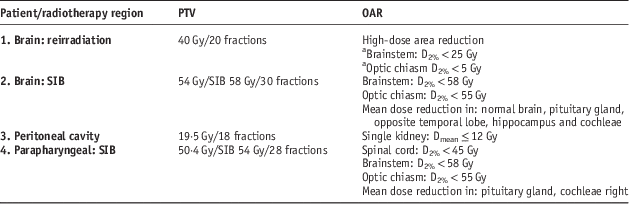
The objectives of the irradiation planning are presented in Table 1.
The objectives of the radiotherapy planning

Notes: a The dose was limited because of the primary irradiation.
Abbreviations: PTV, planning target volume; OAR, oragns at risk; SIB, simultaneous boost method.
For each plan the dose volume histograms for PTV and organs at risk (OAR) were computed. To compare the PTV coverage, the homogeneity index (HI) and the conformity index (CI) were evaluated.
The dose homogeneity was computed according to the equation:  $${\rm HI=}{{{\rm D}_{{{\rm 2\,\%\,}}} {\rm {\minus}D}_{{{\rm 98\,\%\,}}} } \over {{\rm D}_{{\rm p}} }}$$
, where D2% was the near maximum dose, D98% the near minimum dose, Dp the prescribed dose. In SIB plans it was calculated for the boost area. The conformity index was computed according to the equation:
 $${\rm CI}={{V_{{{\rm ref}}} } \over {V_{{\rm T}} }}$$
, where V ref was the volume receiving a dose equal to or greater than the reference dose, V T the target volume. To assess the degree of plan’s conformity more accurately, especially for situations when V ref and V T are similar but not spatially overlapped, the conformation number (CN) was estimated. This parameter was defined by Van't Riet et al. as:
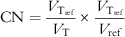 $${\rm CN}={{V_{{{\rm T}_{{{\rm ref}}} }} } \over {V_{{\rm T}} }}{\times}{{V_{{{\rm T}_{{{\rm ref}}} }} } \over {V_{{{\rm ref}}} }}$$
, where
 $$V_{{{\rm T}_{{{\rm ref}}} }} $$
was the volume of target receiving a dose equal to or greater than the reference dose, V T the target volume and V ref the volume receiving a dose equal to or greater than the reference dose.Reference Van't Riet, Mak, Moerland, Elders and van der Zee8 For a better understanding of the differences between 3DCRT and VMAT we also analysed the target volume covered by 95% of prescribed dose (PTV95%), the normal tissue volume covered by 95% of prescribed dose (VNT95%) and the tissue volume receiving the moderate dose of 25 Gy (V25Gy) and low dose of 5 Gy (V5Gy).
For 3DCRT and VMAT plans, the calculated number of MUs and the time used to deliver the single irradiation fraction were compared. The irradiation time was measured from the beginning to the completion of the single fraction delivery. The 3DCRT plans were delivered with a maximum dose rate of 450–500 MU/minute, for VMAT the dose rate did not exceed 250 MU/minute.
Results
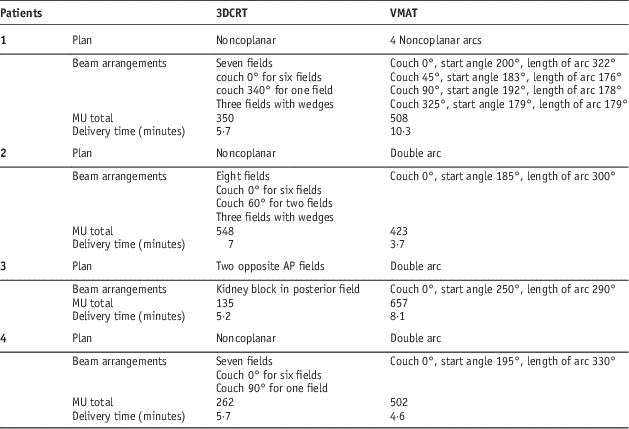
The details of individual plans, MU number and delivery time for single fraction were shown in Table 2
Plans characteristics
Abbreviations: 3DCRT, 3D conformal therapy; VMAT, volumetric modulated arc therapy; MU, monitor unit.
To obtain the 3DCRT plan that complies with the PTV coverage and OAR constraints criteria, the noncoplanar beam arrangement was used in three cases. This was the key cause of the treatment time extension which was longer than in VMAT plan for two patients. In one case also MU amount was greater for 3DCRT plan.
The detailed analysis and comparison for all plans is presented in Table 3.
The detailed analysis for 3DCRT and VMAT plans

Abbreviations: 3DCRT, 3D conformal therapy; VMAT, volumetric modulated arc therapy; HI, homogeneity index; CI, conformity index; PTV, planning target volume; NT, normal tissue; V25Gy, volume receiving the moderate dose of 25 Gy; NA, not applicable.
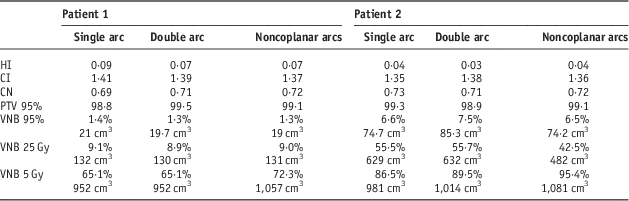
For patient no. 1 VMAT with four noncoplanar arcs configuration was used. The PTV coverage and conformity parameters were better for this plan compared with 3DCRT, but both methods achieved the 95% isodose coverage to at least 98% of the PTV. The main disadvantage of the conformal 3D plan was much greater volume of normal tissue covered by 95% isodose (52 versus 19 cm3) which resulted in significant CI and CN deterioration (CI: 1·37 versus 2·02 and CN: 0·72 versus 0·48, respectively). Comparing the noncoplanar beam configuration to the single arc and double arc, the conformity parameters were slightly improved. Additionally, the noncoplanar arcs achieved a bit smaller normal brain volume covered by the 95% isodose which amounted 19·0 versus 19·7 cm3 for double arc and 21·0 cm3 for single arc. The OAR constraints were complied in all plans. All other parameters are presented in Table 4.
VMAT conformity parameters for three different arcs configuration in patients with brain tumour
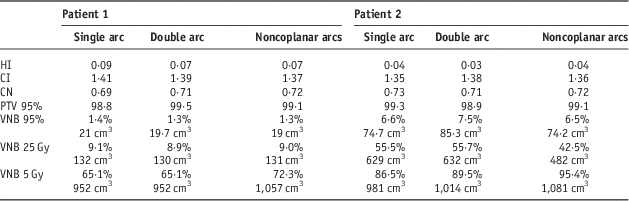
Abbreviations: VMAT, volumetric modulated arc therapy; HI, homogeneity index; CI, conformity index; CN, conformation number; PTV, planning target volume; VNB, normal brain volume.
VMAT with double arc was applied for patient no. 2. The PTV coverage, conformity and homogeneity parameters were slightly better in this plan compared with 3DCRT. The shorter irradiation time and fewer MUs used in single fraction delivery were the additional advantages. Comparing the three VMAT arcs configurations, the significant difference in the conformity and homogeneity parameters has not been demonstrated. The noncoplanar arcs plan resulted in the reduction of the normal brain volume receiving the moderate dose (Table 4). This plan was the most beneficial in the OAR sparing. The opposite structures: the left temporal lobe, hippocampus and cochleae obtained significantly lower mean doses, respectively: 20·9, 26·7, 18·8 versus 28·4–32·4, 39·9–42·2 and 30·7–33·2 Gy for remaining plans. The maximum dose for the centrally located structures such as the optic chiasm and brainstem as well as the mean dose for the pituitary gland were almost equivalent. It is presented in Figure 1.
The OAR doses for the patient 2.
For patient no. 3, VMAT with double arc was applied. In this case mainly the conformity and homogeneity parameters were evaluated. Almost all scanned tissues were in the full prescribed dose. The right kidney received the mean dose of 12 Gy in the both plans. In this case, the 3DCRT plan was unsatisfactory due to worse target volume covering. The PTV95% amounted 88% for 3DCRT versus 99% for VMAT.
For patient no. 4, VMAT with double arc was used. The rotational technique was beneficial comparing the PTV coverage (98·7 versus 90·7% for 3DCRT). Treatment time with 1·8 Gy fraction was 4·6 minutes for VMAT versus 5·7 minutes for 3D plan. The mean MU was 502 and 262, respectively. In VMAT, larger tissue volume received high and moderate dose, contrary to the low-dose volume which was smaller. Except the right cochleae which received about 15 Gy lower dose in arc plan, the difference in the OAR sparing was insignificant (Figure 2).
OAR doses characteristics for the patient 4.
Summarising, for all presented cases the PTV coverage was improved for VMAT plans compared with 3DCRT. In patients irradiated for the whole peritoneal cavity and for the pharyngeal region, 3D plans were unacceptable due to the insufficient target volume coverage. For patients with brain tumour, VMAT was also the method of choice because of higher conformity and better OAR as well as normal tissue protection. Planning with double or noncoplanar arcs slightly improved plan quality compared with single arc.
DISCUSSION
The significant advance in the irradiation delivery has been mainly driven by the need to reduce the dose to normal tissue and thereby decrease the risk of toxicity. Besides the obvious advantages of IMRT, this method still raises some concerns due to the use of large number of MU and the increase of the low dose area.Reference Hall and Wuu1 Most authors highlighted that VMAT modality through the reduction in the treatment time and MUs could be the best option in paediatric patients due to the possibility of anaesthesia time shortening and decreasing of secondary malignancies risk.Reference Matuszak, Yan, Grills and Martinez4–Reference Shaffer, Nichol and Vollans7
We presented four selected paediatric neoplasms in which VMAT had the clear advantage compared with the standard 3D conformal techniques. These cases were: brain tumour reirradiation, high-grade glioma located in close vicinity of the brainstem, whole peritoneal cavity irradiation in Wilms tumour and rhabdomyosarcoma in parapharyngeal region.
There is little data about clinical application of VMAT in children with neoplasms. Matuszak et al., presented the paediatric case with recurrent rhabdomyosarcoma to compare IMRT and VMAT plans. The dosimetric quality was similar in these plans, but the total MU and time required for delivery were reduced by 24 and 78%, respectively.Reference Matuszak, Yan, Grills and Martinez4 The similar advantages in the treatment time and the MU amount were found in the application of the intensity-modulated arc therapy in children with retroperitoneal tumours. Shaffer et al., in their comparison stated that the intensity-modulated techniques allowed for the conformity increase and reduction of the dose for the liver. The treatment time was the shortest in VMAT compared with the remaining techniques. Likewise, the significant MU number reduction was obtained.Reference Shaffer, Vollans, Vellani, Welsh, Moiseenko and Goddard6 This observation was not confirmed in our evaluation but all VMAT plans were delivered using double or noncoplanar multi arcs configuration which was the cause of the considerable time and MU increase.
Wagner et al. recommended the 3D conformal radiotherapy over the intensity-modulated techniques for paediatric patients with brain tumours guided by their calculations of the low dose region which was larger in IMRT methods than for 3DCRT.Reference Wagner, Christiansen, Wolff and Vorwerk9 It seems that the minimal difference in the low-dose volume should not justify this recommendation, especially if the target coverage was noticeably worse for the 3DCRT technique. In our analysis the low-dose volume was slightly greater for all 3DCRT plans. The noncoplanar fields arrangement was the main cause of this issue.
Beltran et al., in the study about the intensity-modulated arc therapy for paediatric posterior fossa tumours highlighted that the conformity should be the priority in paediatric patients because of the most serious toxicity like necrosis or second neoplasms occurring predominately in high-dose region.Reference Beltran, Gray and Merchant5 As stated in the main reviews, most of the secondary tumours emerge close to the irradiated fields.Reference Galloway, Indelicato, Amdur, Morris, Swanson and Marcus10–Reference Pettorini, Park, Caldarelli, Massimi, Tamburrini and Di Rocco12 Diallo et al., in the cohort of 115 second tumours, found 12% of them in the central area of the irradiated volume, 66% in the beam-bordering region.Reference Diallo, Haddy and Adjadj11 In the Galloway analysis, the dose to the second tumour site was usually in the range from 20 to 36 Gy.Reference Galloway, Indelicato, Amdur, Morris, Swanson and Marcus10 The others late effects connected with cognition, endocrine function and hearing are also the result of the high-dose application.Reference Merchant, Conklin, Wu, Lustig and Xiong13 Beltran et al., recommended the double noncoplanar IMAT, especially when critical structures are in the proximity of the PTV due to better conformity of the high-dose volume.Reference Beltran, Gray and Merchant5 This evaluation is in accordance with our observations. The noncoplanar VMAT was the most beneficial in the limitation of the high- and moderate-dose volume. For patient no. 1, the volume of normal brain covered by the 95% of prescribed dose was reduced by 10% in the noncoplanar plan compared with single arc. In patient no. 2, this high-dose volume reduction was smaller, but the volume of normal brain obtained at least 25 Gy was reduced by 24%, and additionally more favourable OAR protection was received. The critical structures localised oppositely to the target volume obtained the mean dose reduced by average 34% for hippocampus, 35% for temporal lobe and 40·5% for cochleae compared with double and single arc. It seems that VMAT, especially with noncoplanar arcs arrangement could be the method of choice in the reirradiated patients and in these with brain tumours localised laterally to the critical structures. For remaining centrally located neoplasms, the single or double arc could be the preferred VMAT option mainly due to the shorter treatment time and the MU number reduction.
Qi et al., formulated similar conclusions in the comparison study in children with germinoma. VMAT was compared with 3D conformal radiotherapy in the whole-ventricular radiation. The arc therapy provided increased conformity and reduced dose to normal tissue. Additionally, authors used the IQ modelling to show the potential benefit of the decreased dose to the temporal lobes. The difference in IQ scores between VMAT and 3DCRT was ~6 points.Reference Qi, Stinauer, Rogers, Madden, Wilkening and Liu14 One can expect that this will have an impact on academic, social and employment functioning for these children.
In the complex-shaped target volume, for example, in patients irradiated for the whole peritoneal cavity or with head and neck tumours, the previously used 3D techniques produced the insufficient PTV coverage. VMAT presented the conformity improvement and better OAR protection. It seems that the majority of these patients could benefit from the arc therapy. Nowadays in our department, only for whole brain irradiation and limb sarcomas no advantages of VMAT technique were observed.
One of the most interesting and difficult radiotherapy technique is the total marrow irradiation (TMI) before stem cell transplantation.Reference Fogliata, Cozzi and Clivio15, Reference Aydogan, Yeginer, Kavak, Fan, Radosevich and Gwe-Ya16 Because of the complexity of VMAT usage in TMI, the description of this method will be the subject of another publication.
CONCLUSIONS
VMAT is the new radiation technology which has the clear superiority over the conventional conformal methods with regard to the improvement in the dose conformity and normal tissue sparing. The noncoplanar arcs arrangement is beneficial in the decrease of the high-dose volume and OAR protection, particularly the opposed structures in the laterally located brain tumours. This should be the method of choice in the reirradiated patients. There is the evidence to show that VMAT has a definite place in the paediatric radiotherapy. This method may be considered as the alternative to proton therapy. However, the longer follow-up will be required to quantify the risk of late toxicity.
Acknowledgements
None.
Financial Support
This research received no specific grand from any funding agency, commercial or not-for-profit sectors.
Conflicts of Interest
None.