Introduction
Reconciling human development and biodiversity conservation is one of the most urgent and largely unresolved challenges of the Anthropocene (e.g., Tucker et al. Reference Tucker, Böhning-Gaese, Fagan, Fryxell, Van Moorter and Alberts2018, Lindsey et al. Reference Lindsey, Anderson, Dickman, Gandiwa, Harper and Morakinyo2022). At a global scale, more than 1 million species are effectively threatened, directly and indirectly, by human activities (IPBES Reference Brondizio, Settele, Díaz and Ngo2019), associated with rapid human population growth and demands for resources, agricultural expansion, infrastructural development and more (Tilman et al. Reference Tilman, Clark, Williams, Kimmel, Polasky and Packer2017). Small-holder agriculture has a relatively large impact on deforestation and biodiversity loss in human-dominated landscapes (Millennium Ecosystem Assessment 2005, Perrings & Halkos Reference Perrings and Halkos2015), with large mammals being particularly at risk (Cardillo et al. Reference Cardillo, Mace, Jones, Bielby, Bininda-Emonds and Sechrest2005). However, wildlife holds significant cultural heritage value not only for local people, but also for people across the world (Macdonald et al. Reference Macdonald, Burnham, Hinks, Dickman, Malhi and Macdonald2015).
The West African giraffe (Giraffa camelopardalis peralta) was historically spread across much of the Sudano-Sahelian zone but is now restricted to Niger (Suraud et al. Reference Suraud, Fennessy, Bonnaud, Issa, Fritz and Gaillard2012, Brown et al. Reference Brown, Kulkarni, Ferguson, Fennessy, Muneza, Stabach, Fennessy, DellaSala and Goldstein2021). Several threats related to human population growth, including poaching, habitat loss and fragmentation, caused its dramatic decline during the later twentieth century (Fennessy et al. Reference Fennessy, Marais and Tutchings2018). In 1996, only 49 individuals remained, concentrated in the ‘Giraffe Zone’ (GZ) – a community area commencing c. 60 km from the capital, Niamey (Ciofolo Reference Ciofolo1998, Le Pendu & Ciofolo Reference Le Pendu and Ciofolo1999). From the mid-1990s, the giraffe population rebounded from the brink of extinction following targeted conservation efforts (Suraud et al. Reference Suraud, Fennessy, Bonnaud, Issa, Fritz and Gaillard2012, Fennessy et al. Reference Fennessy, Bidon, Reuss, Kumar, Elkan and Nilsson2016, Reference Fennessy, Marais and Tutchings2018).
The Government of Niger, with the support of local communities and local and international non-governmental organizations (NGOs), undertook concerted efforts to establish development-linked livelihoods and awareness programmes throughout the GZ whilst fighting against giraffe poaching. Three targeted initiatives were the Projet d’Utilisation des Ressources Naturelles de Kouré et du Dallol Bosso nord (PURNKO, ‘Use of the Natural Resources of Kouré and Northern Dallol Bosso Project’) and two giraffe-centred local associations working directly with communities on a range of activities including micro-financing, water provision, habitat restoration, environmental education and ecotourism: the Association to Safeguard Giraffe of Niger (ASGN) and the Association pour la Valorisation de l’Ecotourisme au Niger (AVEN; ‘Association for the Valorisation of Ecotourism in Niger’; Fennessy et al. Reference Fennessy, Marais and Tutchings2018).
Local development and humanitarian assistance have been critical to the positive coexistence of local communities with giraffe. Such coexistence assumes willingness to share the land and natural resources with the animal for the sake of both humans and wildlife (Pooley Reference Pooley2021).
In 2018, the first ever reintroduction of West African giraffe in Niger was undertaken by the Giraffe Conservation Foundation, the Government of Niger and partners supporting the implementation of the country’s National Giraffe Conservation Strategy. Eight giraffe were reintroduced from the GZ into their former habitat in Gadabedji Biosphere Reserve (GBR; Gašparová et al. Reference Gašparová, Fennessy, Rabeil, Zabeirou and Brandlová2018). The first ever International Union for Conservation of Nature (IUCN) Red Listing of the West African giraffe resulted in it being categorised as Endangered (in 2008). Today, the population is estimated at c. 600 individuals (Brown et al. Reference Brown, Kulkarni, Ferguson, Fennessy, Muneza, Stabach, Fennessy, DellaSala and Goldstein2021). In 2018, the West African giraffe was downlisted to Vulnerable on the IUCN Red List (Fennessy et al. Reference Fennessy, Marais and Tutchings2018).
The increasing populations of both humans and giraffe have exacerbated human–giraffe conflict in the GZ (Leroy et al. Reference Leroy, De Visscher, Halidou and Boureima2009, Ministry of Environment 2015), fuelled by damage inflicted on subsistence farmers, especially their cowpea crops (Vigna unguiculata) and mango trees (Mangifera indica; Laboureau Reference Laboureau1997, Luxereau Reference Luxereau2004, ASGN 2018, Rabeil et al. Reference Rabeil, Zabeirou, Pourchier, Abbagana, Sanoussi and Sahailou2019). In response to such damage, some local community members have threatened and/or killed giraffe (ASGN 2018, Rabeil et al. Reference Rabeil, Zabeirou, Pourchier, Abbagana, Sanoussi and Sahailou2019, ARM Zabeirou pers. comm. 2022). Many farmers have fenced their mango trees, but their fields are too large to protect all of the trees, and giraffe prefer to forage from trees that are located within and around these fields (Suraud Reference Suraud2011). Despite a seemingly high tolerance towards giraffe, such conflict will probably continue to increase as both populations grow and competition for limited resources increases. This may shape the future perceptions and attitudes of the local people towards giraffe conservation efforts (Ruppert et al. Reference Ruppert, Sponarski, Masiaine, Larpei, Lekushan and Lenaipa2022). As such, it is crucial to understand the current situation and assess changes over time as to whether the benefits of living with giraffe outweigh the costs of coexistence.
In this study, we aimed to: (1) describe the current situation of the West African giraffe in a human-dominated landscape; (2) assess local people’s attitudes and perceptions towards giraffe; and (3) understand local people’s habits and practices of natural resource use in the GZ and GBR to inform the development of beneficial human–giraffe relationships in both areas.
Methods
Study area
The GZ lies in a transition area of the W Park Biosphere Reserve; however, it is not officially delimited, nor is it a formally protected area. It is spread across the central plateaus of Kouré and North Dallol Bosso, commencing c. 60 km south-east of the capital, Niamey. The human population of Niger is estimated to be c. 23 million people from several ethnic groups: Hausa (>50%), Zarma (21%), Touareg (11%), Fulani (6.5%) and other minorities (Fuglestad & Diouldé Reference Fuglestad and Diouldé2021). People from three of these ethnic groups live in the GZ for at least some of the year. In the rainy season (June–September), farmers from the sedentary Zarma ethnic group practise extensive subsistence farming of cereal crops such as millet, sorghum, beans and corn (Ciofolo Reference Ciofolo1995). Herders from the Fulani and Touareg ethnic groups live in isolated encampments and move across the plateaus with their livestock (Ciofolo Reference Ciofolo1995).
As the only formally protected area in the Nigerien Sahelian zone, GBR lies in the Sahelian grasslands of central Niger and has been legally protected as a Forêt classée et reserve de faune (a forest reserve and faunal reserve) since 1965 (Simonet Reference Simonet2018). Since 1992, dry season (October–April) grazing by local communities within GBR has been permitted under the agreement between the Directorate of National Parks and Reserves (DPN/R) and the Chefs de Groupement (regional authorities working in GBR; Wacher Reference Wacher2010). However, camping, grazing at night, cutting of trees to feed livestock and hunting are forbidden, although this is not always strictly complied with (Wacher Reference Wacher2010). The local Touareg and Fulani people living around GBR are nomadic, whilst the south is settled by Hausa, who practise agriculture and livestock husbandry (UNESCO 2020).
Data collection
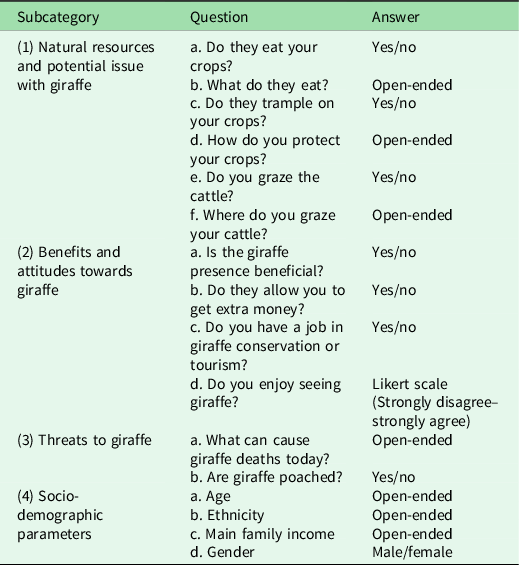
In July 2020, face-to-face questionnaire surveys were undertaken in both the GZ and GBR study sites (Appendix S1). The survey was conducted by one of the co-authors (ARAM), who is local and with whom the respondents felt more confident. Prior to any interview, the research was explained to the authorities of each village, and they were asked for permission to conduct the survey. The questionnaires were prepared in French whilst the questions were asked in a local language (Zarma or Hausa). The answers were recorded in French and later translated into English. The questionnaires were divided into four subcategories, each with a series of questions (ranging from two to six) and answer opportunities (dichotomous, five-point Likert-type scale or open-ended; see Table 1 for exact wording and coding).
Examples of the questions asked divided into subcategory and answer type.

Data analysis
Data were entered into an Excel file and prepared for analysis by classifying and manually coding the responses so they could be processed by R software (R Core Team 2021). We reduced the original dataset as not all variables were relevant for the multivariate analysis. We then analysed response variability among the respondents through a multiple correspondence analysis (MCA) using the FactoMineR package (Lê et al. Reference Lê, Josse and Husson2008) that allows qualitative datasets with many categorical variables to be processed and provides robust results when the number of interviewees exceeds 100 (Pagès Reference Pagès2014). A first MCA was computed based on 19 active variables and 8 supplementary variables (see Table S1), which allowed us to identify 14 outliers. Because of the sensitivity of MCAs to outliers, these were removed from the dataset, and we processed a second MCA by using 17 active variables because 2 of the 19 active variables showed no variability after the outliers’ removal. For the attitude-related questions, we used Cronbach’s α to measure the internal reliability of the responses (Tavakol & Dennick Reference Tavakol and Dennick2011). One of the questions – ‘I would be happier if there was no giraffe in the area’ – was removed as it lowered the consistency among the variables (see Table S2). Pearson’s χ2 tests were used to analyse the correlations between couples of variables in IBM SPSS Statistics for Windows, version 27 (IBM Corp., Armonk, NY, USA).
Results
Respondents’ socio-demographic profiles
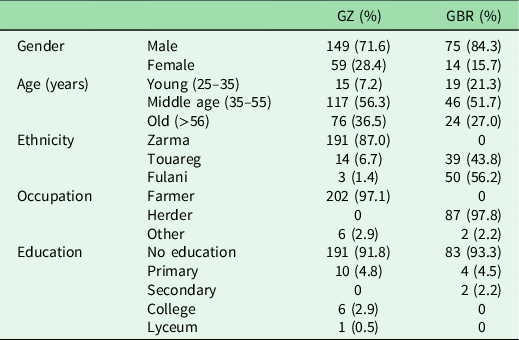
Of the 297 respondents (208 in the GZ and 89 in GBR), the majority were male (75.4%; Table 2). Most respondents were middle-aged (54.9%), followed by older adults (33.7%) and young adults (11.4%; Table 2). Three ethnicities were represented: (1) Zarma (64.3%), (2) Touareg (17.1%) and (3) Fulani (17.1%). Most respondents were farmers (68%), 29.3% were herders and other occupations were minor (2.7%). Family income mainly came from agriculture (41.1%) and pastoralism (23.6%), followed by trade (15.2%), income from families living in urban zones (7.7%) and other incomes including undeclared incomes (12.5%). The majority (92.3%) of respondents did not have any education, 4.7% had only primary school education and <3.0% had attended tertiary education (Table 2).
Summary of the socio-demographic parameters of the respondents in the surveys from both study sites, including total count and percentages.

GBR = Gadabedji Biosphere Reserve; GZ = ‘Giraffe Zone’.
People’s use of natural resources
Respondents’ gathering and use of natural resources were focused on subsistence crop farming (100% in the GZ and 7.9% in GBR), cattle grazing (63.5% in the GZ and 100% in GBR) and fuelwood harvesting (86.5% in the GZ and 91.0% in GBR). In GBR, 96.6% of respondents claimed that they grazed cattle in the Reserve and only during the determined period (dry season; 98.8%). A minority grazed cattle outside of the Reserve (3.4%) or they did not know whether they grazed them inside of the Reserve (1.2%). Most respondents from the GZ (87%) harvested fuelwood in the area where they lived; 6.1% of them did this very often, 92.8% did this sometimes and 1.1% did this rarely. Most respondents from GBR (92.1%) harvested fuelwood, and all of them did this in the morning. Moreover, 28.0% stated that they harvested fuelwood inside the Reserve, and 60.9% did this throughout the year.
The benefits and detriments of human–giraffe coexistence
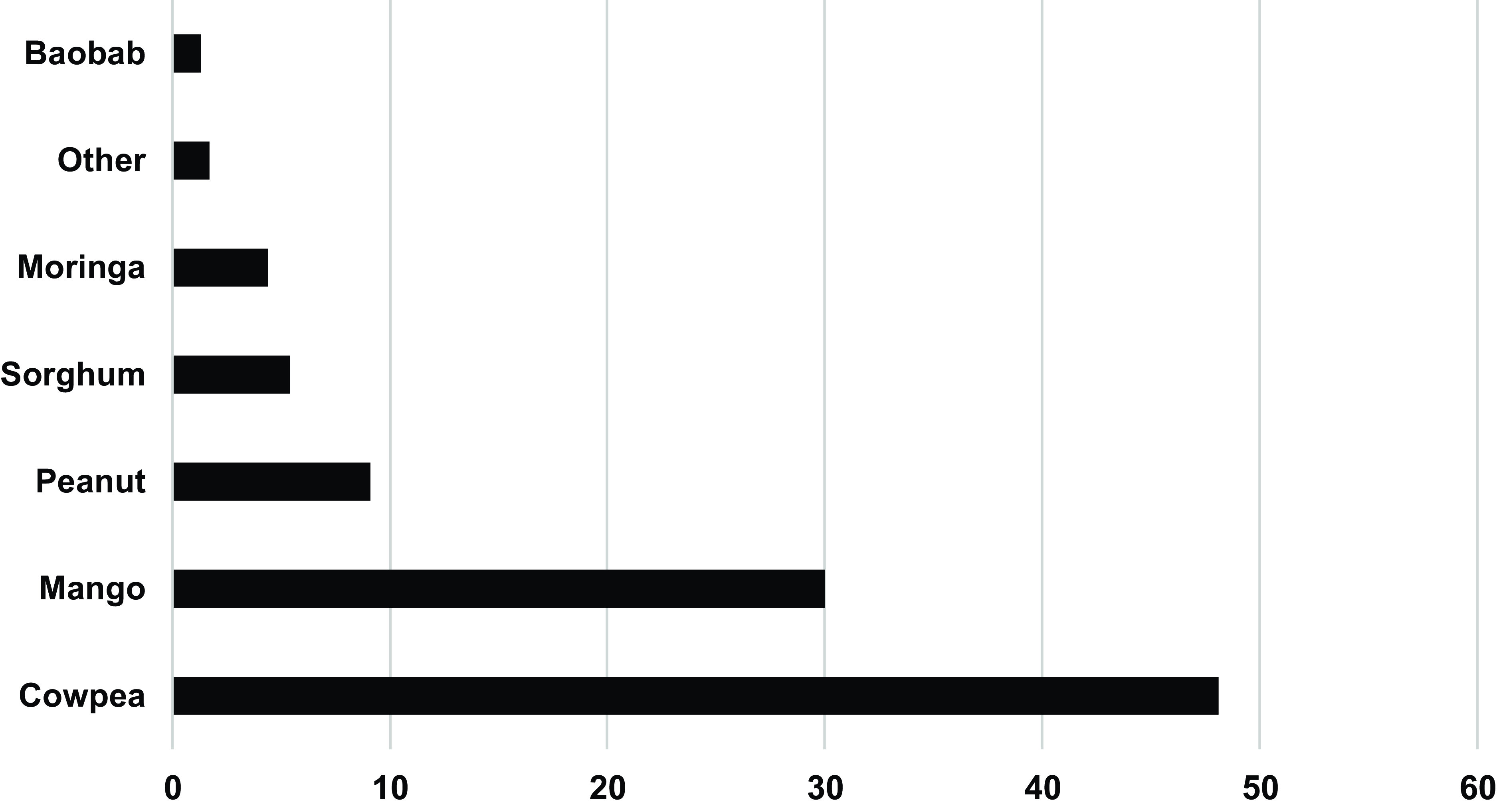
The majority (82.7%) of respondents in the GZ complained about crop damage caused by giraffe, while none complained of such an issue in GBR. All GZ respondents who reported an issue with giraffe (57.9%) highlighted crop damage (χ2 = 303; p < 0.001) as the key threat, and this included the eating of crops (100%) and trampling (65.5%). The saliency of crop damage depended on the site (χ2 = 180; p < 0.001), people’s occupation (χ2 = 173; p < 0.001) and ethnicity (χ2 = 204; p < 0.001). Farmers in the GZ, who have Zarma ethnicity, responded as being the most vulnerable to damage, especially as farming was their main occupation. The most damaged crops were cowpeas (V. unguiculata; 83.3%) and mangos (M. indica; 51.1%); others were sorghum (Sorghum bicolor), moringa (Moringa oleifera), peanuts (Arachis hypogaea) and baobab fruit (Adansonia sp.; Fig. 1). Almost all damage incidents (97.7%) occurred at night. People’s responses to damaged fields were to protect their crops, either in the field or in granaries; the crop damage and protection were correlated with each other (χ2 = 182; p < 0.001). The main types of protection were bringing the harvested crops home (54.8%), putting them into storage (21.0%) and building a moat as a barrier (20.4%), especially around mango trees (93.8%). Some 61.0% of farmers indicated that when they observed giraffe close to their fields or granaries they would chase them away.
Percentage representation of respondents’ answers according to the crops that were eaten by the giraffe in the ‘Giraffe Zone’. The category ‘other’ includes aubergine, manioc and fruit of the African fan palm (Borassus aethiopum).

With respect to benefits associated with giraffe conservation, micro-credits (32.2%), and the construction of water points (27.1%) were the most reported in the GZ. A few additional benefits included the provision of wire mesh to protect fields (7.1%), the construction of latrines (7.1%), healthcare (6.2%), baobab nurseries (3.8%) and rehabilitation of habitat (1.4%). In GBR, no one interviewed indicated any benefits. Overall, respondents claimed that the presence of giraffe did not directly benefit most residents financially (86.1% GZ; 97.8% GBR). However, the possibility of receiving extra money depended on study site (χ2 = 9.12; p = 0.003), with the possibility of receiving extra money being higher in the GZ. In addition, the respondents from the GZ had more opportunities to be involved in ecotourism and giraffe conservation than those in GBR (χ2 = 41.6; p = 0.001).
Attitudes towards giraffe
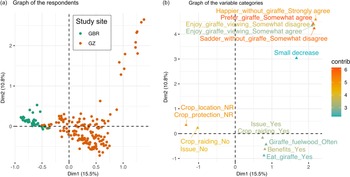
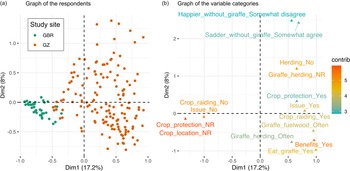
The first MCA highlighted a clear separation along the first dimension between respondents in GBR and respondents in the GZ (Fig. 2a); this was mostly explained by respondents in GBR declaring there to be no issues and no crop raiding caused by giraffe in contrast to respondents in the GZ (Fig. 2b). Interestingly, despite the issues that they reported, respondents in the GZ also declared that they derived benefits from giraffe. The second dimension of the MCA was mainly structured by a few outliers who harboured a relatively negative attitude towards giraffe, as they disagreed with statements such as ‘I enjoy viewing giraffe’ or ‘I would be sadder without giraffe’, or they considered that they would be happier without giraffe (Fig. 2b).
Results of the first multiple correspondence analysis (MCA) computed on the basis of all 297 respondents. (a) Plot of the respondents in the two first MCA dimensions, coloured according to study site (Gadabedji Biosphere Reserve (GBR) in green, ‘Giraffe Zone’ (GZ) in orange). (b) Plot of the active variables coloured according to their contributions to the MCA’s first two axes. For the sake of readability, only the 15 most contributing categories are shown.

A second MCA without the 14 outliers confirmed the separation between respondents from the GZ and those from GBR (Fig. 3a). The first dimension of the MCA tended to separate respondents who reported issues related to giraffe, in particular crop raiding, from those who reported no such issues (Fig. 3b). The second dimension was linked to respondents’ positive attitudes towards giraffe.
Results of a second multiple correspondence analysis (MCA) computed on the basis of 283 respondents (14 outliers removed). (a) Plot of the respondents in the two first MCA dimensions, coloured according to study site (Gadabedji Biosphere Reserve (GBR) in green, ‘Giraffe Zone’ (GZ) in orange). (b) Plot of the active variables coloured according to their contributions to the MCA’s first two axes. For the sake of readability, only the 15 most contributing variables are shown.

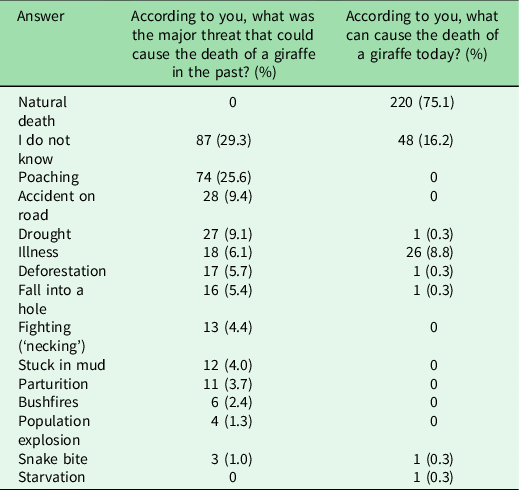
Thus, the second MCA highlighted that vulnerability to crop damage did not influence people’s attitudes. This was further supported by the fact that 93.6% of respondents considered that the giraffe population should increase in the next 3 years, and 97.0% of them preferred to have giraffe nearby rather than none. A strong positive attitude towards giraffe was also apparent from the answers to the questions about their happiness and enjoyment of nearby giraffe, even though their presence was not always seen as beneficial (66.3%). There was a high consistency among answers related to attitude (Cronbach’s α = 0.856). The positive feelings and attitudes (48.1%) were further supported by those indicating that they did not poach giraffe because they liked to see them. Most respondents (77.4% in the GZ and 64.0% in GBR) indicated that giraffe deaths are today predominantly due to natural causes, whereas the historical threats were more variable, with poaching being the second most common cause (Table 3).
Historical and current threat responses regarding giraffe in the study areas. Note that the question was open-ended and multiple answers were possible.

Discussion
We found that the GZ and GBR residents held overall positive attitudes towards living with giraffe and considered them part of their heritage, despite the increasing reports (ARM Zabeirou pers. comm. 2022) of damage caused to crops and the general lack of direct benefits from giraffe presence.
Conflict with wildlife is not a new or unique phenomenon in Niger (Woodroffe et al. Reference Woodroffe, Thirgood and Rabinowitz2005, Watve et al. Reference Watve, Patel, Bayani and Patil2016), and across Africa herbivores such as hogs/pigs (Potamochoerus sp.), African savannah elephant (Loxodonta africana) and hippopotamus (Hippopotamus amphibius) cause varying degrees of loss and damage to agricultural fields, leading to clashes as to how to manage wildlife (Woodroffe et al. Reference Woodroffe, Thirgood and Rabinowitz2005, Gross et al. Reference Gross, Lahkar, Subedi, Nyirenda, Lichtenfeld and Jakoby2018, Adeola et al. Reference Adeola, Sulyman, Babatunde, Onihunwa, Mohammed, Joshua and Adeniji2022). Moreover, damage to physical property and even severe injuries or deaths amongst humans, although not caused by giraffe, continue to occur (Compaore et al. Reference Compaore, Sirima, Hema, Doamba, Ajong, Di Vittorio and Luiselli2020, Marowa et al. Reference Marowa, Matanzima and Nhiwatiwa2021). However, the impact of crop damage caused by the West African giraffe in Niger is possibly unique in Africa (Leroy Reference Leroy, De Visscher, Halidou and Boureima2009). Whilst this scenario is less dangerous for human safety, the potential impact on individual livelihoods may in future result in increased retaliation, thus negatively impacting human–giraffe coexistence (Leroy Reference Leroy, De Visscher, Halidou and Boureima2009, Ruppert et al. Reference Ruppert, Sponarski, Masiaine, Larpei, Lekushan and Lenaipa2022). Whilst negative attitudes towards wildlife stemming from human–wildlife conflict have been observed (Gross et al. Reference Gross, Lahkar, Subedi, Nyirenda, Lichtenfeld and Jakoby2018), people are often positively biased towards some animals more than others due to aesthetic appreciation. This can influence their conservation decision-making (Stokes Reference Stokes2007, Marešová & Frynta Reference Marešová and Frynta2008, de Pinho et al. Reference de Pinho, Grilo, Boone, Galvin and Snodgrass2014). In general, the attitudes of people living with giraffe across Africa are mostly positive (Hamutenya et al. Reference Hamutenya, Hauptfleisch, De Cauwer, Fennessy, Fennessy and Nzuma2022, Ruppert et al. Reference Ruppert, Sponarski, Masiaine, Larpei, Lekushan and Lenaipa2022), and the animals are viewed as ‘attractive’ enough for them to be considered worth protecting (de Pinho et al. Reference de Pinho, Grilo, Boone, Galvin and Snodgrass2014).
We observed a significant difference in terms of resource use and management in the two areas that giraffe inhabit in Niger. This was a result of both the significantly larger population in the GZ (c. 600 individuals; Zabeirou Reference Zabeirou2018) versus GBR (8 individuals; Gašparová et al. Reference Gašparová, Fennessy, Rabeil, Zabeirou and Brandlová2018) and the subsistence nature of people relying on agriculture; for example, crop production was the main form of subsistence farming in the GZ, whereas pastoralism was predominant in GBR. Despite GBR being a formally protected area, it allows grazing of cattle during the dry season, and although firewood cutting and collection are prohibited, this is not strictly enforced (Wacher Reference Wacher2010). In contrast, the GZ is an unprotected area, and the preferred vegetation type of the giraffe – tiger bush – is seemingly facing ongoing pressure from cattle grazing and firewood cutting for the local and capital city markets (Morou et al. Reference Morou, Ambouta, Karim, Mahamane, Saadou, Mainassara and Sinsin2011, Ismael et al. Reference Ismael, Issoufou, Biaou, Ali and Oumani2020). Such pressure has led to increased habitat degradation, resulting in reduced giraffe forage available and increased bare soil (Wu et al. Reference Wu, Thurow and Whisenant2000), which directly and indirectly threaten the long-term conservation of the giraffe.
In the GZ, giraffe preferred foraging for cowpeas and mangos, predominantly during the night, despite them not being the most planted crops (Leroy Reference Leroy, De Visscher, Halidou and Boureima2009). In the last few decades, local people have increased efforts to protect their crops from giraffe, such as by digging moats around mango trees and storing harvested crops in granaries as soon as possible rather than leaving them in the field (Leroy Reference Leroy, De Visscher, Halidou and Boureima2009, Sogbohossou et al. Reference Sogbohossou, Kassa, Aboibacar and Mahamane2013).
In some landscapes, protected areas have positive economic, social and environmental impacts on local people, both directly and indirectly (Andam et al. Reference Andam, Ferraro, Sims, Healy and Holland2010). In the GZ, the main perceived benefits reported were monetary, despite direct financial benefits not being received. However, many respondents were receiving support indirectly through a local micro-credit scheme (ASGN 2018). Since 2001, this scheme has provided support to women living in the GZ by helping them to develop their own income-generating activities (ASGN 2018). This support was directly linked to local giraffe conservation development issues, enabling these women to offset losses caused by giraffe. Since 2000, some community members have worked as local giraffe guides and educators for AVEN in the GZ, thus allowing them to benefit from tourism and international NGO support (ARM Zabeirou pers. comm. 2022); however, tourism worldwide was negatively impacted by the COVID-19 pandemic, and related conservation efforts have also suffered (van der Merwe et al. Reference van der Merwe, Saayman and Jacobs2021).
While ecosystem services were not highlighted as a benefit, respondents generally indicated that giraffe were important to the area in terms of value to the environment and local heritage. Such attitudes were a testament to the benefits that the giraffe bring to the community, led by the government and NGO partners. Overall, local communities held positive attitudes towards giraffe in the GZ and GBR despite negative livelihood impacts, as reported elsewhere (Sekhar Reference Sekhar1998, Granados & Wladji Reference Granados and Weladji2012, Megaze et al. Reference Megaze, Balakrishnan and Belay2017, Allendorf Reference Allendorf2022). Unsurprisingly, the community in the GZ was concerned about crop damage while simultaneously appreciating the monetary and non-monetary benefits of giraffe. Whether or not the costs were considered to outweigh the benefits depended on the individual.
Currently, the main threats facing the giraffe in Niger are both natural deaths and road accidents (Zabeirou Reference Zabeirou2018, Reference Zabeirou2019). However, poaching does occur, and data on poaching are not easy to obtain where it occurs at the periphery of the GZ. The last major incident occurred in 2017, when five giraffe were killed by armed bandits close to the border with Mali (Zabeirou Reference Zabeirou2018). In the same year, eight more individuals died, one as a result of a road accident (Zabeirou Reference Zabeirou2018). In 2018, eight giraffe died, three from natural causes, four from traffic accidents and one from falling into a well (Zabeirou Reference Zabeirou2019). Since 2019, 22 individuals have been found dead, some of them because of road accidents, but some probably died of injuries caused by people defending their crops (ARM Zabeirou pers. comm. 2022).
The Nigerien populations of the West African giraffe, people and livestock are growing, as are the pressures on natural resources. Currently, and over the past few decades, human–giraffe conflict has resulted in crop losses. Local communities, in particular women, have benefitted from living with giraffe through micro-credit schemes, the benefits of which to date have overweighed any costs incurred. In the long term, it will be important to provide ongoing support to those living alongside giraffe and link benefits with conservation development activities to sustain human–giraffe coexistence into the future.
Supplementary material
To view supplementary material for this article, please visit https://doi.org/10.1017/S0376892923000243.
Acknowledgements
We thank the Nigerien Wildlife Authorities and their staff for the permission to undertake the work and the Giraffe Conservation Foundation, who provided valuable technical and financial support. We are grateful to Dr Kirstie Ruppert from the San Diego Zoo Wildlife Alliance for her contribution in the designing of a draft of the questionnaire. In addition, we thank Czech University of Life Sciences, Hlávkova nadace ‘nadání’, Ivan Carter Wildlife Conservation Alliance, IUCN SOS and the European Commission, Rufford Small Grant, Sahara Conservation Fund, for their funding and/or logistical support.
Financial support
This work was financially supported by Czech University of Life Sciences, Faculty of Tropical AgriSciences IGA20223106, Giraffe Conservation Foundation, Hlávkova nadace ‘nadání’ and a Rufford Small Grant (grant number: 27641-1).
Competing interests
The authors declare none.
Ethical standards
None.