1. Introduction
It is commonly argued that the ungrammaticality of the sentences in (1) is due to a general constraint of the form ‘nonrestrictive relative clauses must immediately follow their antecedents’ (Espinal Reference Espinal1991: 752). Similar assertions may be found in Potts (Reference Potts2002a) and Arnold (Reference Arnold2007).Footnote 2
Each of these authors noted the similarity between non-restrictive and restrictive relative clauses in this respect, and with good reason: as seen in (2), restrictive relative clauses also cannot appear to the left of what they modify – their hosts, or modified heads. It seems reasonable that non-restrictive relative clauses should not either.
- (1)
(a) *Which I said earlier, there are some minor problems.
(based on Arnold Reference Arnold2007, ex. (33))
(b) *Who used to play the piano, my father(,) knows a thing or two about music.
(2) *Who you saw the man is my uncle.
However appealing, this intuition is misguided, at least with respect to relative clauses. There are limited contexts in which the left-adjunction of a non-restrictive relative clause is possible. Among the factors determining the possibility of left-adjunction are the syntactic category of the modifier, the identity of the relativizer, and the category of the modified head. The inclusion of these factors among the principles of relative clause linearization has consequences for the analysis of certain parenthetical uses of as, such as those in (3).
- (3)
(a) We have considered this before, as most of you know.
(b) They made foolish choices at first, as many in their situation have.
Huddleston (Reference Huddleston, Huddleston and Pullum2002: 1147–1148) and Potts (Reference Potts2002a, Reference Pottsb) analyze these parenthetical as-clauses as preposition phrases, in opposition to structurally and functionally similar relative clauses with which, such as those in (4).
- (4)
(a) We have considered this before, which most of you know.
(b) They made foolish choices at first, which many in their situation have.
In support of this are several differences between as and which, including the fact that as-clauses may adjoin to the left of the clause they modify. But, once an across-the-board constraint against left-adjoined relative clauses is eliminated, we must ask whether the remaining differences between as and which justify analyzing one as a preposition and the other as relativizer.
Treating as as a relative pro-sentence is in fact the traditional analysis and it is assumed by several authors including Kayne (Reference Kayne1984), Ross (Reference Ross, Brugman and Macaulay1984), and Postal (Reference Postal1994, Reference Postal2004). None of these authors, however, provides any synchronic evidence in its favor, and Postal (Reference Postal2004: 32) claims in passing that there is no substantive difference between the preposition and relativizer analyses. I argue that not only is there no conclusive evidence against a relativizer analysis of as, there is at least one good reason to favor it over other possibilities.
The primary concern of this paper is to explore the ways in which structures with similar, even identical, internal syntactic structures, exhibit different ‘external’ syntactic properties. I do not assume that there is a single set of features that count as ‘external’, in opposition to internal features. The finiteness of a verb may be viewed as simultaneously ‘internal’ (specifying certain inherent semantic/syntactic properties of a verb) and ‘external’ (specifying the combinatory possibilities of the phrase it heads). The structures to be examined – relative clauses – do, however, permit a clearer division. The internal properties of interest are the presence of a finite clause, and a gap within that clause, corresponding to a functional word (as, which, etc.) at the left periphery. The external property to be examined is linearization with respect to the element modified by the relative clause. A full and general account of relative clauses must crucially keep these aspects of syntactic constructions separate, as I argue in the following sections.
Section 2 introduces supplemental relative clauses. Sections 3 demonstrates the possibility of left-adjunction of non-restrictive relative clauses, and presents an account of the linearization possibilities within Sign-based Construction Grammar (Sag Reference Sag2010a, Reference Sag, Sag and Boasb). Section 4 revisits the question of the syntax and semantics of parenthetical as-clauses. Examination of the internal structure of as-clauses shows that treating them as relative clauses (with as the relativizer) is eminently possible, despite semantic and pragmatic differences with wh-relatives. The fact that their linear positioning with respect to the matrix clause is markedly different from that other relative clauses is not problematic, in light of the new data from which and what. Finally, I provide positive evidence for a relativizer account, noticing that as- and which-clauses exhibit discourse-anaphoric connections to their antecedents. Section 5 summarizes and concludes.
2. Supplemental relative clauses
I follow Huddleston, Pullum & Peterson (Reference Huddleston, Pullum, Peterson, Huddleston and Pullum2002: 1035–1036) in splitting relative clauses (RCs) into integrated and supplemental variants, rather than restrictive and non-restrictive. With respect to relativization the difference is mostly terminological, but it is useful in that it draws parallels between supplemental relative clauses (SRCs) and other supplements, such as parenthetical sentential adverbs (hopefully, regrettably). The supplementation construction as laid out by Huddleston, Payne & Peterson (Reference Huddleston, Payne, Peterson, Huddleston and Pullum2002: 1350–1351) has two functional elements: the supplement and the anchor. The supplement is the material which is presented independently of the main clause. It is often set off prosodically, or by punctuation in written text. The anchor is the part of the main clause that the supplement depends on semantically. Take the case of nominal apposition: The perpetrator, Mr Jones, is sitting right over there. The anchor is the perpetrator, and an identificational relation is set up between that NP and the supplement, Mr Jones. Huddleston, Payne & Peterson posit a separate Supplement relation, akin to Head, Complement, and Modifier, which supplements hold with respect to their anchors (page 1354). The authors further argue that the lack of syntactic integration provides evidence against incorporating the supplement into the rest of the sentence as a constituent. Nothing crucial seems to hang on this decision, and in fact Potts (Reference Potts2005) and Arnold (Reference Arnold2007) have argued that the semantic and syntactic properties of SRCs are handled at least equally well by treating them as syntactically integrated, just as restrictive RCs are.
The question of how adnominal RCs come to modify the nouns they do reduces in part to the question of how relative pronouns come to be related to particular nouns. I take the general approach of Jackendoff (Reference Jackendoff1977), Sag (Reference Sag1997), and Arnold (Reference Arnold2007) in treating the relativizer in SRCs as ‘essentially pronominal’ (Arnold Reference Arnold2004b: 7): it is an individual-denoting expression coindexed with its antecedent, parallel to the relation between a personal pronoun and its antecedent. The reference resolution process is simply more tightly constrained by syntactic configuration in RCs. Throughout the paper I avail myself of the term ‘antecedent’ (of a relativizer) to indicate that noun, clause, etc., which is modified by a particular relative clause.
For current purposes, RCs may be distinguished on the basis of three parameters: (i) whether they are supplemental or integrated; (ii) whether they modify a noun (adnominal), a predicate (adpredicative), or a clause (adsentential, adclausal); and (iii) what their linear position is with respect to what they modify. Consider first the adnominal integrated relative clause (IRC) illustrated in (5) (relative clauses in italics, modified head underlined). In each case the RC appears post-nominally. Prenominally-positioned RCs, in (6), are ungrammatical.
- (5)
(a) the paintingwhich all the buyers considered purchasing
(b) the paintingfor which bids were made
(c) the paintingbids for which should not be accepted
- (6)
(a) *(the) who all the buyers considered purchasing (the) painting
(b) *(the) for which bids were made (the) painting
(c) *(the) bids for which should not be accepted (the) painting
The constraint holds for adnominal supplemental relative clauses as well:
- (7)
(a) Kim, who I went to school with, is now a doctor.
(b) Kim, about whom I can say only little, is now a doctor.
(c) Kim, discussions about whom should only be carried out in private, is actually an international spy.
- (8)
(a) *Who I went to school with, Kim(,) is now a doctor.
(b) *About whom I can say only little, Kim(,) is now a doctor.
(c) *Discussions about whom should only be carried out in private, Kim(,) is actually an international spy.
Supplemental relative clauses hold a supplemental relation to their anchor, but the linearization pattern is the same as for integrated structures. At first sight, SRCs with clausal or verbal anchors follow this linearization pattern as well. The sentences in (9) illustrate supplemental relatives with a predicate anchor (and thus a predicate-sized gap within them), and those in (10) illustrate supplemental relatives with a clausal antecedent and clausal gap. The sentences in (11) and (12) illustrate the ungrammaticality of placing the RC prior to the anchor. Hereafter, all grammatical examples are from the British National Corpus unless otherwise noted.
- (9)
(a) He wondered whether I would give a dinner, which I said I would.
(b) It was published in eighty six eighty seven, although it's no longer available in shops, it can still be obtained through the library service if you care to request it, which I have.
- (10)
(a) These timings will hold so long as wait times exceed processing times, which is often true.
(b) My littlest brother, Josh, is engaged now, which I found out on Thursday at Cari's.
(http://www.ourboldhero.com/2009/08/in-which-i-dont-mention-time-i-got-lost.html, 6 January 2011)
- (11)
(a) *Which I said I would, he wondered whether I would give a dinner.
(b) *It was published in eighty six eighty seven, although it's no longer available in shops, it can still be obtained through the library service if, which I have, you care to request it.
- (12)
(a) *Which is often true, these timings will hold so long as wait times exceed processing times.
(b) *Which I discovered when we interviewed Gary Garritan, the piano is from the Garritan Personal Orchestra.
Integrated and supplemental relative clauses have nearly identical internal syntactic properties. They are both clauses with an extracted wh-phrase and as a whole are structures of the same category.Footnote 3 It would be a clean and neat story if this uniformity extended to linearization. However appealing, I argue that it is not the best approach. The general expectation may be that all types of a particular syntactic category (PP, NP, and so on) will have similar or identical external syntactic distributions, but this is by no means true in general.
Hudson (Reference Hudson2007) illustrates two ends of a continuum of predictability from external distribution to internal structure, and vice versa. He argues that ‘there is nothing which has “the internal structure of a noun phrase”’ (emphasis original), as an NP's phrase structure depends on whether it is headed by a common noun, proper noun, or pronoun (page 198). Rather, NPs share an external syntax: ‘they can all be used freely as subject, object, complement of a preposition, and so on’ (page 198). Conversely, VPs share an internal structure (essentially, having a valence, or constraints on varieties of dependents) but their external distribution is determined by their inflectional class (finite, nonfinite, gerund) and the larger structures that call for those classes. ‘No distributional facts at all’ are entailed simply by the category VP (page 201). Whether these statements are ultimately taken as true (and this partly depends on one's analysis of, e.g., infinitival phrases, proper nouns, and so on), they do get at the fact that certain phrase types have more consistent internal structure or external distribution than others.
The typology of adverb phrases set out in Pullum & Huddleston (Reference Huddleston, Huddleston and Pullum2002: Section 7), which follows Jackendoff (Reference Jackendoff1972), exhibits a similar internal/external syntax split. Internally, adverb phrases are all basically the same, but externally there are two broad categories: clause-oriented and VP-oriented. There are several subcategories, each associated with a set of linearization possibilities and tendencies, depending on the syntactic and semantic features of the adverb (e.g., manner, time/place, epistemic). To a lesser extent, one observes heterogeneous external syntax among adjectives. They are normally only pre-head, but there are exclusively post-nominal adjectives (e.g., galore), and at least three that may appear on either side (e.g., enough and last/next when combined with the names of days of the week). Seen in this light, it should come as no surprise that relative clauses manifest the same sort of internal/external differences.
3. Left-adjunction of relative clauses
A supplemental which relative clause may appear to the left of its anchor if it is itself preceded by a coordinator:
- (13)
(a) Having argued this far Lorentz has to go all the way and he was forced to conclude that there will be no American M until Hollywood goes and until ‘independent companies allow their directors to do away entirely with actors, and (which is the only sensible way to manufacture movies at all) pick types and faces off the streets’.
(b) Their apparently similar, sharply segmented body plan either arose more than once or – which is also more than possible – it is very primitive …
(Colin Tudge, The Variety of Life. Oxford University Press, 2002, p. 200)
(c) Nevertheless, it is now clear, as I hope to show, that the two opposite types of symptom do in fact appear in connection with the coming of agriculture and, which is more to the point for our present concerns, that this is a phenomenon not without relevance to the understanding of the modern world.
(d) In the early 1970s, in the heyday of abstract philosophy of education, it was commonplace to draw a distinction between education ‘in the true sense’ and pseudo-education; or, which came to the same thing, between education and training.
(e) Yours is the Earth and everything in it / And – which is more – you'll be a Man, my son!
(Rudyard Kipling, ‘If’, in Rewards and Faries, 1st World Library, 2007, p. 143)
(f) Either they were performing this public duty in giving the protection asked for, in which case I think they cannot charge, or, which no one suggests, they were at the request of an individual doing something which it was not their duty to do, in which case it seems to me both public policy and section 10 of the County Police Act 1839, make the contract illegal and void.
(g) He had had no private income, pension, or – which had surprised me in the last few years – life insurance.
The existence of left-adjoined relative clauses (LARCs) was briefly noted by Huddleston, Pullum & Peterson (Reference Huddleston, Pullum, Peterson, Huddleston and Pullum2002: 1066): ‘A supplementary relative with a coordinated clause as antecedent can precede it, following the coordinator’. In some cases the anchor appears to be smaller than a clause (e.g., (13d, g)), but the interpretation is still clausal (‘that he had had no life insurance had surprised me’). This is plausibly understood as left-periphery ellipsis in coordinate structures (Beavers & Sag Reference Beavers, Sag and Müller2004), and I will proceed with the understanding that all the anchors are in fact verbal.
In coordinate structures with more than two coordinates, such as (14a), LARCs must still follow a coordinator. It is thus impossible in (14b) but possible in (14c). Adding an additional LARC before the final coordinate does not improve the former sentence, and is (as predicted) perfectly fine in the latter.
- (14)
(a) The event may have happened once, (it may have happened) twice, or, perhaps, (it may have happened) three times.
(b) *The event may have happened once, which would be slightly unlikely, (it may have happened) twice, or, perhaps, three times.
(c) The event may have happened once, or, which would be slightly unlikely, (it may have happened) twice, or, perhaps, three times.
Which-relatives with clausal antecedents thus have this limited possibility for left-adjunction, along with a more common right-adjunction pattern. There also exist what-relatives, exemplified in (15). Such clauses are exclusively supplemental, and must appear to the left of the anchor: *The dislocation turns out to be movable, what is even more important. They too are often (but not always; see below) post-coordinator.
- (15)
(a) When the probabilities get very small, as they do with some of the school types, d is not a very suitable measure of effect. Any measure based on ratios (or, what amounts to the same thing, differences in logs) is to be preferred.
(b) Somewhere along the line a human being made a low-quality decision – and, what is worse, some supervisor or executive managed to allow it to happen.
(c) How had that fancily-named high-hab brat come to be here at the garrison block? Mingling, what's more, with Dorcas gang members, or so it seemed?
The fixed phrase what's more in (15c) has fully acquired the distribution of sentential adverbs: it may break up a subject and finite verb, a noun and a post-modifier, a verb and an oblique argument, and so on. In what follows, I set what's more aside, because it seems best analyzed as a fixed expression with its own unique syntax rather than as a relative clause.
3.1 Non-adjacency to coordinator
As is shown in (16), it is possible – though rare – for a LARC with which to be separated from the coordinator by an adverbial expression.
- (16)
(a) Yet, too often it is the first and the last primary source consulted on the matter of his metrical theories; or at least, which amounts to the same thing, it remains the authoritative account.
(b) For this reason it was one time suggested that for, for example, a reaction [equation], the rate should be expressed in the form [equation], or alternatively (which comes to the same thing) [equation], where the a's are activities and the γ’s are activity coefficients.
(c) But even if each of the alleged misdemeanours happens to be true, it would be crass empiricism (or alternatively, what comes to the same thing, crass moralism) to deny the CPI (M)'s historical commitment to democracy from a set of individual incidents, of the sort that all political formations at the ground level can be accused of.
(http://www.macroscan.org/cur/sep10/cur070910CPI.htm,2 December 2010)
(d) The view under discussion … must then be rejected, for the further reason, or, perhaps, what comes to the same reason differently stated, that it cannot be reconciled with the limitation fundamentally implicit in the constitutional separation of the powers – namely …
(http://supreme.justia.com/us/289/553/case.html, 2 December 2010)
What differs from which in not requiring a coordinator to its left:Footnote 4
- (17)
(a) In other words, at these two points the crystal is pretty well broken away. What is even more important, the dislocation turns out to be movable.
(b) Our poverty programs have failed to reduce poverty. What is worse, they sometimes injure the very persons they are designed to aid.
These discourses would sound very strange without the LARCs, or a similar discourse-connective mechanism. This suggests that a more general account of both which and what LARCs may be possible, one which derives many or all of the linear order constraints from discourse-related functions. Such an account, however, is beyond the scope of the present paper. What must minimally be specified is that what and which LARCs are not simply variants of each other, but have different external syntactic distributions, and so must be handled by separate, but related, constructions.
3.2 Left-adjunction and word order domains
I develop an analysis of LARCs based on the word order domain approach to linearization (Reape Reference Reape, Bunt and Horck1996, Kathol Reference Kathol2000, Chaves Reference Chaves2007), particularly within the framework of Sign-based Construction Grammar (SBCG; Beavers & Sag Reference Beavers, Sag and Müller2004, Hofmeister Reference Hofmeister2010). This framework represents linguistic expressions as signs with information about phonology (phon), morphological form (form), syntax (syn), semantics (sem), and word order domains (dom), among others, as illustrated in the attribute–value matrix (18).
(18) A schematic sign in Sign-based Construction Grammar


What constitutes a well-formed sign is described by constructions, which are constraints placed upon constructs (abbreviated cxt), or local subtrees. A construct consists of a mother (mtr; a sign), a head-daughter (hd-dtr; a sign), and daughters (dtrs; a list of signs). Well-formed signs are either listed (e.g., as a lexical item), or are licenced as the mother of a well-formed construct (Sag Reference Sag, Sag and Boas2010b).
Constructional constraints take the form of conditional statements. For instance, a construction of the form relative-clause-cxt → […] states that any construct of the type relative-clause-cxt must conform to such-and-such specifications. Construct types are arranged in an inheritance hierarchy registered in the signature of the grammar, which spells out the types of feature structures in the grammar, what their general properties are, and their relations to one another. A construct type which is a subtype of one or more other construct types will have (or ‘inherit’) all of their properties. This is one of the key means by which generalizations across grammatical structures are stated in SBCG, and it is one which will be put to use in the present analysis of relative clause constructions.
The word order domain of mother signs is determined by the DOM lists of the daughter signs. The order of elements in this list corresponds to the order of pronunciation, as in the Constituent Ordering Principle of (19) below (Hofmeister Reference Hofmeister2010: 289). (‘A⊕B’ indicates a list composed of all the elements of A followed by all the elements of B.)
(19) Constituent Ordering Principle
In most English constructions, the mother's dom list is a concatenation of the dom lists of the daughters, in the order listed:
(20) Concatenation
Another way of regulating word order is by means of linear precedence (LP) constraints of the form X≺Y. Linear precedence constraints are stated in terms of dom elements. Following Kathol (Reference Kathol2000), Beavers & Sag (Reference Beavers, Sag and Müller2004), and Hofmeister (Reference Hofmeister2010), I treat these elements as signs (i.e., either terminal or intermediate mother nodes), but not constructs (i.e., feature structures with mothers and daughters).
Given this framework, consider two ways in which PPs and APs may be ordered with respect to a noun they modify. (This discussion is for illustrative purposes, and I suppress many of the details which would necessarily inform a full-fledged analysis.) One way is to specify that PP-plus-nominal and AP-plus-nominal constructs are concatenating, and list the modifier and head in the proper order (in general, N–PP and AP–N). The other way involves LP constraints. Because a preposition or adjective may be specified as a noun-modifier even ‘before’ any of its own dependents are combined with it, an LP constraint specified in terms of terminal signs may suffice to specify the ordering of the entire PP or AP with respect to the noun. This would not be possible with, for instance, relative clauses, because the syntactic potential for modification is introduced constructionally (Sag Reference Sag2010a: 522). As such, the ordering of such clauses with respect to nouns is straightforwardly handled by means of a concatenation construction.
As an example, (21) is a construction licensing integrated adnominal relative clauses to the right of their heads (I include only those features that are relevant to the bare bones of syntactic modification and linearization). As indicated via ↑ notation, this construct is a subtype of head-functor (Sag Reference Sag2010a: 523) and concat-cxt, the latter guaranteeing that the order in which the daughters are listed is the ultimate order.Footnote 5 The CNP, or common noun phrase, is a common noun with modifiers, if any. The notation ‘X:D’ indicates that the value D is being tagged as X for identification with another part of the feature structure.
(21) Adnominal relative-clause modification (↑head-functor & ↑concat-cxt)
I introduce the feature relzr (relativizer) with possible values of either none (for non-relative-clause signs) or who, which, when, etc., indicating what the relativizer in the relative clause is (see crel in Sag Reference Sag2010a). The value rel subsumes the more specific relativizer values, and in (21) serves to indicate that the second daughter is a relative clause. This serves to distinguish relative clauses from each other based on which relativizer is present, which will be crucial in the specification of left-adjoined relative clauses.
The LARC constructions are subtypes of a general supplementation construction, sketched in (22).
(22) Supplementation
Supplements ‘select’ their anchors by means of a sign-valued anchor attribute (X in (22)), parallel to select.Footnote 6 No linear order is specified between the supplement and the anchor. Though I am not primarily concerned with the semantics and pragmatics of supplementation, for the sake of concreteness, I adopt in general form the proposal of Potts (Reference Potts2005), introducing a partition of a sign's semantics into at-issue and supplemental domains (the latter corresponding to Potts' ‘conventional implicature’). The supplemental relative clause's at-issue meaning (and any supplemental meaning, which might arise due to additional supplemental material within the relative clause) is incorporated into the mother's supplemental meaning specification; the mother's at-issue meaning specification is simply that of the head daughter's (L 1 in (22)).
The matrix in (23) displays the construction for a supplemental relative clause. The second daughter is specified as a verbal constituent with a fully satisfied valence (val) requirements, i.e., as a clause. Boxed numbers indicate portions of the feature structure which are grammatically constrained to be identical.
(23) Supplemental relative clause (↑ filler-gap-cxt)
Supplemental relative clauses differ from integrated relative clauses (such as defined by Sag Reference Sag2010a) in that the relativizer's at-issue meaning in the former is anaphorically dependent on the (at-issue) meaning of the anchor. I adopt the notation ≈ of Arnold (Reference Arnold2004b) and Arnold & Borsley (Reference Arnold, Borsley and Müller2010) to indicate referential or anaphoric dependence (a relation which includes identity). The lexically-specified relzr value of the filler daughter is identified with the relzr value of the RC as a whole.
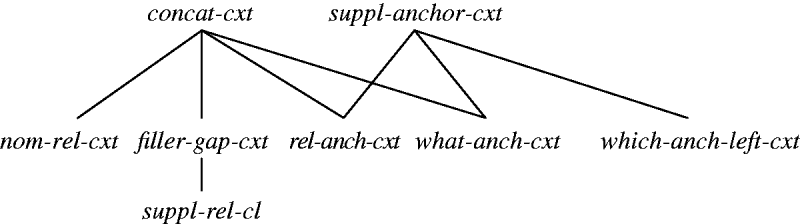
The constructions outlined above are displayed in Figure 1, which illustrates a portion of the type hierarchy that concerns relative clauses. The constructions of interest – the LARCs – are what-anchor-cxt and which-anchor-left-cxt, presented in (24) and (25) below. Each of these constructions inherits from the general supplement-anchor-cxt. An additional construction, rel-anch-cxt (not described in this article) regulates the combination of obligatorily post-anchor SRCs with their anchors. However, as we will see below, only what-LARCs are concatenating constructions. Which-LARCs are subject to their own idiosyncratic linearization principles.
Relative clause and related construct types.
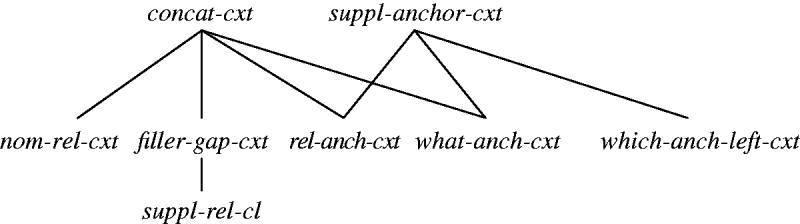
A construction for what-RCs is shown in (24).
(24) What-relative clause plus anchor (↑ suppl-anchor-cxt & ↑ concat-cxt)
A what-RC is always a supplement, and always precedes its anchor. Here and below, H indicates the feature structure of the head daughter. The symbol S abbreviates signs of category verb with fully-satisfied val attributes. Thus, H:S specifies that the head-daughter must be a clause. The construction specifies that the relative clause precedes H, and requires no coordinator or any other element to the left. Finally, the supplement is [relzrwhat], preventing left-adjoined supplemental which-clauses from being licensed by this construction. This is a straightforward subtype of the supplementation construction, with the further specifications that the supplement is a what-clause, and that the anchor is a sentence. As a subtype of concat-cxt, the listed order of the daughters is also their linear order on the mother's dom.
Which-clauses, in (25), are more complex.
(25) Which-relative clause plus anchor (left-adjoined) (↑ suppl-anchor-cxt)
The supplement is a which-RC. The anchor is required to be a conjunct marked by a coordinator [coord +] (Beavers & Sag Reference Beavers, Sag and Müller2004). Specifically, it is composed of a coordinator (the first element of dom) and a sentence. Rather than simply concatenating the daughters' dom lists, the mother's dom is composed of the coordinator, followed by the dom list of the relative clause (δ1), followed by that of the anchor without the coordinator (δ2). This yields the proper order of, for example, or, which is also more than possible, it is very primitive. Requiring the first element of the anchor to contain a coordinator predicts the ungrammaticality of (14b).Footnote 7
A linear precedence constraint in (26) guarantees that adverb modifiers, or supplements, of an anchor do not appear to the left of the coordinator (*P, alternatively or Q, where alternatively supplements Q).
(26) Linear precedence constraint on coordinators and adverbs
In essence, this constraint states that if both a coordinator and an adverb attach themselves to the same structure, the coordinator must come first. The right-hand element is an adverb supplementing a clause, indexed i. The left-hand element is a coordinator, one of whose semantic arguments (arg1, stipulated to be the one to which the coordinator syntactically attaches) is also indexed i. I follow Beavers & Sag (Reference Beavers, Sag and Müller2004) in treating coordination as not involving syntactic selection (e.g., via select or valence). Thus, the constraint is stated in terms of coincidence of semantic arguments of the two elements.
This is, admittedly, an atypical approach to RC adjunction. The RC is required to adjoin to a phrase like or it is very primitive, even though intuitively the target of supplementation does not include the coordinator. I argue that this approach has theoretical advantages over the alternatives. One possibility is to posit a structure with three daughters – the coordinator, the relative clause, and the anchor. Yet this would duplicate the work of an independently needed conjunct construction – and intuitively we are dealing with a special type of supplementation, not a special type of coordination.
Another possibility is to introduce the notion of upward selection. A structure comprising a which-clause and its anchor could be (constructionally) required to be selected by a coordinator. Such a mechanism might be applied to idioms such as off kilter or out of kilter, whereby instead of listing two separate PP-idioms involving the same noun, kilter itself is listed as requiring that it be selected by one of a small set of prepositions. While the notion of a linguistic expression determining the types of elements that can select it has been occasionally proposed, e.g., inside–out functional uncertainty in Lexical-Functional Grammar (Bresnan Reference Bresnan2001), or the coll feature of Richter & Sailer (Reference Richter, Sailer and Müller2009), it is a powerful tool that should be a last resort. The same inside–out effect could be accomplished by stipulating that a which+anchor construct is of a new syntactic type, which can only be selected by (additional senses of) coordinators, but this introduces into the grammar far more elements than seem necessary. Deciding between these alternatives requires further investigation; I present the construction in (25) above as one plausible understanding of the phenomenon.
3.3 Summary
Supplemental relative clauses with sentential anchors exhibit essentially the same internal structure as other integrated and supplemental RCs, namely a long-distance dependency holds between a wh-phrase and a gap further down in a finite clause. Supplemental relative clauses also predominantly linearize in the same way: the SRC follows the anchor. Yet there exist separate constructions that specifically licence other orders for sentential SRCs. Which-SRCs may left-adjoin, following a coordinator. What-RCs are exclusively supplemental and left-adjoining, and do not have the same coordination constraints as which-RCs.
I now turn to supplemental as-clauses, which have previously been analyzed as non-relativizing structures. I show that, in light of the linearization facts discussed above, a relativizer analysis is just as possible as the alternatives. I also introduce additional data on as-clauses, which highlight exactly where and how they diverge from other sentence-supplementing clauses.
4. Supplemental relativizer as
Suppplemental as-clauses may be grouped into two types: those with a clause gap (CP-as) and those with a predicate gap (predicate-as). Sentences in (27) and (28) illustrate the basic construction. Unless the distinction is relevant, I call any finite clause with an initial as an as-clause, whether it contains a clause- or a predicate-shaped gap.
(27) As-clauses with a clause gap (CP-as)
(a) Secondly as most reviewers say, at the end of the book we still don't fully understand where Bush is coming from.
(b) I mean they set up their own photo opportunities at every opportunity, as we all know.
(28) As-clauses with a predicate gap (predicate-as)
(a) The next day, although I sprayed the pests, as I knew I must, I stood at arm's length from the compost heap and wore jeans and high-rise trainers.
(b) Mrs Thatcher expressed confidence that she would win and declared again, as she had at the outset, that even if she did not win outright she would continue to a second ballot.
(c) Those with assets exceeding £500,000 can also apply, as can businessmen willing to invest over £150,000 and create new employment.
Semantically, as-clauses are very close to sentential SRCs. The meaning of the gap in the as-clause is filled by main-clause material adjacent to the as-clause, just as with relative clauses. Thus, in (27a), what ‘most reviewers say’ is that ‘at the end of the book we still don't understand where Bush is coming from’, and in (28a), what ‘I knew I must’ do is ‘spray the pests’. And, just as with other supplements, their semantic content is cordoned off from the rest of the sentence in that it does not interact scopally with the semantics of the anchor (Potts Reference Potts2005: 41–44). I will return to semantic differences between as- and which-clauses after first exploring their internal and external syntactic properties.
It is worth noting that supplemental as-clauses have several properties of comparatives, including the possibility for subject–auxiliary inversion (e.g., He left early, as did I, as opposed to He left early, as I did) and various types of reduction (e.g., as promised, as with other groups). In the present study, however, I limit discussion to as-clauses followed by a finite clause. This allows for a direct comparison with the most extensive account to date (Potts Reference Potts2002a, Reference Pottsb) and with the specific claims in the literature levied against a relativizer analysis, which also consider only full, finite clauses. These comparative-like structures must eventually be dealt with if a relativizer account is to succeed, but addressing those issues is left here to future research.
4.1 Internal syntax of supplemental as
Potts (Reference Potts2002b) demonstrates that, just as with wh-relatives, as-clauses exhibit a long-distance dependency (LDD). The LDD holds between the gap in an as-clause and some element in the vicinity of the as. The clearest evidence comes from constraints on extraction from strong islands, e.g., relative clauses, adjuncts, subjects, complex noun phrases, and wh-clauses. For a full account, see Potts (Reference Potts2002b: Section 2.1.2). Here I offer some representative (constructed) data, based on tests from this work. Each group of sentences shows a gap within an island to extraction (the bracketed portion). The fact that they are ungrammatical indicates that the gap is in an LDD with an element outside the island. I indicate by coindexation the connection between as (or which, below) and the gap. Though I ultimately argue in favour of the relativizer analysis of as, the notation here is intended to be neutral between that and a null operator account.
(29) Relative clause island
(a) *I sprayed the pests, as iI met [people who told me I must __ i ].
(b) *They set up their own operation, as iI was pointed towards [papers that have reported __ i].
(30) Subject island
(a) *I sprayed the pests, as i [his telling me I must __ i] was infuriating.
(b) *They set up their own operation, as i [the Tribune reporting (on) __ i] was viewed as crucial to the police investigation.
(31) Wh-island
(a) *I sprayed the pests, as imy father found out/asked me [if/whether I could __ i].
(b) *They set up their own operation, as ithe papers have discovered/wondered [whether they have __ i].
Within a relativizer account, it is as which is the long-distance filler of the gap. Under an alternative account such as that of Potts (Reference Potts2002b), the filler is a null operator, and as is a clause-external subordinator (a preposition, in Potts' analysis). As it is uncontroversial that which is a relativizer, it is useful to compare first the internal syntactic properties of as- and which-clauses. I concentrate on two main parameters: the syntactic category of the gap and occurrence of certain types of copular clause.
4.1.1 Nominality of the gap
The gaps in as-clauses with clausal gaps are not nominal, while those in similarly clause-gapped which-RCs are (Stowell Reference Stowell1987, Postal Reference Postal1994, Potts Reference Potts2002b). Here I focus on CP-as, but see Arnold & Borsley (Reference Arnold, Borsley and Müller2010) on the non-nominality of predicate-gapped which-SRCs. A predicate like aware takes either a clausal or prepositional argument. Just in case the gap in an as-clause is the argument of aware, as in (32a), the preposition valence is unacceptable; the opposite holds for which-clauses, as is shown in (32b) (sentences are constructed).
- (32)
(a) He is doing fine, as I'm sure you're aware (*of) [ CP/*NP__].
(b) He is doing fine, which I'm sure you're aware *(of) [ CP/*NP__].
Because of is incompatible with the non-nominal valence (*aware of that he was doing fine), it is incompatible with as-clauses. Data from other areas of the grammar, including verbs that only take clausal complements (in (33a, b)) and resumptive pronouns (in (33c)), as well as comparable data from German (see Potts Reference Potts2002a: 64), indicate that as-clauses have non-nominal gaps, while (CP) which-clauses have nominal gaps (all data in (33) are constructed, based on Potts Reference Potts2002a: Section 3).
- (33)
(a) They've given up, as/*which it appears [ CP__].
(b) They've given up, as/*which our boss complained [ CP__].
(c) All classes have been cancelled, which i/*as I wonder whether students will make pamphlets that explain it i.
Despite this general intuition, as-clauses can be found with a stranded preposition:
- (34)
(a) As I'm sure many are aware of __ by now, Lynch added digital blurring to a nude scene involving Laura Harring for the video releases.
(http://www.lynchnet.com/mdrive/dvdreview.html, 2 December 2010)
(b) One symptom in isolation does not make a diagnosis as we have talked about __ before.
(http://www.mayoclinic.com/health/personality-disorders/MY00063, 2 December 2010)
This parallels the phenomenon of movement mismatches observed by Bresnan (Reference Bresnan2001: 17–19) in topicalization and passive structures:
- (35)
(a) That one symptom in isolation does not make a diagnosis, we have definitely talked about before.
(b) That particles are also waves is captured by this theory.
The conclusion that as-clauses have non-nominal gaps can be maintained, with the addition that they are subject to the independently attested mismatches that occur with extraction. The syntactic category of the gap, however, does not speak directly to a syntactic analysis of the long-distance dependency. There is no reason a priori to exclude a non-nominal relativizer from the lexicon, just as there is no reason to exclude whatever variety of null operator must be posited in a non-relativizer account.
4.1.2 Equative constructions
Supplemental which may fill a subject gap in what Potts (Reference Potts2002a: 66) calls CP-equative clauses, while as may not. Representative examples, from Potts (Reference Potts2002a: 67), are shown in (36). In both cases the ‘full’ equative clause is That Joan hates parties was the problem/claim/issue.
- (36)
(a) Joan hates parties, which was the problem/claim/issue.
(b) *Joan hates parties, as was the problem/claim/issue.
Potts argues that this is a semantic, not a syntactic distinction, and that it rests crucially on the nominality of as- vs. which-clauses. The claim is that clausal arguments in equative clauses undergo semantic nominalization so that they denote an individual rather than a proposition (see Potts Reference Potts2002a: Section 4, and Section 4.1.3 below). This permits the clause to be referred to by which, but not by the non-nominal operator in as-clauses. A sentence like (36b) thus crashes during semantic composition. If correct, this difference poses no difficulty for a relativizer analysis, as the crucial semantic operation takes place in the anchor, and the grammaticality effect is again due to the nominality of the gap. There are reasons, however, to believe that the crucial difference lies, at least in part, in further differences between as- and which-clauses.
First, as noted by Potts (Reference Potts2002a: 76, n. 18), as- and which-clauses may be coordinated:
(37) Life exists on Mars, as I said scientists would demonstrate and which people will surely be discussing for years to come.
The problem is that as-clauses and which-clauses require their anchors to be propositions and individuals, respectively, yet with coordination there is only one anchor, which must denote in only one semantic type. Coordination should be impossible.Footnote 8 A solution Potts considers is that, in these instances, the as-clause is an SRC with the same requirements on its anchor as a which-clause. This predicts that as-clauses, when coordinated with which-clauses, should behave like the latter with respect to CP-equatives. This seems not to be the case, as illustrated in (38): even when conjoined with which, as-clauses retain whatever property it is that blocks certain types of copular clauses, as in (38a), and nominal gaps, as in (38b) (modulo the mismatches outlined in Section 4.1.1).
- (38)
(a) ?*Top officials have been syphoning off money from our profits for years, as was the problem and which we are now beginning to investigate.
(b) ?*Top officials have been syphoning off money from our profits for years, as many are aware of and which we are now beginning to investigate.
Therefore, a different approach must be taken, either to coordination or to the CP-equative asymmetry. Further, it turns out that not all CP-equatives are banned in as-clauses. With certain nouns, such as way, practice, and case, copular clauses are easily found:
- (39)
(a) Argyll would deal – impersonally, as was his way – with any offender.
(b) Laing is opposed to the appointment of worker directors, as is the practice in Scandinavia.
(c) As was initially the case in the 19th century with the pasteurization of milk, food irradiation has raised public concerns about the safety of the process.
The overall function of the as-clauses with a CP-equative is to frame the state-of-affairs in the anchor as part of a habitual, recurring, or predictable situation. This tendency is reflected in the most common post-copular nouns in as-clauses – case, custom, way, practice, and wont – which have such a backgrounding function. This collocational tendency also dovetails nicely with the observation by Huddleston (Reference Huddleston, Huddleston and Pullum2002: 1148) that ‘[t]he informational content of the comparative [as] clause is backgrounded, whereas the relative [which] presents the information it expresses as separate from that of the main clause’. In fact, while (36b) does indeed sound degraded, such sentences are attested, and sound natural when there is an indication that what is being talked about is a recurring situation, and is thus easier to understand as providing background information.
- (40)
(a) As was the problem for the first six weeks of the season, the whole of the offense is quite fine.
(http://bleacherreport.com/articles/174982-is-garrett-atkins-slump-just-a-slump-or-is-it-worse, 2 December 2010)
(b) However, luck was on my side, and not on Lee's (as is frequently the problem) and I got the first objective and rolled a six.
(http://atomsmashing.wordpress.com/2010/05/11/a-bit-one-sided/, 2 December 2010)
At present, it is not clear why there should be such a semantic/pragmatic constraint on as-clauses, and why it is in force primarily in certain syntactic contexts. At the same time, it is difficult to see how these facts could be related to whether as is a relativizer or not. Thus, while this does constitute an interesting difference between as and which, it is largely independent of the internal syntax of each construction.
4.1.3 As and relativization
At this point, all the observed clause-internal syntactic properties of supplemental as-clauses can be represented in the following lexical entry for as (see Sag Reference Sag2010a on lexical entries for wh-relativizers):
(41)
This entry, for CP-as, is specified as category verb (which includes predicates and clauses), and denotes a proposition (Ginzburg & Sag Reference Ginzburg and Sag2000). Predicate-as would be identical but denote a property. This entry would then be the left daughter in a structure licensed by suppl-relative-cl. As with the left-adjoined wh-relatives, a separate construction describes the relationship between as-clauses and their anchors. Before proceeding to that, however, I address two points against a relativizer analysis made by Potts (Reference Potts2002b: Section 2.2). As a point of comparison I briefly present his preposition account.
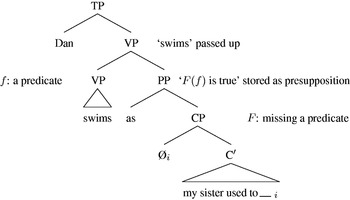
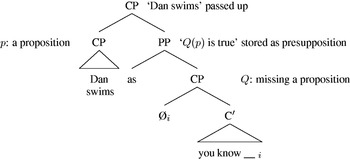
Potts (Reference Potts2002b: 654) posits lexical entries for predicate- and CP-as. Their denotations are indicated in (42) and (43), and their structural positions in Figures 2 and 3.Footnote 9
(42)
as Pred=λF〈〈s,et〉,t〉[λf 〈s,et〉: F(f) is true [f]]
 as Pred
 =λF〈〈s,et〉,t〉[λf 〈s,et〉: F(f) is true [f]]
(43)
as CP=λQ〈〈st,t〉,t〉[λp 〈st〉: Q(p) is true [p]]
Semantic composition of predicate-as.

Semantic composition of CP-as.

In the structures in Figures 2 and 3, the gap is due to the presence of a phonologically-null operator (Ø), which moves to the specifier position in the clause. This is unlike in a wh-relative clause structure, in which the wh-word itself fills the gap. The denotations in (42) and (43) let as select a clause with a very particular type of semantics. The clause will either be a proposition missing a predicate, or a proposition missing a propositional argument. The as acts as a semantic transfer point.
Contrast as in (43) above with which in (44).Footnote 10
(44)
which CP=λf 〈e,t〉[λx p〈e〉: f(x) is true [x p]]
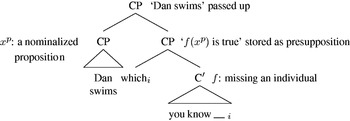
As a relativizer, the final position of which is where the null operator Ø is in as-clauses. The main semantic difference to note is that which takes as an argument a set of ‘nominalized propositions’ (λx p〈e〉), and that it returns a partial identity function (λx p〈e〉:…[x p]) on these nominalized propositions (see Figure 4).
Semantic composition of CP-which.

Given this proposal, let us consider Potts' objections to a relativizer as. He observes that that as is blocked from appearing in its ‘base’ position, unlike other pro-sentential words like so: so I hoped is paraphrasable as I hoped so, but as we all hoped cannot be *we all hoped as. Yet, it is not the case that every variety of extracted element must have a non-extracted variant. In fact, relative pronouns do not ever appear in-situ (*the child you met whom). The existence of wh-in-situ questions does not fulfill the extracted/in-situ alternation test for wh-words, as relative clauses and questions are not paraphrases of one another. The relativizer that (or the appropriate null operator) similarly have no in-situ alternatives. The non-occurrence of in-situ as is equally expected under both a relative clause and a PP analysis.
A further argument (not made by Potts) might be that the other senses of as – including especially the one that means roughly ‘because’ – are not extracted elements but subordinating prepositions; as such it makes more sense to place supplemental as in this category. This is essentially the argument made for treating that as a complementizer in relative clauses. Unfortunately the usual tests for pronoun-hood that are attempted on that (e.g., *the child that's toy broke, *the child with that I was playing) cannot be applied to as, because those tests require the extractee to be nominal. Again, the syntactic facts are equivocal with respect to what fills the gap.
Potts's second argument comes from cross-linguistic comparison of as-like constructions. The word analogous to as in Thai is yaaŋ, which is related to the question word for ‘how.’ This is illustrated in (45) (from Potts Reference Potts2002b; comp abbreviates complementizer). If yaaŋ is the extracted element, that would make it the only case of movement of a phonologically non-null element in an otherwise wh-in-situ language. Setting yaaŋ to be a preposition avoids this problem altogether.
(45) thuʔ.rian ʔa.roy yaaŋ thii khon ee.chian laai khon ruuDrurians delicious as comp Asians many many class know‘Durians are delicious, as many Asians know.’ (Potts Reference Potts2002b: ex. (35))
There are some difficulties with this approach. The Thai yaaŋ-clauses still contain a gap, and therefore would contain a null operator. Because an in-situ wh-phrase may appear within an island with no ill effects (Ruangjaroon Reference Ruangjaroon2005), the operator in yaaŋ-clauses must move to Spec,CP to generate the observed island violations. This requires the stipulation that the movement operation is sensitive to the lexical identity or phonological form of the moved elements (one each for predicate- and CP-gapped clauses), or that these operators alone contain a feature which compels them to move. This does not seem to be any worse than simply allowing, exceptionally, a single construction in which there is a long-distance dependency between an overt relativizer and a gap. As with the in-situ argument, then, the Thai syntactic facts do not seem to come down on one side or the other.Footnote 11
4.2 External syntax
Several further differences have been observed between as- and which-clauses:
(i) As-clause gaps may not appear within ‘selective’ islands, i.e., islands which under some circumstances allow long-distance dependencies; which-clause gaps may.
(ii) As-clauses cannot span negation; which-clauses may.
(iii) As-clauses may be ‘niched’ (i.e., have very few linearization restrictions); which-clauses cannot (see also Ross Reference Ross, Brugman and Macaulay1984).
(iv) As-clauses may, depending on their position, ‘ignore’ main-clause negation and modality when determining the semantic content of their gap; which-clauses may not.
Potts (Reference Potts2002a: 74–76) pins the first difference on the nominality of the gap, and the second on semantic (and possibly pragmatic) asymmetries, and so I set them aside as not directly relevant to consideration of the syntactic structure of these clauses. Below, I address the latter two differences, which crucially involve questions of external syntax.
Section 3 above showed that linearization of relative clauses is sensitive to a variety of factors, including the relativizer itself and the syntactic type of the anchor (noun vs. clause). Nevertheless, if as-clauses were relative clauses, they would be unique in their tremendous range of linearization possibilities. Schematic indications of the range of linear positions are shown below. In each place marked with a ✓, a clause like as I said is possible. The subscripted *, ?, ??, and ✓ indicate varying degrees of acceptability (according to my intuition).
- (46)
(a) ✓The *chancellor ✓might ✓have ?been ?too ??willing ?to ?ignore ??students *of *literature✓.
(b) ✓He ✓ignored ?most ??of *the *students' *desires✓.
Ross (Reference Ross, Brugman and Macaulay1984) noted this possibility for flexible placement (the possibility of ‘niching’ in various locations) and characterized the linearization possibilities as ‘roughly the same… as any other sentence adverb’ (page 261).Footnote 12 As Pullum & Huddleston (Reference Huddleston, Huddleston and Pullum2002: 578–580) observe, however, not all adverbs (even ‘sentence adverbs’, or ‘clause-oriented adverbs’, as they call them) have the same linear preferences. They identify several semantic types of AdvP, including manner/means/instrument (e.g., erratically, arithmetically), act-related (e.g., foolishly), degree (e.g., almost), and evaluation and speech act-related (e.g., unfortunately, frankly). Each of these classes is associated with its own pattern of linearization. Though the distribution of as-clauses is unlikely to be identical to any of these, it may be compared with evaluation and speech-act adverbs (e.g., unfortunately, frankly), which, according to their intuitions, have the linear possibilities shown in (47). For Pullum & Huddleston (Reference Huddleston, Huddleston and Pullum2002: 578), a ? indicates a location where the adverb ‘might occur but would be disfavoured (not fully acceptable)’.
- (47)
(a) ✓They ?had ?set out ?too late?.
(b) ✓This ??is ?becoming ?a joke?.
There is of course no need to pin the distribution of as-clauses to a specific, existing, class of AdvPs. We can simply observe that the criteria for linearization of supplemental AdvPs includes the semantic type of the adverb and the syntactic category of the anchor (predicative, clausal), and so these features should be available to other supplemental constructions as well.
The construction in (48) describes the combination of an as-clause with its anchor. Rather than concatenation of the dom elements of the daughters, the as-clause – as a whole – is shuffled (symbolized by
 ) with the dom elements of the anchor in a ‘liberating’ construction (Hofmeister Reference Hofmeister2010: 290). Two lists combined via this operation maintain their own internal orderings, but items from separate lists may intermingle. This effectively allows the as-clause to appear anywhere except in the middle of strings which are (independently defined as) uninterruptable (see Beavers & Sag Reference Beavers, Sag and Müller2004 and Hofmeister Reference Hofmeister2010 for implementation of this via ‘compaction’ in an HPSG/SBCG framework). The as-clause itself is compacted into a one-element list, indicating that it itself cannot be interrupted by anchor material (or by any further additions to the structure).
(48) Supplemental as-clause plus anchor (↑ suppl-anchor-cxt)
This is only a rough representation, designed to show the possibility of combining what is internally a relative clause with an anchor as though it were a sentential adverbial. Accounting for differences in acceptability for different niching locations is a more general issue that will involve a better understanding of niching of a wide variety of constituents. The only as-specific issue not addressed in this construction is the fact that, as Potts (Reference Potts2002a: 77–81) notes, an as-clause linearly ordered after clausal negation can ignore the negation. They did not take the bribe, as Kim claimed can indicate either that Kim claimed that they did take the bribe, or that they did not. Potts derives this effect from attachment to a structure below negation (e.g., VP). However, assuming that negation is subordinate to tense, this predicts that when negation is ignored, so is tense – yet, it is always identical between the anchor and the as-clause. It cannot be that Kim claimed that they will take, are taking, (habitually) take, etc., the bribe. The ultimate solution, it appears, must appeal to more than just hierarchical structure.
The picture that emerges from this and the other SRC constructions is that the determination that a particular structure is a relative clause reveals little about its linearization possibilities. It is only when we learn whether the relative clause is supplemental or integrated, adnominal or adpredicative/adclausal, and whether the relativizer is as, what, or which, that the linear ordering possibilities become fixed. Put another way, the linearization potential of a particular phrase is not alone diagnostic of its internal syntax, nor vice versa.
Support for this point comes from a distinct sense of supplemental as. In what I will call name-as, the gap in the as-clause corresponds to a ‘name’ of some sort. Typical sentences are provided in (49).
- (49)
(a) In other words, unless Ralph Nader builds that mass movement pretty quick, thereby breaking the two-party duopolyas he calls it, look out America – more beer riots are on the way!
(http://www.alternet.org/story/12479/?page=entire, 9 June 2008)
(b) That was when Adams began to rely on her peers to in order to as she calls it ‘survive and figure out how to make [her life work].’
(http://www.wiretapmag.org/wire/85395/, 27 April 2011)
(c) And I think that they were anxious to – as they referred to it – shed their containers.
(http://corpus2.byu.edu/coca/x4.asp?t=227584&ID=582005475, 27 April 2011)
(d) This is the account I attribute to, as I call him, ‘Sartre-Two’, and to which I now turn.
(Julian Young, The Death of God and the Meaning of Life, Routledge, 2003, p. 142)
If linearization is determined by the internal syntax of the modifier, then we should expect name-as clauses to have a distribution comparable to other supplemental as-clauses discussed here. This is predicted by Huddleston (Reference Huddleston, Huddleston and Pullum2002: 1147), who claims that the distributional difference between (adclausal) as and which is ‘attributable to the fact that the as here is itself the comparative governor, rather than being selected by some superordinate governor that it must follow’. Yet, name-as cannot appear just anywhere in the sentence. It may appear preceding or following the anchor, but nowhere else, as can be confirmed by attempting to move any of the above as-clauses away from or into their respective anchors. Unlike (48), name-as is shuffled with a compacted anchor, meaning that it may appear before or after, but not in the middle.Footnote 13
Stepping back, we can ask, given the internal syntactic consistency of relative clauses (including for the moment as-clauses): Are there any distributional generalizations to be made? It is true that supplemental as- and wh-clauses cannot be separated from their sentential anchor. Yet, this alone does not account for the detailed linearization constraints on specific constructions. Adnominal supplemental relative clauses are only post-anchor, and can be extraposed. Name-as and CP-/predicate-as can appear either anchor-initially or anchor-finally, and the latter (along with clause-oriented AdvPs) can be niched in the middle of the anchor. Adclausal what relatives must, and which-clauses can, appear anchor-initially. In sum, the grammar need only contain the fully-specified constructions. The high-level generalizations about linear order are best understood as meta-grammatical observations that may or may not be part of any individual's grammatical competence (Kay Reference Kay, Lehrer and Kittay1992). This does not mean, as one anonymous JL referee worries, that we throw out the basic fact that most relative clauses are right-adjoined. Yet, this fact need not be explicitly represented in the grammar, either in the specific constructions or in the type hierarchy. These simply provide the basic syntactic resources of a language. Which ones are more frequent or ‘canonical’ is partly based on the specificity of the constructions (which-LARCs place severe constraints on surrounding structure, which works against their being very frequent), and partly on the types of discourse in which particular constructions tend to be used.
In the final section, I turn to evidence that as-clauses (and which-SRCs) exhibit a type of anaphoricity seen in do so and one anaphora. This makes an SRC analysis of as not only possible, but perhaps more suitable than the alternatives.
4.3 As and anaphoricity
The semantic composition outlined in (42) and (43) entails an inflexible calculation of the meaning of an as-clause. Its semantic variable is filled by exactly the denotation of the node to which it adjoins. For Potts this is a virtue: it allows semantic interpretation to follow surface syntax, without appeal to ‘interruptions’ in the syntax. I will refer to this as a sister-antecedent approach. An alternative, which is in keeping with a relative clause approach, is to understand the relationship between as and the anchor as primarily discourse anaphoric (as is predicted given the anaphoric dependency specified in (23)). This section presents some previously unnoticed data that support such an understanding.
The division of as-clauses into those with predicate-sized gaps and those with clause-sized gaps usually corresponds to the ‘size’ of main clause semantics which is ported into the as-clause. Yet, there exists a class of sentences in which, due to additional material in the as-clause, this correlation does not hold. In (50), the as-clauses are bracketed, and the anchors to which they attach are in italics. In each case some part of the anchor cannot be interpreted as filling the as-clause's gap, because it is supplanted by an adjunct in the as-clause. These ignored portions and their correspondents are underlined.
- (50)
(a) Or perhaps she got the name of the Chinese American Citizens Alliance close but not quite right, [as she had with the Arizona Historical Society's library]?
(b) The secret police will doubtless try to make sure there are no demonstrators chanting in the streets on Saturday, [as thousands did in Leipzig on Monday night].
In (50a) the verbal complement of had is missing, but it is not interpreted as the entire VP of the anchor. Doing so would result in anomaly: #She had gotten the name of the Chinese American Citizens Alliance close but not quite right with the Arizona Historical Society's library. Rather, the as-clause-internal with-PP contrasts with part of the anchor, and supplants it in the interpretation of the as-clause. What is missing in the as-clause is ‘gotten the name of… close but not quite right’, where the final part of the interpretation is supplied by the with-PP as ‘the Arizona Historical Society's library’. The example in (50b) is similar, though with contrasting place and time expressions.
One possibility that can be set aside is that predicate-as in fact involves verb phrase ellipsis. Adjuncts local to an ellipsis site may replace parts of the antecedent that might otherwise be included (he bought a car yesterday, and his brother (did (so/it)) today). But Potts (Reference Potts2002b: 627–629) has demonstrated that ellipsis is not implicated in as-clauses, so the data in (50) require separate analysis.
More striking is that the same phenomenon is possible with CP-as, such as those in (51).
- (51)
(a) Yet, [just as Bruno claimed for an infinite universe], this finite model has ‘no center nor edge’.
(Eric Paul Jacobsen, From Cosmology to Ecology: The Monist World-view in Germany from 1770 to 1930, Peter Lang, 2002, p. 28)
(b) I suppose we'll never know whether Bush … associates this construction [noo-kyoo-lar] with folksy, hypermasculine speech ([as Arnold Zwicky suggests for some other features [of his speech, i.e., is-is]]).
(http://itre.cis.upenn.edu/myl/languagelog/archives/001139.html, 1 May 2008)
(c) [T]he question arises whether a mono (exclusive) diet of millet may not have great therapeutic value, [as was claimed for the rice diet (rice and distilled water) in cardiac conditions].
(Raymond W. Bernard, Organic Foods for Health, Health Research Books, 1956, p. 14)
(d) Now, [just as is claimed for the case of colour], it may seem that the experience of musical harmonies must ‘reveal’ something about their ‘intrinsic nature’.
(Jillian Scott McIntosh, Naturalism, Evolution, and Intentionality, University of Calgary Press, 2001, p. 221)
Each of the sentences in (51) has an as-clause with a clausal gap, but what semantically fills those gaps is not propositional, i.e., not a predicate with all its arguments. In (51a) we understand Bruno to be claiming that ‘an infinite universe has no center nor edge’, meaning that what is missing is ‘has no center nor edge’. The for-PP provides the missing subject. In (51b), the as-clause asserts that Zwicky suggests ‘Bush associates… with folksy, hypermasculine speech’, with ‘…’ provided by the for-PP. Such non-complete propositions are characteristic of verb phrases (which have no subjects) or open propositions. However, neither of the verbs involved (claim and suggest) take VPs or open propositions (at least not in the senses intended), only fully saturated propositions.
This phenomenon is not unique to as-clauses. It is observed in which-SRCs with predicate or clausal gaps:
- (52)
(a) In the end, I decided to watch it, so I could again serve the public by telling them about another B movie person to avoid ([which I did earlier with Albert Pyun in my review of Omega Doom].)
(http://www.badmovieplanet.com/unknownmovies/reviews/rev169.html, 9 June 2008)
(b) As a matter of fact, Müller claimed that Burke was more German than he was English – [which he also claimed for Shakespeare].
(http://mars.wnec.edu/grempel/courses/germany/lectures/07reform. html, 9 June 2008)
Culicover & Jackendoff (Reference Culicover and Jackendoff2005: 138) observe a similar phenomenon with respect to one anaphora: ‘the construction of an interpretation for one… is simply the interpretation of the antecedent NP less the material in contrast’. By ‘the material in contrast’ is meant any phrases local to the one that have corresponding material in the antecedent NP. What counts a contrast or correspondence may be determined syntactically, semantically, or pragmatically. Examples are in (53) (based on Culicover & Jackendoff Reference Culicover and Jackendoff2005, examples (66)–(68)).
- (53)
(a) One kid got a scoop of ice cream in a cone with chocolate sprinkles, and another kid got one (in a cup) (with rainbow sprinkles) too.
[one=‘a scoop of ice cream (in a cone) (with chocolate sprinkles)’]
(b) I hung up a portrait of my father showing us having fun together next to one of my mother.
[one=‘a picture (showing us having fun together)’]
In these sentences, the modifiers appearing after one influence the calculation of one's antecedent. Culicover & Jackendoff (Reference Culicover and Jackendoff2005) call such adjuncts ‘orphans’ (see also Mikkelsen, Hardt & Ørsnes Reference Mikkelsen, Hardt and Ørsnes2011). They note the existence of orphans in the verbal domain, with the anaphoric expressions do so, X happen, and verb phrase ellipsis.Footnote 14 Examples of this for do so and it-happen anaphora are shown in (54) (from Culicover & Jackendoff Reference Culicover and Jackendoff2005: 288).
- (54)
(a) Robin broke the window (with a hammer) and Mary did so to the tabletop.
(b) John turned the hot dog down flat, but he wouldn't have done so with filet mignon.
(c) John ate the cake but it wouldn't have happened with the pizza.
(d) John shot Mary, but it wouldn't have happened with Sam.
Culicover & Jackendoff find some patterns for how the orphans are interpreted: with introduces a Theme, and for often replaces topics, loosely speaking (for instance, in as-clauses with claim or suggest, the for-phrase replaces the individual about which a claim or suggestion is being made). This is despite the fact that the antecedent verb may not take such PPs as complements (*John turned with the hotdog down flat). Of course it is also possible to replace material in the antecedent with a canonical PP. For instance, in non-anaphora contexts, with-PPs can introduce instruments; in a do so phrase, it can also replace an instrument from the antecedent. If the meaning of one or do so were simply based on the syntactic configuration of their antecedents, this flexibility of interpretation would not be expected. Treating these elements as anaphoric expressions opens up the possibility for non-identity with the antecedent.
The fact that this same flexibility is seen in as- and which-clauses poses a problem for a sister-antecedent account. When the as-clause's semantics is composed with that of the node to which it is adjoined, there is no preventing the entire semantic denotation of the anchor from being incorporated into the gap. For example, if as he claimed for an infinite universe from (51a) above adjoins to this finite model has no center nor edge, it will be looking for something to fill the missing argument of claim, but there is no way to exclude ‘this finite model’. The result is that the intended reading, where Bruno claims that an infinite universe has no center nor edge, is predicted to be unavailable.
In contrast, treating as and which as discourse anaphors (with syntactic restrictions on possible antecedents) groups them with do so, one, and X happen. This predicts that sentences like (50)–(55) are possible, as it is precisely in the context of such anaphors that orphans are licensed. This dovetails nicely with a relativizer analysis. Relative pronouns in adnominal appositive relative clauses have been analyzed as discourse-anaphoric pronominals (Del Gobbo Reference Del Gobbo2003: 123; Arnold Reference Arnold and Müller2004a; Arnold & Borsley Reference Arnold, Borsley and Müller2010, and citations therein). Given this precedence in the domain of adnominal RCs, and the existence of the non-nominal anaphor do so, I see no trouble in extending the idea of anaphoricity to non-wh sentential relativizers like as.
Taking such a step leads to a further prediction: there should be other contexts in which there is a mismatch between the as-clause's missing semantics and the meaning of the anchor. One such context is when the supplement denotes a generic or habitual situation, while the anchor denotes a specific event, as in (55).
- (55)
(a) When they wed Esteban did not love Elena, who was not exactly pretty, nor did Elena love Esteban, who was not exactly gallant; however, [as sometimes happens,] their marriage was a success, and more of one the longer it lasted.
(http://corpus2.byu.edu/coca/x4.asp?t=1004775&ID=376079576, 27 April 2011)
(b) We didn't find the submarine where it was supposed to be[, which is usually the case].
(http://corpus2.byu.edu/coca/x4.asp?t=233172&ID=597290924, 27 April 2011)
In this case the exact denotation of the anchor must be abstracted into a generic meaning. The as-clause, as a result, means approximately, ‘it sometimes happens that a marriage is a success,’ and the which clause means ‘It is usually the case that we don't find a submarine where it is supposed to be.’
Taking a discourse anaphoric approach to as-clauses seems the most straightforward way – or at least the most promising first step – towards an understanding how such sentences mean what they do. At this stage it is not possible to rule out a sister-antecedent approach. A properly specified null operator, combined with additional principles of semantic interpretation, might handle the data just as well. Yet, given the existence of wh-relatives with the same semantic property, and the resulting unity of orphan-licensing contexts, an overall tighter system is arguably obtained by grouping as with other relativizers. Future investigations into the structure and interpretation of as-clauses will at the very least need to take these semantic and pragmatic properties into account, and will not be able to ignore the possibility of a relative clause analysis.
5. Conclusions
In this paper I have presented a range of data from supplemental clauses, illustrating the relationship (or lack thereof) between their internal structure and external syntactic distribution. While the majority of SRCs follow their anchors, there do exist constructions which license the pre-anchor position for specific varieties of clause- and predicate-modifying supplements. Which-relatives can appear in the initial position, provided they are preceded by a coordinator. What-relatives are licensed only in the initial position, and are often, but need not be, preceded by a coordinator. This is despite their nearly-identical internal relative-clause syntax.
These findings were leveraged in arguing that supplemental as-clauses too might be considered RCs, despite several differences with which-clauses, including constraints on linearization. Previous analyses treated as-clauses as merely ‘superficially’ related to RCs (e.g., Del Gobbo Reference Del Gobbo2003: 99), possibly because of their different linearization patterns. This required positing an alternative structure for their internal syntax which duplicated RC syntax. By separating internal from external (especially linearization) features, one can succinctly capture cross-constructional generalizations while retaining a place for item-specific differences.
The internal/external distinction has been leveraged previously in several varieties of analysis, e.g., the work on gerunds by Hudson (Reference Hudson2007) and pre-determiner degree-modified adjuncts like too big a table (Zwicky Reference Zwicky1995). It may be applied to structures which are internally non-nominal but which appear in typically nominal positions (under the table is a good place to hide) and structures which are internally nominal but externally adverbial or prepositional (they left last Monday) (McCawley Reference McCawley1983). In the case of as and which, the distinction provides additional analytic gain. Treating both of these constructions as SRCs groups them semantically and pragmatically with do so, X happen, and other discourse-anaphoric constructions that allow for orphan phrases. The internal/external division is made clear in a framework like SBCG which allows, when necessary, detailed specifications of subtypes of construct types. Thus, while a single construction specifies the internal makeup of an SRC, several subtypes exist which constrain how such a clause hooks up with its anchor. This makes it clear what unifies these constructions (e.g., long-distance dependency, semantic supplementation), and what distinguishes them from each other (linearization constraints).
As is also made clear by the constructional descriptions, there is no clean cut between the internal and external features of a given expression. Any given sign specifies aspects of its combinatory potential, by means of such attributes as select, val, anchor, and so on. Yet, the relation between the internal makeup of a sign and its linearization with respect to the elements it combines with (via val, anchor, etc.) is not trivial. A construction licensing a combination of supplement and anchor does not specify the ordering relation between the two. It is the subtypes which specify linearization, sometimes in very different ways. This provides further support for a (principled, and partial) disconnect between hierarchical structure and linear order (Hofmeister Reference Hofmeister2010) and for the use of a grammatical framework that recognizes a mix of regularity and idiosyncrasy within syntactic structures.