1 Phonological structure
Research on the more recent development of future time expressions in English tends to focus on two areas, namely the emergence and grammaticalisation of be going to on the one hand and the development of shall and will (i.e. the decline of shall and increase of will in most grammatical contexts) on the other (e.g. Danchev & Kytö Reference Danchev, Kytö and Kastovsky1994; Pérez Reference Pérez1990; Fries Reference Fries1925; Gotti et al. Reference Gotti, Dossena, Dury and Facchinetti2002; Gotti Reference Gotti, Facchinetti, Krug and Palmer2003). Other means of referring to the future (all subsumed under the term ‘future time expressions’ here) such as the present progressive, the simple present and be to have hardly received any attention so far. Moreover, the question of a potential connection between the developments of the individual future time expressions has (with the exception of the developments of will and shall) been almost completely neglected to date.
The present article constitutes a first attempt at answering this question, i.e. to what degree the evolution of future time expressions in the late modern period can be described in terms of a redistribution of future time expressions and to what degree it can be described in terms of discourse change. An exclusive redistribution of forms would mean that the meanings and contexts of usage of future time expressions have remained fairly constant over the past 350 years and that it is merely the forms that fulfil the relevant functions that have changed. If contexts of usage and thus the expressed future meanings have changed either quantitatively or qualitatively, however, scholars will have to consider whether the development of future time expressions rather reflects changes in discourse conventions, either in general or at least in certain registers.
In the study presented in this article, the development of the future uses of will, ’ll, shall, be going to, be to and the present progressive will be traced from 1650 to 1999. The investigation will be based on the British part of ARCHER (A Representative Corpus of Historical English Registers). First, overall frequency developments of the future uses of the expressions under investigation will be compared. Then, the development of the individual expressions in certain grammatical contexts will be compared, in order to tackle the questions of possible replacements of certain forms with others and of possible general changes in discourse about the future. In a third step, the developments in different registers will be regarded separately, in order to investigate whether register-specific changes in discourse may also play a part in the development of future time expressions across the late modern period.
2 Previous research
While research that tries to link the diachronic evolution of future time expressions to change in discourse is, to my knowledge, practically nonexistent to date, there are a few studies that at least touch on the question of potential connections between the more recent developments of individual future time expressions. The only potential connection that has been studied in some detail, however, is the one between shall and will. In an early systematic study of the usage of the two expressions, Fries (Reference Fries1925) investigated the use of will and shall in British drama from 1560 to 1918 and American drama from 1905 to 1918. His approach of investigating the two future time expressions as a closed system, as it were, and interpreting changes as one form replacing the other, has been followed by subsequent researchers. The underlying assumption of a direct connection between the development of the two expressions is evident in Fries’ presentations of the results – both graphically, as the developments are displayed in percentages of will vs shall, and verbally, as the opposing developments in the two auxiliaries are interpreted as replacement processes (Reference Fries1925: 995ff., 1023f.). His main results pertain to the development of will and shall in declarative statements, where he finds that ‘in the 2nd and 3rd persons will has gradually displaced shall’ and that ‘the 1st person with will has always predominated with no great shift of frequency or development’ (Reference Fries1925: 1023). An important limitation of his analyses which they share with many others on the diachronic development of will and shall (e.g. Kytö Reference Kytö1991 and see below) is that future uses and non-future uses are not differentiated, so that senses that can only be expressed by one of the two auxiliaries (and where, consequently, processes of replacement cannot have taken place) are included.
An exception to this is the approach adopted by Gotti (Reference Gotti, Facchinetti, Krug and Palmer2003), who compares the diachronic development of different uses of the two auxiliaries in Middle, Early Modern and Present-day English. Gotti finds that the volitional uses of both will and shall decline over the centuries, with shall declining much more drastically. He also finds that ‘[i]n the expression of prediction . . ., the use of shall is increasingly being replaced by forms of will’ (Reference Gotti, Facchinetti, Krug and Palmer2003: 295). As in most writings on will and shall, however, the diachronic developments of these two auxiliaries are also described as processes of mutual replacement, and the relation of these developments to the ones of other future time expressions is not considered.
In the case of be going to, where the evidence generally points towards a considerable increase in the past few centuries (for exceptions see below), diachronic investigations tend to concentrate on the grammaticalisation processes involved and are not usually concerned with the question of a potential connection with the development of other future time expressions (e.g. Danchev & Kytö Reference Danchev, Kytö and Kastovsky1994; Mair Reference Mair, Lindquist and Mair2004; Pérez Reference Pérez1990). Occasionally, the assumption that the rise of be going to has taken place at the expense of will (and possibly shall) can be found, though this is not usually stated explicitly: ‘be going to + infinitive is frequently used, especially in modern AmE, as a substitute for the pure future instead of shall and will’ (Núñez Pertejo Reference Núñez Pertejo1999: 140). I am aware of only two studies in which the diachronic substitution of be going to for other future time expressions is considered a possibility:
The going-to-future . . . has become more frequent because it tends to be chosen more often in contexts in which it has long been established and competing with will/shall and other expressions of futurity. (Mair Reference Mair, Hickey and Puppel1997: 1541)
While Mair does not investigate this question any further, I have recently investigated a potential connection between the rise of be going to and the decline of be to in the course of the late modern period (Nesselhauf Reference Nesselhauf, Houswitschka, Knappe and Müller2006). This study has revealed that some substitutions (in the sense that be going to is used in contexts in which be to was used earlier) may have taken place, but only in a minority of instances (namely in cases where earlier be to expressed ‘intention’).
Apart from Nesselhauf Reference Nesselhauf, Houswitschka, Knappe and Müller2006, I am aware of only two studies diachronically investigating the potential connection between the development of future time expressions other than only will and shall.Footnote 1 These are Berglund (Reference Berglund2005) and Smith (Reference Smith2005), who each investigate several future time expressions in the very recent past. Both base their work on LOB and FLOB, two matching corpora of British English from 1961 and 1991.
Smith investigates will + be -ing, will + infinitive, shall + infinitive, be going to (present), be to (present) and the futurate present progressive with respect to their frequency. Smith's focus is on the development of will + be -ing, and his analysis reveals that in terms of relative frequency, it is the proportion of will + be -ing that increases most markedly. The proportion of will + infinitive and be going to also increases, though slightly, and in absolute terms their numbers decrease. The proportion of the futurate present progressive, be to and shall + infinitive decrease, with the progressive displaying the slightest and shall the greatest decrease, both in relative and absolute terms. Smith concludes that ‘the spread of will + be -ing . . . may not be so closely connected to a usurping of will + simple infinitive as one might assume’ (Reference Smith2005: 150). An important limitation of the study again is that all uses of be to, will and shall were taken into consideration, including non-future uses, so that the proportions given do not accurately reflect the proportion of expressions of the future.
Berglund (Reference Berglund2005) analyses the proportions of will, ’ll, shall, be going to and gonna in LOB and FLOB as well as separately in the press sections of these corpora (and the press sections of the matching corpora of American English). The starting point of her analysis is Mair's (Reference Mair, Hickey and Puppel1997) observation that be going to increases in the press sections of LOB and FLOB and the question of whether this increase is mirrored by a decrease in will and shall. To investigate this, she analyses the relative frequencies of the five future time expressions (with be going to and gonna combined). Her analysis reveals a slight increase in the proportion of (present) be going to and gonna and a slight increase in the proportion of ’ll, as well as a slight decrease in the proportion of shall and will. Berglund concludes that ‘the increase in the use of be going to found by Mair is indeed at the expense of will and shall (although not ’ll), and not due to an increased use of expressions of future as a whole’ (Reference Berglund2005: 131). When she extends her analysis to all sections of the two corpora, there is evidence that these developments are limited to certain registers, however. The only development that holds across most registers is the decrease in shall; for all the other investigated future time expressions (including be going to/gonna) she finds that ‘there is little consistent variation between the earlier and later corpus. The use of the other expressions does not seem to vary with time’ (Reference Berglund2005: 132).
In addition to the common limitation of the lack of distinction between future and non-future uses, a further limitation inherent in Berglund's approach is the fact that the calculated proportions of the future time expressions do not include all the existing future time expressions. This, as well as the fact that Berglund investigates different registers separately, explains the differences between her results and those of Smith. Owing to the choice of corpora, both studies are also restricted to a time span which is relatively short for the examination of grammatical change. The trends they observe therefore may or may not be indicative of longer-term developments in the system of future time expressions.
3 Data and methodology
The present study differs from most of the previous ones on the diachronic development of future time expressions in that it is limited to the future uses of the relevant expressions, so that only uses which, in principle at least, could have substituted for each other in the course of the late modern period have been included. It is also the first study that examines more than two future time expressions simultaneously across Late Modern English.
The corpus used for the study, ARCHER (A Representative Corpus of Historical English Registers), version 3.1, consists of nine different registers of British and American English from 1650 till 1999.Footnote 2 The corpus is subdivided into fifty-year periods, each of which contains between 10,000 and 30,000 words of texts from each register. The following registers are represented in the corpus (abbreviation in brackets):
drama (d), fiction (f), homilies & sermons (h), journals/diaries (j), medical prose (m), newspaper reportage (n), scientific research writing (s), private letters (x).
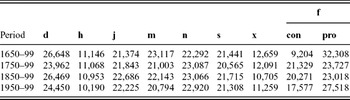
The category ‘fiction’ naturally contains both the registers fiction prose and fiction conversation, which, for the purposes of this investigation, have been analysed separately (abbreviated as ‘pro’ and ‘con’). For the analyses presented in this article, only the British part of the corpus and only every other fifty-year period was investigated, namely (abbreviations as they appear in corpus examples given in brackets) 1650–99 (2b), 1750–99 (4b), 1850–99 (6b), 1950–99 (8b). The exact number of words for each register in the relevant subperiods is given in table 1. As can be seen, the composition of each fifty-year period is almost identical for all registers, except for the subcategories of fiction prose and fiction conversation. The total number of words in each fifty-year period is about 180,000, so that the present study is based on slightly over 700,000 words.
Composition of ARCHER 3.1 (relevant subperiods only)

Searches were performed on these data for all the forms of will, ’ll and shall that are recorded in the OED for the relevant periods (including, among many others, wil, wul, wilt, won't, wont; ’ll, ’l, ’le; shalt, shal, shan't, sha'n't). In the case of the progressive with future time reference, be going to and be to, only the present tense forms were included in the investigation, so as to ensure comparability with the ’ll future forms (i.e. will, ’ll, shall), as would and should were also excluded from the searches. For the progressives and be to, all present tense forms of to be recorded in the OED for the relevant period were included in the searches, as well as -ing, -yng, -in, -in’ and -n’ in the case of the progressive, and to and t’ in the case of be to. Up to three intervening words were allowed between to be and -ing in the case of the progressive, and two intervening words were allowed in the case of be to. In the case of be going to, the search was for some fifty recorded forms of going (such as goin’, goin, agoing, gonna, gona, etc.), plus to or t’, with up to two intervening words allowed. These search strategies should have captured the majority, if not all, instances of the future time expressions investigated. Particularly in the case of be to, however, it has to be pointed out that a few instances, namely those with more than two intervening words, may have been missed.
The next step in the analysis was to manually exclude instances which do not represent cases of auxiliary will, shall and ’ll (in particular, instances of the noun will), cases of be + -ing that do not represent instances of the progressive, cases of be going to which do not represent instances of the going to future (but rather progressives of go plus an adverbial introduced by to) and cases of be to which do not represent the semi-modal be to (but, for example, instances of copular be plus to introducing an infinitive clause).
In a third step, the future and non-future uses of the expressions investigated had to be distinguished. This step proved to be the most difficult one in the analysis, as expressions are often ambiguous between future and non-future uses. In those cases where a clear decision could not be made the instances were included in the analysis. In the case of will and ’ll, clear examples of predictions referring to the present were excluded (By now, they'll/will be eating dinner), as well as instances expressing habits or characteristic behaviour (At weekends, he'll/will be in the club by 7 o'clock), and instances expressing general predictions (If litmus paper is dipped in acid, it will turn red; examples from Leech Reference Leech2004: 86). In the case of shall, clear instances of obligation (A player who bids incorrectly shall forfeit fifty points [rules of a card game]; Leech Reference Leech2004: 89), of addressee's volition (Shall I open the window?) and addressee's advice (Shall I ring her or not?) were excluded. In the case of be to, clear instances of obligation (You are to report this to the police; OALD 2000: 93), of possibility (The exhibition of modern prints is currently to be seen at the City Gallery; CIDE 1995: 106) and of if-clauses of purpose (If he is to be stopped, we have to act now) were excluded (see also Nesselhauf Reference Nesselhauf, Houswitschka, Knappe and Müller2006).Footnote 3
The simple present with future time reference was excluded from this study, due to time constraints. It is intended, however, to include it in a larger project on the evolution of future time reference in Late Modern English (Nesselhauf, in prep.). What this omission means for the interpretation of the results will be discussed in section 4.1. Minor future-referring expressions and/or those with strong connotations going beyond mere reference to the future are also disregarded here, such as be on the point of, be about to, be due to, etc.
4 Developments across registers
4.1 The overall development of future time expressions in Late Modern English
Before questions of possible redistribution processes can be investigated, the overall development of future time expressions in the course of the late modern period has to be considered. Perhaps somewhat surprisingly, even the general development of different future time expressions in the past few centuries has hardly been investigated, with the exception of be going to and shall, where both general wisdom and numerical evidence point to an increase and decrease, respectively.
With respect even to will, however, the picture is far from clear.Footnote 4 Data from LOB and FLOB (British English, 1961 and 1991) point towards a slight decrease (in absolute terms) in the written language of the second half of the twentieth century (Leech Reference Leech, Facchinetti, Krug and Palmer2003: 229; Smith Reference Smith2005: 149). Investigations and statements limited to will and shall consistently show or assert a relative increase of will and often seem to imply an overall increase (see section 2). One of the only clear statements on the development of will in absolute terms can be found in Görlach, who asserts an ‘increase of “future” will’ for the nineteenth century, though the basis for this claim is unclear (Reference Görlach1999: 84). Whereas the decrease of shall might warrant such a conclusion, the rise of the going to future might have the contrary effect on will.
With respect to the proportions of the increase in be going to, the decrease in shall and the development of will in the past few centuries, no data are available so far, except for the data on the very recent development in Smith and Berglund (see section 2). Analyses on the numerical development of future uses of be to in Late Modern English and the progressive with future time reference have recently been provided in Nesselhauf (Reference Nesselhauf, Houswitschka, Knappe and Müller2006) and (Reference Nesselhauf2007); in the latter, it was demonstrated that the use of the progressive with future time reference has increased quite considerably in the course of the late modern period.
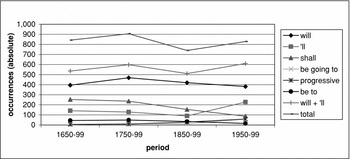
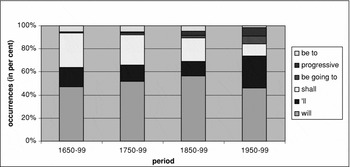
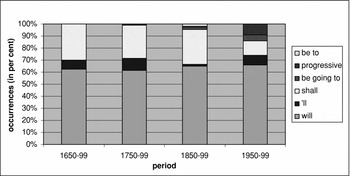
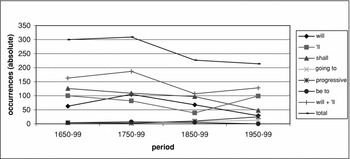
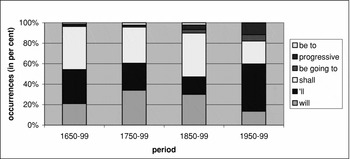
A survey of the development of several future time expressions (abbreviated as ‘FTEs’ in the figures) in the relevant period is provided in Figures 1 and 2 below.Footnote 5Figure 1 gives absolute numbers, Figure 2 the proportions of all the future time expressions investigated, thus pretending (though in full awareness of the limitation of this approach) that the investigated future time expressions represent a closed functional system. Figure 2 thus expresses how likely a writer or speaker in a certain period is (on average) to use a certain future time expression if reference to the future is made. The Figures for ’ll are given both separately and together with will throughout the article, as it is by no means clear whether ’ll can be regarded merely as a contracted form of will or whether and to what degree it leads a life of its own.
FTEs (present) in ARCHER, BrE

FTEs (present) in ARCHER, BrE, in per cent

The major caveat with respect to the results displayed in Figure 2 is that the simple present with future time reference has not been included in the study. How does this affect the results? A reasonable assumption with regard to the development of the simple present with future time reference in main clauses in the past two and a half centuries is provided by Denison. His assumption is based on the fact that in earlier centuries, the simple present with future time reference can sometimes be found in contexts where it would be inappropriate today, and he therefore claims that ‘[d]uring our period the simple present with future meaning has lost ground somewhat in main clauses’ (Reference Denison and Romaine1998: 189). At the same time, an impressionistic result from my own data is that the simple present with future time reference may have slightly increased in subordinate clauses, as in the earlier fifty-year periods will and shall are sometimes encountered in temporal clauses, where the present would in all likelihood be preferred today. It may perhaps be assumed, therefore, that the overall frequency of the simple present for future time reference has remained roughly stable. This means that, had the simple present with future time reference been included, the overall percentages would naturally be lower for each of the other expressions but the depicted developments for the individual future time expressions would probably be approximately the same.
The overall numbers of the future time expressions investigated are 842 for the period 1650–99, 906 for 1750–99, 740 for 1850–99 and 829 for 1950–99 (see Figure 1), so that no clear overall development can be observed. Thus the future is, in all likelihood, referred to neither more nor less frequently today than it was 350 years ago, at least not by future time expressions.
Figures 1 and 2 reveal that will is the most frequent future time expression throughout the late modern period. Together with ’ll, it accounts for between 65 and 75 per cent of all future time expressions in the whole time span under consideration. Shall is the second most frequent, though it is ousted by ’ll in the twentieth century. Even in the most recent fifty-year period, however, shall is (slightly) more frequent than be going to, which may be surprising considering that the form is often perceived as dying out whereas the recent development of be going to is commonly described in terms of considerable or even dramatic increase (e.g. Mair Reference Mair, Lindquist and Mair2004: 129; Danchev et al. Reference Danchev, Pavlova, Nalchadjan and Zlatareva1965: 375). What is also interesting is that the increase in the present progressive with future time reference, which has been hardly acknowledged so far, is almost identical to the increase in be going to, both in extent and with respect to its temporal development. It seems that the fact that be going to is much easier to analyse than the progressive with future time reference has blinded researchers to a development which is at least of similar extent. The Figures also show a steady though not radical decrease in be to.
With respect to the question of the overall development of will, the data reveal neither a clear overall increase nor a clear overall decrease. When will is regarded separately from its potential variant ’ll, an increase in the first or first two fifty-year periods (depending on whether absolute or relative frequencies are considered) can be observed, followed by a decrease. If will and ’ll are considered together, no clear development emerges in terms of absolute numbers. Görlach's assertion of an (allegedly absolute) increase in will in the nineteenth century can thus not be confirmed. In terms of relative frequencies, there has been a steady increase in will plus ’ll in the past 350 years. Interestingly, the decrease in shall is greater than the increase in will and ’ll, so that if all ll future forms (i.e. will, ’ll and shall) are considered, a decrease can be observed (by about 100 instances or about 10 per cent) in the past 350 years. For comparison, the relative increase in both present be going to and the progressive is by around 7 per cent each, the decline in be to by around 3 per cent.Footnote 6
These results show that the assumption of a mere replacement of shall by will (and ’ll) in the course of the late modern period (in addition to, say, a replacement of be to by be going to and the simple present by the present progressive) is certainly too simplistic. In principle, each decreasing future time expression could in part have been replaced by each increasing one. What is more, replacement chains might also have occurred in that, for example, shall was (wholly or partly) replaced by will in certain contexts, and will, in these or other contexts, has in turn since been replaced by be going to or the progressive. Finally, discourse shifts may have taken place (exclusively or, more likely, in addition), so that the increase or decrease in certain future time expressions merely reflects an increase or decrease in the expression of certain future meanings (e.g. intention, arrangement, prediction, etc.).
4.2 The development of future time expressions in contexts of negation
To investigate further the question of a potential redistribution of forms and of discourse change, the development of future time expressions in contexts of negation was examined. Processes of redistribution, i.e. one future time expression assuming the functions of another over the centuries, are likely to be at work if the results reveal that certain future time expressions are increasingly used in contexts of negation and certain others decrease in such contexts over time. Contexts of negation in this analysis are not only taken to include clauses negated by not (and n't), but also those negated by never and those with a negated or negative subject or object (e.g. Nobody is going to help you; I will accept no apology this time).
In Figure 3, the development of the future time expressions in contexts of negation is displayed in absolute numbers; Figure 4 displays the development in per cent of all negative contexts per period (i.e. how likely the use of each future time expression is if a writer/speaker wants to express future in a negative context). Figure 3 shows a tendency for all ’ll future expressions to be used less in negative contexts in later as compared to earlier periods, whereas be going to and the progressive increase in negative contexts, though by no means as sharply as the ’ll forms decline. Be to is hardly used in negative contexts in any of the periods investigated.
FTEs (present) in contexts of negation, BrE

FTEs (present) in contexts of negation, BrE, in per cent

Figure 4 shows that if future is to be expressed in contexts of negation, throughout the first three periods, the probability that this is done by one of the ’ll future forms is almost 100 per cent (30 per cent shall, 70 per cent will or ’ll, the latter being rare). Only in the third period can major changes be observed, in that the proportion of shall in negative contexts drops considerably (from around 30 per cent to around 10 per cent). This is counteracted by only a comparably slight increase in will and ’ll (more in ’ll than will), but additionally also by an increase in be going to and in particular the progressive. If the individual future time expressions and their use in negative contexts is considered, it is interesting to observe that both be going to and the progressive are only very rarely used in negative contexts at all at the beginning of the late modern period (between 100 per cent and 92 per cent of all their occurrences are in positive contexts) and display a rather marked increase later, so that in the last fifty-year period they are used in negative contexts about 20 per cent of the time, which closely corresponds to the proportion of will in negative contexts at that time.
These results support the hypothesis that be going to and the progressive may have assumed some functions that were earlier performed by the ’ll future time expressions. However, in negative contexts, such replacements only appear to have taken place in the twentieth century. This analysis, like the previous ones, also shows that the development of will and shall cannot merely be described as a mutual replacement process, as the decrease in shall is not mirrored by a comparable increase in will and ’ll; nor do the results point towards a mere replacement of will by ’ll. Finally, they clearly do not point to a large-scale replacement of be going to by be to either, a conclusion which the overall development (see section 4.1) might suggest (see also Nesselhauf Reference Nesselhauf, Houswitschka, Knappe and Müller2006).
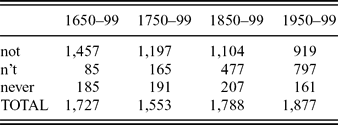
A striking tendency that emerges from the analysis is that the total percentage of all examined future time expressions in negative contexts constantly decreases, namely from 20 per cent in the first period to 14.7 per cent in the last (with 18.5 per cent and 15 per cent in the second and third periods, respectively). This may indicate a possible change in the discourse about the future. It may also reflect a more general tendency of a decrease in negative contexts throughout the corpus. To investigate this, a rough approach was adopted, in that searches for three frequent indicators of negative contexts, namely not, n't and never, were performed on the corpus. The results of this search are given in table 2, which clearly demonstrates that there is no tendency whatsoever of a general decrease in negative contexts.
Negation in ARCHER, BrE
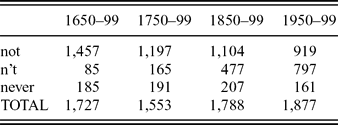
The observed decrease in future time expressions in negative contexts therefore actually points to a change in discourse about the future in the late modern period. It seems that there has been an increasing tendency to write and talk about events that are expected to happen rather than those that are not, or perhaps more precisely, to express events not expected to happen in ways other than directly negating the verb phrase containing the future time expression.
4.3 The development of future time expressions in questions
In a third analysis, the use of future time expressions in direct questions was investigated, again as an approach to the question of whether processes of redistribution – and if so which ones – may have taken place and whether the changes observed can be fully explained by such processes. Only those sentences were considered in which the clause containing the future time expression in question had an interrogative form. A sentence such as Why don't you give him something that he will actually take with him? was therefore not included.
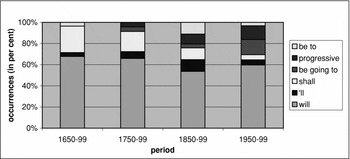
Figure 6, in which the proportion of each future time expression in questions is displayed, shows that contrary to the overall development of will/’ll and its development in contexts of negation, the proportion of will/’ll in questions actually decreases somewhat over the late modern period. In addition, shall decreases considerably and constantly across the whole time span. The relative increase in be going to and the progressive is greater and sets in much earlier than in contexts of negation. If replacements of the ’ll forms by either of these two future time expressions have taken place, therefore, they appear to have started considerably earlier. The results again do not point to a simple replacement of shall by will/’ll either.
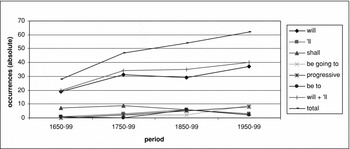
Figure 5, which displays the developments in absolute numbers, shows that almost all future time expressions have increased quite considerably in questions, with the exception of shall which, however, decreases much less in questions than overall. This means that overall, future time expressions in questions have increased in the course of the late modern period. In the period 1650–99, only 3.3 per cent (or 28) of all future time expressions occur in questions, while in the period 1950–99, this is true of 7.5 per cent (or 62 instances), and there is steady progress in between (with 5.2 per cent in the second and 7.3 per cent in the third period). Again, therefore, the question has to be asked whether a change in the discourse about the future has taken place or whether this result reflects a general increase in questions in the time span under investigation.
FTEs (present) in questions, BrE

FTEs (present) in questions, BrE, in per cent

As a rough approach to this question, a search was performed for all question marks in ARCHER in the relevant periods. The results point towards a steady increase in direct questions in the late modern period, with 607 in the first period, 654 in the second, 977 in the third and 1,000 in the last. Unlike in the case of negation, therefore, we are not dealing with a change in discourse specific to future time reference here, but with a more general process. It seems likely that the increase in questions is one aspect of what has been referred to as the trend towards colloquialisation (Mair Reference Mair2006: 187ff.), i.e. an approximation of written to spoken usage. In the present case, in particular, it appears to be the fact that the use of direct quotations has increased in certain registers over the centuries that has led to an increased use in questions with future time expressions (and in all likelihood to an increased use of questions in general). If the registers in which will occurs in questions are looked at, for example, it turns out that in the first fifty-year period, this is predominantly the case in drama. In the last two periods, future time expressions in questions in fiction conversation are almost as frequent, and they generally occur in a wider variety of registers than in earlier periods. This increase can thus be partly explained by the fact that fiction appears to make increasing use of direct conversation in the course of the late modern period (see also table 1).Footnote 7 It may, however, also be the case that in the (sub)register of fiction conversation, questions about the future or questions in general have increased. So with regard to questions, a general change in discourse conventions seems to have taken place in Late Modern English, possibly connected to an even more general trend towards colloquialisation, and this increase in questions naturally also affects the use of future time expressions.
4.4 The co-occurrence of future time expressions with first-person singular subjects
In Nesselhauf (Reference Nesselhauf2007), the analysis of the progressive with future time reference revealed a particularly dramatic increase of the construction with first-person singular subjects, which indicates that an investigation of uses of future time expressions with the subject I might be a promising approach to the question of a potential redistribution of forms. If Fries’ findings on Late Modern English drama accurately reflect the situation in Late Modern English more generally, will and shall have not changed much with respect to first-person singular usage. The increase in the progressive with I might therefore point towards a replacement of be to, in particular in view of the fact that both constructions often express future by arrangement.
Figures 7 and 8 show that the relation of will, shall and ’ll is fairly complex with regard to the use with first-person singular subjects. It seems that at the beginning of the late modern period, the contracted form was slightly more frequent than will; in the two middle periods will was preferred, while in the last period a steep increase in I'll and a considerable, though somewhat less marked, decrease in I will can be observed. This, like the previous analyses, points to some degree of redistribution of the two forms throughout the period, but one that interacts with other types of redistribution. The data also show that a potential replacement of earlier I shall with I'll only seems probable for the final fifty-year period.
FTEs (present) with first person singular, BrE

FTEs (present) with first person singular, BrE, in per cent

What is striking in Figures 7 and particularly 8 is that the zig-zag developments of will/’ll on the one hand and shall on the other are near mirror-images of each other, so that a considerable degree of interaction seems likely with respect to first-person uses (probably with a slight overall tendency to replace I shall by I will in the course of the late modern period).
In accordance with what was observed before, in the choice of future time expressions with first-person singular subjects the development is by no means restricted to a redistribution of the three ’ll future forms either. There is also an increase in I'm/am going to and, to an even greater extent, I + present progressive over the relevant time span. The hypothesis that the present progressive might have replaced greater numbers of be to with first-person singular subjects is, however, not supported by the analysis. Be to throughout occurs with first-person subjects in very low numbers, though with decreasing numbers from the second period onwards, so that a small-scale replacement by progressive forms is possible. Unless the progressive (and be going to) has replaced many earlier instances of simple present plus I, they have probably replaced ’ll future forms; though whether the redistribution has been simple (e.g. I + progressive for earlier instances of shall) or more complex (e.g. I + 'll for earlier I will and later I + progressive for I will) cannot be decided on the basis of this analysis. The hypothesis that the present progressive might have been replacing earlier ’ll future forms is additionally supported by a finding reported in Nesselhauf (Reference Nesselhauf2007). The evidence reported there points to a possibly new and increasing use of the progressive for expressing spontaneous decisions, which is commonly described as one of the uses of will.
Considering the overall use of future time expressions with a first-person singular subject, a striking decline can be observed, from 300 in the first to 214 in the final fifty-year period (with 309 in the second and 227 in the third). When compared to the use of other subjects with future time expressions, I occurs in 35.6 per cent of the cases in the first period and 25.8 per cent in the last (with 34.1 per cent in the second and 25.8 per cent in the third period). This means that writers and speakers write and speak less about their own plans, intentions, arrangements for the future and predictions concerning themselves today than in earlier times, which seems a somewhat counterintuitive result. It also seems to run counter to the trend towards colloquialisation, as it implies a movement away from personal to possibly more abstract concerns. The trend of a decreasing use of future time expressions with I does not, however, seem part of a more general trend of a decreased use of this personal pronoun. A search in ARCHER for I yields 2,848 instances in the first period, 3,329 in the second, 3,447 in the third and 2,800 in the last, thus displaying an increase at the beginning and a decrease only between the final and pre-final period. The observed tendency therefore in all likelihood reflects a change in the discourse about the future (at least in certain registers: see below, section 5.3).
5 The development of future time expressions in individual registers
5.1 Overall developments in individual registers
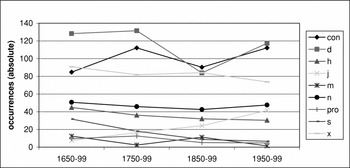
To investigate whether in addition to the general changes in the discourse about the future observed in the previous analyses there are also more specific differences pertaining to individual registers, the development of future time expressions in each of the registers represented in ARCHER was regarded separately. The frequency of developments of the future time expressions in the different registers is displayed in Figure 9.
FTEs (present) per register

The Figure reveals that the number of future time expressions differs radically from register to register and that the same is true for the diachronic development of future time expressions. What is interesting is that if the registers are considered according to their degree of formality, there is hardly any general correspondence with frequency and overall development of future time expressions (in that, for example, all informal registers display the same general overall development). Only a few generalisations of this type can be made. The two most formal registers, medical and science writing, display low overall numbers of future time expressions while three of the informal registers, drama, fiction conversation and private letters, display high overall numbers. In addition, the two informal speech-based registers, drama and fiction conversation, both display diachronic fluctuation rather than a clear development.
Apart from these few general tendencies, each register tends to have its own special characteristics with respect to future time reference, both synchronically and diachronically. An average number of future time expressions can be found in newspaper reportage and sermons. In diaries, science writing, fiction prose and medical writing, the future is in general referred to comparatively rarely. With respect to overall developments, only one register displays a clear increase in future time expressions, namely diaries, whereas three display a clear decrease, namely sermons, science writing and private letters. In the other registers, no clear development can be discerned. While in those registers, a change in discourse can nevertheless not be excluded (certain future time expressions and/or certain functions may have replaced each other), those in which developments have clearly taken place have undergone changes that go beyond a redistribution of future-referring forms.
5.2 Discourse change in diaries
While a detailed investigation of the discourse change(s) involved in each of the registers is clearly outside the scope of the present article, two registers will briefly be examined with respect to potential register-based discourse change in the area of future time reference. The two registers selected for this purpose are diaries and science research writing, as they are the two registers which display the clearest developments with respect to the use of future time expressions (a clear increase in diaries; a clear decrease in science writing).
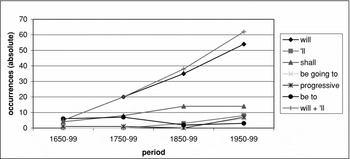
Figure 10 displays the evolution of the individual future time expressions in the register of diaries. What is particularly striking, especially if compared to the development across registers (see Figure 1), is the dramatic increase in will throughout the late modern period. What is more, even shall slightly increases over the centuries. The form 'll, on the other hand, is comparatively rare in this register and increases only comparatively slightly. The developments of be going to, the present progressive and be to largely correspond to their overall development across registers. The marked increase in future time expressions in this register is therefore largely due to a considerable increase in will (and a slight increase in shall, which is probably slight only because replacements by will have additionally taken place). If the usage of will in diaries is – impressionistically – compared in the different periods, there seem to be at least two reasons for this. First of all, diaries appear to be one of the registers in which the use of direct quotations has increased in the course of the late modern period (see section 4.3). One example of such a use is given in (1).
(1) But I remember also what my old housemaster, C. M. Wells, said to me as we parted for the last time after lunch at the Turf Club. He was ninety-two, I was in my late fifties. I said to him a shade patronizingly, ‘I hope you will be all right, sir’, to which he replied as incisively as ever, ‘I might die at any moment, but so, my good fellow, might you.’ (1981long.j8b; my emphasis)
Secondly, it appears that entries in diaries are, in the later periods, much more concerned with (potential) future events than in earlier periods. In the earlier periods, diaries are often restricted to reporting past events, as the following, rather typical, passage in (2) illustrates.
(2) 30th, Saturday – About noon (being a stiff gale at N.W. by N.) myself, with the fleet above mentioned, set sail from the Spithead, near Portsmouth.
Dec. 3d, Tuesday – We stretched it up into Torbay, where I came to an anchor about three in the afternoon, and the rest presently after. I hanged out a flag of council in the mizen-shrouds, and shot off a gun. The commanders came on board of me. (1650penn.j2b)
Diaries from later periods are not usually thus restricted, but are often concerned with the future either in the form of pure predictions (as for example in (3)), or in the description of own intentions (as in (4)) or, perhaps most frequently, in the form of predictions that are coloured by the writer's personal hopes or fears or at least heavily rely on the writer's subjective judgement ((5)-(8); my emphasis throughout).
(3) when the ice thaws they will effectively block up the entrance (1853hall.j6b)
(4) I have a plan that side by side with my law I will go right through a course of English poetry. (1886bail.j6b)
(5) Perhaps it will solve itself by the visit to Nepal (1961evan.8jb)
(6) In terms of psychological warfare this is far more damaging since it will at once raise Harold's suspicions that Roy and his press agent, John Harris, have been at work. (1968cros.j8b)
(7) What a magnificent work: powerful, comic, and penetrating. But I bet the critics will not see past Marlowe's reputation. (1976hall.j8b)
(8) I am convinced he will never be Secretary of State (1974cast.j8b)
So it seems that the increased use of future time expressions is to some degree a consequence of a change in the discourse conventions of this register, namely from merely reporting events to also expressing personal views, including those on potential future events. This observation ties in well with one made by Biber & Finegan (Reference Biber, Finegan, Nevalainen and Kahlas-Tarkka1997), who found that diaries have in general become somewhat less informational and more ‘involved’ in the course of the late modern period.
FTEs (present) in diaries, BrE

5.3 Discourse change in science research writing
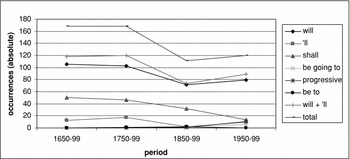
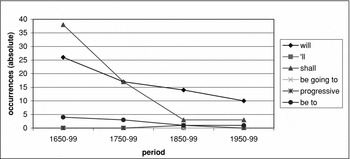
As for science research writing, Figure 11 shows that the drastic decline of future time expressions is almost exclusively due to will and shall. The progressive, be going to and ’ll hardly occur in any period, and the scope and decline of be to roughly corresponds with its development across registers. Both will and shall, however, decline much more drastically than across registers (see section 4.1). The decline of shall is particularly notable; in the first period it even greatly outnumbers will, whereas in the last two periods there are hardly any occurrences.
FTEs (present) in science writing, BrE

When the occurrences of will in the earlier periods are surveyed, it emerges that will is mainly employed to address readers, usually either the editor, specific members of the Royal SocietyFootnote 8 or other scientists, or, in some cases, ‘the reader’ in general (examples are given in (9)–(11); my emphasis throughout).
(9) But, Sir, since our honourable Philosopher hath discovered the pure Gold, and digged out the Oar; I hope, you and others of the R. Society will find out some ingenious and docible persons, who, . . . (1675ray-.s2b)
(10) And because I am again upon this first Experiment, I shall desire, that Mr. Lucas will repeat it with all the exactness and caution that may be (1676newt.s2b)
(11) to give the Reader an exact view of Animal-shells, as well as of Fossils figured like Shells, whereby he will be best able to Judge, what to think of their Original. (1674ano1.s2b)
Contrary to will, instances of shall in science writing in this period are mainly instances with first-person singular subjects. An overwhelming proportion of these are used as text-structuring devices, as exemplified by (12)–(15) below (my emphasis throughout):
(12) Last, it is copiously contained in common Mineral Sulphur, as I shall anon fully evince (1674leew.s2b)
(13) And now I shall abruptly begin this Section (1675br–.s2b)
(14) One thing more I shall add: That the utmost length of the Image from the faintest Red at one end to the faintest Blew at the other, must be measured. (1676newt.s2b)
(15) And therefore at present I shall say nothing in answer to his Experimental discourse (1676newt.s2b)
While text-structuring devices are not infrequent in texts from later periods either, it seems that their frequency has decreased. This impressionistic observation is supported by the fact that it has become common practice to explicitly divide research writing into sections (see also Atkinson Reference Atkinson1996: 346), which means that there is less need for other means of structuring. A second reason for the decrease in shall with this function appears to be that text-structuring devices in present-day science writing are usually much less author-centred than in earlier centuries. If such structuring devices were to be used at all in contemporary research articles in contexts like the above, we might expect phrases such as ‘as will be demonstrated below’ (for (12)), ‘This section starts out by. . .’ (for (13)), ‘It has to be added that. . .’ (for (14)), or ‘A discussion of . . . lies outside the scope of the present paper’ (for (15)). Not only would active voice often be replaced by passive voice (which per se would not affect the frequency of future time expressions, as the possible replacement for (12) shows), but future time expressions may also be replaced by other types of expressions (as in (13) or (14)), namely expressions which assign responsibility to factors external to the author.
The change in the use of future time expressions in science writing is thus to a considerable degree a consequence of a change in discourse conventions. These changes go far beyond the use of future time expressions. Atkinson (Reference Atkinson1996), for example, has shown that it is typical of early science research writing for the author to assume a central position in the text, and that this is reduced in the course of the late modern period to the point where the author almost completely disappears.Footnote 9 Similarly, Biber & Finegan (Reference Biber, Finegan, Nevalainen and Kahlas-Tarkka1997: 266) found in their analysis that science writing has moved from more involved to more informational – the opposite from what was observed for diaries. For the use of future time expressions, this disappearance of the author means fewer addresses to potential readers on the one hand (which mainly affects will) and, more importantly, fewer declarations of intention as regards the structuring of the text (resulting in a decrease of (I) shall). It is important to note that this discourse change in science writing is partly, though certainly not exclusively, responsible for the overall decrease of future time expressions with first-person singular subjects and that it runs counter to the general trend towards colloquialisation (see also Biber & Finegan Reference Biber, Finegan, Nevalainen and Kahlas-Tarkka1997).
6 Conclusion
Based on a new approach, the simultaneous investigation of a number of future time expressions (and limited to their future uses), the analyses presented in this article have provided a number of new insights concerning the development of future time expressions in the late modern period. As to the overall development, it has been demonstrated that unlike previously described, will has not increased in the course of the last 350 years, and will and ’ll considered together only slightly so. It has also been shown that the increase in the present progressive with future time reference, which has hardly been acknowledged so far, is at least on a par with the often described increase in the going to future. With respect to a possible redistribution of future time expressions in the course of the late modern period, it has clearly emerged from the analyses that processes of redistribution are highly complex and cannot be reduced to a simple formula such as shall has replaced will (in certain uses) and be going to has replaced be to. Potential processes of replacement also are ’ll for will but also for shall, be going to for will but also shall and ’ll, progressive for will and ’ll, will for be to and others. In addition, chains of redistribution also seem likely (with a certain form first replacing another and subsequently being replaced).
With respect to potential discourse changes affecting the evolution of future time expressions, a development towards overall less or more frequent reference to the future by future time expressions could not be identified. What has been observed, however, is various changes in the preferred grammatical contexts, or the way in which the future is referred to. An increasing tendency to use future time expressions in affirmative contexts has been found, as well as an increasing tendency to ask questions about the future. In addition, the analysis has revealed that the tendency to refer to the speaker's own plans, intentions and arrangements for the future has generally decreased. While the decrease in negative contexts and the decrease in first-person singular subjects have been found to be specific (though in all likelihood not exclusive) to discourse about the future, the increase in questions is not. Instead, the latter may be part of a more general change in discourse norms, namely a general (though not exceptionless) trend towards colloquialisation.
A separate examination of the different registers has revealed that the development of future time expressions differs radically from register to register. A closer analysis of the register of diaries and of the register of science research writing brought to light register-specific changes in discourse with respect to future time reference. In diaries, a development from a restriction to reporting past events to the expression of more personal views, including hopes and fears for the future, was observed. In science writing, a development away from an author-centred writing with frequent addresses to the reader and frequent statements of the author's intentions regarding the structuring of the text was observed, also with a considerable effect on future time expressions.
While these results clearly provide a number of important insights into the recent development of future time expressions, there is much scope for further research. First of all, the simple present for future time reference will have to be considered as a member of the (changing) system of future time expressions. Second, the investigation of potential register-based discourse changes will have to be extended to include more registers. Finally, it will be necessary to undertake the laborious task of actually separating out the different uses of each future time expressions in the individual periods in order to make more precise statements about the processes of redistribution of forms.
While further research will certainly reveal more details on the development of future time expressions and the underlying reasons and mechanisms, the present article has revealed the considerable complexity of the process and uncovered some of its aspects. The investigation has demonstrated that the development of future time expressions in the late modern period is by no means restricted to either a redistribution of forms or to a change in discourse about the future, but is a complex interplay of partial and probably chain-like redistributions, and of general as well as register-specific changes in discourse.