There is no lack of article-length publications on individual aspects of Welsh phonology.Footnote * However, it has been a long wait for a book-length overview, especially one that incorporates modern theoretical insights. Hannahs' new book is thus a welcome addition to the Phonology of the World's Languages series. As with other volumes in the series, the author sets out to strike a balance between theory-neutral description and theoretically informed analysis. His framework of choice is Optimality Theory. The book will be of interest to specialist phonologists, Celticists, and linguists with a non-specialist interest in Welsh.
The book is divided into seven chapters: an introduction to the history of Welsh and its modern dialects, a phonetic outline, four core chapters on phonology and a final chapter touching on phenomena and issues not addressed elsewhere in the book.
Chapter 2 provides a compact but comprehensive overview of Welsh phonetics, including outlines of the consonant and vowel inventories of the main dialects (Hannahs accepts the established broad division into northern and southern varieties). Particularly welcome here are the author's succinct discussions of a range of phenomena that have not always been clearly described elsewhere, including voicing in stops, gemination, the status of affricates, vowel length and schwa. The chapter provides the reader with a very useful entry to the relevant literature.
In Chapter 3, Hannahs presents his analysis of the prosodic structure of the word in Welsh. His description of syllable structure follows well-established practice in two respects: (a) it is based almost entirely on the monosyllabic word, and (b) it assumes that consonant-cluster phonotactics are syllabically conditioned. This approach gives rise to certain anomalies, by no means peculiar to Welsh. For one thing, it leads to the claim that consonant clusters at the end of words form complex codas. If these really are syllabic constituents, defined independently of words, we expect them also to occur elsewhere in the word. The same clusters do indeed also occur medially, but here they pattern in two ways, neither of which is consistent with complex coda status. Some are clearly heterosyllabic. For example, when internal, clusters of falling sonority form coda–onset sequences, e.g. plentyn [plεn.tɨn] ‘child’, gerddi [gεr.ði] ‘gardens’ (cf. the same final clusters in plant [plant] ‘children’, gardd [garð] ‘garden’). Others contain word-level morphological junctures, such as consonant sequences that straddle the boundary between members of compounds, e.g. tystlythr [[təst][ləθɨr]] ‘testament’ (< tysty ‘witness’+lythyr ‘letter’), trystfawr [[trəst][vaʊr]] ‘noisy’ (< trwst ‘noise’+mawr ‘big’). The clusters preceding these junctures are thus in fact word-final (on the usual assumption that each member of a compound forms a word in itself). Once we control for morphological complexity, we are left with the generalisation that domain-internal codas in Welsh can contain no more than a single consonant.
What are we to make of the fact that the phonotactic restrictions on word-final clusters (e.g. the [nt] of plant [plant]) are the same as those on word-internal heterosyllabic sequences (e.g. the [nt] of plentyn [plεntɨn])? When the same question has faced researchers working on other languages, it has prompted two quite different answers. One is that cluster phonotactics are not syllabically conditioned after all (cf. Steriade Reference Steriade1999). The other is that final clusters of falling sonority are not complex codas, but are syllabified in the same way as their internal counterparts, i.e. as coda–onset sequences (cf. Dell's Reference Dell1995 analysis of French).
Welsh also has consonant clusters of rising sonority, consisting of a consonant and a liquid, which Hannahs discusses later in the book. Word-internally, these are syllabified as complex onsets (in accordance with onset maximisation), e.g. cablu [ˈkaːblɨ] ‘to blaspheme’, goblygu [goˈbləgɨ] ‘to wrap’. They also potentially occur in word-final position. Hannahs refers to these as complex codas, which is somewhat puzzling, since they do not actually show up as clusters here, but are instead subject to one of two processes. Either the sequence is split by an epenthetic vowel, as in cwbl [ˈkʊbʊl] ‘all’ (where the second vowel is an epenthetic copy of the first), or the liquid is deleted, as in posibl [ˈpɔsib] ‘possible’. Nor can these sequences be said to be complex codas underlyingly, since, at least under the standard OT assumptions Hannahs works with, syllable structure is absent from lexical representation. Perhaps he is alluding to the fact that rising-sonority clusters can appear finally in stems (reflected in written forms such as posibl). However, here they only surface as genuine clusters when they form internal complex onsets followed by a suffix vowel (e.g. pobl+og [ˈpɔblɔg] ‘populous’). In absolute word-final position, a stem-final cluster is subject to epenthesis (pobl [ˈpɔbɔl] ‘people’). In any event, consonant–liquid sequences provide no support for the claim that Welsh has complex codas.
The word in Welsh is minimally bimoraic. Short vowels bear one mora, while long vowels and diphthongs bear two. The moraicity of single word-final consonants varies according to quality: [p t k m ŋ] are moraic, [l n r] are moraic in some words but not in others, and the remaining consonants are non-moraic. Word-final clusters are generally moraic, with the exception of [sC] and [ɬC] in northern dialects. The moraic status of a consonant is reflected in the length of the preceding vowel. Stressed vowels are short before moraic consonants and consonant clusters (apart from [sC] and [ɬC]), and long before non-moraic consonants. With monosyllables, this yields long vowels in for example sudd [sɨːð] ‘juice’ and cryg [krɨːg] ‘hoarse’, and short vowels in sut [sɨt] ‘how’ and dim [dim] ‘not’. With variably moraic [l n r] we find some words with a short vowel (e.g. tal [tal] ‘tall’) and others with a long vowel (e.g. tâl [taːl] ‘pay’). As with his discussion of syllabification, Hannahs focuses his moraic descriptions on monosyllabic words. However, in order to get a clear overview of weight in Welsh, it is also important to know how moraicity works in polysyllables with regular penultimate stress. Although the author is much less explicit about this, we can infer from examples elsewhere in the book that penultimate stressed syllables follow the same basic pattern of consonant-sensitive vowel length as monosyllables. Thus we find for example a long vowel in rhagor [ˈ ʰaːgor] ‘excellence’ (where the following consonant is a non-moraic onset) vs. a short vowel in campio [ˈkampjo] ‘to frolic’ (where the consonant is a moraic coda).
The interplay between vowel length and the following consonant begs the question of whether Welsh has anything approaching quantity-determined stress, with all stressed syllables having to be heavy. The language is not usually described in these terms (and Hannahs certainly doesn't do so), presumably on the grounds that canonical quantity-determined languages, such as Italian or Icelandic, do not care about the quality of the consonant following a stressed vowel. At least going solely by the broad phonetic transcriptions generally used for Welsh, we might initially assume that the language allows stressed light syllables, e.g. macyn [ˈmakɨn] ‘handkerchief’, llyfr [ˈɬəvɨr] ‘book’, melyn [ˈmεlɨn] ‘yellow’. However, there are certain durational facts about Welsh that suggest the issue should not be left to lie. One is that, when intervocalic, the consonants Hannahs describes as moraic are longer than their non-moraic counterparts. He takes this as evidence for representing them as geminates.Footnote 1 Under this analysis, Welsh stress starts to look very much like a quantity-determined system, at least word-medially: a stressed syllable must be bimoraic, consisting of either a long vowel in an open syllable (as in safon [ˈsaː.vɔn] ‘standard’) or a short vowel in a closed syllable (as in macyn [ˈmak.kɨn] ‘handkerchief’, plentyn [ˈplεn.tɨn] ‘child’). The predictability of the consonant-length difference explains why it is generally not transcribed phonemically, but of course predictable length is one of the hallmarks of quantity-determined stress.
The quantity-determined analysis extends to consonants at the end of stressed monosyllables, where bimoraicity takes the form of either a short vowel+a moraic consonant (as in clap [klap] ‘gossip’) or a long vowel+a non-moraic consonant (as in lab [laːb] ‘blow, stroke’). A reasonable question to ask of this analysis is whether there is any duration evidence to support the moraic vs. non-moraic distinction in final consonants, parallel to that in medial position. We would expect a consonant to be of greater duration after a short vowel than after a long vowel. Hannahs' review of the phonetic literature suggests this is indeed the case, although he does not follow up on it. It would be particularly good to know whether this duration difference also holds of the distinction between moraic and non-moraic versions of [l n r]. In any event, there is an additional reason for delving further into the duration evidence: it is surely not an accident that the plosives Hannahs describes as moraic are fortis, while their non-moraic counterparts are lenis. It is well known that postvocalic fortis obstruents are of greater duration than lenis. The fact that, of the Welsh final stops, it is the phonetically longer fortis series that co-occur with preceding short vowels strengthens the suspicion that we are dealing here with a quantity-determined system.
There are other indications of a link between quantity and fortis/lenis in Welsh. In the final chapter, Hannahs discusses ‘provection’, a process that turns lenis stops into fortis after a stressed vowel (the Welsh term for this, calediad ‘hardening’, seems more felicitous). This is the context where Hannahs describes the fortis series as geminates, so hardening produces alternations between short and long consonants; compare pretonic lenis [g] in agorodd [aˈgɔroð] ‘open 3sg.past’ with post-tonic fortis [kk] in agor [ˈakkɔr] ‘open’, or lenis [b] in gwlyb [glɨːb] ‘wet’ with fortis [pp] in gwlyped /ˈglɨːb+hεd/>[ˈgləppεd] ‘as wet as’ (in the latter example, we also see the effects of vowel shortening and vowel mutation, on which more below).
How is the evident bond between stressed vowel length and consonant duration in Welsh to be captured, not just word-medially but also finally? One approach is to assume that length and fortis/lenis contrasts are represented in terms of the same abstract suprasegmental feature, as advocated by Iosad (Reference Iosad2012) in his treatment of Pembrokeshire Welsh. Hannahs' own moraic descriptions suggest a weight-based approach. However, he does not develop this, leaving several important questions unasked. For example, does drawing a distinction between moraic and non-moraic consonants replace the feature specification of fortis/lenis in Welsh? How is the distinction between moraic and non-moraic consonants integrated into syllable structure? Is this distinction represented differently in word-internal vs. word-final positions? If it is (and Hannahs' positing of complex codas suggests he believes it is), how can this be reconciled with the phonotactic parallels between the two contexts? The author deserves credit for bringing together the apparently disparate length and fortis/lenis facts of Welsh in one place. Nevertheless, given the book-sized space at his disposal, we can't help feeling that an opportunity has been missed to go deeper into the issues they raise.
Chapter 4, on phonological processes in Welsh, begins with a discussion of schwa, which occupies a special place in the Welsh vowel system. It behaves like a reduced vowel in appearing in unstressed syllables, but like a full vowel in also appearing in stressed syllables. However, unlike other full vowels in the system, it can only occur as short. Amongst other things, this means that it cannot appear in monosyllables, where its shortness would contravene word-minimality requirements.
Schwa features in a mutation process that reduces [u ɨ ai aɨ aʊ ɨʊ] to [ə ə əi əɨ ɔ ɨ] in pre-final position, e.g. taith [taiθ] ‘journey’, teithio [təiθjo] ‘to travel’. The process is neutralising, since vowels with the mutated quality can also appear in final position, e.g. dweud [dwəɨd] ‘to say’. [ɨ] shows two different behaviours with respect to mutation. In some words, it alternates with [ə] (e.g. bryn [brɨn] ‘hill’, bryniau [brənja] ‘hills’), while in others it fails to alternate at all (e.g. pur [pɨːr] ‘pure’, puro [pɨːro] ‘purify’). Hannahs rejects a previous account that posits an absolutely neutralised underlying contrast between two types of /ɨ/. He proposes a convincing constraint-based alternative where stable [ɨ] is underlyingly /ɨ/, while alternating [ɨ] is underlyingly /ə/. The contrast is contextually neutralised under [ɨ] in final syllables because of the independent ban on schwa in this position. This analysis mirrors Welsh orthography, which uses y for alternating [ɨ] and u for stable [ɨ].
The other vowel which schwa mutates with is [u], e.g. trwm [trum] ‘heavy’, trymion [trəmjɔn] ‘heavy (pl)’. Here Hannahs posits an underlying /u/, which surfaces as [u] in a word-final syllable and as [ə] elsewhere. Mutation to [ə] is blocked if another [u] appears in the final syllable, e.g. cwmwl [kumul] ‘cloud’ (*[kəmul]). (Compare this with cymylau /kumul+a/>[kəməla] ‘clouds’, where mutation does occur because the otherwise blocking /u/ in the root-final syllable is no longer final in the word.) According to the author, the blocking effect results from the two nuclei being doubly linked to a single feature specification. The latter counts as final in the word and thus does not meet the pre-final structural description of mutation.
The chapter ends with discussions of two other processes: place and manner assimilation in nasals, and vowel ‘affection’. The latter is a now morphologised form of umlaut that raises and/or fronts root vowels under the influence of [i] or [ɨ] in a suffix, e.g. mab [maːb] ‘son’, meibion [ˈməibjɔn] ‘sons’.
It is becoming increasingly clear that the context for many of the segmental phenomena previously analysed in terms of the syllable is better viewed in terms of the foot. In Chapter 6, Hannahs adds to this evidence by showing how the foot plays host to a range of phenomena in Welsh, including vowel epenthesis, the distribution of [h] and the deletion of antepenultimate unstressed syllables.
As mentioned above, vowel epenthesis is one of the strategies Welsh employs to break up rising-sonority clusters at the end of words, e.g. pobl /pɔbl/>[pɔbɔl] ‘people’. Under Hannahs' OT account, this particular repair is driven by, among other factors, a need for the output to form a bisyllabic foot. Highly ranked foot-binarity constraints are violated when a candidate is neither bisyllabic nor bimoraic; this rules out consonant deletion as a repair when it would yield a monomoraic monosyllable, e.g. /pɔbl/>*[pɔb] (recall that final [b] is non-moraic). Specific rankings of additional markedness, alignment and faithfulness constraints are needed to ensure that the epenthetic vowel is a copy of the root vowel, that epenthesis is medial rather than final and that the linear order of the root segments is preserved as far as possible. Further constraint rankings are needed to ensure that this analysis also works for forms with final three-consonant clusters with a falling-rising sonority profile, such as the final underlying /ŋkr/ of cancr ‘cancer’. Both attested [kaŋkar] and unattested *[kaŋk], with final deletion, satisfy foot binarity, the former syllabically, the latter moraically (recall that true – i.e. falling-sonority – word-final clusters are moraic). To cater for examples such as this, epenthesis must always be preferred over deletion, achieved by ranking Max-IO over Dep-IO.
According to previous descriptions, [h] in Welsh can only appear either word-initially or in the onset of a stressed syllable. Hannahs proposes that this disjunction can be avoided by stating the distribution ‘simply’ as ‘foot-initial’ (p. 103). This is the same distribution as plosive aspiration, a pattern now increasingly being recognised as typical of aspirating languages, including English (cf. Davis & Cho Reference Davis and Cho2003). It would be invidious to make constant comparisons between the phonologies of Welsh and English (not least because of political sensitivities in Wales and the United Kingdom at large), and Hannahs steers well clear of doing so here. That's not to say there aren't good linguistic grounds for investigating the phonological similarities – centuries of language contact, bilingualism and borrowing. However, Hannahs is probably right to have decided that a book in this series is not the place to dwell on this issue.
In fact, Hannahs' account of [h] turns out to require a disjunction after all. The account is woven into his OT analysis of footing in Welsh. Regular main stress is penultimate, derivable by building syllabic trochees aligned with the right edge of the word. In monosyllabic words, as well as in words with lexically marked final stress such as parhau ‘to continue’ and gwahodd ‘to invite’, the foot at the right edge of the word is a bimoraic monosyllable rather than bisyllabic. Hannahs derives this pattern by a constraint ranking that makes it less important for feet to be syllabically binary than for syllables to be footed and lexical stresses to be preserved. Syllables preceding a final or penultimate stress may be footed, indicating the presence of subsidiary stresses, or left unfooted.
As for [h], it can appear initially in a foot (which we indicate by parentheses), whether this contains a main stress, as in brenhines [(ˌbrεn)(ˈhinεs)] ‘queen’ or a subsidiary stress, as in hanesyddol [(ˌhanε)(ˈsəðɔl)] ‘historical’. However, it can also appear word-initially in an unstressed (i.e. unfooted) syllable, e.g. hanesion [ha(ˈnεʃɔn)] ‘stories’, hyhi [hə(ˈhiː)] ‘she (emph)’ (note that the stray syllables here are monomoraic and thus too small to satisfy foot binarity). The statement of the distribution of [h] must thus refer disjointly to foot-initial and word-initial positions. Exactly the same analytic challenge is posed by other languages with parallel distributions of [h] and aspiration. The distribution could be described more broadly as ‘metrical domain-initial’. The only obvious way to retain a purely foot-based treatment is to allow initial stray syllables to be incorporated into something like a superfoot (cf. Davis & Cho Reference Davis and Cho2003).
Although the author does not employ the superfoot directly in his treatment of the distribution of [h], it does feature later, in the discussion of antepenultimate deletion. This optionally deletes an initial unstressed syllable in trisyllabic words, e.g. adéryn > déryn ‘bird’, eistéddwch > stéddwch ‘sit (2formal.imp)’, Nadólig > Dólig ‘Christmas’ (stress marking ours). Some words fail to undergo the process in spite of apparently meeting its structural description, e.g. capéli > *péli ‘chapels’, uchélach > *chélach ‘higher’. Hannahs suggests the difference can be attributed to different metrical representations. The initial syllable is adjoined to a superfoot in stable trisyllables such as capeli, but attaches directly to the prosodic word in alternating forms such as aderyn. In the latter case, the initial syllable is extrametrical, and it is this that makes it a target of deletion. The author acknowledges that extrametricality violates the general constraint requiring all syllables to be parsed. What is not acknowledged, though, is that the deletion of [h]-initial syllables in words such as hosánau > sánau ‘socks’ and hesbínod > sbínod ‘yearling ewes’ also violates the constraint requiring [h] to be preserved in domain-initial position. Hannahs notes that frequency may be playing a role here, with more common words being more susceptible to truncation. This would be consistent with a non-metrical account of the lexical selectivity of the process, according to which the longer and shorter forms of more frequent trisyllables are simply listed in the lexicon.
If there is one phenomenon that looms large over any description of Celtic phonology, it is word-initial consonant mutation. Hannahs chooses to postpone discussion of this phenomenon until the penultimate chapter of the book. His reasoning is that mutation is not phonological, and thus does not deserve to occupy centre stage in a book belonging to a series on phonology. The reader, especially one not fully versed in Celtic phonology, might find the postponement frustrating, since the central place of mutation in Welsh grammar inevitably means it keeps cropping up throughout the book, including in the opening chapters.
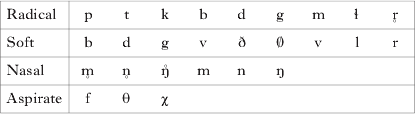
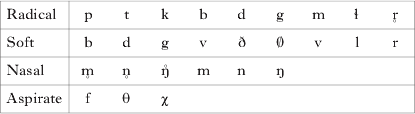
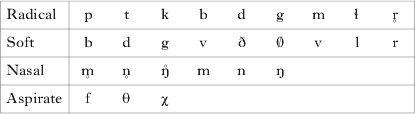
The mutation of radical (root-initial) consonants in Welsh comes in three main grades – soft, nasal and aspirate. On page 126 Hannahs provides a handy summary of their effects, given as Table I.
Mutation table for Welsh.
By ‘not phonological’, Hannahs means that mutation is not phonologically conditioned. This much is pretty uncontroversial: as the author's review of the literature shows, there is general agreement that, though Celtic mutation was once phonologically regular, it is now triggered by complex sets of morphological and syntactic factors. This is not to say that the phenomenon is altogether non-phonological: there are clear, segmentally non-arbitrary connections between the inputs and outputs in all three grades.
Hannahs reviews various approaches to mutation, ranging from the fully phonological (in which alternants derive from a single underlying form) to the fully lexical (in which alternants are listed in the lexicon as allomorphs). He rejects the first of these, on the grounds that the environment of mutation cannot be specified in phonological terms. Moreover, a fully phonological analysis is incompatible with a basic prediction of OT, that an unfaithful (i.e. mutated) form would only be selected if it is less marked; as is clear from (1), for at least some mutated forms, the opposite is the case. Hannahs rejects a fully lexical account on the grounds that it overlooks the undeniably phonological connection between mutation inputs and outputs.
The solution Hannahs himself proposes is based on what he terms ‘pattern extraction’, a notion strongly reminiscent of Bybee's schemas (cf. Bybee & Slobin Reference Bybee and Slobin1982, Bybee & Moder Reference Bybee and Moder1983). The extracted patterns are represented independently in the lexicon in the form of links between each radical consonant and its mutated alternants, as in (1a). The speaker/hearer draws upon these links to arrive at the correct form of a morpheme in a given mutation context. The contexts themselves are defined by subcategorisation, which can be lexical (e.g. the preposition â ‘with’ selects an <aspirate> alternant) or syntactic (e.g. <soft> is selected on the initial word following an XP).
Much of the time, Hannahs presents the extraction patterns as relations among autonomous phonemes, as in (1a) (p. 138). However, in acknowledgement of the subsegmental regularities underlying these relations, he hints that speakers might further generalise the patterns into segment classes, as in (1b).
(1)

Other than making passing reference to the feature [continuant], he goes no further than using traditional IPA terms to label these classes. Adequate as this labelling might be for the handful of alternation examples with which he illustrates pattern extraction, it is not up to the task of capturing the overall shape of the three mutation types in (1), a point that has been made elsewhere in the literature on Celtic phonology. There is no discussion in this chapter of specific proposals for how best to capture these regularities in terms of features or elements, and no mention, for example, of Buczek's (Reference Buczek and Gussmann1995) and Cyran's (Reference Cyran2010) work on Welsh, or of Cyran's (Reference Cyran1997) work on the cognate patterns in Irish.
Various productive phenomena related to mutation in Welsh can be taken as showing the advantages of an approach based on pattern extraction over one based on lexical allomorphy. Loans and neologisms can take part in mutation (e.g. drinc ‘drink’> fy nrinc ‘my drink’), and some loans have been reanalysed as already-mutated forms (e.g. melfed from English velvet). In some native Welsh words, an etymologically mutated consonant has been reanalysed as the radical, leading to a further, unetymological mutation. For example, bobl ‘people’ (from pobl by soft mutation) can be ‘over-mutated’ to fobl. The word addo ‘promise’, which frequently occurs in a soft mutation context (e.g. dy addo ‘your promise’), can be reanalysed as underlying gaddo, with an unetymological [g]. Evidence of this sort strongly suggests that, although the trigger for mutation may no longer be phonological, the consonant alternations themselves still show active feature-based patterning.
The last chapter briefly describes further aspects of Welsh phonology not treated elsewhere in the book, including the process of calediad mentioned above. There are discussions of: (i) the segmental and stress differences between ‘loose’ and ‘strict’ compounds; (ii) the analytical challenge posed by proclitics and enclitics, which appear to be in the domain of their host for some phonological phenomena but not for stress; (iii) the syllabification of the definite article y/yr/'r, which sometimes behaves as a proclitic and at others an enclitic; and (iv) the syllabification of the voiceless sonorants [

 ʰ], which can apparently split across a syllable boundary, e.g. fy mhen /ə εn/>[əm hεn] ‘my head’. It would have been good to see these issues discussed at greater length. Nonetheless, this chapter is one of the most useful parts of the book, as it clearly sets out some of the problems that readers might want to tackle themselves.
The phonology of Welsh raises as many analytical questions as it answers. This could be seen as one of the book's strengths, especially since it does such a valuable job of marshalling the available facts in one place. It provides an excellent entry point for phonologists wishing to take these questions further, and will serve as an important reference point for future work on Welsh.