Early one Sunday in 1948, Frederic Vercoe set out from his home in San Marino, California, for a speaking engagement in downtown Los Angeles.Footnote 1 Perhaps he took the Arroyo Seco Parkway, which had opened for drivers 8 years before, linking the city more tightly with its “vast agglomerate of suburbs.”Footnote 2 Although the roads may have changed, Vercoe had been making some version of this commute for decades. He had recently retired after a long career with the Los Angeles County Public Defender—13 years as a deputy, followed by 19 years as head of the office—and now maintained a small private law practice downtown.Footnote 3 Many mornings, Vercoe would have had business at the Hall of Justice, the ten-story box of “gray California granite” that housed the jails and courtrooms.Footnote 4 On this particular morning, he was headed instead to Clifton's Cafeteria at Seventh Street and Broadway. Perhaps, as he drove the dozen miles west into the city, he admired the “geraniums, cosmos, sweet peas, asters and marigolds” that lined the “gardens, parkways, and driveways,” or perhaps he was used to the foliage by now.Footnote 5 Vercoe had lived in California for more than 30 years, making him, by West Coast standards, a real “old-timer.”Footnote 6
When Vercoe arrived at Clifton's, perhaps he took a moment to scan the bulletin boards outside, where Angelenos posted want ads and “appeals for congenial friendship.” Stepping inside, perhaps he grinned at the faux redwood trees and indoor waterfalls, or hummed along with the cafeteria's famous pipe organ.Footnote 7 Then presumably he located the Sunday Morning Breakfast Club, which had invited him to speak on the subject of “Counsel for the Defense.”Footnote 8 It was a speech he had given many times in his years as the public defender, and even in retirement, he continued to travel the Southern California luncheon and club circuit. In front of audiences ranging from the Unity Republican Club and the Hollenbeck Ebell Women's Club to the Young People's Class at the First Methodist Church of Pasadena, he explained the workings of the criminal courts and the role of the public defender, which he celebrated as a progressive innovation that Los Angeles had pioneered.Footnote 9 By 1948, he could deliver his familiar overview from a typewritten outline: “on the one hand … the prosecutor. Able, experienced, powerful. Trained in the law. Trained in the trial of cases. A fearless antagonist. Mighty resources at his command.” And “on the other hand … the public defender. Able, experienced, resourceful. Trained in the law. Trained in the trial of cases. An honest but fearless fighter.”Footnote 10
Vercoe's self-description as a courtroom “fighter” illuminates public defenders’ professional identity in the United States in the decades after the criminal courts had developed into a modern bureaucracy, but before the Warren Court constitutionalized criminal procedure. Historians have characterized lawyering for the poor as outside the mainstream of adversarial legal culture, describing a “two-tiered legal system” in which lawyers celebrated courtroom combat on behalf of paying clients but relegated the indigent to a lesser form of advocacy that valorized “compromise.”Footnote 11 Comporting with this characterization, legal scholars have portrayed early public defenders as “assembly-line” workers who conducted little factual investigation and developed lawyering techniques centered around “pressuring [each] defendant to enter a plea,” because they worked within an “ideological framework” that defined poor people as “guilty and unworthy” of adversarial trials.Footnote 12 Studies of indigent defense in the first half of the twentieth century have provided important insight into the origins of the modern plea bargaining regime. Yet characterizing early public defenders as ideologically committed to nonadversarial process for the poor overlooks the extent to which public defenders such as Vercoe were shaped by the larger legal culture, shared in its veneration of adversarialism, and emphasized trial advocacy as the core of their own lawyerly expertise.
Established in 1914 to provide free legal representation for the indigent, primarily in criminal cases, the Los Angeles County Public Defender was the nation's first such municipal office. Before the 1960s expansion of the constitutional right to counsel, there were only a handful of local public defenders nationwide, many of them in California.Footnote 13 As one of the office's longest-serving incumbents, Vercoe helped to cement the public defender's place within the Los Angeles civic bureaucracy and to develop a professional identity for this now familiar, but then novel type of lawyer: the urban public defender. He helped to launch the office as part of its original group of deputy defenders, and then served as its third chief defender from 1927 to 1946, a longer tenure than either of his predecessors.Footnote 14
In defining their role, Vercoe's generation of public defenders blended two sets of political and professional influences. The first was the progressive vision of efficient municipal administration. Befitting their origins in Progressive Era urban reform politics, public defenders were officers of the modern criminal justice bureaucracy, which “good government” mugwumps hoped would bring efficiency and expertise to bear upon the novel dislocations of the twentieth-century city.Footnote 15 Focusing on this dimension of early-twentieth-century indigent defense, scholars have described early public defenders as nonadversarial based largely on a particular set of sources: Progressive Era reform proposals that promoted public defense as a way to improve judicial efficiency.Footnote 16 Walton Wood, the Los Angeles Public Defender's founding incumbent, published a series of articles praising public defense as a cost-saving measure and offering statistics showing that his deputies took fewer cases to trial than did private attorneys.Footnote 17 Drawing partly on Wood's writings, Michael McConville and Chester L. Mirsky portray early public defenders as willing collaborators with the prosecution, because they understood their professional duty in terms of “assist[ing] the process of conviction”; they interpret Wood's boasts about plea rates to demonstrate genuine animus toward the poor.Footnote 18 George Fisher reads Wood's writings differently: not as transparent expressions of his own personal views but as “public relations gestures,” intended to attract support for public defense from fiscal conservatives and law-and-order politicians. Nevertheless, Fisher agrees with the descriptive point that early public defenders “bragged in a decidedly nonadversarial way” about avoiding trials.Footnote 19 Whether read critically or sympathetically, then, Wood's writings are taken to show that public defenders publicly embraced their new role as plea negotiators, blithely abandoning the legal profession's traditional veneration of trials.
Yet as lawyers, public defenders were also heirs to a self-celebratory professional culture that prized courtroom oratory and adversarial combat, the second strand of influence upon Vercoe and his deputies. As Amalia Kessler writes, “it was the courtroom that for centuries lay at the core of lawyers’ professional identity,” the stage on which they performed for jurors, fellow lawyers, judges, and the general public.Footnote 20 By the twentieth century, the top tier of the East Coast bar had shifted from courtroom work toward more of a corporate counseling role.Footnote 21 But for ordinary lawyers around the country, the courtroom remained the most valuable forum in which to demonstrate their skill, build their reputation, and secure their membership in the legal fraternity of their community.Footnote 22 Trials, in particular, offered lawyers the opportunity to showcase their talents for an audience, particularly the venerated forensic art of cross-examination.Footnote 23 Vercoe's generation of public defenders aspired in many ways to this trial-centered tradition of lawyerly civic performance, even as they updated its particulars for the modern, metropolitan criminal courtroom with its mounting caseloads and bureaucratic tendencies.
Vercoe presented himself to Los Angeles primarily as an expert trial lawyer. Although he certainly invoked efficiency at times, he latched more strongly onto a different progressive fixation—professional expertise—which he combined with the traditional adversarial celebration of courtroom forensics. He retained Wood's efficiency rhetoric in the office's annual reports, which continued to reproduce what became boilerplate recitations of cost savings. But in public speeches and appearances, and to some extent in California's courtrooms, he and his deputies presented themselves to fellow lawyers and to the public not as cost-saving plea negotiators, but as heroic defenders of the innocent. Presenting a public image of themselves as adversarial necessarily required that, at least openly, they did not describe the poor as uniquely unworthy of adversarial defense. Indeed, Vercoe rarely emphasized the characteristics his clients shared as a group, such as their poverty, but instead defined the public defender's role in individualized terms, as providing skilled factual investigation and trial advocacy for each client. Like all identities, this self-presentation was selective in some respects, but it did have some grounding in practice. Although they resolved most cases through pleas, Vercoe and his deputies continued to try enough of their cases through the 1940s that trials remained a regular part of their work routines. From any given defendant's perspective, the process may not have appeared particularly adversarial. But from the defenders’ perspective, there were enough trials overall for it to remain credible to portray themselves as the prosecutors’ courtroom adversaries.
Vercoe's career also offers insight into the intertwined nature of race, gender, and lawyers’ professional identity in the twentieth century. For most of the nineteenth century, masculinity had functioned as “an unarticulated first principle” of the American legal profession, and even after women challenged formal barriers to professional entry, many lawyers continued to consider it more “natural” for lawyers to be men.Footnote 24 Legal historians have chronicled the hostile reactions that greeted lawyers who were women, members of minority racial groups, or both when they entered the “male domain” of the courtroom.Footnote 25 Joining a growing literature on the social history of lawyers in their “everyday practice,” this article's account of Vercoe's career demonstrates the inverse of this phenomenon: how race and gender could function as a resource, not a constraint, for white male lawyers in potentially marginal professional roles.Footnote 26 Vercoe's claims to expertise apparently provoked little controversy. In fact, he was able to leverage his experience as public defender into a side business teaching evening courses in trial advocacy. Perhaps he and his deputies could be readily recognized as legal experts within the context of early-twentieth-century Los Angeles because the office was staffed under his tenure almost entirely by white men who comported with the dominant cultural image of the courtroom lawyer. Their race and gender, combined with their emphasis on their own technical expertise rather than the identity or circumstances of their clients, enabled them to secure civic standing and professional esteem at a time when laypeople and lawyers alike disdained criminal lawyers as of low status and ethically dubious: the legal profession's “lower stratum.”Footnote 27
The Public Defender's Progress
Although public defenders would later become associated with the constitutional right to counsel, the Los Angeles County Public Defender—the nation's first—originated not in constitutional litigation but in the Progressive Era politics of urban reform. In 1911, California, at the urging of progressive Governor Hiram Johnson, enacted a constitutional amendment granting counties a limited degree of home rule. Los Angeles County leaders therefore set about drafting a new charter, which took effect in 1913.Footnote 28 Among other provisions, the charter provided for a public defender's office, to be staffed through a civil service examination.Footnote 29 The drafting history of the public defender provision is murky.Footnote 30 Some contemporary sources attributed it to Clara Foltz, the California lawyer who first developed the idea of the public defender beginning in the 1890s and lobbied both nationwide and in Los Angeles for public defender legislation.Footnote 31 Over time, Foltz's role faded in collective memory and longtime residents of Los Angeles primarily credited Judge Lewis Works, who sat on the county board that drafted the charter. Walton Wood, the office's first incumbent, vaguely recalled that labor unions had played some role in supporting the proposal.Footnote 32
Whatever the provision's precise origins, its adoption was facilitated by the state of civic flux that characterized boomtown Los Angeles. Lacking the entrenched philanthropic and legal hierarchies of the East Coast, Western cities were especially receptive to experiments with new modes of local governance.Footnote 33 Progressive Era advocates of public defense cited a variety of rationales, ranging from Foltz's essentially humanitarian arguments on behalf of the poor to the “good government” view that public defenders would replace predatory private criminal lawyers with upstanding public officials.Footnote 34 In the East, none of these arguments got very far. In New York, for example, the elite corporate bar regarded public defense as a slippery slope toward government control of the legal profession. Instead, the East Coast bar tended to define indigent defense as a matter for private charity.Footnote 35 Los Angeles did not yet have the same type of powerful corporate bar to complain about public defense.Footnote 36 During the charter debate, the district attorney criticized the public defender provision as “unnecessary and expensive,” but his objections failed to carry the day.Footnote 37 On the strength of the Los Angeles example, California enacted statewide legislation in 1921 authorizing, although not requiring, every county to establish a public defender.Footnote 38 By 1957, public defenders had been established in nineteen of the state's fifty-eight counties, including San Francisco and Alameda (Oakland).Footnote 39
Frederic Vercoe began his career in the Los Angeles Public Defender's Office shortly after moving west from Chicago. Born in 1876, he had attended North-West Division High School in Chicago's West Town neighborhood and then earned degrees from the Chicago College of Law and the Chicago Law School.Footnote 40 In 1912, he unsuccessfully ran for Congress on the Progressive Republican ticket.Footnote 41 The next year, along with his wife and their two children, he joined the ongoing migration of Midwesterners to Southern California.Footnote 42 Soon after arriving, he was one of eight attorneys selected through a competitive examination to staff the Public Defender's Office when it opened in January 1914.Footnote 43 Then, after 13 years as a trial deputy, he was promoted to public defender in 1927, after first Walton Wood and then his successor William Tell Aggeler left to become Los Angeles County superior court judges. Vercoe would helm the office from 1927 until 1946, when he reached the county's mandatory retirement age.Footnote 44 He then maintained a private practice until he died in 1960, at the age of 83, 3 years before the Supreme Court decision that expanded the constitutional right to counsel and, ultimately, led to the establishment of public defender offices nationwide.Footnote 45
Given Vercoe's politics, it is not surprising that he found Los Angeles a congenial home. When he arrived, California had recently adopted several Progressive Republican-endorsed procedural reforms, including the statewide initiative, and Los Angeles had recently eliminated the ward system, introduced direct legislation and primary elections, and converted a number of municipal jobs to civil service.Footnote 46 Having touted his “clean cut” and “honest” bona fides in his own brief political foray, he may have later grown troubled by the city's scandals, such as the flagrantly corrupt mayoral tenure, in the 1930s, of Frank Shaw, the object, coincidentally, of a successful recall campaign spearheaded by the owner of Clifton's Cafeteria.Footnote 47 In this same era, Los Angeles police and prosecutors also pioneered extremely punitive modes of governance and targeted the city's Asian, Mexican, and African-American communities with disproportionate rates of arrest and brutal policing tactics.Footnote 48 “Shaw's kleptocracy” and the city's “strong-arm” police department fostered the noir image of Los Angeles that formed the backdrop for an entire genre of literary fiction in the 1930s—the hardboiled detective novel—and continues to permeate popular culture representations of Southern California.Footnote 49 But what Vercoe must have appreciated about Los Angeles, particularly when he first arrived, was its structure of metropolitan government, which approximated the urban progressive ideal of centralized bureaucracy.Footnote 50
Although Vercoe apparently abandoned his ambitions in electoral politics, the Public Defender's Office offered another forum for promoting his generically progressive views. In speeches and writings, he situated the public defender within a conventional progress narrative. In the “dark ages,” he explained, judges had appointed young and often incompetent lawyers to represent indigent defendants.Footnote 51 Now in Los Angeles, because of the innovation of the public defender, the formerly corrupt and haphazard assigned counsel system had been replaced with a professional, expert public service. Vercoe sought to disabuse audiences of the myth that public defense was “revolutionary.” In his view, public defenders aided rather than undermined societal stability, because they helped to ensure that “every person accused of crime” felt that he or she had received “a square deal in the courts.”Footnote 52 The phrase “square deal,” of course, echoed the consummate Progressive Republican Teddy Roosevelt's campaign slogan from decades earlier. Manifesting his generation's faith in forward movement, Vercoe hailed his office as the culmination of centuries in which “man has become more humane to man.”Footnote 53
Criminal Law in the City of Angels
Vercoe's career spanned a period of enormous growth for Los Angeles. As late as 1890, the city of Los Angeles was still essentially a frontier town, with only 50,000 residents, and the surrounding county remained quite rural. By the time Vercoe arrived in 1913, the population had sextupled to over 300,000. By 1930, it had again quadrupled, to 1,200,000, making Los Angeles, seemingly overnight, the fifth-largest city in America. Fewer than one third of residents had been born in California; the plurality, like Vercoe, hailed from the Midwest.Footnote 54 Los Angeles County officials prided themselves on managing this massive, growing, and transitory population with the largest metropolitan government in the country, developing a new model of municipal bureaucracy that they proclaimed “the equal, if not superior, in efficiency to that of many leading corporations.”Footnote 55 Among the big cities, Los Angeles perhaps most fully achieved, at least on paper, the mugwump dream of replacing machine politics with new approaches to urban management modeled after “the business enterprise.”Footnote 56
Southern California's boosters envisioned, however, a particular type of growth. To families and workers, they marketed the region as an Anglo-Saxon paradise of bungalows, palm trees, and pleasant weather, an antidote to the East Coast's crowded tenements and snowy winters.Footnote 57 To industrialists deciding where to locate new plants, they billed Los Angeles County as conveniently free of immigrants and labor unions.Footnote 58 It was true that Los Angeles had a relatively small European immigrant population, but Southern California had longstanding Mexican, Chinese, and Japanese communities, as well as a small but growing African-American population, all of which fit uneasily into the boosters’ vision.Footnote 59 Mexican youth, in particular, became the constant targets of county officials’ “Americanization” campaigns and police harassment.Footnote 60 During the 1930s, Los Angeles County officials partnered with federal immigration authorities in the deportation and repatriation campaign that drove one third of the city's Mexican residents, many of whom were United States citizens, back to Mexico.Footnote 61
In the popular imagination, boomtown Los Angeles acquired a dual character: promoted by its publicists as a sunny Eden free of the teeming poor, but chronicled by its detractors as a noir dystopia of shattered dreams and moral depravity.Footnote 62 The novelist Nathanael West captured the dynamic in his 1939 depiction of a Hollywood street scene, divided into two groups: jaunty office workers in “sports clothes” and tennis “sneaks,” “darting into stores and cocktail bars,” and then a second group of “people of a different type,” who “loitered on their corners,” “their eyes filled with hatred,” looking as though “they had come to California to die.”Footnote 63 Vercoe, by virtue of his career, straddled both worlds. As a white professional escaping Chicago, he was exactly the type of migrant that boosters sought to attract. Yet his work brought him into daily contact with the seamier side of Los Angeles that the boosters sought to downplay. The county charter authorized the public defender to represent “all persons who are not financially able to employ counsel and who are charged in Superior Court” with any contempt, misdemeanor, or felony offense.Footnote 64 Accordingly, the cases defenders handled ranged from the mundane to the horrifying. Over the decades, they spanned the gamut from drug possession and teenage fistfights turned lethal to gruesome, tabloid-fodder rapes and murders.Footnote 65 Among the latter group of clients were Jack Price, who showed up outside the laundry where his common-law wife worked, a few days after she tried to leave the relationship, and shot her dead, and Lee Dwight Murphy, who pummeled his wife with a belt buckle 2 weeks into their marriage. When she died of the injuries 6 years later, Murphy was apprehended in Pittsburgh, remanded to California, and charged with capital murder.Footnote 66
Notwithstanding the sordid subject matter of Vercoe's day-to-day work, local boosters welcomed him into the civic pantheon. At the start of each year, the Los Angeles Times published a souvenir poster of the city's “Representative Officials and Professional Men.” The sheriff, the postmaster, various judges, the school superintendent, the public works commissioner, the district attorney, and other officials were depicted in formal portraits, aligned in orderly rows: the men (and a few women, despite the headline) who together governed the fast-growing city.Footnote 67 Vercoe was typically included in these features, even appearing one year in the top row along with the charismatic Sheriff Eugene Biscailuz, a local celebrity.Footnote 68 The rival Los Angeles Examiner similarly included the public defender in its occasional guides to the “Outstanding Personages in Civic, Professional and Business Life of Los Angeles!” who “Reflect[ed] the American Way of Life.”Footnote 69 Precisely because these features amounted to boilerplate puffery, the public defender's inclusion is revealing. In this period, both the Times and the Hearst-owned Examiner were politically reactionary.Footnote 70 Their editors would likely not have celebrated Vercoe if they had viewed the Public Defender's Office as a charity or welfare program.Footnote 71
The public defender's respectability is also indicated by the Los Angeles Times coverage of People v. Dyer, a notorious 1930s murder case. In 1937, three young girls went missing; their bodies were later found in a public park, where they had apparently been raped and strangled. Albert Dyer, a school crossing guard employed through the Works Progress Administration, was charged, convicted, and ultimately executed for all three murders. Deputy public defenders William Neeley and Ellery Cuff represented Dyer in a lengthy trial that horrified the people of Los Angeles for weeks.Footnote 72 While in jail awaiting trial, Dyer was reportedly threatened with vigilante violence by a group of men from the neighborhood.Footnote 73 Meanwhile, both at trial and on appeal, Dyer's lawyers consistently asserted his innocence.Footnote 74 The Times participated in the panic, publishing page one updates throughout the trial. Yet the Times coverage signaled no disapproval of the public defenders representing Dyer, whose advocacy on his behalf was summarized matter-of-factly. In one article, Vercoe explained the importance of giving Dyer a “fair trial.” Only then could “the public” feel certain that “the issue” of his guilt had been resolved “to the satisfaction of all.”Footnote 75
The civic esteem was not merely symbolic. In 1928, Vercoe reported annual pay of $5,400, the equivalent of $75,700 in 2016 dollars.Footnote 76 By the 1930s, his salary had risen to $7,200, or $124,000 in 2016 dollars.Footnote 77 These figures placed Vercoe in the top tier of male workers in Los Angeles.Footnote 78 He earned nearly ten times the annual pay of Southern California citrus pickers, but also more than twice the salary of a citrus packinghouse manager.Footnote 79 Among lawyers, his income also compared favorably. Both nationally and within California, fewer than 10% of male lawyers and judges reported income greater than $5,000 in 1940.Footnote 80 Vercoe was certainly not wealthy, and in fact, was consistently paid less than other county-employed lawyers. In the same years that Vercoe earned $7,200, the district attorney and county counsel earned $9,000.Footnote 81 Still, his salary was respectable.
Vercoe's subordinates were also paid relatively well. During his tenure, the office grew to a staff of thirteen deputy defenders and three secretaries.Footnote 82 In the 1930s, his chief deputy earned $5,490 a year (or $91,800 in 2016 dollars); line defenders started at $3,000 (or $50,100); and the head secretary earned $2,220 (or $37,100).Footnote 83 These were solid wages in the midst of the Great Depression, particularly when combined with the stability afforded by civil service protections.Footnote 84 Presumably in part because of the material benefits, the office suffered little turnover. In 1937, the deputy defenders averaged 10 years of experience, and the most recent hire was a 7 year veteran.Footnote 85 When deputies did leave the office, it was typically not for private practice, but to take a legal position elsewhere in the county government.Footnote 86 Civil service salaries enabled public defenders to live in the Los Angeles that was pictured on postcards. After a stint in Monterey Park, Vercoe and his family lived primarily in the San Gabriel Valley suburbs around Pasadena, in that era the heart of white, middle-class, garden-bungalow Los Angeles, far removed—both physically and politically—from the bohemian, left-wing subculture in the neighborhood then known as Edendale.Footnote 87 Several of Vercoe's deputies also lived in the “quiet and conservative” bedroom communities east of Los Angeles.Footnote 88 William Neeley and his family, for example, lived in a 1920s Tudor-style home in the “endless suburb” of Glendale.Footnote 89
The esteem in which Vercoe was held contrasted with the tawdry cultural standing of criminal lawyers generally. By the early twentieth century, the once-generalist legal profession had splintered into specialties and stratified into a rigid internal hierarchy, with corporate law widely viewed as the most prestigious (certainly the most lucrative) practice and the problems of ordinary people—personal injury, divorce, crime—defined as being of low status. Not coincidentally, the lawyers who practiced in these less-esteemed specialties were often recent immigrants or members of other marginalized groups—women, Jews, Catholics, African-Americans—whom corporate law firms refused to hire.Footnote 90 Criminal defense fell into such disrepute that an ever-shrinking percentage of lawyers were willing to work in that field. One survey found that 40% of Cleveland lawyers had a blanket policy of rejecting criminal cases and only 3% took criminal cases on a regular basis.Footnote 91 The fraction of the bar who did specialize in criminal defense were denigrated, by fellow lawyers and members of the general public alike, as “‘shysters,’ … ‘snitch lawyers,’ ‘jail lawyers,’ ‘vampires,’ [or] ‘legal vermin.’”Footnote 92
In this context, Vercoe and his deputies were surely aided in securing their place within the civic establishment, if only tacitly, by their white, male, professional identity, which apparently helped to insulate them from the reputational damage that lawyers with low-status clients typically suffered. Under Vercoe's tenure, the office's criminal lawyers were predominantly (perhaps exclusively) white and all male.Footnote 93 Given the era's norms of racial identification, the best evidence of their socially recognized “whiteness” is precisely the fact that neither journalists nor other observers remarked on their race. When lawyers who departed from the white male norm entered courtrooms, it tended to be discussed.Footnote 94 Vercoe stated that he had “no prejudice against women lawyers,” although in 1930, he reportedly passed over one woman, Jessie Dolfin, who applied for a deputy defender post, in favor of a male applicant who had ranked beneath her on the civil service examination.Footnote 95 In this way, the Los Angeles Public Defender's Office, at least in its first few decades, departed from the historical pattern in which salaried, government legal jobs, as well as lawyering for the poor, frequently became the special province of women lawyers.Footnote 96 Perhaps women lawyers did not apply to the Public Defender's Office in large numbers, or perhaps they were not hired, because criminal trial work was viewed as quintessentially masculine, requiring as it did exposure to unseemly facts and people, and calling as it did upon a relish for adversarial combat.Footnote 97 It is difficult to disentangle the defenders’ masculinity from their self-presentation as trial lawyers, but the two strands of their professional identity were certainly related and likely mutually reinforcing.Footnote 98
Beyond their race and gender, Vercoe and his deputies presented themselves as office professionals. They do not seem to have openly involved themselves in political causes.Footnote 99 In a 1946 group photograph of Vercoe and his staff, Vercoe sits in the front row flanked by thirteen men in suits and ties, and three older women in dark dresses, who were the office's secretaries.Footnote 100 The men's attire situates them firmly within the Midwestern-inflected office-working middle stratum of Los Angeles society, which constituted one fourth of the city's male workforce by 1930.Footnote 101 The historian Clark Davis observes that, in Los Angeles, white-collar professional work overlapped with conceptions of racial whiteness, whereas the agricultural, industrial, and service sectors were dominated by workers of Mexican, Japanese, and Southern European descent. This conflation of racial categories with labor hierarchies reflected not only actual employment patterns (which were themselves, of course, shaped by racial ideology) but also the “cult of ‘Anglo-Saxonness’” that pervaded Los Angeles civic and corporate culture.Footnote 102 Whether or not they bought into this cult, Vercoe and his staff comported outwardly with its norms of self-presentation. They were the picture of white-collar, jacket-and-tie propriety, in contrast not only to the seedy subject matter that filled their working days, but also to the flashy fashions of Hollywood and the zoot suits of the city's diverse youth culture.
Just as no one commented on Vercoe's whiteness, Vercoe does not appear to have written or spoken at length about his views on the question of race. His papers do not suggest any interest in the racial pseudoscience or eugenicist theories that fascinated many Californians of his generation, but neither do they suggest any active interest in racial justice or the early stirrings of the civil rights movement.Footnote 103 His wife, Lottie Vercoe, was active in the local chapter of the Daughters of the American Revolution (DAR) and “known in San Marino as the ‘flag lady,’ for her activity in the cause of displaying the American flag on special occasions.”Footnote 104 The Daughters of the American Revolution promoted an exclusive, Anglo-Saxon vision of national belonging, defining American identity in terms of lineal descent from revolutionary war heroes.Footnote 105 Mrs. Vercoe's DAR membership may not have bespoken her husband's views, of course, but it did indicate something about the Vercoes’ social milieu. Frederic Vercoe's day-to-day work consisted of defending the poor, the marginalized, and the morally dubious, but—at least in the types of activities that leave tangible records—he did not carry that work into his social or political life.
“A Good Lawyer-Like Manner”
During and after his career as public defender, Vercoe supplemented his income by offering evening classes on “Criminal Trials and Appeals” to Los Angeles-area lawyers.Footnote 106 Promising to impart “knowledge and trial technique … acquired by long years of experience in the handling of criminal cases,” which “cannot be acquired from codes and text books,” the courses provided a step-by-step overview of how to represent a client at each stage of the criminal process, from arrest and bail proceedings through trial and appeals.Footnote 107 For young lawyers in Los Angeles, Vercoe's lecture outlines became a sought-after how-to guide.Footnote 108 For historians as well, the lecture outlines provide insight into how Vercoe defined the ideal public defender. Whether or not his lessons comported with public defenders’ actual practices, they reveal what he believed to constitute his expertise and what he sought to pass on to younger lawyers.
Beginning with the title, every detail of the courses conveyed that what Vercoe considered most marketable about his experience as a public defender was his know-how as a trial lawyer. Two thirds of the lectures concerned trial matters.Footnote 109 The outlines include some discussion of guilty pleas, but few specifics about negotiating plea deals and little discussion of sentencing advocacy, which many defenders today see as a central component of their work. Promoting his courses as useful even for civil practitioners, Vercoe lamented that too many lawyers “settle cases to the disadvantage of their clients” because they “have never learned how to … try a case.” In contrast, Vercoe advertised his own extensive trial expertise, honed through decades in which he “personally handled thousands of criminal cases.”Footnote 110
Vercoe presented criminal defense not as a function of innate talent or intuition, but as a body of knowledge and skills that any diligent lawyer could master with guidance from more experienced attorneys. His lessons combined encyclopedic citations of the relevant case law and statutory provisions with nuts-and-bolts tips specific to Los Angeles County, right down to what floor of what building held the courtrooms and how to telephone the county jail in order to locate a detained client. The lecture outlines were filled with exhortations to “study” a particular provision of the California Penal Code or a helpful California Supreme Court case.Footnote 111 Vercoe encouraged lawyers to develop their own transferable expertise across cases and to preserve copies of their briefs “in a folder marked Trial Briefs,” to “save time and greatly aid you in other cases where the charge is the same.”Footnote 112 True to his own advice, Vercoe maintained a voluminous file of news clippings on criminal law, crime rates, the California prisons, and other related topics.Footnote 113
In Vercoe's telling, it was not flashy argument, tricky manipulation of jurors, or ingenious alibis that distinguished successful lawyers, but rather encyclopedic knowledge of the law, conscientious preparation, and strategic foresight. Throughout the classes, Vercoe constructed an archetype of the successful defense attorney as a kind of chess player, always looking several steps ahead down the timeline of a criminal case and seeking to gain every advantage early on that could possibly benefit the client at a later stage.Footnote 114 The ideal lawyer was meticulous at every step of the process, taking “voluminous notes of witnesses’ statements” while investigating and engaging in “a thorough study of the law relative to the crime charged.” “I cannot stress too strongly,” Vercoe emphasized, “the necessity for thoroughly preparing yourself on the law of your case.”Footnote 115 From the perspective of Wall Street lawyers trained in Ivy League law schools, Vercoe would perhaps have appeared to be an uninspired provincial, preoccupied with mastering facts and doctrine rather than thinking broadly about the “foundations of justice.”Footnote 116
Vercoe elaborated on his lawyerly ideal in a discussion of how to conduct preliminary examinations “in a good lawyer-like manner.” Vercoe advised his students to “[b]e forceful in presenting your arguments and motions but always courteous” to the judge and witnesses; “not [to] fight with” ornery witnesses, but instead request the judge to caution them; “not [to] wise-crack,” which “cheapens you”; and “not [to] quarrel with opposing counsel,” as “[s]quabbles in court lessen your chance for a successful outcome.” He concluded: “Be a gentleman or lady at all times. It will get you places, and the court and opposing counsel will respect you. / It will give you a good reputation as an adversary to be feared. / As a final admonition—be thoroughly prepared to try your case.”Footnote 117 Far from disclaiming adversarialism, Vercoe celebrated becoming “an adversary to be feared” as the height of lawyerly achievement. But he defined adversarial success to mean winning cases through diligent preparation and professional courtesy, not in terms of theatrical combat or rhetorical flourishes. “Exhibit a pleasing personality,” he recommended, in a later lesson on cross-examination. “Nearly every body likes a pleasing personality.”Footnote 118 In some ways, then, Vercoe perpetuated long-standing tropes of the successful (manly) trial lawyer—particularly with his emphasis on examining witnesses as the lawyer's signature skill—yet in other ways he modified and updated those tropes for the modern, urban professional, who might, in his classes if not in Vercoe's own office, be a “gentleman” or a “lady.”
Vercoe offered a set of guidelines for criminal lawyers steeped in Depression Era cultural norms of friendliness and positivity. He concluded his lessons on cross-examination with a “last admonition”: “Smile whenever it seems opportune to do so.”Footnote 119 In the popular imagination, the flip side of the celebrated courtroom orator was the long-standing negative stereotype of the stock-figure lawyer who indulged in “pettifogging” and “greedy manipulation of technicality.”Footnote 120 Some criminal lawyers embraced this stereotype, turning it on its head as a measure of their zealous defense of their clients’ due process rights.Footnote 121 Vercoe instead instructed his pupils not to “antagonize the witnesses,” and not to alienate jurors by “bickering over inconsequential things” or fixating on “trifling discrepancies.” “Inject some humor into the case whenever possible,” he recommended, and exercise “good judgment” when deploying “[r]idicule and sarcasm,” especially with women and children, who naturally invite jury sympathies. “You may be able to soften down very damaging testimony by smiling,” Vercoe explained. “The jury sees you smiling and may think that there is something about the evidence that is helping you.”Footnote 122
Vercoe's advice resonated with the contemporaneous popular culture emphasis on what cultural historian John Kasson calls “conspicuous demonstrations of confidence.”Footnote 123 As Kasson describes, President Franklin Roosevelt distinguished himself from the dour Herbert Hoover with his “radiant smile,” which he cultivated in the hopes of conveying to the nation a “contagious sense of optimism.”Footnote 124 Roosevelt's Secretary of Labor, Frances Perkins, attributed his political success to his practiced “capacity to feign … genial enthusiasm.”Footnote 125 “Smile like Roosevelt,” preachers instructed their congregations.Footnote 126 In the same years that Vercoe was exhorting Los Angeles lawyers to “smile,” Dale Carnegie was instructing businesspeople to “win friends” through pleasant demeanor, and Hollywood producers were cranking out movies in which the child star Shirley Temple modeled a happy face.Footnote 127 Vercoe's exhortations were rooted in strategy, however. He was teaching lawyers how to influence jurors shaped by Roosevelt newsreels and Shirley Temple films. Lawyers, he explained, must be “[b]e courteous and friendly to witnesses whenever it is possible” so as not to “create antagonism in the jury.”Footnote 128 As this formulation implies, Vercoe recognized that sometimes friendliness might not be possible.
Protecting the Innocent
The public defender's “most important function,” Vercoe explained in his speeches, was to “prevent [the] innocent from being convicted.”Footnote 129 In his annual reports, in a list of the office's “advantages,” he noted that the Public Defender's Office reduced the chances of a “miscarriage of justice against a poor and perhaps illiterate defendant.”Footnote 130 When Vercoe spoke privately with John Anson Ford of the Los Angeles County Board of Supervisors, he also highlighted this dimension of the public defender's role. Frequently, Ford later recalled, “Vercoe came into my office and told with pride the story of some unfortunate, who although innocent, would have been sent to the penitentiary but for the diligence of deputy public defenders in ferreting out and marshaling the facts.”Footnote 131 Vercoe encouraged lawyers to conduct their own investigations, reviewing with the defendant “the case from every angle,” corroborating the defendant's account against “the physical facts,” and interviewing the defendant's “relatives and close friends.”Footnote 132
Conversely, and comporting with his emphasis on trial lawyering, Vercoe discouraged guilty pleas early in the timeline of a case. In his lectures, he admonished lawyers to exercise special caution before allowing clients to plead guilty. Prior to entering a plea, he urged, “thoroughly post yourself as to what can happen to [the defendant] … Fully acquaint yourself with the power and authority of the court, and what sentences he must or is authorized, under the law, to pronounce after a plea of guilty.” Moreover, Vercoe urged lawyers retained after a defendant had already pled guilty “not [to] hesitate” to withdraw the plea if “thorough investigation convinces you” that the defendant might fare better at trial. Vercoe pointed to California case law, holding that because “the law seeks no unfair advantage over the defendant,” judges should “liberal[ly]” and “indulgent[ly]” allow defendants to withdraw hastily entered guilty pleas.Footnote 133 However, withdrawing a plea could be risky, because California law at the time also permitted the prosecution to introduce evidence at trial of a defendant's earlier, withdrawn guilty plea. Vercoe urged lawyers “not [to] be deterred” by this potential disadvantage, and provided tips for explaining a premature plea to a jury.Footnote 134
Of course, when teaching classes about trial advocacy, Vercoe might have been expected to play up his solicitude for the defendant's right to trial. But he expressed the same solicitude in a 1941 debate within the California Bar about a proposed revision to the state code of criminal procedure. Pursuant to a 1934 amendment to the California Constitution, felony defendants were permitted to enter guilty pleas as early as their initial arraignment before a magistrate.Footnote 135 In 1941, the San Francisco Chapter of the National Lawyers Guild (NLG) urged repeal of this amendment. In the view of the NLG, defendants too often pleaded guilty “at an early stage” of their cases, before they could “consult with … friends.”Footnote 136 Vercoe agreed with the NLG's position because, in Los Angeles, as the result of a quirk of municipal law, the county public defender lacked jurisdiction to appear in the city magistrate courts where some defendants’ initial appearances took place. Magistrates would often appoint private attorneys who happened to be near the courtroom to represent defendants at these preliminary proceedings. Frequently, the private attorney immediately entered a guilty plea on behalf of the defendant, before any investigation had taken place. Then, when the case was transferred to county superior court for further proceedings and sentencing, a deputy public defender from Vercoe's office was appointed and “often [felt] it necessary to have the plea of guilty set aside.”Footnote 137 In other words, Vercoe explained, defendants were being induced to plead guilty despite being “innocent of the crime charged.”Footnote 138
Vercoe's counterpart in Alameda County—Willard Shea—took the opposite position. In that county, the public defender did have jurisdiction to represent defendants in initial proceedings and reportedly permitted half of them to plead guilty at this early stage. In the NLG's view, this practice must have “result[ed] in pleas of guilty” by “the wrong men.”Footnote 139 Shea insisted, however, that there was no evidence of any case “in which there has been a miscarriage of justice on account of the plea of guilty before Police Magistrates.”Footnote 140 As this disagreement reflected, Shea, the Alameda County Public Defender from 1927 to 1950, differed from Vercoe in that he described himself as a plea negotiator more than as a trial lawyer. “All I ever did,” Shea later recalled of his career, “was to try to get the best break I could get for the thousands of defendants that went through the mill.” It was through negotiating pleas, in Shea's view, that he offered “value not only to the defendant, but to the county.”Footnote 141 In Shea's recollection, “a big argument” ensued at the bar committee meeting on the NLG's proposal.Footnote 142 According to the meeting minutes, Franklin Padan, Vercoe's chief deputy and a member of the committee, sharply questioned Shea's rationale for permitting early guilty pleas.Footnote 143
Although this dispute partly stemmed from different local rules about the public defender's jurisdiction, it also revealed differences in the two public defenders’ conceptions of the defense attorney's role. In Shea's model, it was ordinarily advantageous for defendants to plead as early as possible, particularly in low-level cases, because the prosecutor might agree to a lesser charge in exchange for resolving the case quickly. Shea thought that private attorneys dragged cases to trial for their own benefit, only to see their clients convicted, when they might have secured a favorable plea deal had they “worked the angles.”Footnote 144 In other words, Shea measured the defense attorney's value to clients in terms of negotiating a favorable outcome relative to the worst-case scenario. Los Angeles public defenders emphasized instead the defense attorney's value in conducting an independent investigation of the facts.
Still, this difference between Shea and Vercoe was one of emphasis, and both defenders framed their views as assessments about the best interests of the defendant, not (at least openly) in terms of easing the work of prosecutors. Shea echoed Vercoe's adversarial self-presentation when reminiscing about his relationship with Earl Warren, the Alameda County District Attorney for many of the years that Shea was public defender. Shea described his dealings with Warren as cooperative but only “[u]p to a point. If we could work out a plea that was advantageous to the defendant, well and good. But if you couldn't or if you had a defendant who in spite of it backed away, why we fought as hard for them as we possibly could.”Footnote 145
Trial Rates—or, the Ideal in Practice
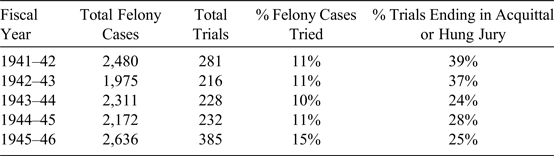
In sum, then, Vercoe and his deputies defined the public defender's role as revolving around adversarial trial advocacy and, where possible, the vindication of innocence claims. It is, of course, a separate question whether defenders carried out this ideal in practice. How many cases did they actually try? How did their trial rates compare with those of private attorneys practicing in the same courtrooms? A comprehensive, quantitative analysis of trial rates in the Los Angeles criminal courts is beyond the scope of this article. However, some preliminary suggestions can be made about the relationship between defenders’ professional image and actual practice based on the limited data that Vercoe himself provided in the office's annual reports (see Table 1).
Los Angeles County Public Defender Felony Caseload and Trial Rates, 1941–46

Source: 1941–42 through 1945–46 volumes of Annual Report of Los Angeles County Public Defender, Stanford Law Library.Footnote 146
According to these statistics, Vercoe and his deputies tried 10–15% of their felony caseloads each year, including both jury and bench trials. Most of the defenders’ felony cases, therefore as many as nine out of ten, were resolved from the public defender's perspective before trial, typically because the defendant pled guilty, although in some cases it was because the defendant retained private counsel and dropped off the public defender's docket or because the government dropped the charges.Footnote 147 In the annual reports themselves, Vercoe downplayed the trial rate and instead emphasized the bulk of cases that ended in pleas. Each year the report reproduced a section entitled “Advantage of Public Defender from Economic Standpoint,” estimating how much money the office had saved the county by avoiding trials “where the defendants were obviously guilty.”Footnote 148 In Vercoe's public speeches, too, he occasionally noted that the office saved money by avoiding unnecessary trials.Footnote 149 Such statements reproduced stock tropes introduced by the office's founder, Walton Wood, on whom scholars have focused when portraying early public defenders as nonadversarial.Footnote 150
Vercoe's appeals to efficiency must be understood within context. The creation of the public defender had been, initially, a progressive reform, and, therefore, the Progressive Era “gospel of efficiency” provided the original vocabulary for praising the reform's merits.Footnote 151 That vocabulary then continued to appear as boilerplate in public defenders’ annual reports for decades. The cost savings trope must also be situated within the more specific context of Los Angeles County, whose Board of Supervisors constituted the annual reports’ primary audience.Footnote 152 City and county leaders prided themselves on running one of the nation's largest and most complex municipal bureaucracies, and the highest praise they could offer an official was that he ran his department “on a business basis.”Footnote 153 During the same era, Los Angeles Police Chief James Davis similarly emphasized efficiency in his annual reports, and supporters of the Police Department's juvenile delinquency prevention programs justified them in terms of cost savings.Footnote 154
For the purposes of asking normative questions about the merits of the Public Defender's Office or the quality of justice in pre-Warren Court Los Angeles, the numbers reported in Vercoe's annual reports lend themselves to different interpretations depending on one's baseline views about the appropriate ratio of guilty pleas to trials and, perhaps, about the merits of adversarialism generally. And ultimately the numbers can only contribute partial insight to such questions. How defendants experienced the criminal process—information that would be central to any holistic qualitative assessment—is hard to glean from sources produced by their lawyers, and it is certainly not susceptible to divination from the data alone. How did defenders decide whether to take a case to trial, and how much input did clients really have in that decision? Were defenders trying more cases than they would have preferred because they were acquiescing to clients who insisted on trials? Or was it the opposite: were they trying fewer cases than they would have liked because clients were the ones who thought pleading guilty was prudent? Or perhaps the answers varied from client to client and from defender to defender? How did defenders’ interactions with their clients differ based on the client's race, gender, or other factors? Answering such questions would require further evidence about defenders’ and clients’ private interactions.Footnote 155
For understanding defenders’ own conceptions of their professional identity, however, the numbers are illuminating. Regardless of one's views about how many trials there should have been, the figures in the annual reports help to answer a different and purely descriptive question: whether trials happened in enough cases to constitute a regular occurrence. By that metric, trying 10–15% of cases should indeed be understood as a relatively high trial rate. Today only about 3% of felony cases nationwide proceed to trial, and a typical public defender might handle one trial a year.Footnote 156 In contrast, Vercoe and his deputies practiced in a world where trials remained relatively routine. In 1942–43, for example, the office handled 216 trials total, roughly 18 trials a month, implying that each attorney must have been in trial once or twice a month. In 1945–46, the office's fourteen attorneys collectively handled 385 trials, or 32 trials a month—at least two trials a month per attorney, and likely more, because attorneys teamed up for major cases. These statistical impressions track defenders’ own incidental descriptions of their workloads. For example, in 1937, Vercoe requested an extension of the deadline for an appellate brief because the office had just had “three murder cases set for trial” in a 2 month period.Footnote 157 On at least one occasion in 1935, Deputy Defender Richard Bird concluded one trial in the morning and commenced another trial the same afternoon.Footnote 158
Thus, defenders had reason from their perspective to describe themselves as trial lawyers and as frequent courtroom adversaries of the District Attorney's Office. From any given defendant's perspective, of course, the typical case did not end with a trial. Therefore, depending on one's views about how to characterize plea bargaining, one might interpret the data to suggest that the system was nonadversarial. But if so, that interpretation itself provokes interesting and perhaps discomfiting questions about the possibility of disjuncture between a lawyer's own self-conception and the reality of the system in which that lawyer worked. For lawyers to cultivate a sense of themselves as adversarial might only require that trials are routine for them—not that trials take place for the majority of their clients. A relatively small number of trials as a fraction of a lawyer's overall caseload can add up quickly in terms of the time spent in trial. Yet the premise of the American commitment to adversarial legal culture is that there is no difference between the two perspectives; that the collective efforts of so many adversarial lawyers are precisely what constitutes an adversarial system, which is to say, in the criminal context, a system that functions meaningfully to check the state.
It is beyond the scope of this article to determine the extent to which the Los Angeles criminal courts overall were meaningfully adversarial during the years of Vercoe's career, notwithstanding that Vercoe and his deputies presented themselves publicly as adversarial lawyers. Against the Los Angeles law enforcement machine, perhaps the most Vercoe and his deputies did was to help some of the defendants they represented avoid the worst of a range of bad outcomes. On the other hand, the overall scale of California's jail and prison complex remained exponentially smaller throughout Vercoe's career than it would later become; so perhaps in some way Vercoe and his deputies did help to keep standing some then-existing floodgates on how many people the carceral maw could consume, floodgates that some later set of changes opened.Footnote 159 If historians should not accept at face value early defenders’ self-presentation as adversaries of the state, it equally seems too simplistic to write them off as cogs in “the state's social control apparatus.”Footnote 160 But further and more fine-grained studies of the California criminal justice machinery, including the development over time of its prosecutors, courts, jails, and prisons, are needed to tease apart the causal connections between these various phenomena, aided, one hopes, by this article's portrait of how Vercoe and his deputies defined their role within that machinery.
Conceptions of Prejudice
Vercoe recognized that criminal defendants faced disadvantages in practice, notwithstanding the presumption of innocence and other theoretical protections. “Prisoners are sometimes unlawfully held under arrest for hours and some times longer without booking them,” he alerted his students in the very first lecture, when explaining how to locate a client in jail.Footnote 161 Although offered as a helpful practical tip, such guidance also conveyed the darker message that police and prosecutors could not necessarily be trusted. Meanwhile, Vercoe expressed sympathy for defendants qua defendants. He advised lawyers of the need to corroborate anything their clients told them, but not because defendants lied or were necessarily untrustworthy. Rather, a client “may mislead you unconsciously,” he explained, because of the understandable “nervous strain of being under arrest.”Footnote 162
But although Vercoe frequently referenced the special prejudice encountered by individuals accused of crimes, he framed prejudice in individualized, psychological terms. “Remember,” he emphasized, “the odds are all against the defendant. … It seems to be a trait of human nature to believe the witnesses for the prosecution.”Footnote 163 In Vercoe's account, opprobrium attached to individual defendants simply because of their status as defendants; the prejudice they encountered was produced by universal tendencies in “human nature.” Vercoe lamented that “society as a unit does not presume that a person accused of crime, yet untried, is innocent. Startling as it may seem … society presumes him to be guilty.”Footnote 164 Defenders in Vercoe's office translated this recognition into jury instructions urging jurors not “to be prejudiced against the defendant because of the fact that he is charged with this offense,” and not “to convict this defendant for fear that a crime may go unavenged or for the purpose of deterring others,” but rather to “acquit the defendant unless every fact necessary to establish his guilt has been proven beyond a reasonable doubt.”Footnote 165
In contrast to his passionate denunciations of generic prejudice against the accused, Vercoe rarely mentioned more specific forms of prejudice on account of a defendant's race, nationality, class, or other group categories. Only once, and briefly, did the lecture outlines expressly mention racism. In a lecture on jury selection, Vercoe first advised special care when selecting a jury in cases involving “sex crimes” or liquor violations; in the latter cases, he recommended ferreting out jurors who belonged to temperance organizations. He then mentioned the additional possibility of “prejudice” on account of “race, creed, color or membership in certain other organizations.”Footnote 166 Racial prejudice, then, was one of several factors to consider when selecting jurors, but it was not something that Vercoe discussed at length as a factor in police or prosecutorial bias.
That Vercoe marketed his expertise as a trial lawyer—not, for example, as a lawyer for the poor—also reflected Los Angeles public defenders’ identity not as lawyers for any group or cause, but as lawyers for individual clients. They defined themselves as equivalent to privately retained counsel in every respect except for the source of their pay and, perhaps, their heightened skill level.Footnote 167 In 1937, a graduate student interviewed Vercoe and other members of the office for his master's thesis, and concluded—presumably echoing what he heard in the interviews—that the public defender's “work in theory differs not at all from that of private counsel.”Footnote 168 William Neeley, one of Vercoe's longtime deputies and his eventual successor as head of the office, gave a similar description in 1948. He wrote that public defenders, although county employees, were also, “as regularly admitted members of the bar,” “subject to the same duties and obligations to the court and to their clients as an attorney in private practice.”Footnote 169 In 1944, the California Supreme Court had endorsed this view of the public defender in the course of deciding a death penalty appeal that involved allegations of ineffective assistance by one of Vercoe's longtime deputies. “[W]hen the public defender is appointed,” the court held, he becomes the defendant's attorney “to the same extent as if regularly retained and employed by the defendant.”Footnote 170
This individualized and generic framing of the public defender's role comported with Vercoe's emphasis on the danger of wrongful conviction. In a 1932 speech, he noted that the governor of California had recently pardoned eight men from Los Angeles because they were innocent. He then told a lengthy story about a client who had been convicted by a jury, only to learn much later that the police had crime-scene fingerprints exonerating him. The client had already spent 18 months at San Quentin when the prints were finally tested and he was pardoned and released. The case of a man exonerated only after a significant prison stay might seem an inapposite choice of anecdote for illustrating the public defender's value, but Vercoe used his story to make the point that, if such a miscarriage of justice could happen even with representation “by able counsel,” far worse might have resulted with “an inexperienced and incompetent” lawyer. Vercoe then hinted cryptically at several other “innocent men” languishing in San Quentin. Although he lacked the time to describe each case in detail, he said, “these cases stand out like beacon lights pointing to the ever-present danger of convicting innocent men.”Footnote 171
Mexican-American Defendants: Two Cases
In emphasizing individual claims to innocence, Vercoe avoided framing his work in terms of protecting marginalized or vulnerable groups; for example, Southern California's large and growing Mexican diaspora, a frequent target of repressive policing. By 1928, Los Angeles was home to the United States's largest Mexican community.Footnote 172 The Public Defender's Office certainly represented Mexican defendants when appointed, but Vercoe generally did not describe his clientele as a group in ethnic terms.Footnote 173
Mexican Angelenos, in turn, must not have viewed the Public Defender's Office as a reliable champion, because they often turned to their own community for legal assistance. In 1926, community leader Maria Dozel founded the Sociedad de Madres Mexicanas, or “Las Madres,” which raised funds to hire private attorneys for those facing criminal charges.Footnote 174 Particularly in the late 1920s and early 1930s, Mexican nationals also sought legal help from the Mexican Consulate, which sent members of its volunteer auxiliary, the Comisión Honorifica Mexicana, to visit compatriots in jail. (After the early 1930s, the consulate shifted its focus away from individual casework.)Footnote 175 Few details survive about these community-based efforts, and it is unclear how active Las Madres was or how long it remained in operation, but even if the organization proved to be short lived, its existence implies that Mexican residents of Los Angeles did not take for granted that public defenders would adequately represent their friends and family.
It is unclear whether Mexican defendants hired their own counsel, when possible, because they were unfamiliar with the Public Defender's Office, because they believed that private attorneys could secure better outcomes for their clients, or because they knew about but specifically mistrusted the office.Footnote 176 It seems plausible that Mexican Angelenos may have been inclined to mistrust or even fear the Public Defender's Office simply because it was a county entity.Footnote 177 If so, Vercoe would hardly have allayed their concerns. In his standard speech, Vercoe praised Los Angeles District Attorney Buron Fitts as a fair-minded official “seeking to injure no man unjustly.”Footnote 178 Vercoe may have felt obligated to include such standard praise when addressing luncheon-club audiences accustomed to respecting law enforcement. Such comments would, nevertheless, likely have sounded tin eared to many Mexican Angelenos, because Fitts was the same district attorney who, in 1934, had targeted the popular Mexican radio personality Pedro González. Fitts had González arrested on a series of manufactured accusations after first trying and failing to convince the federal government to revoke his broadcast license. He argued that González might use his radio program to foment anti-American riots.Footnote 179
Two cases in which the Public Defender's Office represented Mexican-American defendants—one extremely high profile, the other quite routine—together illuminate the ways in which Vercoe and his deputies’ individualized conception of the public defender's role remained detached from racial justice campaigns in Depression and World War II era Los Angeles. The high-profile case was the 1942 Sleepy Lagoon trial, which became, in and around Hollywood, a cause célèbre akin to a local Scottsboro case.Footnote 180 The episode began when Jose Diaz, a young Mexican national, was found dead near the scene of a late-night brawl at a birthday party in Sleepy Lagoon, a then-rural area of Los Angeles County. Fomenting hysteria about a Mexican “crime wave,” police rounded up hundreds of working-class youth for questioning, most of them Mexican, and ultimately charged twenty-two defendants collectively with Diaz's murder. There was little evidence of any kind about what exactly had happened to Diaz, and virtually no evidence specifically implicating the defendants.Footnote 181 Nevertheless, the District Attorney's Office pressed on, conducting a chaotic and protracted mass trial. Ostensibly because of the crowded conditions of the courtroom, the judge required the defendants to sit separately from their attorneys, prohibiting them from consulting with their counsel during the proceedings. At the end of the trial, the all-white jury returned guilty verdicts against six of the defendants and acquitted the remainder. The radical muckraker Carey McWilliams publicized the defendants’ plight and raised funds to support their appeals. All six convictions were ultimately reversed, but the racist hysteria aroused by the trial helped to precipitate the Zoot Suit Riots: an extended period of white mob violence, primarily targeting Mexican-American men, in the summer of 1943.Footnote 182
The Public Defender's Office played a small part in the Sleepy Lagoon trial. Although several of the defendants had secured their own counsel, either through friends or, in one case, the Mexican Consulate, the court initially appointed Deputy Public Defender Richard Bird to represent several of the defendants who remained. From the first day of trial on October 13, 1942, through the morning of November 2, Bird continued to appear as counsel for two of the defendants (one of whom was among the six who were ultimately convicted). Bird raised objections to prosecutors’ lines of questioning and participated in cross-examining the state's witnesses; but he also agreed to several of the prosecution's administrative requests regarding the coming and going of witnesses out of a desire to avoid “inconveniencing anybody.”Footnote 183 On one occasion he initiated a line of questioning but then quickly “let it go” because it would prove “too difficult”; the witness spoke poor English and there remained “a lot of other witnesses” to get through.Footnote 184 Bird was among the most experienced of the group of defense lawyers, who often disagreed among themselves about trial tactics.Footnote 185 Given the shambolic quality of the trial and the obstacles placed by the judge in the way of defense counsel, he did not stand out as uniquely unhelpful to his clients in comparison with the other lawyers involved, nor did he stand out as particularly zealous or aggressive in challenging the prosecution.Footnote 186 Likely for that reason, Bird plays a minor role in historical accounts of the Sleepy Lagoon case and has largely disappeared from popular accounts.Footnote 187
Friday, October 30, was Bird's last full day participating in the Sleepy Lagoon trial. On Monday morning, November 2, his remaining clients moved to replace him with private counsel: George Shibley, a politically radical lawyer based in Long Beach who had been retained on their behalf by a local activist named LaRue McCormick, who directed the Southern California branch of the Communist Party-affiliated International Labor Defense.Footnote 188 In her conception of defense advocacy, McCormick could not have differed more from the Public Defender's Office. She viewed each criminal trial as an opportunity to build working-class solidarity by “turn[ing] the courtroom into a classroom.”Footnote 189 By organizing picket lines outside of courtrooms and filling the pews with supportive spectators, McCormick aimed not only to demonstrate opposition to the state but also to educate observers about how individual cases connected to larger patterns of injustice.Footnote 190 When McCormick learned of the Sleepy Lagoon trial, she became concerned about the seemingly uncoordinated defense effort and helped to found an ad hoc Sleepy Lagoon Defense Committee.Footnote 191 After Bird left the trial, the Public Defender's Office took no further part in either the defense campaign or the larger public relations efforts on behalf of the defendants. The Sleepy Lagoon case never appeared in the Public Defender's Office annual reports. Nor, insofar as Vercoe's notes reveal, did the case appear in Vercoe's lists of anecdotes illustrating the dangers of wrongful conviction.Footnote 192
A contrasting episode was the routine narcotics case of an individual Mexican-American defendant named Manuel Romero, arrested in 1935 for possessing marijuana. A police officer testified that he had watched Romero exit a beer parlor, encounter “a short Mexican” and receive a package, and then drop the package beside a wall, whereupon the police “followed him…placed him under arrest; and…walked over and picked up this package containing four mariahuana cigarettes.”Footnote 193 The same Richard Bird represented Romero who appeared several years later in the Sleepy Lagoon trial. While questioning the police witnesses in this case, Bird injected sarcastic asides, lampooning the notion that possessing four marijuana cigarettes—even if true—constituted a “dastardly deed” worthy of judicial concern.Footnote 194 After Romero was convicted, another deputy, William Neeley, took over on appeal. Neeley argued that Romero had been denied his right to a speedy trial. The specifics of this claim were somewhat complicated—depending on the particulars of Romero's arrest and time in custody—and ultimately unavailing; the appellate court upheld Romero's conviction and his 1 year county jail sentence.Footnote 195
The appellate brief that Neeley filed on Romero's behalf was replete with lofty acclaim for due process. In denying Romero a speedy trial, Neeley argued, the state had withheld “a fundamental right” “guaranteed from the earliest times to the English people” and “wrung from reluctant and autocratic sovereigns by a people who by suffering and bloodshed struggled for the successive declarations of liberty which now constitute the very foundations of our free people.” Too often, Neeley continued, “ill informed” critics complained that procedural protections for criminal defendants hindered the “effective prosecution of crime.” “Undoubtedly,” he noted wryly, critics “at the time of the Magna Carta” similarly complained: “Have we then reached that stage of perfection of law where we can relax the enforcement of those rights in the belief that protection against government is no longer necessary; or will future generations look back to our era with the same horror of the inhumanity of government as administered today that we hold of its administration in the past?”Footnote 196 It would be difficult to invent a more fitting encapsulation of the twists and pollinations of American legal history than Neeley's brief: a disquisition on the timeless rights of “the English people” offered by a lawyer with an Irish name to the courts of the former Spanish colony of California on behalf of a Mexican client charged with possessing “leaves of Indian Hemp.”Footnote 197
“Too often we think of an accused as being one apart from society, one not like ourselves,” Neeley wrote in another flowery passage. “We react to the thought that he must be made of different stuff than we who are not accused, therefore why concern ourselves that he be assured of any particular safeguards …. This philosophy ignores the teachings of history that in almost every instance the charters of liberty of the individual under the common law were demanded and granted by reason of the evils of misaccusation and a denial to those accused of an opportunity of a prompt and fair hearing.”Footnote 198 Although this passage may well have been filler, its words nevertheless hum with resonance given the defendant's identity and the larger climate of anti-Mexican bigotry in 1930s Los Angeles.
People v. Romero shows that early public defenders engaged in vigorous adversarial advocacy on behalf of their indigent and often immigrant or minority clients; however, this was done always within the confines of individual cases.
Conclusion
Los Angeles public defenders during Vercoe's tenure, from the late 1920s through the mid-1940s, developed a professional identity that combined twentieth-century themes of efficiency and expertise with elements of nineteenth-century adversarial legal culture. Benefiting from their social position as white middle-class professional men with respectable suburban families, they cultivated a public image as expert trial lawyers, detached from the marginalized status of their indigent clients. Depending on the audience, they emphasized different strands of this professional identity. Vercoe's annual reports, written for the self-professed “business-like” Board of Supervisors, spoke in the idiom of cost savings that the first generation of Progressive Era public defenders had introduced. But in his public speaking and especially in the evening classes he offered for the bar, where he enjoyed freer rhetorical rein, Vercoe billed himself not as a local bureaucrat, processing files, but as a trial lawyer, standing alone with the innocent accused against hostile police and a judgmental society. His self-presentation as a trial lawyer had some basis in his practice. Vercoe and his deputies, like most criminal lawyers throughout the twentieth century, resolved more cases through pleas than through trials. But they continued to try enough cases—for the 1940s, 10–15% of their felony caseload—that trials constituted a regular component of their work. They occasionally had multiple trials in a week or even on the same day. From their perspective, then, it was not fantastical to identify themselves primarily as trial lawyers, even if the criminal process may not have appeared especially trial centered from any given defendant's perspective.
In line with this professional identity, Vercoe and his deputies advanced a model of defense advocacy that emphasized each individual defendant's right to a full investigation of the facts and, if necessary, a trial: a model rooted partly in due-process values but also in concerns for the accuracy of outcomes. The great danger that public defenders helped to forestall, in Vercoe's telling, was the danger of wrongfully convicting the innocent. Thus Vercoe and his deputies questioned the propriety of permitting a defendant to plead guilty before a complete factual investigation. As evidenced by the appellate briefs that they filed on behalf of their clients, they did not necessarily write off their indigent clients as guilty. To the contrary, in some cases they continued pressing innocence claims even after a judge or jury had issued a guilty verdict. From the routine drug possession conviction at issue in People v. Romero to the horrific triple-murder conviction at issue in People v. Dyer, Depression Era public defenders in Los Angeles advanced an array of legal and factual arguments to California's appellate courts on behalf of marginalized and ostracized clients who enjoyed very little sympathy from the majority of Californians. They did so, however, not out of political commitment to (or identification with) the poor as a class, but out of professional commitment to what they understood to be their duties as lawyers and, in particular, to what they understood to be their role as defense lawyers. In cases presenting the opportunity to protest systemic racial and class injustice, such as the Sleepy Lagoon trial, advocates for the defendants turned to private lawyers and outside groups, such as the International Labor Defense.
Cultivating a professional identity as expert trial lawyers may have helped public defenders in Los Angeles to shore up their civic standing. Defining themselves as courtroom adversaries but professional peers of the District Attorney's Office, these early public defenders secured a place for themselves within the developing metropolis of Los Angeles as respectable contributors to urban governance. My argument is not that these early public defenders consciously exploited their role to improve their status, or were merely using their clients instrumentally. They seem to have believed in their role within what they understood as an adversarial legal process. My argument is that, precisely because they believed in that process, they did not define their role in terms of challenging or remaking it (whether from the left, in the service of working-class politics, or from the right, in the service of law and order). If there were a factory metaphor latent in Vercoe and his deputies’ self-presentation, it was not assembling convictions like widgets, but quality control: public defenders tested whether the courts were operating correctly, confirming the facts of each case to safeguard defendants from the risk of erroneous conviction. They defined that risk in individualized, psychological terms. In explaining why judges or juries might go awry, they did not emphasize racism or other historically specific forms of prejudice but the universal tendency of humans to assume guilt or misapprehend the facts.
The strength of the adversarial ideal in the Los Angeles Public Defender's Office, at least through the 1940s, raises further research questions about chronology, periodization, and regionalism in the history of criminal justice. At some point during the twentieth century, criminal trials did become so exceedingly rare in the United States that public defenders began to describe themselves more as plea negotiators and sentencing advocates than as trial lawyers, even if they lamented rather than celebrated that shift.Footnote 199 In Los Angeles specifically, this change seems to have occurred by 1970. That year, a political scientist studied Los Angeles public defenders and found that when identifying the value they provided for clients, they emphasized neither trial skills nor factual investigation, but their ability to exploit prosecutors’ predilections and incentives to craft advantageous plea deals.Footnote 200 At the level of professional identity, this shift apparently remained incomplete as late as the 1940s.Footnote 201
To readers familiar with the present-day landscape of indigent defense, Vercoe's lawyerly ideal may seem puzzling. In recent years, advocates have offered a range of normative visions for public defenders, using aspirational terms such as “community lawyering,” “client-centered advocacy,” and “holistic defense.” Holistic defenders, for example, pride themselves on “listen[ing] to neighbors in bodega lines, housing projects, and community centers” and visiting “tenant associations, school boards, and churches.” Defining their mission to expand beyond simply resolving their clients’ immediate criminal charges, they engage in “outreach, education, organizing, and policy work in partnership with clients and other community members to create large-scale change in the community.”Footnote 202 Many public defenders today orient their work within broader political struggles. The 2015 “Law for Black Lives” conference, organized by the Center for Constitutional Rights in support of the Black Lives Matter movement, featured a panel entitled “Defending the Accused: Radical Approaches to Criminal Defense,” with a former public defender among the speakers and many public defenders in the audience.Footnote 203 That same year, San Francisco's elected public defender urged his peers nationwide to “stand up for racial justice.”Footnote 204
If Vercoe did not fit the pejorative archetype of the public defender as an assembly-line bureaucrat, neither was he a precursor to this more recent vision of the public defender as a cause lawyer. Although he had once entertained political ambitions, he appears to have abandoned them once he began his career in indigent defense. He engaged in a kind of community outreach, but not in his clients’ neighborhoods. Rather, he spoke frequently to audiences of his own social and professional peers, at society luncheons, church groups, and women's clubs. Unlike “cause lawyers,” he never described his work as a way to “redistribute political power and material benefits in a more egalitarian fashion.”Footnote 205 Unlike “political lawyers,” he was not seeking “to use law to change society or alter allocations of power.”Footnote 206 He specialized in the type of “individualized, atomized, depoliticized” advocacy that today's proponents of “community lawyering” now lament.Footnote 207
What unites the assembly-line archetype and the community organizer model is a shared premise that lawyering for the poor does or should take a distinctive form, different from lawyering for paying clients. Some scholars have portrayed early public defenders as believing that the poor did not deserve adversarial representation and instead should receive a more muted form of advocacy. Calls for “holistic defense” are predicated on the mirror image of that theory: the idea that indigent defendants require a special type of lawyering that offers services beyond what paying clients require, tailored to the distinctive needs of the poor. Vercoe and his deputies strove precisely to reject the premise that lawyering for the poor should be different from lawyering for anyone else. They defined themselves as trial lawyers with a specialized repertoire of professional expertise; the fact that their job involved deploying that expertise on behalf of poor people was to them incidental. Only thus could Vercoe, in offering his evening classes, market his experience as public defender as a font of practical lessons that could benefit any lawyer in any type of practice.
The point of these comparisons is neither to celebrate Vercoe's adversarialism nor to denigrate him for failing to meet contemporary standards of advocacy, but simply to highlight the distinctions between his lawyering ideal and the ideals that animate present-day discussions of indigent defense. Vercoe's world, despite its superficial similarity and even its relative temporal proximity, appears on further examination quite distant from that of lawyers today. To the extent that public defenders now identify themselves as community or poverty lawyers, or as participants in movements for racial justice, those identities are not inherent in their role but the result of changes over time within the legal profession and American legal culture, changes that legal historians have not yet fully reconstructed.