In “The Scholarly Conference: Do We Want Democracy and Markets or Authority and Tradition?” (Rom Reference Rom2012), I call for an almost total transformation of the conventional conference into the customized conference. It is, admittedly, a radical proposal—although I believe that there are strong grounds for embracing it—and some of my colleagues (see Leal in this issue) responded with a defense of the traditional conference and its emphasis on the panel format. It may be argued that section heads can use their deep knowledge to assemble panels that are rich and coherent, bringing like-minded scholars together to share research of mutual interest, or that they can craft panels to nudge their subfields into new directions. Presenters can introduce their research to new audiences through captivating talks and gain valuable insights from the penetrating questions and comments of discussants and observers. Audiences can be exposed to novel theories, innovative methods, unique data or counterintuitive findings they otherwise would miss, and make the acquaintance of bright scholars they otherwise would not meet.
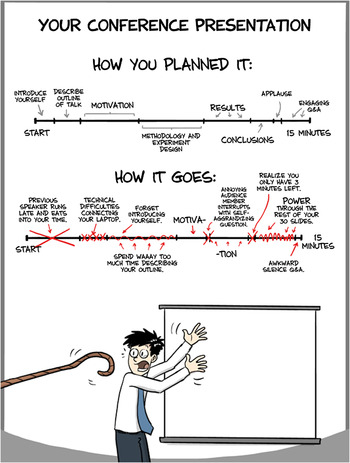
The potential for high-quality panels and presentations is achieved less often in practice than we might wish. Too often, it seems, “[t]he presenters walk in, present, and walk out; the audience sits down, listens, and leaves” (Rom Reference Rom2012, 339). As for the presentations, there might be more than a little truth to Chom’s view, shown in figure 1.
Piled Higher and Deeper
Source: Reprinted with permission. “Piled Higher and Deeper” by Jorge Chom, available at www.phdcomics.com

Let us assume, however, that the customized conference that I am recommending is rejected in favor of the conventional conference and its emphasis on panel meetings. What can we do to improve the panels? Require panelists to create video presentations and then “flip” the panels.
REQUIRING VIDEOS: A BRIEF DIVERSION AND A DISCOVERY
Until the flourishing of the Internet, most humans—popes, professors, and peasants alike—communicated by speaking (live) or writing (recorded). Accordingly, speaking and writing were the key communication skills emphasized in higher education.
The Internet did not eliminate those traditional forms of communication, but it did open up arenas for other types to thrive. Videos—even educational ones—became ubiquitous. Footnote 1 Multimedia websites, containing text but often emphasizing visual displays (i.e., pictures, graphics, and videos), became a primary source for disseminating information. Footnote 2
Responding to these changes in communication possibilities, I decided to offer (or require) students in my courses the opportunity to create videos or “digital portfolios” (essentially, multimedia websites) in addition to or in lieu of oral presentations and written papers. My pedagogical purposes were twofold. First, I wanted to help my students develop the technical skills necessary to create videos and digital portfolios. Footnote 3 Second, I wanted to provide them the opportunity to use the forms of communication that they actually are likely to use. Nevertheless, the core requirements emphasized the substantive content of the presentations, not the flashiness of their delivery. What happened next surprised me.
In general, the quality of the digital projects greatly exceeded my expectations. Although “style” was not a major factor in assessment, their projects often were beautiful. More important, the content quality has been high. The digital portfolios also were richer than papers. The videos—of special relevance here—were almost always, I believe, vastly better than “live” oral presentations.
Why might this be the case? My answers are speculative because I have been unable to uncover any research that addresses this question, but they may be informative for my recommendation.
Apparently, it is easier to procrastinate on an oral presentation than on a video. Students seem more confident in their ability to prepare a talk than to produce a video at the last minute. Perhaps this is because creating educational videos is new to them, unlike oral presentations that they undoubtedly have given many times. Footnote 4 It is possible that they are more engaged by the idea of working with technology. It also is conceivable that they care more about how their peers will judge their presentation.
Students are instructed that it is acceptable to speak directly into the camera, simply recording their speech; however, few students choose this option. This may be because they do not like watching themselves, but it also could be that the resulting video is likely to be boring. To make the video more engaging, most students appropriately use maps, pictures, graphs, and video clips that, in fact, make the presentations more appealing and instructive.
Whether students are giving talks or making videos, they are instructed to comply with established time limits. Although neither presentation form is inherently superior in terms of compliance, students often underestimate the actual length of their talk because they do not practice with a stopwatch. With videos, they know to the second how long their presentation is; therefore, in practicing, they are more likely to abide by the limits. This has multiple benefits: (1) the videos do not have lengthy introductions and rushed conclusions; (2) extraneous material is deleted; and (3) all presentations can be given in the allotted time.
Finally, students appear to be more willing to make a weak speech than a weak video. This may seem counterintuitive, but it can be explained in two ways. The audience may be more forgiving of a bad talk (after all, we all have bad days) than a weak video, which can be edited. When a speech is over, it is over, and whatever embarassment that may have occurred is fleeting. A video lives on, and the ability to relive any embarrassment does too. Moreover, at least for me, it would be more embarrassing to be part of the audience watching myself doing the embarrassing act than actually to be doing it live.
In summary, video presentations appear to be stronger than live talks because students prepare better, are creative, meet time restrictions more often, and seek to avoid embarrassment. Footnote 5
Video presentations appear to be stronger than live talks because students prepare better, are creative, meet time restrictions more often, and seek to avoid embarrassment.
Would the same be true for videotaped conference presentations? Would political scientists behave like political science students? Unless we are willing to assume that academics are more open to embarrassment, less concerned about meeting requirements, less creative, or less likely to procrastinate, then the answer is yes.
Hence, this is the first part of my recommendation. In addition to submitting a paper, panelists would be required to submit a video presentation of their work. The video could be uploaded on a conference channel (e.g., YouTube), or perhaps each panel would have a dedicated channel. The APSA could require that videos be of a certain length (e.g., no longer than 12 minutes) or leave it to the discretion of the presenter.
FLIPPING THE PANELS
A series of “high-profile” publications in the New York Times (Fitzpatrick Reference Fitzpatrick2012), The Chronicle of Higher Education (Berrett Reference Berrett2012), and Science (Mazur Reference Mazur2009) made “flipping the classroom…something of a “buzzword” in higher education (Reference BrameBrame n.d.). The core concept of “flipping” is that students are exposed to new material outside of the classroom and before the class meeting so that they engage in more active learning (through “problem-solving, discussion, or debates”) in class (Reference BrameBrame n.d.). As Keller stated, “If you [flip] well, you can use faculty members’ time and expertise more appropriately…and you can get better student-learning outcomes” (quoted in Berrett Reference Berrett2012).
I recommend that we flip conference panels, not as a matter of being trendy but rather as a step to more effectively using our mutual time together. Rather than summarizing their paper, presenters would come to the panel with questions that they need answered to improve or extend their research. Instead of listening to presentations, audience members would come with their own questions regarding the panelist’s research, or suggestions for improvements, or implications for new research, and so forth. The panels thus would be devoted exclusively to conversations between presenters and the audience with the goal of enhancing individual and communal research efforts.
Flipping the classroom effectively is not easy—I needed two semesters to master it. It requires that students come to class prepared by completing the advance readings or assignments. If they are not prepared, the active learning that is based on prior knowledge cannot occur. Compared to traditional lectures, flipping increases the demands on faculty because professors must develop classroom activities that deepen the learning. This format is not always popular with students, who are accustomed to the more passive style of taking notes on lectures (Berrett Reference Berrett2012; see also Smith Reference Smith2013 for counterevidence). Footnote 6 Finally, flipping is not guaranteed to improve learning outcomes: “To date, there’s no scientific research base to indicate exactly how well flipped classrooms work” (Goodwin and Miller Reference Goodwin and Miller2013). Some researchers have found benefits (e.g., Deslauriers, Schelew, and Wiesman Reference Deslauriers, Schelew and Wiesman2011; Ferreri and O’Connor Reference Ferreri and O’Connor2013; King and Sen Reference King and Sen2013); others dispute this not as a theoretical matter but rather based on actual classroom experience (i.e., flipping not done well) (Andrews et al. Reference Andrews, Leonard, Colgrove and Kalinowski2011).
These pedagogical and behavioral concerns are clearly relevant for the proposal to flip the panels; there is no guarantee that flipping panels would improve the conference. The traditional conference is easier: we rely on the comfort of custom. Furthermore, attendees already have the opportunity to read papers in advance of the panels in order to be prepared to discuss them. However, I suspect that most do not read them beforehand precisely because they know that they will hear them summarized at the presentation.
For panel flipping to work, a new norm must be established: presenters must post their work before the conference to appear at the panels and live presentations must be prohibited so that panels are actively engaging.
CONFERENCE OPTIONS
The recommendations to videotape presentations and flip the conference are distinct from one another. Presentations could be videotaped but the conference not flipped. The conference could be flipped but the presentations not recorded (therefore, participants would need to read the papers in advance). In this section, I rank the main options in descending-preference order.
First Place: The Full 360
In this option, presenters would be required to post videos in advance of the conference; formal presentations would not be given. Panels would be devoted exclusively to discussion. This option provides the greatest potential for both improved presentations and enhanced discussions.
This option also provides the greatest flexibility. Attendees can choose to watch all panel videos or only those of greatest interest to them. The panel session could include, for example, small groups in which attendees initially meet with the scholar of their choice; the groups then would circulate every 15 minutes or so before a final convening. An additional benefit of this approach is that attendees could visit multiple panels that are scheduled simultaneously: that is, meet with an author, discuss, move to another panel, and repeat.
The Full 360 option also imposes the greatest demands on participants. To benefit from the discussions, attendees would need to watch the videos in advance and be prepared to discuss them. Presenters must consider carefully what they want viewers to learn from their video and what they want to obtain from the discussion. Of course, these demands are what we expect from students and teachers in our own classrooms.
The Full 360 option also imposes the greatest demands on participants. To benefit from the discussions, attendees must watch the videos in advance and be prepared to discuss them.
Second Place: The 180
In this option, presenters would be required to post videos but they would be shown at the panel meeting. In this way, the panel would resemble the traditional format. Key benefit? Better presentations. Main disadvantages? Passive audiences and limited time for discussion if videos run long.
A Close Third: The 180 with a Twist
In this option, presenters would submit papers in the usual way, with no videos. Formal presentations would not be given at the panel meetings. Attendees would be expected to read the papers in advance and come prepared to discuss them. Key benefits? Better discussions (with all of the potential benefits outlined in The Full 360) and fewer demands on presenters. Potential disadvantages? Presenters would not hone their presentation skills and attendees would not have the opportunity to hear the presenters personally explain their research.
The second- and third-place options are a virtual tie. For this judge, the benefits of having researchers explain their research slightly edges out the value of an audience arriving at the panel prepared to discuss it. I understand that other judges may disagree.
Dead Last: The Belly Flop
In this option, panel presentations continue in the traditional format; please refer to the Chom cartoon for further details.
FINAL CONSIDERATIONS
Videotaping presentations and flipping the panels would not be a magical cure for conference ailments. As with any substantial change in institutional rules, those who benefit from or are merely accustomed to the existing rules are understandably wary of change. As we know, the potential for future benefits is generally a less powerful motivator than the fear of future losses (e.g., see Kahneman Reference Kahneman2012, 283–6). Footnote 7 To the extent that scholars are risk averse, they will oppose the proposal to video presentations and flip the panels—unless they can be convinced that the ratio of gains to losses is sufficiently high.
What are the losses generated by this proposal? For some more-senior scholars, it might be the loss of a cherished tradition: the conference format they know and (conceivably) love. However, although it is always risky to argue against the Fiddler on the Roof, in this case I will. The tradition of marriage is worth preserving; the tradition of child marriage is not. The traditional conference does not serve the best interests of the scholarly community.
Will requiring videos lead to worse presentations? I cannot think of any reason why it would. Unless presenters spend less time preparing their video than they do preparing their talk, the worst outcome expected would be that they record the same talk they would have given live. If the behavioral responses of presenters align with those of my students—and I expect that they do—we should anticipate that, on average, the video presentations will be superior to the live talks. Better presentations will benefit the scholarly community.
Of course, presenters may not want to create videos, finding it costly to do so. Footnote 8 Indeed, resistance is inevitable, at least in some quarters. Whereas many scholars undoubtedly are comfortable in videotaping themselves, or are eager to try, others are reluctant to use video technology or simply do not enjoy seeing themselves on camera.
My first inclination is to respond that resistance is futile. If we are to remain an innovative profession, it is incumbent on us to embrace technologies that can enhance teaching and learning. But allow me to suggest another argument: live conference presentations do little to advance the skills or reputation of scholars. Brief scholarly talks are given at conferences and almost nowhere else. On balance, preparing one-off live presentations imposes costs on the presenter and produces minimal benefits.
Requiring videos can produce a larger benefit: creating relatively brief videos is a skill that is professionally useful to academics. Do you want to design a massive open online course (MOOC)? You will make 10-minute videos: each “learning sequence” is typically accompanied by one (Wikipedia n.d. (b)). Are you not interested in a MOOC but are willing to make video supplements to political science textbooks? You will make 10-minute videos (see, e.g., the supplemental material for Kollman Reference Kollman2014). Do you want to develop a MOOC for your university or make your video useful for flipping the classroom? You had better be making relatively brief videos! Guo (Reference Guo2013) analyzed the use of edX videos by millions of viewers and discovered that the median “engagement time” (this term was not precisely defined but apparently means “viewing time”) for watching videos was 6 to 9 minutes. It is noteworthy that the longer the video, the less likely students were to engage; longer videos actually led to shorter viewing times (however, the decline for 9- to 12-minute videos was not sharp).
Nevertheless, videotaping presentations would have another value versus live talks: the time limits that constrain presentations at panels need not be imposed. If presenters believe that their research merits a 20- or even 30-minute video, they would be allowed to create one of that length. However, caveat venditor.
Finally, videotaping presentations would allow APSA participants to watch only those in which they were interested, even if they cannot attend the panel where the presentation is discussed.
If we are to remain an innovative profession, it is incumbent on us to embrace technologies that can enhance teaching and learning.
Will conference attendees suffer losses from having the panels flipped? Yes, if attending panels without prior exposure to the research is considered a loss. The opportunities for gain are substantial. Attendees actually can engage in conversations with presenters at the panels, to their mutual benefit. They can preview research presentations that they value most highly and attend multiple panels during a single session to talk to the authors they most want to meet.
CONCLUDING THOUGHTS
My recommendation to videotape presentations and flip the panels need not be accepted—or rejected—in its entirety. A full-fledged experiment is possible, with panels randomly assigned to “conventional” and “video-and-flip” formats with data collected on outcomes. A pilot program, with some panels volunteering for the Full 360, is certainly feasible. Do I hear anyone volunteering?