Introduction
Family poultry represent an appropriate system for supplying a fast growing human population with high quality protein and providing additional income to poorer, small farmers (Guèye, Reference GUÈYE2009; Akinola and Essien, Reference AKINOLA and ESSIEN2011; Mengesha, Reference MENGESHA2012). Family poultry are as important to the rural areas as industrial poultry are to the urban regions (Moula et al., Reference MOULA, FARNI, SALHI, IGUER-OUADA, LEROY and ANTOINE-MOUSSIAUX2012). Under the present circumstances in Nigeria, any development that increases productivity of family poultry by 10% would contribute far more poultry products than a 10% increase in industrial poultry, which would require far more capital investment (Sonaiya, Reference SONAIYA2009). Animal genetic resources (AnGR) are crucial to all future developments and adaptations, and carry an international obligation to conserve certain characteristics for sustainable and future use. Therefore diversity is necessary to be able to adapt to future markets, production systems, available feed resources, environmental issues, laws and regulations, and disease pressure. Of the utmost consequence are food supply and security, although cultural and historical values also have importance (Tromso, Reference TROMSO2010).
Poultry genetic resources in general are considered to be the most endangered and under-conserved; and strategic approaches to conservation at the national level need to be developed and implemented (Hoffmann, Reference HOFFMAN2009). Knowledge-based management of AnGR is critical to address current agricultural, socio-economic, and environmental challenges facing animal production. Consequently, characterisation of AnGR constitutes one of the priorities of the FAO global plan of action (Alders and Pym, Reference ALDERS and PYM2009), in particular in developing countries, where there is a lack of information regarding what and how to conserve, develop, and select among local breeds.
Waterfowl production has progressed rapidly in the past few decades and will, without doubt, continue to play an increasingly important role in the world with respect to food production and security (Huang et al., Reference HUANG, PINGEL, GUY, LUKASZEWICZ, BAEZA and WANG2012). Duck meat production was increased from 1.3 million tons in 1991 to 3.6 million tons in 2007 (Pingel, Reference PINGEL2009), with 65% of the world production coming from China. Duck production in 2010 was six-fold that of 1961 (FAOSTAT, 2012). In Nigeria, the duck population was ranked third (9,553,911) after chicken (101,676,710) and guinea fowl (16,976,907) respectively (NBS, 2012). Muscovy ducks make up about 74% of the ducks in Nigeria, and its meat is lower in fat and hence considered to be healthier (Adesope and Nodu, Reference ADESOPE and NODU2002). Ferdus (Reference FERDUS1999) reported that increased duck rearing would be a great addition to total poultry output since they do not interfere with chicken production due to different rearing and scavenging venues. Due to its good foraging and incubation behaviour, Muscovy ducks are especially suitable for scavenging systems and they have a better adaptability to hot climates than chickens (Raji et al., Reference RAJI, IGWEBUIKE and USMAN2009). The Muscovy duck would be suitable for small-scale rural farmers in Africa and Latin America and could contribute to food security (Pingel, Reference PINGEL2009). Due to the fact that duck raising is still not well developed in Nigeria, the Muscovy duck is most commonly kept on free-range and backyard premises. Even though ducks are hardier and more resistant to diseases and environmental hazards, they are fewer in number compared to chickens basically because of cultural beliefs, which tend to portray ducks as mystique birds. However, development in research and technology has increasingly eliminated these cultural barriers and enhanced the productivity of the birds (Ikani, Reference IKANI2003). The following paper reviews the phenotypic, biochemical and molecular genetic characteristics as well as the meat and egg attributes of local Muscovy ducks in Nigeria.
Brief description of Nigerian Muscovy ducks
The Muscovy duck is the most popular variety in Nigeria. Muscovy Ducks originated in Central and South America (Anonymous, 2012). Although they were domesticated hundreds of years ago, have they been getting increased attention from backyard homesteaders only recently. The plumage can be black, white, a combination of the two or multicoloured (Raji et al., Reference RAJI, IGWEBUIKE and USMAN2009). Muscovy ducks are easily recognised by the fleshy outgrowths, red in colour, found round the eyes and beaks. They are found mostly along the coastal areas of southern Nigeria (Ugbomeh, Reference UGBOMEH2002; Ikani, Reference IKANI2003). The Muscovy duck has few of the problems associated with the Pekin, and some added benefits and so has become a favourable alternative to the Pekin Duck. The main reason why people raise these ducks is for their ample and succulent breast meat., with many people likening it to filet mignon (Anonymous, 2012).
Morpho-biometric characterisation
Phenotypic characterisation of AnGR is the process of identifying distinct breed populations and describing their external and production characteristics in a given environment and under certain management, taking into account the social and economic factors that affect them. The information provided by characterisation studies is essential for planning the management of AnGR at local, national, regional and global levels (FAO, 2011). The Global Plan of Action for Animal Genetic Resources (FAO, 2007) states that ‘A good understanding of breed characteristics is necessary to guide decision-making in livestock development and breeding programmes’.
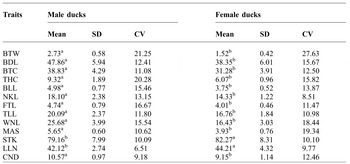
Knowledge about body size and skeletal proportions of native stock is imperative because it can prove, to some extent, a reasonable representation of genetic differences among populations (Yakubu et al., Reference YAKUBU, MUSA-AZARA, AYA, BARDE and ABIMIKU2009). In a phenotypic study on Nigerian Muscovy ducks, sex-associated differences were found in all the body traits and indices investigated. Males (drakes) had significantly (p<0.05) higher body weight, body length, breast circumference, thigh circumference, bill length, neck length, foot length, total leg length, wing length, massiveness and condition index (Table 1).
Descriptive statistics of the body weight (kg), linear body measurements (cm) and morphological indices (%) of adult African Muscovy ducks according to sex (Yakubu, Reference YAKUBU2011).

SD: Standard deviation; CV: Coefficient of variation.
BWT: Body weight; BDL: body length; BTC: breast circumference; THC: thigh circumference; BLL: bill length; NKL: neck length; FTL: foot length; TLL: total leg length; WNL: wing length; MAS: massiveness index; STK: stockiness index; LLN: long-leggedness index; CND: condition index.
abMeans within rows not sharing superscripts are significantly (P< 0.05) different from each other.
However, female ducks dominance (p<0.05) in stockiness and long-leggedness was observed (Yakubu, Reference YAKUBU2011). Generally, a higher phenotypic variation of traits indicates a higher genetic variation, which guarantees a sufficient selection response. This is important because directional selection on morphological traits, which commonly occurs in natural populations (Kingsolver et al., Reference KINGSOLVER, HOEKSTRA, HOEKSTRA, BERRIGAN, VIGNIERI, HILL, HOANG, GILBERT and BEERLI2001), rarely operates on only one character at a time. The higher leg to body ratio of the females is an indication that they have relatively longer legs while their male counterparts have a relatively longer body. This index could play a role in the assessment of type and function. While the females display a narrower body, which is suitable for egg production, whereas the males exhibit a blockier appearance, which is more a characteristic of meat yield (Yakubu, Reference YAKUBU2011). Sexual dimorphism in Muscovy ducks has been studied by Huang et al. (Reference HUANG, PINGEL, GUY, LUKASZEWICZ, BAEZA and WANG2012). In a related study, Yakubu et al. (Reference YAKUBU, KAANKUKA and UGBO2011) compared the morphometric traits of Muscovy ducks from two agroecological zones of Nigeria: Common descriptive statistics showed that ducks from the rainforest zone had significantly higher (P< 0.05) body weight (2.2 ± 0.05 kg versus 2.0kg ± 0.05 kg), foot size (5.5 ± 0.09 cm versus 4.3 ± 0.05 cm) and thigh circumference (8.6 ± 0.18 cm versus 7.5 ± 0.15) , while their guinea savannah counterparts were longer (P< 0.05) in the neck (16.0 ± 0.18 cm versus 14.1 ± 0.24 cm).
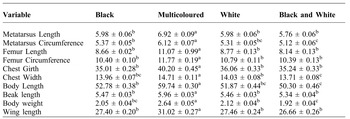
On the basis of categorical traits, Raji et al. (Reference RAJI, IGWEBUIKE and USMAN2009) reported four plumage colours in Muscovy ducks in the northern part of Nigeria: multicoloured (36.9%), white (30.6%), black (6.4%) and black and white (26.1%). The mean body weight for the four plumage colours viz; multicolour, black, white, and black and white, were 2.64 kg, 2.05 kg, 2.12 kg and 1.92 kg, respectively (Table 2). The apparent wide variation in plumage colours is an indication that the duck populations have not been ‘purified’ through selective breeding, and so great opportunities exist for their improvement. One of the possibilities as postulated by Dana et al. (Reference DANA, VAN DER WAAIJ, DESSIE and VAN ARENDONK2010), is to drive selection towards specific coat colours putting into cognisance the relationship between polygenetic effects of coat colour and other traits of interest (for example, physiology, morphology and behaviour ) (Toth et al., Reference TOTH, KAPS, SOLKNER, BODO and CURIK2006).
Means and standard errors of body weight (kg) and linear body measurements (cm) of mature local Muscovy ducks in Nigeria as affected by plumage colour (Raji et al., Reference RAJI, IGWEBUIKE and USMAN2009).

abcMeans within rows with different superscripts are significantly (P< 0.05) different from each other.
Biochemical characterisation
Information on blood parameters of Muscovy ducks can be used to serve as baseline data to be used in clinical evaluation and improvement of local stock, as reported for indigenous chickens by Ladokun et al. (Reference LADOKUN, YAKUBU, OMEJE, SOKUNBI, OTITE and ONYEJI2008). Nigerian Muscovy ducks have erythrocyte counts that are lower than the average counts reported for temperate breeds of ducks, but higher than those reported for Nigerian domestic chickens. No significant difference in the average total leucocyte count between the male and female Muscovy ducks was observed. The total leucocyte count in Muscovy ducks was reported as higher than those for temperate breeds of ducks and the Nigerian domestic chickens. Higher lymphocyte counts was recorded for male Muscovy ducks (72.75%) than for females (61.37%) while lower basophil average counts were reported for males (0.75%) compared to females (1.5%) (Sulaiman et al., Reference SULAIMAN, ADUTA and SALAMI2010).
In a related study, Okeudo et al. (Reference OKEUDO, OKOLI and IGWE2003) reported that packed cell volume (PCV) was 46.00% ± 1.73 and 41.17% ± 3.13 and haemoglobin concentration (HBC) was 15.67% ± 0.29, 14.17% ± 1.13 for drakes and ducks respectively, indicating significant differences (P< 0.01) between males and females. Mean erythrocyte sedimentation rate (ESR) of the drakes (1.63 ± 0.35 mm/hr.) was significantly different (P< 0.05) from the 1.95 ± 0.30 mm/hr observed in the females. Male and female blood coagulation time (BCT) were 1.55 ± 1.00 and 1.85 ±11.05 seconds and mean corpuscular haemoglobin concentration (MCHC) values were 34.07% ± 1.01, 34.42% ± 2.13, respectively for males and females. Leukocyte count indicated no significant difference (P> 0.05) between the males and females. Again, heterophils and lymphocytes counts did not reveal significant differences (P> 0.05) between the male and female birds. The serum protein value of the females (12.07 ± 1.59/100 ml) was significantly higher (P< 0.01) than the 6.87 ± 0.42 g/100 ml recorded in males. Serum calcium and phosphorous levels were significantly different (P< 0.01) at 7.43 ± 0.75 mg/dl, 8.52 ± 0.58 mg/dl and 3.20 ± 1.51 mg/dl, 7.98 ± 1.39 mg/dl in the males and females, respectively.
DNA molecular characterisation
Development of a global database containing detailed information on the genetic diversity of farm animals may prove a useful tool in the conservation and restoration of endangered species in the future (Semik and Krawczyk, Reference SEMIK and KRAWCZYK2011). With advances in technology, a number of techniques for in-depth genome analysis and evaluation of genetic variation in different breeds have been developed. The most important techniques include analysis of microsatellite sequences, mitochondrial DNA, Y-chromosomal markers and SNP (single-nucleotide polymorphism) markers (Petit et al., Reference PETIT, BALLOUX and EXCOFFIERR2002; Ajmone-Marsan et al., Reference AJMONE-MARSAN, GARCIA and LENSTRA2010; Groeneveld et al., Reference GROENEVELD, LENSTRA, EDING, TORO, SCHERF, PILLING, NEGRINI, JIANLIN, FINLAY, GROENEVELD and WEIGEND2010; FAO, 2011). However, there is virtually no published work on the genetic diversity of Nigerian ducks using these techniques, which would have served as a better complement to the phenotypic characterisation to ascertain the breed status and facilitate structured breeding and conservation of Muscovy ducks. Therefore, research efforts and funding should be directed to the molecular characterisation of Nigerian Muscovy ducks.
Meat production attributes
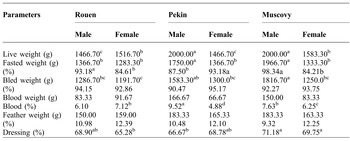
In a study involving a comparison of the carcass and meat quality characteristics of two exotic breeds of duck (Rouen and Pekin) and the local Muscovy duck, Omojola (Reference OMOJOLA2007) reported higher dressing percentage in Nigerian Muscovy ducks (Table 3). Huang et al. (Reference HUANG, PINGEL, GUY, LUKASZEWICZ, BAEZA and WANG2012) reported a range of 4.7-5.1kg body weight for male Muscovy ducks at slaughter. The carcass yield was 70% ± 5 and 51% ± 8 in males and females, respectively. Meat productivity was 26.7 and 11.5 kg/m2 per year in males and females, respectively (Banga-Mboko et al., Reference BANGA-MBOKO, LELOU, MAES and LEROY2007). Etuk et al. (Reference ETUK, OJEWOLA and ABASIEKONG2006) reported that Muscovy ducks under semi-intensive systems (SI) with either access to wallows (IW) or without (IO), did not differ in their final body weights, average daily gains, average feed intake and feed conversion ratios. From a survey, Oteku et al. (Reference OTEKU, IGENE and YESSUF2006) reported that about 64.6% agreed that duck meat is recommendable as one of the ways to address the problem of animal protein shortage in Nigeria, if its acceptance could be improved through product development.
Live, fasted, blood feather and the dressing percentage of duck as affected by sex and breeds (Omojola, Reference OMOJOLA2007).

abcMeans within the same row and breed column not sharing superscripts are significantly (P>0.05) different
Egg production characteristics
Ikani (Reference IKANI2003) reported that, under the scavenging conditions, Muscovy ducks can lay between 60 and 80 eggs per year and about 100 and 125 eggs per year in controlled conditions. Muscovy ducks in intensive management systems come into lay significantly earlier, (IO, 203 days and IW, 207 days) than ducks in semi-intensive system (248 days). Eggs from ducks in IO and IW were significantly heavier (76.4 g and 76.3 g, respectively) than eggs from those in SI. Clutch sizes were significantly larger IO and IW (19.0 and 18.73 eggs, respectively) than SI (16.23 eggs). There was however, no significant difference between ducks in IO and IW in all the parameters measured. Ducks in intensive management systems (IO and IW) appear to exhibit better egg laying potential than those in semi-intensive systems (Etuk et al., Reference ETUK, OJEWOLA, AKOMAS, ETUK and OGBUEWU2011). The average number of eggs per duck per season was 80.8 ± 0.74 (Duru et al., Reference DURU, AKPA, SAI'DU, OLUGBEMI and JOKTHAN2006). Ogah and Musa (Reference OGAH and MUSA2011) reported that Muscovy ducks in the guinea and rainforest agroecological zones respectively, had body weight at first egg of (1497 g ± 16.8 versus 1579 g ± 17.6), at an age of 314.7 days ± 3.33 versus 331.7 ± 3.49) with an average number of eggs laid at point of lay being 6.30 ± 0.36 versus 5.60 ± 0.38 and a mean egg weight of 50.70 g ± 0.88 versus 52.99 g ± 0.92. However, in Congo-Brazzaville, Banga-Mboko et al. (Reference BANGA-MBOKO, LELOU, MAES and LEROY2007) reported that laying recorded per female and per clutch was 14.6 eggs ± 3.0, while Nickolova (Reference NICKOLOVA2004) reported greater egg weights (78.36g-85.32g) for Muscovy ducks in Bulgaria. These differences may be due to varying environmental conditions. One feature of Muscovy ducks in Nigeria is its readiness to hatch not only its own eggs, but any other egg set under it (Ikani, Reference IKANI2003; Duru et al., Reference DURU, AKPA, SAI'DU, OLUGBEMI and JOKTHAN2006), which is a useful benefit for smaller famers with diverse flocks of production birds.
Conclusions
The morphological, meat and egg attributes of the Muscovy duck readily make it the waterfowl of choice for Nigerian poultry farmers. Nigeria needs to take advantage of the economic and nutritional benefits from duck rearing to improve the shortage in the animal protein supply in the family diet. Generally, rearing waterfowl is more convenient and successful than chickens for regions with hot and humid climates. In countries with such climatic conditions more support should be given for waterfowl production, especially the Muscovy duck, in small-scale family farms to ensure an increase in productivity and an important contribution to food security.
Acknowledgements
Funding for this study was provided by the National Secretariat of the Academic Staff Union of Universities (ASUU), Ibadan, Nigeria; and this is gratefully acknowledged. Special thanks to Prof. U. Awuzie (immediate past ASUU Chairman) and Dr. Nasir Fagge (current ASUU Chairman) for facilitating the research grant.