Interword spacing is the orthographic and typographic space used to separate orthographic words (i.e., strings of letters preceded and followed by spacing). Interword spacing has no equivalent in the spoken language, where there are no pauses at word boundaries. It is part of grammatical punctuation, because it provides grammatical information (about word boundaries) that is not present in the spoken language (Halliday, Reference Halliday1990). Interword spacing is not universally used. From a synchronic perspective, although a majority of the world's writing systems use it, many writing systems do not, including Brahmi-derived writing systems such as Thai and Tibetan (Daniels & Bright, Reference Daniels and Bright1996), and Chinese-derived ones such as Japanese and Korean (the former has no spacing, the latter separates phrasal units called eojeol). From a diachronic perspective, there is no evidence of an evolutionary trend toward the use of interword spacing (as argued for instance by Saenger, Reference Saenger1997). Spacing was sometimes eliminated from writing systems that had previously used it (e.g., in Latin); in situations of writing systems contact, interword spacing was sometimes not introduced (e.g., in Japanese).
English, Chinese, and romanized Chinese have different conventions regulating the use of spacing. English is written with orthographic words separated by spacing, whereas Chinese is written in hanzi (Chinese characters). Hanzi are self-contained units composed of a variable number of strokes and inscribed within a square area. They are the written representations of one or more morphemes that are placed on a semantic continuum ranging from closely related to completely unrelated, and may or may not be homophonic. Each hanzi represents a monosyllabic morpheme, that is, the hanzi maps onto language at the morpheme level and onto spoken language at the syllable level. Hanzi are equally spaced, and word boundaries are not marked. Hanyu pinyin (Chinese phonetic transcription system) is the official romanization system in the People's Republic of China. It represents the phonology of Standard Chinese using the letters of the Roman alphabet with diacritics for tones. It is a supplementary writing system, which is used as a pedagogical tool for both Chinese children and second language (L2) learners, and for applications such as bibliographical references and software development. Because Chinese graphemes (hanzi) map onto the spoken language at the syllable level, spacing in pinyin could be used to separate syllables. This is the case for other Chinese phonetic transcriptions systems, such as zhuyin fuhao, which is in current use in Taiwan. Unlike zhuyin, pinyin is conventionally written with syllables grouped in orthographic words separated by spacing (International Organization for Standardization, 1991). Notwithstanding the existence of official rules for determining word boundaries, pinyin spacing conventions are not consistent or clear (e.g., see comments in Lu, Reference Lu1996), because it is difficult to determine what is a “word” in Chinese. Chinese words can be composed of one or more morphemes, and therefore, one or more hanzi and one or more syllables. Chinese word segmentation is not an easy task, and among Chinese researchers there is wide debate as to what constitutes a word and how to test wordhood (e.g., Chao, Reference Chao1968; Duanmu, Reference Duanmu and Packard1998). When L2 learners learn pinyin, it is generally written with interword spacing, and the position of spacing is determined either by following the official pinyin segmentation rules or by relying on the English translation of Chinese text and spacing the Chinese equivalents of English orthographic words.
INTERWORD SPACING AND FIRST LANGUAGE (L1) READING
The important role of interword spacing in reading English is well documented (for a review, see Rayner, Reference Rayner1998). When interword spacing is eliminated or replaced with fillers, English readers are disrupted, with a 30% to 50% decrease in reading rate, more regressions and longer fixations (Rayner & Pollatsek, Reference Rayner and Pollatsek1996). The importance of interword spacing has been explained in different ways. Some researchers believe that spacing guides saccadic movements of the eye (i.e., Pollatsek and Rayner 1990), whereas others believe that it plays an important role in word recognition (i.e., Epelboim, Booth, & Steinman, Reference Epelboim, Booth and Steinman1994). Although the bulk of research on spacing concentrated on English language reading, the orthographic word seems to play an important role also in other writing systems that are written with interword spacing. In such writing systems, readers' eyes tend to fall at the center of words or at its left side; this preferred viewing position was found not only in alphabetic writing systems (studies reported in Kajii, Nazir, & Osaka, Reference Kajii, Nazir and Osaka2001) but also in Hebrew (Deutsch & Rayner, Reference Deutsch and Rayner1999).
Interword spacing does not facilitate reading in all writing systems. Research shows that adding interword spacing does not facilitate reading in writing systems that do not mark word boundaries, such as Thai. Kohsom and Gobet (Reference Kohsom, Gobet, Shafto and Langley1997) added interword spacing in Thai texts, using both meaningful texts and texts composed of scrambled words. With meaningful texts, the presence of interword spacing did not affect either reading rate or reading errors during oral reading. Although interword spacing reduced the number of added words, it is not clear whether this is a positive effect or evidence that interword spacing lead to a stronger reliance on low-level processes. Furthermore, participants reported that interword spacing made reading harder, although this was not confirmed by the experimental data. Similar results were found with Hebrew. Hebrew joins nouns and postpositions in single orthographic words, and native users were not facilitated when the boundary between nouns and postpositions was marked (Wade-Woolley & Geva, Reference Wade-Woolley and Geva1998).
INTERWORD SPACING AND CHINESE READING
Because adding interword spacing does not facilitates native readers of unspaced writing systems, it should not facilitate native readers of Chinese. Researchers found that interword spacing does not facilitate the reading of normal Chinese texts (Inhoff, Liu, Wang, & Fu, Reference Inhoff, Liu, Wang, Fu and Peng1997; Liu, Yeh, Wang, & Chang, Reference Liu, Yeh, Wang and Chang1974), although it facilitates the reading of garden-path sentences in the absence of context (Hsu & Huang, Reference Hsu and Huang2000a); moving texts presented on single-line displays (Shieh, Hsu, & Liu, Reference Shieh, Hsu and Liu2005); and highly complex texts (Hsu & Huang, Reference Hsu and Huang2000b).
Adding interword spacing does not affect Chinese readers' reading rate when reading sentences, whether presented on a tachistoscope (Liu et al., Reference Liu, Yeh, Wang and Chang1974) or on a computer screen (Inhoff et al., Reference Inhoff, Liu, Wang, Fu and Peng1997). Three studies found positive effects of interword spacing in Chinese reading under special circumstances. Hsu and Huang (Reference Hsu and Huang2000a) used sentences composed of three two-hanzi lexical items arranged on two lines: in the same-line condition there were no word breaks at line ends, in the different-line condition one lexical item was split with one hanzi on one line and one hanzi on the next line. Sentences were read faster under the same-line condition. These results are probably not because of the presence of interword spacing, for two reasons. First, in the same-line condition the two hanzi composing the first lexical item were separated by a two-hanzi wide word-internal spacing. If interword spacing affected reading, these sentences should have been read more slowly. Second, in the only example provided the line break is not only a word boundary but also a clause boundary. In their second experiment, the researchers found that interword spacing facilitates the reading of garden-path sentences without context. In a related study, the same researchers found that interword spacing facilitates reading high difficulty texts, but not low and medium difficulty texts (Hsu & Huang, Reference Hsu and Huang2000b). Finally, researchers found that when texts are presented on a single line moving on the screen, interword spacing increases the maximum reading rate, but not the preferred reading rate (Shieh et al., Reference Shieh, Hsu and Liu2005). Single-line scrolling texts require unusual reading strategies, as shown by reading rates of about one-third the normal reading rate for Chinese texts, even with primary school texts. In conclusion, it appears that interword spacing only facilitates Chinese readers in abnormal reading conditions, as phrase or clause chunking does with English readers (Bever, Jandreau, Burwell, Kaplan, & Zaenen, Reference Bever, Jandreau, Burwell, Kaplan and Zaenen1991; Hartley, Reference Hartley1993; Keenan, Reference Keenan1984).
The lack of facilitative effects of interword spacing on normal reading fits in well with other evidence that the word does not play an important role in low-level reading processes in Chinese. For instance, Chinese readers do not seem to have a preferred landing position (Yang & McConkie, Reference Yang, McConkie, Wang, Inhoff and Chen1999), probably because in Chinese there is no parafoveal information about word boundaries and word shape. Unlike English readers (Pollatsek & Rayner, Reference Pollatsek and Rayner1982), in Chinese readers the length of lexical items (i.e., the number of hanzi) does not affect saccade length (Inhoff, Liu, & Tang, Reference Inhoff, Liu, Tang, Wang, Inhoff and Chen1999). Finally, whereas word reading in English is affected by word characteristics such as length and frequency (Just, Carpenter, & Woolley, Reference Just, Carpenter and Woolley1982), word reading in Chinese is affected by the complexity and frequency of hanzi (Chen, Reference Chen, Chen and Tzeng1992; Zhang & Peng, Reference Zhang, Peng, Chen and Tzeng1992) or by both word and hanzi frequency (Peng, Liu, & Wang, Reference Peng, Liu, Wang, Wang, Inhoff and Chen1999). In Chinese text reading, skipping, refixation, and gaze duration are affected by both word and hanzi frequency (Yang & McConkie, Reference Yang, McConkie, Wang, Inhoff and Chen1999). Finally, when texts are manipulated by inserting an inappropriate word (violation paradigm), English readers show disruption at the critical word level and Chinese readers at the end of the sentence (Chen, Reference Chen, Wang, Inhoff and Chen1999). It appears that the word does not play an important role in Chinese low-level reading processes as it does in English. This could explain why interword spacing does not facilitate normal reading. A related issue worth noting is that determining word boundaries for these experiments is not simple. Research has consistently shown that Chinese speakers performing word segmentation tasks often segment texts into phrases, and produce inconsistent word segmentations (Bassetti, Reference Bassetti, Cook and Bassetti2005; Hoosain, Reference Hoosain, Chen and Tzeng1992). Interword spacing may be less useful for readers who do not have the same concept of “word” as literate English speakers. In general, it appears that interword spacing is useful in some specific circumstances such as lexical garden-path sentences or single-line scrolling texts, but Chinese readers are not affected by the marking of word boundaries when reading normal sentences.
INTERWORD SPACING AND PINYIN READING
Although Chinese is written without interword spacing, it is often argued that pinyin should be more readable with interword spacing, because this eliminates the problem of homographs (Duanmu, Reference Duanmu2001). In Chinese, there is no one-to-one correspondence between hanzi and syllable, or between hanzi and morpheme. According to an influential pinyin scholar (Yin, Reference Yin1990), Chinese has 1,300 syllables and 5,000 frequently used hanzi; therefore, each syllable on average corresponds to 4 frequently used hanzi, with some syllables corresponding to as many as 40. Because Chinese syllables correspond to more than one hanzi, grouping syllables in word units reduces the number of homophones, because homophonic disyllabic lexical items are less frequent than homophonic morphemes. In the following example, the sentence “The television is broadcasting the news” is written first with intersyllable spacing and then with interword spacing, and the number of homophones is written below each syllable or word:

The correct hanzi for diàn has to be identified among 13 homophones and the correct hanzi for shì among 29, whereas the orthographic word diànshì has only two homophones, and all the other orthographic words in the example correspond to only one lexical item (according to Beijing Waiguoyu Xueyuan, 1984). For this reason, it is argued that pinyin should be easier to read with interword spacing, but this has not been demonstrated by empirical research. King (Reference King1983) asked Chinese readers to read pinyin texts and rewrite them in hanzi, as a measure of reading comprehension. Texts varied in length from a disyllabic word to a whole paragraph, and were written with interword or intersyllable spacing. Participants who read texts with syllables evenly spaced were better able to rewrite the pinyin materials into hanzi, although no effects were found with sentences.
It appears that, because of characteristics of the Chinese language and writing system, the word does not play an important role in Chinese reading. It is therefore not surprising that segmenting Chinese texts into orthographic words does not facilitate its readers, not even when reading romanized Chinese. Still, this may not be the case for L2 readers of Chinese who are used to interword spacing in their L1 writing system.
INTERWORD SPACING AND L2 READING
Research shows that all readers are better adapted at reading their native writing system with its usual orthographic conventions, because eliminating interword spacing from word-spaced writing systems has negative effects, whereas adding it to unspaced writing systems has no positive effects. This raises the question of what facilitates L2 readers whose two writing systems have different orthographic conventions.
In general, interword spacing seems to facilitate readers of word-spaced L2 writing systems, regardless of whether their native writing system uses interword spacing or not. For instance, when Thai readers read L2 English without interword spacing, they make more reading errors than with word-spaced texts, and their reading rate decreases more than in English native users (Kohsom & Gobet, Reference Kohsom, Gobet, Shafto and Langley1997), although their L1 Thai does not use interword spacing. Research was also done on L2 readers of Hebrew, a nonalphabetic writing system that separates words with spacing but joins nouns and postpositions into single orthographic words. Results show that marking the boundary between postpositions and nouns facilitates English and Russian readers of Hebrew but not Hebrew native readers (Wade-Woolley & Geva, Reference Wade-Woolley and Geva1998). It appears that interword spacing facilitates L2 readers of word-spaced writing systems. However, there is some evidence that the L1 writing system may modulate the strength of the effects of interword spacing. One study (Epelboim et al., Reference Epelboim, Booth and Steinman1994) used eye-tracking methods and found that one out of their three readers of L2 English was not disrupted when interword spacing was removed. This participant was a native reader of Dutch, a writing system that uses word spacing more sparingly than English, and he was not negatively disrupted when interword spacing was removed from L1 Dutch texts.
All the studies mentioned above looked at readers of L2 writing systems that use interword spacing. L2 readers of Chinese may behave differently because Chinese is not word spaced. The only study of the effects of adding interword spacing on L2 readers of Chinese is Everson (Reference Everson1986). Contrary to his expectations, Everson found disruptive effects of interword spacing on eye movements in American advanced readers of L2 Chinese texts, with significantly higher numbers of fixations. Comprehension was not affected, and the decrease in reading rates was not significant. Chinese native readers and beginner L2 readers were not affected. The study did not control variables such as text length (the version with interword spacing had about 25% more lines) or text alignment (the version with interword spacing was not justified, as is the norm in Chinese). Still, it appears that interword spacing can negatively affect L2 readers of a writing system that does not normally use interword spacing, even when their L1 writing system is word spaced.
In conclusion, it appears that the following is true:
1. Native readers of word-spaced writing systems are facilitated by interword spacing when reading both L1 and L2 writing systems that are normally word spaced.
2. Native readers of non-word-spaced writing systems are not facilitated when interword spacing is added to their L1 writing system.
3. Native readers of non-word-spaced writing systems may or may not be facilitated by interword spacing when reading a word-spaced L2 writing system (when English is written without interword spacing Thai readers are disrupted but at least one Dutch reader was not).
4. Native readers of word-spaced writing systems reading a non-word-spaced L2 writing system (such as American readers of L2 Chinese) are not facilitated by the addition of interword spacing, and may even be disrupted.
THE PRESENT STUDY
The present study aims at testing the effects of adding interword spacing in Chinese on native Chinese readers and L2 readers of Chinese whose L1 writing system uses interword spacing. In particular, the study aims at clarifying whether the effects of interword spacing in L2 reading are modulated by characteristics of both the L1 and L2 writing systems. Two experiments compared reading speed and comprehension of Chinese sentences written with or without interword spacing. In the first experiment, Chinese sentences were written in pinyin, an alphabetic writing system that is normally written with interword spacing, and uses the same script (the roman alphabet) as the native writing system of the L2 participants. The second experiment presented Chinese sentences written in hanzi, which is written without interword spacing. If interword spacing facilitates all readers, sentences written with interword spacing should be read faster by both L1 and L2 readers, when reading both pinyin and hanzi. If reading is affected only by the orthographic conventions of the writing system being read, neither English nor Chinese readers should be facilitated by interword spacing when reading hanzi. If L2 reading is affected only by L1 orthographic conventions, interword spacing should facilitate English users of Chinese as an L2 (CSL) both when reading pinyin and when reading hanzi, and Chinese native readers should never be positively affected. If there is an interaction of L1 and L2 orthographic conventions, English CSL users should be facilitated when reading pinyin but not when reading hanzi, and Chinese native readers should never be facilitated. Experiments 1 and 2 tested the last hypothesis.
EXPERIMENT 1: THE ORTHOGRAPHIC WORD IN PINYIN SENTENCE READING
Previous research shows that Chinese native users recode pinyin materials better when written with intersyllable than interword spacing (King, Reference King1983). Regarding L2 learners, there is no evidence of effects of interword spacing on pinyin reading, but pinyin materials for learners of Chinese are usually written with interword spacing (e.g., T'ung & Pollard, Reference T'ung and Pollard1982), both because pinyin is conventionally written this way (International Organization for Standardization, 1991), and because teachers believe this facilitates learners (e.g., Kan, Reference Kan1994). Still, there is no evidence that interword spacing has a facilitative effect on reading in either native or L2 readers of pinyin.
The present experiment tests the hypothesis that interword spacing facilitates pinyin sentence reading in English readers of CSL, but not in Chinese native readers, because of the effects of readers' L1 writing system. English readers of Chinese are native users of a writing system that marks word boundaries with spacing; Chinese readers are native users of a writing system that marks monosyllabic morpheme boundaries with spacing. If the facilitative effect of interword spacing is because of L1 orthographic conventions, it should only facilitate English readers of Chinese.
Design
A 2 × 2 mixed design was used to test the effects of L1 writing system and type of spacing on reading rate and comprehension. L1 writing system was a between-group factor, with two levels: Chinese native readers and English readers of CSL. Type of spacing was a within-group factor, with two levels: interword spacing and intersyllable spacing. There were two dependent variables: reading rate, expressed in number of syllables per second, and comprehension, expressed as the percentage of correct responses.
Participants
Fourteen native users of Chinese and 14 English native-speaking users of CSL were recruited at various British universities. The Chinese native users were native speakers and readers of Standard Chinese from the People's Republic of China, enrolled at a British university. The mean age was 28, and there were 1 male and 13 females. They had learned pinyin at primary school and were proficient English readers; therefore, they were aware of the use of interword spacing as an orthographic clue to word boundaries.
The English CSL users were native speakers and readers of English who had studied Chinese at a British university for 3 years. Their mean age was 22 years, and there were nine women and four men. They had begun learning Chinese at university and had spent between 1 and 2 years in a Chinese-speaking country.
Participants' Chinese reading proficiency was tested by means of a cloze test and by self-rating and teacher rating for L2 readers. The cloze test is generally considered a good measure of reading proficiency (Alderson, Reference Alderson and Oller1983). A 480-hanzi long reading text from an intermediate-level Chinese language textbook (Chou, Link, & Wang, Reference Chou, Link and Wang1997) was adapted by deleting every eighth hanzi, thus obtaining 50 single-hanzi gaps. Native readers scored 41.50 on average (SD = 2.94). CSL readers scored 25.36 on average (SD = 8.08). CSL readers' cloze test scores were significantly correlated with self-rating and teacher rating of reading ability (τ = .76 and .69, respectively, both p < .05). Participation was voluntary and paid. All participants reported normal or corrected to normal vision.
Task, materials, and procedure
A picture–sentence verification task was used to measure participants' reading rate and comprehension under two presentation conditions: with interword spacing and with intersyllable spacing. Participants saw a series of sets comprising a drawing and a pinyin sentence, and indicated whether the sentence matched the picture by pressing a button. This task is more appropriate for L2 users than tasks previously used to test Chinese native users, which often involve recall tasks (e.g., Hsu & Huang, Reference Hsu and Huang2001; Inhoff et al., Reference Inhoff, Liu, Wang, Fu and Peng1997), and therefore may be affected by L2 users' more limited production skills. The picture–sentence verification task measures L2 users' reading comprehension and speed without the need for production.
Forty-two sets composed of a drawing and a pinyin sentence were prepared for on-screen presentation, plus 4 sets for the practice session. The black-and-white line drawings represented an object or action. Drawings were selected from a standard English naming battery (Druks & Masterson, Reference Druks and Masterson2000), in some cases slightly adapted to be suitable for Chinese participants. Sentences were eight-syllable length descriptions of the picture, with an average length of 26.4 letters (SD = 2.48), and contained only frequent words and simple structures. Half of the sentences were accurate descriptions of the drawing and half of them were incorrect. For each sentence, two versions were prepared: one written with syllables grouped in words separated by spacing (word condition), the other with each syllable preceded and followed by spacing (syllable condition). Word segmentation was based upon the English translation of the sentence. Spacing width was manipulated to ensure that the word-spaced and syllable-spaced versions of each sentence occupied the same length of space on screen, as in the following example:
Zhuōzi shàng fàngzhe jìsuànj ī. [word condition]
Zhuō zi shàng fàng zhe jì suàn jī. [syllable condition]
On the desk there is a computer.
Participants were instructed to read the sentence and to indicate whether it matched the picture as fast as possible, by pressing a button on a response box. Sentences appeared in black on a white background below the drawing in the center of the screen. The drawing appeared first, followed by the sentence after 1000 ms. Drawing and sentence remained on screen until the participant pressed a button. There was no time-out condition. All participants saw the 42 sets in the same order, but the presentation condition was randomized. Stimulus presentation and recording of responses were managed by PsyScope 1.2.5 (Cohen, MacWhinney, Flatt, & Provost, Reference Cohen, MacWhinney, Flatt and Provost1993), and timing was measured by a PsyScope Button Box.
Results
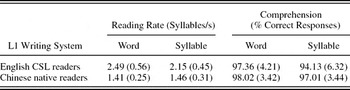
Table 1 shows the raw mean reading rates and the percentage of correct responses by group and type of spacing. Reading rate is expressed as the number of syllables read per second; comprehension is expressed as the percentage of correct responses. Incorrect responses were eliminated from the response time analysis; response times were also subjected to a square root transformation to correct for heterogeneity of variance.
Pinyin sentence reading: Mean reading rate (standard deviation) and comprehension by group and type of spacing

Note: L1, first language; CSL, Chinese as a second language.
The two groups show similar percentages of correct responses with interword and intersyllable spacing, reaching almost ceiling level. Type of spacing affected reading rate only in the English group. English CSL readers read faster when sentences were presented with interword spacing than with intersyllable spacing. Chinese native users were not affected by type of spacing. Finally, English CSL readers read about 1.6 times faster than Chinese native users (M = 2.32 syllables/s, SD = 0.49 and M = 1.44, SD = 0.27, respectively).
Two 2 × 2 mixed analyses of variance (ANOVAs) were performed to analyze the effects of L1 writing system (English, Chinese) and type of spacing (word, syllable) on reading rate and comprehension.
The ANOVA for reading rate revealed a significant main effect for L1 writing system, F (1, 26) = 34.82, p < .001, η 2 = .57. This showed that English CSL users were faster than Chinese native users. The main effect of type of spacing, F (1, 26) = 13.43, p = .001, η 2 = .22, was qualified by the significant interaction between L1 writing system and type of spacing, F (1, 26) = 23.53, p < .001, η 2 = .38. Bonferroni t tests revealed that the English CSL readers read faster with interword spacing than with intersyllable spacing, t (13) = 5.23; p < .001, η 2 = .68, whereas the Chinese native readers were not affected by presentation modality, t (13) = −1.02; ns). The ANOVA for comprehension revealed no effects of either L1 writing system, F (1, 26) = 2.88, ns, or type of spacing, F (1, 26) = 2.48, ns.
To test whether interword spacing facilitates less proficient L2 readers more than more proficient L2 readers, an interword spacing effect was calculated for each CSL reader as the difference between the reader's reading rate with interword spacing and the rate with intersyllable spacing. On average, CSL readers read 20.30 more syllables per minute with interword spacing than without, although there was a high level of variation (SD = 14.54). This effect was then entered into a correlation analysis with cloze scores. Results revealed that there was no correlation between Chinese reading ability and the facilitative effect of interword spacing on pinyin reading (τ = .78, ns).
Further analyses tested whether interword spacing facilitates CSL readers more with positive or negative answers, as an anonymous reviewer suggested that the word advantage may be confined to, or stronger with, negative answers (i.e., sentences that did not match the picture). A 2 × 2 repeated-measure ANOVAs tested the effects of type of answer (positive, negative) and type of spacing (word, syllable) on reading rate and comprehension. With regard to reading rate, the main effect of type of spacing was confirmed, and response times were overall faster with positive answers, F (1, 13) = 20.66, p = .001, but there was no interaction, F (1, 13) = 1.13, ns. With regard to comprehension, CSL readers gave more correct responses to positive than negative answers, F (1, 13) = 9.84, p < .01. There was no main effect of type of spacing, F (1, 13) = 2.87, ns, but the interaction, F (1, 13) = 7.12, p < .05, shows that interword spacing facilitates CSL readers' comprehension with negative answers, but not with positive answers.
Discussion
The results confirm the experimental hypothesis that the presence of interword spacing facilitates pinyin reading in English readers of CSL but not in Chinese native readers. The English participants read pinyin sentences faster with interword spacing than intersyllable spacing, whereas the Chinese participants read at the same speed under the two spacing conditions. Interword spacing facilitates comprehension only for the English participants when the correct answer is negative, but not in the easier cases when the correct answer is positive.
The facilitative effect of interword spacing in English CSL readers cannot be attributed to low levels of reading proficiency, because (a) the reading materials were very simple; (b) the English participants' levels of comprehension were almost at ceiling levels and did not differ from those of Chinese native readers; and (c) the Chinese readers, who were less proficient at reading pinyin, were not facilitated by interword spacing. It appears that the effects of interword spacing are better explained as a consequence of the participants' L1 writing system.
Interword spacing and the L1 writing system
With regard to Chinese native readers, the lack of effects of interword spacing on reading rate is consistent with King's previous findings (King, Reference King1983) that interword spacing does not affect the decoding of pinyin sentences (although he found negative effects on the decoding of texts). Results of the present study and King (Reference King1983) are consistent, although King's study was off-line and the present one was on-line and pinyin is far more widespread in China now than it was 25 years ago. The absence of a facilitative effect cannot be attributed to lack of familiarity with the convention of interword spacing as a clue to word boundaries, because the Chinese participants were all experienced readers of L2 English. Furthermore, Chinese native readers should have been facilitated more than English CSL readers for two reasons. First, the Chinese participants were less proficient readers of pinyin than the English participants. Second, they had a larger mental lexicon, so arguably they needed interword spacing to disambiguate homophones more than English CSL readers, who presumably only knew a few homophonic hanzi for each syllable. Research on chunking shows that artificially marking the boundaries of various linguistic units facilitates less proficient readers and does not affect normally proficient readers (Bever et al., Reference Bever, Jandreau, Burwell, Kaplan and Zaenen1991; Hartley, Reference Hartley1993; Keenan, Reference Keenan1984). Because the Chinese readers were less proficient in reading pinyin than the L2 readers, and they probably knew more homophones than L2 readers, they should have benefited more from the presence of the orthographic word. The lack of effects of interword spacing can then be explained as an effect of their L1 writing system. Because Chinese readers are not facilitated by interword spacing when reading Chinese, they are also not facilitated when reading romanized Chinese. An alternative explanation is a floor effect that might have hidden facilitative effects, and future research may look at more proficient Chinese readers of pinyin.
With regard to English readers of CSL, interword spacing facilitates their pinyin reading, or vice versa the absence of interword spacing negatively affects their pinyin reading. The effect of interword spacing could be due to their L1 writing system, as well as to the orthographic conventions of pinyin. English readers are facilitated by the presence of interword spacing when reading English. Therefore, they are also facilitated when reading an L2 writing system, at least one that is normally written with interword spacing. King (Reference King1983) suggested two reasons why interword spacing does not facilitate Chinese native readers, which could help explain the differences between the two groups in this study. First, King proposed that Chinese readers carry over a preference for syllables from hanzi reading to pinyin reading. If that is so, English CSL readers could be carrying over a preference for orthographic words from their word-spaced L1 writing system. Second, King argued that Chinese speakers consider their language monosyllabic. If that is so, English speakers, who think that English is made of words, might consider the word the natural unit of reading for Chinese as well. Indeed, research shows that English CSL speakers segment Chinese texts into words similarly to the way pinyin does, whereas Chinese readers produce more varied segmentations, based on different criteria (Bassetti, Reference Bassetti, Cook and Bassetti2005, Reference Bassetti2007).
Contrary to expectations, there was no correlation between Chinese reading proficiency, as measured by cloze test scores, and the interword spacing effect among CSL readers. This means that less proficient L2 readers of Chinese are not facilitated more than more proficient ones. Furthermore, the high levels of comprehension confirmed that the sentences were very easy for all participants. Interword spacing appears to facilitate CSL readers not because of low reading proficiency, but because of the orthographic conventions of their L1 writing system and related reading processes.
In conclusion, interword spacing does not facilitate all readers of Chinese, and its effects are not related to reading proficiency, because in CSL readers there was no correlation between reading proficiency and interword spacing effect, and because Chinese participants were not facilitated, although they were less proficient than CSL participants in pinyin reading. Interword spacing only appears to facilitate pinyin reading in readers of word-spaced L1 writing systems.
L1 writing system and pinyin reading rate
An unexpected finding was that English CFL readers read pinyin faster than Chinese readers. This experiment therefore helps answer the perennial question of whether L2 reading is a language problem or a reading problem (e.g., Alderson, Reference Alderson, Alderson and Urquhart1984). The experiment disentangled the effects of spoken language proficiency from the effects of writing systems decoding skills. Because pinyin is not the native writing system of either group, and neither group normally uses it for reading and writing Chinese, Chinese native readers are not more proficient at reading pinyin than L2 readers. Chinese native readers are native users of the language it represents, and English CSL readers are native users of its script, that is, the roman alphabet. It appears that, at least for reading simple sentences with context, language proficiency is less important than proficiency in decoding the script.
The next question is then why the English readers read pinyin sentences better than native speakers of Chinese. One possible explanation is that English readers have better phonological decoding skills. These skills were developed in order to read their L1 writing system, which is similar to pinyin in that it is alphabetical and is written with the same alphabet. English CSL users may therefore be better able to decode pinyin than Chinese readers, whose L1 writing system is not alphabetical. In particular, Chinese children are not taught to read pinyin letter-by-letter, but by sounding out whole syllables or onsets and rimes. Another possibility is that English CSL users may be more used to reading pinyin than Chinese native users because it is extensively used in their first year textbooks and in dictionaries. Still, a more intriguing explanation is also possible. Differently from Chinese hanzi texts, pinyin texts do not represent morphemic information. Because the English writing system mostly represents phonology, English CFL readers may be less disrupted when morphemic information is not provided in Chinese texts. Chinese native readers may be more negatively affected, because morphemic information plays an important role in their L1 reading processes. At least for these simple sentences, accompanied by context (the picture) and consisting of highly frequent lexical items, English CFL readers can easily cope with the lack of morphemic information and comprehend sentences using only the phonemic information provided by romanization, with the same reading rate as Chinese hanzi sentences (see results from Experiment 2). Chinese native readers, who are used to extracting morphemic information from Chinese hanzi, are more disrupted when this information is not available, and read almost four times as slowly as when reading normal Chinese sentences (see Experiment 2). If this is the correct explanation of the present data, this would mean that for English CFL readers the morphemic information provided by the Chinese writing system is less central for decoding than it is for Chinese native readers, in line with the fact that their L1 writing system mostly encodes phonology. This would fit in with previous evidence that English readers of L2 Japanese read faster than Japanese native readers when only phonemic information is available, without morphemic information, as in reading Japanese written in kana without kanji (Everson, Reference Everson and Hadley1993), and with evidence that at beginner level American CSL readers read pinyin texts faster than hanzi texts (Everson, Reference Everson1988). There is also other evidence that morphemic decoding is less important for English native readers than for native readers of morphemic writing systems. For instance, learners of Chinese who are native users of alphabetic writing systems rely more on phonetic radicals for learning hanzi than Japanese learners (Shi & Wan, Reference Shi and Wan1998). This happens because CSL readers whose L1 writing system is phonographic attribute great importance to those elements of their L2 writing system that represent the sound of the language. In conclusion, it is not clear why English CSL readers read pinyin sentences faster than Chinese native readers, and this could be because of a variety of reasons, such as higher familiarity with pinyin, or more developed phonological decoding skills. Future research could therefore test Chinese native readers who are proficient readers of pinyin. Still, it is also possible that native users of phonographic writing systems do not need morphemic information for reading Chinese as much as Chinese native users do, and future research could test this hypothesis.
EXPERIMENT 2: THE ORTHOGRAPHIC WORD IN HANZI SENTENCE READING
Experiment 1 revealed that interword spacing facilitates English users of CSL when reading pinyin. Pinyin is written with the same alphabet as the CSL users' L1 writing system and is generally word spaced. The next question was then whether the facilitative effect of interword spacing on CSL readers would also appear when their L2 was written with a script that is not their L1 script and is written without interword spacing. The second experiment therefore tested whether interword spacing facilitates English CSL users when reading hanzi sentences. This experiment was meant to better explain the facilitative effects of interword spacing in Experiment 1, and it was hypothesized that English CSL users would not be facilitated when reading hanzi. If English CSL users are facilitated by interword spacing when reading hanzi, this would mean that the orthographic conventions of the L1 writing system affect L2 reading regardless of the L2 writing system being read. If, as expected, they are not facilitated, this would mean that interword spacing only facilitates native users of word-spaced writing systems when they read a word-spaced L2 writing system, but not when they read a normally unspaced L2 writing system. This would indicate an interaction between the characteristics of the two writing systems of biliterate readers, rather than a blanket effect of their L1 writing system.
Design, materials, and participants
Design, participants, task, apparatus, and procedures were the same as in Experiment 1. Participants performed Experiment 2 after Experiment 1.
Forty-two sets composed of a drawing and a picture were prepared using the same criteria as in Experiment 1 (plus 4 sets for the practice session). Sentences were eight hanzi long. Two versions were prepared for each sentence: one with interword spacing (word condition) and one with inter-hanzi spacing (hanzi condition), as in the following example:

On the desk there is [a] telephone.
Results
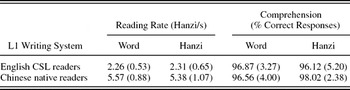
Two 2 × 2 mixed ANOVAs were used to analyze the effects of L1 writing system and type of spacing on reading rate and comprehension. The first factor was a between-group factor (L1 writing system, with two levels: English and Chinese); the second factor was a within-group factor (type of spacing, with two levels: word and hanzi). Reading rate was expressed as the number of hanzi read per second; comprehension was expressed as the percentage of correct responses. Table 2 shows the mean reading rates and percentage of correct responses by group and type of spacing. The presence of orthographic words did not affect either reading rate or comprehension in either group. The L1 writing system did not affect comprehension, as both groups performed almost to ceiling level, but it affected reading rate, as the Chinese native users were more than twice faster than the English CSL users.
Hanzi sentence reading: Mean reading rate (standard deviation) and comprehension by group and type of spacing

Note: L1, first language; CSL, Chinese as a second language.
The ANOVA for reading rate revealed a main effect of L1 writing system, F (1, 26) = 116.56, p < .001, η 2 = .82. Type of spacing did not affect reading rates, F (1, 26) = .73, ns. The interaction between L1 writing system and type of spacing was also not significant, F (1, 26) = 2.03, ns.
The ANOVA for comprehension revealed no effects of either L1 writing system, F (1, 26) = .533, ns, or type of spacing, F (1, 26) = 1.742, ns. Separate analyses for positive and negative answers also did not reveal any effects.
The interword spacing effect (the difference between the reader's reading rate with interword spacing and the rate with interhanzi spacing) was almost nonexistent. English CSL users read 2.76 more hanzi per minute with interhanzi spacing than with interword spacing. Still, there was much variation (SD = 13.05), with the effects of interword spacing ranging from −33.36 to 17.10. The Chinese native speakers' group had a small negative interword spacing effect (M = −11.07 hanzi/min) with large variation (SD = 33.89, range = −59.82 to 73.72). The standard deviation for the Chinese group was three times the mean, and for the English CSL group it was more than four times the mean. CSL readers' interword spacing effect did not correlate with reading proficiency as measured with the cloze test (τ = −.16, ns).
Discussion
The results of this experiment confirmed the hypothesis that interword spacing does not facilitate English users of CSL in reading hanzi sentences, although it facilitates them in reading pinyin sentences. This is in line with previous findings that interword spacing does not speed up hanzi text reading in American CSL readers (Everson, Reference Everson1986). As predicted, Chinese readers were also not affected. This is consistent with previous findings that interword spacing does not facilitate native readers' reading of normal Chinese materials (Inhoff et al., Reference Inhoff, Liu, Wang, Fu and Peng1997; Liu et al., Reference Liu, Yeh, Wang and Chang1974).
Chinese native readers read faster than English CSL readers, confirming again the important role of script decoding skills in reading speed. English CSL readers, who are native users of the roman alphabet, read Chinese sentences almost twice as fast as Chinese native readers when sentences were written in pinyin, whereas Chinese native readers read Chinese sentences twice as fast as English CSL readers when sentences were written in hanzi. This confirms that reading speed is affected by script decoding skills more than by spoken language proficiency when the reading materials are simple and context is provided (in this case, by providing pictures).
Finally, this experiment shows that the picture–sentence verification task is a suitable tool for measuring reading rate and comprehension in L2 readers of Chinese. The task was sensitive enough to reveal the effects of presentation modality on reading rate and comprehension. Unlike silent reading followed by recall, the picture–sentence verification task does not require either memorization or oral or written language production, both of which are likely to interfere with measurement of reading rate and comprehension in L2 readers. Unlike reading aloud tasks, it is not affected by difficulties with retrieving the phonology of hanzi or with pronouncing the L2. Compared with sentence verification tasks, the picture–sentence verification task is less likely to be affected by cultural variables. Although the picture–sentence verification task has its shortcomings, particularly in that it involves the nonlinguistic processes of processing the picture and comparing the sentence with the picture, it still appears fit for the purpose of measuring L2 reading rate and comprehension.
CONCLUSIONS
The results of this study can be summarized in a few points:
1. Interword spacing does not always facilitate reading. It did not facilitate Chinese readers, confirming previous findings that native readers of unspaced writing systems are not facilitated by interword spacing.
2. Interword spacing does not always facilitate L2 reading. English readers were only facilitated when reading pinyin. This shows that adding interword spacing to a writing system that is not normally spaced does not necessarily help L2 readers reading simple materials.
3. The reading processes developed to read the L1 writing system do not always affect L2 reading. If this was the case, interword spacing should have facilitated English readers when reading hanzi as well as pinyin. It appears that English CSL users' reading processes are suited to the absence of interword spacing in the Chinese writing system. This rules out the possibility that the orthographic conventions of the L1 writing system indiscriminately affect L2 reading, and therefore shows that L1 reading transfer is only one of the factors affecting L2 reading.
4. The effects of interword spacing are not related to reading proficiency, that is, interword spacing does not facilitate less proficient readers more than more proficient readers. This is shown by the fact that Chinese readers were not facilitated when reading pinyin, and that there was no correlation between English CSL participants' reading ability and the interword spacing effect. Because research on English readers show that marking the boundaries between phrases or clauses only facilitates less proficient readers, it is not clear why interword spacing effects are not related to reading proficiency in Chinese hanzi and pinyin reading.
5. There is a high level of variation in the interword spacing effect. Interword spacing facilitates some L2 readers of Chinese, but other readers are not affected or are even disrupted, and the effects vary dramatically from reader to reader.
In conclusion, it appears that in L2 reading there is an interaction between the characteristics of the L2 writing system being read and the reading processes developed to read the L1 writing system.
The results of this study support a view of the L2 reader and the bilingual–biliterate person as a multicompetent L2 writing system user, that is, one individual with two languages and two writing systems in one mind (Cook & Bassetti, Reference Cook, Bassetti, Cook and Bassetti2005). This contrasts with much research on L2 reading that focuses exclusively on L1 transfer, sometimes conceptualized as an unavoidable and mechanical effect (Cook & Bassetti, Reference Cook, Bassetti, Cook and Bassetti2005). Although the English readers of Chinese were slower than native readers, these results show that L2 reading is not simply inefficient reading, it is qualitatively different from native readers' reading. L2 readers' reading processes are at the same time influenced by their L1 reading processes and by the characteristics of their L2 writing system. The relationship between L1 reading processes, L2 writing systems, and L2 reading processes appears to be more complex than a mechanistic view of L1 transfer would suggest. Readers of L2 Chinese can read pinyin better than native readers, and can use interword spacing to facilitate their pinyin reading, revealing reading processes that are not only different from those of native readers, but can even be more efficient. At the same time, L2 readers adapt to the characteristics of their L2 writing system. In line with native readers, CSL readers are also unaffected by interword spacing when reading hanzi sentences. It appears that the L2 reader is not a victim of his or her weaker spoken language proficiency and lower script decoding skills, but a multicompetent user of two languages and writing systems.
Finally, the results of this study can contribute to recent debates on proposals to introduce interword spacing in the Chinese writing system. In line with various previous studies, this study also found no facilitative effects of adding interword spacing on hanzi sentence reading in either native or nonnative readers. Although research shows positive effects on the reading of special types of linguistic materials, such as garden-path sentences, in the same way as marking phrase of clause boundaries can help English readers under specific circumstances, more research is needed to establish whether spacing should be introduced in the Chinese writing system, and if so whether it should separate orthographic words or other orthographic units. In particular, it may be unnecessary to impose on Chinese children the heavy load of learning interword spacing conventions, a skill that requires as long as two years in children learning to read an alphabetic writing system (Ferreiro, Reference Ferreiro and Nunes1999), and might be even more complex in a language such as Chinese that is hard to segment into words even for professional linguists. Future research could look into the effects of interword spacing on reading in Chinese primary school children.
ACKNOWLEDGMENTS
This research was supported by a postgraduate studentship awarded to the author by the Economic and Social Research Council (ESRC Award PTA/026/27/0610). The author is grateful to Vivian Cook and Jackie Masterson for their tremendous support and to Michelle Hsu-McWilliams and Caiwen Wang for help in recruiting participants and preparing materials.