


Visual impairment is increasing globally, with an estimated prevalence of 2.2 billion people with various types and severity levels of visual impairments (World Health Organization, 2021). Visual impairments refer to low vision, blindness, limited visual field, photosensitivity, color vision deficiency, or night blindness (Golub, Reference Golub2006; Job Accommodation Network, n.d.). In the United States, over 3.4 million individuals aged 40 years and older have blindness or visual impairment (Saaddine et al., Reference Saaddine, Venkat and Vinicor2003). Furthermore, Varma et al. (Reference Varma, Vajayanat, Burkemper, Wu, Torres, Hsu, Choudhury and McKean-Cowdin2016) projected as many as over 25 million Americans to have visual impairment or blindness by 2050.
Employment provides a sense of fulfillment and purpose, besides the economic benefits among people with visual impairments (Vidya, Reference Vidya2017; Wang et al., Reference Wang, Badley and Gignac2004). However, people with visual impairments have a higher unemployment rate compared to the general population in the United States (17.1% vs. 9.0%) (McDonnall et al., Reference McDonnall, Crudden and Zhou2013). Those with employment often contend with work access challenges, which would lower their sense of job satisfaction and wellness (Okungu et.al., Reference Okungu, Griffin-Shirley and Pogrund2019; Rumrill et al., Reference Rumrill, Schuyler and Longden1997; van Nispen et al., Reference van Nispen, Vreeken, Comijs, Deeg and van Rens2016) due to various factors such as negative attitudes of employers and absence of targeted accommodations (Antonelli et al., Reference Antonelli, O’Mally and Steverson2018; McNeil, Reference McNeil2019).
Workplace accommodations refer to tools or procedures for equitable work success (U.S. Equal Employment Opportunity Commission, 2016; Wang et al., Reference Wang, Badley and Gignac2004). Workplace accommodations are necessary for those with disabilities to perform essential job functions (Vidya, Reference Vidya2017), increase productivity, reduce work limitations, and retain qualified employees (Schartz et al., Reference Schartz, Hendricks and Blanck2006; Solovieva et al., Reference Solovieva, Dowler and Walls2011). Some common work access accommodations for visual impairment include screen reading software, large-print or braille material, service dogs, and open and locking door systems (Bruno & Nascimento, Reference Bruno and do Nascimento2019; Dong et al., Reference Dong, Guerette, Warner, Zalles and Mamboleo2017). Americans with Disabilities Act (ADA) of 1990 and its Amendments Act of 2008 require employers to provide reasonable accommodations that do not cause undue hardship. The laws specifically state that it is an employee’s responsibility to request an accommodation. Most accommodations for visual impairment are low in cost (Dong & Guerette, Reference Dong and Guerette2013; Dong et al., Reference Dong, Guerette, Warner, Zalles and Mamboleo2017).
Despite these benefits, workplace accommodations have been underutilized as individuals with visual impairment being reluctant to request accommodations (Frank & Bellini, Reference Frank and Bellini2005). Baldridge and Veiga (Reference Baldridge and Veiga2006) and Baldridge and Swift (Reference Baldridge and Swift2013) found that 67.6% of the participants with visual impairments withheld requests for accommodations at least once each year, and 59.9% withheld requests at least once each quarter. The underutilization of accommodations could negatively impact an individual’s full potential and job satisfaction (Baldridge & Veiga, Reference Baldridge and Veiga2001). This study aimed to examine antecedent and process factors impacting decisions to request or withhold request for accommodations by people with visual impairments.
Antecedent Factors to Accommodation Requests Among People with Visual Impairments
Demographic factors
Of work accommodation antecedents, demographics of age, race, disability severity, and job level and education are among the most studied. For instance, older workers with sensory disabilities were less likely to request compared to younger workers (Dong & Guerette, Reference Dong and Guerette2013) and less likely to obtain any personal assistant services (Frank, Reference Frank2000). By race, African Americans were less likely to request and receive accommodations compared to their White counterparts (Harlan & Roberts, Reference Harlan and Robert1998). Regarding disability severity, individuals having less severe sensory disabilities were less likely to request workplace accommodations (Dong & Guerette, Reference Dong and Guerette2013). Wolffe and Candela (Reference Wolffe and Candela2002) found that for less severe visual impairments, the required accommodations tend to be inexpensive or affordable to the employer. By education and level of employment, those with higher levels of education and in senior work positions have greater access to work accommodations of choice compared to peers with lower levels of education and lower levels of work seniority (Collela, Reference Colella2001). Employees with higher levels of education and senior levels of employment tend to have more workplace social capital for choosing accommodation arrangements (Dong & Guerette, Reference Dong and Guerette2013; Harlan & Robert, Reference Harlan and Robert1998).
Psychosocial factors
Psychosocial factors are important work process enablers. Significant ones include self-efficacy, outcome expectancy, affect, knowledge of workplace accommodations, and workplace social attitudes. Self-efficacy refers to beliefs about one’s capacity to accomplish choice of actions (Lent et al., Reference Lent, Brown and Hackett1994), such as requesting work accommodations (Dong et al. Reference Dong, Guerette, Warner, Zalles and Mamboleo2017; Dong & Guerette, Reference Dong and Guerette2013). Coffey et al. (Reference Coffey, Coufopoulos and Kinghorn2014) proposed that lower self-efficacy among visually impaired women impaired their work motivation and work aspirations. Outcome expectancy refers to perceptions on outcomes of given actions that influence work-related behaviors and job performance in work settings (Lent et al., Reference Lent, Brown and Hackett1994). For example, Dong and Guerette (Reference Dong and Guerette2013) found that people with higher outcome expectations were more likely to request workplace accommodation (see also Dong, Reference Dong2011; Dong et al., Reference Dong, Fabian and Xu2016). Work affect, or feelings and emotions, influenced outcome expectancy and self-efficacy (Dong et al., Reference Dong, Fabian and Xu2016; Lent et al., Reference Lent, Brown and Hackett1994; Vance et al., Reference Vance, Campbell and Dong2018) For instance, Dong and Guerette (Reference Dong and Guerette2013) reported that employees with sensory disabilities with positive affect were more likely to request and receive accommodations than peers with negative affect.
Participants with sensory impairments and hearing impairments reported lack of knowledge about the ADA and policies and procedures on accommodations (Dong et al., Reference Dong, Guerette, Warner, Zalles and Mamboleo2017; Dong & Guerette, Reference Dong and Guerette2013). Dong and Guerette (Reference Dong and Guerette2013) found that participants who requested and received accommodations reported higher levels of knowledge than their counterparts who did not request. Furthermore, a lack of awareness of needed accommodations and their rights under ADA was highlighted as a reason for not requesting and receiving accommodations among employees with visual impairments (Baldridge, Reference Baldridge2001; Frank, Reference Frank2000). Positive workplace social attitudes enhanced chances to request workplace accommodations (Antonelli et al., Reference Antonelli, O’Mally and Steverson2018; Colella Reference Colella2001; Dong & Guerette, Reference Dong and Guerette2013). Workplace environments with less disability stigmas and stereotyping affect were conducive to providing employment test accommodations (Frank & Bellini, Reference Frank and Bellini2005; Harlan & Robert (Reference Harlan and Robert1998; Hollins, Reference Hollins1989; Styers & Shultz, Reference Styers and Shultz2009).
Few studies have examined influences on workplace accommodations by people with visual impairments. This study sought to examine personal and psychosocial characteristics associated with requesting workplace accommodations among individuals with visual impairments. It sought to replicate and extend the findings of the emerging body of evidence on workplace accommodation requesting with visual impairment. The following questions guided the study:
-
1) What types of accommodations do people with visual impairments request or not request in this study?
-
2) What are the salient psychosocial and demographic factors that influence requesting accommodations by people with visual impairments?
Method
Participants
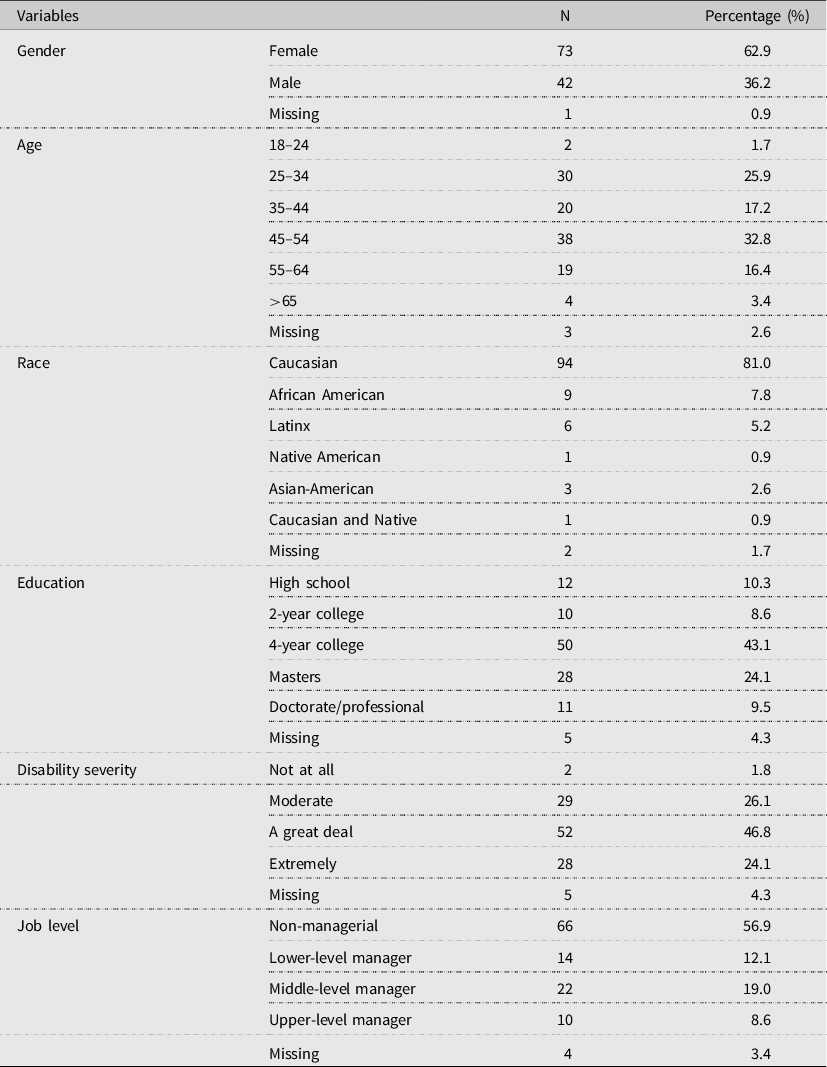
We recruited 116 people with visual impairment for this study (see Table 1 for demographics). All participants need to meet the following inclusion criteria: 1) 18 years of age or older, 2) self-reported a visual impairment, 3) had a need for workplace accommodations in the past three months prior to filling out the survey. Participants reported their disability severity levels: 1.8% said not at all (n = 2), 26.1% said moderate (n = 29), 46.8% said a great deal (n = 52), 24.1% said extremely, 4.3% were missing (n = 5). Job levels reported were 56.9% non-managerial (n = 66), 12.1% lower-level manager (n = 14), 19.0% middle-level manager (n = 22), 8.6% upper-level manager (n = 10), and 3.4% missing (n = 4). See Table 1 for details of demographic information of the participants in the study.
Demographic characteristics of participants

Measures
Participants self-reported if they requested job accommodation(s) three months prior to taking the survey. They also reported types and cost of accommodations either requested or considered but did not request. Furthermore, participants self-reported their levels of knowledge on ADA and accommodation policies and procedures through two survey questions on a five-point Likert scale. Finally, participants also completed the following measures:
Self-efficacy
Accommodation requesting
Participants completed an adapted 4-item Accommodation Self-efficacy Scale (ASS, Rumrill, Reference Rumrill1993). The scale on a five-point Likert scale “Not at all confident” (1) to “Very Confident” (5) was used. Sample items include “Identifying my job accommodation needs” and “Discussing my accommodations needs with my employer.” The alpha reliability of scores from the ASS in the current study was .85.
Goal setting
Participants also completed an adapted 4-item Goal-setting Self-efficacy Scale (GSS, Karoly & Ruehlman, Reference Karoly and Ruehlman1995) that assesses the degree to which people feel capable of achieving their most important work-related goal. Items were rated on a five-point scale “Not at all confident” (1) to “Very Confident” (5). Sample items include “Having the ability to reach my work goal” and “Possessing the necessary skills to attain my work goal.” The alpha reliability of scores from the GSS in the current study was .90.
Outcome expectations
Anticipated employer compliance
The adapted Anticipated Employer Compliance (AEC, Baldridge, Reference Baldridge2001) consists of four items to measure anticipated employer compliance for accommodation requests. The items are on a five-point Likert scale ranging from “Disagree” (1) to “Agree” (5). Sample items include “If I asked for the accommodation, it would probably be provided” and “If I requested accommodation, I would likely receive it.” The alpha reliability of scores from the AEC in the current study was .96.
Accommodation appropriateness
The adapted Accommodation Appropriateness (AP, Florey, Reference Florey1998) is a 3-item measure of one’s perception on the reasonableness of one’s accommodation requests. Participants were asked to respond on a five-point Likert scale ranging from “Disagree” (1) to “Agree” (5). Sample items include “Most people at the work would approve of me requesting this accommodation” and “Most people at the work would support my requesting for this accommodation.” The alpha reliability of scores from the AP in the current study was .93.
Personal cost perception
The 3-item Personal Cost Perception (PCP, Anderson & Williams, Reference Anderson and Williams1996) evaluates one’s perception of cost associated with seeking workplace assistance. Participants rate the items on a five-point Likert scale ranging from “Disagree” (1) to “Agree” (5). Sample items include “I would feel inadequate or incomplete if I asked for this accommodation” and “Asking for this accommodation would make me feel foolish.” To be consistent with other subscales of outcome expectation, we reverse-coded the items in this subscale and named the construct as non-personal cost. The alpha reliability of scores from the PCP in the current study was .65.
Affect
The Positive and Negative Affect Schedule (PANAS; Watson et al., Reference Watson, Clark and Tellegen1988) is a 20-item measure that assesses differences in positive and negative emotions on how comfortable they felt with asking for job accommodations in the past three months. To reduce the response burden, five items from each positive affect and negative affect were selected with the equal representation of items in covarying item pairs (Crawford & Henry, Reference Crawford and Henry2004). Participants rate the items on a five-point Likert scale from “Not at all” (1) to “Extremely” (5). Sample items include “Determined,” “Enthusiastic,” “Afraid,” and “Nervous” Scores from the PANAS achieved alphas of .85 and .88 (for positive affect and negative affect, respectively) in the present study.
Workplace supports
The 6-item scale Workplace Supports (WS, Dong & Guerette, Reference Dong and Guerette2013) is a measure of one’s perception of a disability friendly job environment and level of acceptance by the workplace. Participants rate the items on a five-point Likert scale ranging from “Strongly Disagree” (1) to “Strongly Agree” (5). Sample items include “How did you rate your relationship with your employer/supervisor at the workplace where you considered or asked for the accommodation(s)?” and “How did you rate the supportiveness from your coworkers at the workplace where you considered or asked for the accommodation(s)?” The alpha reliability for scores from the WS in the present study was .84.
Procedures
The study, as part of a larger research project of the first author, was approved by the Florida State University’s Institutional Review Board. All the participants participated in this study voluntarily with their own informed consent. After completing the survey, participants were also offered an opportunity to enter a raffle with a chance to win a $10 Amazon gift card.
We took measures to keep the participants’ information confidential. For example, all data were analyzed and reported in a way no personal identifiable information would be revealed outside of the research team. Once the raffle was done and gift cards were sent to winners, names of the winners and their email addresses were deleted.
Data analysis
We utilized logistic regression to predict the likelihood of requested workplace accommodations among people with visual impairments by antecedent demographic factors (i.e., gender, age, education, job status, and job level) and psychosocial factors (i.e., self-efficacy, outcome expectation, affect, and the level of workplace supports) and on whether to request workplace accommodations among people with visual impairments. The non-multicollinearity assumption was met as all correlations among independent variables were under .80. The sample size also met the requirements for logistic regression as by the Hosmer and Lemeshow approach (Abu-Bader, Reference Abu-Bader2010). We collapsed age, race, education, and job status each into the following groups: 18–54 vs. 55 and older; Caucasian vs. others; high school or less vs. college or higher; non-management vs. management in the logistic regression.
Results
Accommodations requested and not requested
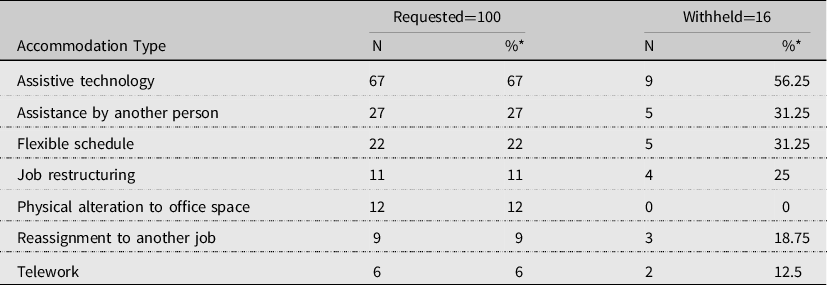
Among the 116 participants, the higher requested accommodations were assistive technology (n = 67, 67.00%), assistance by another person (n = 27, 27.00%), and flexible scheduling (n = 22, 22.00%). The higher withheld accommodations are assistive technology (n = 9, 56.25%), assistance by another person (n = 5, 31.25%), and flexible scheduling (n = 5, 31.25%). See Table 2 for details.
Workplace accommodations requested or withheld

* Percentages add up over 100%, as multiple accommodations can be chosen.
Correlations of psychosocial factors (i.e., self-efficacy, outcome expectancy, affect, workplace supports, and knowledge on ADA and accommodations) as well as means, standard deviations, range, skewness, and kurtosis were presented in Table 2. With the exception between negative affect and other all variables, all the correlations were positive. See Table 3 for details.
Intercorrelations and descriptive statistics

*<.05 **<.01. a As request behavior is dichotomous, point-biserial correlations were used. b RA: Reasonable accommodation.
Logistic regression of psychosocial and demographics factors on accommodation request decision
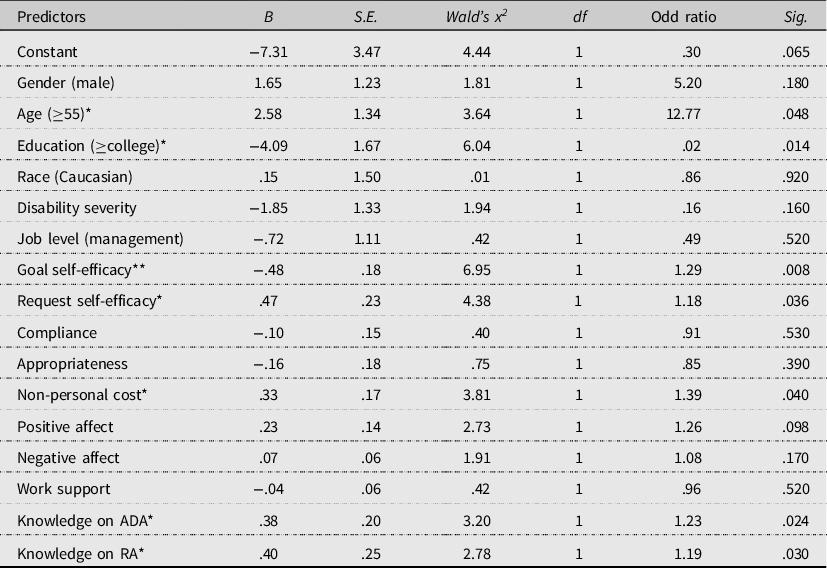
The omnibus test for the logistic regression model was statistically significant, x 2 (16, N = 116) =35.13, p < .001, indicating reliable prediction of the dependent variable (whether requesting job accommodation or not) by the independent variables (Negelkerke R2 = .52). The results indicated that psychosocial factors such as self-efficacy in accommodation request, self-efficacy in goal setting, non-personal cost of outcome expectancy, and knowledge on ADA and accommodation and education (i.e., college or higher) were significant predictors for requesting accommodations. Each unit of increase in accommodation request self-efficacy, goal-setting self-efficacy, absence of personal cost, knowledge on ADA, and knowledge on accommodation represented 29%, 18%, 39%, 23%, and 19% higher likelihood of requesting accommodations among people with visual impairments. Individuals self-reported college or higher degrees were 98% more likely to request accommodations compared to their counterparts with high school or a lesser degree. Participants who are 55 years or younger were 27% more likely to request accommodations than their counterparts who are more than 55 years. However, all the other variables were found to be non-significant predictors associated with requesting workplace accommodations. See Table 4 for details.
Logistic regression analysis on requesting accommodations

*p<.05 **p<.01. RA: Reasonable accommodation.
Discussion
The purpose of this study was to examine types of work accommodations that individuals with visual impairments requested/withheld as well as impacting factors on requesting workplace accommodations. We found that individuals who are over the age of 55 are less likely to request accommodations than younger individuals. These results confirm past research (Dong & Guerette, Reference Dong and Guerette2013; Frank, Reference Frank2000). On the other hand, the lower accommodation requests among those 55 and higher could be related to higher developed work management skills over a longer period of work participation. Moreover, lower accommodation request rates in individuals 55 and older could be attributed to having lower self-advocacy among individuals with a sensory disability (Dong & Guerette, Reference Dong and Guerette2013; McMullin & Shuey, Reference McMullin and Shuey2006).
Participants with a higher education level (associate degrees and higher) were more likely to request accommodations than participants who had less education (high school degree or less). The results in the current study are consistent with those of Solovieva et al. (Reference Solovieva, Dowler and Walls2011). Higher education level might facilitate the development of self-knowledge and self-advocacy for accommodations (Dong et al., Reference Dong, Mamboleo and Davis2020).
Higher levels of goal self-efficacy and accommodation request self-efficacy were associated with a higher likelihood for requesting accommodations. This finding is supported by past research (Coffey et al., Reference Coffey, Coufopoulos and Kinghorn2014; Dong et al., Reference Dong, Guerette, Warner, Zalles and Mamboleo2017; Dong & Guerette et al., Reference Dong and Guerette2013). Higher self-efficacy may reduce fears and anxieties about requesting and enhance success with managing outcomes of the requests (Coffey et al., Reference Coffey, Coufopoulos and Kinghorn2014; Styers & Shultz, Reference Styers and Shultz2009).
Participants in the current study believed their perception of non-personal cost to facilitate their accommodation request efforts (see also Baldridge & Veiga, Reference Baldridge and Veiga2001, Reference Baldridge and Veiga2006; Dong & Guerette, Reference Dong and Guerette2013). For example, when requesters experience personal costs (i.e., shame, inadequacy, burdensomeness), accommodation requests are often withheld (Baldridge & Viega, Reference Baldridge and Veiga2006), which may be threat to self-esteem from the embarrassment of being denied.
The current study found higher levels of knowledge on the ADA and the process to request accommodations to predict the likelihood of accommodation requests. The findings are consistent with workplace self-advocacy abilities with visual impairments (Dong et al., Reference Dong, Guerette, Warner, Zalles and Mamboleo2017). Ensuring employees’ knowledge on the process of requesting accommodations may allow them to access workplace accommodations, which assist them effectively do their job and complete their tasks (Gamble et al., Reference Gamble, Dowler and Hirsh2004).
Implications for Practice
Rehabilitation professionals may pay special attention and provide workshops and training for older workers with visual impairment and blindness to boost their self-efficacy requesting accommodations through enhancing knowledge on ADA and workplace accommodation policies and procedures. Rehabilitation professionals may hold focus groups by inviting employees who have had successful accommodation experiences to share their experiences and act as role models. Role play activities and relevant training may also boost employees’ skills to articulate their accommodation needs and demonstrate how accommodations can positively enhance their abilities to complete their work tasks and job performance. Such training may focus on how successful accommodations requests may assist employees with visual impairments to reach their work goals, which in turn fosters their self-efficacy to set and reach their future work goals.
Rehabilitation professionals need to educate employees with visual impairments to be more proactive and assertive in expressing that their workplace needs must be addressed by appropriate workplace accommodations. Enhancing one’s self-advocacy and building a sense of community may mitigate the impact of personal cost related to disability disclosure and accommodation requests.
Rehabilitation professionals may provide training to educate employers/supervisors on the positive effects of creating an inclusive work environment through providing workplace accommodations and through reducing negative attitudes and misconceptions about disability and accommodation requests.
Limitations
This study has several limitations. First, this was a cross-sectional online survey study, and the data do not represent accommodation requests practices over time. Second, the sample size of the current study is relatively small, which would limit generalizability. Third, a large percentage of participants in this study reported requesting workplace accommodations. This may skew the study results and limit the variability of variables in the study Future studies may consider longitudinal study with a larger sample size to enhance the dependability of findings. In addition, future research may pay additional efforts to recruit participants who did not request or receive workplace accommodations.
Conclusion
People with visual impairments experience challenges in the workplace such as requesting and utilizing workplace supports. The current study identified psychological and demographic factors that significantly impact decisions to request workplace accommodations among employees with visual impairment and blindness. Rehabilitation professionals need to work with various stakeholders (e.g., employees with visual impairments, employers, and coworkers) to foster a more inclusive and empowering environment through educating employees with visual impairments to full advantage of workplace resources. Moreover, assisting workplace to recognize benefits of creating an inclusive work environment would depend on accommodations accessibility.
Acknowledgements
The authors would like to express their appreciation to the feedback of the reviewers and editor.