This article posits a tool for measuring how much the physical environment of schools impacts childrens’ environmental attitudes. Such a tool offers a way of testing the efficacy of architectural design strategies, such as the inclusion of visible environmentally sustainable design (ESD) features, for improving children's attitudes to the natural environment. The tool is an adaptation of the NEP for Children, revising the original to make it suitable for the particular contexts of evaluating the design of schools.
A key argument underpinning research on learners’ environmental attitudes and behaviours is that it is crucial to understand environmental attitudes because these inform pro-environmental behaviour, which is the ultimate goal of environmental education (Rickinson, Reference Rickinson2001). Thus, environmental attitudes research is critical for understanding what determines attitudes, and therefore for understanding the impacts of environmental education programs on environmental attitudes and behaviours (Newhouse, Reference Newhouse1990). Or, as Kwan and Miles (Reference Kwan and Miles1998) put it, as young people hold environmental attitudes, ‘to achieve success in environmental education teachers need to identify and draw on children's opinions about environments’ (p. 12).
As much of the data on what impacts environmental learning is quantitative in nature (Rickinson, Reference Rickinson2001), quantitative measurement is one of the most widely accepted methods of measuring environmental attitudes (Dunlap, Van Liere, Mertig, & Jones, Reference Dunlap, Van Liere, Mertig and Jones2000; Larson, Green, & Castleberry, Reference Larson, Green and Castleberry2011; Leeming, Dwyer, & Bracken, Reference Leeming, Dwyer and Bracken1995; Manoli, Johnson, & Dunlap, Reference Manoli, Johnson and Dunlap2007; Noe & Snow, Reference Noe and Snow1990b). This article investigates the use of a quantitative approach to evaluate how environmental attitudes are impacted by learning contexts. In particular, the article proposes an instrument — the NEP (Children@School) — for measuring how the physical environment of schools, rather than the pedagogical or psycho-social environments, might have an impact on childrens’ environmental attitudes while at school (and thus, it might be hoped, beyond). For while there are many environmental education programs for children, few studies have been able to develop appropriate scales for evaluating the impacts of the learning contexts of these programs on childrens’ environmental attitudes.
For an instrument to be appropriate for use with children, apart from being reliable and valid, it needs to be specifically designed for their age. Thus, ‘instruments that exclusively employed complex question structure to address broad attitudinal dimensions and global concepts in adult and teenage populations are less relevant for younger children’ (Larson et al., Reference Larson, Green and Castleberry2011, p. 73). While researchers have developed some child-appropriate environmental attitude assessment instruments, such as the Children's Attitudes toward the Environment Scale (CATES; Musser & Malkus, Reference Musser and Malkus1994), the Children's Environmental Attitude and Knowledge Scale (CHEAKS; Leeming et al., Reference Leeming, Dwyer and Bracken1995), 2-MEV (i.e., 2-factor model of environmental values; Bogner & Wilhelm, Reference Bogner and Wilhelm1996), and Children's Environmental Perceptions scale (CEP; Larson et al., Reference Larson, Green and Castleberry2011), few of these have been designed to address children's environmental attitudes within educational contexts, and none have been designed to measure the impact of the design of physical learning spaces on children's environmental attitudes. This article proposes an adaptation of the NEP for Children scale to measure children's environmental attitudes in schools: the NEP (Children@School). While the NEP (Children@School) adapted the NEP for Children for Australian use, its design makes it appropriate for wider global use. In the development of the scale, 624 children, aged 10 to 12 years, defined by Newman and Newman (Reference Newman and Newman2014) as the middle childhood life-stage, completed a survey on their environmental attitudes towards their school learning environments.
It was found that the NEP (Children@School) scale has three dimensions: Children's Environmental Attitudes towards Human Intervention, Children's Environmental Attitudes via ESD at School, and Children's Environmental Attitudes towards Eco-Rights. When the estimate reliability omega value was calculated for each of these factors, the results indicated that the scale can reliably measure the the efficacy of the physical design of learning spaces for improving children's attitudes to the natural environment.
Background
Environmental sustainability has become a major social issue (Wilson & Knopt, Reference Wilson and Knopt2002). As environmental sustainability is largely about human choices and actions, each individual has a great deal to contribute towards environmental change (Mayer & Frantz, Reference Mayer and Frantz2004). To understand how environmental problems are perceived by individuals, it is necessary to investigate the attitudes that inform human relationships towards their physical environments. Attitude ‘implies more than simply the knowledge of a body of factual information; instead, it implies a combination of factual knowledge and motivating emotional concern, which result in a tendency to act’ (Stapp et al., Reference Stapp, Bennett, Bryan, Fulton, MacGregor, Nowak and Havlick1969, p. 15). Attitudinal variables includes those factors that deal with ‘the individual's feelings, pro or con, favourable or unfavourable, with regard to particular aspects of the environment or objects related to the environment’ (Hines, Hungerford, & Tomera, Reference Hines, Hungerford and Tomera1987, p. 4). As such, it is argued that environmental attitude research is critical for understanding what determines attitudes (Newhouse, Reference Newhouse1990), and ultimately for contributing towards pro-environmental changes.
One of the main objectives of environmental education is to modify and promote people's environmental behaviour. Since one of the determinants of behaviour is attitude (Kraus, Reference Kraus1995), it is important to evaluate environmental attitudes that facilitate modifying environmental behaviours (Pooley & O'Connor, Reference Pooley and O'Connor2000). Acknowledging attitude as one of the formative agents in environmental literacy, researchers such as Leeming et al. (Reference Leeming, Dwyer and Bracken1995) believe that research on children's environmental attitudes needs to be furthered because ‘early attitudes and knowledge shape the later thinking of adolescents and adults’ (Leeming et al., Reference Leeming, Dwyer and Bracken1995, p. 23). Therefore, as it has been found that children gain environmental knowledge and develop environmental attitudes as early as kindergarten (Bryant & Hungerford, Reference Bryant and Hungerford1977), the importance of studying and being able to measure children's environmental development and orientations is clear, and thus of being able to determine how such orientations can best be informed.
Teaching via school curricula is the primary method for environmental education. However, other less directly observable and more implicit methods have also been developed, such as learning through participation (hands-on experiences) or learning through ‘knowing eye’ (visual literacy). Taylor and Enggass (Reference Taylor and Enggass2009) believe that once we start to ‘read’ an environment, we have cultivated a knowing eye. The visual literacy gained from a knowing eye enables the occupants of a space to read, see, deeply perceive, and critically analyse that physical environment. The physical environment is therefore also referred to as a ‘three-dimensional textbook’ or ‘silent curriculum’, which might not be palpable but which impacts the learning experiences of users of a space (Taylor & Enggass, Reference Taylor and Enggass2009, p. 25). As such, the wider study that led to the development of the NEP (Children@School) aimed to determine whether learning via knowing eye allows the design of school learning spaces to be used as pedagogic tools for environmental education.
According to the literature, environmental attitudes and behaviours are believed to be impacted by the duration of exposure to incentives that encourage pro-environmentalism (Partain, Reference Partain1980). As most of the environmental initiatives in schools are short term and do not provide students a long period of exposure to environmental issues, the role of the school built environment is of paramount importance because it offers students a semi-permanent visual exposure. As ‘physical elements in the environment can act as visual cues or prompts for learning’ (Wilks, Reference Wilks2010, p. 9), design can be seen to have a pedagogical value. Moreover, as we have discussed elsewhere (Izadpanahi, Elkadi, & Tucker, Reference Izadpanahi, Elkadi and Tucker2015) sustainability features that have been added to or included in redesigned school learning spaces have been shown to inform patterns of pro-environmental attitudes.
Before moving on to discuss the development of the NEP (Children@School) and how it acknowledges the potential use of school design as a pedagogy for enhancing environmental attitudes, the theoretical background of the use of such quantitative instruments is summarised. First, the development of environmental attitudes scales is discussed, including the New Ecological Paradigm (NEP) — the source of the NEP for Children. A discussion of environmental attitudes scales for children will then be a precursor to a description of the NEP for Children-2007 (Manoli et al., Reference Manoli, Johnson and Dunlap2007) — the basis of NEP (Children@School).
Environmental Attitudes Scales for Adults
Efforts to measure environmental attitudes have led to the development of many assessment instruments (Leeming et al., Reference Leeming, Dwyer and Bracken1995). Although these instruments share a similar aim, different scales have different approaches depending on the research objectives. In a study by Werner et al. (Reference Werner, Turner, Shipman, Twitchell, Dickson, Bruschke and von Bismarck1995), attitude change due to participation in a free curbside recycling program was measured using a 40-item questionnaire that tapped ‘general recycling attitudes, and behaviours, attitudes towards the curb-side pick-up firm, and self-concept as a recycler’ (Werner et al., Reference Werner, Turner, Shipman, Twitchell, Dickson, Bruschke and von Bismarck1995, p. 201). In another study, Tuncer, Ertepinar, Tekkaya, and Sungur (Reference Tuncer, Ertepinar, Tekkaya and Sungur2005) used a 45-item Likert questionnaire to measure the effect of school type and gender on students’ environmental attitudes. The questionnaire consisted of four dimensions: ‘awareness of environmental problems, national environmental problems, solutions to the problems, and awareness of individual responsibility’ (Tuncer et al., Reference Tuncer, Ertepinar, Tekkaya and Sungur2005, p. 215). Schindler (Reference Schindler1999) created the survey of Environmental Issue Attitudes in order to measure college students’ attitudes. This 20-item survey also measured demographics, ecology knowledge, and self-reported changes in behaviours toward the environment.
While there is no universal instrument to gauge environmental attitudes, the NEP is perhaps the most widely used instrument for measuring environmental attitudes (Dunlap et al., Reference Dunlap, Van Liere, Mertig and Jones2000; van Petegem & Blieck, Reference van Petegem and Blieck2006). Employing the NEP, a scale rigorously tested for internal consistency and validity, provides the opportunity for researchers to compare the results of different studies, and thus consistently build upon knowledge about environment and attitudes. Unlike previous environmental scales that predominantly focused on attitudes towards specific problems such as energy consumption, waste disposal, and air/water pollution (Albrecht, Bultena, Hoiberg, & Nowak, Reference Albrecht, Bultena, Hoiberg and Nowak1982), the NEP relates to a more general position about environment (Noe & Snow, Reference Noe and Snow1990b). Considering the scope and limits of the other environmental attitudes scales reviewed above, the NEP is a clear choice for adaptation for measuring the environmental attitudes of children. Thus, before moving on to explain the NEP (Children@School), the following sections will describe the development process and characteristics of the NEP.
New Environmental Paradigm (NEP)
Dunlap and Van Liere (Reference Dunlap and Van Liere1978) developed the NEP scale to investigate ‘whether a more general position about society and its resources existed among American public’ (Noe & Snow, Reference Noe and Snow1990b, p. 21). The 12 items of the NEP ‘focused on beliefs about humanity's ability to upset the balance of nature, the existence of limits to growth for human societies, and humanity's right to rule over the rest of nature’ (Dunlap, Van Liere, Mertig, & Jones, Reference Dunlap, Van Liere, Mertig and Jones2000, p. 427).
In 2000, Dunlap et al. modified the New Environmental Paradigm to the New Ecological Paradigm (NEP). This new scale was designed to improve upon several aspects of the original scale by covering a broader range of environmental worldviews, providing better balance of pro-environmental and anti-environmental items, as well as removing outdated terminology. The NEP aimed to assess five key factors: (1) limits to growth, (2) anti-anthropocentrism, (3) fragility of nature's balance, (4) rejection of human exemptionalism, and (5) belief in eco-crisis. As all five factors were assessed using 3 items specifically designed for each, the NEP has a total of 15 items.
The NEP Scale Reliability
‘Reliability of a scale is an indication of how accurately and repeatably it determines whatever it reports to measure’ (Schindler, Reference Schindler1999, p. 16). The NEP scale has been subjected to a good deal of reliability testing and has been found to have reasonably strong internal consistency (Dunlap et al., Reference Dunlap, Van Liere, Mertig and Jones2000). As Dunlap (Reference Dunlap2008) reports, ‘alpha averaged .71 for all 140 samples’ (Dunlap, Reference Dunlap2008, p. 11) in 68 studies that employed different versions of the NEP. The NEP is reported to have stronger internal consistency in the context of more developed nations.
Cross-Contextual and Cross-Cultural Applicability of the NEP
It has been found that ‘culture influences the structure of environmental beliefs’ (Bechtel, Corral Verdugo, & de Queiroz Pinheiro, Reference Bechtel, Corral Verdugo and de Queiroz Pinheiro1999, p. 123). In order to control for the impact of cultural differences on research, a scale needs to be used in a corresponding and homogeneous context to which the scale was developed. Alternatively, a scale should be tested in terms of reliability and cross-cultural applicability prior to being applied in a culture for which the scale was not originally designed. A review of the literature reveals that different versions of the NEP have been administered across 36 nations (Dunlap, Reference Dunlap2008). Noe and Snow (Reference Noe and Snow1990a) write that ‘the NEP scale has also been administered in ethnic and cross-cultural studies seemingly without problems in translation’ (p. 28). While the NEP was first developed for use in the United States, it has been utilised in Latin American countries (Bechtel et al., Reference Bechtel, Corral Verdugo and de Queiroz Pinheiro1999; Vikan et al., Reference Vikan, Camino, Biaggio and Nordvik2007), developing countries (Furman, Reference Furman1998), and European countries (Gooch, Reference Gooch1995).
The NEP has also been used in Australia, the country for which the NEP (Children@School) was developed. Casey and Scott (Reference Casey and Scott2006) used the NEP to measure the environmental concerns of 292 participants from 126 urban and rural locations across Australia. They found that ‘the socio-demographic bases of environmental concerns in Australia appear to be quite similar to the socio-demographic bases of such concern found in U.S. studies’ (Casey & Scott, Reference Casey and Scott2006, p. 63). They reported that Cronbach's alpha for the NEP scale in their study (.84) compared favourably with the corresponding reliability estimates in the U.S. studies: .78, .82 (Department of Sustainability, Environment, Water, Population and Communities, 2011), and .83 (Dunlap et al., Reference Dunlap, Van Liere, Mertig and Jones2000). Thus, it can be posited that the NEP has demonstrated good cross-cultural applicability.
Dimensionality of the NEP
On some occasions, the variables involved in analysis are not comprised of a single construct. Rather, a specific variable can be composed of two or more underlying variables. These underlying variables are referred to as dimensions or factors. To identify these dimensions or factors, factor analysis is used as a statistical technique in this paper.
While evidence supports the overall reliability and cross-cultural applicability of the NEP, there is a lack of consensus on whether the NEP measures a single construct or is inherently multidimensional. While many studies have reported that the NEP is a unidimensional scale, thus indicating that all items were seemingly tapping a single attitudinal domain (Dunlap et al., Reference Dunlap, Van Liere, Mertig and Jones2000; Edgell & Nowell, Reference Edgell and Nowell1989; Lefcourt, Reference Lefcourt1996; Noe & Snow, Reference Noe and Snow1990b; Shin, Reference Shin2001; Slimak & Dietz, Reference Slimak and Dietz2006; Steg, Dreijerink, & Abrahamse, Reference Steg, Dreijerink and Abrahamse2005), several other studies have reported that the NEP consisted of two or more factors (Albrecht et al., Reference Albrecht, Bultena, Hoiberg and Nowak1982; Bechtel et al., Reference Bechtel, Corral Verdugo and de Queiroz Pinheiro1999; Corral-Verdugo, Bechtel, & Fraijo-Sing, Reference Corral-Verdugo, Bechtel and Fraijo-Sing2003; Dunlap & Van Liere, Reference Dunlap and Van Liere1978; Gooch, Reference Gooch1995; Noe & Snow, Reference Noe and Snow1990a; Shetzer, Stackman, & Moore, Reference Shetzer, Stackman and Moore1991).
Scales to Measure Children's Environmental Attitudes
While children's understanding of their relationship with and impact upon the environment is of interest to both researchers and educators, there have been few studies that have used appropriately developed scales for evaluating children's environmental attitudes. For a scale to be appropriate for use with children, apart from being reliable and valid, it needs to be specifically designed for their level of comprehension. Thus, ‘instruments that exclusively employed complex question structure to address broad attitudinal dimensions and global concepts in adult and teenage populations are less relevant for younger children’ (Larson et al., Reference Larson, Green and Castleberry2011, p. 73). As shall be discussed now, researchers have developed some child-appropriate environmental attitude assessment instruments, such as CATES (Musser & Malkus, Reference Musser and Malkus1994), CHEAKS (Leeming et al., Reference Leeming, Dwyer and Bracken1995), 2-MEV (Bogner & Wilhelm, Reference Bogner and Wilhelm1996), and CEP (Larson et al., Reference Larson, Green and Castleberry2011).
CATES-1994
The Children's Attitudes toward the Environment Scale (CATES) was developed by Musser and Malkus (Reference Musser and Malkus1994) to measure environmental attitudes of grade-school children. The scale items reflect children's knowledge of environmental issues. There have been different opinions about the psychometric properties of the scale. Smith-Sebasto and Semrau (Reference Smith-Sebasto and Semrau2004) used CATES to evaluate an environmental education program at the New Jersey School of Conservation (NJSOC). Their primary goal was to assess the effect of the NJSOC program on students’ attitudes towards environment. Both Musser and Malkus (Reference Musser and Malkus1994) and Smith-Sebasto and Semrau (Reference Smith-Sebasto and Semrau2004) report that CATES has logical internal consistency reliability (Cronbach's alpha = 0.70) and high test–retest reliability (0.68, p < .001). On the contrary, some studies have raised the issue that CATES has poor test–retest reliability (Kim, Zeman, & Kostareva, Reference Kim, Zeman and Kostareva2007). Researchers have suggested that CATES has not been commonly used because it has a bipolar answer structure that does not give children a variety of choices to select from (Manoli et al., Reference Manoli, Johnson and Dunlap2007).
CHEAKS-1995
The Children's Environmental Attitude and Knowledge Scale (CHEAKS) (Leeming et al., Reference Leeming, Dwyer and Bracken1995) was derived from an adult scale developed by Maloney, Ward, and Braucht (Reference Maloney, Ward and Braucht1975) and is used to gauge ecological attitudes and knowledge. According to the developers, this scale has been shown to have acceptable levels of validity and reliability. CHEAKS is comprised of two subscales. One subscale assesses attitude and has 36 items (12 items of verbal commitment, 12 items of actual commitment, 12 items of affect). The other subscale assesses knowledge and has 30 items. The attitudinal items were sampled systematically from six content-dependent subdomains (water, energy, animals, recycling, pollution, and general issues). The knowledge subscale systematically sampled the same six content-dependent subdomains (Leeming et al., Reference Leeming, Dwyer and Bracken1995).
Evans et al. (Reference Evans, Brauchle, Haq, Stecker, Wong and Shapiro2007) raised some criticism about CHEAKS. They stated that this scale includes difficult items for children to understand. The scale also includes items that children do not generally have any control over. The forced-choice response format of CHEAKS can also lead to children becoming disinterested with the task at hand (Johnson & Manoli, Reference Johnson and Manoli2011). While CHEAKS has generally strong psychometric properties (Walsh-Daneshmandi & MacLachlan, Reference Walsh-Daneshmandi and MacLachlan2006), ‘it lacks a clearly formulated theoretical basis for its structure’ (Johnson & Manoli, Reference Johnson and Manoli2011, p. 86), and is considered to be too long (66 items) for administering to children.
MEV-1996
The 2-MEV scale was developed by Bogner and Wilhelm (Reference Bogner and Wilhelm1996) to gauge adolescents’ concern towards the environment and was used to determine the effectiveness of educational programs. The first version of the 2-MEV scale was designed for German students aged from 10 to 16 years. The scale had 69 items and was revealed to have several subscales, such as attitudes, verbal commitment, and actual behaviour. Following on from several studies that included students from Denmark, Germany, Switzerland, and Ireland, the number of scale items was reduced to 20 (Bogner, Reference Bogner1998a, Reference Bogner1998b, Reference Bogner1999; Bogner & Wiseman, Reference Bogner and Wiseman1997, Reference Bogner and Wiseman1998; Wiseman & Bogner, Reference Wiseman and Bogner1997). This scale continues to be used (Bogner, Reference Bogner2000, Reference Bogner2002; Bogner, Brengelmann, & Wiseman, Reference Bogner, Brengelmann and Wiseman2000; Bogner & Wiseman, Reference Bogner and Wiseman2002a, Reference Bogner and Wiseman2002b). Johnson and Manoli (Reference Johnson and Manoli2011) modified the scale further to make it appropriate for children aged between 9 and 12 years in the United States. The revised 2-MEV scale has 16 items and is capable of measuring changes in participants’ environmental attitudes before and after they participate in ‘Earth’ education programs (Johnson & Manoli, Reference Johnson and Manoli2011). The revised 2-MEV scale seemed to have the potential to be used in the current study. However, the children's version of this scale has only been used in the United States. As such, the reliability of this scale in the Australian context was uncertain.
CEPS-2011
The Children's Environmental Perceptions Scale (CEPS) was developed to measure perceptions of nature held by children aged between 6 to 13 years in the United States (Larson et al., Reference Larson, Green and Castleberry2011). The CEPS measures two distinct components of environmental orientation: eco-affinity and eco-awareness. Eco-affinity items are identified as reflecting ‘personal interest in nature and intentions to engage in pro-environmental behaviour, and Eco-awareness items reflects a cognitive grasp of environmental issues related to the general importance and sustainability of natural ecosystems’ (Larson et al., Reference Larson, Green and Castleberry2011, p. 83). The CEPS was meant to help researchers determine the ways children perceive the natural world, and ‘identify cognitive and affective aspects of existing environmental education programs that need improvement’ (Larson et al., Reference Larson, Green and Castleberry2011, p. 72). The CEPS is a psychometrically sound scale and contains fewer items than the CHEAKS and CATES scales and thus requires less time to administer (Leeming et al., Reference Leeming, Dwyer and Bracken1995; Musser & Malkus, Reference Musser and Malkus1994). However, the CEPS has some shortcomings in terms of its applicability to a study of the impact of learning spaces on environmental orientations, for most of the CEPS items ask about plants and animals. A study on learning spaces requires a more holistic measure covering a broader range of environmental issues, such as orientations towards energy consumption and waste reduction. Moreover, the CEPS has not been tested in different cultural contexts — a clear problem for studies outside of the United States.
NEP for Children—2007
The most widely used attitude scale for adults is the NEP (Manoli et al., Reference Manoli, Johnson and Dunlap2007). Manoli et al. (Reference Manoli, Johnson and Dunlap2007) adapted the NEP to make it an appropriate scale to use with children. This scale was called the NEP for Children. This scale includes 10 items and has a 5-point Likert-scale scoring system from 1 (strongly disagree) to 5 (strongly agree). NEP for Children is appropriate for use with children aged between 10 to 12 years. Manoli and colleagues report that the NEP for Children measures the same three interrelated dimensions as the NEP: Rights of Nature, Eco-Crisis, and Human Exemptionalism (the belief that humans are exempt from the constraint of nature). However, they also found that ‘it is possible to treat the scale as a unidimensional measure providing one overall score on the anthropocentric to ecocentric continuum’ (Manoli et al., Reference Manoli, Johnson and Dunlap2007, p. 11).
One of the limitations of NEP for Children relates to the origin of the NEP scale. NEP was originally designed to measure the environmental world view of American people. Therefore, some of the social and cultural aspects that informed it were unique to American societies (Ogunbode, Reference Ogunbode2013). This issue has also been stated by the developers of the scale, for according to Manoli and colleagues, NEP for Children should be used with ‘larger numbers of students in a variety of locations’ (Manoli et al., Reference Manoli, Johnson and Dunlap2007, p. 11). However, unlike some of the previously discussed scales, NEP for Children has been shown to be statistically reliable when used in Australia (Manoli et al., Reference Manoli, Johnson and Dunlap2007), and therefore could be used in this context with a high level of confidence.
Considering the scope and the limits of the environmental attitudes scales reviewed above, the 10-item NEP for Children by Manoli and colleagues (Reference Manoli, Johnson and Dunlap2007) was adapted as the basis for the study of the impact of learning spaces on the environmental orientations of middle childhood school pupils in Australia. The adapted scale was named NEP (Children@School). NEP (Children@School) underwent a validity and reliability test through a pilot study and then a main study as described in the methodology section.
Methodology
The NEP for Children was revised in in two stages: first via a pilot survey and then, nearly a year later, via the survey of 624 children from seven schools. Four of the schools were conventionally designed, the other three were designed with ecological sustainability in mind and included highly visible ESD features that are incorporated into school lessons. The NEP (Children@School) was thus developed by analysing the impact on children's environmental attitudes of ESD in their learning spaces.
Participants
Rationale for selecting two contrasting types of learning spaces
The impacts on environmental attitudes of two contrasting types of learning spaces in Victoria, Australia were compared in the study: (1) schools designed with ecological sustainability in mind, and (2) conventionally designed schools. The ResourceSmart AuSSI Vic rating system is used for identifying schools that could be considered as being designed for ecological sustainability and is the most frequently used method for determining the sustainability credentials of Victorian primary schools. Although ResourceSmart AuSSI VIC does not focus on design credentials, it does consider school performance in terms of water, energy, biodiversity and management; qualities that are very closely connected to design. There were 26 5-star schools in Victoria by 2013 (AuSSIVic, Reference AuSSIVic2013). Only 3 out of the pool of 26 sustainable primary schools made themselves available for the data collection of this study. The sustainability characteristics of these schools are detailed below.
The first school had large areas of solar panels and water tanks for harvesting rainwater designed to be highly visible from the children's playground. The school also had 10 large water tanks in total, with messages printed on them, such as ‘Every drop counts’, ‘Be water wise’, ‘Learn water — live water’, ‘Save water — save life’, and ‘Our water — our future’. There was also a rainwater calculator for children to gauge how much water is saved in the tanks. Moreover, there were outdoor learning spaces, playgrounds constructed of natural materials, and a hen house.
The second school had developed a sustainability centre where students can experience animal husbandry, grow plants and vegetables, propagate plants, and engage in planting, composting, and associated scientific concepts. It utilised solar panels, water tanks, and numerous outdoor learning spaces. This school did not use air conditioners for cooling the classrooms; rather, the school buiding was designed for natural ventilation, and in some cases ventilation fans were used.
The third school had energy and water audit equipment for maintaining the records of resource consumption, which could be accessed easily by both students and staff. The trees in the outdoor learning spaces were selected for their low water use, and natural materials were used in play areas to reduce environmental impact. The addition of compost and outdoor eating areas, and adoption of a biodiversity module to inform ideas for developing the school grounds, were among other measures taken in this school.
It should be noted that the three selected sustainable schools had very good access to resource-conservation facilities. Equipment such as energy meters and water meters, as explicit examples of facilities in these schools, allows children to control and monitor resource consumption. These schools use clean, non-polluting and renewable energy sources, such as solar energy. The schools also have gardens that allow children to grow their food locally. Although growing food might be a symbolic action at these schools, for limited quantities are grown, the activity can be seen to encourage children to engage in pro-environmental behaviours.
Four conventional primary schools in Victoria were also randomly chosen, each largely consisting of buildings constructed in the last 40 years. The conventional schools all lacked the physical attributes that could potentially promote environmental attitudes. Thus, they did not have food-growing gardens, compost bins that could explicitly communicate sustainable food-growing principles, nor solar panels and water tanks located in visually exposed places that could be incorporated into learning. In all of the sustainably designed schools, solar panels and water tanks were placed around or as part of children's playgrounds so students could see them and gauge their water and energy consumption through monitoring equipment used on an everyday basis. Moreover, all of the conventional schools used reverse-cycle air conditioners for heating and cooling the educational spaces rather than employing passive strategies that could be communicated to children. The consistent lack of such physical attributes in the four non-sustainable school buildings informed their classification in the ‘conventional’ schools category.
The difference in the number of schools selected from each category can be explained by the desire to have a near equal sample size of children in each type of school.
Children
The participating children included 624 students in the fourth, fifth, and sixth grades, with an age range of 10 to 12 years. The children comprised 42% males and 58% females. The children who participated in data collection were simply those students who were present on the day of survey and were willing to take part. Those students who wished to attend were asked to fill out a consent form. The grade level composition of the participants was: 244 children from Grade 4 (ages 9 to 10), 169 from Grade 5 (ages 10 to 11), and 211 from Grade 6 (ages 11 to 12). Of the 624 surveys, 387 were from students enrolled at schools designed for sustainability. The other 237 surveys were from students enrolled at conventional schools.
Materials and Procedure
In order to develop NEP (Children@School), six items related to the ecologically sustainable design (ESD) of school buildings and outdoor classrooms were considered for addition to the NEP for Children: (1) ‘I would be willing to go to a school that is a part of nature’; (2) ‘I believe that artificial light in classrooms should be generated by solar panels’; (3) ‘It makes me feel bad to use recycled water for watering the garden or flushing school toilets’; (4) ‘I would be willing to grow food in the school garden’; (5) ‘I feel more connected with nature when classes are held in outdoor spaces’; (6) ‘It makes me feel better when we have natural daylight rather than artificial light in classrooms.’
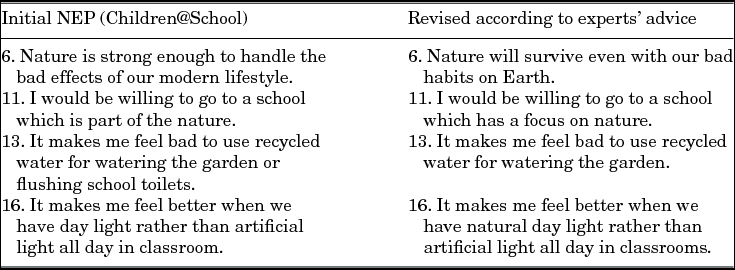
Experts from different areas of specialisation, including primary school teachers, science and environmental educators, and ecology and sustainable design university lecturers examined the initial NEP (Children@school) questionnaire for both content and face validity. They checked the content, comprehensibility, and clarity of the items (as recommended by Erdogan, Ok, & Marcinkowski, Reference Erdogan, Ok and Marcinkowski2012). Consequently, some sentences were reworded and shortened, and some technical terms were replaced by terms more familiar to children. Table 1 summarises the items that experts suggested to modify.
Modifications on Initial NEP (Children@School) Suggested by Experts

Note: The numbers represent the number of the item in the questionnaire sent to experts.
Item numbers 6, 11, and 16 were paraphrased to become more comprehensible for children. Item number 13 was changed because it addressed two issues simultaneously, of watering the garden and flushing the toilets, and thus made it difficult for some children to rate. One child might want to use recycled water for watering the garden, but might not like to use that kind of water for flushing the toilet. As asking about two issues at the same time could invalidate the item, and only one dimension (using recycled water for watering the garden) needed to be questioned, this item was changed to ‘It makes me feel bad to use recycled water for watering the garden’. Future researchers might consider reframing this question in order to retain both concepts in the instrument.
Ethics approval was obtained to collect information from primary school children. According to the approval, all the data were collected anonymously, any participants of the project could withdraw from attending the survey without any adverse consequences, children were asked to freely leave from responding to the survey if they did not feel comfortable in any way, and they did not require the researcher's permission to quit the attendance.
Pilot Testing the NEP (Children@School)
In 2013, the initial draft of the NEP (Children@School) scales was administered in a primary school for pilot testing the appropriateness of the scale for children in Grades 4 to 6. The pilot study aimed to identify any difficult terms or ambiguous questions. It indicated there were no problematic items on the scale and that the children could answer the questionnaire without any confusion. Thus, the pilot school data were included in the final analysis as one of the conventional schools.
Main Study
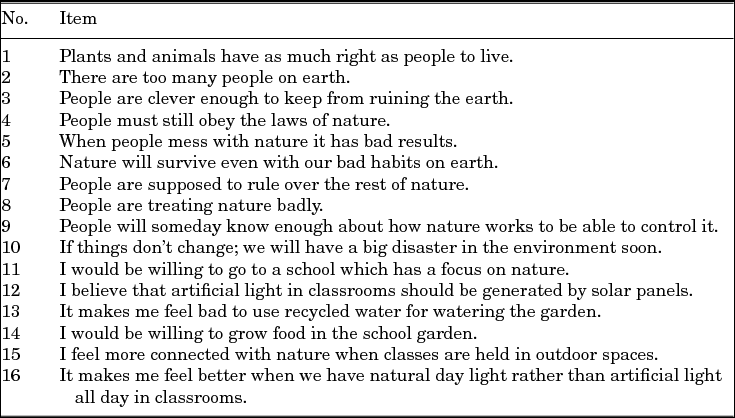
Later in 2013, the 16-item NEP (Children@School) questionnaires (Table 2) were administered in three schools considered as designed for sustainability and four conventional schools. On the day of testing, 45 minutes was allocated for data collection. Due to limited resources, it was only possible to collect the data from a maximum of 50 children at a time. In each school, at least one of the teachers assisted with the procedure and supervised the children by encouraging them to answer carefully. Before launching the survey, the researchers ensured that all children understood that the data was anonymous and that the child could terminate the survey at any time without consequences.
NEP (Children@School) Questionnaire

Analysis and Results
In order to check the reliability of NEP (Chidren@School) and identify potential underlying dimensions, the scale, as described below, was subjected to reliability tests and factor analyses.
Dimensionality of the NEP (Children@School)
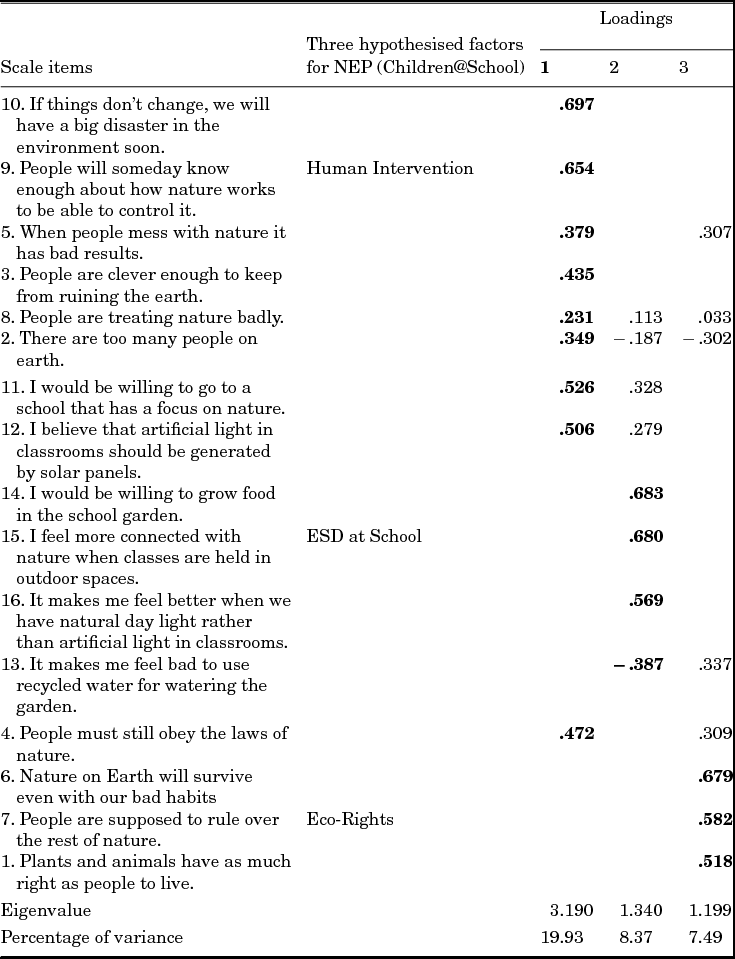
The psychometric properties of the NEP (Children@School) were evaluated. McDonald's omega, calculated with R package, was calculated as the measure of reliability. The dimensionality of the scale was checked due to the need to calculate the omega for each of the potential subscales, known as factors. Principal component analysis was conducted employing the Varimax rotation method. A KMO value of .803 and Bartlett's test of sphericity significance value of .000 indicated that factor analysis was appropriate for this sample.
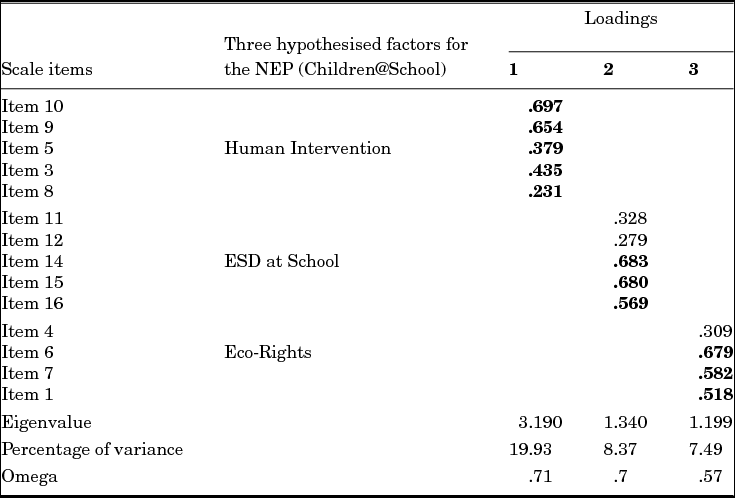
The principal component matrix identified three potential factors for the scale. These factors were named Human Intervention, Eco-Right, and ESD at School. The Human Intervention dimension addresses the type of issues that are mostly the result of long-term, large-scale human intervention in nature. The Eco-Right dimension addresses fundamental beliefs towards the environment and includes items that are mostly subjective and based on a person's belief system. The ESD at School dimension includes items that address sustainability features in school that facilitate children's connectedness with nature, such as outdoor classrooms and food growth in the school garden. These features help inform pro-environmental attitudes in children and provide opportunity to link these attitudes to behaviours through experiential learning.
The rotated loadings (i.e., the factor loadings that represent how much a factor explains a variable in factor analysis) were investigated by an orthogonal rotation approach through the Varimax technique (Table 3). Most of the loadings were higher than .3 as the cut-off for optimal item-loadings (Pallant, Reference Pallant2013). There were two exceptions for this: (1) Item number 8 had a loading of .231 under the Human Intervention factor (its highest loading on any factor). However, item number 8 was retained, as the reliability of Human Intervention would decrease if it was deleted. (2) Item number 12, which had a loading of .279, had a much higher loading on Human Intervention (.506), but was theoretically best fit to the factor ESD at School.
Principal Component Analysis of the NEP (Children@School) Items With Varimax Rotation

Note: Bold type represents the highest loadings.
Item numbers 11 and 4 also had higher loadings on Human Intervention, but they were classified to different factors according to their greater applicability to the conceptual theme of those factors. These items still possessed loadings higher than .3 on the allocated factors. Thus, the rotated component loadings suggested that the items could be meaningfully classified into three different factors: (1) Children's Environmental Attitudes towards Human Intervention, (2) Children's Environmental Attitudes via ESD at School, and (3) Children's Environmental Attitudes towards Eco-Rights.
Reliability of the NEP (Children@School)
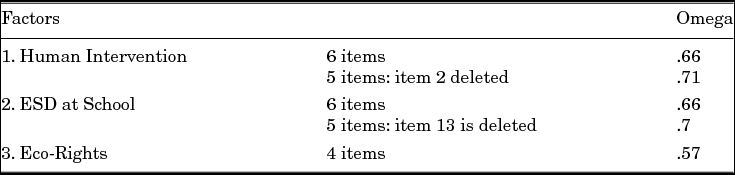
The estimate reliability of omega was calculated for each of the three identified factors (Table 4). Results show that the first factor had an omega value of .66, which could be increased to a respectable value of .71 when item number 2 (‘There are too many people on earth’) was deleted. Deletion of item number 2 was seen as appropriate because it might be seen as ambiguous for 10- to 12-year-old children, who could see a loss of people as a threat to their wellbeing. Further rationale for deleting item number 2 was that it did not consistently reflect the factor it had the highest loading on: Human Intervention.
Omega Values Calculated by R Package for the NEP (Children@School)

The omega value for factor 2 — ESD at School — increased from .66 to .7 if item number 13 was deleted. Negative loading of item number 13 on factor 2 indicated the need for reverse coding (De Vaus, Reference De Vaus2014); however, this item was theoretically in the same direction as its underlying factor as it had already been reverse coded. As such, a possible misconception around the direction of the question (‘It makes me feel bad to do something good’) was seen to contaminate the analysis and thus the item was dropped from the scale. Future researchers might consider reframing this question in order to retain it in the instrument.
The third factor, Eco-Rights, had an omega of .57, which although not very high can be argued as acceptable because of the psychological construct of the scale and the diversity of the construct being measured (Kline, Reference Kline1993). Moreover, some researchers believe that reliability coefficients as low as .5 will suffice in the early stages of research (Nunnally, Reference Nunnally1978).
It is worth underlining that all of the items within the Rights of Nature factor of the Manoli et al. (Reference Manoli, Johnson and Dunlap2007) study have fallen into the Eco-Right factor in this study. Moreover, the items classified in Eco-crisis and Human Exceptionalism in Manoli et al. (Reference Manoli, Johnson and Dunlap2007) have been classified within the Human Intervention factor in this study — with some deletions and modifications. Five of the six new items in NEP (Children@School) were grouped within the ESD at School factor. The indication is that the NEP (Children@School) is constituted from 14 items and three factors, as summarised in Table 5.
Identified Factors for the NEP (Children@School)

Note: Bold type represent the highest loadings.
Discussion
Over several decades, numerous researchers have strived to develop instruments for measuring children's environmental attitudes (Bogner, Reference Bogner1998a; Bogner & Wiseman, Reference Bogner and Wiseman1998; Johnson & Manoli, Reference Johnson and Manoli2011; Larson et al., Reference Larson, Green and Castleberry2011; Leeming et al., Reference Leeming, Dwyer and Bracken1995; Manoli et al., Reference Manoli, Johnson and Dunlap2007; Musser & Malkus, Reference Musser and Malkus1994). However, most of these instruments are not largely applicable for measuring the impact of educational settings on environmental knowledge and attitudes. Since children have shown that they gain environmental knowledge and develop environmental attitudes as early as kindergarten (Bryant & Hungerford, Reference Bryant and Hungerford1977), it is crucial to understand how educational spaces, in which children spend a considerable amount of time, can contribute to environmental orientation (Bell & Dyment, Reference Bell and Dyment2008; Cole, Reference Cole2013). This study therefore posits a scale that measures the impact of sustainable design in school settings on children's environmental attitudes.
The results indicate that the NEP (Children@School) can determine the impact of learning space design on children's environmental attitudes, and suggests the scale can be useful in a range of educational settings. In the study that necessitated the development of the scale (Izadpanahi et al., Reference Izadpanahi, Elkadi and Tucker2015), the NEP (Children@School) was employed to compare the environmental attitudes of Australian children in two types of schools: conventional schools and schools designed for improved ecological sustainability. The results indicated that children who attended sustainably designed schools, compared to those who attended conventionally designed schools, held more pro-environmental attitudes. It follows that sustainable design features in schools can be used as pedagogical tools to elevate children's environmental attitudes (Tucker & Izadpanahi, Reference Tucker and Izadpanahi2017), and that the NEP (Children@School) can evaluate the effectiveness of such tools.
While NEP (Children@School) was designed in Australia, it has the potential to be applied in other contexts. The global applicability of NEP (Children@School) derives from the fact that this instrument does not include any questions specific to the Australian context that could not be used in other cultures. Thus, future researchers might utilise the scale in different school settings in a variety of geographical contexts, and with larger sample sizes, to determine the generalisability of the NEP (Children@School). In addition to school contexts, with minor rewordings the scale might also prove useful to evaluate the impact on children of other types of sustainably designed environments. Thus, the NEP (Children@School) offers architects, educationalists, and policy makers the possibility of evaluating the effectiveness of sustainable design in learning spaces as a pedagogical tool for enhancing children's environmental attitudes.
Conclusion
This study aimed to develop a new instrument, NEP (Children@School), for measuring children's environmental attitudes while at school so that the impact can be determined of the design of physical learning spaces on children's environmental attitudes. Data collected from 624 primary school children were subjected to factor analysis and reliability testing. The results indicate that a 14-item NEP (Children@School) is appropriate to measure the impact of learning spaces on the environmental attitudes of children from 10 to 12 years. The scale consists of three reliable factors: Children's Environmental Attitudes towards Human Intervention, Children's Environmental Attitudes via ESD at School, and Children's Environmental Attitudes towards Eco-Rights. Omega values, as the estimates of reliability, confirmed that each of the three identified factors were statistically reliable. While the NEP (Children@School) was designed and applied in the context of Australian education for middle childhood, it likely has applicability in other English-speaking contexts for, as stated, the instrument does not include questions specific to the Australian context; moreover, the questions may be suitable for children older than 12 years of age.
Author Biographies
Dr Parisa Izadpanahi is a lecturer at the School of Built Environment, Curtin University, Australia. Parisa has won several awards such as Graham Treloar Prize — The Most Outstanding Publication in Embodied Energy and Sustainability, and Best Paper Award, PLEA 2014. Her current focus is on smart cities, and environmental design and human wellbeing.
Richard Tucker has 20 years’ experience as a teacher and researcher in the context of architectural education. He has over 50 publications to his name, reflecting an expertise in five interrelated areas: (1) sustainable design of urban ecologies, (2) the evaluation and perception of sustainable design, (3) teamwork in design, (4) education for the sustainable design of urban ecologies, and (5) built environment design education. Richard has been a team member of grant-funded projects totalling over $1 million; eleven investigations including six as project leader. In 2011, Richard became only the second teacher in the discipline of architecture in Australia to be awarded an ALTC Award for Teaching Excellence.