Introduction
The genus Laimydorus was erected for the first time by Siddiqi (Reference Siddiqi1969) to accommodate one known species, Laimydorus prolificus Thorne & Swanger, Reference Thorne and Swanger1936, that he transferred from Dorylaimus Dujardin, Reference Dujardin1845 and regarded it as the type species of the new genus. Currently, the genus Laimydorus contains about 55 nominal species plus 5 species inquirendae (Peña-Santiago Reference Peña-Santiago2021). Laimydorus closely resembles Dorylaimus but differs from it in the absence of longitudinal ridges on the cuticle surface. Also, it is similar to the genus Mesodorylaimus Andrássy, Reference Andrássy1959 but distinguished from the latter in having a double and high guiding ring, supplements more numerous and always contiguous, and a very long prerectum in males (Andrássy Reference Andrássy2009).
Available documents on the Laimydorus species from Iran are very limited. In fact, only one species, namely Laimydorus pseudostagnalis (Micoletzky, Reference Micoletzky1927) Siddiqi, Reference Siddiqi1969, has previously been recorded in the country (Fadaei-Tehrani & Coomans Reference Fadaei-Tehrani and Coomans2005). Nevertheless, a nematological survey conducted to study the diversity of dorylaims in the West Azarbaijan province of the country yielded two populations of Dorylaimidae de Man, Reference de Man1876. The study revealed that one of the populations is an undescribed species of Laimydorus and the other belongs to a known species of the genus Labronema. The aim of this work is to describe Laimydorus zehsaziani n. sp. using morphology, morphometric, and molecular characters and to provide new data for Labronema vulvapapillatum.
Material and methods
Extraction and processing of nematodes
Several soil samples were collected from the rhizosphere of natural and cultivated soils of Miandoab county, West Azarbaijan province, Iran, during 2020. Nematodes were extracted following the Whitehead and Heming (Reference Whitehead and Hemming1965) method, transferred to anhydrous glycerin according to the De Grisse (Reference De Grisse1969) protocol, and mounted on glass slides for studying under a light microscope.
Light microscopy
Mounted specimens were observed under an Olympus BX41 light microscope. The morphometric data, including Demanian indices and the usual measurements and ratios, were taken using a drawing tube attached to the microscope. Drawings were done using CorelDRAW®, software version 12. Pictures were taken using a DP50 digital camera connected to the microscope. Raw photographs were edited using Adobe® Photoshop® CS.
DNA extraction, PCR, and sequencing
For the molecular study according to Archidonia-Yuste et al. (Reference Archidona-Yuste, Navas-Cortés, Cantalapiedra-Navarrete, Palomares-Rius and Castillo2016), a single nematode from each species was placed on a clean slide containing a drop of distilled water or worm lysis buffer and crushed by a sterilized scalpel. To disintegrate the nematode body and facilitate the separation of DNA, the tubes were stored at -80°C for 1 hour, at 65°C for 1 hour, and at 95°C for 15 minutes. DNA samples were stored at -20°C until used as a PCR template. The D2-D3 segments were amplified using the D2A (5ˊ-ACAAGTACCGTGAGGGAAAGTTG-3ˊ) and D3B (5ˊ-CGGAAGGAACCAGCTACTA-3ˊ) primers (Nuun Reference Nunn1992). A 25 μl PCR reaction mixture was composed of 10 μl ddH2O, 12.5 μl PCR master mix (Ampliqon), 0.75 μl of each forward and reverse primers, and 1 μl of DNA template. The purified PCR products were sent for sequencing to Bioneer Company, South Korea. The newly generated sequences were deposited in the GenBank database under the accession numbers presented in the phylogenetic tree.
Phylogenetic analysis
The obtained sequences in this study were aligned using Muscle software implemented in MEGA6 (Tamura et al. Reference Tamura, Stecher, Peterson, Filipski and Kumar2013) with the other segments of 28S rRNA gene sequences available for other dorylaimid nematodes in GenBank. Bayesian analysis (BI) was performed using MrBayes 3.1.2 (Ronquist & Huelsenbeck Reference Ronquist and Huelsenbeck2003). The best-fitted model of DNA evolution was obtained using MrModel test 2.3 (Nylander Reference Nylander2004) with Akaike-supported model accompanied by PAUP* version 4.0b10 (Swofford Reference Swofford2003). BI analysis under the general time-reversible model with invariable sites and a gamma-shaped distribution (GTR+I+G) model was done. After discarding burn-in samples and evaluating convergence, the remaining samples were retained for further analysis. Bayesian posterior probability (BPP) values were given on appropriate clades. The tree was viewed using the program FigTree v1.4.3.
Results
Laimydorus zehsaziani n. sp.
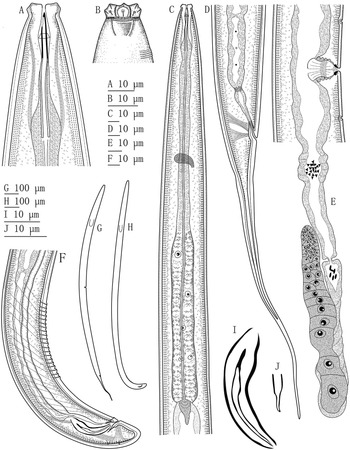
Laimydorus zehsaziani n. sp. (drawings): (A) anterior body region in lateral median view; (B) anterior region in lateral surface view; (C) neck region; (D) female posterior body region; (E) female posterior genital system; (F) male posterior body region; (G) female entire; (H) male entire; (I) spicule; (J) lateral guiding pieces.

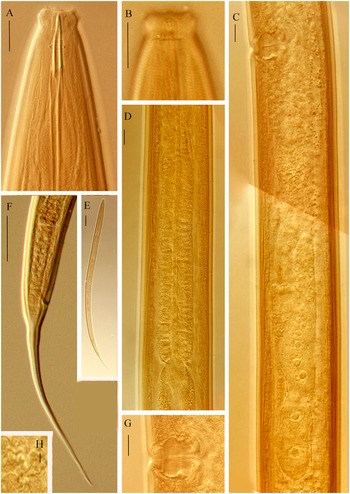
Laimydorus zehsaziani n. sp. (female): (A) anterior body region in lateral median view; (B) anterior region in lateral surface view; (C) posterior genital system; (D) pharyngeal expansion and pharyngo-intestinal junction; (E) entire body; (F) posterior body region; (G) vagina; (H) Z-differentiations in uterus. Scale bars: (A–D), (G), (H) 10 μm; (E) 100 μm; (F) 50 μm.

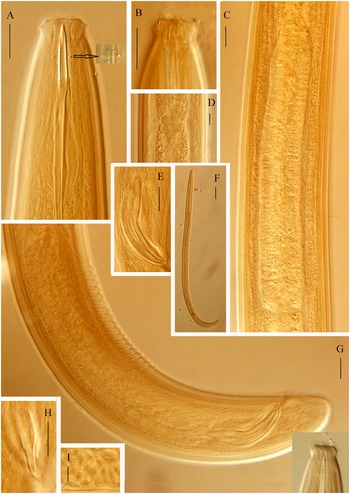
Laimydorus zehsaziani n. sp. (male): (A) anterior body region in lateral median view; (B) anterior region in lateral surface view; (C) pharyngeal expansion; (D) pharyngo-intestinal junction; (E) spicules; (F) entire body; (G) posterior body region; (H) lateral guiding pieces; (I) sperm cells. Scale bars: (A–E), (G) 10 μm; (F) 100 μm; (H), (I) 5 μm.

Material examined
Three females and three males from one location were examined and were in a good state of preservation.
Morphometrics
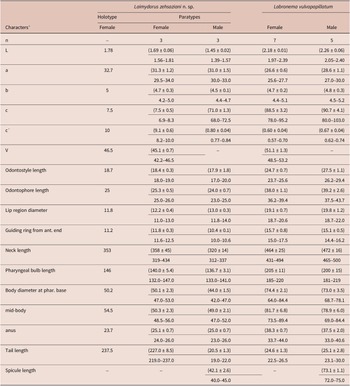
(See Table 1)
Morphometrics of Laimydorus zehsaziani n. sp. and Labronema vulvapapillatum (Meyl, Reference Meyl1954) Loof & Grootaert, Reference Loof and Grootaert1981 from Iran. All measurements are in μm, except for L in mm, and in the following form: mean ± s.d. (range)

* L = body length; a = body length/maximum body diameter; b = body length/neck length; c = body length/tail length; c′ = tail length/body diameter at anus; V = distance of vulva-anterior end/body length × 100.
Description
Adults: Medium-sized and slender nematodes, body nearly straight to slightly curved ventrad in females and J-shaped in males upon fixation. Cuticle two-layered, outer layer thicker and lighter colored than inner one with fine transverse striae, 3.0–4.5 μm thick at anterior region and throughout most of body and 3.5–5.0 μm at postanal region. Lateral chord 19–24 μm, or 40–42% of body width. Body pores, if present, obscure. Lip region offset by weak constriction and wider than adjacent body, ca 2.2–2.7 times as broad as high and lips separated. Amphids stirrup shaped with a slit-like opening at base of lip region, 5.0–6.0 μm wide or occupying 44–46% of lip region diameter. Cheilostom is a truncate cone, lacking any differentiation. Odontostyle is typical of the genus, 1.3–1.6 times the lip region diameter long and its aperture 2.5–4.0 μm long. Odontophore is rod-like, lacking knob or swolling at base, and 1.3–1.4 times longer than odontostyle. Guiding ring double and distinct, located at 0.7–1.0 of lip region diameter from anterior end. Pharynx consists of a slender anterior section gradually enlarging into the basal expansion that is 5.6–5.8 times longer than wide; expansion part of pharynx is 41–44% of total neck length and gland nuclei located as follows: DN = 61–65; S1N1 = 70–73; S1N2 = 80–82; S2N = 87–90 according to Loof and Coomans (Reference Loof and Coomans1970). Nerve ring surrounding the pharynx at 124–138 μm or 34–43% of neck length from anterior end. Cardia elongate conoid, 20–24×12–14 μm.
Female: Genital system didelphic-amphidelphic, with both branches more or less equally and well-developed; anterior one 360–406 μm long or 22% of body length, posterior one 383–414 μm long or 21–24% of body length; ovaries reflexed, surpass the oviduct-uterus junction, oocytes first in two or more rows and then in a single row; oviduct consisting of a slender part and a poorly developed pars dilatata with a small lumen often containing sperm cells, joining ovary terminally, oviduct and uterus separated by a very weak sphincter; uterus 126–142 μm long and tripartite, i.e., with broad proximal region with visible lumen, a spherical to oval short intermediate region, but dilated region containing abundant refractive granular bodies (Z organs), and a narrow distal part, with visible lumen, no eggs in uterine observed. Vagina extending inwards for 21–28 μm or 47–53% of corresponding body diameter, pars proximalis 12.0–14.0×12.0–14.0 μm having nearly sigmoid walls and surrounded by moderately developed, circular musculature; pars refringens vaginae (in lateral view) consisting of two trapezoidal pieces, measuring 2.5–4.5×1.0–2.0 μm; pars distalis poorly differentiated and 1.5–2.0 μm long. Vulva longitudinal, pre-equatorial and one advulval papillae present in both pre- and post-vulval regions in one specimens. Prerectum 57.5–75.0 μm or 2.3–3 times anal body diameter or 3.8–4.6% of body length. Rectum longer than anal body diameter. Tail elongate, at first convex-conoid, then more or less uniformly tapering to a narrowly rounded terminus. One or two pairs of caudal pores present.
Male: Reproductive apparatus diorchic, testes opposed and well-developed. Sperm cells 5.0–6.0 μm long. Spicules dorylaimoid and sclerotized, 1.6–1.7 times anal body diameter, ventral contour with a weak hump. Spicule head occupying 15–20% of total spicule length, its contours equilateral, slightly rounded towards median line of spicule. Median accessory piece 31–34 μm long, occupying 79–82% of spicule length, reaching terminal tip of spicule. Lateral guiding pieces 8.0–9.5 μm long or 19–22% spicule length. In addition to adcloacal pair, a series of 18–20 contiguous ventromedian supplements present, starting well anterior to range of spicules or with hiatus. Prerectum 195–205 μm, 7.5–8.5 times anal body diameter long or 12.2–14.9% of body length, its junction with intestine anterior to supplement series. Tail convex-conoid with blunt terminus, much shorter than that of in females. One pairs of caudal pores present.
Molecular characterization
After sequencing and editing, a D2-D3 28S rRNA sequence (GenBank accession ON059339) 779 bp long was obtained for the Laimydorus zehsaziani n. sp. Its analysis has allowed us to explore the evolutionary relationships of the genus.
Diagnosis
The new species is characterized by its body length (1.56–1.81 mm in females and 1.39–1.57 mm in males), lip region offset by weak constriction and wider than adjacent body (11–14 μm), odontostyle (17–20 μm) long, neck length (312–434 μm), vulva longitiudinal (V = 42.2–46.5), uterus well-developed and always with Z-differentiations, long tail (219–237 μm, c = 6.9–8.3, c´ = 8.2–10) in females, short and convex-conoid with blunt terminus tail (19–22 μm, c = 68–72.5, c´= 0.77–0.84) in males, spicules 40–45 μm long, and 18–20 contiguous ventromedian supplements with hiatus.
Relationships
Laimydorus zehsaziani n. sp. comes close to three other members of the genus – namely, Laimydorus papillatus Ahmad & Ahmad, Reference Ahmad and Ahmad2002; L. parapapillatus Mushtaq & Ahmad, Reference Mushtaq and Ahmad2006; and L. vulvapapillatus Mushtaq & Ahmad, Reference Mushtaq and Ahmad2006. The new species differs from L. papillatus and L. parapapillatus mainly in the absence vs presence of well-developed, mammiform dorsal and ventral body pores along the entire body length. Furthermore, other differences are also realized.
Laimydorus zehsaziani n. sp. can be distinguished from L. papillatus by small body length in females and males (1.56–1.81 vs 2.47–2.72 and 1.39–1.57 vs 2.43 mm, respectively), narrower lip region (11–13 vs 16–18 and 11.8–14 vs 16 μm, respectively), shorter odontostyle length (18–19 vs 33–35 and 17–20 vs 35 μm, respectively), small pharyngeal basal expansion (132–147 vs 323–339 and 133–141 vs 323 μm, respectively), shorter tail (219–237 vs 427–439 μm, c = 6.9–8.3 vs 5.6–6.3 and 19–22 vs 24 μm, c = 68–72.5 vs 102 μm, respectively), and presence of Z-differentiations in uterus vs absence.
Compared to L. parapapillatus, the new species has small body size in females and males (1.56–1.81 vs 2.34–2.81 and 1.39–1.57 vs 2.22 mm, respectively), shorter odontostyle length (18–19 vs 28–31 and 17–20 vs 32 μm, respectively), narrow lip region width (11–13 vs 15–17 and 11.8–14 vs 17 μm, respectively), small pharyngeal basal expansion (132–147 vs 264–320 and 133–141 vs 292 μm, respectively), longer female tail (219–237 vs 140–168 μm, c = 6.9–8.3 vs 13.9–18.3, c´ = 8.2–10 vs 4.7–5.4) and relatively shorter male tail (19–22 vs 25 μm, c = 68–72.5 vs 89.8, c´= 0.77–0.84 vs 0.60), presence vs absence of advulval papillae in both pre- and post-vulval regions, shorter spicules (40–45 vs 55 μm), and numbers of ventromedian supplements (18–20 vs 26).
The new species can be distinguished from L. vulvapapillatus by relatively shorter body length in females and males (1.56–1.81 vs 1.89–2.10 and 1.39–1.57 vs 1.72–1.95 mm, respectively), shorter odontostyle (18–19 vs 25–28 and 17–20 vs 25–27 μm, respectively), narrow lip region (11–13 vs 16–17.5 and 11.8–14 vs 16.5–17 μm, respectively), small pharyngeal basal expansion (132–147 vs 196–216 and 133–141 vs 208–212 μm, respectively), anteriorly located vulva (V= 42.2–46.5 vs 46.7–49.3), longer female tail (219–237 vs 95–150 μm, c = 6.9–8.3 vs 13.5–20.7, c´ = 8.2–10 vs 3.3–4.6), and shorter spicules (40–45 vs 57–61 μm).
Type locality and habitat
Baroog region, Miandoab county, West Azarbaijan province, Iran (GPS Coordinates: N 36°56′53″, E 46°20′21″, altitude 1346 m a.s.l.), from the rhizosphere of grassland plants in Baroog mountains.
Type material
Female holotype, female and male paratypes deposited at Nematology Collection, Department of Plant Protection, Faculty of Agriculture, University of Tabriz, Tabriz, Iran, slides No 102/1, 102/2, and 102/3.
Etymology
The new species is named in honour of the late Dr. Hassan Zehsazian, former Faculty Member of the Department of Plant Protection, Faculty of Agriculture, University of Tabriz, Tabriz, Iran.
On the phylogeny
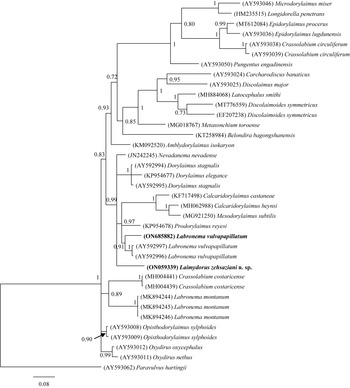
A sequence of 28S rRNA is herein provided for a representative of the genus Laimydorus for the first time, shown in the tree presented in Figure 5. Molecular analysis does not clearly resolve the phylogenetic relationships of the new species because few genera of the family Dorylaimidae are currently sequenced and available. It is clear that Laimydorus zehsaziani n. sp. is grouped with some genera of the family, including Nevadanema Álvarez-Ortega & Peña-Santiago, Reference Álvarez-Ortega and Peña-Santiago2012; Dorylaimus; Labronema Thorne, Reference Thorne1939; Calcaridorylaimus Andrássy, Reference Andrássy1986; Mesodorylaimus; and Prodorylaimus Andrássy, Reference Andrássy1959 from which the genus Mesodorylaimus reveals close morphological similarities with the genus Laimydorus. More and additional DNA sequences are needed from different genera of the family for reconstruction of the phylogenetic tree precisely.
Labronema vulvapapillatum (Meyl, Reference Meyl1954) Loof & Grootaert, Reference Loof and Grootaert1981
(Figure 4)
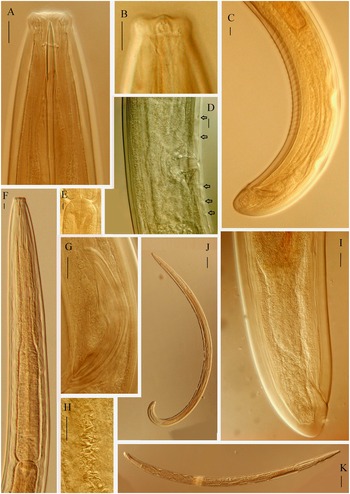
Labronema vulvapapillatum (Meyl, Reference Meyl1954) Loof & Grootaert, Reference Loof and Grootaert1981: (A) anterior body region in lateral median view; (B) anterior region in lateral surface view; (C) male posterior body region; (D) vulval region (arrows pointing the advulval papillae in both pre- and post-vulval regions); (E) pharyngo-intestinal junction; (F) neck region; (G) spicules; (H) Z-differentiation in female uterus; (I) female posterior body region; (J) male entire body; (K) female entire body. Scale bars: (A–I) 10 μm; (J), (K) 100 μm.

Morphometrics
See Table 1.
Distribution
Vakil Kandi, Miandoab county, West Azarbaijan province, Iran (GPS Coordinates: N 36°58′16″, E 46°04′13″), from the rhizosphere of rangeland plants.
Remarks
This species was collected and recorded for the first time from natural and disturbed habitats of the Kerman province, Iran, by Shokoohi et al. (Reference Shokoohi, Abolafia, Mehrabi-Nasab and Peña-Santiago2013). Our collected population in general morphology and measurements is very similar to previously described populations (see Murillo-Navarro & Jiménez Guirado Reference Murillo-Navarro and Guirado2006 and Shokoohi et al. Reference Shokoohi, Abolafia, Mehrabi-Nasab and Peña-Santiago2013). The phylogenetic analysis based on the D2-D3 region of the 28S rRNA (Figure 5) revealed that understudy species of the genus Labronema is a member of a moderately supported clade (0.91 Bayesian posterior probability) and is placed adjacent to Labronema vulvapapillatum. At present, we consider the Iranian population and the two populations studied by Helder et al. (Reference Helder, van den Elsen, Bongers, van der Wurff and Bakker2006) as conspecific based on the position in the tree, but the precise identity of Iranian population should be studied in detail with more markers and with a comparison of morphological and morphometrical characters as well. Furthermore, in a BLAST search, the newly generated sequence (ON685882) showed a 93% identity (42 indels/no gap) with former sequences of L. vulvapapillatum (AY592996 and AY592997, which were deposited by Helder et al. Reference Helder, van den Elsen, Bongers, van der Wurff and Bakker2006).
Consensus 50% majority rule Bayesian phylogenetic tree of Laimydorus zehsaziani n. sp. and Labronema vulvapapillatum (Meyl, Reference Meyl1954) Loof & Grootaert, Reference Loof and Grootaert1981 based on 28S rRNA D2-D3 sequences under the GTR+I+G model. Posterior probabilities more than 50% are given for appropriate clades. The newly obtained sequences are in bold.

The genus Labronema was traditionally classified under the subfamily Qudsianematinae Jairajpuri, Reference Jairajpuri1965 in Qudsianematidae Jairajpuri, Reference Jairajpuri1965 with other rounded-tail dorylaimid genera. But recently, eight genera, including Labronema, were transferred from Qudsianematidae to Dorylaimidae, and the new subfamily Labronematinae was proposed to accommodate the genera (see Peña-Santiago & Álvarez-Ortega Reference Peña-Santiago and Álvarez-Ortega2014).
Acknowledgements
We acknowledge the Faculty of Agriculture, University of Tabriz, Tabriz, Iran for providing Laboratory facilities.
Financial support
This research received no specific grant from any funding agency, commercial, or not-for-profit sectors.
Competing interests
There are no conflicts of interest in this work.