Introduction
The complexity of the assessment of anxiety in older adult populations has been much discussed (Stanley et al., Reference Stanley, Beck and Zebb2000; Wolitzky-Taylor et al., Reference Wolitzky-Taylor, Castriotta, Lenze, Stanley and Craske2010). Maturation brings the experience of different cultural, political, and social experiences compared to younger adults, as well as the physiological and developmental changes that accompany advancing age (Knight and Poon, Reference Knight, Poon, Woods and Clare2008). Furthermore, some physiological manifestations of anxiety and depression may overlap with medical comorbidities in older adult populations. These issues require special consideration in older adult populations, and may negatively impact on the ability to accurately assess anxiety and depression in older adults. This may in turn delay the provision of appropriate treatment.
Researchers have taken two general approaches to improve the assessment of anxiety in older adults: (1) develop new measures specifically for older adults; and (2) validate existing measures of anxiety that may be applicable in older adult populations. The latter approach has suggested that a number of popular anxiety measures developed for younger adults do not retain their psychometric properties in older adult populations (Wolitzky-Taylor et al., Reference Wolitzky-Taylor, Castriotta, Lenze, Stanley and Craske2010). However, the issue common to both approaches is that the experience of anxiety in older adults is not fully understood; and consequently without knowing the nature of the construct intended to be measured, the validity of a measure is difficult to determine. Although the need to understand the construct of anxiety in older adults is crucial, clinicians regularly use existing measures that they believe are appropriate to assess older adult clients. Therefore, it is essential to provide validity evidence for measures that are in common use for each population in which they are used.
Previous researchers have predominantly used correlational type studies, where sum scores of measures are compared against one another, to evaluate existing anxiety measures in older adults. However, this method does not allow for the effects of measurement error to be explicitly modeled. The use of confirmatory factor analysis (CFA) enables researchers to test hypotheses of the underlying factor structure of measures, as well as modeling measurement error. This in turn enables a more robust evaluation of the psychometric properties, construct validity, and clinical utility of a measure.
Symptoms of anxiety are commonly observed in older adult patients with a psychiatric diagnosis, but often do not meet the criteria for a DSM-IV anxiety disorder (Palmer et al., Reference Palmer, Jeste and Sheikh1997; Diefenbach et al., Reference Diefenbach2003). Similar observations have been made with adult populations (Wilk et al., Reference Wilk2006). Within a New Zealand population, 49.6% of adults with a 12-month diagnosis of any mood disorder had a comorbid anxiety disorder. However of those with an anxiety disorder, 26.6% had a comorbid mood disorder (Oakley Browne et al., Reference Oakley Browne, Wells, Scott and McGee2006). This suggests that there may be shared elements of anxiety and depression, and that both disorders should be screened for when considering individual diagnoses.
Tripartite theory of anxiety and depression
The commonly observed significant correlation between anxiety and depression led Clark and Watson (Reference Clark and Watson1991) to hypothesize that: (1) anxiety and depression share a common feature of negative affect, which is comprised of worry, general distress, self-criticism, and a negative attributional style; (2) low levels of positive affect would be characteristic of depression, e.g. anhedonia symptoms such as a reduced ability to positively engage with the environment, low energy, psychomotor retardation, and poor social engagement; and (3) an anxiety factor of primarily physiological hyper-arousal. The key criticism of the tripartite structure has focused on the significant correlations between anxiety and negative affect, suggesting that the differentiation between factors may be artificially created (Dunbar et al., Reference Dunbar, Ford, Hunt and Der2000; Bjelland et al., Reference Bjelland, Dahl and Neckelmann2002; Desmond and MacLachlan, Reference Desmond and MacLachlan2005; Gale et al., Reference Gale2010).
Hospital Anxiety and Depression Scale (HADS)
The HADS (Zigmond and Snaith, Reference Zigmond and Snaith1983) is a popular measure of anxiety and depression used within the Australian and New Zealand mental health community. It involves a 14-item self-report measure with seven items measuring anxiety and seven measuring depression. Reponses are made on a four-point Likert scale. As the HADS was originally developed for medically ill outpatients and has a low emphasis on cardiovascular symptoms, it follows that it may be appropriate for older adult populations where there is a high prevalence of medical co-morbidity. Johnston et al. (Reference Johnston, Pollard and Hennessey2000) supported the use of the HADS in medically ill populations as they found the psychological symptoms were distinct from somatic symptoms, that the measure had good internal consistency, and in CFA found distinct anxiety and depression factors.
Psychometric evaluations of the HADS within adult populations
Research suggests good internal consistency and good to very good concurrent validity correlations ranging between 0.60 and 0.80 of the HADS with the Beck Depression Inventory, the State-Trait Anxiety Inventory, the Symptom Checklist 90 Scale, and the General Health Questionnaire (GHQ; Bjelland et al., Reference Bjelland, Dahl and Neckelmann2002). The reported sensitivity and specificity of the HADS for DSM-III, DSM-III-R, and DSM-IV anxiety and depression with a threshold of 8+ ranged from 0.70 to 0.90. The gold standard instruments included the Structured Clinical Interview for DSM (SCID), the Diagnostic Interview Schedule, The Generalized Anxiety Scale, and the Clinical Interview Schedule (see Bjelland et al., Reference Bjelland, Dahl and Neckelmann2002 for further detail). Bjelland et al. (Reference Bjelland, Dahl and Neckelmann2002) considered that the differences in the reported sensitivity and specificity were likely to be due to changes in diagnostic criteria over the duration of the research, and the variation of gold standard instruments to evaluate the HADS.
CFA studies of the HADS in adult populations
CFA studies with the HADS have predominantly tested competing two- and three-factor models. The three-factor model was proposed by Dunbar et al. (Reference Dunbar, Ford, Hunt and Der2000) based on the Clark and Watson (Reference Clark and Watson1991) tripartite theory of anxiety and depression, whereas the two-factor model is based on the structure of the HADS reported by Zigmond and Snaith (Reference Zigmond and Snaith1983). Bjelland et al. (Reference Bjelland, Dahl and Neckelmann2002) reviewed research on the psychometric properties of the HADS in adults and observed that there was minimal statistical difference between the two- and three-factor models. Bjelland et al., commented that high correlations were consistently observed between factors on both the two- and three-factor models.
Psychometric properties of the HADS in older adult populations
The performance of the HADS in older adult populations has been evaluated less extensively than with adult populations; however, it is one of the most well-researched measures in use with older adults. Studies that have evaluated the psychometric properties of the HADS in older adult populations have found moderate to high internal consistency (Cronbach's α 0.73–0.85; Spinhoven, et al., Reference Spinhoven, Ormel, Sloekers, Kempen, Speckens and Van Hemert1997; Wetherell et al., Reference Wetherell, Birchler, Ramsdell and Unützer2007; Bryant et al., Reference Bryant, Jackson and Ames2009; Helvik, Reference Helvik2011) and good test-retest reliability over an average three-week period for the anxiety (0.89), depression (0.86) and total scale scores (0.91; Spinhoven et al., Reference Spinhoven, Ormel, Sloekers, Kempen, Speckens and Van Hemert1997).
Factor structure with older adult populations
Limited research has evaluated the factor structure of the HADS with older adult populations. Research has primarily tested competing two- and three-factor structures for the HADS through either exploratory factor analytic or CFA methods. As with adult populations, support has been found for both competing structures of the HADS, with little statistical difference found between the two- and three-factor models. Research that has reported a three-factor solution has found high correlations between the anxiety and negative affect factors (0.82–0.96; Dunbar et al., Reference Dunbar, Ford, Hunt and Der2000; Bjelland et al., Reference Bjelland, Dahl and Neckelmann2002; Desmond and MacLachlan, Reference Desmond and MacLachlan2005; Gale et al., Reference Gale2010). Although Gale et al. (Reference Gale2010) found better fit for the three-factor model, a two-factor model was considered to be more practical. Gale et al. (Reference Gale2010) considered that there was little meaningful separation between the three factors clinically, and suggested that the few indicators on the latent variables lent support to a two-factor model. Gale et al. also found factorial invariance for the HADS between genders within cohorts, but not between age-related cohorts.
The original two-factor structure reported by Zigmond and Snaith (Reference Zigmond and Snaith1983) has been supported in several studies using older adults (Spinhoven et al., Reference Spinhoven, Ormel, Sloekers, Kempen, Speckens and Van Hemert1997; Bjelland et al., Reference Bjelland, Dahl and Neckelmann2002; Desmond and MacLachlan, Reference Desmond and MacLachlan2005; Rodriguez-Blazquez et al., Reference Rodriguez-Blazquez, Frades-Payo, Forjaz, de Pedro-Cuesta and Martinez-Martin2009; Gale et al., Reference Gale2010). However, other studies have found support for a three-factor solution of the HADS based on the Clark and Watson (Reference Clark and Watson1991) tripartite theory of anxiety and depression (Dunbar et al., Reference Dunbar, Ford, Hunt and Der2000; Desmond and MacLachlan, Reference Desmond and MacLachlan2005).
Validity studies with older adults
Research evaluating the validity of the HADS in older adult populations has been limited to predominantly correlational type studies. Evaluations using older adult populations have found moderate to high correlations between the anxiety and depression components of the HADS (0.43–0.73, p < 0.001, Spinhoven et al., Reference Spinhoven, Ormel, Sloekers, Kempen, Speckens and Van Hemert1997; 0.45, p < 0.01, Wetherell et al., Reference Wetherell, Birchler, Ramsdell and Unützer2007; 0.61, Rodriguez-Blazquez et al., Reference Rodriguez-Blazquez, Frades-Payo, Forjaz, de Pedro-Cuesta and Martinez-Martin2009). Similar significant correlations were reported in adult populations (Bjelland et al., Reference Bjelland, Dahl and Neckelmann2002).
Clinical utility with older adults
Evaluations of the HADS with older adults have found mixed evidence of sensitivity and specificity. In a sample of medical outpatients that included both younger and older adults Spinhoven et al. (Reference Spinhoven, Ormel, Sloekers, Kempen, Speckens and Van Hemert1997) found good sensitivity for a minor psychiatric disorder as defined by ICD-10 and identified by the Present State Examination (PSE). However, Spinhoven et al. found poor sensitivity and were unable to identify a cut-off that adequately balanced sensitivity, specificity, and positive predictive value. In contrast, Wetherell et al. (Reference Wetherell, Birchler, Ramsdell and Unützer2007) reported high sensitivity and specificity using a cut-off of 8+ against the Mini International Neuropsychiatric Interview (MINI) as a gold standard for GAD diagnosis. Wetherell et al. (Reference Wetherell, Birchler, Ramsdell and Unützer2007) also reported that the HADS was superior to the Brief Symptom Inventory (BSI) for detecting GAD in their sample, and found that the HADS measures somatic manifestations of anxiety rather than artifact caused by medical illness.
Summary
Research has found good psychometric properties for the HADS in adult populations, however, validity for the HADS in older adult populations has been less well researched. The HADS shows promise for clinical utility in older adults due to the low reliance on physiological symptoms to represent anxiety and depression. Furthermore, the presence of both anxiety and depression items on the HADS provides an opportunity to further evaluate the tripartite model of anxiety and depression in an older adult sample.
Study aims
The present study intends to evaluate the clinical utility and psychometric properties including the factor structure of the Hospital Anxiety and Depression Scale (HADS), which was developed for adults but is in common use in Australia and New Zealand with older adult populations. The results will provide some evidence for the validity and utility of the HADS in an Australasian context.
Methods
Participants
Community-dwelling older adults aged 60–80 years (M = 68, SD = 7.2) were recruited from members of older adults’ organizations in New Zealand. As cognitive screening was not conducted, to reduce the likelihood of including participants with cognitive impairment, participants over 80 years and those in rest-homes or hospitals were excluded. Overall, 203 New Zealanders of European descent (Pakeha; n = 122) or other European (n = 60) participants responded (83% return rate; male: n = 73; female: n = 117; not specified: n = 13).
Measures
Hospital Anxiety and Depression Scale (HADS)
The HADS (Zigmond and Snaith, Reference Zigmond and Snaith1983) is a 14-item self-report measure of anxiety (seven items) and depression (seven items), divided into an anxiety and a depression subscale. Response choices are worded to reflect each unique item stem, and two of the depression items are reverse scored. The anxiety subscale is comprised of predominantly somatic manifestations of anxiety with one item each that reflects cognitive and subjective emotional experience of anxiety. The depression subscale predominantly includes items relating to symptoms of anhedonia, psychomotor retardation, and loss of concentration.
Procedure
Participants were administered the HADS as part of a larger study evaluating assessment measures of anxiety in older adults. The order of measures included was randomized to minimize order and fatigue effects. Participants independently completed the self-report questionnaires at home and returned them by mail.
Hypothesized factor structure of the HADS
HADS1
Two correlated factors – anxiety and depression – as per the factor structure reported by Moorey et al. (Reference Moorey1991) and proposed by Zigmond and Snaith (Reference Zigmond and Snaith1983). Odd numbered items were specified to load onto depression and even numbers to anxiety.
HADS2
Three correlated factors – negative affect (items 1, 5, 7, and 11), anhedonic depression (items 2, 4, 6, 7, 8, 10, 12, and 14), and autonomic anxiety (items 3, 9, and 13) – consistent with the tripartite model of anxiety and replicating the model proposed by Dunbar et al. (Reference Dunbar, Ford, Hunt and Der2000). Dunbar et al. (Reference Dunbar, Ford, Hunt and Der2007) considered item 7 to load onto negative affect and anhedonic depression, and specified that the error of items 11 and 14 to covary.
HADS3
A revision of HADS2, which removed the error covariances and dual factor loading from item 7 that may artificially inflate model fit.
HADS4
A hierarchical tripartite model as proposed by Dunbar et al. (Reference Dunbar, Ford, Hunt and Der2000) that placed negative affect (items 1, 5, 7, and 11) as the higher-order factor, and anhedonia (items 2, 4, 6, 8, 10, 12, and 14) and somatic anxiety (items 3, 9, and 13) as second-order factors.
HADS5
A revision of HADS1 that removed items 10 and 14 that had factor loadings of <0.45.
HADS6
A revision of HADS3 that removed items 10 and 14 that had factor loadings of <0.45.
Statistical analysis
The psychometric properties of the HADS were evaluated using SPSS (SPSS Inc, 2008) and AMOS (Arbuckle, Reference Arbuckle2006) to calculate item-total correlations, internal consistency, convergent validity, and undertake CFA.
Sample size
Smaller sample sizes in structural equation modeling (SEM) tend to underestimate goodness of fit when compared to larger samples particularly when the models are complex (Fan et al., Reference Fan, Thompson and Wang1999). Statistical power analysis for using the root mean squared error of approximation (RMSEA) in SEM was conducted (see MacCallum et al., Reference MacCallum, Browne and Sugawara1996). This method specified a null hypothesis that the RMSEA is 0.05 or less (i.e. close fit) and an alternative hypothesis that the RMSEA was 0.08 (i.e. mediocre fit). Based on this, the present sample of 203 participants and models with 76 degrees of freedom (Df) yielded power of 0.9 for the test of close fit of the RMSEA to the population.
Missing data
The impact of missing data within this study was minimized through the use of pairwise exclusion in SPSS where available, along with the maximum likelihood method in SEM. A significant Little's missing completely at random (MCAR) test suggested that data were missing at random, and therefore the maximum likelihood method was appropriate (Brown, Reference Brown2006).
Evaluation of model fit
The fit statistics used in this study were sensitive to model misspecification and provided information on both the fit of a measurement model within the sample, and the estimated fit within the population (Brown, Reference Brown2006). Goodness of fit was assessed using the χ 2 test of exact fit, the Comparative Fit Index (CFI), the Tucker-Lewis Index (TLI; the CFI and TLI yield a coefficient with values ranging from 0 to 1, with values greater than 0.90 suggesting adequate fit, and those exceeding 0.95 suggest the model is a good fit: Hu and Bentler, Reference Hu and Bentler1999), and the RMSEA (a RMSEA of ≤0.05 is considered a close fit, 0.05–0.08 indicates reasonable fit, 0.08–0.10 indicates mediocre fit, and >0.1 indicates poor fit: Hu and Bentler, Reference Hu and Bentler1999). The CFI, TLI, and RMSEA are minimally affected by sample size (Fan et al., Reference Fan, Thompson and Wang1999). The TLI rewards model parsimony, whereas the RMSEA is not affected by model complexity (Cheung and Rensvold, Reference Cheung and Rensvold2002). The RMSEA estimates how well the model may hold in the population if the covariance matrix of the population was available.
Results
Internal consistency
The internal consistency of the HADS anxiety subscale (M = 11.9, SD = 3.6, α = 0.84) was slightly higher than for the depression subscale (M = 9.9, SD = 2.5, α = 0 .75), both were in the acceptable range. The item-total correlation for each item of the HADS ranged from 0.33 to 0.65, with items 14 and 10 contributing the least to the total observed score.
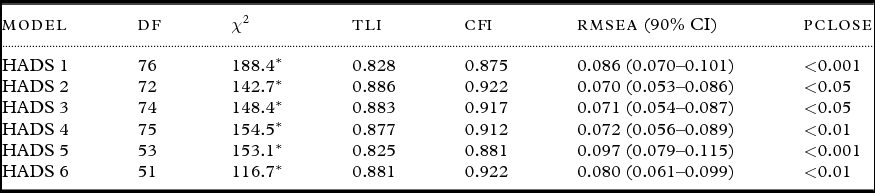
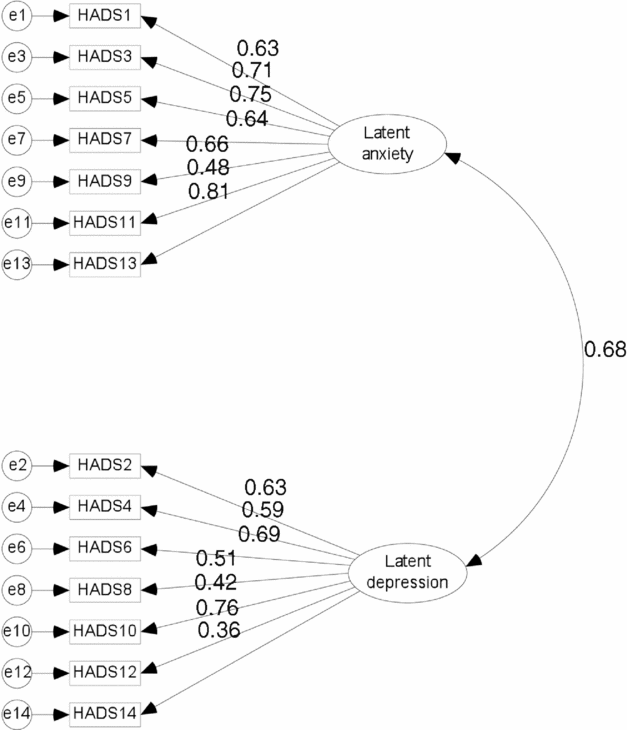
The HADS1 model based on the hypothesized two-factor structure revealed mediocre fit based on the RMSEA and CFI statistics (Table 1). A moderate correlation (0.68) was observed between the anxiety and depression factors.
Goodness-of-fit indices for competing structural models of the HADS

*p < 0.001.
Note: HADS = Hospital Anxiety and Depression Scale; Df = degrees of freedom; χ 2 = chi-squared statistic; TLI = Tucker Lewis Index; CFI = Comparative Fit Index; RMSEA = root mean squared error of approximation.
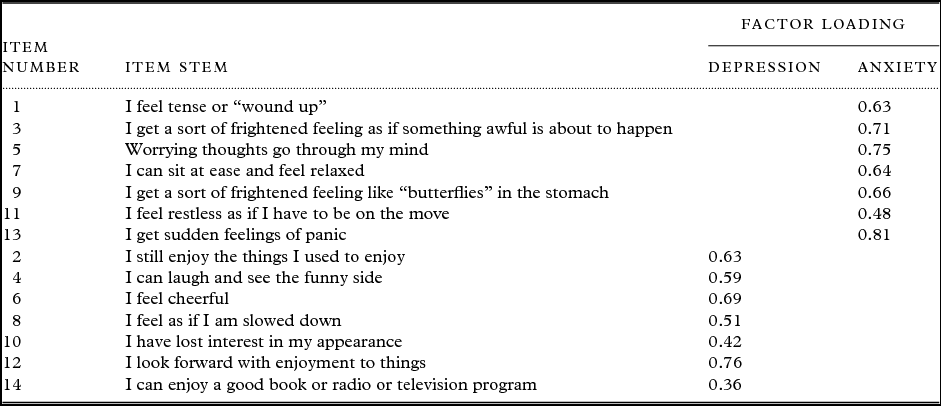
The standardized estimates of HADS1 items showed moderate to strong relationships with their respective latent variables (Table 2). Item 14 showed a weak relationship (0.36) with latent depression (see Figure 1.).
Relationships between items and latent variables on the HADS1 model
Relationships between observed and latent variables of the HADS1 model.
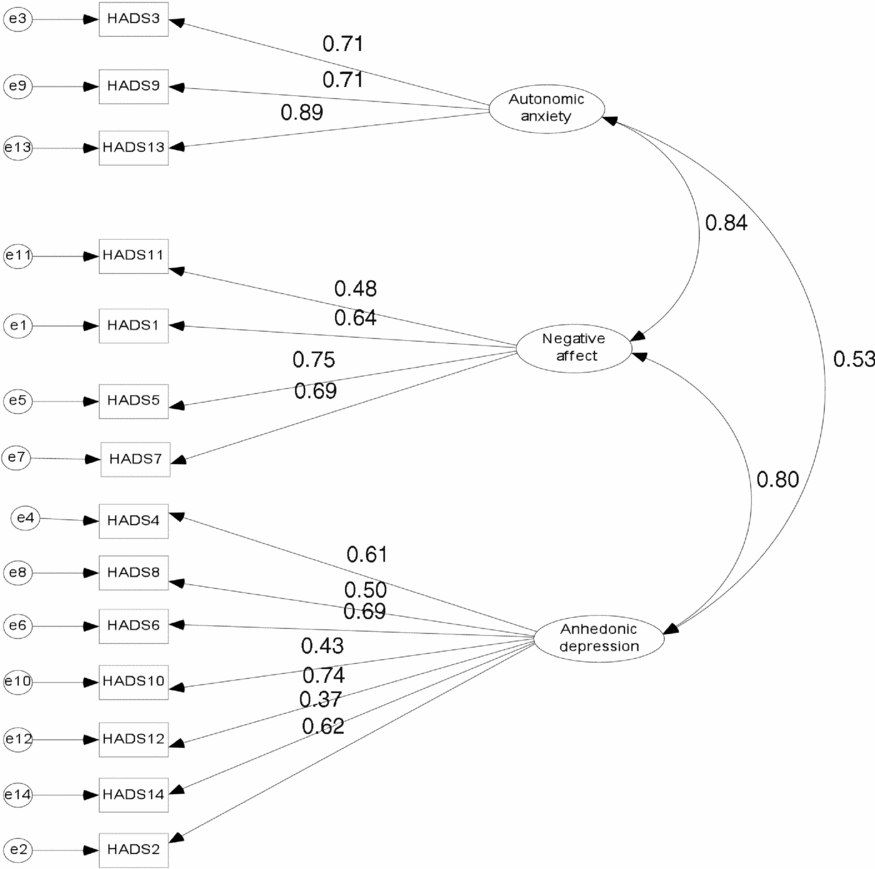
The HADS2 model with three correlated factors provided the best fit to the data, but the weak loading of item 7 onto anhedonia (0.29) and stronger loading onto negative affect (0.44) suggested a weak relationship with anhedonia. Strong correlations were observed between negative affect and anhedonia (0.87), and negative affect and autonomic anxiety (0.77), suggesting a high proportion of shared variance between the factors (Brown, Reference Brown2006). A moderate correlation (0.53) was observed between autonomic anxiety and anhedonia.
Items should load onto one distinct construct. Therefore, the double-loaded item 7 as per Dunbar et al. (Reference Dunbar, Ford, Hunt and Der2000) on the HADS2 model was specified in HADS3 to load only onto negative affect (See Figure 2.). The single loading of item 7 increased the estimate from when it was shared with anhedonia (0.69 and 0.44 respectively) at the expense of model fit.
Relationships between observed and latent variables of the HADS3 model.
The higher order tripartite model (HADS4) proposed by Dunbar et al. (Reference Dunbar, Ford, Hunt and Der2000) showed a marginal reduction in model fit when compared to both correlational models (HADS2 and HADS3).
The HADS5 model revised the original two-factor model (HADS1) by removing items 10 and 14 that had low item-total correlations (0.36 and 0.33 respectively) and factor loadings of 0.45. This revision considerably reduced the model fit (see Table 2). The HADS6 model followed this same procedure and revised the tripartite model (HADS3) to remove item 10 and 14 that also performed poorly on this model and had weak relationships with their respective factors. This modification decreased model fit (see Table 2).
Discussion
The good internal consistency found for both subscales of the HADS is similar to findings from other older adult samples (Spinhoven et al., Reference Spinhoven, Ormel, Sloekers, Kempen, Speckens and Van Hemert1997; Wetherell et al., Reference Wetherell, Birchler, Ramsdell and Unützer2007; Bryant et al., Reference Bryant, Jackson and Ames2009). The majority of items showed good item-total correlations and moderate to strong factor loadings onto their respective constructs. It is possible that stronger factor loadings for the anhedonia items may be found in a clinical sample. The strong positive correlation between the HADS anxiety and depression subscales is consistent with the current understanding of an overlap between anxiety and depression (Clark et al., Reference Clark, Steer and Beck1994), and has been found consistently in past research with the HADS (Bjelland et al., Reference Bjelland, Dahl and Neckelmann2002; Gale et al., Reference Gale2010).
Factor structure
Although the fit statistics for the HADS1 model that tested the original two-factor structure of the HADS were beneath the lower bound of what would be considered good fit, competing factor structures were not supported. The broad confidence interval of the RMSEA for all models suggests that the estimated discrepancy value is imprecise and therefore the model's fit to the population cannot accurately be determined (MacCallum et al., Reference MacCallum, Browne and Sugawara1996). While the three-factor model HADS2 showed the best fit of models trialled, the placement of items on multiple factors artificially increased model fit. Other three-factor solutions trialled found reasonable fit; however, they brought the problems of: (1) construct underrepresentation, the autonomic anxiety factor only had three items; (2) the lack of differentiation between factors as observed in the high correlation between the negative affect and the other two factors; and (3) the lack of clinical utility of a three-factor HADS.
The support for the two-factor model over the tripartite models, along with the correlations between factors on the tripartite models, lend support to similar findings in previous research with older adults (Dunbar et al., Reference Dunbar, Ford, Hunt and Der2000; Desmond and MacLachlan, Reference Desmond and MacLachlan2005; Gale et al., Reference Gale2010). The consistent finding of high correlations within the tripartite model, and the low number of items representing each factor supports previous authors suggestion that three factors may not be clinically meaningful constructs within the HADS (Gale et al., Reference Gale2010). Furthermore, the HADS was developed as a measure that could be easily administered by a range of healthcare professionals; a two-factor model may increase the ease of interpretation by those who do not have specialist mental health assessment skills. The lower complexity of a two-factor model increases the clinical utility of the measure, with a marginal compromise to the psychometric properties.
Specification of levels of anxiety
Although a non-clinical sample of active older adults, the majority of participants were measured as having clinically significant anxiety. The mean score for anxiety was within the moderate range, and the mean depression score within the mild range. When using the recommended cut-offs (Snaith and Zigmond, Reference Snaith and Zigmond1994) merely 10% of participants in the current study were measured as being within the “normal” range for anxiety on the HADS.
There are a number of possibilities for this finding. One is that there was something non-heterogenous about the sample characteristics; however, the sample was taken from active older adults who were involved in community organizations. Another is that the incidence of anxiety is higher than previously thought. However, the New Zealand Mental Health Survey found that in a non-clinical community-dwelling sample of New Zealand adults over 65 years, the 12-month prevalence of any DSM-IV anxiety disorder was 6%, and 1% for generalized anxiety disorder (Oakley Browne et al., Reference Oakley Browne, Wells, Scott and McGee2006). Variable sensitivity and specificity for the HADS has been found in previous research (Spinhoven et al., Reference Spinhoven, Ormel, Sloekers, Kempen, Speckens and Van Hemert1997; Johnston et al., Reference Johnston, Pollard and Hennessey2000; Wetherell et al., Reference Wetherell, Birchler, Ramsdell and Unützer2007; Bryant et al., Reference Bryant, Jackson and Ames2009). This suggests that there may be an issue with the norming and the sensitivity and specificity of the HADS that is resulting in false positives of anxiety in older adult samples. Rather than using cut-off scores, it may be more helpful for clinicians to examine client's responses at item level and use this as a tool to talk about their anxiety. Importantly, the HADS does not provide clinicians with information on the functional impairment caused by anxiety, which may help to identify clinically significant anxiety.
Conclusion
The present research sought to evaluate the clinical utility of the HADS and in a New Zealand context. The HADS showed good psychometric properties however, there appeared to be an issue with sensitivity and specificity that may be resulting in over-diagnosing. Consequently, it is suggested that the HADS should not be used as a diagnostic tool until appropriate norms have been established. The good psychometric properties of the HADS items lend it to be used instead as an indication of response to treatment through measuring an individual's change over time, and to facilitate assessment by using client's responses on items as a discussion point.
The overlap between anxiety and depression found in this study lends partial support to the tripartite model, and further supports the notion found in previous studies that there is a large element of shared variance between the two factors. The partial support found in this study for the tripartite model of anxiety and depression may reflect construct underrepresentation of all three factors, due to the small number of items on the HADS that measure the hypothesized depression factor that includes anhedonia. The tripartite model should be evaluated in future using additional measures of depression.
Although partial support was found for the tripartite model, a two-factor model is likely to have higher clinical utility due to the ease of interpretation by non-mental health trained clinicians, and the common understanding of anxiety and depression as separate constructs within hospital settings. Furthermore, the high correlation between factors on the tripartite model suggests that a two-factor model should be favored.
Conflict of interest
None.
Description of authors’ roles
Margaret Roberts designed the study, collected the data, analyzed the data, and wrote the paper; Richard Fletcher supervised the “methods” aspects of the research and gave feedback on preparing the paper for publication; and Paul Merrick supervised the “clinical psychology” aspects of the paper and gave feedback while preparing the paper for publication.