A. MONUMENTAL
1. Barcombe (TQ 417 144), Lewes, East Sussex (fig. 1). Part of a limestone slab, the inscribed face now 285 by 185 mm, foundFootnote 2 in 2020. The bottom edge is original, and so is the right edge, which is squared as if to butt against another slab. This would suggest a large inscription built into an important structure. The top edge is now broken. Inscribed in well-drawn letters: […] | […]IMPNI[…] | […]COLA […]Footnote 3
Barcombe, inscribed stone (no. 1) (photos: Robert Wallace).

2. Dearham (NY 073 364), Cumbria, St Mungo's church (fig. 2). Fragment of a red sandstone altar, 290 by 295 mm, foundFootnote 4 in 1884 built into the north wall of the nave, but now built into an interior wall of the vestry. It presumably came from Maryport (Alauna), which is two miles to the west. The capital has been cut down and the die rounded as a pillar. Only the top of this die survives, very worn and now illegible, but in 1884 its first line was read as: MATRIBVS | […], Matribus […]. ‘To the Mothers …’Footnote 5
Dearham, altar fragment (no. 2) (photo: Jon Allison).

B. INSTRUMENTUM DOMESTICUM
BEDFORDSHIRE
3. Maulden (TL 051 364) (fig. 3). Part of a copper-alloy finger-ring foundFootnote 6 in 2015. The circular bezel is inscribed: SSS.Footnote 7
Maulden, ring bezel (no. 3) (photo: PAS).

DEVON
4. Exeter (Isca, SX 91695 92565), Quintana Gate, within the north-western corner of the Roman fortress and later walled town (fig. 4). Fragment of a glass bottle base foundFootnote 8 in 2017, with part of a moulded inscription: […]ERECV[…], [?Iulia V]erecu[nda fecit]. ‘Iulia Verecunda made (this).’Footnote 9
(a) Exeter, moulded glass base (no. 4) (photo: AC Archaeology); (b) composite drawing of the Exeter fragment (in blue) and the Castleford fragment (no. 30) (drawing: H.E.M. Cool).

5. Ibid. (fig. 5). Wall sherd of a greyware jar foundFootnote 10 in 2017. A graffito scratched after firing reads: […].ỊIINI, probably […].ieni. ‘(Property) of […]ienus.’Footnote 11
Exeter, coarseware sherd with graffito (no. 5) (photo: AC Archaeology).

Co. DURHAM
6. Lanchester (Longouicium, NZ 15 46) (fig. 6). Ansate plaque cut from gold sheet, 56 by 37 mm, a casual findFootnote 12 in the 1940s. Like the gold ansate plaque RIB 1077 (Lanchester) by the same dedicator to Mars Augustus, it has three holes pierced for attachment in the top edge and a text in dot-punched capitals: VICTORI|ɅE ɅVG | ɅVFFIDI|VS ɅNVS | D D, Victoriae Aug|(ustae) Auffidius <Aufidi>anus | d(ono) d(edit). ‘To Imperial Victory, Auffidius Aufidianus gave this as a gift.’Footnote 13
Lanchester, gold plaque (no. 6) (photo: Bloomsbury Auctions).

GLOUCESTERSHIRE
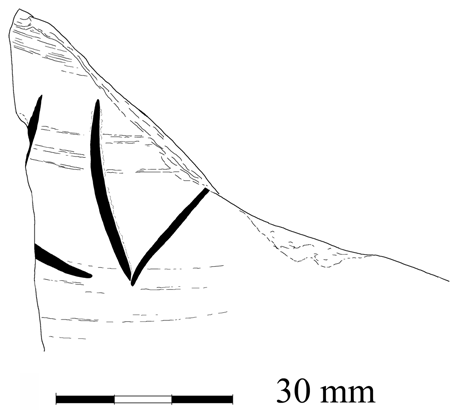
7. Gloucester (Glevum, SO 831 183), Greyfriars (fig. 7). Sherd from just above the base of a flat-bottomed south-Gaulish amphora, probably Gauloise 4 (Peacock and Williams Class 27), foundFootnote 14 in 2013. It was inscribed before firing while the vessel was inverted: […]LV[…], probably […]LV Footnote 15
Gloucester, amphora sherd (no. 7) (drawing: R.S.O. Tomlin).

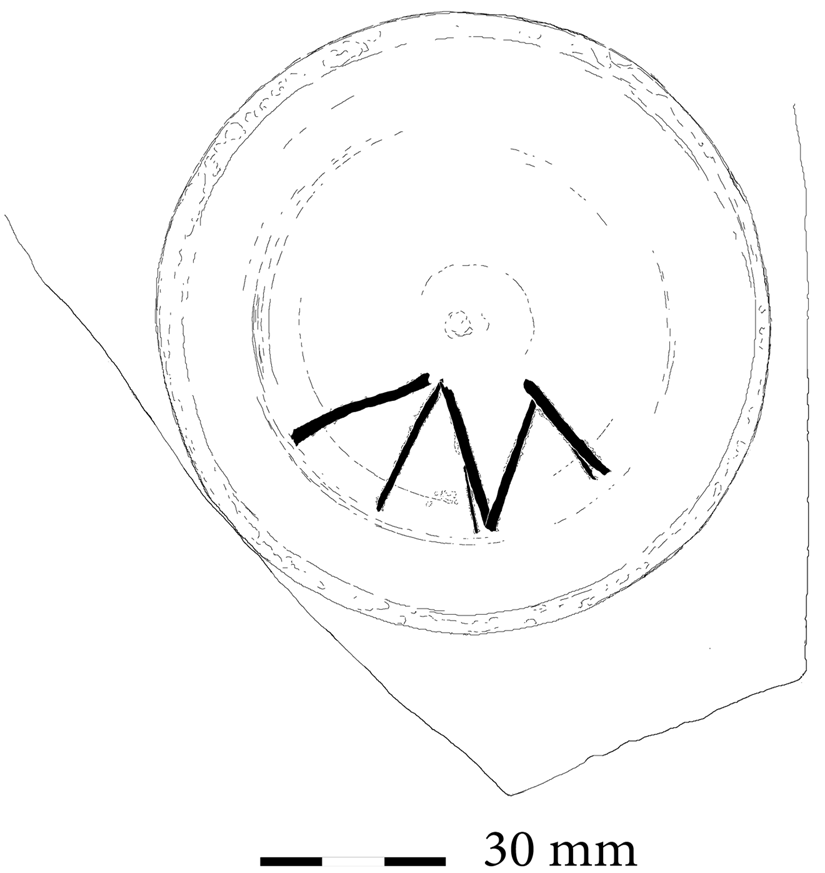
8. Ibid. (fig. 8). Sherd comprising much of a samian platter (SG, Dr. 18) stamped MANDV (Manduilus, a.d. 60–80). Underneath, within the foot-ring which is still complete, five strokes were incised after firing. The graffito is complete and, although it forms a zigzag as if an illiterate mark of ownership, it is better seen as two letters combined: ɅM, Am(…). The owner's name abbreviated.Footnote 16
Gloucester, samian sherd (no. 8) (drawing: R.S.O. Tomlin).

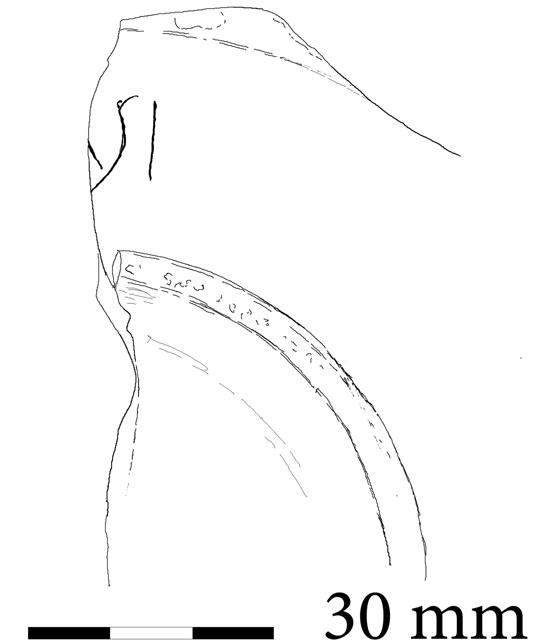
9. Ibid. (fig. 9). Sherd preserving most of the profile of a samian platter (SG, Dr. 18) indistinctly stamped. On the underside of the floor, above the foot-ring, is the end of a graffito lightly incised after firing: […].SI. The end of the owner's name in -us or -ius, in the genitive case.Footnote 17
Gloucester, samian sherd (no. 9) (drawing: R.S.O. Tomlin).

10. Uley (ST 789 996), West Hill, the temple of Mercury (fig. 10). Oblong strip of lead, 54 by 111 mm, foundFootnote 18 in 1978. It is damaged by being folded three times, and the surface is heavily corroded. One face has lost its right-hand edge, but is inscribed short-axis with nine lines of irregular capitals and traces of a tenth: [.].O PẸCTỊ[…] | .S Q̣VI VE[…] | CES PERD[…] | ḌITIT DOṆ[…] | .VT ILLVM .[…] | […]ṂḄỊṢ[…] | VOLAVERVNT […] | VERḄECẸS VT ILLỌS […] | .INE SANG̣Ṿ[.]Ṇ[…] | … The text can be partly restored: [de]o Pecti[ll|u]s qui ue[rbe]|ces perd[idit] | {ditit} don[at] | . ut illum .[…] | […]MBIS [in]|uolauerunt | uerbeces ut illos | [s]ine sangu[i]n[e] | … ‘To the god, Pectillus who has lost (his) wethers, gives that (he) … him … (they) have stolen the wethers, that [he / they return] them without bloodshed.’Footnote 19
Uley, lead tablet (no. 10) (photo and drawing: R.S.O. Tomlin).

11. Wortley (SO 766 918), Roman villa (fig. 11). Fragment of a flanged tile (tegula) foundFootnote 20 in 1987, inscribed before firing in cursive letters: IIII KAL OCT[…] | Ḍ CLV[…], iiii Kal(endas) Oct[obres] | D CLV[…]. ‘On the fourth day before the Kalends of October [28 September] …’Footnote 21
Wortley, inscribed tile (no. 11) (photo: Museum in the Park, Stroud).

12. Ibid. (fig. 12). Fragment of a tegula inscribed before firing in cursive letters: […]..NḌ[…], perhaps [Ka]nd[idus].Footnote 22
Wortley, inscribed tile (no. 12) (photo: Museum in the Park, Stroud).

13. Ibid. (fig. 13). Fragment of a tegula foundFootnote 23 in 1989, inscribed before firing in cursive letters: KAL IVḶ[..]Ṣ, Kal(endis) Iul[ii]s. ‘On the Kalends of July [1 July].’Footnote 24
Wortley, inscribed tile (no. 13) (photo: Museum in the Park, Stroud).

14. Ibid. (fig. 14). Fragment of a vessel lid in fine brick-red fabric, probably Severn Valley ware, 75 mm in diameter, foundFootnote 25 in 1994. Inscribed before firing in the intervals of a band of decoration around the edge, in capitals: […]BF.LI[…]Footnote 26
Wortley, coarseware lid (no. 14) (photo: Museum in the Park, Stroud).

LEICESTERSHIRE
15. Witherley (SP 34 98) (fig. 15). Lead pig or ingot, plano-convex in section, 453 by 246 mm, 120 mm deep, weight 74 kg, foundFootnote 27 in 2020. Incised on the flat face: CCCXXX̣ṾỊ, ‘336’.Footnote 28
(a) Witherley, lead ingot (no. 15) (photo: PAS); (b) the incised letters (drawing: R.S.O. Tomlin from the photograph).

CITY OF LONDON
16. Regis House, 45 King William Street EC4 (TQ 3288 8074) (fig. 16). Fragment of a stylus writing-tablet, 72 by 32 mm, foundFootnote 29 in 1994. The text on the recessed face is now lost, but it was crossed from corner to corner by two intersecting diagonals. On the plain outer face, incised in capitals: […] | …ṆỊṢ..[…] | VɅNI, probably ending in [Sil]uani. ‘… of Silvanus.’Footnote 30
London, writing-tablet (no. 16) (drawing: R.S.O. Tomlin).

17. Blossoms Inn, 30 Gresham Street EC2 (TQ 3241 8125) (fig. 17). Most of a stylus writing-tablet, 147 by 93 mm, foundFootnote 31 in 2000. On the plain outer face, coarsely incised: VIIN, Ven(…), probably Ven(ustus).Footnote 32
London, writing-tablet (no. 17) (drawing: R.S.O. Tomlin).

18. Ibid. (fig. 18). Stylus writing-tablet, almost complete, 147 by 104 mm, but missing the top and bottom edges. The recessed face is very ribbed and pitted except for a narrow band towards the top where the surface is smooth enough to preserve trace of letters in what must have been the first three lines. These traces are shallow and incomplete since the stylus only registered when it cut across the grain. The end of the first line reads: … q̣ụem ea res p̣e… This can be restored as [… eiue ad] quem ea res pe[rtin|ebit]. ‘… [or to him] whom the matter will concern …’Footnote 33
London, writing-tablet (no. 18) (drawing: R.S.O. Tomlin).

19. Sugar Quay, Lower Thames Street EC3 (TQ 33290 80573) (fig. 19). One corner of a tablet recessed on both faces, 56 by 35 mm, foundFootnote 34 in 2012. At the bottom of the ungrooved inner face are incomplete traces of the beginning of three lines: […] | … […] | … […] | priṃas … […].Footnote 35
London, writing-tablet (no. 19) (drawing: R.S.O. Tomlin).

20. 17 Fish Street Hill EC3 (TQ 3290 8079) (fig. 20). Amulet in the form of a phallus (fascinum) made of chalk, 48 by 34 mm, 20 mm thick, foundFootnote 36 in 1987. One end is now broken off and abraded. Scratched in capitals on the shaft within a rectangular outline: FELIC.[…], felic[iter]. ‘Good luck!’Footnote 37
London, chalk amulet (no. 20) (photo: Museum of London).

21. 100 Bishopsgate EC3 (TQ 5332 1814) (fig. 21). Black-burnished (BB2) rim sherd foundFootnote 38 in 2010–17. Coarsely incised after firing on the wall below the rim: […].ON, perhaps [C]on for [C]on(stans).Footnote 39
London, coarseware sherd (no. 21) (photo and drawing: R.S.O. Tomlin).

22. Ibid. (fig. 22). Wall sherd of white-slipped ware. Four letters have been neatly incised in the white slip after firing, so as to show up red against a white background. The first is incomplete and the fourth cuts a score-mark which is not part of the letter: […].AGO[…]Footnote 40
London, coarseware sherd (no. 22) (photo and drawing: R.S.O. Tomlin).

NORTHAMPTONSHIRE
23. Stanwick (SP 979 713), Roman villa (fig. 23). One half of a cylindrical spindle-whorl made of chalk, 37 mm in diameter, 23 mm thick, with a hole in the centre for the spindle 8 mm wide, foundFootnote 41 in 1990. Round the outer face, crudely incised: […]ẸNḌẸIV[…], probably IV[…]ENDE for Iu[l(iae) [….]uend(a)e. ‘(Property) of Iulia [….]uenda.’Footnote 42
(a) Stanwick, chalk spindle-whorl (no. 23); (b) composite drawing of the inscribed face; (c) Uley, tablet 61 (detail): DONɅVI, with the same angular D (photo and drawings: R.S.O. Tomlin).

NORTHUMBERLAND
24. Housesteads (Vercouicium, NY 790 688) (fig. 24). Wall sherd of a south-Spanish oil amphora (Dressel 20), foundFootnote 43 in unrecorded circumstances. Coarsely incised after firing: ɅGɅD.[…]Footnote 44
Housesteads, amphora with graffito (no. 24) (photo: Corbridge Roman Site).

25. Ibid. (fig. 25). Wall sherd of a Dressel 20 amphora, coarsely incised after firing: […]TTIC[…] | […]PTI, probably [A]ttic[us] | […]pti (filius). ‘Atticus, (son) of […]ptus.’Footnote 45
Housesteads, amphora with graffito (no. 25) (photo: Corbridge Roman Site).

26. Vindolanda (NY 768 663) (fig. 26). Rim sherd of a black-burnished jar foundFootnote 46 in 2015. Indistinctly scratched after firing on the upper wall between the rim and the lattice decoration: […]ṆNICCV[…], perhaps [Conge]nniccu[s].Footnote 47
Vindolanda, coarseware sherd (no. 26) (drawing: R.S.O. Tomlin).

OXFORDSHIRE
27. Gatehampton (SU 600 799), Roman villa, near Goring-on-Thames. Moselle black-slipped motto beaker foundFootnote 48 in 2017. Painted in white barbotine: IVVAT, iuuat. ‘Let (this) help.’Footnote 49
28. Ibid. Moselle black-slipped motto beaker found in 2016. Painted in white barbotine: AMANTI DA, amanti da. ‘Give (this) to (your) lover.’Footnote 50
SUFFOLK
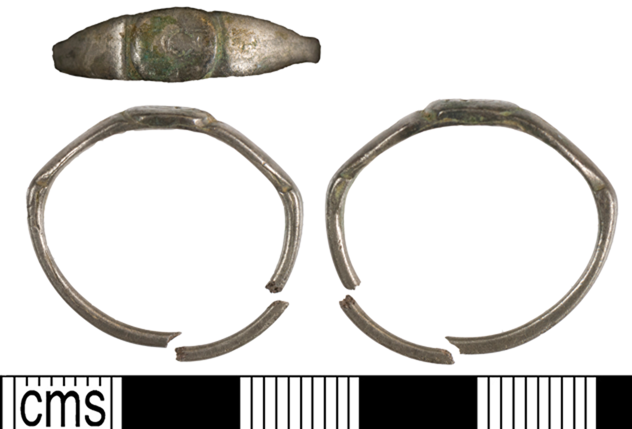
29. Clare (TL 770 456) (fig. 27). Part of a copper-alloy finger-ring, foundFootnote 51 in 2020. The circular bezel is 9.7 mm in diameter and very worn, but inscribed: SSS | SSS.Footnote 52
Clare, ring bezel (no. 29) (photo: PAS).

YORKSHIRE (WEST)
30. Castleford (Lagentium, SE 429 257). Fragment of a glass bottle base, foundFootnote 53 in 1974/85, with part of a moulded inscription: […]NDAFE[…], [?Iulia Verecu]nda fe[cit]. ‘Iulia Verecunda made (this).’Footnote 54
YORKSHIRE (NORTH)
31. Aldborough (Isurium, SE 409 666) (fig. 28). Lead sealing foundFootnote 55 in 2020 just north of the Roman walled town. Impressed within a rectangular die: … L, probably [c(ohortis) III or IIII] L(ingonum). ‘(Sealing) of the Third (or Fourth) Cohort of Lingones.’Footnote 56
Aldborough, lead sealing (no. 31) (photo: Tom Shurlock).

32. Hutton Buscel (SE 974 841) (fig. 29). Silver finger-ring (Henig type VIII) foundFootnote 57 in 2020. The circular bezel is inscribed: TOT, To(u)t(atis).Footnote 58
Hutton Buscel, silver ring (no. 32) (photo: PAS).

WALES
MONMOUTHSHIRE
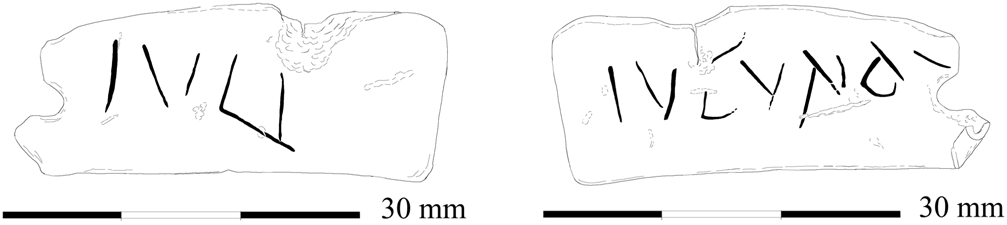
33. Caerleon (Isca, ST 33930 90410), Priory Field, within the legionary fortress (fig. 30). Rectangular lead tag, 37 by 14 mm, foundFootnote 59 in 2010. Both faces are inscribed in crude capitals. (a) IVLI. (b) IVCVNDI, Iul(i)i | Iucundi. ‘(Property) of Iulius Iucundus.’Footnote 60
Caerleon, lead tag (no. 33): both faces (drawing: R.S.O. Tomlin).

34. Ibid. (fig. 31). Rectangular lead tag, 34 by 20 mm, inscribed on one face in crude capitals: IVLI | …ṾṆDI, probably Iul(i)i | [Iuc]undi. ‘(Property) of Iulius Iucundus.’Footnote 61
Caerleon, lead tag (no. 34) (drawing: R.S.O. Tomlin).

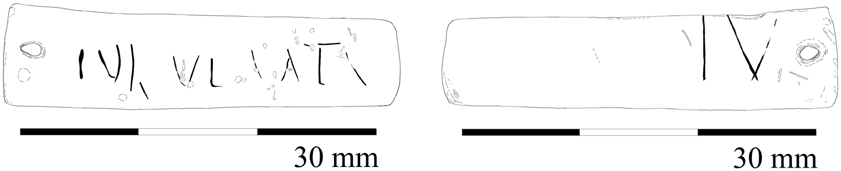
35. Ibid. (fig. 32). Narrow rectangular lead tag, 50 by 12 mm, inscribed in capitals on both faces. The incisions are shallow and some are now incomplete. (a) IVL ṾẸ[.]ỊɅTI, Iul(ii) Ve[.]iati. ‘(Property) of Iulius Ve[.]iatus.’Footnote 62 (b) IV, probably ‘4’.Footnote 63
Caerleon, lead tag (no. 35): both faces (drawing: R.S.O. Tomlin).

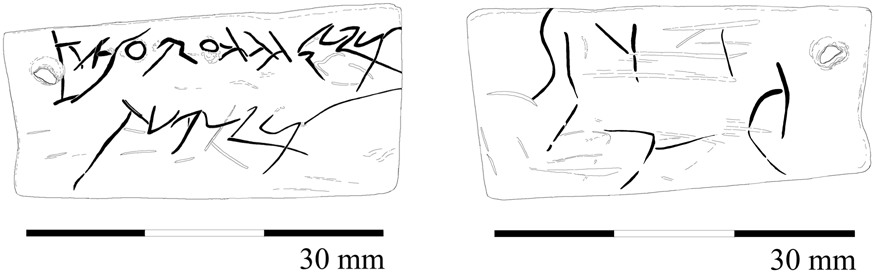
36. Ibid. (fig. 33). Rectangular lead tag, 33 by 16 mm, inscribed on both faces but by different hands. The reading is complicated by various strokes (drawn in outline) that seem to be unrelated to the letters and sometimes underlie them, as if they were casual or traces of an earlier text. (a) in cursive letters: Ịx̣esoromagulus | auṛlus.Footnote 64 (b) Undeciphered, a medley of incisions, many of them not letters: S… | …Footnote 65
Caerleon, lead tag (no. 36): both faces (drawing: R.S.O. Tomlin).

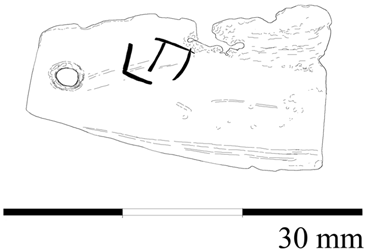
37. Ibid. (fig. 34). Rectangular lead tag, 29 by 20 mm, inscribed on one face. The incisions are largely filled with corrosion products, and in places must be deduced from the overlying encrustation that preserves their outline. In capitals: ṂṚINIɅ|NI, probably M<a>rinia|ni. ‘(Property) of Marinianus.’Footnote 66
Caerleon, lead tag (no. 37) (drawing: R.S.O. Tomlin).

C. ADDENDUM ET CORRIGENDUM
(a) Britannia 44 (2013) 393, no. 24 (Caerleon) (fig. 35). Rectangular lead tag, 35 by 15 mm, found with those just described. The other face has now been drawn, with a better reading: LɅI, probably L(ucius) A(…) I(…).Footnote 67
Caerleon, lead tag (addendum) (drawing: R.S.O. Tomlin).

D. CHANGES OF LOCATION
(a) RIB 1020 (probably Cumberland). This fragment of a Twentieth Legion dedication slab has been moved to another address in Barkway, Hertfordshire.Footnote 68
(b) RIB II.1.2404.56 (Carsington). This inscribed lead pig or ingot is now displayed in the Peak District Lead Mining Museum.