Introduction
Approximately half of all animal species, from nearly all orders (Poulin and Morand, Reference Poulin and Morand2000), show a facultative or obligatory parasitic lifestyle (Windsor, Reference Windsor1998). Traditionally these are divided into two groups: microparasites, i.e. single-celled organisms, and macroparasites, which primarily include a variety of endoparasitic helminths and ectoparasitic insects (Morand et al. Reference Morand, Krasnov and Poulin2006). Every host individual provides a discontinuous habitat patch that may support a discrete community of parasites (Bush et al. Reference Bush, Lafferty, Lotz and Shostak1997; Gotelli and Rohde, Reference Gotelli and Rohde2002). Resource partitioning between parasitic species reflects strategies to avoid competition on a host (Schoener, Reference Schoener1974; Mouillot et al. Reference Mouillot, George-Nascimento and Poulin2003) and is often correlated with ecomorphological and/or behavioral adaptations, for example to an efficient use of particular locations on the host (Bush et al. Reference Bush, Lafferty, Lotz and Shostak1997; Linhares and Komeno, Reference Linhares and Komeno2000; Hsu et al. Reference Hsu, Hsu and Wu2002; ter Hofstede et al. Reference ter Hofstede, Fenton and Whitaker2004; Tello et al. Reference Tello, Stevens and Dick2008).
In this context, bats are an interesting study system, as they offer at least two distinctly different habitat surfaces, the furry body and the furless wing membranes (Wenzel et al. Reference Wenzel, Tipton, Kiewlicz, Wenzel and Tipton1966; ter Hofstede et al. Reference ter Hofstede, Fenton and Whitaker2004). In addition, many bats are hosts for a variety of ectoparasites, such as bat flies, which are obligate parasites and highly host-specific (Wenzel et al. Reference Wenzel, Tipton, Kiewlicz, Wenzel and Tipton1966; Wenzel, Reference Wenzel1976; Dick and Patterson, Reference Dick and Patterson2007). Bat flies are generally assigned to two families, the monophyletic Nycteribiidae and the paraphyletic Streblidae (Dittmar et al. Reference Dittmar, Morse, Dick, Patterson, Morand, Krasnov and Littlewood2015). In response to bat species richness, both parasite families are most diverse in tropical regions, with Nycteribiidae being most speciose in the Old World and Streblidae in the New World (Dick and Miller, Reference Dick, Miller, Brown, Borkent, Cumming, Wood, Woodley and Zumbado2010; Graciolli, Reference Graciolli, Brown, Borkent, Cumming, Wood, Woodley and Zumbado2010). The majority of the neotropical Streblidae are parasites of the highly diverse leaf-nosed bats (Phyllostomidae) (Wenzel et al. Reference Wenzel, Tipton, Kiewlicz, Wenzel and Tipton1966; Wenzel, Reference Wenzel1976; Dick and Gettinger, Reference Dick and Gettinger2005). Due to high host specificity, bat flies form distinct parasite communities on each host species. Such a community may include 2–5 species, with each parasite species showing preferences for a specific body area on the host (Wenzel, Reference Wenzel1976; ter Hofstede et al. Reference ter Hofstede, Fenton and Whitaker2004; Dick and Gettinger, Reference Dick and Gettinger2005; Tello et al. Reference Tello, Stevens and Dick2008; Patterson et al. Reference Patterson, Dick and Dittmar2009). Without quantifying Wenzel et al. (Reference Wenzel, Tipton, Kiewlicz, Wenzel and Tipton1966) pointed out when several bat fly species are occurring on the same host, they are usually morphologically different types, presumably specialized for living on different body regions of the host. Based on the body regions from which the parasites were primarily collected, ter Hofstede et al. (Reference ter Hofstede, Fenton and Whitaker2004) distinguished two distinct groups, one associated with the wing membranes and the other associated with the fur of the host bat. Dick (Reference Dick2005) included behavioural observations and morphological characteristics to define three ecomorphological groups, assigning each to a niche on the bat host: some bat fly species live almost exclusively on the wing membranes (‘wing crawlers’), others stay mainly on the furred body, with some moving on the fur (‘fur runner’) and some moving through it (‘fur swimmer’). While tarsal claws are well developed in all three groups and important for attachment (Dick and Patterson, Reference Dick, Patterson, Morand, Krasnov and Poulin2006), overall leg morphology is also crucial for efficient movement of insects and therefore also for bat flies (Full and Tu, Reference Full and Tu1991).
Leg morphology is directly correlated to habitat preferences in anoles, lizards and spiders, and may be a key factor in mechanisms of coexistence (Losos and Sinervo, Reference Losos and Sinervo1989; Beuttell and Losos, Reference Beuttell and Losos1999; Lapinski et al. Reference Lapinski, Walther and Tschapka2015). In recent years, various studies have focused on the co-occurrence of bat flies, revealing positive correlations in abundance among sympatric streblid species on a given host bat, indicating niche partitioning between bat fly species parasitizing the same host species (Tello et al. Reference Tello, Stevens and Dick2008; Patterson et al. Reference Patterson, Dick and Dittmar2009; Presley, Reference Presley2010).
The morphological characterization of the three behavioural groups is based on 12 characteristics (head, thorax, fore-, mid- and hindleg) (Dick, Reference Dick2005). In this study we attempt to corroborate the categorization of streblid bat fly species into these groups using a reduced set of characteristics, focusing only on the morphology of the hind leg. Using only the hind leg offers a highly reproducible approach and provides measurements, which are easily comparable between ecomorphological groups. Further, we offer new implications for the inclusion of bat fly niche partitioning in models of species co-occurrence and species competition.
Material and methods
All streblid flies were collected within a large-scale bat diversity assessment in central Panama between 2013 and 2015. Bats were captured at 18 different locations with mist nets (Ecotone, 6 × 2.5 m2, 16 mm mesh and 2 × 70 denier) set at ground level, checked every 15 min. After capture, bats were held in clean, soft cotton bags for up to 1 h until processing at an improvised field camp at the capture location. Wings, dorsal and ventral pelage of every bat individual were thoroughly examined for the presence of streblid bat flies. Bat flies were collected with entomological forceps and stored in individual vials containing 96% ethanol. We further recorded standard body measurements, age, sex and reproductive status as well as further samples, totalling the handling time of each bat to 10–15 min. In the laboratory, all collected bat flies were counted and identified to species level (Wenzel et al. Reference Wenzel, Tipton, Kiewlicz, Wenzel and Tipton1966; Wenzel, Reference Wenzel1976; Guerrero, Reference Guerrero1993, Reference Guerrero1994a, Reference Guerrerob, Reference Guerrero1995a, Reference Guerrerob, Reference Guerrero1996, Reference Guerrero1997, Reference Guerrero1998). Based on the literature and prior personal observations, all species were assigned to one of the following three behaviourally distinct groups: wing crawler for bat fly species living on the wing membranes, fur runner for species moving along the surface of the host fur, and fur swimmer for species moving through the host fur (Dick, Reference Dick2005).
The main differences between these three groups are the preference of a particular site on the bat host as well as their movement behaviour within these niches. To investigate if these three designated groups correlate with morphological characteristics, we focused on the structure of the hind legs, as these are crucial for movement on the host and qualitative observations of structural differences are mentioned in the literature (ter Hofstede et al. Reference ter Hofstede, Fenton and Whitaker2004; Dick, Reference Dick2005). Insect legs allow standardized measurements of the clearly separable leg sections: femur, tibia and tarsi. Additionally, the thickness of the femur provides more information as it can give indications on the muscular force of the leg, characterizing insect locomotion (Graham, Reference Graham1985).
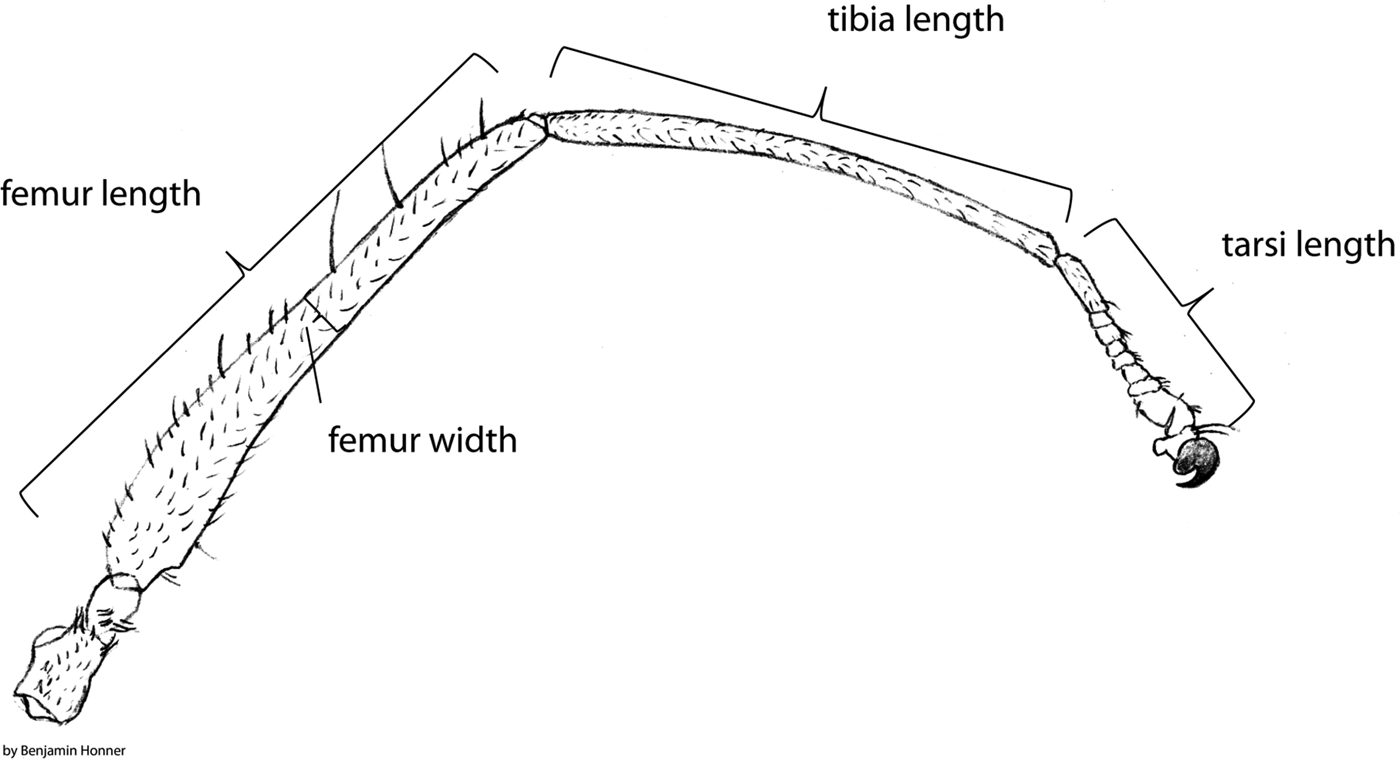
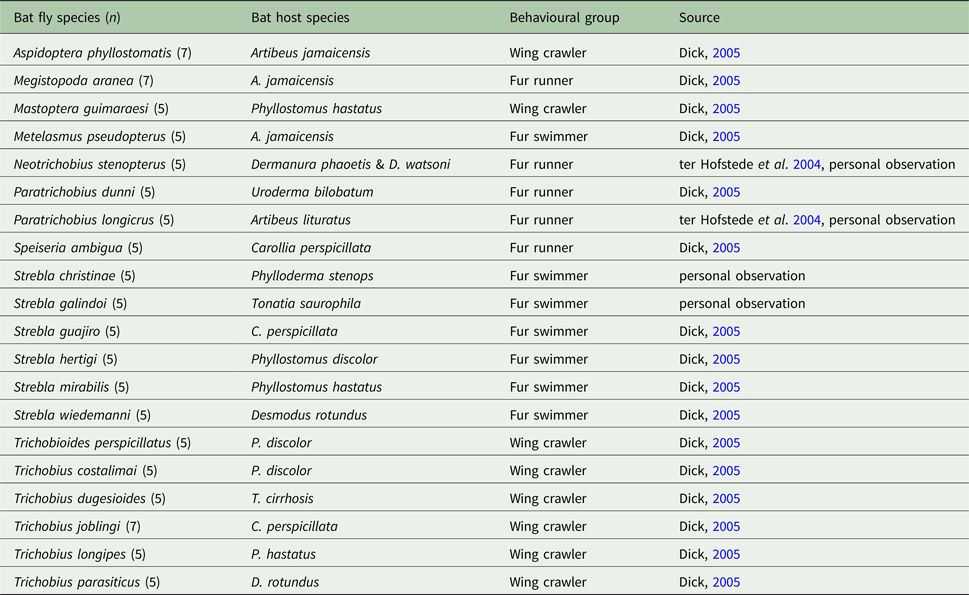
Under a stereomicroscope, we used a scalpel to separate the right hind legs of 110 bat flies (Streblidae) from 20 species, collected from 12 species of phyllostomid bats (Table 1). We focused on streblid species that commonly co-occur on their host bats, covering 10 genera of Streblidae with species of different size and host associations. We photographed the separated legs, and with the software ImageJ [version 1.50i (Rasband, Reference Rasband1997–2016)], measured in pixels the length of the femur, tibia and tarsi, including the terminal claws, as well as the width of the femur at half distance (Fig. 1). To account for size differences between bat fly species and degree of magnification, we used ratios for our analyses and standardized all length measurements by dividing them by the total leg length. We standardized the femur width by dividing it by the femur length.
Schematic depiction of a streblid bat fly leg, indicating the measurements for analysis.

Bat fly species included for the analysis, with associated species and assigned behavioral group

We conducted all statistical analyses in R v3.3.1 (R Development Core Team, 2016). We tested the individual leg measurements for differences between the three bat fly groups with Kruskal–Wallis rank sum tests [kruskalmc(), R-package pgirmess, Giraudoux, Reference Giraudoux2016]. Using nonmetric multidimensional scaling [metaMDS(), R-package vegan, Oksanen et al. Reference Oksanen, Blanchet, Friendly, Kindt, Legendre, McGlinn, Minchin, O'Hara, Simpson, Solymos, Stevens, Szoecs and Wagner2016], we visualized the distance matrix based on the leg measurements (Bray–Curtis dissimilarity) and tested for significant differences among the observed bat fly groups using permutational multivariate analysis of variance [PERMANOVA, adonis(), 1000 permutations, R-package vegan].
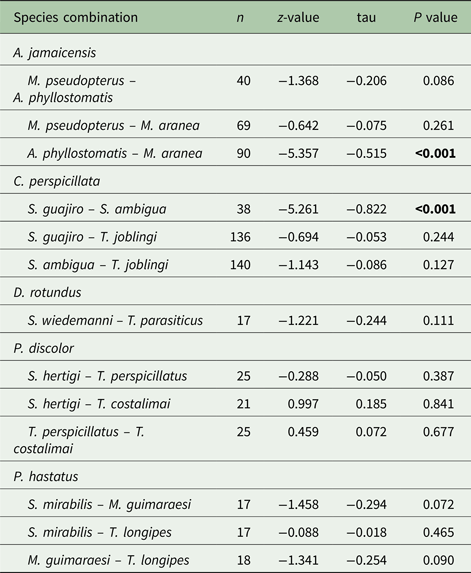
As we were focusing only on possible negative correlations and Kendall's Tau is a more accurate test to use with smaller sample sizes, we further analysed the co-occurrence of bat fly species on their respective host species (Table 2, Supplementary Table S2) with one-tailed correlations [cor.test(), method = Kendall] for each bat fly species pair. To avoid large-scale and location-specific characteristics influencing the occurrence of bat fly species in our dataset, for this analysis we only analysed bat flies from host individuals captured at locations where we collected all focal bat fly species for a particular bat species. We also excluded double-zero records from our pairwise correlations (Tello et al. Reference Tello, Stevens and Dick2008).
Results for co-occurrence analyses (Kendall correlation) of bat fly species on their specific host bat species (N = number of pairs analysed)

Results
The different bat flies showed characteristic movement patterns on their host bat, especially when trying to evade capture. Wing crawlers moved slowly across the bats’ wing membranes, often scuttling sideways like crabs, and attached strongly to the wing membrane when collected. Bat flies using the furry body parts of the host bats moved quickly, typically showing one of two modes of escape. Fur runners pushed through the fur to the surface, moving quickly to areas around the ears or the ventral axillary regions. Fur swimmers, in contrast, were mostly found in the long fur of the bats’ neck, only noticeable when slightly blowing into the fur or by the wave-like fur movement when moving through the hairs, like velociraptors through high grass in the movie Jurassic Park (Spielberg, Reference Spielberg1997). Unlike wing crawlers and fur runners, fur swimmers possess a ctenidium, or a necklace of spines on their ventral side, which allows them to cling to the bat hairs, sometimes so strongly that their legs or even heads would be ripped off when pulling them out of the fur with forceps. Based on these behavioural observations we can clearly distinguish these three groups of bat flies on phyllostomid bats.
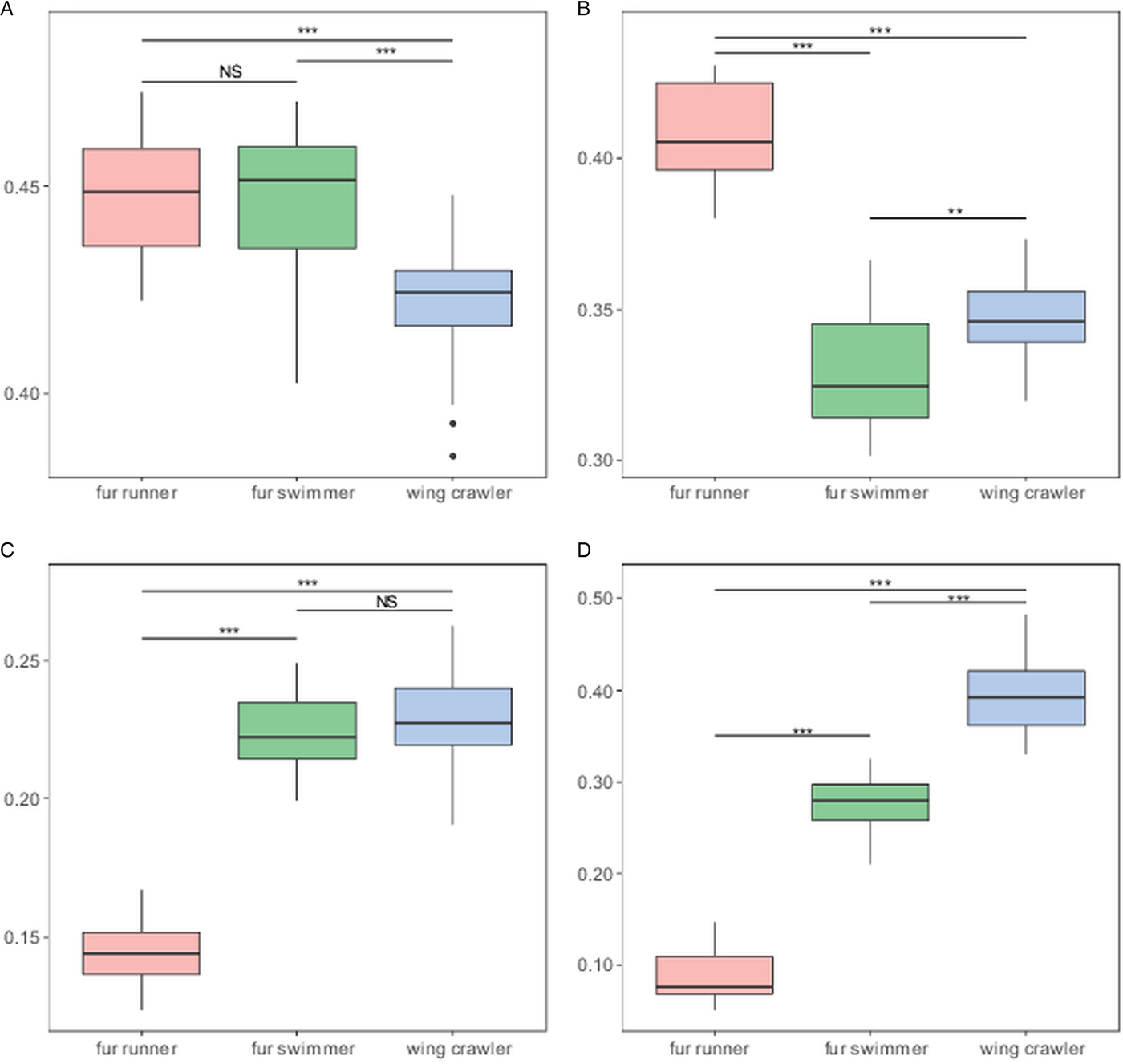
Comparing the relative leg dimensions revealed significant differences in all four measurements between the three groups of bat flies (Fig. 2, Supplementary Table S1). Wing crawlers had a significantly shorter relative femur length than fur runners and fur swimmers (Kruskal–Wallis test, χ 2 = 42.8, P < 0.001), whereas the latter two did not differ from each other. Tibia length differed significantly between all three groups (Kruskal–Wallis test, χ 2 = 73.0, P < 0.05) and was longest in fur runners and shortest in fur swimmers. Fur runners had significantly shorter relative tarsi length than the other two groups (Kruskal–Wallis, χ 2 = 66.0, P < 0.001). The relative width of the femur differed significantly between all three groups, with fur runners having the thinnest and wing crawlers the broadest femur (Kruskal–Wallis test, χ 2 = 96.0, P < 0.001).
Differences in relative (A) femur, (B) tibia and (C) tarsi length as well as (D) relative femur width for the three ecomorphologically adapted groups of bat flies (NS = not significant, ** = P < 0.1, *** = P < 0.001).

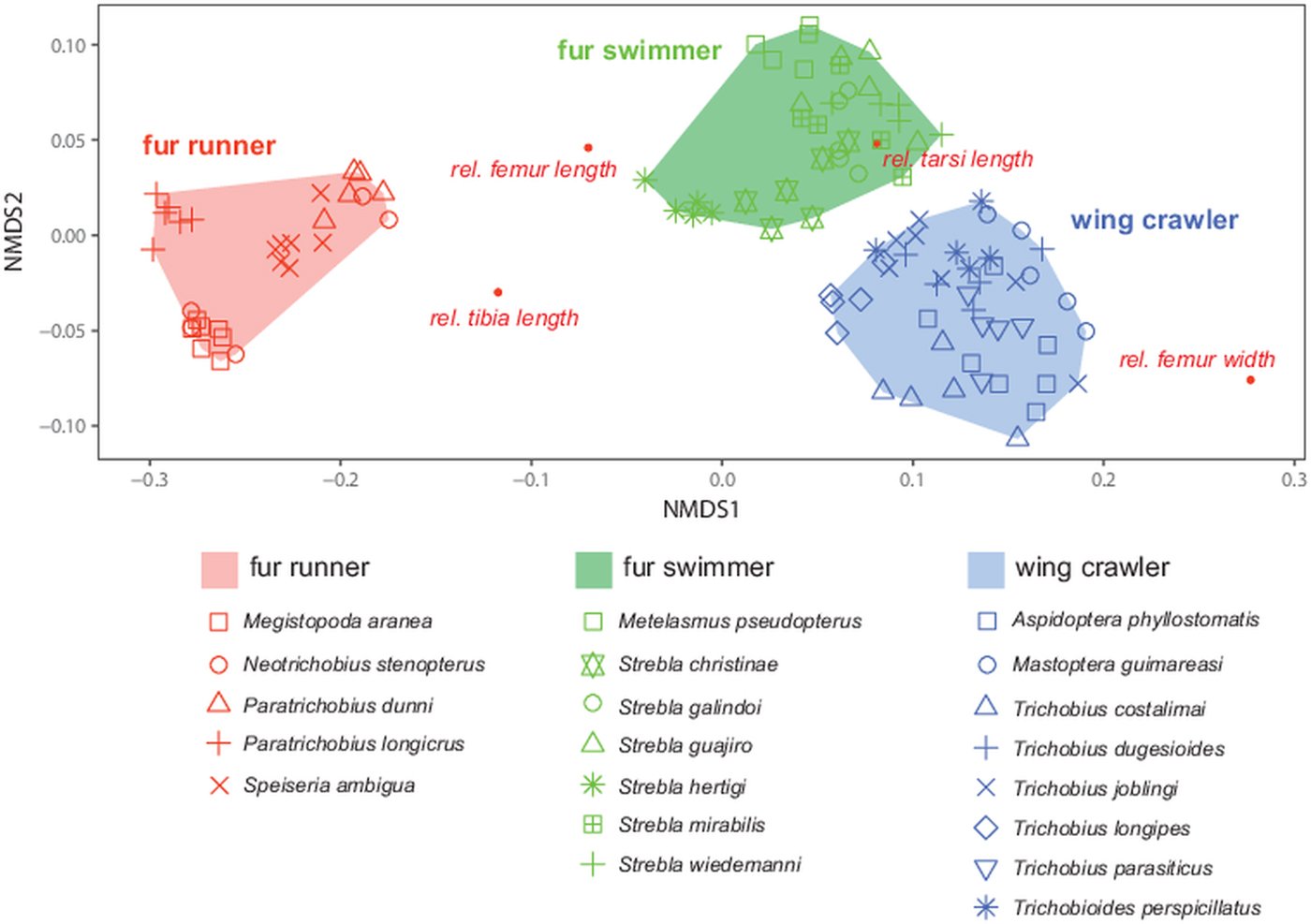
A non-metric multidimensional scaling (NMDS, final stress = 0.035, linear fit r 2 = 0.996) analysis on these leg measurements show a clear separation of all three groups (Fig. 3). A dissimilarity analysis shows that the three groups significantly differ from each other (Adonis, F = 480.92, R 2 = 0.90, P < 0.001).
Non-metric multidimensional scaling (NMDS) showing significant separation of three ecomorphological groups (Adonis, F = 484.08, R 2 = 0.90, P < 0.001). Red asterisks represent weighted averages for the corresponding leg measurements.

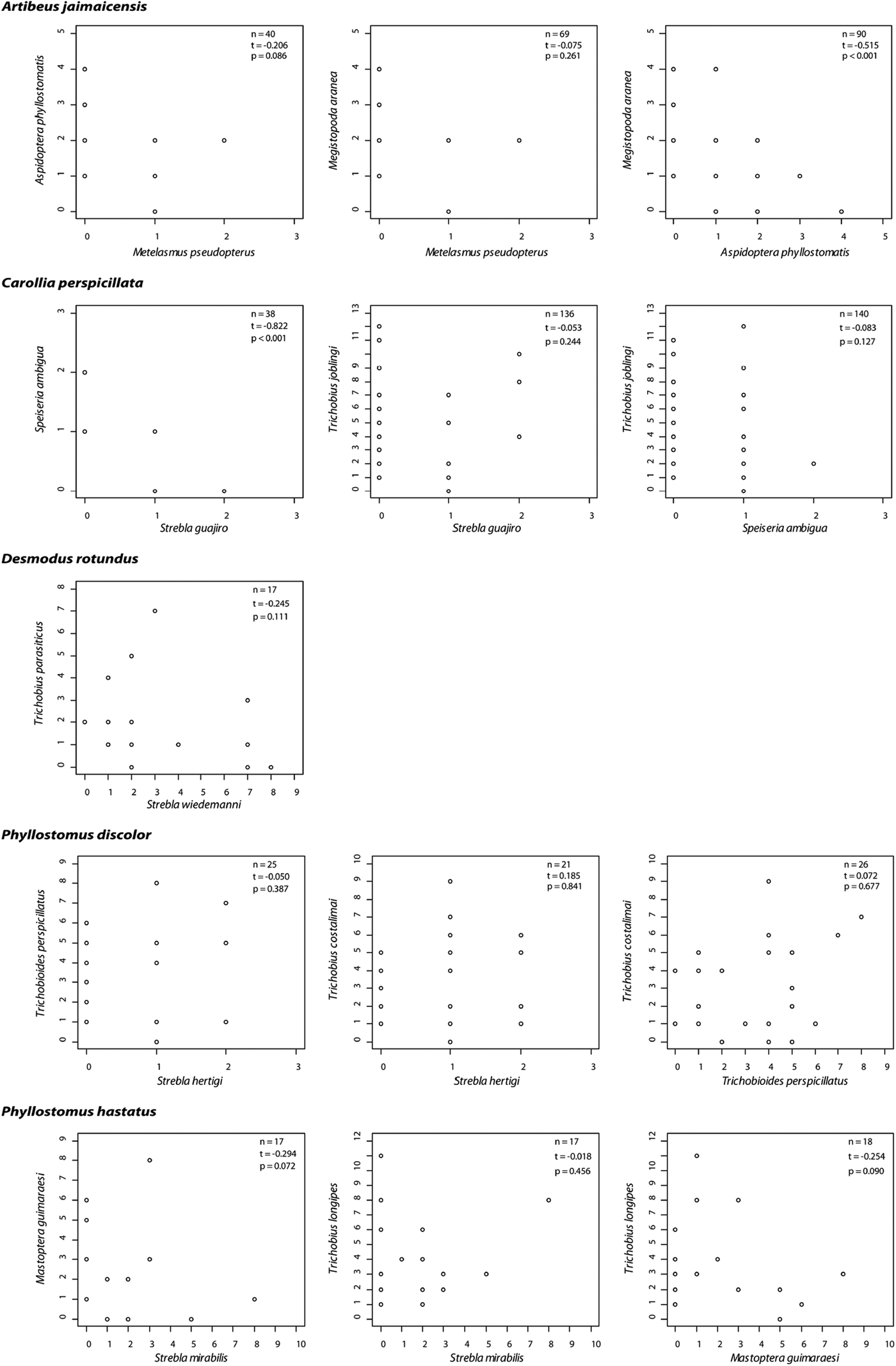
With regard to species co-occurrence, we found negative interactions only in two species pairs [Aspidoptera phyllostomatis vs Megistopoda aranea (z = −5.357, t = −0.515, P < 0.001) and Strebla guajiro vs Speiseria ambigua (z = −5.261, t = −0.822, P < 0.001)], whereas the remaining 11 pairs showed no or positive density correlations (Table 2, Fig. 4).
Scatterplots of densities for all bat fly species pairs occurring on their respective host bat species.

Discussion
Our behavioural observations of 20 species of bat flies are consistent with reports in the literature (Wenzel et al. Reference Wenzel, Tipton, Kiewlicz, Wenzel and Tipton1966; ter Hofstede et al. Reference ter Hofstede, Fenton and Whitaker2004; Dick, Reference Dick2005) and allowed us to clearly distinguish three groups of bat flies based on movement patterns and niche use on their respective host bat. The occurrence of these three bat fly groups on single host individuals allow the suggestion of niche separation as a mechanism to avoid competition between co-occurring bat fly species (Wenzel et al. Reference Wenzel, Tipton, Kiewlicz, Wenzel and Tipton1966; ter Hofstede et al. Reference ter Hofstede, Fenton and Whitaker2004; Tello et al. Reference Tello, Stevens and Dick2008; Presley, Reference Presley2010). These three groups were first categorized as distinct ecomorphological groups by Dick (Reference Dick2005) who termed them as ‘fur runners’, ‘fur swimmers’ and ‘wing crawlers’. Our behavioural observations of streblid bat flies parasitizing phyllostomid bats in Panama are consistent with these ecomorphological categorizations.
Our study fortifies the evidence for a clear morphological separation of these three groups of bat flies. The assignment of bat fly species to these three ecomorphological groups, based only on the hind-leg morphology, is consistent with the categorization based on 12 morphological measurements shown by Dick (Reference Dick2005).
Fur runners have long and thin legs which allow them to move quickly over the surface of the fur of their host bat, while wing crawlers have short and sturdy legs with massive femurs and pronounced tarsi and terminal claws that facilitate the attachment to the hairless and exposed wing membranes (Wenzel et al. Reference Wenzel, Tipton, Kiewlicz, Wenzel and Tipton1966; Dick, Reference Dick2005; Dick and Patterson, Reference Dick, Patterson, Morand, Krasnov and Poulin2006). Fur swimmers combine characteristics of the other two groups, namely long and strong legs that allow them to move quickly within the fur of their host bats (Wenzel et al. Reference Wenzel, Tipton, Kiewlicz, Wenzel and Tipton1966; Dick, Reference Dick2005).
Whether these morphological adaptations have evolved several times independently, or whether the distinct ecomorphological groups represent phylogenetic units is still unclear, as no concise phylogeny of New World Streblidae exists (Dick and Patterson, Reference Dick, Patterson, Morand, Krasnov and Poulin2006; Dittmar et al. Reference Dittmar, Porter, Murray and Whiting2006, Reference Dittmar, Morse, Dick, Patterson, Morand, Krasnov and Littlewood2015). Five of the currently recognized eleven subfamilies of Phyllostomidae are parasitized by members of all three ecomorphological groups, whereas flies of two groups can be found in four more subfamilies (Wenzel et al. Reference Wenzel, Tipton, Kiewlicz, Wenzel and Tipton1966; Wenzel, Reference Wenzel1976; Cirranello et al. Reference Cirranello, Simmons, Solari and Baker2016; Rojas et al. Reference Rojas, Warsi and Dávalos2016). This strongly indicates a shared origin for these three groups, as convergent developments are possible in some cases, but highly unlikely for all of them. This coincides well with the evidence for a long history of association between bat flies and bats, with the currently oldest fossil record of bat flies, a specimen preserved in amber (Enischnomya stegosoma, Nycterophiliinae), dating back to the upper Eocene to middle Miocene (Schlee, Reference Schlee1990; Iturralde-Vinent and MacPhee, Reference Iturralde-Vinent and MacPhee1996; Poinar and Brown, Reference Poinar and Brown2012), while the separation of Phyllostomidae and Mormoopidae is estimated to have occurred in the late Eocene and the diversification of Phyllostomidae is assumed to have started in the Oligocene, around 30 ma ago (Rojas et al. Reference Rojas, Warsi and Dávalos2016).
On extant neotropical bat species we frequently find several co-occurring bat fly species, but generally only one representative species for each ecomorphological group (Wenzel, Reference Wenzel1976; Fritz, Reference Fritz1983; Linhares and Komeno, Reference Linhares and Komeno2000; Dick and Miller, Reference Dick, Miller, Brown, Borkent, Cumming, Wood, Woodley and Zumbado2010). The abundance of one bat fly species is often positively correlated with the abundance of other species inhabiting the same host individual (Wenzel et al. Reference Wenzel, Tipton, Kiewlicz, Wenzel and Tipton1966; Dick and Patterson, Reference Dick, Patterson, Morand, Krasnov and Poulin2006; Presley, Reference Presley2007, Reference Presley2010; Tello et al. Reference Tello, Stevens and Dick2008). This contrasts apparently other co-occurrence studies suggesting density compensation, an inverse relationship between population density and species diversity generated by competition between different species (Dick and Patterson, Reference Dick, Patterson, Morand, Krasnov and Poulin2006; Presley, Reference Presley2007, Reference Presley2010; Tello et al. Reference Tello, Stevens and Dick2008). The results of our density correlations are consistent with these findings, showing no significant negative correlation for 14 of 16 bat fly species interactions on six bat species, indicating strong niche differentiation. In choice experiments bat flies (Trichobius joblingi) preferred clean bats over bats already infested with individuals of the same parasite species, whereas no preference could be detected when offering them clean bats and bats infested with a bat fly species (Speiseria ambigua) occupying another niche on the host bat (Dick and Dick, Reference Dick and Dick2006). This indicates that intraspecific competition might be less influential than interspecific competition, whereas interspecific competition might be largely synonymous to ‘inter-ecomorphological group’ competition. The threshold for the existence of competition effects might also depend on host size and therefore habitat size or food availability for the parasites. The two medium-to-large-sized bat species of the genus Phyllostomus, P. discolor and P. hastatus, were the only records in our data set exhibiting the co-occurrence of two bat fly species of the same ecomorphological group. In both cases, we could not find any negative interactions between the two species of wing crawlers. Similar results were obtained by Presley (Reference Presley2007) for two parasites with the same habitat preference found on the large, 60 cm wingspan Noctilio leporinus in Paraguay, showing positive correlations in both occurrence and abundance.
On two host bat species we observed negative density correlations between two bat fly species. The first observed significant negative correlation between S. guajiro vs S. ambigua on Carollia perspicillata, was also reported by Tello et al. (Reference Tello, Stevens and Dick2008). These two bat flies belong to the ecomorphological group of fur swimmer and fur runner, respectively, using both the furry body area of the host bat (Fritz, Reference Fritz1983; Tello et al. Reference Tello, Stevens and Dick2008). This behaviour may cause resource competition, especially on small-sized bats. The second pair of bat fly species showing a significant negative density correlation occurs on different body regions of the host species Artibeus jamaicensis, namely wing membranes and on the fur. We did not expect this strong negative interaction between these two ecomorphological groups, especially not on large-sized host bats. However, a peculiarity of the host bat species A. jamaicensis is its flexibility in roost sites, using caves, hollow trees or the foliage (Handley and Gardner, Reference Handley and Gardner1991). As bat flies are obligated to leave their host bat to deposit the pupae in the roost (Overal, Reference Overal1980; Dick and Patterson, Reference Dick, Patterson, Morand, Krasnov and Poulin2006), the bats’ roost is highly important for maintaining the bat fly life cycle. Every roost type offers a different habitat longevity as well as a characteristic microclimate and substrate (Patterson et al. Reference Patterson, Dick and Dittmar2007; Dittmar et al. Reference Dittmar, Dick, Patterson, Whiting and Gruwell2009), which may favour the abundance of one bat fly species over the other. Depending on the roost characteristics, the manner of pupiposition may also differ among bat fly species. Pupiposition can occur at different distances to the host bat, with winged species depositing farther away than species with reduced wings (Ross, Reference Ross1961; Overal, Reference Overal1980; Dittmar et al. Reference Dittmar, Dick, Patterson, Whiting and Gruwell2009). Pupae of e.g. Trichobius-, Speiseria- or Megistopoda-species are deposited to the substrate of the roost walls (Overal, Reference Overal1980; Fritz, Reference Fritz1983; Dittmar et al. Reference Dittmar, Dick, Patterson, Whiting and Gruwell2009), whereas in contrast, pupae of flies of the genus Strebla and Nycterophilia do not possess pronounced attachment processes and therefore might be dropped freely in the roost (Wenzel in Marshall, Reference Marshall1981; Fritz, Reference Fritz1983). Fritz (Reference Fritz1983) recovered in experiments with caged host bats pupae of St. guajiro and St. wiedemanni on the ground, whereas pupae of T. joblingi and Sp. ambigua were directly attached to the cage. This indicates that not only competition but also a wide range of other factors such as roosting habits may influence the occurrence of streblid bat fly species on their host bats (Wenzel et al. Reference Wenzel, Tipton, Kiewlicz, Wenzel and Tipton1966; ter Hofstede and Fenton, Reference ter Hofstede and Fenton2005; Patterson et al. Reference Patterson, Dick and Dittmar2007). Roost characteristics may, therefore, play a major role in the bat fly species composition and may even mask competition between congeneric bat fly species.
In sum, we confirmed three distinct ecomorphologies in streblid bat flies, each preferring a different habitat on their host. We found significant differences in leg morphology associated with these distinct ecomorphological groups. As to date, no detailed phylogeny of bat flies is available, it remains uncertain whether these ecomorphological groups reflect phylogeny or whether adaptations to different habitat use evolved several times independently within the New World Streblidae. The division of the bat host into three structurally distinct habitats contributes to avoiding competition among the ectoparasites. Additionally, we found evidence for density-dependent competition between species belonging to the same ecomorphological group. Finally, we found evidence that bat fly species composition might differ depending on the ecological background, with quality and availability of roosting sites favouring the abundance of one bat fly species over the other. Further studies are needed focusing on co-occurrences and community ecology of bat flies, integrating roosting information of host bats in the field.
Supplementary material
The supplementary material for this article can be found at https://doi.org/10.1017/S0031182018000318
Acknowledgements
We thank the Smithsonian Tropical Research Institute for the use of facilities and for logistical support, especially Oris Acevedo and Belkys Jimenez. Special thanks go to Stefan Brändel and his field crew for extensive bat fly sampling. We also thank Carl Dick for valuable input and comments on this manuscript. Animal capture and handling were approved by the Panamanian Government (MiAmbiente SE/A-75-13, SE/A-69-14) and the Institutional Animal Care and Use Committee (IACUC, 2013-0401-2016).
Financial support
This study was funded by the German Research Foundation (DFG) SPP 1596 Grant TS 81/6-1 to M.T., which had no influence in study design or interpretation of the results.