Introduction
The number of male per 100 female live births (defined as the sex ratio at birth, SRB for brevity's sake) has been shown to be consistently stable in human populations irrespective of time and geographical location. All over the globe 105 boys are born for every 100 girls and this ratio presents little fluctuation over time and across countries (Tarver & Lee, Reference Tarver and Lee1968). In fact the SRB is considered to be so stable that any significant deviation from this ‘global average’ of 105 is attributed to sex-selective under-reporting, sex-selective abortion, sex-selective infanticide or other man-made factors (Yi et al., Reference Yi, Ping, Baochang, Yi, Bohua and Yongpiing1993).
Generally male fetuses are more fragile than female ones. They are more susceptible to maternal stress, environmental degradation and poor hygienic conditions. Therefore, intrauterine mortality, commonly known as spontaneous abortion, affects more male fetuses than female ones. It has been estimated that the sex ratio at the time of conception (defined as the primary sex ratio, or PRS) may be as high as 170 males per 100 females, but the lower survival rates of male embryos during gestation cause the SRB to be considerably lower than the PSR (Markle, Reference Markle1974). Apart from environmental and psychological factors, the ethnic group of the parents affects the SRB as well. Black populations, for example, have a consistently lower SRB than white populations, ranging from 102 to 104 male per 100 female births. This difference is attributable to the levels of hormones circulating in the body of women at the time of conception. The theory goes, and the evidence supports it, that black people have higher levels of gonadotrophin and thus a higher probability of conceiving girls and consequently a lower SRB (James, Reference James1980).
Purely demographic factors are also powerful determinants of SRB. Maternal age, paternal age and birth order could be responsible for the observed fluctuation in the SRB across different population groups. Studies that correlate age of mother with the SRB using univariate analysis have found that as mothers get older the SRB becomes less masculine. This negative effect of maternal age on the SRB attenuates or even disappears when other variables (such as paternal age and birth order) are brought into the analysis. The effect of paternal age on the SRB is similar to that of maternal age. When examined as a single independent variable, paternal age correlates negatively with SRB, i.e. younger fathers tend to have more male births than older fathers. When other independent variables are taken into account (maternal age, birth order), the effect of paternal age on the SRB is ambiguous (Chahnazarian, Reference Chahnazarian1988).
Birth order seems to be a stronger determinant of the SRB than maternal and paternal age. Lower order births are more likely to be males than higher order ones and this effect persists, even when controlling for maternal and paternal age and for ethnic group. In any case, and despite the different biological, demographic, environmental and socioeconomic factors that apply to different populations, the SRB oscillates between 104 and 107 boys for 100 girls in the vast majority of countries (Chahnazarian, Reference Chahnazarian1988; Pergament et al., Reference Pergament, Todydemir and Fiddler2002).
However, significant deviation from this ‘global average’ is noticed in certain developing countries due to selective preference for males. India and China are typical paradigms of these countries. The SRB in China started rising above 108 in the 1980s (Yi et al., Reference Yi, Ping, Baochang, Yi, Bohua and Yongpiing1993), reached a record high of 121 in 2004 and has presented a downward trend in the last few years due to China's effort to curb the imbalance in SRB (English.news.cn, 2013). In India the SRB arrived at a record high of 113.6 in 2003–2005, while for the period 2007–09 it was 110.4 (UNFPA, 2011). Both countries have a long-standing tradition of son preference by using ultrasound machines that permit non-invasive antenatal sex determination, which can lead to decisions for sex-selective abortions. Moreover, infanticide and the ill-treatment and neglect of girls are very common in India, where the proportion of girls to boys is the worst after China. In many cases, as evidenced in India, China and Pakistan, the parents of newborn girls shun declaring them to the authorities, to have an even chance of having a second child. In some cases, even if female births have been registered, the parents neglect the girls when they get sick – hoping perhaps to have a second chance of a male child if the girl succumbs to illness (Sudha & Rajan, Reference Sudha and Rajan1999; Sahni et al., Reference Sahni, Verma, Narula, Varghese, Sreenivas and Puliyel2008).
The variation of the SRB in the countries of the Indian sub-continent and China is a motive to investigate whether there are variations of this kind in migrants living in Greece and originated from the aforementioned countries. Actually, there has only been one previous study concerning SRB and ethnicity in Greece. This investigated (among other things) the SRB by the citizenship of mother and found an exceptionally high SRB for Asian mothers (129 boys for every 100 girls) (Verropoulou & Tsimbos, Reference Veropoulou and Tsimbos2010). However, this study was based on births recorded in 2006 only and the exceptionally high SRB for Asians may be partly related to the relatively small number of observations (1239 births). An analysis that includes more years and a bigger sample would show whether the elevated SRB of Asians living in Greece is the norm and would reinforce (or otherwise) the conclusions drawn by Verropoulou and Tsimbos.
Another question is whether SRB differs by legal status of birth. Studies that refer to this topic have found contradictory results. Generally in the 19th century and up to the first half of the 20th century in Europe and the Americas, the SRB tended to be more masculine when the births were legitimate than otherwise (Jastrzebski, Reference Jastrzebski1919; Lawrence, Reference Lawrence1941; James, Reference James1987). Among the explanations put forward for this difference is that in societies where unwed mothers and their children are scorned upon, the social environment exerts such an adverse impact on unwed pregnant women that intrauterine mortality is higher for the fetuses of unwed pregnant women than for the ones of married women (Winston, Reference Winston1931, pp. 15–16). Higher intrauterine mortality would affect more male fetuses than female ones, since male fetuses are more fragile, and thus the SRB of illegitimate births, according to this explanation, tends to be lower. In modern Western societies, however, there does not seem to be any significant difference in the SRB of legitimate and illegitimate births (Erickson, Reference Erickson1976). Nevertheless, in our data the legal status of birth makes a substantial difference when used as a control variable for SRB by education of the mother. Therefore, it was included in the analysis.
In the aforementioned context, the present article aims to investigate whether the SRB in Greece presents significant deviations from the normal among different ethnic groups when controlling for the socio-demographic characteristics of the mother (education, age, and birth order) and for the legal status of the birth (legitimate/illegitimate).
Data and Methods
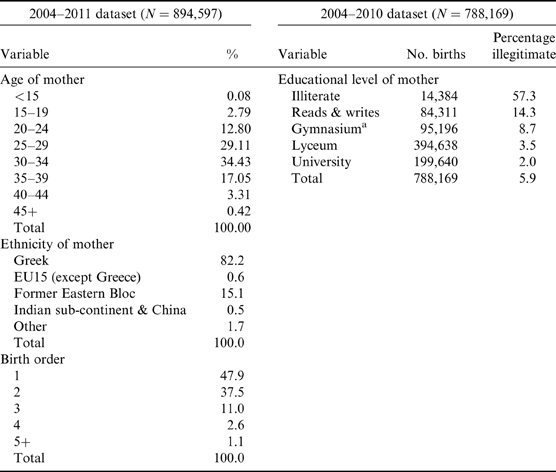
The number of live births by various categories was commissioned by EL.STAT (Hellenic Statistical Authority, formerly known as National Statistical Service of Greece) for the purposes of this study for the years 2004–2011. In fact the present analysis is based on two datasets: one for the years 2004–2010 and one for the years 2004–2011. The dataset for 2004–2011 contains all variables of interest except for the legal status of birth, while that of 2004–2010 contains all variables of interest (including the legal status of birth) but not birth order. The sample sizes and the frequency distribution of births by the category of each variable of interest are shown in Table 1.
Distribution of births by variables of interest, Greece 2004–2011

a Graduates of the Greek gymnasium have completed 9 years of education, i.e. 6 years in primary school and the first 3 years of secondary education.
The reason that the analysis starts from 2004 is that this is the earliest year for which ethnicity (i.e. citizenship) of parents is available, and as will be seen further on, the most notable variation of SRB is observed among different ethnic groups. Five ethnic groups based on the citizenship of the mother are used in this study. More specifically, the ethnic group ‘Greek’ contains women of Greek citizenship, including those with double citizenship (Greek and foreign). The ethnic group ‘EU15’ is made up of citizens of Austria, Belgium, UK, France, Germany, Denmark, Ireland, Spain, Italy, Luxembourg, the Netherlands, Portugal, Finland and Sweden (i.e. the fifteen countries that first entered the European Union apart from Greece, thus fourteen countries). The ethnic group ‘former Eastern Bloc’ contains citizens of seventeen countries, namely Albania, Armenia, Bulgaria, Poland, Czech Republic, Hungary, Ukraine, Georgia, Russia, Belarus, Estonia, Latvia, Lithuania, Moldova, Romania, Slovakia and Slovenia. The ethnic group ‘Indian sub-continent and China’ comprises citizens from India, Pakistan, Bangladesh and China. The residual category ‘Other’ contains citizens of countries that do not belong to any of the aforementioned four ethnic groups.
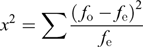
The analysis is based on calculating and comparing sex ratios at birth among ethnic groups, levels of education, age group of mother at birth, birth order and legal status of birth. Goodness-of-fit tests have been employed to check whether the variation of SRB observed among the categories of a variable is statistically significant. The goodness-of-fit tests have been performed with the use of the chi-squared statistic. For instance, to test whether the variation of SRB among different ethnic groups is statistically significant, the SRB of the general population is calculated, which, for the years 2004–2011 in Greece was 106.62. This SRB implies a proportion of male births to all births of 0.516. By applying this proportion to the number of births in each ethnic group, the expected number of male births per ethnic group is calculated. From thereon, a goodness-of-fit test based on the chi-squared statistic can be performed. The null hypothesis is that there is no statistically significant variation between the expected and the observed number of births by ethnic group and that whatever differences are there between the two distributions (expected and observed) occurred by random chance. The alternative hypothesis is that the differences between the expected and the observed number of births are statistically significant. The magnitude of the differences between the expected and the observed frequencies is measured with the test statistic:
 $$x^2=\sum{(f_o-f_e)^2\over f_e}$$
The sampling distribution of this test statistic is known to follow the chi-squared distribution with k-1 degrees of freedom (Healey, Reference Healey1996, pp. 259–261), where k stands for the categories of the variable (in the example given here, ethnicity has five categories), f o stands for ‘observed frequency’ and f e stands for ‘expected frequency’. In the current example, the null hypothesis is rejected at the 0.05 level of significance if x 2 takes values greater than 9.488 (which is the critical chi-squared value at 0.05 level of significance with four degrees of freedom).
Additionally, weighted least-squares logistic regression for grouped data is used in order to disentangle the relative importance of the socio-demographic factors in the variation of SRB in Greece. In the model of logistic regression for grouped data the dependent variable is not binary. It is not, for example, 0=male birth, 1=female birth, as would be the case had information from birth certificates been available. In this study's case, the statistical software STATA calculates the proportion of male births from two variables: male births (or ‘positive responses’) and total births (‘total observed’). The rest of the variables (age of mother at birth, mother's education and mother's ethnicity) are taken as independent variables. The results can be presented either in logits, that is natural logarithms where the base is Euler's e, or as an odds ratio, which is a useful way to summarize the probability of an individual being in one state rather than another.
Results
SRB by year and legal status of birth
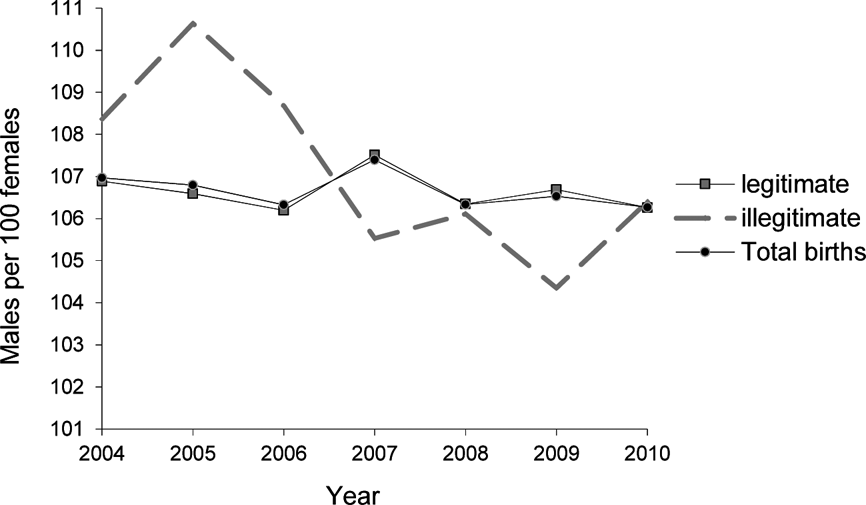
First of all SRB is examined for legitimate and illegitimate births over the period 2004–2010 (Fig. 1). The SRB of legitimate births is more or less stable at about 106–107 male per 100 female births in the period under consideration. The SRB of illegitimate births presents greater variation than that of legitimate ones, oscillating between 104.4 and 110.6 in the period 2004–2010. However, the goodness-of-fit test showed that this variation is not statistically significant, as the p-value is very close to 1.
Sex ratio at birth by legal status of birth in Greece, 2004–2010. Source: data commissioned from EL.STAT. Number of illegitimate births: 46,408; χ2=1.87; df=6; p-value=0.93. Number of legitimate births=741,761; χ2=1.41; df=6; p=0.93.
SRB by ethnic group
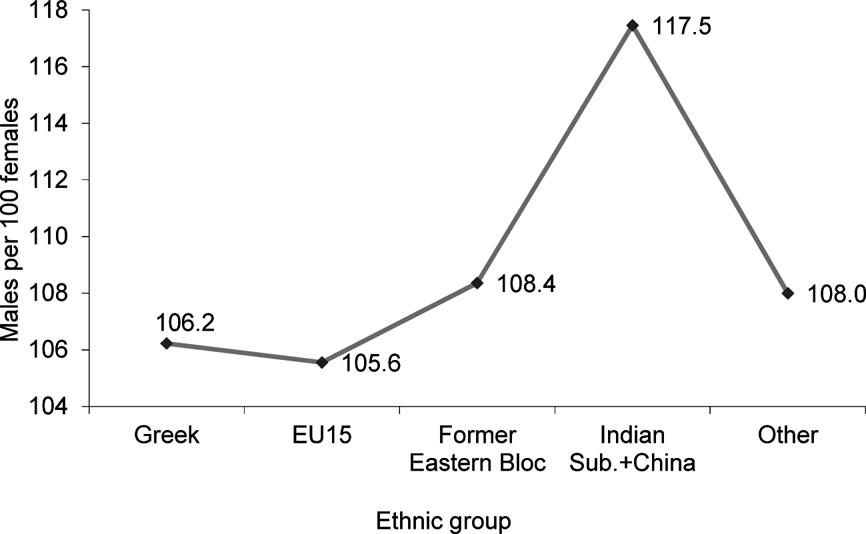
The variation of the SRB by ethnic group is remarkable. Mothers from the Indian sub-continent and China bore on average 117.5 boys for every 100 girls in the period 2004–2011, a figure that is unnaturally high (Fig. 2). The SRB for the former Eastern Bloc (108.4) is also higher than the natives' index, while the lowest SRB is observed in European citizens coming from the fourteen most affluent member states of the European Union (EU15). The values of SRB for every ethnic group are thought to be reliable as they are based on a large number of births aggregated all over the period 2004–2011 (Table 1).
Sex ratio at birth by ethnic group, Greece 2004–2011. Source: data commissioned from EL.STAT. Number of births: 894,597; χ2=10.65; df=4; p<0.05.
SRB and the socio-demographic profile of the mother
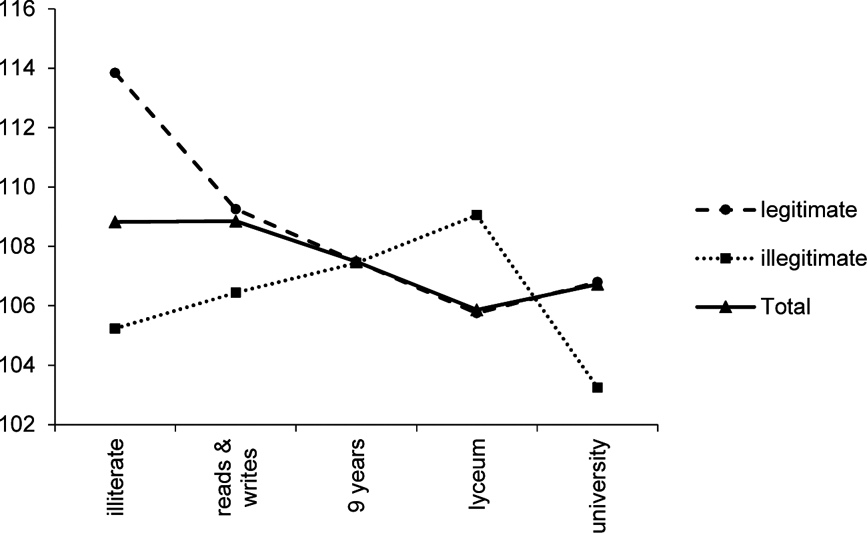
The SRB is considerably higher for legitimate births (114) than for illegitimate ones (105) among the illiterate group, a result that is rather unexpected. In the same direction, but at a smaller extent, are the results for those women who were able to read and write and also for university degree holders (Fig. 3).
Sex ratio at birth by education of mother and legal status of birth, Greece 2004–2010. Source: data commissioned from EL.STAT. Number of legitimate births: 741,761; χ2=12.22; df=4; p=0.02. Number of illegitimate births: 46,408; χ2=1.58; df=4; p=0.81.
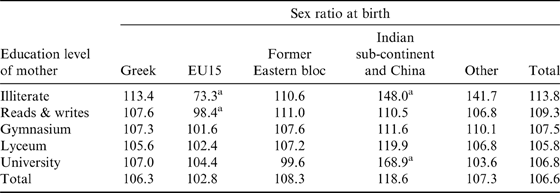
Births born to illiterate women consist of an unusually high proportion of males in all but one ethnic group (EU15). Even illiterate Greek women bear a lot more boys than girls and these births are not illegitimate (results in Table 2 refer only to legitimate births). This is evidence that preference for sons is a widespread mentality among the lower educated spheres of society and that a proportion of illiterate women might resort to sex-selective abortions in order to define the sex of their child. It may be the case, as well, that the high SRB among illiterate women is due to sex-selective under-registration, given that the only illiterate women of Greek citizenship at reproductive age in 21st century Greece are usually people belonging to minority ethnic groups living at the edge of the society, such as the Roma ethnic group.
Sex ratio at birth based only on legitimate births by ethnicity and education of mother, Greece 2004–2010
a Results based on fewer than 200 births.
The SRB by age of mother was examined in eight age groups. Six of them were 5-year age groups (15–19 until 40–45) and two of them were open-ended age groups (age of mother <15 and age of mother 45+) for a total of 894,597 births recorded in the period 2004–2011. It was found that the SRB does not present significant variation by age of mother except for the two open-ended age groups. For very young mothers (<15 years old) SRB is very low (91 girls per hundred boys, based on 678 births) and for very mature mothers (>45 years old) the SRB is also low (99.5 based on 3779 births). In the rest of the age groups SRB oscillates within the ‘normal’ range (105.6 to 107.9 boys per 100 girls). The goodness-of-fit test showed that the variation of the SRB by age of mother is not statistically significant (p=0.45).
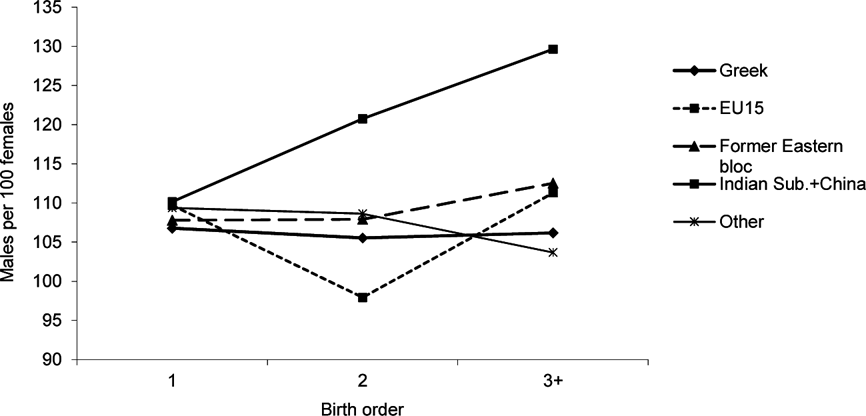
Figure 4 shows how the sex ratio at birth fluctuates according to birth order when controlling for mother's ethnicity. For people from the Indian sub-continent and China, the SRB is positively associated with birth order. There is a spectacular increase of the SRB from parity 1 to parity 3+ from 110 to 130 boys per 100 girls born to mothers from the Indian sub-continent and China.
Sex ratio at birth by mother's ethnicity and birth order, Greece 2004–2011.
The SRB by birth order shows that sex-selective abortions may not take place only among Chinese and Indians. A preference for sons in families that already have two children may well exist in people from the former Eastern Bloc: the SRB at parity 3+ is unnaturally high (112.5 boys per 100 girls) and the goodness-of-fit test confirmed that variation in SRB by birth order for this ethnic group is statistically significant (p=0.03).
Europeans living in Greece (ethnic group EU15) seem to prefer their first born to be a son and their second child to be a daughter: they bear 109.4 boys per 100 girls in their first pregnancy and 98 boys per 100 girls in their second pregnancy. This fluctuation from parity 1 to parity 2 seems abnormal and the number of births upon which these sex ratios are based are not negligible (2401 births at parity 1 and 1825 births at parity 2). However, the goodness-of-fit test showed that the overall variation of SRB by birth order in this ethnic group (EU15) is not statistically significant at the 0.05 level. Nevertheless, if only variation from parity 1 to parity 2 is examined, the goodness-of-fit test gives a p-value of 0.18, meaning that there is a fairly good chance (0.82) that the drop of SRB from parity 1 to parity 2 does not occur by random chance.
The relative importance of socio-demographic factors
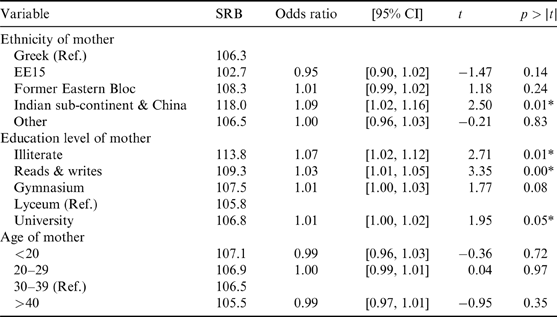
It is very likely that some of the variables that have been examined so far as determinants of the sex ratio at birth are inter-related. Educational level is usually associated with age, since women younger than 20 years of age cannot be university graduates and the youngest of them have not yet completed secondary education. Logistic regression helps us to disentangle, to some degree, the inter-relation between different variables and to decide which variables are more important determinants of the SRB. Table 3 presents the results from logistic regression in terms of odds ratios. Since there is no information available for each individual birth, one cannot take the sex of each newborn as the binary dependent variable and use the classical logistic regression. Instead, a grouped logistic regression was run, where the dependent variable was male births as a proportion of total births. This procedure produces weighted least-squares estimates, which are presented here in the form of odds ratios. The reference categories of the independent variables are the ones with the highest frequency of total births, that is ‘Greek’ for the variable ‘ethnicity of mother’, ‘Lyceum graduates’ (those who have finished secondary school, i.e. who have attained 12 years of education counting from primary school) for the variable ‘education of mother’ and ‘30–39’ for the variable ‘age of mother at birth’.
Results of logistic regression (weighted least-squares for grouped data) showing the role of ethnic group, education and age of mother in the SRB of legitimate births (N=741,761), Greece 2004–2010
F (11.953)=3.46; Prob>F=0.0001. R 2=0.038; adjusted R 2=0.027.
* p<0.05.
After experimenting with the data, it was found that the variation in SRB is statistically significant in only two variables: ethnic group of mother and education of mother. In the case of mother's education the likelihood of having a male birth over a female one differs significantly for legitimate births only. Therefore, in Table 3 only legitimate births are examined. Age of mother is also included in the model to show that, when controlling for ethnicity and education, the age of mother is not a strong determinant of the SRB.
The category ‘Ethnic Asian’ refers to mothers originated from the Indian sub-continent and China; these women are 1.09 times more likely to bear a boy than a native Greek is. This odds ratio is statistically significant (p=0.01), corroborating the earlier assumption that the extremely high SRB for people from the Indian sub-continent and China, who live in Greece, might be due to sex-selective abortions.
Women of very low educational level (categories ‘illiterate’ and ‘reads & writes’) are also significantly more likely to bear a boy compared with one who has completed secondary education (the reference category). These results support the supposition that the unnaturally high SRB for women with minimal education, and more so for illiterate ones, is due to some of these women intervening with their pregnancy in order to achieve the birth of a boy, or failing to register female births. The results of logistic regression are also statistically significant for university graduates, who are slightly more likely to bear a boy than women with only secondary education. Yet, this statistical significance for such a small difference in odds ratios is probably due to the large sample of university graduates (195,634 legitimate births during the period 2004–2010). On the other hand, the results for gymnasium graduates are not statistically significant because the sample is smaller (86,921 births).
The association of mother's age with SRB is not statistically significant and the only reason this variable was inserted in the model was to show that education of mother remains a strong correlate, even when controlling for age of mother, which means that education is a determinant of SRB per se.
Discussion and Conclusions
An unnaturally high SRB for Indian, Pakistani, Bangladeshi and Chinese people living in Greece is the most important finding of this research. A similarly high SRB for Asians in Greece had also been found by another study published in 2010 (Verropoulou & Tsimbos, Reference Veropoulou and Tsimbos2010). However, the study of Verropoulou and Tsimbos was based on births recorded in 2006 only and therefore the exceptionally high SRB for Asians may have been based on a relatively small number of observations (1239 births). It is now clearly understood that the distorted SRB for Asians is not a random effect that occurred in a year or two. Based on eight consecutive years (2004–2011) and on 4260 births born to Chinese, Indian, Pakistani and Bangladeshi mothers, one can be positive that sex-selective abortions take place among these people. A strong preference for boys is known to exist in their countries of origin and sex-selective abortions, as well as under-registration of female births, have been well established in the relevant literature, as discussed in the Introduction. It would be plausible, therefore, to assume that such a high SRB for people from the Indian sub-continent and China, who live in Greece, is also due to sex-selective abortions and perhaps under-registration of girls.
The second striking finding of this research is that a strong preference for boys is also exhibited by the most uneducated classes of society among the native Greeks. An SRB of 113.4 boys per 100 girls among Greek illiterate women implies that some kind of sex-selection takes place in the class of uneducated people. Logistic regression confirmed that women of very low educational level (categories ‘illiterate’ and ‘reads & writes’) are significantly more likely to bear a boy compared with someone who has completed secondary education (reference category) There are no data on the social background of these women, but in 21st century Greece the only people who do not attend compulsory education are marginal social groups that are not integrated into the usual norms of society. One such group are some members (not all and not the majority) of the Greek Roma. Education and ethnicity were the only variables that showed a significant association with SRB in the model of logistic regression used in this paper.
Sex ratio at birth by age of mother presents variation but this seems to be due to biological reasons. It is known that male fetuses are more likely to be spontaneously aborted when maternal stress is in action. This fact explains the very low SRB when the mother is less than 15 years old, at which age it is more likely that a pregnancy is unwanted. A low SRB is also observed in births born to women at the end of their reproductive years (45+).
Birth order was found to be positively associated with SRB as far as migrants from the Indian sub-continent and China are concerned. The dramatic increase in SRB from birth order 1 to birth order 3+ from 110 to 130 attests to the strong preference of South East Asians for sons: when a woman is pregnant with her third or higher parity child it is more likely that there is already a daughter in the family (from a previous birth). Therefore, female births after a certain number of children must be suppressed in favour of male births (Park & Cho, Reference Park and Cho1995).
Moreover, the results show that a preference for sons in families that already have two children may also exist in people from the former Eastern Bloc, since the SRB at parity 3+ rises to 112.5 from just under 108 at parities 1 and 2. It is interesting also that women from EU15 states bear 109.4 boys per 100 girls in their first confinement and only 98 boys per 100 girls in their second one. Nevertheless, the results regarding the variation of SRB by birth order in this ethnic group (EU15) are not statistically significant. A larger sample (larger than the 5069 births born to women who originated from EU15 states in the present data) might give more reliable results and permit the deduction of safer conclusions.