Introduction
Alcohol use disorders are among the most prevalent mental disorders worldwide, and are the cause of significant disability and burden (World Health Organisation, 2001). The literature available to date clearly indicates that various problems in psychosocial functioning are commonly found in people with alcohol use disorders (O’Connell & Beyser, Reference O’Connell and Beyser2002; McCrady, Reference McCrady2006), and that these problems are more common in this group than in the general population (Grant et al. Reference Grant, Stinson, Hasin, Dawson, Chou, Dufour, Compton, Pickering and Kaplan2004).
The most commonly occurring co-morbid conditions in individuals with alcohol problems are mood and anxiety disorders (Rosenthal & Westreich, Reference Reeve1999), with the incidence of co-morbidity varying across studies. Overall co-morbidity has been reported at 37% (Rosenthal & Westreich, Reference Reeve1999), while 12-month prevalence for mood and anxiety problems has been reported as 19% and 17%, respectively (Grant et al. Reference Grant, Stinson, Dawson, Chou, Dufour, Compton, Pickering and Kaplan2006). The incidence of co-morbidity among treatment-seeking individuals has been reported to be higher, with rates of 41% and 33% reported for mood and anxiety disorders, respectively (Grant et al. Reference Grant, Stinson, Dawson, Chou, Dufour, Compton, Pickering and Kaplan2006).
Di Sclafani et al. (Reference Di Sclafani, Finn and Fein2008) found that individuals with alcohol problems who have never received treatment reported higher levels of psychiatric pathology than a control group without alcohol problems. However, the bulk of this difference was due to sub-diagnostic levels of distress, and the two groups did not differ in terms of the quantity of non-alcohol-related psychiatric diagnoses they received. Similar findings have been reported for abstinent alcoholics (Fein et al. Reference Fein, Di Sclafani, Finn and Scheiner2007), questioning whether differences in psychiatric symptom levels are sufficient to generate such high rates of co-morbid diagnoses.
One problem that arises for clinicians working with clients with alcohol and other substance use disorders is the need to distinguish between co-morbid conditions (i.e. independent psychiatric problems) and conditions where psychiatric symptoms are secondary to the substance misuse. Substance-induced depression cannot be distinguished from an independent major depressive disorder (MDD) based on symptomatology alone (Seignourel et al. Reference Rush, First and Blacker2008). Similarly, symptoms that result directly from cessation of alcohol consumption in individuals with alcohol use disorders may be virtually indistinguishable from anxiety symptoms to both patients and professionals (Ramirez, 2002).
It is not possible to assess mood and anxiety symptoms accurately while an individual is still actively using alcohol or other addictive substances. For example, the American Psychiatric Association states that in order to make a diagnosis of MDD, clinically significant depressive symptoms must be present during a period of abstinence of at least 1 month, and preferably longer (American Psychiatric Association, 2000). One research report (Reeve, Reference Ramirez2002) indicated that most patients entering alcohol treatment centres would fulfil the criteria for major depression, but that 80% of these cases resolve within 2 weeks through abstinence alone.
The variability in reported levels of psychiatric distress and the apparent reduction of symptoms with treatment of the alcohol problem calls into question the reliability and validity of diagnosing co-morbid conditions among individuals with alcohol use disorders who present for treatment of their alcohol problem. The present study was designed to examine this issue in greater depth. It sought to characterise the rates of co-morbid psychiatric symptoms among a group of individuals commencing treatment for alcohol dependence, and to examine the stability of these symptoms following treatment of the alcohol problem.
Methods
Study design
The present study was designed as a longitudinal study, where symptoms of anxiety, depression, and general psychosocial functioning of a group of individuals undergoing residential treatment for alcohol dependence would be examined at treatment entry and again, 28 days later, on completion of the treatment programme. Entry to the formal treatment programme only took place once a Chlordiazepoxide detox was completed and individuals were no longer taking addictive medications.
Study sample
The sample used in this study consisted of individuals entering the St. John of God Hospital alcohol treatment programme. This programme is mainly based on the Minnesota Model of treatment, and its primary focus is on targeting the alcohol problem rather than co-morbid psychiatric difficulties. All patients who were accepted onto the alcohol treatment programme were considered eligible to participate in this research project. Whilst programme co-ordinators make every attempt possible to offer treatment to any patient with alcohol use problems, a small number of inclusion/exclusion criteria do apply. These are as follows: (a) patients must have a diagnosis of alcohol dependence rather than alcohol abuse, (b) patients must not be currently actively psychotic, (c) patients must not be taking any addictive medications, (d) patients must have some desire to stop drinking, and (e) patients displaying signs of serious memory, attention, or other cognitive deficits that would likely impair their ability to learn from the experience of the 28-day programme were considered unsuitable for this form of treatment.
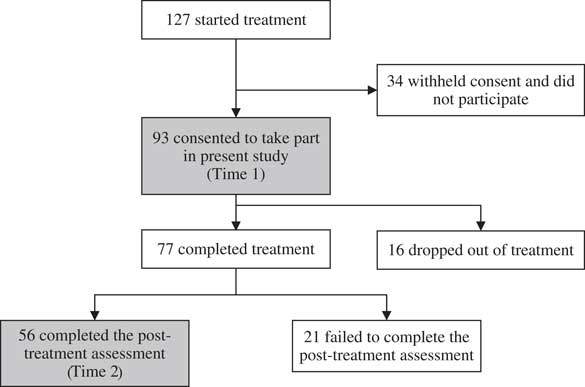
All patients who commenced the alcohol treatment programme in St. John of God Hospital in the 12-month period between February 2008 and January 2009 were approached to participate in this study. Out of a total of 127 patients, 93 (73.23%) agreed to participate. There were no significant differences in age, t (125)=−0.76, p>0.05, or gender χ 2 (1)=0.102, p>0.05, between those who gave consent and participated in the study and those who declined to participate.
The study sample contained 44 males and 49 females. They had an average age of 48.10 years. On average participants had received 14.55 years (s.d.=3.55) of formal education. The Wechsler Test of Adult Reading (The Psychological Corporation, Reference Seignourel, Green and Schmitz2001) was used to give an estimate of Full Scale IQ (FSIQ) and the study group had a mean FSIQ of 101.79 (s.d.=9.42). Participants in the present study all received a diagnosis of alcohol dependence, which was made by their clinical team before their commencement of the alcohol treatment programme. The Alcohol Use Disorders Identification Test (AUDIT) (Babor et al. Reference Babor, Higgins-Biddle, Saunders and Monteiro2001) was used to quantify participants’ alcohol problems in a standardised manner. The study group had a mean score of 27.96 (s.d.=5.73) on this measure.
Measures
Measures of anxiety and depression
Anxiety was measured in this study using the Beck Anxiety Inventory (BAI) (Beck and Steer, Reference Beck, Epstein, Brown and Steer1990), which is a 21-item self-report questionnaire that was designed to assess anxiety, with a focus on somatic symptoms. The BAI has been reported to have good internal consistency and adequate to good temporal stability (Rush et al. Reference Rosenthal and Westreich2008).
Depression was measured using the Beck Depression Inventory – II (BDI-II) (Beck et al. Reference Beck, Steer and Brown1996), a 21-item scale measuring cognitive, affective, and somatic symptoms of depression. The BDI-II has good internal consistency and good test–retest reliability (Beck et al. Reference Beck, Steer and Brown1996).
Procedure
Participants completed the aforementioned questionnaires at treatment entry after completing any detox (Time 1). Those who completed treatment were also asked to complete these same measures the night before they were discharged from the programme (Time 2).
Analysis
To identify whether participants as a group were reporting problematic levels of anxiety and depressive symptoms at treatment entry, their scores on the BAI and BDI-II were compared against scores reported in the literature for other clinical and non-clinical groups using one-sample t-tests. To characterise rates of reporting in the present sample, participants were classified according to severity groups reported in the BAI and BDI-II manuals.
In order to examine whether clients’ reported symptoms of anxiety and depression changed over the course of the 28-day inpatient treatment programme, the post-treatment scores of all participants for whom such data were available were compared against their scores at pre-treatment using t-tests for dependent samples.
In order to examine how the levels of anxiety and depressive symptoms reported by participants changed between treatment entry (Time 1) and treatment completion (Time 2), participants were first classified according to the cut-off scores suggested in the BAI and BDI-II manuals into groups representing ‘minimal’, ‘mild’, ‘moderate’ and ‘severe’ anxiety and depression (see Tables 2 and 3). The changes in classification from Time 1 to Time 2 were then examined using Wilcoxon’s signed ranks tests.
Results
Levels of anxiety and depression at treatment entry (Time 1)
The mean BAI score obtained by the study group (14.75; s.d.=13.59) was significantly higher than that of 9.31 reported by Dent and Salkovskis (Reference Dent and Salkovskis1986) for the non-clinical standardisation sample, t (92)=3.862, p<0.001, but significantly lower than that of 22.35 reported by Beck et al. (Reference Beck and Steer1988) for the clinical sample with diagnosed anxiety disorders, t (92)=−5.391, p<0.001. The mean score obtained by the study group on the BDI-II (21.34; s.d.=11.52) is significantly higher than the mean score of 12.56 reported for the non-clinical standardisation Beck et al. (Reference Beck, Steer and Brown1996) t (82)=6.941, p<0.001, and does not differ significantly from the mean score of 22.45 reported by Beck et al. (Reference Beck, Steer and Brown1996) for the clinical sample with diagnosed mood disorders, t (82)=−0.880, p>0.05.
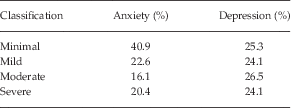
In order to characterise the rates of different levels of anxiety and depressive symptoms reported by participants at treatment entry, they were classified according to the cut-off scores suggested in the BAI and BDI-II manuals into groups representing ‘minimal’, ‘mild’, ‘moderate’ and ‘severe’ anxiety and depression. As can be seen from Table 1, ~60% of participants showed symptoms of mild or more severe anxiety, while the corresponding figure for depression was 75%.
Proportion of participants reporting different levels of anxiety and depression symptoms at Time 1

Composition of study group at Time 2 relative to Time 1
Post-treatment data were available for 56 of the 93 individuals who consented to participate in the study. Fig. 1 illustrates the composition of the participants who were lost to this stage of the study. In order to demonstrate that these 37 individuals did not differ from the 56 individuals who completed the post-treatment assessment, pre-treatment scores of the two groups on the measures of psychological functioning and on the AUDIT were compared using t-tests. There was no significant difference between the scores of those who completed the post-treatment assessment and those who did not on the BAI, t (91)=1.429, p>0.05, and the BDI-II, t (81)=1.362, p>0.05.
Outline of participants who took part in the pre- and post-treatment stages of the study.

Levels of anxiety and depression at treatment completion (Time 2)
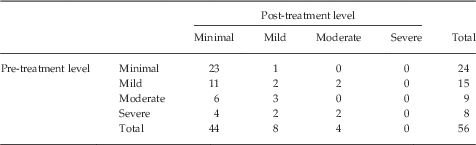
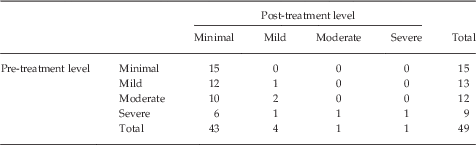
The group showed significant improvement in symptoms of anxiety (Time 1: mean=13.13, s.d.=12.96; Time 2: mean=4.68, s.d.=5.88), t (55)=5.006, p<0.001 and depression (Time 1: mean=19.76, s.d.=11.42; Time 2: mean=7.53, s.d.=7.67), t (48)=7.700, p<0.001. These scores at Time 2 were found to be lower (i.e. less symptomatic) than the non-clinical normative data reported above (BAI: t (55)=−5.896, p<0.001; BDI-II: t (53)=−5.383, p<0.001) (Tables 2 and 3).
Pre- and post-treatment levels of anxiety reported by participants

Pre- and post-treatment levels of depression reported by participants

Results of the analysis involving the severity classification of BAI anxiety symptoms indicated that the change in classification level was highly significant, z=4.404, N-Ties=31, p<0.001. Out of 56 individuals for whom data were available, 28 showed improvement, 25 showed no change, and only three showed deterioration when based on the classification of level of anxiety symptoms endorsed. When the BDI-II was examined, again this change was found to be highly significant, z=5.027, N-Ties=32, p<0.001. Out of 49 individuals for whom data were available at both time points 32 showed improvement, 17 showed no change, and none showed deterioration when based on the classification of level of depressive symptoms endorsed.
Discussion
This study was carried out in a single clinic using a non-random sample – all consecutive admissions over a 12-month period were approached to participate. The first aim of the study was to characterise the rates of co-morbid psychiatric symptoms among a group of individuals commencing treatment for alcohol dependence. The second aim of the study was to examine the stability of these symptoms over the course of a 28-day inpatient treatment programme targeting alcohol dependence.
At treatment entry, participants as a group reported significantly greater levels of anxiety and depressive symptoms (as measured by the BAI and BDI-II) compared with non-clinical standardisation samples (Dent and Salkovskis, Reference Dent and Salkovskis1986; Beck et al. Reference Beck, Steer and Brown1996). They reported fewer anxiety symptoms than a clinical sample with diagnosed anxiety disorders (Beck et al. Reference Beck and Steer1988). The level of depressive symptom endorsement did not differ from that reported by a clinical sample with diagnosed mood disorders (Beck et al. Reference Beck, Steer and Brown1996). These findings are in keeping with past research, where high levels of psychiatric symptoms are found in individuals with alcohol problems (e.g. Rosenthal and Westreich, Reference Reeve1999; Grant et al. Reference Grant, Stinson, Dawson, Chou, Dufour, Compton, Pickering and Kaplan2006).
At the time of completing treatment, the levels of anxiety and depressive symptoms reported by participants had fallen significantly despite the fact that treatment did not directly tackle these symptoms. Indeed, at the end of treatment the levels of anxiety and depressive symptoms reported by the study group were lower than the levels reported by the non-clinical standardisation samples for the BAI (Dent and Salkovskis, Reference Dent and Salkovskis1986) and the BDI-II (Beck et al. Reference Beck, Steer and Brown1996).
The finding that participants in the present study reported low levels of psychiatric symptoms (21.4% for anxiety and 12.2% for depression) on completion of treatment for their alcohol problem is in stark contrast to the levels reported at treatment entry (59.1% for anxiety and 74.7% for depression). Rates from the present study at treatment completion are lower than those reported by Rosenthal and Westreich (Reference Reeve1999) and by Grant et al. (Reference Grant, Stinson, Dawson, Chou, Dufour, Compton, Pickering and Kaplan2006) for treatment-seeking individuals. However, they are similar to 12-month prevalence rates reported by Grant et al (Reference Grant, Stinson, Dawson, Chou, Dufour, Compton, Pickering and Kaplan2006). The reduction in reported symptoms from start to end of treatment is strikingly similar to that reported by Reeve (Reference Ramirez2002), where symptoms that appear to suggest the presence of psychiatric co-morbidity abate through treatment of the alcohol problem alone. Similar findings are reported by Gossop et al. (Reference Gossop, Marsden and Stewart2006) in UK drug users (primarily opioid dependent) after treatment for their drug dependence. This begs the question of the extent to which seemingly co-morbid problems may be more accurately explained as either substance induced or withdrawal related.
It is not possible to distinguish between substance-related depression and independent major depression on the basis of symptoms alone (Seignourel et al. Reference Rush, First and Blacker2008). Similarly, symptoms arising from alcohol withdrawal may be virtually indistinguishable from anxiety symptoms (Ramirez, 2002). One of the key factors in distinguishing between co-morbid mood/anxiety disorders and substance-related disorders is the persistence of symptoms in the absence of active substance use (American Psychiatric Association, 2000). The fact that psychiatric symptoms abated for the majority of participants through treatment of the alcohol problem alone suggests that a significant proportion of seemingly co-morbid conditions were actually substance-related in nature. This holds important implications for diagnosing and treating mood and anxiety disorders in individuals presenting for treatment of an alcohol problem.
The results of the present study suggest that diagnosing mood and anxiety problems in people presenting with an active alcohol dependence disorder is an unreliable practice, and consequently questions the validity of such diagnoses. That is not to say that individuals with alcohol problems do not experience co-morbid conditions. Rather, the results suggest that co-morbidity may be better diagnosed after a period of abstinence during which the alcohol problem has been treated. Assessing for co-morbid conditions at time of treatment seeking, while the person is still using alcohol, is likely to result in some individuals being inappropriately diagnosed with a co-morbid condition. It may also result in inappropriate or unnecessary treatments being prescribed for such individuals.
Limitations
The sample was not randomly selected but was a cohort sample of consecutive admissions to a single clinic over a 12-month period. The relatively small sample size and the fact that post-treatment measures were not available for a sizeable proportion of the study sample limits generalisability of results. It is possible that those who dropped out of treatment or who failed to complete post-treatment measures continued to experience symptoms of anxiety/depression despite not differing at treatment entry from those who completed post-treatment measures. Our ability to generalise results is also limited by the fact that the study took place in a private hospital whose funding is principally through private health insurance. Although independent of the treating team and not working on the treatment programme, the principal researcher was employed in the associated organisation.
Financial Support
This research received no specific grant from any funding agency, commercial, or not-for-profit sectors. It was undertaken as part of the requirements for the Doctorate in Clinical Psychology undertaken by the first author. This training was sponsored by Saint John of God Hospital and Saint John of God Menni Services.
Conflicts of Interest
None.
Ethical Standards
The authors assert that all procedures contributing to this work comply with the ethical standards of the relevant national and institutional guidelines on human experimentation and with the Helsinki Declaration of 1975, as revised in 2008. Ethical approval for this research project was sought and obtained from the Saint John of God Provincial Ethics Committee in Stillorgan, Dublin, Ireland, and from the Human Research Ethics Committee in University College, Dublin, Ireland.