INTRODUCTION
The rough-toothed dolphin (Steno bredanensis Lesson, 1828) is known to be endemic to the offshore waters of tropical, sub-tropical and warm-temperate seas around the world. This species prefers deep waters with a sea surface temperature (SST) of 25°C (Leatherwood & Reeves, Reference Leatherwood and Reeves1983; Miyazaki & Perrin, Reference Miyazaki, Perrin, Ridgeway and Harrison1994; Jefferson, Reference Jefferson, Perrin, Würsig and Thewissen2002) although they do occur in waters with lower water temperatures (Ott & Danilewicz, Reference Ott and Danilewicz1996; Ritter, Reference Ritter2002). The rough-toothed dolphin appears grey in colour without obvious pigmentation patterns apart from a distinctively-shaped dark cape and variable areas of mottling with white/pink spotted areas on the latero-ventral region. The literature concerning rough-toothed dolphins indicates that little is known about this species (Miyazaki & Perrin, Reference Miyazaki, Perrin, Ridgeway and Harrison1994; Steiner, Reference Steiner1995; Waring et al., Reference Waring, Palka, Mullin, Hain, Heansen and Bisack1997; Addink & Smeenk, Reference Addink and Smeenk2001; Jefferson, Reference Jefferson, Perrin, Würsig and Thewissen2002; Kuczaj & Yeater, Reference Kuczaj and Yeater2007; Baird et al., Reference Baird, Webster, Mahaffy, McSweeney, Schorr and Ligon2008). In September 2002, a stranded dead rough-toothed dolphin was reported at Gamba (Gabon) and this finding provided the first verifiable record of this species in Gabon waters (Rosenbaum & Collins, Reference Rosenbaum and Collins2004). Weir (Reference Weir2006) reported three at-sea sightings with rough-toothed dolphins off Angola and one off Gabon. The species has also been recorded for the Côte d'Ivoire, Ghana, St Helana (Cadenat, Reference Cadenat1959; MacLeod & Bennett, Reference MacLeod and Bennett2006; Weir, Reference Weir2010), in the western Gulf of Guinea (Jefferson et al., Reference Jefferson, Curry, Leatherwood and Powell1997; Van Waerebeek & Ofori-Danson, Reference Van Waerebeek and Ofori-Danson1999; Ofori-Danson et al., Reference Ofori-Danson, Van Waerebeek and Debrah2003) and off north-west Africa (Jefferson et al., Reference Jefferson, Curry, Leatherwood and Powell1997), although published at-sea records are rare. Information concerning the behaviour of rough-toothed dolphins is sparse (Kuczaj & Yeater, Reference Kuczaj and Yeater2007) and some notes regarding behavioural observations are included in this note.
MATERIALS AND METHODS
A dedicated cetacean survey was carried out off Gabon, West Africa between 5 March and 7 August 2009 aboard a geophysical seismic survey vessel, the CGG ‘Venturer’ at 12.5 m eye height. The study area was situated approximately between 25 and 130 nautical miles off the coast. Dedicated watches were carried out by one observer scanning with the naked eye but using binoculars (8 × 43 Leica) aiding species identification and group size estimations. Standard Joint Nature Conservation Committee recording forms were used (JNCC, 2004). The radial sighting distance to animal(s) was determined using a range finding stick (Komdeur et al., Reference Komdeur, Bertelsen and Cracknell1992). The bearing to animal(s) and their heading were determined by ship's compass. Other sightings data included time (UTC), water depth (depth sounder or electronic sea chart), presence of calf and/or juvenile, school size, group composition and behaviour.
The behaviours of the dolphins were noted in 3-minute samples during focal group follows (Mann, Reference Mann1999). Behaviour states included travel, foraging, milling, resting, social, interaction with boat, acrobatics and play with object. Behaviour events were recorded continuously (such as spy hop, fluke slap, breach and swimming abreast) using a dictaphone and digital photographs.
The following environmental data were collected: GPS position, speed (knots), course, wind speed and direction, visibility (km), swell height (m), SST (°C) and Beaufort sea state. Photographs were taken with a digital camera (Sony α-700 with a SIGMA 70-200 f2.8 zoom lens).
RESULTS AND DISCUSSION
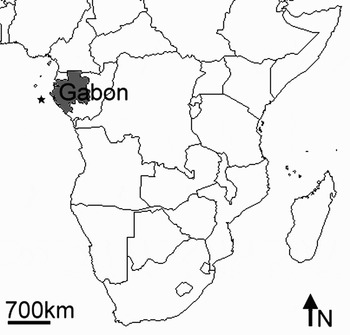
On 10 June 2009 1247 (GMT), at least 50 Steno bredanensis were sighted in deep offshore waters off Gabon (01°49′S – 07°27′E to 01°45′S – 07°29′E; Figure 1). This was the only sighting with rough-toothed dolphins during the total survey period. The encounter with the dolphins lasted 2 hours 43 minutes during which the vessel was travelling at a slow speed of 2.5 knots, steering a steady course in 3056 m deep waters. The vessel was not in operation at the time and was conducting maintenance on towed equipment. The visibility was excellent (>5 km) with a slight sea state, low swell (1 m) and a SST of 23.5°C. Details regarding other cetaceans are presented elsewhere (De Boer, in press).
Location of Gabon in tropical West Africa and sighting position of the rough-toothed dolphins (marked as an asterisk).

Surface behaviour
The group of 50 dolphins consisted of all age-classes, including six juveniles and two calves. Rough-toothed dolphins are usually observed in groups of 10 − 20 animals, although larger aggregations do occur (e.g. Leatherwood et al., Reference Leatherwood, Reeves, Perrin and Evans1982; MacLeod & Bennett, Reference MacLeod and Bennett2006; Baird et al., Reference Baird, Webster, Mahaffy, McSweeney, Schorr and Ligon2008). The dolphins were ‘surface active’ (displaying acrobatics) throughout the encounter and were travelling parallel to the vessel (staying on starboard only) or were briefly bow-riding and surfacing ahead of the vessel. The dolphins frequently changed direction with dolphins travelling either ahead of the vessel (up to a distance of 400 m) or travelling in an opposite direction until approaching the stern area. The direction change appeared to be initiated by tail-slapping of one and other (responding) dolphins upon which all the members of the pod would change direction. This behaviour of directional change following tail-slapping (or in some cases inverted tail-slapping) was noted on seven occasions and confirmed by the numerous photographs taken during the encounter. The period between the directional changes varied between 4 and 18 min but was no longer observed in the last hour of observations. The sub-group formations (2−8 animals) varied from tight to loose formations (2−5 body lengths). Towards the end of the observation period the dolphins were more widely dispersed with single animals seen more frequently at the surface.
The sub-groups were regularly seen travelling ‘line abreast’ as described in Neumann & Orams (Reference Neumann and Orams2003) involving up to 11 individuals. Such synchronous swimming behaviour among tightly spaced sub-groups may characterize this species (Steiner, Reference Steiner1995; Addink & Smeenk, Reference Addink and Smeenk2001; Pittman & Stinchcomb, Reference Pittman and Stinchcomb2002; Ritter, Reference Ritter2002; Götz et al., Reference Götz, Verfuß and Schnitzler2005). Social interactions were frequent and were carried out by both adults and juveniles and consisted of touch (pectoral fin rubbing), chasing and belly-flashing. Other active surface events observed included fluking, fluke rise, fluke wave, spy hop, flipper wave, chin slap, backwards leaping, high leaping, side leaping, breaching and spraying water out of the mouth. The dolphins were also seen foraging with animals swimming in circles and diving in a synchronized manner creating lots of splashes (‘carousel feeding’ in Neumann & Orams, Reference Neumann and Orams2003). One dolphin was observed carrying a plastic bag on its beak. The apparent playful nature of rough-toothed dolphins has been reported in other studies and they are known to associate with floating objects but also with other species like turtle (Caretta caretta) and puffer fish (Lagocephalus lagocephalus; Leatherwood et al., Reference Leatherwood, Reeves, Perrin and Evans1982; Watkins et al., Reference Watkins, Tyack, Moore and Notarbartolo-di-Sciara1987; Steiner, Reference Steiner1995; Lodi & Hetzel, Reference Lodi and Hetzel1999; Pitman & Stinchcomb, 2002; Ritter, Reference Ritter2002; Kuczaj & Highfill, Reference Kuczaj II and Highfill2005; Kuczaj & Yeater, Reference Kuczaj and Yeater2007).
On several occasions the dolphins were probably engaged in foraging activities with the dolphins observed circling in apparent coordinated movements as in pursuit of prey. The directional changes and repeated tail-slapping were probably carried out to affectively herd prey and such coordinated movements have been interpreted as co-operative foraging of rough-toothed dolphins (Steiner, Reference Steiner1995; Lodi & Hetzel, Reference Lodi and Hetzel1999; Addink & Smeenk, Reference Addink and Smeenk2001; Pitman & Stinchcom, 2002).
A large remora (family Echeneididae) was attached to one of the dolphins (right flank) but it was not possible to identify the remora to species as this is difficult without a close inspection (Fertl & Landry, Reference Fertl and Landry1999, Reference Fertl and Landry2002). It was also observed that a juvenile dolphin initially had an unidentified remora attached on its left flank but after a series of breaching events the remora appeared to have been dislodged.
Scarring and interactions with fishing gear
The dorsal fins of most animals showed features which allowed individual recognition, mainly nicks and scars, which were used to identify the sub-groups. The majority of the individuals showed extensive body-scarring and blotching and a few dolphins showed fresh pinkish wounds and older scars probably caused by bites from cookie-cutter sharks (Isistius brasiliensis) which are regularly observed on S. bredanensis (e.g. Miyazaki & Perrin, Reference Miyazaki, Perrin, Ridgeway and Harrison1994; Addink & Smeenk, Reference Addink and Smeenk2001). In addition to this, some dolphins showed scars probably caused by entanglement in fishing gear. These lesions included deep incisions around the dorsal fin and lacerations in front of the dorsal fin and are thought to be indicative of interactions with fishing gear (Kuiken et al., Reference Kuiken, Simpson, Allchin, Bennett, Codd, Harris, Howes, Kennedy, Kirkwood, Law, Merrett and Phillips1994). Towards the end of the encounter, the group was widely scattered and moved away from the vessel whilst briefly investigating a Fisheries Aggregating Device (FAD). Such interactions between rough-toothed dolphins and fishing gear, including FADs have been observed off Brazil, Hawaii and Mauritania (Maigret, Reference Maigret1994; Lodi & Hetzel, Reference Lodi and Hetzel1999; Addink & Smeenk, Reference Addink and Smeenk2001; Baird et al., Reference Baird, Webster, Mahaffy, McSweeney, Schorr and Ligon2008).
Anomalously white pigmentation
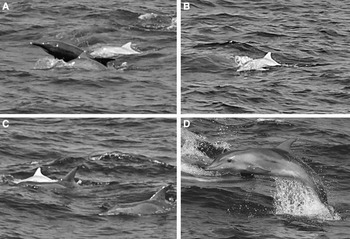
One of the calves was uniformly white and possessed a very faint outline of the characteristic caped pigmentation pattern (Figure 2). Examination of photographs indicated the presence of two small darker dots in the vicinity of the blowhole but unfortunately the eye colour could not be confirmed. The calf remained in close association with a normally pigmented adult and was seen surfacing on its own on two occasions and appeared to be interacting with other members of the pod. For the majority of the time, however, it was swimming in the echelon position and on one occasion the calf appeared to be suckling. The mother/calf pair was generally observed on the outskirts of the dolphin group, furthest from the vessel making a closest approach of approximately 350 m whilst other dolphins, including juveniles with slightly paler pigmentation compared to that of adults (Figure 2D), frequently approached the vessel to bow-ride.
Photographs of the anomalously white pigmented rough-toothed dolphin calf: (A) swimming with another calf in front, (B) surfacing on its own and (C) swimming next to adult. (D) Photograph of typically pigmented juvenile.

Albinism is differentiated from piebaldism (body pigmentation missing in only some areas) and leucism (dark-eyed anomalously white animals) and pigmentation patterns should not be the only criterion used to define albinism, as some mutant phenotypes (pseudo-albinism) may be due to the action of genes at other loci (Fertl & Rosel, Reference Fertl, Rosel, Perrin, Würsig and Thewissen2002). Anomalously white pigmentations have been recorded in a number of cetacean species (Hain & Leatherwood, Reference Hain and Leatherwood1982; Fertl et al., Reference Fertl, Pusser and Long1999, Reference Fertl, Barros, Rowlett, Estes and Richlen2004; Fertl & Rosel, Reference Fertl, Rosel, Perrin, Würsig and Thewissen2002; Stockin & Visser, Reference Stockin and Visser2005; Nascimento et al., Reference Nascimento, Spinelli, Santos, Queiroz, Pansard, Medeiros, Gondim, Jesus, Silva and Yamamoto2007). Fertl et al. (Reference Fertl, Pusser and Long1999) reviewed the occurrence of anomalously white cetaceans for 20 species, listing a sighting made in 1978 of a white S. bredanensis off Cocos Island, Costa Rica. Further investigation of this sighting, however, revealed that the individual was actually a ‘pale’ bottlenose dolphin (Tursiops sp.; Webber & Fertl, personal communications). No other records of anomalously white S. bredanensis have been reported (Fertl et al., Reference Fertl, Barros, Rowlett, Estes and Richlen2004). Anomalously pigmented S. bredanensis have been reported from Hawaii (piebaldism; R. Baird, personal communication) and from the Canary Islands (light-grey coloured individuals showing all normal flank patterns; Morganonline, 2007). Little is known about how common anomalously white cetaceans are and about the survivability of those presenting the condition (Fertl & Rosel, Reference Fertl, Rosel, Perrin, Würsig and Thewissen2002).
The present sighting provides the first record of an anomalously white rough-toothed dolphin and furthermore contributes to our knowledge of cetaceans in the relatively under-recorded tropical West African region.
ACKNOWLEDGEMENTS
Thanks to the bridge crew of the survey vessel and to CGG ‘Veritas’ DL and the Ministry of Gabon, and to all those who encouraged me to document this interesting encounter. The manuscript was improved by comments from N. Hodgins and S.A. Kuczaj.