This study focuses on language users who belong to the increasing number of young people growing up in multilingual urban neighborhoods in Stockholm. A significant number of these young people cannot be described easily in terms of such dichotomies as native-nonnative speakers, first-second language (L1-L2) users, or mono-bilinguals (see Fraurud & Boyd, Reference Fraurud, Boyd, Källström and Lindberg2011; Leung, Harris, & Rampton, Reference Leung, Harris and Rampton1997). They were born in Sweden or arrived at an early age and speak Swedish as (one of) their L1(s) or as an early additional language. They have a high proficiency in Swedish, which is also the language that most of them feel most confident in and prefer to speak. In addition to the majority language Swedish (as well as foreign languages in the national curriculum such as English and French), these young speakers have linguistic backgrounds and experiences that involve one or more other languages in different ways—because of either domestic or community multilingualism.
The manner in which some of these young people use the majority language sometimes differs from that of young people from more homogeneous, monolingual neighborhoods. For example, in main clauses in which a constituent other than the subject is in initial position, such speakers may vary between using standard Swedish word order—namely the verb-second (V2) rule—and a violation against this rule—noninversion. Thus, instances of Sen stack han (“Then he left”; ADVERBIAL VERB SUBJECT) alternate with Sen han stack (ADVERBIAL SUBJECT VERB). Possibly due to its salience, this feature is commonly assumed to be much more frequent than empirical evidence has shown it to be; for most of the young people who use it, it is confined to peer-to-peer interactions and specific functions (Ganuza, Reference Ganuza2008). Noninversion is also a well-known syntactic feature in learner Swedish, which is probably why it is generally interpreted as an indication of nonnativeness—regardless of the speaker’s actual linguistic background. Similar phenomena have also been observed in other multilingual urban contexts in Europe. Such migration-induced linguistic variation has been approached by researchers from psycholinguistic and SLA perspectives as well as from various sociolinguistic and ethnographic perspectives.
From a cognitive and psycholinguistic point of view, this variation has been analyzed as a type 1 variation in advanced, near-native, or nativelike L2 acquisition and use (Ekberg, Reference Ekberg, Møller, Quist, Holmen and Jørgensen1998, Reference Ekberg, Hyltenstam and Lindberg2004; Hyltenstam, Reference Hyltenstam and Harris1992; Hyltenstam & Abrahamsson, Reference Hyltenstam, Abrahamsson, Doughty and Long2003; Stroud, Reference Stroud, Holmen, Hansen, Gimbel and Jørgensen1988).Footnote 1 From a social point of view, the variation has been analyzed in terms of new or emerging varieties of the majority language (e.g., Fraurud & Bijvoet, Reference Fraurud, Bijvoet, Hyltenstam and Lindberg2004; Kotsinas, Reference Kotsinas, Linell, Adelswärd, Nilsson and Petersson1988; Quist, Reference Quist2000). Here, two major strands can be discerned: approaches that are mainly descriptive or variationist (Cheshire, Fox, Kerswill, & Torgersen, Reference Cheshire, Fox, Kerswill and Torgersen2008; Ganuza, Reference Ganuza2008; Opsahl & Nistov, Reference Opsahl, Nistov, Quist and Svendsen2010; Torgersen, Kerswill, & Fox, Reference Torgersen, Kerswill, Fox and Hinskens2006; Wiese, Reference Wiese2006, Reference Wiese2009) or those that are more interactionist or ethnographic (Aarsaether, Reference Aarsaether, Quist and Svendsen2010; Haglund, Reference Haglund, Quist and Svendsen2010; Jaspers, Reference Jaspers2008; Jonsson, Reference Jonsson2007; Keim, Reference Keim, Androutsopoulos and Georgakopoulou2003; Quist, Reference Quist2005; Rampton, Reference Rampton1995; Werndin, Reference Werndin, Musk and Wedin2010). In a recently concluded research project in Göteborg, Malmö, and Stockholm (the SUF project), various psycholinguistic and sociolinguistic approaches were combined (see Boyd & Fraurud, Reference Boyd, Fraurud, Auer and Schmidt2010; Ganuza, Reference Ganuza2008; Prentice, Reference Prentice2010; Svensson, Reference Svensson2009; Tingsell, Reference Tingsell2007; Werndin, Reference Werndin, Musk and Wedin2010, and contributions in Källström & Lindberg, Reference Källström and Lindberg2011).Footnote 2
Whereas most of the SLA research in this context has focused on more or less clear cases of L2 users, paying special attention to near-nativeness, the main bulk of the sociolinguistic research has focused on styles, practices, or slang associated with young urban multilinguals. An integration of both approaches is necessary for the understanding of the language development and use of high-level (L1-L2) users such as those observed in the present study. Furthermore, to account for the full range of language variation and language users in these settings, it may be necessary to reconsider some of the traditional notions within sociolinguistics and SLA, including, for example, language variety (see Bijvoet & Fraurud, Reference Bijvoet, Fraurud, Källström and Lindberg2011) and target language.
In the context of the present thematic issue of SSLA on high-level L2 acquisition, learning, and use, a challenging question is as follows: What is the (actual) target language of (individual) language users? The answer to this question is far from straightforward. First, the extent to which the term target language is applicable in a study like this is questionable because the use of the word would strongly suggest that it deals with learners, and L2 learners in particular. However, the object of study also includes language users and language use at the margins of established notions such as L1-L2 user-use. Second, the answer to the question is complicated by the fact that the assumed target language is not homogeneous. The majority language displays sociolinguistic variation, the acquisition of which has been studied within SLA in terms of type 2 variation—in addition to type 1 variation or “the variable nature of the interlanguage of L2 learners” (Mougeon, Rehner, & Nadasdi, Reference Mougeon, Rehner and Nadasdi2004, p. 408). Third, and perhaps most importantly, today’s multilingual urban settings embrace variation that falls outside the “NS [native speaker] patterns of variation” (Bayley & Regan, Reference Bayley and Regan2004, p. 325) and thus also outside the normal range of type 2 studies. When attributing language users with agency, the possibility must be acknowledged that their targets may differ from the L1 norm (e.g., Cook, Reference Cook1999; Sridhar & Sridhar, Reference Sridhar and Sridhar1986). A further complicating (and much less researched) issue has to do with how people actually perceive and construct the sociolinguistic variation that surrounds them—that is, constructions that the authors have found to differ considerably from individual to individual.
Young people in today’s multilingual neighborhoods may construct, for example, native Swedish in a way that does not agree with the monolingual Swedish norm. One of the participants in the speaker evaluation study presented in this article expressed a very distinct opinion of what native Swedish sounds like: “Swedes speak slowly and they love long words.”Footnote 3 When this participant was given the prompt “speak like a typical Swede” (in an imaginary phone call about going to the cinema), his overall phonology and grammar became nativelike or near-native. However, instead of using the standard word for “cinema,” bio, he used an almost archaic word, biograf, pronouncing it slowly and clearly. His articulated b-i-o-g-r-a-f-e-n (the cinema) was commented on by several listeners in the study, who interpreted it in the opposite way of what he intended: as evidence of what they conceive of as his nonnativeness.
Taking these complexities into account, how is it possible to gain insight into what the individual language user targets, or rather relates to, in his or her language development and use? A necessary first step is to study the language user’s perceptions of ambient sociolinguistic variation, letting perception embrace both language attitudes in a traditional sense and sociolinguistic awareness—that is, awareness of the linguistic differences and social meanings with which these are associated. This approach is illustrated in this article by presenting a selection of data from a speaker evaluation study carried out within the research project entitled Sociolinguistic Awareness and Language Attitudes in Multilingual Contexts (SALAM).Footnote 4
A STUDY OF YOUNG PEOPLE’S PERCEPTIONS OF AMBIENT SOCIOLINGUISTIC VARIATION
With the aim of assessing young Stockholmers’ perceptions of ambient sociolinguistic variation, a speaker evaluation experiment was carried out, using a methodology inspired by perceptual dialectology within folk linguistics (Niedzielski & Preston, Reference Niedzielski and Preston2003, and contributions in Long, Reference Long2002, and Preston, Reference Preston1999) on the one hand and language attitude research on the other hand (e.g., Garrett, Reference Garrett2010). Because little research has been done on contemporary language variation in Stockholm thus far, this study called for an exploratory approach. The design involved eliciting and combining different—quantitative as well as qualitative—data types. This design was developed through a series of pilot studies, one of which is reported in Bijvoet and Fraurud (Reference Bijvoet and Fraurud2008, Reference Bijvoet, Fraurud, Källström and Lindberg2011).
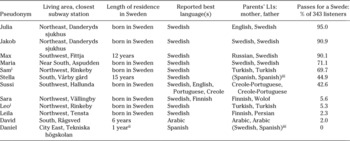
Speech samples of 20–25 s each were collected from a total of 48 speakers, all residents of Stockholm (age range: 17–21). The purpose was to include speakers whose linguistic, ethnic, and social backgrounds broadly differed without using preconceived categories of speakers or ways of speaking, and without dismissing participants who fell in between established categories or dividing them into test and control groups. The speech samples were elicited by means of a method developed to produce stimuli that were spontaneous and peer directed at the same time as the content was controlled. The speakers were asked to make an imaginary phone call to a good friend, more or less closely following a specified structure. They were encouraged to use their own words and ways of speaking. To avoid verbatim repetition, no written manuscript was provided; instead, the speakers listened to a couple of sample phone calls recorded earlier (for a detailed description of the elicitation method, see Bijvoet & Fraurud, Reference Bijvoet, Fraurud, Quist and Svendsen2010). In all, 161 speech samples were obtained from the 48 speakers. After testing a first selection of recordings on a small listener panel, 12 samples were selected as stimuli, which were judged to have a quality of authenticity and which offered a broad illustration of language variation among young Stockholmers (see Table 1). Two of these samples were produced by one and the same speaker (i.e., a matched guise, see Lambert, Hodgson, Gardner, & Fillenbaum, Reference Lambert, Hodgson, Gardner and Fillenbaum1960). This speaker (Leo-Sam in Table 1) had Turkish parents, was born in Sweden, and had lived all his life in Rinkeby.Footnote 5 He produced his first speech sample (referred to as speaker Leo) when asked (just like all the other speakers) to imagine talking to a close friend. The second sample (referred to as speaker Sam) was produced when he was asked to speak the way he might in order to pass for a “typical Swede.”Footnote 6 It is worth noting that none of the listeners in the study detected that the samples were produced by the same speaker, and many of them could hardly believe it when told afterward.
Brief description of the twelve speech stimuli

i The Sam and Leo stimuli is produced by the same speaker (i.e., a matched guise).
ii Born in Sweden, abroad since two years of age.
iii Not living with his or her parents.
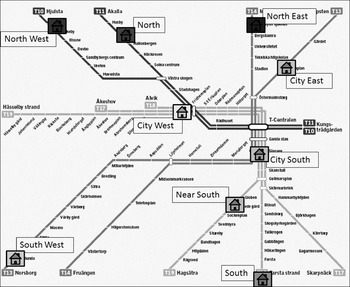
In the experiment, the 12 stimuli were played back to 16 groups of listeners (n = 343) who attended nine senior high schools in different areas of Stockholm, with each school represented by at least 30 students. Just like the speakers, the listeners had varying ethnic and social backgrounds as well as linguistic experiences. Their median age was 17. The nine senior high schools involved in this study are indicated on the Stockholm subway map in Figure 1.
Stockholm subway map showing the nine schools participating in the study.

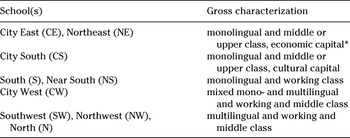
In a simplified way, the nine schools can be characterized in terms of monolingualism or multilingualism and social class (see Appendix A). These characterizations are adequate for a majority of the students at each school, as is also confirmed by demographic research (Broady, Reference Broady2002; Broady & Börjesson, Reference Broady, Börjesson and Lundgren2008). However, they are simplifying in that the schools also include individuals who differ from the majority with regard to background, which is why it is important to analyze and report data at both the group and the individual level. In this presentation of data, individual and groups of listeners are sometimes referred to as monolingual or bilingual. Bilingual is used for those listeners who report that they speak at least one language in addition to the majority language, Swedish, or foreign languages in the national curriculum. However, it is important to remember that this dichotomy often conceals considerable heterogeneity with regard to quantitative and qualitative aspects of monolingualism and multilingualism within the resulting groups. Further individual characteristics will be mentioned when deemed relevant in the present context.
The 343 listeners were presented with the stimuli, numbered 1 to 12, one at a time. First, they evaluated each speaker on semantic differential scales of the kind frequently used in language attitude studies (Garrett, Reference Garrett2010; Garrett, Coupland, & Williams, Reference Garrett, Coupland and Williams2003). Second, they listened again to the stimuli and filled in a questionnaire that contained open-ended as well as multiple-choice questions. They were asked to make guesses about the speakers’ linguistic and social background, both directly (i.e., by indicating the L1 of the parents as well as the speaker’s length of residence in Sweden) and indirectly (i.e., by indicating the speaker’s area of residence on a Stockholm subway map included in the questionnaire—choosing one of the 100 stations). The listeners could also provide comments pertaining to their subway station choices. Additionally, all listeners were asked—for each speaker—how they would label the kind of Swedish they were listening to.
After the entire listener group had filled in the questionnaire, 3 to 5 students from each group were invited to elaborate on their views on language variation in Stockholm in a semidirected group discussion. In all, 20% of the listeners (n = 69) took part in these discussions, which had an average length of 40 min and yielded about 10 hr of recording. As a point of departure for the discussions, speech samples were played back again, and the participants were asked questions, among other things, about how they would position their own way of speaking in relation to four of the samples (i.e., a linguistic self-perception task), and how they would group these speakers with regard to likely friendships. They were also asked to freely associate on several speakers and to imitate their ways of speaking. They also reported on their mobility in, familiarity with, and perceptions of different neighborhoods in Stockholm. The group discussions provided opportunities for an in-depth dialogue with the participants and supplied further details on their perceptions. These data constitute an essential tool for the interpretation of the questionnaire data (an overview of the different tasks and data types is presented in Appendix B).
The sections “Convergent Perceptions: Shared Stereotypes” and “Divergent Perceptions: Individual Differentiations” illustrate with data not only how the listeners displayed convergent perceptions of ambient sociolinguistic variation in some respects but also—and more interestingly—how they divided and related to the linguistic space of Stockholm in very different ways.
CONVERGENT PERCEPTIONS: SHARED STEREOTYPES
It is clear that people living in the same city will have partially overlapping experience and knowledge as well as stereotypes and views about the demography and sociolinguistics of the city. This is reflected in the responses from the 343 young listeners in the SALAM study. Regarding issues about who lives where and how people speak in different parts of the city, there was a strong convergence among the listeners for some of the 12 stimuli speakers, whereas, perhaps more importantly, other stimuli triggered widely divergent perceptions (see the “Divergent Perceptions: Individual Differentiations” section). One reflection of the partial convergence can be seen in the total accumulation of all listeners’ guesses concerning a speaker’s area of residence. Asking listeners to indicate, for each speaker, one of the 100 stations on the Stockholm underground map was one way to indirectly elicit their constructions of the sociocultural structure of the city as well as the speaker’s position within this structure. Somewhat remarkably, each of the 100 subway stations was selected by at least one listener for at least one speaker, which illustrates a spread that can be related to individual differences in local affiliations.
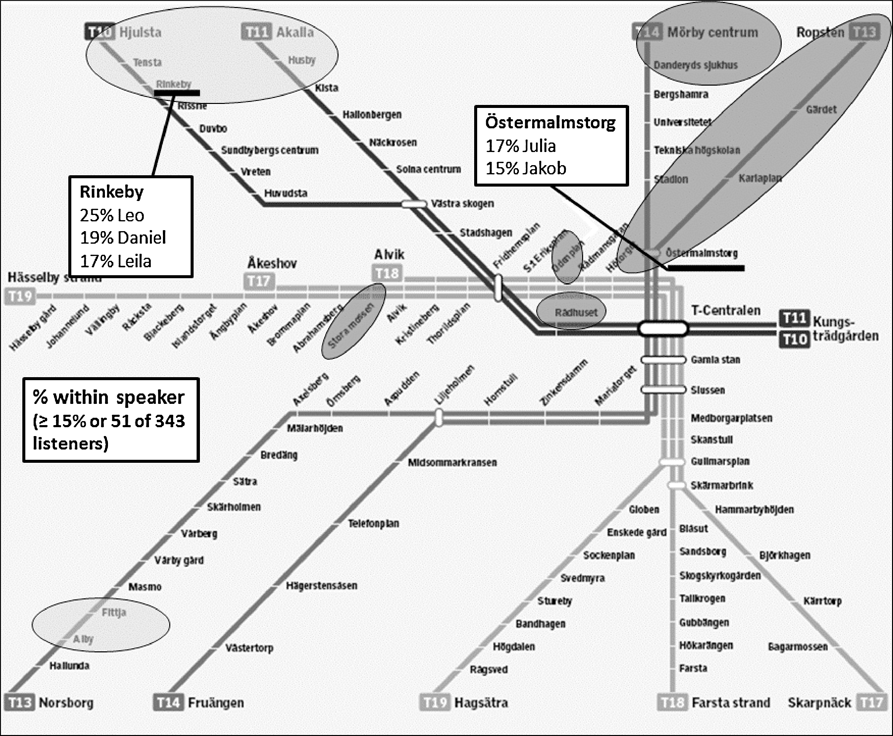
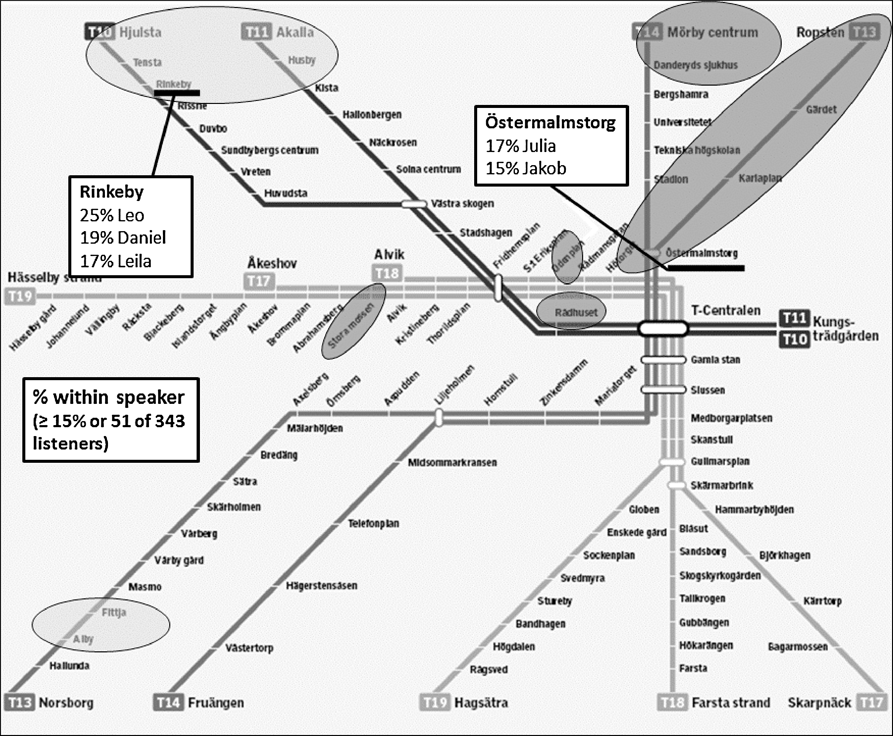
More striking, however, was the overall convergence of guesses, as reflected in the result of a hierarchical cluster analysis.Footnote 7Figure 2 shows, on the underground map, some results of this analysis of the guesses from all 343 listeners concerning all 12 speakers. For graphical reasons, it is not possible to present all the clusters on the map here, but the two most prominent ones are indicated by ellipses in two shades of gray. These two clusters of stations stand out in that they contain the highest percentages of listeners making a particular speaker-station association, and they thus reflect two prominent who-lives-where stereotypes (only associations made by at least 15%, n = 51, of the listeners are displayed here). The light gray subway cluster contains multilingual areas in the outskirts of Stockholm, including the emblematic suburb Rinkeby, where, for example, as many as one fourth of the listeners believed that speaker Leo lives (rather than in any of the other 99 places). The darker gray subway cluster contains upper-class villa areas to the west and northeast of the city, and a number of areas in central and northeastern Stockholm, including Östermalmstorg, where, for example, 17% of the listeners placed speaker Julia. Leo and Julia seem to be good representatives for two common speaker stereotypes: the guy from the multilingual suburb and the upper-class girl.
Hierarchical cluster analysis of the guesses of all 343 listeners as to the place of residence of all 12 speakers (two of six clusters).
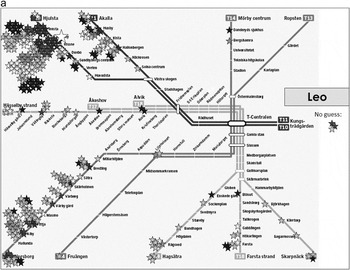
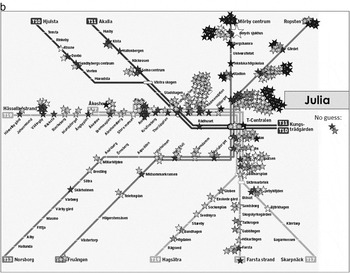
A more detailed picture of how all individual listeners locate Leo and Julia in Stockholm is given in Figures 3a and 3b (in which each star represents a listener’s guess, and the larger star represents the actual place of residence of the speaker). Again there was a convergence among listeners in that most of them placed Leo and Julia in multiethnic and upper-class areas, respectively—for Julia, however, there were a somewhat higher number of exceptions. The wider range of guesses concerning Julia’s place of living can partly be related to the observation that parts of downtown Stockholm and the eastern subway line belong to the areas that, for some of the listeners, are more or less blank spots. Perhaps more importantly, Julia’s way of speaking is adopted by a wider group of young people from all over Stockholm because it seems to represent an ideal for many of them (see the discussion on linguistic self-perception in the “Divergent Perceptions: Individual Differentiations” section).
All 343 listeners’ guesses as to speaker Leo’s place of residence.

All 343 listeners’ guesses as to speaker Julia’s place of residence.

Factor analysis of the attitude scales for Leo and Julia: all schools.

Further detail of the stereotypes represented by Leo and Julia is provided by the listeners’ labeling of their ways of speaking. Most labels used for Leo’s way of speaking refer to nonstandard language in the form of either the slang of young people in the multiethnic suburb or simply accented Swedish (e.g., “Rinkeby Swedish,” “immigrant Swedish,” “slang,” “suburban Swedish,” and “broken Swedish”).Footnote 8 For a majority of listeners, Julia’s speech represents the opposite of Leo’s. Among the most frequent labels used to characterize Julia’s speech are, first and foremost, those that appear to denote some notion of the standard norm (e.g., “ordinary,” “good,” “pure,” “fine Swedish,” and simply “Swedish”). Other listeners noted an upper-class tone in her speech (e.g., “posh Swedish”) or a girlishness (e.g., fjortis, literally “fourteenager,” used as pejorative for early teenagers, mostly girls who lack maturity and have an obsessive fixation on appearance).
The listeners’ reactions to Leo’s and Julia’s speech are at least partly an echo of the perpetual debate about language and education in the media and society at large. The polarization of good and bad Swedish is long standing, but today the focus has shifted from what Bernstein (Reference Bernstein1958) called the restricted code of the working-class to alleged problems with multilingualism, or various conceptions of what is commonly perceived as Swedish with something foreign (Bijvoet & Fraurud, Reference Bijvoet and Fraurud2006).
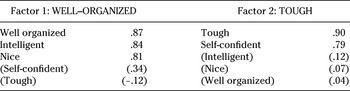
Convergent perceptions with regard to the evaluation of Leo and Julia and their ways of speaking are also reflected in the data from the semantic differential scales. To interpret the data from the adjective scales, a factor analysis was carried out to help identify the underlying dimensions that account for the patterns of correlation. This analysis reduced 5 of the adjective scales to 2 factors, which are labeled here as (after the property with the strongest loading, see Table 2): WELL ORGANIZED, conflating the properties well-organized, intelligent, and nice, and TOUGH, conflating tough and self-confident.Footnote 9
Factor analysis of the adjective scale data for all speakers and all listeners

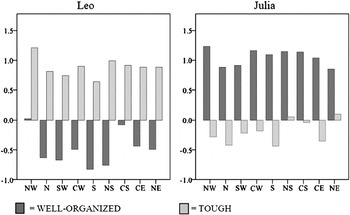
As evident in Figure 4, reactions to Leo’s and Julia’s speech are almost in direct opposition of one another. Leo’s way of speaking generally triggers high values on the properties tough and self-confident. At the same time, a majority of the schools ascribe fairly low values to him for the properties conflated in the factor WELL–ORGANIZED. For Julia, the factor WELL–ORGANIZED has a very positive representation in the responses from all listeners at all schools, which means that they assign high values on scales measuring the properties well-organized, intelligent, and nice. The other dimension (TOUGHNESS) is ascribed rather low values, which signals that listeners from a majority of the schools perceive Julia as a nontough, non-self-confident person. Some differences between the schools can be observed, however. For example, according to students from Northwest and City South schools, the dimension WELL–ORGANIZED does not contribute either positively or negatively to how Leo is characterized. Additionally, according to listeners from Near South, City South, and Northeast schools, TOUGHNESS does not contribute to the listeners’ characterization of Julia. Due to a lack of space, it is not possible to go further into the differences between schools. The general picture, however, is clear, and the attitude scales provide further characteristics to the two stereotypes of the tough guy from the multilingual suburb and the well-behaved girl from the upper-class area.
DIVERGENT PERCEPTIONS: INDIVIDUAL DIFFERENTIATIONS
Besides the partly convergent constructions of some demographic and sociolinguistic facts of Stockholm and of certain speaker stereotypes, the 343 listeners in this study diverge considerably in several beliefs and evaluations. They differ with regard to which aspects of linguistic variation they attach the most importance to: nativeness-ethnicity, correctness, social class, gender, or authenticity. They differ in the way they identify and delineate good Swedish and other constructs. And they also differ in how they relate their own speech to that of others.
What Matters Most: Ethnicity, Social Class, or Correctness?
The design of this study involved eliciting and combining different—quantitative as well as qualitative—data types. These data types show how individual listeners may focus on different dimensions of sociolinguistic variation, which results in different ways to divide and relate to the linguistic space of Stockholm. To illustrate this, data from 3 listeners (here called Henrik, Hasse, and Hannah) are presented in this section in some detail.
Henrik has a monolingual family background. He lives in an upper-class neighborhood and is a student in a social science program with an economics focus at Northeast School.Footnote 10 Hasse’s family background is also monolingual. He lives in a working-class area and is a student in a construction program at South School. Finally, Hannah has a bilingual family background (Arabic-Swedish). She lives in a multilingual neighborhood and is a student in a social science program at Northwest School.
The data types used here include variety labels, guesses about the speakers’ area of residence and linguistic background, self-perception data, and the data obtained from group discussions. A dimmed version of the Stockholm subway map as a structure in the background is used here to display these data for each of the three listeners (Figures 5, 6, and 7, respectively).
Henrik’s perception of ambient sociolinguistic variation.

Hasse’s perception of ambient sociolinguistic variation.

Hannah’s perception of ambient sociolinguistic variation.
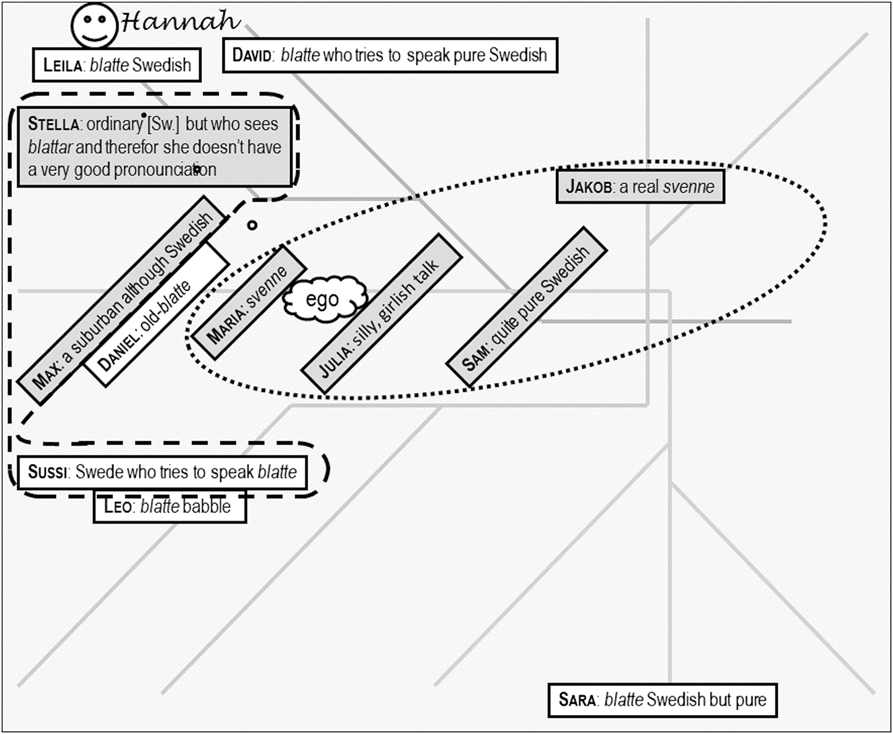
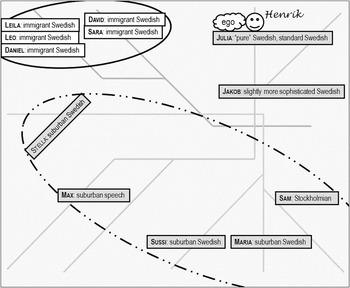
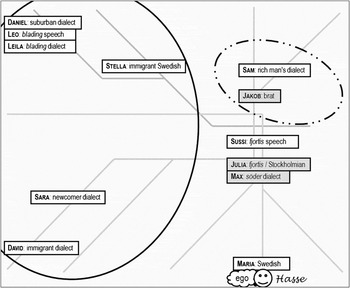
In Figure 5, the 12 speakers are presented on the underground map according to Henrik’s guesses, together with the labels he suggested for their ways of speaking. Additionally, the gray-shaded labels indicate that Henrik believes the speaker to have monolingual Swedish parents, and white labels are used to show that he believes the speaker to have a bilingual family background. Henrik himself lives in the northeastern part of Stockholm; his residential area is indicated on the map by the symbol ☺.
First and foremost, in his division of the linguistic space of Stockholm, Henrik identified two distinct groups of speakers: “the immigrants” and “the Swedes.” Five of the speech stimuli (Leo, Leila, David, Daniel, and Sara) he labeled “immigrant Swedish”—disregarding the differences between, for example, having a L1 accent and using suburban slang. They all live, he believed, in the multiethnic neighborhoods in the northwestern part of Stockholm (encircled by a continuous line). Furthermore, among “the Swedes,” Henrik distinguished working-class speakers (indicated by the dashed-dotted circle). For four of them (Maria, Max, Stella, and Sussi) he used the word förort (suburban), whereas Sam’s speech was labeled “Stockholmian.” To Henrik, suburb seemed to denote neighborhoods relatively close to the city limits of Stockholm that are inhabited by a predominantly monolingual, working-class population. This way of using the word suburb was more common some decades ago to simply denote neighborhoods outside the city. In today’s Swedish, suburb is instead commonly used in reference to the multiethnic, multilingual neighborhoods on the outskirts of big cities. The label Stockholmian may also represent different concepts for different listeners (see Bijvoet & Fraurud, Reference Bijvoet, Fraurud, Källström and Lindberg2011). Henrik’s choice to position Sam in the southern part of downtown Stockholm (in the district Söder, “South”) suggests that, to him, Stockholmian is associated with the old slang of Söder, a former working-class district. When the question about who lives where in Stockholm was raised in the group discussion, Henrik expressed a very distinct view of the sociocultural structure of Stockholm: “Well, like, not in the city and not really far out, but in-between far out and in the city you have Svensson-Svensson and then, like, the immigrants a little further out, [and] a little wealthier [people] closer to the city.”Footnote 11
Another issue treated during the group session was the participants’ linguistic self-perception. Self-perception data were elicited by asking the participants to position themselves in relation to a selection of the speech stimuli: Julia, Maria, Sara, and Leila. Both Julia and Maria were perceived by a large majority of listeners as Swedes in the (narrow) sense of having parents with only Swedish as their mother tongue (95.0% and 71.1%, respectively, see Table 1).Footnote 12 As many listeners note, however, they differ from each other in terms of social class: Julia has an upper-class background and Maria a working-class background. Unlike Julia, Maria used some old Stockholm slang. Both Leila and Sara were born in Sweden and grew up in a multilingual neighborhood. Very few listeners indicated that they might pass for Swedes (2.3% and 5.6%, respectively, see Table 1).Footnote 13 Leila used a great deal of suburban slang, something that Sara carefully avoided. There is also a slight class difference between the families of these two girls: Sara’s family belongs to the middle class and Leila’s to the working class.
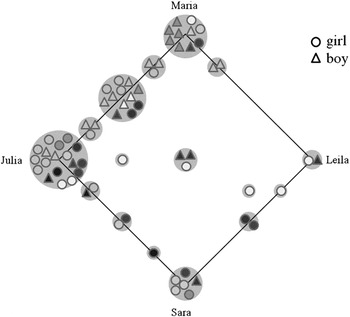
The participants in the group discussions were asked to position their own way of speaking on a sheet of paper showing a rhomb with the 4 selected speakers (see Appendix C). Henrik identified his own way of speaking with Julia’s (in Figure 5 this is indicated by a little cloud containing the word ego). He described Julia’s speech as “pure Swedish” and “standard Swedish,” and he guessed that she lived in his own neighborhood, which is in the wealthiest, northeastern, part of Stockholm.
As compared to Henrik, Hasse used a more diverse set of labels, as shown in Figure 6. Several of the labels Hasse and other listeners used are difficult to render in English without longer explanations—for example, the labels fjortis, blading, and blatte. Blading is probably a local (South School) distortion of blatte, a more widespread label initially used as a derogatory word for “immigrant.” Today, blatte is still often used in this way, but it is at the same time in the process of being reclaimed by some young people with immigrant backgrounds. In this article, the Swedish words are used (indicated by italics in text and figures), rather than trying to translate these kinds of labels.
Hasse also identified a group of speakers remote from himself: “the immigrants” (again encircled by a continuous line). He used different labels for the immigrants’ ways of speaking: “immigrant Swedish,” “immigrant dialect,” “blading speech,” “blading dialect,” “suburban dialect,” and “newcomer dialect.” It is important to note that Hasse, in contrast to Henrik, used suburban in today’s more common way—that is, with reference to the multiethnic neighborhoods on the outskirts of Stockholm.
As the white labels show, Hasse believed that a majority of the speakers have a bilingual family background. In addition to “the immigrants” (Daniel, Leo, Leila, Stella, Sara, and David), he guessed that Sam, Sussi, and Maria were also from bilingual families, although this was not reflected in the labels he assigned to them (i.e., “rich man’s dialect,” “fjortis/Stockholmian,” and “Swedish,” respectively). In these cases, Hasse guessed that the speakers’ parents had a north European L1: English, Russian, or Finnish, respectively (whereas non-European languages were associated with the other speakers assumed to have bilingual backgrounds). The possibility that Hasse may have been biased by the context of the study cannot be eliminated; the authors have previously observed that the mere presence of one immigrant speaker in a study like this may trigger participants to believe that immigrants are the focus of the study. But Hasse’s evaluations may also tell us something about prevailing stereotypical views of “the real immigrant” (i.e., dark-haired or dark-skinned people, who have non-European languages as a L1 and speak foreign-sounding Swedish).
In addition to ethnicity, speakers’ social class was also highlighted by Hasse—but this time from the opposite perspective of Henrik. He identified Jakob and (interestingly enough) also Sam (encircled by the dashed-dotted line) as upper-class speakers.Footnote 14 Hasse expressed an intense dislike of upper-class people during the group interview. When asked to associate freely about Jakob, he exclaimed, “Yeah, it’s one of those brat smarmy backslick disgusting creatures!” In the linguistic self-perception task, Hasse identified himself with Maria. He guessed that she lived in his own neighborhood (again indicated by the symbol ☺), and her way of speaking was simply “Swedish” for him.
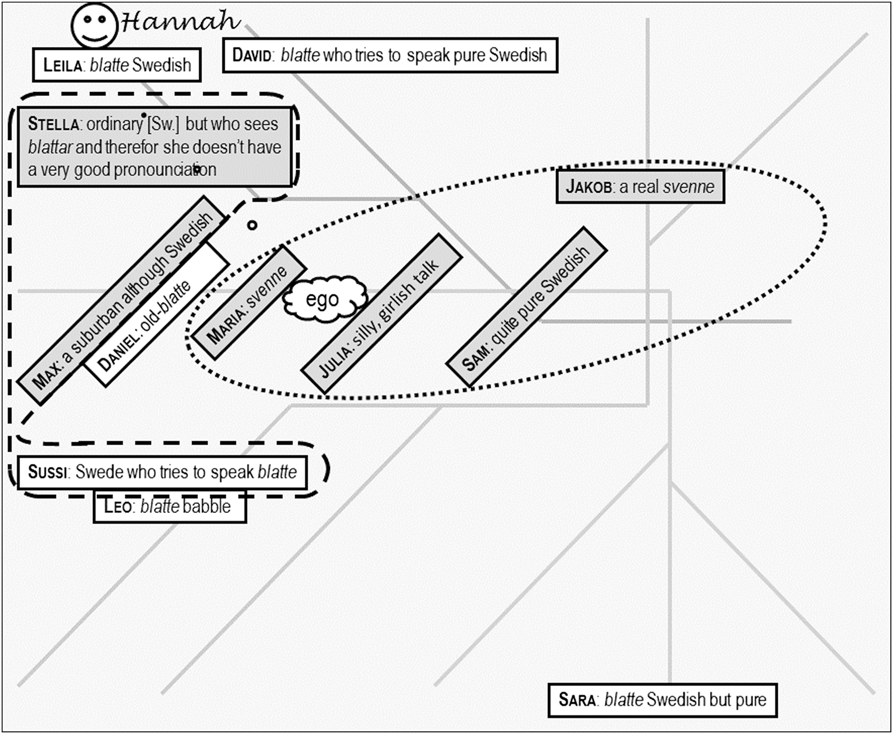
Hannah, finally, was also attentive to the dimension of ethnicity. For her, “the Swedes” constituted one distinguishable group of native speakers living in central Stockholm (gray-shaded labels encircled by the dotted line in Figure 7). However, the picture then became more complex. Hannah also distinguished:
1. “Swedes” who in different ways are influenced by “immigrants’” ways of speaking (Stella, Max, and Sussi, encircled by the dashed line)
2. “Immigrants” who try to speak “proper Swedish” (David and Sara)
3. “Immigrants” who speak suburban slang (Leila and Leo)
4. “Immigrants” who have moved from a multiethnic suburb to a less multiethnic one (Daniel).
Thus, in addition to the dimension of ethnicity, Hannah seemed to be sensitive to dimensions such as correctness and authenticity. She used elaborate labels to explain different ways of speaking Swedish, for example: “ordinary [Swede] but who socializes with blattar and therefore she doesn’t have a very good pronunciation” (about Stella), and “Swede who tries to speak blatte” (about Sussi). Even though the label Swede is assigned to Sussi, Hannah perceived Sussi to have a bilingual background—as shown by the white label. However, just like Hasse, Hannah believed that a north European language was involved, in this case Finnish. In the case of other speakers whom she believed to have a bilingual background, Hannah suggested south European or non-European languages.
In the group discussion, Hannah presented a theory for Sara’s way of speaking Swedish (i.e., “blatte Swedish but pure”). Hannah claimed, “[She is a] wannabe Swede but can’t get it, like, but tries a hundred percent in some way but it feels, like, maybe her parents are divorced and that, like, her mum is going out with some Swede, like, lives with a Swede.” In the linguistic self-perception task, Hannah positioned herself in between Julia and Maria, who, Hannah believed, lived in a more monolingual part of the city as compared to her own residential area (again indicated by ☺).
To summarize, by means of examples from different data types, it is possible to see how Henrik, Hasse, and Hannah divide the linguistic space of Stockholm along partly similar, partly different dimensions of sociolinguistic variation. Ethnicity was a dimension on which all 3 listeners focused. Generally, ethnicity seems to be a social category relevant to many young people today (see Christensen, Reference Christensen, Quist and Svendsen2010; Maegaard, Reference Maegaard, Quist and Svendsen2010). However, the discussion is not only about who is a “Swede” and who is an “immigrant” but also about different types of “immigrants.” “Real immigrants” (so-called blattar) do not have a (north) European language as their mother tongue. The monolingual listeners Henrik and Hasse focused on the dimension of social class (although from contrasting perspectives), whereas bilingual Hannah was more attentive to the dimensions of authenticity and correctness. These patterns—ethnicity being relevant to all listeners, monolinguals focusing to a greater extent on social class, and bilinguals aiming more at correctness and authenticity—were found in data from all the group discussions as well as in the larger database containing data from all 343 listeners.
Who Are the Speakers of “Good Swedish”?
Given that the dimension of correctness is highly relevant, particularly to many young bilingual people, it is important to examine more closely who the speakers of “good Swedish” are—according to different individuals. To do so, an examination was performed of the listeners’ use of good-Swedish labels, here operationalized as comprising all labels that contain at least one of the following words: bra “good,” fin “fine,” or ren “pure” (and that do not contain negation, the word rather or other weakening adverbs, or words indicating nonstandard language, such as slang or accented, e.g., “good suburban slang”). Although the application of good-Swedish labels cannot be considered to directly reflect the actual target language for listeners’ interactions outside the peer-to-peer group, it is possible that, interpreted in the light of the other data types, this kind of labeling data can provide some clues for understanding different individuals’ constructions of such a standard Swedish norm.
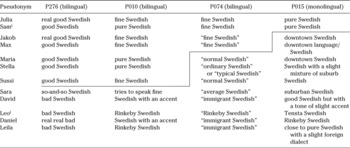
As illustrated in Table 3, listeners differed considerably with regard to the application (or nonapplication) of good-Swedish labels. Many listeners did not use these kinds of labels at all or did so for just one or two of the speakers, whereas others applied them to a larger number of speech samples. When looking at data from all the 343 participants, it can be noted that the 5 listeners with the widest application of good-Swedish labels (6 or more samples) were all bilingual.Footnote 15
Four listeners’ scope of good Swedish (3 bilinguals and 1 monolingual)

i Matched guise stimuli.
Note. The labels are exact representations of the labels suggested by the participants, including quotation marks.
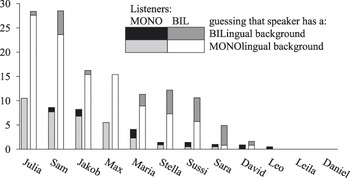
Differences between monolingual and bilingual listeners also surfaced in group data. Figure 8 displays, for each speech sample, the percentages of monolingual and bilingual listeners, respectively, who applied good-Swedish labels to this speaker. In each bar, different shadings indicate the distribution of listeners who guessed that the speaker had a bilingual and a monolingual background, respectively.
Percentages of monolingual (MONO) and bilingual (BIL) listeners, respectively, who applied good-Swedish labels to speakers and of their guesses about speakers’ linguistic backgrounds.

First, it is important to note that, overall, it is more common among bilingual listeners to use good-Swedish labels. For example, 28% of the bilingual listeners applied good-Swedish labels to Julia as well as to Sam, compared to 11% and 8%, respectively, of the monolingual listeners. Both samples contained (almost) no nonstandard features (old or new slang, foreign accent, incorrect grammar, etc.), and both triggered high values for the factor WELL–ORGANIZED in the attitude data.
Second, a tendency was observed for bilingual listeners to more readily apply good-Swedish labels to speakers they believed had a bilingual background also—see Figure 8 for the bilingual listeners’ evaluations of Stella, Sussi, and Sara. Additionally, some of the listeners crediting Sam with good Swedish perceived him as having a bilingual background (e.g., the 3 bilingual listeners in Table 3), although a majority of them thought that he was born in Sweden to monolingual Swedish parents.
All participants’ answers (n = 69) to the linguistic self-perception task.

What can these data reveal about the norms guiding language development and use among young people in today’s multilingual Stockholm? It is clear that Julia was not the only available model according to the bilingual listeners in the study. Sam was an equally good candidate, in particular if he was also perceived as a native Swede. This is further confirmed by the attitude data, in which the evaluation of Sam was remarkably similar to that of Julia.
How to Position One’s Own Way of Speaking
In this study, a variety of quantitative and qualitative data types have contributed to the picture of speaker Julia as a well-behaved girl from a prosperous neighborhood—a monolingual native Swede without any foreign influences in her speech who offers a model of good, fine, and pure Swedish. Does this also mean that young people in today’s multilingual Stockholm identify with Julia’s way of speaking? The linguistic self-perception data offered some important insight into this.
As described in connection with the analysis of Henrik’s, Hasse’s, and Hanna’s constructions of ambient sociolinguistic variation, the participants in the group discussions were asked to position their own way of speaking in relation to the speech samples of Julia, Maria, Sara, and Leila.Footnote 16 In Figure 9, answers from all 69 participants are indicated in the rhomb (female participants are represented by a circle, males by a triangle).
The speaker who attracted the highest number of listener positionings of the 4 girls was Julia. Eight of the 18 listeners who positioned themselves in this way had a social and linguistic background similar to Julia’s, and they also shared similar ways of speaking with her, according to nonsystematic listener judgments. Of the remaining 10, there were some who could be identified by others as having their roots in the multilingual suburb, due to their display of some phonological features associated with non-Swedishness. An equal number of participants (n = 18) chose to position themselves somewhere on the axis between Julia and Maria. Among those, there were some students from the City South School who, again according to nonsystematic listener judgments, actually did speak in a way very similar to Julia’s, but who explicitly distanced themselves from Julia because of—what to them is obvious—her upper-class background. This may possibly be related to the progressive profile of this school, characterized by more cultural capital than the other schools. Maria’s way of speaking, with its use of old Stockholm slang words, was chosen by 10 of the participants, most of whom attend schools in working-class areas, just like Maria. In all, 67% of the participants (n = 46) positioned themselves somewhere on the perceived native axis between Julia and Maria. In agreement with patterns commonly noted in sociolinguistic studies, female participants tended to identify to a higher degree with Julia, who represented the standard norm, and males with Maria, who represented covert prestige. Most of the participants who did not position themselves on the perceived native axis had a bilingual background, and several of them were late learners.
Judging from these data, it seems that at least the fundamental aspects of Julia’s way of speaking (ignoring what is perceived as girlishness by some listeners) constitute at least one plausible model of standard Swedish for many young people. However, interpreting this kind of linguistic self-perception data is complicated by the fact that listener positionings may reflect either the intentions and desire of participants to speak in a certain way, or their estimation of their ability to actually do so, or both. The fact that participants identified with Julia in this self-perception task might not necessarily imply that they perceived her as a model for their own speech, although this seems quite likely in light of the overall data. By the same token, the fact that participants did not identify with Julia does not exclude that they perceived her speech as a model for their own speech. To achieve a deeper understanding of these young people’s linguistic intentions and abilities, further systematic study of their perceptions of ambient language variation as well as their linguistic self-perception is called for.
DISCUSSION AND CONCLUSION
Returning now to the question posed in the introduction of this article—What is the (actual) target language of (individual) language users?—studying language users and use in contemporary multilingual contexts calls for a reformulation of this question. To acknowledge the full range of both interindividual and intraindividual variation in these contexts, the question needs to be elaborated so as to take into account (a) both L1 and L2 users as well as users at the margins of these notions, and (b) both type 1 and type 2 variation within L2 acquisition as well as variation not evaluated against the L1 norm.
To gain insight into what the individual language users are actually targeting in their language development and use, it is necessary to study their own perceptions of ambient sociolinguistic variation. For this purpose, different types of data from a speaker evaluation study were analyzed: variety labels, guesses about the speakers’ area of residence and linguistic background, as well as self-perception data and other data from group discussions.
These data seem to suggest that the young participants do not simply aim at or even relate to a given target language. For example, for many of them, the speaker Julia at first sight seemed to be a good candidate as a model for their own speech—as representative of the monolingual norm. However, speaking like Julia also implies some risks, especially for male participants who do not want to lose masculinity and toughness, and for those who detect an upper-class quality in her speech from which they want to dissociate themselves. The risks in going too far in the direction of a perceived monolingual norm become even more evident in the case of the matched guise speaker Leo-Sam. When this speaker adjusted his speech in order to pass for “a typical Swede” (doing Sam), he was considered by a majority of listeners to speak good Swedish and to be well-organized, intelligent, and nice—but sometimes at the cost of being judged as affected or effeminate, particularly by his peers (Bijvoet & Fraurud, Reference Bijvoet, Fraurud, Quist and Svendsen2010). Thus, going (too) Swedish may imply both costs and benefits.
Issues concerning the way a person speaks and the way a person should speak in different situations and with different people is something that engages many young people today, especially in multilingual neighborhoods and schools. In one of the group discussions that provided data for the present study, a girl pointed out the need to adjust to standard Swedish in certain situations: “At, for example, a job interview you can’t speak like that [referring to suburban slang]; you must speak pure Swedish.” Her classmate, however, objected that one should not go too far in giving up his or her own way of speaking because this might mean risking the loss of identity:
But I feel that when you try to hide your own language . . . it’s like you are trying to hide a part of yourself . . . you are not genuine. So even if I go to a job interview and I’d remove my natural way of speaking . . . I would feel more robotized, as if I just speak; no feeling, no personality. And then it seems to me that nobody would like to employ me just because I’m like a blank piece of paper. (Authors’ translation)
The way these young people speak and speak about speaking suggests that their linguistic choices involve something more complex than a switch between clear-cut language varieties. What these young people do can be visualized as navigating a somewhat hazardous sea with islands and rocks that represent constructions of different ways of speaking—to either target and approach (to different degrees) or to avoid—specified along dimensions of class, ethnicity, gender, authenticity, language proficiency, and so on. Navigating in linguistic space is a complex process that involves individual and subjective nautical maps, which contain constructions of (a) one’s own current way of speaking (current position on the map) and (b) other and others’ ways of speaking (the positions of different possible destinations as well as shallows and rocks).
Without suggesting a simple causal relationship between speech perception and production (see Baker & Trofimovich, Reference Baker and Trofimovich2006), speech production may be seen as necessarily involving a nautical map of constructions of different ways of speaking. Thus, instead of asking what the (actual) target language of (individual) language users is, it is necessary to ask the following: What do the nautical maps that guide language users when they navigate in linguistic space look like? In this study, different data types have provided some clues to the nautical maps of the participants, in particular with regard to point 2 mentioned previously. As the analyses show, the nautical maps guiding linguistic practices often differ, a finding that again strengthens the argument for studying subjective perceptions. Regarding the participants’ self-perception, identified in point 1, these data are more limited but nevertheless reflect the dominance of the ambient monolingual Swedish norm, which does not mean that this norm may not also be contested and extended.
Finally, one preliminary finding needs to be highlighted: For some individuals there appears to be a gap between self-perception and production that may be consequential for their language development and use. The possible existence of such gaps is suggested by data from participants in the self-perception task who identify with the Julia model but who, at the same time, are identified by others as nonnatives due to their use of linguistic features associated with non-Swedishness. On the basis of the assumption that both other-perception and self-perception have some bearing for production, these observations suggest that the diversity of constructions of ambient sociolinguistic variation as well as possible gaps between self-perception and production have to be taken into consideration in the study of language development and use in multilingual contexts.
APPENDIX A

* See Broady’s (2002) and Broady and Börjesson’s (Reference Broady, Börjesson and Lundgren2008) application of Bourdieus’s economic-cultural capital distinction in the characterization of Stockholm schools.
APPENDIX B
The study included both questionnaires and group discussions.

APPENDIX C