Introduction
The vast number of biodegradable polymers is chemically synthesized or biosynthesized during the growth cycles of organisms. Some micro-organisms and enzymes capable of degrading these have also been identified. Depending on the synthesis process, classification of polymers into four different categories can be proposed:Reference Averous and Boquillon1 (1) polymers from a biomass, such as agro-polymers from agro-resources (e.g., starch, cellulose) and their derivatives (e.g., modified starch or cellulose), (2) polymers through microbial production (e.g., the polyhydroxyalkanoates), (3) polymers chemically synthesized using monomers obtained from agro-resources (e.g., poly(lactic acid)), and (4) polymers whose monomers and polymers are both obtained by chemical synthesis from fossil resources. Only the first three categories are obtained from renewable resources. We can sort these biodegradable and bio-based polymers into two main families: the agro-polymers (category 1) and biodegradable polyesters (categories 2 to 4), also called biopolyesters. They represent an interesting alternative route to common non-degradable polymers for short-life-range applications (packaging, agriculture). Compared to conventional thermoplastics, their properties are sometimes too weak for certain end applications. Therefore, it is necessary to improve the properties of these polymers to make them fully competitive with common thermoplastics.
Nanocomposites are novel materials with significantly improved properties due to the incorporation of small amounts (less than 10 wt%) of nano-sized fillers into a polymer matrix. The different types of nanofillers can be classified according to their morphologies such as (1) layered (e.g., clays), (2) spherical (e.g., silica), or (3) acicular particles (e.g., whiskers, carbon nanotubes). Their specific geometrical dimensions, and thus aspect ratios, partly affect the final material properties. The layered silicate clays offer high surface areas, up to 700 m2/g (i.e., a huge interface with the polymer matrix, which governs the global material properties). The final behavior can be considerably improved thanks to strong polymer-nanofiller interactions as well as good particle dispersion.
Nano-biocomposites, a novel class of polymer-based material, are obtained by adding nanofillers to these biodegradable and bio-based polymers, resulting in promising bio-based materials that show improved properties while preserving final material biodegradability without causing toxic effects to the constituents of ecosystems. These are mainly destined for short-term applications (e.g., packaging, agriculture or hygiene devices, and biomedical applications). Until the end of the 20th century, very few articles had been printed on these materials, but this has increased over the last few years.
This article aims to present a brief report on the state-of-the-art of nano-biocomposites, including some recent results. Since this field is fairly broad, this article is limited to describing, as representative examples, nanocomposites based on the most studied biopolymers from each family, with montmorillonite (MMT) as the most common nanofiller.
From nanoclay to nanocomposite
Phyllosilicates
Phyllosilicates represent a large family of minerals with numerous clays, including MMT. They show varying structures, textures, and morphologies. These structures, as well as the preparation of the materials and the control of the clay affinity toward the biopolymer, will condition the final morphologies and properties of the nanocomposites.
Phyllosilicates structure
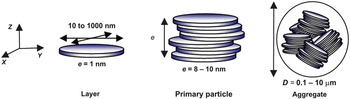
The phyllosilicates present three main organization levels depending on the observation scale: (1) the layer, (2) the primary particle, and (3) the aggregate level (Figure 1).
Phyllosilicate multiscale structure showing the individual clay platelet, a stack of a few platelets forming the primary particle, and the aggregate structure consisting of associated primary particles with their characteristic dimensions (thickness e and average diameter D).

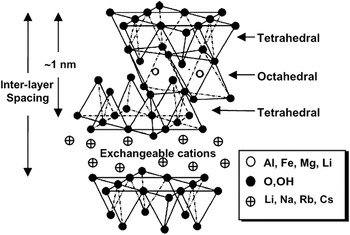
The phyllosilicate crystal structure is based on the pyrophyllite structure Si4Al2O10(OH)2 and can be described as a crystalline 2:1 layered clay mineral, with a central alumina octahedral sheet sandwiched between two silica tetrahedral sheets corresponding to seven superposed atomic layers (Figure 2).Reference Hendricks2 This structure becomes (Si8)(Al4–yMgy)O20(OH)4,  for MMT (where M+ are exchangeable inorganic cations, as detailed hereafter). The differentiations are mainly due to isomorphic substitutions that take place inside the aluminum oxide layer. These substitutions induce a negative charge inside the clay platelet, which is counterbalanced by inorganic cations (Li+, Na+, Ca2+, K+, Mg2+) located in the interlayer spacing. The charge amount is characterized by the cationic exchange capacity (CEC) and corresponds to the amount of monovalent cations necessary to compensate the negative charge of the platelets, usually given in milliequivalent per 100 grams (meq/100 g). The MMT CEC varies from 70 to 120 meq/100 g, depending on its extraction site, due to slight differences in the isomorphic substitutions leading, for instance, to different Mg content.Reference Thomas, Michot, Vantelon, Montarges, Prelot, Cruchaudet and Delon3
Structure of 2:1 phyllosilicates.

The distance between two platelets of the primary particle, named interlayer spacing or d-spacing (d 001), depends on the silicate type. This value depends not only on the layer crystal structure, but also on the type of the counter-cation and on the hydration state of the clay. For instance, d 001 = 9.6 Å for anhydrous MMT, with sodium as the counter ion, but d 001 = 12 Å under common humidity conditions due to the adsorption of one layer of water molecules between two platelets.Reference Alexandre and Dubois4
Phyllosilicate organo-modification
To enhance the intercalation/exfoliation process, a chemical modification of the clay surface, with the goal of matching the polymer matrix polarity, is often carried out.Reference Alexandre and Dubois4, Reference Sinha Ray and Okamoto5 The cationic exchange is the most common technique, but other original techniques, such as organosilane grafting,Reference Dai and Huang6, Reference Ke, Lü, Yi, Zhao and Qi7 ionomers usage,Reference Shen, Simon and Cheng8 or block copolymers adsorption,Reference Fischer, Gielgens and Koster9 are also employed.
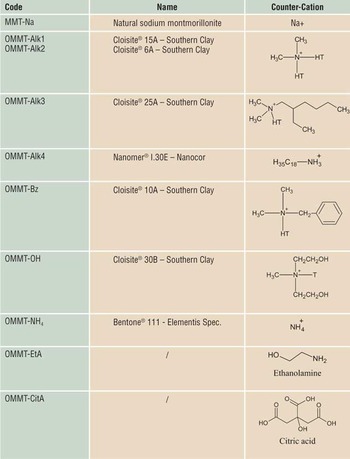
The cationic exchange consists of inorganic cation substitution by organic ones. These surfactants are often alkylammonium cations, having at least one long alkyl chain. In addition to the modification of the clay surface polarity, organo-modification increases d 001, which will also further facilitate the polymer chains intercalation.Reference Lagaly10 Various commercially available organo-modified MMTs (OMMTs), which mainly differ in the nature of their counter-cation and their CEC, are produced using this technique (e.g., Cloisite 15A, 20A, 30B, or Nanofil 804). The modified or unmodified MMTs used to produce nano-hybrid materials are designated according to the abbreviations given in Table I.
Nanofiller types (trade name and code) and their corresponding counter-ion chemical structure.

T = Tallow (∼65% C18; ∼30% C16; ∼5% C14) - HT = Hydrogenated Tallow
OMMT, organo-modified montmorillonite; with organo-modifier ammonium salts bearing different alkyl groups (Alk1, Alk2, Alk3, Alk4), benzyl moiety (Bz), ethanolamine (EtA), and citric acid (CitA).
Nanocomposites fabrication protocol
Nanofiller incorporation into the matrix can be carried out using three main techniques:Reference Alexandre and Dubois4 (1) the solvent intercalation route, which consists of swelling the layered silicates in a polymer solvent to promote macromolecule diffusion in the clay interlayer spacing; (2) the in situ intercalation method, for which the layered silicates swell in the monomer or monomer solution before polymerization; and (3) the melt intercalation process, which is based on polymer processing in the molten state, such as extrusion.
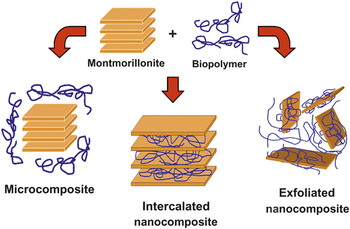
Depending on the process conditions and the polymer/nanofiller affinity, different morphologies can be obtained (Figure 3). These morphologies can be sorted into three distinct categories: (1) microcomposites, (2) intercalated nanocomposites, or (3) exfoliated nanocomposites.Reference Alexandre and Dubois4, Reference Sinha Ray and Okamoto5, Reference Vaia and Giannelis11 In the microcomposites, the polymer chains do not penetrate into the interlayer spacing, and the clay particles aggregate. In this case, the designation as a nanocomposite is a misnomer. In the intercalated structures, the polymer chains diffuse between the platelets, leading to a d 001 increase. In the exfoliated state, the clay layers individually delaminate and homogeneously disperse into the polymer matrix. Intermediate dispersion states are often achieved, such as intercalated-exfoliated structures.
Schematic representation of the three main morphologies: microcomposites, intercalated nanocomposites, and exfoliated nanocomposites.

Renewable nano-biocomposites
Nano-biocomposites based on agro-polymers
This section is illustrated with two main matrices, starch and chitosan. Starch is the most representative example of agro-polymers used to obtain nano-biocomposites, whereas chitosan shows great promise for the preparation process of these materials due to its specific polycation behavior (as described hereafter).
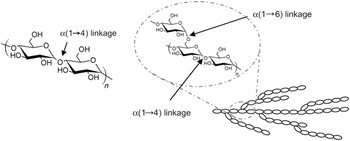
Starch is mainly extracted from cereals (wheat, corn, rice) and tubers (potatoes, manioc), since it is stored in seeds or roots as the main plant energy reserve. Native starch is found as granules composed of two α-D-glucopyranose homopolymers: amylose and amylopectin. Their proportions in the granules depend directly on the botanical source. Amylose is mainly a linear polysaccharide composed of D-glucose units linked by α(1→4) linkages (Figure 4). Amylopectin is the main starch component and has the same monomeric unit as amylose. It is composed of 95% α(1→4) and 5% α(1→6) linkages. The latter linkage type creates a highly branched structure in amylopectin. Consequently, the amylopectin structure and organization is in the form of grapes with pending chains (Figure 4). The starch granule structure consists of alternate crystalline and amorphous areas leading to a concentric structure. The amorphous areas are composed of amylose chains and amylopectin branching points. The semi-crystalline areas are mainly composed of amylopectin side chains. Depending on the botanical origin, starch granules present a crystallinity varying from 20 to 45%.
Starch main constituents: amylose chemical structure (left) and amylopectin chemical structure and grape organization (right).

Starch-based nano-biocomposites
Because of the numerous intermolecular hydrogen bonds existing between the chains, the melting temperature of starch is higher than its degradation temperature.Reference Shogren12 Consequently, to obtain a plastic-like material with conventional plastic processing techniques, it is necessary to introduce high water content or/and some non-volatile plasticizers (glycerol, sorbitol), which will increase the free volume and thus decrease the glass transition and melting temperatures.Reference Swanson, Shogren, Fanta and Imam13 These plasticized materials are currently named “thermoplastic starch” or “plasticized starch.”
Starch, being a very abundant and cheap raw material that is relatively easy to process, is the most studied polysaccharide in nano-biocomposite systems, primarily when plasticizedReference Wilhelm, Sierakowski, Souza and Wypych14–Reference Chen, Chen and Evans42 but also in blends with, for example, biopolyesters.Reference Lee, Xu and Hanna43–Reference Lee, Chen and Hanna46
To attain exfoliation for plasticized starch-based nano-biocomposites, different nanofillers and preparation protocols were developed. First, from 1 to 9 wt% of hydrophobic nanofillers were incorporated into starch plasticized with glycerol by melt intercalationReference Chiou, Yee, Glenn and Orts16, Reference Park, Li, Jin, Park, Cho and Ha17, Reference Park, Lee, Park, Cho and Ha19–Reference Chiou, Yee, Wood, Shey, Glenn and Orts21 or solvent intercalation.Reference Tang, Alavi and Herald36 It was demonstrated that the incorporation of OMMT such as OMMT-Alk1,Reference Chiou, Yee, Glenn and Orts16 OMMT-Alk2,Reference Park, Li, Jin, Park, Cho and Ha17 or OMMT-BzReference Chiou, Yee, Glenn and Orts16, Reference Park, Li, Jin, Park, Cho and Ha17 (i.e., with organo-modifier bearing different alkyl groups or benzyl moiety, see Table I for description) led to the formation of conventional micro-biocomposites, since the clay remained as micron-sized agglomerates due to poor affinity with the matrix. Better results were obtained with OMMT-Alk4.Reference Tang, Alavi and Herald36 This result can be explained by the OMMT having only one long alkyl chain and thus a slightly less pronounced organophilic character compared to the previous organo-clays. The dispersion of the more hydrophilic OMMT-OH (with organo-modifier bearing hydroxyl groups) led to a higher dispersion state with an increase in d 001 and a large decrease in diffraction peak intensity. This morphology was likely achieved due to the hydrogen bonds established between the hydroxyl groups from the starch chains and the clay surfactant.Reference Park, Lee, Park, Cho and Ha19
Nano-biocomposites based on plasticized starch with glycerol were prepared with MMT-Na. Because of the hydrophilic nature of starch and MMT-Na, this nanofiller was supposed to lead to an enhanced nano-dispersion state. These materials were prepared with a solventReference Wilhelm, Sierakowski, Souza and Wypych14, Reference Kampeerapappun, Aht-ong, Pentrakoon and Srikulkit15, Reference Pandey and Singh26, Reference Cyras, Manfredi, Ton-That and Vazquez27, Reference Tang, Alavi and Herald37, Reference Lilichenko, Maksimov, Zicans, Merijs Meri and Plume39, Reference Mondragon, Mancilla and Rodriguez-Gonzalez40 or melt blending process.Reference Chiou, Yee, Glenn and Orts16–Reference Huang, Yu and Ma25, Reference Bagdi, Muller and Pukanszky35 For a glycerol content higher than 10 wt%, these systems led to the formation of an intercalated structure with d 001 increasing from 12 to 18 Å. This latter d 001 value is already well reported in the literature and is generally attributed to glycerol intercalation.Reference Park, Lee, Park, Cho and Ha19, Reference Pandey and Singh26, Reference Tang, Alavi and Herald37 A similar morphology was obtained with sorbitol as the plasticizer.Reference Ma, Yu and Wang28 Dean et al. have obtained amylocorn starch nano-biocomposites by solventReference Dean, Yu and Wu29 and meltReference Dean, Do, Petinakis and Yu41 processes, with water as the only plasticizer, to obtain a homogeneous dispersion with an intercalated or exfoliated structure. In addition, ChaudharyReference Chaudhary38 obtained an intercalated/exfoliated morphology with a melt dispersion of a hydrophobic nanofiller, OMMT-Alk3, without a polyol plasticizer. This result is likely related to the hydrogen bonds established between glycerol and MMT platelets, which could disturb the clay exfoliation process.Reference Wilhelm, Sierakowski, Souza and Wypych14, Reference Huang, Yu and Ma25, Reference Pandey and Singh26
To overcome these limitations induced by polyol plasticizers, some researchers replaced these plasticizers with ureaReference Tang, Alavi and Herald37, Reference Chen, Chen and Evans42 or formamide.Reference Tang, Alavi and Herald37 The dispersion of MMT-Na into urea or formamide-plasticized starch led to the formation of intercalated structures. Thus, to increase the clay/matrix affinity, different OMMTs were incorporated, namely, OMMT-EtA (organo-modifier bearing ethanolamine),Reference Huang and Yu30 OMMT-CitA (organo-modifier bearing citric acid),Reference Huang, Yu and Ma32 and OMMT-NH4.Reference Chen, Chen and Evans42 Incorporation of OMMT-EtA led to intercalated structuresReference Huang, Yu and Ma33, Reference Huang, Yu, Ma and Jin34 or exfoliation.Reference Huang and Yu30 Similarly, exfoliated nano-biocomposites were obtained with the dispersion of OMMT-CitAReference Huang, Yu and Ma32 and OMMT-NH4.Reference Chen, Chen and Evans42 Nevertheless, these compounds are eco-toxic and cannot be used to obtain safe biodegradable “green” materials.
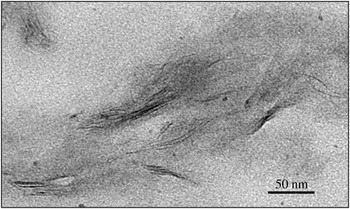
Kampeerapappun et al.Reference Kampeerapappun, Aht-ong, Pentrakoon and Srikulkit15 focused their attention on the use of a new eco-friendly compatibilizer, chitosan, to promote MMT platelet exfoliation. They prepared cassava starch/chitosan/MMT-Na nano-biocomposites by casting. These researchers assumed that chitosan, as a cationic polysaccharide, could be a compatibilizing agent between the negatively charged clay layers and the starch matrix, leading to fewer clay aggregates and improved mechanical properties. Chivrac et al.Reference Chivrac, Pollet and Averous47 successfully applied the use of a cationic polysaccharide surfactant to promote the clay exfoliation process by using cationic starch as a MMT organo-modifier. No diffraction peak was observed by x-ray diffraction (XRD), suggesting an exfoliated morphology. Moreover, transmission electron microscopy (TEM) analyses confirmed the nano-dispersion and showed that the use of this surfactant led to a non-aggregated structure (Figure 5). It is assumed that this good dispersion state is achieved because of the preferential interactions established between the hydroxyl groups of the different starch-based chains.
Transmission electron microscopy image of a highly exfoliated starch nano-biocomposite based on montmorillonite that has been organo-modified by cationic starch.Reference Chivrac, Pollet and Averous47

These different studies have clearly demonstrated the possibility of exfoliating MMT nanoclays into plasticized starch matrices through the solvent and melt processes. The resulting properties (mechanical, barrier, thermal stability) of the corresponding nano-biocomposites were largely enhanced and point out the great potential of these materials.Reference Park, Li, Jin, Park, Cho and Ha17, Reference Park, Lee, Park, Cho and Ha19, Reference Chivrac, Pollet and Averous47
Nano-biocomposites based on chitosan
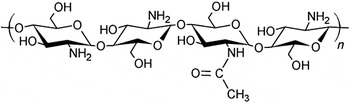
Chitosan is a random linear chaining of N-acetyl-D-glucosamine units (acetylated unit) and D-glucosamine (deacetylated unit) linked by β(1→4) linkages (Figure 6). Contrary to chitin, which is the second most abundant agro-polymer produced in nature after cellulose and mainly extracted from crab and shrimp shells, chitosan is not widespread in nature. It is found in some mushrooms (zygote fungi) and in the termite queen’s abdominal wall. It is thus industrially obtained by partial deacetylation of chitin. In the solid state, chitosan is a semi-crystalline polymer. In a diluted acid solution, the amino groups are protonated, and chitosan becomes a water soluble polycation. Chitosan is characterized by its degree of acetylation and by its molecular weight. These parameters influence its viscosity and solubility. Depending on the bioresource (crab or shrimp species) and transformation process, industrial chitosan shows molecular weights varying from 5,000 to 1,000,000 g·mol–1 and a degree of acetylation from 2 to 60%.
Chitosan chemical structure.

A great number of chitosan-based nano-hybrids have been synthesized, studied, and reported in the literature.Reference Kampeerapappun, Aht-ong, Pentrakoon and Srikulkit15, Reference Darder, Colilla and Ruiz-Hitzky48–Reference Wang, Du, Yang, X., Shi and Hu54 Chitosan/OMMT-OH nano-hybrid materials had been prepared in water by solvent processing but led to the formation of highly flocculated systems. This morphology is obtained because OMMT-OH cannot be dispersed into water.Reference Xu, Ren and Hanna49 Besides, since chitosan is a polycation in acid conditions, it can be easily adsorbed on the MMT-Na surface. This property has been extensively used to prepare chitosan/MMT-Na hybrid materials by a solvent route. Kampeerapappun et al.Reference Kampeerapappun, Aht-ong, Pentrakoon and Srikulkit15 performed XRD experiments that showed that chitosan did not diffuse into the clay interlayer spaces. However, these results were contradicted by those of Darder et al.,Reference Darder, Colilla and Ruiz-Hitzky48 who showed chitosan intercalation by the shifting of the MMT-Na diffraction peak to lower angles. Moreover, a broadening and intensity decrease of the diffraction peak was observed, indicating a disordered intercalated/exfoliated structure.Reference Darder, Colilla and Ruiz-Hitzky51, Reference Wang, Shen, Tong, Chen, Phang, Lim and Liu53 Günister et al.Reference Günister, Pestreli, Unlu, Atici and Gungor50 studied the interactions between MMT-Na and chitosan by zeta potential measurements and showed chitosan ionic adsorption on the clay surface and effective intercalation.
Thus, exfoliated chitosan nano-biocomposites displaying improved properties have been obtained with MMT-Na. However, such nano-hybrids have only been prepared by using a solvent process.
Nano-biocomposites based on biopolyesters
A number of researchers have developed nano-biocomposites based on renewable biopolyesters and MMTs.Reference Bordes, Pollet and Avérous55 The two main matrices, which will be discussed hereafter, are poly(lactic acid) (PLA) and polyhydroxyalkanoates (PHAs). PLA is a widely used and studied biopolyester matrix for nanocomposite preparation since it is presently the most important renewable and biodegradable polyester on the bioplastic market. As a second representative example of renewable and biodegradable polyesters, the large family of PHAs has also been widely investigated for utilization in the preparation of nanocomposite materials to address some of the weaknesses of these bacterial biopolyesters.
Poly(lactic acid)-based nano-biocomposites
PLA is a very promising material, and many attempts were carried out to reach the exfoliation state in corresponding nano-biocomposites. Various organo-clays with different organo-modifiers were selected, and several preparation routes were tested. OgataReference Ogata, Jimenez, Kawai and Ogihara56 first attempted to prepare PLA-based nanocomposites by the solvent intercalation method. Unfortunately, the layered silicates were not individually well dispersed but rather formed tactoids (i.e., agglomerated particles) consisting of several stacked clay platelets.
Finally, Krikorian and PochanReference Krikorian and Pochan57 successfully prepared exfoliated materials with randomly distributed clay platelets via solvent intercalation with OMMT-OH. The interactions between OH functions from the clay organo-modifier and C=O moieties of the PLA backbone favored exfoliation. Consequently, the mechanical properties improved (e.g., the storage modulus, main indicator of the material rigidity, increased by 61% with 15 wt% of OMMT-OH).
Wu and WuReference Wu and Wu58 also obtained an exfoliated structure in PLA-based nanocomposites using a solution mixing process. They increased the interactions between the filler and the matrix by treating MMT with n-hexadecyl trimethylammonium bromide (CTAB) cations and then modified the clay with chitosan.
The fabrication of PLA/clay nano-biocomposites by melt intercalation has also been widely described in the literature,Reference Pluta, Galeski, Alexandre, Paul and Dubois59–Reference Paul, Delcourt, Alexandre, Degée, Monteverde and Dubois73 yielding various materials structures. Okamoto and his group at Toyota Technological Institute (Nagoya, Japan) tested several PLA-based systems that differed in the aspect ratio of the inorganic platelets, nature of the organo-modifier, and clay content.Reference Maiti, Yamada, Okamoto, Ueda and Okamoto61–Reference Sinha Ray, Yamada, Okamoto and Ueda71 Depending on these parameters, intercalated, intercalated-and-flocculated, nearly exfoliated, and coexisting intercalated and exfoliated states were obtained. They even proposed an interpretation of the nanocomposite structure related to the aspect ratio and organo-modifier chain lengths.Reference Maiti, Yamada, Okamoto, Ueda and Okamoto61 The effect of the organization of organo-modifiers in the interlayer space was also examined by considering an interdigitated layer structure of the surfactants, where the intercalants are oriented slightly inclined to the clay layer. After polymer melt intercalation, researchers found that a smaller initial interlayer spacing led to greater interlayer expansion, suggesting a large degree of polymer chain intercalation. Consequently, the nano-composite exhibited a finer dispersion of the nano-fillers when compared with the nano-composites prepared from OMMT with a larger initial interlayer space.Reference Yoshida and Okamoto74
As a consequence of the clay nanodispersion, and despite the fact that incomplete exfoliation was obtained by melt intercalation, all of these nano-biocomposites exhibited dramatic enhancements in their properties, such as mechanical properties, heat distortion temperature, and oxygen permeability. However, it should be noted that the increments strongly depend on the structure of the nanocomposites. Therefore, by judicious choice of the OMMT, it is possible to tune the material properties.Reference Sinha Ray, Yamada, Okamoto, Fujimoto, Ogami and Ueda68 Furthermore, the process could also play a key role in the final nano-biocomposite structure and properties.Reference Lewitus, McCarthy, Ophir and Kenig75 Finally, the melt intercalation process allows for the incorporation of additives such as compatibilizers and plasticizers.
Some researchers have been interested in developing plasticized PLA-based nanocomposites to reduce brittleness and to improve the flowability during the process. Thus, PLA plasticized with PEGReference Paul, Alexandre, Degée, Henrist, Rulmont and Dubois76–Reference Tanoue, Hasook, Iemoto and Unryu81 or diglycerine tetra-acetateReference Shibata, Someya, Orihara and Miyoshi82 was melt compounded with different organo-clays, leading to intercalated structures. Tanoue et al.Reference Tanoue, Hasook, Iemoto and Unryu81 also studied the structure of such materials using PEG with different molecular weights. Paul et al.Reference Paul, Alexandre, Degée, Henrist, Rulmont and Dubois76 and Pluta et al.Reference Pluta, Paul, Alexandre and Dubois79 showed that there is a real competition between poly(ethylene glycol) (PEG) and PLA for intercalation into the clay interlayer. Therefore, Paul et al.Reference Paul, Delcourt, Alexandre, Degée, Monteverde, Rulmont and Dubois78 settled a protocol consisting of in situ ring opening polymerization of lactide from end-hydroxylated PEG in the presence of OMMT-OH with tin octoate (Sn(Oct)2) as an activator/initiator. This polymerization method, called the “coordination-insertion” method, leads to PLA chains grafted onto the clay surface via the hydroxylated ammonium organo-modifier and to PLA-b-PEG-b-PLA triblock copolymer intercalated into the clay gallery (i.e., the area between two clay platelets). The plasticizing effect is ensured by the PEG sequence of the triblock without phase separation. More generally, this mechanism allows complete exfoliation by ring opening polymerization of lactide after adequate activation.Reference Paul, Alexandre, Degée, Calberg, Jerome and Dubois83
The literature thus includes a number of publications on PLA-based nano-biocomposites. Several answers and strategies are proposed to improve the material properties since PLA is commercially and widely available.
Polyhydroxyalkanoates-based nano-biocomposites
Some drawbacks of PHAs, such as brittleness and poor thermal stability, restrict their development and use. Thus, nano-biocomposites appear to be a possible answer to overcome these issues and to improve PHA properties.
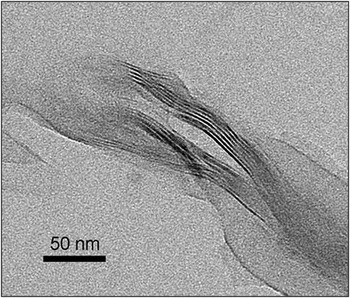
Maiti et al.Reference Maiti, Batt and Giannelis84 prepared polyhydroxybutyrate (PHB)-based nanocomposites by melt extrusion. PHB was then reinforced by adding from 2 wt% up to 4 wt% of OMMT nanoclay. XRD and TEM revealed well-ordered intercalated nanocomposites with decreasing d-spacing when clay content increased. These authors showed enhanced degradation in the presence of OMMT, due to the presence of Al Lewis acid sites in the inorganic layers, which catalyze ester linkage hydrolysis. Hablot et al.Reference Hablot, Bordes, Pollet and Avérous85 prepared PHB- and poly(hydroxybutyrate-co-hydroxyvalerate) (PHBV)-based nanocomposites with different OMMT and obtained an intercalated morphology with partial exfoliation with OMMT-OH (Figure 7). Moreover, it has also been reported that PHA-enhanced degradation can be caused by decomposition products of clay organo-modifiers, which have a catalyzing effect on the thermal or thermomechanical degradation.Reference Bordes, Pollet and Avérous55 Lim et al.Reference Lim, Hyun, Lee and Choi86 carried out another study on PHB-based nanocomposites with PHB/MMT-Alk4. XRD and infrared spectroscopy data showed evidence of intercalated structures.
Transmission electron microscopy image of the intercalated/exfoliated morphology of a polyhydroxybutyrate nano-biocomposite prepared with organo-modified montmorillonite.

Scientists were also interested in the development of PHBV-based nanocomposites, since PHBV presents good properties and better processability than PHB. In 2003, Choi et al.Reference Choi, Kim, Park, Chang and Lee87 described the morphology as well as the thermal and mechanical properties of PHBV/MMT-OH1 with low clay content. These materials were prepared by melt intercalation. XRD and TEM clearly confirmed that intercalated nanostructures were obtained. Such structures were formed thanks to the strong hydrogen bond interactions between PHBV and the hydroxyl groups of the organo-modifier. They concluded that the well-dispersed and layered structure act as an efficient barrier to the permeation of oxygen and combustion gas. The mechanical properties showed that clays can also act as an effective reinforcing agent.
Wang et al.Reference Wang, Song, Chen, Guo, Liu, Zhang and Takeuchi88 and Zhang et al.Reference Chen, Hao, Guo, Song and Zhang89, Reference Chen, Hao, Guo, Song and Zhang90 investigated the structure and properties of PHBV/OMMT nanocomposites. The nanocomposites, prepared by solution intercalation, showed intercalated structures as evidenced by XRD, and clay aggregation occurred for a clay content of 10 wt%.
The PHBV processing behavior could be improved with OMMT-based nanocomposites, since the processing temperature range broadened from the lowering melting temperature with increasing clay content. The tensile properties of the corresponding materials improved with the incorporation of 3 wt% clay.Reference Chen, Hao, Guo, Song and Zhang90 Different studies have confirmed that intercalated nanocomposites formed.
Misra et al. developed a novel solvent-free method to prepare PHB functionalized by maleic anhydride (MA-g-PHB).Reference Misra, Desai, Mohanty and Drzal91 They mixed MA-g-PHB with MMT-OH1 to make the organo-modifier hydroxyl functions react with the MA.Reference Drzal, Misra and Mohanty92 The decrease in intensity of XRD signals and the TEM images showed that more delaminated platelets were obtained, attesting to a greater extent of clay exfoliation that could lead to improved properties. Most of the articles reported the preparation of PHA-based nanocomposites by solvent intercalation, and whatever the preparation route, a full exfoliation state was neither obtained nor clearly demonstrated.
Conclusion
This article presents recent results on nano-biocomposites based on montmorillonites with biodegradable and bio-based polymers. Two main types of renewable matrices have been described in this article, agropolymers and biopolyesters. These nano-hybrid materials mainly differ from conventional nanocomposites in the more hydrophilic character of some matrices. It has been clearly demonstrated that different parameters such as the fabrication route, polymer/clay affinity, and clay content can affect the structure and nano-biocomposite properties. The latter can consequently be tuned as desired by controlling the parameters previously mentioned. It should be noted that a greater reinforcing effect is generally limited to small clay amounts (<∼5 wt%) and has been reached for the exfoliated state, which is not trivial to obtain.
Finally, nano-biocomposites present improvements in various material properties at very low filler content without requiring major changes in the fabrication process since conventional plastic processing systems can be used. The usefulness of nano-biocomposites is no longer in question, and more and more reports are focused on applicative aspects in the environmental, packaging, agriculture device, and biomedical fields. Moreover, since industry has been concerned with sustainable development, production costs of biopolymers continue to decrease, which will allow for the development of biopolymers-based materials, such as nano-biocomposites. Therefore, these materials will be technically and financially competitive toward synthetic polymer-based nanocomposites. Then, this new class of material opens a new dimension for the plastics industry.
Future research will have to address issues such as the difficulty to exfoliate the clay with some biopolymer matrices (e.g., polyhydroxyalkanoates). Further work should provide valuable insight into new methods of nano-biocomposite design to establish new approaches to tailor novel nano-architectures.