INTRODUCTION
Hydroids and hydromedusae (class Hydrozoa; subclass Leptolida) of Russian Arctic seas (often referred to as the ‘northern seas’) have been investigated for many years, and the fauna has been extensively revised faunistically, taxonomically and biogeographically. Six seas exist in the Eurasian Arctic Ocean, all of them completely or partly within the Russian Federation. The Central Polar Basin is regarded as an independent region of the Arctic Ocean.
MATERIALS AND METHODS
All materials examined as part of this study are in collections of hydroids and hydromedusae from Eurasian Arctic seas that have been acquired over many years by Russian scientists. Most are located at the Zoological Institute of the Russian Academy of Sciences, with others collected in several northern seas (mostly using scuba diving) by the author. Included are specimens of 158 valid species (98% of those known from the study area) present in several thousand samples. All collections, together with all relative literature data, were critically checked and revised. In addition to data from my own work (Antsulevich, Reference Antsulevich1987, Reference Antsulevich, Naumov and Fedjakov1991, Reference Antsulevich2006, Reference Antsulevich2008, Reference Antsulevich2009), additional faunistic data on Hydrozoa were extracted from numerous other publications, the most important being those of Broch (Reference Broch1910), Fraser (Reference Fraser1937), Yamada (Reference Yamada1959), Naumov (Reference Naumov1960), Calder (Reference Calder1970, Reference Calder1972, Reference Calder2012), Stepanjants (Reference Stepanjants and Herman1989), Svoboda & Cornelius (Reference Svoboda and Cornelius1991), Cornelius (Reference Cornelius1995), Schuchert (Reference Schuchert2001, Reference Schuchert, Crothers and Hayward2012), Bouillon et al. (Reference Bouillon, Medel, Pages, Gili, Boero and Gravili2004), Vervoort & Faasse (Reference Vervoort and Faasse2009), and Altuna et al. (Reference Altuna, Murillo and Calder2013).
Distributions of North Atlantic Leptothecata (largest order of Hydrozoa) were traced from the North Sea through the Norwegian Sea to the Barents Sea, and eastwards to the Chukchi Sea. For comparative purposes the number of leptothecate species from the North Sea (113 species) was taken to be 100% or 1.00. Several methods were employed in measuring similarity of hydrozoan species composition across the study area. When comparing taxonomic lists of large contiguous areas, the measure of inclusion reflects the derivative relation between neighbouring faunas. The ‘Shimkevich–Simpson Index’ (ISzS), a simple measure of similarity, was calculated on the basis of the formula: ISzS = A/K where K is the number of species in the smaller list and A is the number of species common to the two lists. Hierarchical cluster analyses were used in classification of regional hydrozoan faunas. Biogeographic characteristics of species, and names of types of distribution areas in latitudinal zones, follow Sirenko et al. (Reference Sirenko, Vassilenko and Petrjashev2009).
RESULTS
Faunistic comparison
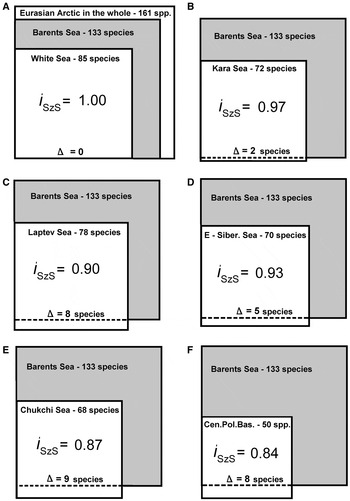
The hydrozoan fauna of the enormous Eurasian Polar Ocean area includes 161 species of Leptolida (as well as about six species of Siphonophora, not included here). The richest fauna, comprising 133 species, occurs in the Barents Sea. The fauna of the White Sea, in direct connection with the Barents Sea, is a 100% subset of that found in the latter. In seas farther east, hydrozoan species composition is substantially reduced, although highly similar in each of them. Numbers of hydrozoan species known from the White, Kara, Laptev, East Siberian and Chukchi Seas, and the Central Polar Basin are, respectively, 85, 72, 78, 70, 67 and 50. Comparisons of smaller regional faunas within that of the Barents Sea are presented as Venn diagrams, where areas of squares correspond to species numbers in each sea (Figure 1). Similarity values calculated among all these local faunistic lists are high, but the measure of inclusion into the richest fauna of the Barents Sea is extremely so: similarity values vary from 0.84 (min. – Central Polar Basin) – 0.87–0.90–0.93–0.97–1.00 (max. – the White Sea) (Figure 1).
Comparisons of and resemblances between sets of hydrozoan species (verified lists of species) from the northern seas of the Russian Federation and the Central Polar Basin with the largest set from the Barents Sea. ISzS – measures degrees of similarity; △ – represents additions to the species composition (number of species) of a given area relative to that of the largest set.

Differences between regional faunas
Resemblances between regional fauna sets and that of the richest Barents Sea fauna are close and readily apparent. Marked similarity exists because large groups of Arctic ubiquitists and boreal-Arctic species of North Atlantic origin are shared throughout. Of particular interest is an analysis of additions to the faunistic compositions (△) of regional faunas compared with that of the foundational fauna of the Barents Sea. In the Kara Sea, for example, just two species were added: Sertularia tolli (Jäderholm, 1908) and Thuiaria uschakovi Naumov, Reference Naumov1960. The first is an extremely rare and narrowly distributed Arctic species, while the second is of doubtful validity (Cornelius, Reference Cornelius1979).
In the Laptev Sea, △ = 8 species: Gymnogonos obvolutus (Kramp, 1933), Bouillonia sp., Rhabdoon reesi (Shirley and Leung, 1970), Lafoea benthophila Ritchie, 1909, Acryptolaria conferta (Allman, 1877), Thuiaria uschakovi Naumov, Reference Naumov1960, Halicreas minimum Fewkes, 1882 and Botrynema ellinorae (Hartlaub, 1909). All are deep-water species not known to be part of the Barents Sea fauna, and all inhabit only the northernmost (bathyal) part of the Laptev Sea (Antsulevich & Vervoort, Reference Antsulevich and Vervoort1993; Stepanjants & Kosobokova, Reference Stepanjants and Kosobokova2006; Svoboda et al., Reference Svoboda, Stepanjants and Ljubenkov2006; Antsulevich, Reference Antsulevich2009). This sea is the only one having a wide bathyal zone, and the northernmost parts of it belong to the Central Polar Basin oceanographically and faunistically. Hydrozoans on the continental shelf of the Laptev Sea consist entirely of species that also inhabit the Barents Sea. The faunas of the East Siberian and Chukchi seas differ from that of the Barents Sea largely through the addition of a few Pacific faunal elements. Just two species of Pacific origin appear in the East Siberian Sea: Abietinaria turgida (Clark, 1877) and A. thuiarioides (Clark, 1877). As might be expected, more such species exist in the Chukchi Sea (Antsulevich, Reference Antsulevich2008).
Distinctive characters of the Central Polar Basin are its greater depth and the remoteness of its fauna from shallow water assemblages. Unique elements of the fauna (△ = 8) are deep-water species. While species composition of the fauna is quite similar to that of the northernmost parts of the Laptev Sea, it also includes the bathypelagic hydromedusae Paragotoea bathybia Kramp, 1942 (Capitata; Corymorphidae) and Bathykorus bouilloni Raskoff, 2010 (Narcomedusae), found at depths near 2000 m. The faunal composition of the Central Polar Basin reflects a certain degree of uniqueness biogeographically.
Biogeographic comparison
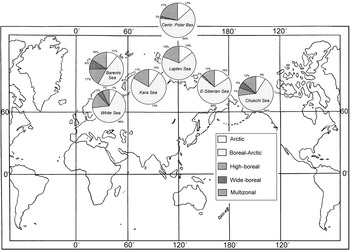
Biogeographically, the fauna of the Eurasian Polar Ocean consists of several elements, including strictly Arctic species, boreal-Arctic and multizonal species (subtropical-boreal-Arctic + cosmopolitan species + some (not all) bipolar species) and boreal species penetrating into certain parts of Arctic seas (usually at the margins or in environments having warmer streams) (Figure 2). The term ‘cosmopolitan’ as used in the literature generally refers to multizonal species. Truly cosmopolitan species, supposedly distributed everywhere in oceans of the world, are not numerous in the Hydrozoa. The number of strictly Arctic hydrozoan species across the entire region is also not large, comprising only 17 species (12%). Amongst these can be recognized Arctic circumpolar (8 spp.), Arctic Eurasian (8) and Arctic Amerasian (1) species. The percentage and composition of Arctic species is rather similar in all seas, albeit somewhat lower in the marginal seas and especially so in the White Sea (due to the notable role of Atlantic boreal species) and in the Chukchi Sea (due to Pacific boreal species). The Arctic Ocean is populated mostly by boreal-Arctic hydrozoans, which comprise more than half of the species everywhere.
Biogeographic affinities (in latitudinal zonality) of the hydrozoan faunas of Eurasian Arctic seas and of the Central Polar Basin.

Arctic ubiquitists, the largest (totalling 64 species) group of hydrozoans in the study, comprise a heterogeneous assemblage. It is a mix of common Arctic species (6 species), boreal-Arctic and mostly circumpolar species (53 species) and five multizonal and almost cosmopolitan species. The group, most of them boreal-Arctic species, comprises the main element of hydrozoans in all Arctic seas and is responsible for the high similarity and faunal uniformity from one sea to the next across many thousands of kilometres along the northern Eurasian coast.
The role of Atlantic fauna in the Arctic seas of Eurasia
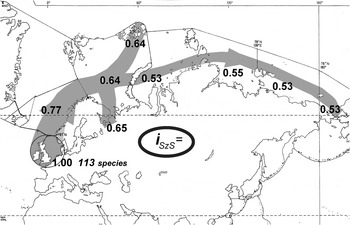
A North Atlantic faunistic complex absolutely predominates in waters of the Arctic Ocean. It consists of a boreal species group and a boreal-Arctic group common to North Atlantic waters. The number of North Sea leptothecate species present in the Barents Sea is 51, with 33 of them in the White Sea and 24 in all others starting with the Kara Sea. Values of similarity (ISzS) for the Barents Sea, separately for the Franz-Joseph Land archipelago and for the White Sea is 0.64–0.64–0.65 respectively. For the Kara Sea, this index drops to 0.53 and remains unchanged across the vast region to the east (Figure 3).
Distribution of North Sea Hydrozoa (Leptothecata) across Eurasian Arctic seas (values of ISzS). Lines and coordinates mark oceanographic borders between the seas.

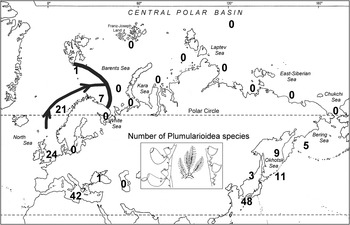
Eight species of the warm-water superfamily Plumularioidea (Hydrozoa; Leptothecata): Kirchenpaueria sp. (=Plumularia fragilis sensu Bonnevie, Reference Bonnevie1899: 88, pl. 7, fig. 1; Broch, Reference Broch1910: 206; Naumov, Reference Naumov1960: 463–464, fig. 352; all are non Plumularia fragilis Hamann, 1882), Nemertesia antennina (L., 1758), Polyplumaria gracillima (G.O. Sars, 1873), Polyplumaria polaris (Naumov, Reference Naumov1960), Schizotricha variabilis (Bonnevie, Reference Bonnevie1899), Cladocarpus bonneviae Jäderholm, 1909, Cladocarpus formosus Allman, 1874 and Cladocarpus integer (G.O. Sars, 1874) are known to occur in western parts of the Barents Sea, but all are absent from the middle of the Barents Sea eastward. To the east, all areas of the Russian and Canadian Arctic regions, as well as the Central Polar Basin, are a ‘Plumularioidea-free’ area (Calder, Reference Calder1970; this work). In the region from 40°N (New York Bight) northwards to the Arctic Ocean in north-eastern North America, few species of plumularioid hydroids have been reported, and those actually present have been reported infrequently. The discovery of two previously unreported aglaopheniid species (superfamily Plumularioidea) off the east coast of Newfoundland in the western North Atlantic was regarded as noteworthy (Altuna et al., Reference Altuna, Murillo and Calder2013). No plumularioids occur in the Chukchi Sea or in the Bering Strait. However, five species of the group appear in the Bering Sea, and many others are known from the Sea of Okhotsk, the Kurile Islands and Japan (Yamada, Reference Yamada1959; Naumov, Reference Naumov1960; Antsulevich, Reference Antsulevich1987, Reference Antsulevich2006, Reference Antsulevich2008, Reference Antsulevich2009; Hirohito, 1995). Absence of species of that superfamily may thus be used as an indicator of Arctic waters or, conversely, their presence indicates ‘non-Arctic’ waters. The group therefore represents a useful environmental indicator distinguishing two major biogeographic zones, namely the boreal and Arctic regions (Figure 4). The next zone of synperates apparent in the east, based on distributions of hydrozoans (Antsulevich, Reference Antsulevich2008) and other marine invertebrates (Scarlato, Reference Scarlato1981), occurred in the south-eastern part of the Chukchi Sea. Almost all boreal species of Hydrozoa disappear in eastern parts of the Barents Sea, and they do not penetrate to the east or to the north into Arctic waters. A few boreal species reappear in the East Siberian (two species) and Chukchi (nine species) seas, but they are Pacific and not Atlantic ones.
Numbers of species of Plumularioidea in Eurasian seas. The thick curved line is the limit of penetration of these hydrozoans into the Arctic. Arrows portray the direction of penetration.

Level of endemism
The presence and abundance of endemic taxa, and their taxonomic rank, are the main characters used to establish the biogeographic distinctness of a region. It is thus notable that no endemic species of Hydrozoa exist within the main part of the Barents Sea. A single species from the outlying area of northernmost Franz-Joseph Land archipelago, Similomerona nematophora (Antsulevich, Reference Antsulevich1987), may be considered endemic, but even that is conditional because infertile colonies can easily be confused with common species of Rhizogeton. Among Arctic hydrozoan species and higher taxa, no endemism exists in any of the Eurasian Arctic seas. The Central Polar Basin, with its marginal parts, contains only three endemic species in three monotypic genera: Similomerona Schuchert, 2004 (see remark above), Eumedusa Bigelow, 1920 and Bathykorus Raskoff, 2010. This sets the Polar Basin somewhat apart biogeographically, but at a rank no higher than a province.
DISCUSSION
General composition of regional faunas
In an analysis of data on hydrozoan species composition and biogeography in the Russian northern seas, five faunistic assemblages can be recognized, as follows: Atlantic species (33 species), most of them boreal but also including some boreal-Arctic ones of Atlantic origin; amphi-boreal species (25 species), inhabiting marginal seas of Eurasia (Barents and White seas on the west and the Chukchi Sea on the east); Arctic ubiquitists and ‘near–ubiquitists’ (64 species), a heterogeneous group and the most diverse of the assemblages; deep-water species (eight species), indigenous to the Central Polar Basin and the northernmost deep-water part the Laptev Sea, with most of them bathypelagic and having various biogeographic affinities; Pacific species (nine species), including both boreal and boreal-Arctic ones of Pacific origin. Utilizing these five faunistic assemblages, ‘formulas’ of faunistic and biogeographic diversity of Hydrozoa for the various Eurasian Arctic seas can be derived as follows:
Barents Sea fauna = Atlantic (all of them) + amphi-boreal (all of them) + Arctic ubiquitists. White Sea fauna = Atlantic (minor part) + amphi-boreal (minor part) + Arctic ubiquitists. Kara Sea fauna = Arctic ubiquitists (almost exclusively). Laptev Sea fauna = Arctic ubiquitists + deep-water fauna. East Siberian Sea fauna = Arctic ubiquitists + Pacific (only two species). Chukchi Sea fauna = amphi-boreal (minor part: only four species) + Arctic ubiquitists + Pacific (all of them). Central Polar Basin fauna = Arctic ubiquitists + deep-water fauna + Arctic endemics.
Conclusions and biogeographic division
Data presented here show that a large complex of North Atlantic species penetrates through all Eurasian Arctic seas. Values apparent in the similarity indexes provide an unmistakable measure of their ‘Atlanticism’ (Figure 4). Results demonstrate that the Arctic hydrozoan fauna is largely derived from that of the North Atlantic. This supports the hypothesis of a relatively recent origin of the Arctic fauna (Еkman, Reference Еkman1953). Judging from the faunal composition of Hydrozoa, no part of the Arctic region can be recognized as a distinct biogeographic realm. The same conclusion can be drawn from the extremely low level (most often it is zero) of endemism in seas of the Arctic Ocean. Species composition of Hydrozoa throughout Russian Eurasia is remarkably homogeneous. Exceptions occur in marginal regions such as the western part of the Barents Sea and the south-eastern part of the Chukchi Sea, where species distribution contours (termed ‘synperates’) come close together. Along these synperates in both the middle of the Barents Sea (remarkably) and in the Chukchi Sea (somewhat less remarkably), substantial changes in biogeographic character of the fauna were observed. These changes mark the intersection of two major biogeographic regions, boreal and Arctic. In a faunistic and biogeographic analysis of Hydrozoa, all temperate and cold waters of the Eurasian seas and the Central Polar Basin were referred to a single Arctatlantic biogeographic realm. Biogeographical subdivisions within this realm have rather low hierarchical rank, the result of low endemism, high faunal similarity across the northern seas, and the predominance of a North Atlantic fauna in Russian northern seas as far as the easternmost Chukchi Sea. That rather uniform assemblage of hydrozoan species ranges across the enormous expanse of the Eurasian Arctic.
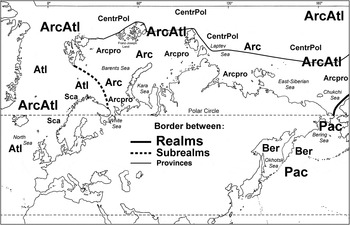
The Central Polar Basin may be considered a separate Central Polar Province of the Arctatlantic biogeographic realm. The northernmost deep-water part of the Laptev Sea should be included in the same province. The remaining Eurasian seas, from the eastern part of the Barents Sea to the north-western part of the Chukchi Sea, are referred to a longitudinally far-reaching division called the Eurasian Arctic Province. On the west within the Barents Sea, this province borders biogeographically (judging from hydrozoan faunal distributions, it is the location of the ‘Plumularioidea distribution line’) with the Scandinavian Province. The latter is also high-boreal and part of the same Arctatlantic biogeographic realm, but within the Atlantic boreal sub-realm of it. Eurasian Arctic and Central Polar provinces unite to form an Arctic sub-realm of the Arctatlantic realm. In the east, the Chukchi Sea part of the Eurasian Arctic province is contiguous with the Pacific biogeographic realm and with its high-boreal Beringian sub-realm (Figure 5). The Canadian Arctic hydrozoan fauna is much like the Eurasian one (Calder, Reference Calder1970, Reference Calder1972). It remains uncertain whether the Canadian Arctic fauna is sufficiently distinct to be regarded as a separate biogeographic assemblage, or whether it should be combined with the Eurasian Arctic into a single province.
Biogeographic division of Eurasian Arctic and adjacent waters, based on distributions of the hydrozoan fauna. ArcAtl – Arctatlantic biogeographic realm area; Atl – Atlantic boreal subrealm area of ArcAtl; Arc – Arctic subrealm of ArcAtl; Pac – Pacific boreal realm area; Ber – Beringian high-boreal subrealm area of Pac; Sca – Scandinavian high-boreal province of Atl; Arcpro – Eurasian Arctic province of Arc; CentrPol – Central Polar province of Arc.

ACKNOWLEDGEMENTS
Great appreciation is expressed for the toil and sacrifices of all of those field investigators who, under harsh Arctic conditions over the last century and more, have sampled benthic and planktonic Hydrozoa in the northern seas of Eurasia. The author is very grateful to two anonymous referees, who helped to improve substantially the content of the manuscript. This work was undertaken without financial support.