Implications
Most of the male piglets are castrated to avoid boar taint, an offensive odour and flavour occurring in pork from intact males. The most frequent current practice is surgical castration without anaesthesia, which is painful for the animal. Immunocastration is an alternative, but some pigs are not correctly treated, so that their meat may exhibit boar taint. This paper suggests a new method, based on the size of accessory sex glands, to check on the slaughter line whether the animal was correctly immunocastrated, and gives evidence that it should be more reliable than the one currently used, based on testis development.
Introduction
As the meat of entire male pigs may exhibit boar taint (an offensive odour and flavour), male pigs are most often castrated at a young age. As the procedure is painful to the animal (EFSA (European Food Safety Authority), 2004), more and more pressure is put on both market and regulatory bodies to ban castration without anaesthesia in the European Union, as it is currently the case in Norway and Switzerland. Vaccination against gonadotropin-releasing hormone (GnRH) (immunocastration) is considered as a good alternative to surgical castration by animal right activists (Oliver et al., Reference Oliver, Font, Furnols, Ouedraogo, Gonzalez, Gil, Lundström, Prunier, Tuyttens, Migdal and Bonneau2008). A commercial vaccine (Improvac™; Pfizer Inc.) has been recently approved in the European Community (EMEA (European Medicines Agency), 2009). The manufacturer recommends that the animals should be vaccinated twice, with the booster injection being administered a few weeks before slaughter.
Immunocastration results in a dramatic decrease in androgens and oestrogens (which induce the development of accessory sex glands) and in androstenone and skatole, the main compounds responsible for boar taint (Bonneau et al., Reference Bonneau, Dufour, Chouvet, Roulet and Squires1994; Dunshea et al., Reference Dunshea, Colantoni, Howard, McCauley, Jackson, Long, Lopaticki, Nugent, Simons, Walker and Hennessy2001; Metz et al., Reference Metz, Hohl, Waidelich, Drochnerb and Claus2002; Cronin et al., Reference Cronin, Dunshea, Butler, McCauley, Barnett and Hemsworth2003; Oliver et al., Reference Oliver, McCauley, Harrell, Suster, Kerton and Dunshea2003; Jaros et al., Reference Jaros, Burgi, Stark, Claus, Hennessy and Thun2005; Zamaratskaia et al., Reference Zamaratskaia, Andersson, Chen, Andersson, Madej and Lundström2008a). There are, however, some animals which are not successfully immunised because they do not respond to the vaccination (Zeng et al., Reference Zeng, Turkstra, Meloen, Liu, Chen, Schaaper, Oonk, Guo and van de Wiel2002; Jaros et al., Reference Jaros, Burgi, Stark, Claus, Hennessy and Thun2005). Furthermore, in field conditions, it can be expected that more animals will escape immunocastration because they have not been properly vaccinated. Those animals are similar to entire males and can therefore exhibit boar taint.
Considering that there is no realistic method available at present to check the absence of boar taint on the slaughter line, the measurement of testis size is currently recommended to check whether a male pig has been successfully immunocastrated (Oonk et al., Reference Oonk, Turkstra, Lankhof, Schaaper, Verheijden and Meloen1995). In experimental situations, there is a limited overlap in the distributions of testis size between successfully immunocastrated and entire male pigs. However, in field conditions where carcasses from animals with very diverse age, weight, genotype and rearing conditions are checked, the extent of overlapping is inevitably much higher. Therefore, a decision on the basis of this criterion results in either false negatives (carcasses considered as boar taint-free, whereas they are actually at risk of exhibiting some) or false positives, depending on the threshold level.
This paper reviews the available data from the literature to investigate whether the size of accessory sex glands could be more reliable than the testis size to control carcasses on whether or not the corresponding animal has been successfully immunocastrated.
Material and methods
A literature review has resulted in the selection of a number of published papers in which the development of genital tract has been recorded at slaughter in both entire male pigs and male pigs vaccinated against GnRH using either Improvac™ (Dunshea et al., Reference Dunshea, Colantoni, Howard, McCauley, Jackson, Long, Lopaticki, Nugent, Simons, Walker and Hennessy2001; Oliver et al., Reference Oliver, McCauley, Harrell, Suster, Kerton and Dunshea2003; Zamaratskaia et al., Reference Zamaratskaia, Andersson, Chen, Andersson, Madej and Lundström2008a and Reference Zamaratskaia, Rydhmer, Andersson, Chen, Lowagie, Andersson and Lundström2008b; Einarsson et al., Reference Einarsson, Andersson, Wallgren, Lundström and Rodriguez-Martinez2009; Pauly et al., Reference Pauly, Spring, O’Doherty, Ampuero-Kragten and Bee2009) or other anti-GnRH vaccines (Falvo et al., Reference Falvo, Chandrashekar, Arthur, Kuenstler, Hasson, Awoniyi and Schanbacher1986; Awoniyi et al., Reference Awoniyi, Chandrashekar, Arthur, Schanbacher, Amador and Falvo1988; Bonneau et al., Reference Bonneau, Dufour, Chouvet, Roulet and Squires1994; Oonk et al., Reference Oonk, Turkstra, Lankhof, Schaaper, Verheijden and Meloen1995). The weights of testis, seminal vesicles and bulbo-urethral glands, as well as the length of bulbo-urethral glands in immunocastrates were expressed as a percentage of the weight or length observed in entire male pigs and plotted against the time elapsed between the second vaccination and slaughter.
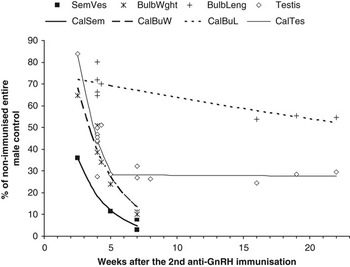
Exponential regressions were fitted to the observed data (Figure 1), using the GNLS procedure of the R statistical package (R, 2008). To take into account the fact that the castration effect is fully observed 1 week after the second immunisation (Claus et al., Reference Claus, Lacorn, Danowski, Pearce and Bauer2007), regressions were calculated on the number of weeks minus 1. The observed R 2 values were 0.28, 0.97, 0.92 and 0.69, respectively, for testis weight, seminal vesicle weight, bulbo-urethral gland weight and bulbo-urethral gland length. As the exponential regression did not fit well the whole set of data for testis weight, two regression lines were calculated, an exponential one before 5 weeks and a linear one after 5 weeks.
Plot of genital tract development in immunocastrated male pigs (expressed as percent of the corresponding development in entire male pigs) against time after the second anti-GnRH vaccination. Data were obtained from the references provided in the ‘Material and methods’ section. Each dot corresponds to the mean of an experimental group of immunocastrates compared with a group of entire males. SemVes: seminal vesicle weight; BulbWght: bulbo-urethral gland weight; BulbLeng: bulbo-urethral gland length; Testis: testis weight. Regression lines (CalSem, CalBuW, CalBuL, CalTes) were fitted to the data as described in the ‘Material and methods’ section.

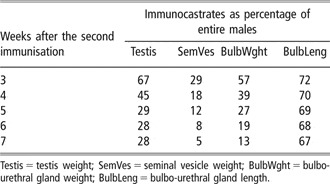
The regression equations were then used to calculate predicted genital tract development at various times after the second immunisation (Table 1).
Calculated development of genital tract in immunocastrated male pigs (expressed as percent of the corresponding values in non-immunised entire male pigs) at various times after the second anti-gonadotropin-releasing hormone vaccination

Testis = testis weight; SemVes = seminal vesicle weight; BulbWght = bulbo-urethral gland weight; BulbLeng = bulbo-urethral gland length.
Results and discussion
Testis weight decreases relatively slowly after the second anti-GnRH immunisation (Figure 1), its weight being 45% and 28% of that observed in entire males, respectively, 4 and 6 weeks after the second immunisation. The weight of bulbo-urethral gland is reduced to a greater extent (39% and 19%, respectively, at 4 and 6 weeks). The reduction in the weight of seminal vesicles is still more dramatic (18% and 8%, respectively, at 4 and 6 weeks). The reduction in the length of bulbo-urethral glands is comparatively much less and much slower.
Testis is made of comparatively solid tissue that needs time to shrink once steroid production has been dramatically decreased after successful immunocastration. In entire males, seminal vesicles are filled with a lot of seminal fluid making most of its weight. As steroids are necessary to the normal function of accessory sex glands, the production of seminal fluid probably stops when the animal is successfully immunocastrated and it can be speculated that the low viscosity seminal fluid is rapidly resorbed. The slower reduction in bulbo-urethral gland weight can be related to the fact that they have a thicker wall than seminal vesicles and that their content is highly viscous, hence likely slower to be resorbed. The thick wall and elongated form of the bulbo-urethral glands are probably the reasons why their length diminishes only very slowly after immunocastration.
Conclusions
As seminal vesicles decline much more rapidly and to a much greater extent than testes, they are potentially a much better criterion to assess the efficacy of immunocastration on the slaughter line. It seems indeed likely that there should be less overlap in the distributions of seminal vesicles weights between successfully immunocastrated and entire male pigs than it is observed for testis weight. However, this remains to be demonstrated. If this is the case, the feasibility of measuring seminal vesicles weight on highly automated, high-flow slaughter lines will have to be investigated.