Melancholy, pessimism, and a certain sarcasm often accompany discussions on the present status of the German language. The German language, one often hears, is virulently infected by Anglicisms, hopelessly at sea because of a confusing and unfinished spelling reform and a “backbencher” in international settings (with the possible exception of the international film industry in which it has the secure status of a raucous law-and-order language). To show that there is more than just a dark side to “the awful German language” as Mark Twain wittily described it in appendix D of his book A Tramp Abroad (1880), this article first presents a brief look at the intriguing past of German as a European lingua franca. Subsequently, the present status of German is dealt with in a more elaborate way. To conclude, a brief outlook is presented.
A Historical Perspective on German as a European Lingua Franca
It seems fair to take the late Middle Ages as a starting point for an historical overview, which is based largely on the historical accounts of Ammon (1991, 2000a); Mattheier (2003); and Stark (1999). At that time the German linguistic area was acquiring vast contours. The core of the German linguistic area was roughly constituted by present-day Germany, Austria, the German-speaking part of Switzerland, Luxembourg, Alsace-Lorraine (eastern France), and South-Tyrol (northern Italy). But because of religiously and/or socioeconomically inspired population movements, the German language also gradually started to take root in the northern and eastern parts of Europe. German settlers of various origins established German as a mother tongue in Silesia, East Prussia, and the eastern parts of Pomerania (since the Second World War these areas have belonged to Poland and Russia); Bohemia and Moravia (since the First World War these areas have belonged to Czechia); Siebenbürgen (Romania); and parts of Hungary, Slovakia, Slovenia, and the Baltic area. Because the population movements partly coincided with the European-wide process of urbanization, the German settlers, most of them having a mercantile spirit, managed to turn their language into a prestigious urban lingua franca that in the course of time would strongly influence its surrounding contact languages. In many cases, the settlers profited from the success of the Hanseatic League, the north German trading organization that from the 13th century onwards started to establish a trading network in northern Europe and the Baltic area that ranged from Brugge to Novgorod. With the exception of Novgorod, where Russian was used, the Hanseatic League succeeded in giving German a secure position within its trading network and thus contributed largely to its international prestige. In Scandinavia, for example, German acquired the status of educational language (Bildungssprache) of the bourgeoisie and the nobility and of a language used in diplomacy and for treaties.
The successful economically-inspired language policy of the Hanseatic League was, however, not supported by an international language policy on the part of the Holy Roman Empire, the political conglomeration comprising most parts of the German linguistic area. Although the Investiture Controversy contributed largely to the diminishing power of Latin as a European lingua franca and gave more openings for the European vernaculars, the Holy Roman Empire (in which German served as the main language) most certainly in its administrative and scientific contacts with foreign powers still preferred the use of Latin. It thus did not follow the path of, for example, Spain and France, which, parallel to their colonial exploits, consciously started promoting their own languages in a standardized fashion in such domains as diplomacy and international politics from the early 16th century onwards.
When in the 16th and 17th century Europe experienced a geopolitical and economical turnover this largely bypassed the Holy Roman Empire. Because of a colonially inspired shift of the major trade routes from northern Europe and the Baltic Sea areas to the Atlantic Ocean, the trading empire of the Hanseatic League almost completely lost its influence. Further, from a political point of view, the Holy Roman Empire was too much confronted with internal religiously inspired discord to actively engage in colonial politics. Conflicts within the Holy Roman Empire eventually led to the Thirty Years War (1618–1648) that would demographically and economically reduce the Holy Roman Empire to ruins.
Still, it is precisely the 17th century that was marked by a high degree of activity concerning the codification of a standard German norm. When in the higher classes of society, the French language gained prestige because of geopolitical circumstances, a number of German intellectuals founded language societies (Sprachgesellschaften) that concentrated on purifying German from French—alamode—influences. The works on language cultivation that were published by, for example, Martin Opitz (Buch von der deutschen Poeterey [Book of German Poetry], 1624) and Justus Georg Schottel (Ausführliche Arbeit von der Teutschen HauptSprache [Comprehensive work on the German main language], 1663) also have to be seen in the light of the awakening of a certain cultural patriotism. The increased study of grammatical and stylistic aspects of German as well as its increased spread throughout society (by means of printing material) eventually helped to settle the conflict of two existing standard varieties in a natural way. From the 14th century onwards the higher classes had started using a more or less standardized form of German, known as the Kanzleisprache (chancellory language), an administrative language originating in Hapsburg's Vienna. It was, however, too bureaucratic to develop into a Volkssprache (vernacular) and thus had to give way to two other competing standards: gemeines Deutsch (“common” German—or East Upper German as it developed in the area of Augsburg and Nuremberg in the late 15th century) and Lutherdeutsch (Luther German—developed by Luther at the beginning of the 16th century and based on East Middle German). Only by the end of the 18th century was the dispute between the two was more or less settled to the advantage of Lutherdeutsch.
Language cultivation activities in the 17th and 18th centuries laid the foundations for a more overtly experienced cultural patriotism that would arise in the 19th century under Prussian rule after the collapse of the Holy Roman Empire. Aside from the multilingual Austro-Hungarian Empire that had come into existence after the Austro-Prussian war in 1866 marked the end of the German Bund, Prussia managed to boost the international prestige of the German language. Not so much the colonial expansion in Africa (Togo, Cameroon, Southwest Africa, and East Africa), but rather Prussia's preponderance in the field of technology and science added renewed lustre to German in those eastern and northern European areas where it traditionally was a prestigious language. It also stimulated interest in German as a foreign language in the United States. The number of pupils studying German as a foreign language in the United States went up to 25 percent in 1915. But even though the international status of German rose considerably on the verge of the 20th century, it needs to be stressed that it still did not reach the international status of French or English. The Great War and to a much greater extent World War II dashed the rise of the German language and—as the next section shows—continues to undermine its magnetism until this very day.
The Present Status of German as a European Lingua Franca
Linguists have put forward various criteria to assess the status of a language as a lingua franca. Most experts list criteria related to the size of the community using the language as a “mother tongue,” the number of countries where it has an official status, the number of people using it as a foreign language, the functional range of the language (i.e., its presence in various domains such as media and science), the economic strength of the language, stereotypes and attitudes related to the language and the (un)planned promotion of the language (cf. Ammon, 1991 & 2000a; Clyne, 1995; Coulmas, 1991, 1993; Kloss, 1974; Phillipson, 1992; and Stark, 1999 for more details). These criteria are bundled here in an alternative, threefold manner. First, the number of speakers of German as a first, second, and foreign language is dealt with. Second, the presence of the language in internationally influential domains is discussed. This includes the presence of German in international politics and international organizations, economy, culture, and science. Third, some related factors supporting the presence of German in internationally influential domains are touched upon, notably language perception, language awareness, language loyalty, language policy, and language promotion.
Number of Speakers of German as a First, Second, and Foreign Language
Putting aside possible interferences with terms such as “mother tongue” and disregarding any terminological finetuning of the distinction between first, second, and foreign language, these terms are interpreted here as follows: The notion “first language” is used to refer to the first language that one acquires in a natural way (i.e., outside of a formal setting) and uses in daily life. The notion “second language” is used to refer to the second language that one—because of migration or other sociological reasons—acquires in a natural setting and that one starts using in daily life. “Foreign language” is used to refer to a language that one acquires in a formal setting (usually in school) and—if at all—uses mainly in limited domains such as tourism and trade. Turning to German, it is the first language of the majority of the inhabitants of the countries or regions in which German has an official status (Germany, Austria, Switzerland, Liechtenstein, Luxembourg, South Tyrol in Italy, and the German-speaking community in Belgium) and of part of the population belonging to a German minority (e.g., in Denmark, Poland, the Czech Republic, Slovakia, Romania or Hungary). German is the second language of many of the migrants who live in countries (or parts of countries) in which German has an official status (e.g., the Turkish population in Germany), of many persons belonging to an autochthonous minority in Germany (Sorbs, Danes) or Austria (Croats, Hungarians, Slovenes), or of persons belonging to a German minority who acquired the majority language as a first language. German is a foreign language of those persons who have acquired it all over the world in a formal setting but do not necessarily use it in daily life but more occasionally in, e.g., tourist or business settings.
Straightforward as this might be, problems arise when attempts are made to provide exact numbers for German as a first, second, or foreign language. No reliable figures exist on the total number of persons mastering German as a foreign language. Data are mostly limited to one generation of language learners at a specific time in history and thus do not account for all the persons who in the course of their life acquired German and are using it or able to use it. Besides that, the distinction between first and second language also proves difficult to translate into numbers. The available statistics do not, for example, give a detailed account of those migrants in Germany (whether they are Rücksiedler [returnees], Spätaussiedler [late-repatriates], Aussiedler [resettlers], etc.) who have German as a first or second language or do not have any notion of it at all. Similarly it is not possible to give exact figures for those members of German minorities who either have German or the majority language as their first or second language. This distinction is hardly considered in minority language statistics. Therefore, the following overview will treat first and second language together and numbers for German as a foreign language will be limited to a single generation of language learners. As a general introduction to the figures following, it should be mentioned that they are to be interpreted as cautious approximations.
The number of speakers of German as first/second language in countries in which German has an official status can be estimated at approximately 82 million in Germany, 7.5 million in Austria, 4.2 million in Switzerland, .37 million in Luxembourg, .3 million in Italy (South-Tyrol), 90,000 in Belgium (Old and New Belgium), and 32,000 in Liechtenstein (based on data from Ammon, 1991; Born & Dickgießer, 1989; Haarmann, 1993, 2002a, 2002b and our own Research Centre on Multilingualism or [RCM]). The number of people who are members of a German minority in countries or parts of countries where German does not have official status and who have German as a first/second language can be estimated at approximately 2.9 million within the European Union (based on data from Born & Dickgießer, 1989; Born & Stickel, 1993; Haarmann, 1993, 2002a, 2002b; Nelde, Strubell, & Williams, 1996; and RCM, 2004).
To these figures should be added the persons with German as a first/second language in Croatia, Kazakhstan, Moldova, Romania, the Ukraine, and Russia (approximately 2 million), North and South America (4.1 million), Namibia and South-Africa (.061 million), Israel (.096 million), and Australia (0.1 million) (based on data from Born & Dickgießer, 1989; Clyne, 2003; Haarmann, 1993, 2002a, 2002b).
If one adds the approximate number of speakers of German as a first/second language one arrives at a total of approximately 104 million on a world scale and approximately 97.5 million within the EU. On a world scale, this puts German generally between the 6th and the 12th position for size of language group depending on the source and the counting methods. Languages that precede German are Chinese, English, Hindi, Spanish, and Russian. Within the EU and its 25 member states it is the biggest language according to first/second speakers followed by French (approximately 58 million) and English (approximately 56 million).
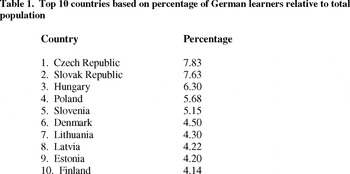
As far as the number of speakers of German as a foreign language is concerned, Clyne (1995, p. 8)—based on figures from the early 1990s—estimates the number of persons learning German as a foreign language at approximately 19 million. A recent survey by StaDaF (Goethe Institut, 2003)1
StaDaF is the abbreviation of Ständige Arbeitsgruppe Deutsch als Fremdsprache [Permanent Working Group on German as a Foreign Language], a co-operation of the Auswärtiges Amt [Foreign Office], the Deutscher Akademischer Austauschdienst [German Academic Exchange Service], the Goethe-Institut Inter Nationes, and the Zentralstelle für das Auslandsschulwesen [Central Office for German Schools Abroad].

Table 1 shows that German as a foreign language has a strong basis in those countries where it has been traditionally present (i.e., countries in eastern and northern Europe). This observation is supported by a recent study of Eurydice, the information network on education in Europe.
In its Key data on teaching languages in Europe (2005), Eurydice provides information on foreign language learning in primary and secondary education in Europe.2
The report covers the 25 member states of the EU as well as Iceland, Liechtenstein, and Norway (as members of the European Economic Area) and Bulgaria and Romania (as candidate countries). The data presented here are limited to the EU.
German in Internationally Influential Domains
It is a common view that numbers alone do not decide upon the international status of a language. With its approximately 418 million speakers (first/second language) Hindi, for example, is perceived as having less international prestige than French with its estimated 138 million speakers. And although Russian once was the obligatory foreign language of all non-Russian people living in the USSR, its numeric potential as a foreign language is nowadays undermined by a dramatic loss of prestige after the implosion of communism. The international status of a language depends on its presence or visibility in internationally influential domains much more than on numbers. Therefore it seems appropriate to elucidate the position of German in international politics and international organizations, economy, culture, and science.
International Politics and International Organizations
On the level of international politics, German is used in negotiations between states or parts of states where German enjoys the status of an official language, i.e., those states where German is the sole official language (e.g., Germany, Austria, and Liechtenstein), those states where German is a co-official language (e.g., Switzerland and Luxembourg) and those states where German has an official status in parts of the country (e.g., South-Tyrol in Italy and the German-speaking Community in Belgium).3
In the case of Belgium it has to be noted that German has official status within some domains on national level as well (Mathiak, 1993).
At the UN, German is not one of the six official and working languages, those being French, English, Spanish, Russian, Chinese, and Arabic. What few people know and what thus hardly contributes to the international prestige of German is that financial contributions from Germany and Austria managed to lift German to a so-called document language (Dokumentensprache) in 1974. This means that the most important documents of the general assembly, the Security Council and the Economic and Social Council are translated (not interpreted) into German. The status of German as a document language also applies to the following suborganizations of the UN: the Universal Postal Union, the Food and Agricultural Organization, the International Labor Organization, the World Health Organization, and the World Bank.
On the level of the EU, German transcends the status of a document language. Together with 19 other languages, it is both an official and a working language. But even though all languages theoretically have equal status, it proves difficult to adhere to this principle in practice. It is true that on the occasion of EU summits as well as in some institutions such as, e.g., the European Parliament, most of the 20 languages share the floor. But certainly within the administrative units of the EU it has been daily practice since the establishment of the European Economic Community (EEC; the predecessor of the EU) to conduct business with a reduced number of working languages. In the early days, French and German were mostly used as working languages. The situation, however, changed when Great Britain joined the EEC in 1973. From that point on, English as a prominent language of the globalizing economy, technical innovation, and the mass media exerted increasing pressure on German and French within EU institutions. Today English is the prevailing language in the institutions, leaving French in second and German in third place. One of the consequences is that job offers first appear in English and French and are then translated these into other languages.
The status of German within the Council of Europe is similar to its status in EU institutions. In the Council of Europe, German theoretically has the status of a working language together with Italian, whereas French and English are official languages. In practice, however, this terminology is misleading. Ammon (1991, pp. 308−309) decribes how official languages within the Council of Europe are de facto working languages and thus mainly used in daily procedures, whereas the working languages are de facto official languages that hardly play any role in daily procedures. Judging on the use of German in the Council of Europe and the EU institutions it can hardly be said that German has the position that it could be expected to have on the basis of its number of speakers or on the basis of its financial contribution to the EU budget (14.3 billion euros net in 2003, or approximately double that of the United Kingdom (UK), which is the second highest contributor).
Economy
The German-speaking countries are economically strong. Switzerland and Luxembourg are, per capita, the wealthiest countries of Europe. The Austrian economy is catching up (cf. Kremb & Spörl in Der Spiegel, 2005, p. 119) and despite a recession at the beginning of the new millennium the German economy is recovering as the cover story of The Economist made clear (August 20, 2005, p. 9). “Made in Germany” (often replaced in a globalized economy by formulae such as “made by Siemens, Bosch, or another German company”) is still a quality label in many branches of industry. As can be deduced from indicators provided by Germany's federal statistical service (www.destatis.de) Germany took a leading position in international export in 2003 (ahead of the United States) and took the second place in imports, following the United States.
The economic strength of a country undoubtedly adds to the prestige of its language and helps to attract students willing to learn this language. Yet, the economic strength of a country is no guarantee of its language's prominence in international business communication. This largely depends on the communication policies and strategies of internationally active (mostly private) companies. These policies and strategies can vary from country to country and depend among other things on the complex weighing of local trading customs and the linguistic composition of the staff in a particular country as against the efficient global functioning of the company in its quest to make a profit. Because it is nearly impossible to give a general sketch of the communication strategies and policies of German companies that are internationally active, only a few general observations will be presented here.
Rumor holds that there is an overall tendency for German-speaking businesspeople to communicate with foreign trading partners in a language that is not theirs. In preferring English, they would follow a trend that is already noticeable in the Netherlands, the Flemish part of Belgium, and Scandinavia and as such convey the impression that trade with German-speaking countries does not necessarily have to involve knowledge of German. In that way they would mar the widespread belief among learners of German as a foreign language that knowledge of German comes in handy in European business settings.
It cannot be denied that German-speaking businesspeople—depending on the company they work for, the branch they represent, the level of negotiation and the geographical setting—sometimes refrain from using their own language and that some German companies do not pay primary attention to knowledge of German when recruiting staff “abroad.” It is indeed somewhat strange that some German companies, even if they are located in areas where German has high prestige (such as in Hungary or the Czech Republic), prefer staff with knowledge of English to staff with knowledge of German (Földes, 1999, p. 4). Yet, systematic research is needed to complement these rather superficial observations and to find out to what extent all aspects of business communication are infected by this trend and whether companies do or do not apply “multilingual” communication strategies in which German as well as the local language(s) of the respective countries in which they are located play a role next to the fashionable, inevitable business English.
In any case, there is no need to be too pessimistic in this respect. A study by Vandermeeren (1998) reveals that German-speaking businesspeople can and do use German to a great extent in dealing with Eastern Europe and neighboring countries. It also needs to be stressed that the German Chamber of Commerce (Handelskammer) regularly publishes so-called “Konsulats- und Mustervorschriften” (consular and exemplary instructions) in which it encourages German companies to use German in business communication and in which it provides practical guidelines on the countries with which German can be used. Moreover, many not necessarily German, Swiss or Austrian companies based in non–German-speaking countries urge their employers to sign up for a crash course in German. And many individuals, especially those who aspire to a commercial job in a German-speaking setting, even at an advanced age take the trouble to study German or to refine their knowledge of German. In the eastern parts of Europe, for example, especially people who are active in such professional domains as the hotel business, trade, industry, and tourism show interest in developing knowledge of German. Unfortunately, the supply of German courses does not always match up to the demand. In this respect it would not be unwelcome to figure out ways that could contribute to a purposive marketing of the German language (and German culture) in the wake of a strong and attractive German economy.
Culture and Science
It is a widespread proposition that the German world today simultaneously presents itself to the outside world as an economic giant (Wirtschaftsriese) and a cultural gnome (Kulturzwerg). The present situation is often compared to the end of the 19th and the beginning of the 20th century when Germany was one of the leading cultural forces within Europe and a trendsetter in many branches of the human sciences as well as the natural sciences. Looking at the status of the German language within science on an international scale, it is somewhat disenchanting to see how the share of German in natural sciences decreased from about 44 percent in 1920 to about 12 percent in 1980. In the same period the share of English, however, grew from about 33 percent to about 64 percent (Ammon, 1999, p. 17). In 1996, the share of English had increased further to 90.7 percent whereas the share of German had further decreased to 1.2 percent (Ammon, 1999, p. 22). The situation is slightly more positive in the humanities, (especially in such areas as Germanic linguistics, history and theology). In 1995 the share of German in publications of the social and human sciences was estimated at 4.1 percent whereas the share of English was estimated at 82.5 percent. The share of English in the total number of publications would, however, be continuously on the increase (Ammon, 1999, p. 24). This is not entirely surprising given the pressure universities and science foundations exert on their staff to publish their articles in “internationally renowned journals” whereby “internationally renowned” is in many cases considered to be a synonym of “anglophone.” Writing in English is considered to be a prestigious activity; writing in one's own language is considered to be provincial.
Still, there is a need to question the general negative view of languages other than English in science. Certainly in the natural sciences there is a tendency to use citation indexes as a starting point for the measurement of a language on a global scale. It is, however, commonly known that citation indexes in the natural sciences are mainly developed in the United States and do not entail all of the material that is available on the European continent. Admittedly, the share of English would still be higher than the share of German (or any other language) when taking into account all existing publications. Yet, the question remains whether it makes sense to measure the weight of German on a global international scale, given the fact that its geographical range and its core territory are limited to Europe. For a precise picture of the status of German as a language of science, it could be revealing to try and measure its weight within a European scientific context. Plans exist within the European Science Foundation to establish a European citation index. Unfortunately no concrete results have been obtained yet, but belief exists that the situation of German as a scientific language within Europe might not be that negative, certainly when compared to all other international and major languages of Europe that are also confronted with declining usage in the scientific world.
A situation that seems far from doomed is that of German in the worldwide production of books. According to the already mentioned StaDaF survey, German occupies third place in the worldwide production of books (English 28 percent, Chinese 13 percent, German 12 percent). The same survey shows that 7.7 percent of the websites are in German (vs. 5.6 percent in French and 56.4 percent in English). German is also used by 12 percent of the Google users as a search language. German magazines (Der Spiegel, Stern, Focus), newspapers (Frankfurter Allgemeine, Die Zeit, Die Welt, Bild, Neue Zürcher Zeitung), radio stations (Deutschlandfunk, Deutsche Welle), and television stations (via satellite or cable) have a wide geographical range. Unfortunately, missing data prevent us from clarifying the weaker position of German vis-à-vis English and its stable and solid position vis-à-vis other “competing” European languages here in detail.
Factors Supporting German in Internationally Influential Domains
This section presents some of the affective factors that support (or fail to support) the use and presence of German in internationally influential domains. First of all, the perception of the German language by foreigners is treated. Secondly, the loyalty of the German-speaking populations toward their own language is addressed. To conclude, a few remarks on language policy and language promotion are presented.
Language Perception
During communism, German, as the language of the German Democratic Republic (GDR) and an (obligatory) foreign language in many of the Warsaw Pact countries, managed to gain the status of a language of freedom and a key to the west. This certainly has contributed to the positive attitude toward German, Germans, Germany, and the other German-speaking countries in general. In other parts of the world (most certainly in North America and most parts of western Europe) other attitudes prevail. There, German is still perceived of as the raucous language of a war-minded state with a worrisome past and full of genetically plump people. This image is cultivated in numerous blockbusters as well as in (especially British) tabloids and reruns of succesful sitcoms (AlloAllo, Hogan's Heroes, the Fawlty Towers episode of “The Germans”). These blockbusters, tabloid, and sitcoms are gefundenes Fressen (“easy pickings”) for researchers focusing on attitudes and stereotypes as well as a source of inspiration for those who write manuals for foreign businesspeople and tourists on how to behave when visiting Germany. The fact that the contemporary image of the German-speaking world (and Germany in particular) is anachronistically frozen in the 1940s encumbers the spread as well as the teaching of German as a foreign language.
But besides the fact that the German language is burdened with an extralinguistic mortgage that seems hard to dispel, it is also shrouded with the myth that it is an impossible language to learn caused by (i) a complex system of cases, (ii) a spelling system that is so opaque that 10 years were enough to reform only part of it, and (iii) the linguistic idiosyncracies that have to be taken into account when traveling from one Bundesland to the other or crossing the border to Austria or Switzerland. Many Germans (perhaps unconsciously) tend to support this rather negative view of their country and especially their language.
Language Loyalty
That the road to German language promotion and language spread is more than partly blocked by a tendency to German self-curtailment has been illustrated by Csaba Földes (1999) who points to the behavior of people who are (both within and out of German-speaking countries) involved in conceptualizing or teaching German as a foreign language (i.e., Deutsch als Fremdsprache, or simply: DaF). Földes notes how DaF-professionals would rather stress the difficulty of German instead of pointing out its logical structure and the fact that German, certainly in comparison to other languages, is relatively easy to learn. On top of that, many manuals on German language acquisition are methodologically outdated and—more than manuals on the acquisition of English as a foreign language—fail to establish thematic links to those aspects of life in which foreign language students in secondary schools are interested. The covering of such issues as the fall of the Berlin Wall, the integration of “guest workers” (Gastarbeiter), and the efforts to counteract the spread of right wing extremist ideas (currently accounting for less than 5 percent of the total electorate) are understandable and noble both in view of Germany's complex history and in view of the perceived pedagogical need to stress the necessity of a tolerant democratic society. However, whether they are the ingredients needed to attract the attention of a post-communist generation to a dynamic and vibrant language and culture can be seriously doubted.
Fortunately, many DaF-advocates, especially those that are “blessed” with the so-called Gnade der späten Geburt (clemency of late birth), are creative enough to develop alternatives on an individual basis and to follow the more joyous road to language learning similar to that found in many handbooks on English as a foreign language. But they, for their part, might find it hard to resist the wave of anglicisms that currently color the German language. The use of anglicisms in the German-speaking world should not be exaggerated in the sense that the survival of the German language is threatened in its present form. It is rather the case that those aspects of modern life that are perceived of as being “hip” or “cool” are rife with an English or “Denglish” (i.e., a hybrid form of D(eutsch) and English) vocabulary, which feeds the suggestion that no other language can be as fashionable as English. This might be related to the increased focus in the German-speaking countries of foreign language learning whereby English (and, in second place, Spanish) dominate language learning curricula. As in other countries the debate on the reform of higher education in German-speaking countries (with a leading role for Germany) is dominated by the introduction of English as a language of instruction that would help the native students to prepare for a professional role in a globalized society and would attract foreign students to study in German-speaking countries. That the native students are sensitized to acquire foreign languages can only be applauded as far as the increasing efforts in the teaching of foreign languages is concerned. Yet, it is a pity that the burgeoning openness to other languages in German-speaking countries continues hand in hand with the decline of the promotion of the German language abroad that started in the 1970s.
Language Policy and Language Promotion
As noted by Hoffmann (2000) and Stark (2000), the almost sudden change in Germany's language policy in the 1970s is at least partly responsible for the difficulties experienced today in spreading and promoting the German language. During the era of Konrad Adenauer, Germany's first postwar chancellor, a language policy was developed that—in view of World War II—was unabashed, self-conscious, and due to the strong personality of Adenauer, generally accepted abroad. Germany managed to combine its language policy and its cultural policy. Knowledge of the German language was perceived of as a necessary prerequisite for a good understanding of the German culture and its contribution to civilization (Hoffmann, 2000, p. 61). German has acquired prestige by its use as a working language in the “Montanunion” and its successor, the EEC. Yet, the pressure of the Wirtschaftswunder (economic miracle) to engage strongly in a global economy, the strong wish for a united Europe and Germany's military reliance on the United States and NATO in the Cold War period (Stark, 2000, p. 97) caused a reversal in Germany's language policy. In 1970 Germany's foreign office (until the present day responsible for the cultural and language policy) published guidelines for the foreign cultural policy (Leitsätze für die auswärtige Kulturpolitik) in which it is stressed that the German language is the carrier and not the goal of Germany's activities abroad.
This disparagement of its own language, which was common for all German-speaking countries and quite different from the language policies of France and the UK, was exemplified by the almost voluntary resignation of the use of German in the European institutions as soon as Great Britain became a member of the EEC in 1973 (cf. Coulmas, 1991). Since then, German EU officials have increasingly turned to the use of English in EU institutions and are among those who would favor the use of English as the sole working language (cf. Quell, 1997). Many German politicians lament this rather self-destructive behavior. Certainly ever since the chancellery of Helmut Kohl, political Germany, as Ammon (2000c, pp. 5–6) notes in the editor's preface to Sprachförderung. Schlüssel auswärtiger Kulturpolitik [Language promotion: The key to foreign cultural policy], has been concerned with questions of the international status of the German language. Verbal decisiveness (in parliamentary debates, newspaper columns, etc.) is, however, only sparsely translated into practical measures. The German foreign office admittedly dedicates almost half of its budget to language promotion activities (200 million / per year) in subsidizing among others the Goethe Institut, the German Academic Exchange Service, the Central Agency for Schools Abroad and the Educational Exchange Service. Still, the Goethe Institute has faced severe budgetary cuts in recent years. Especially in Western Europe, it was forced to close offices or to decrease its activities. But despite these austerity measures, it did not manage to match up to the post-communist demand for German in the eastern part of Europe, where English now is taking the wind out of German sails. One response to this development currently seems to be a concentration of DaF-activities in the Asian world. Whether this will prove to be the right strategy to secure the lingua franca status which German, based on its presence in many internationally influential domains, still enjoys within Europe is highly questionable.
Outlook for German as Lingua Franca
This chapter has tried to give a rough sketch of the present status of German as a European lingua franca. Measured by its number of speakers and its presence in internationally influential domains, the international status of Europe's biggest mother tongue is not as pitiful as some might think. Surely, the international status of German pales before the international status of English. But that is, at least at this point in history, true for any other language. And although more research must be done in this respect, it could be cautiously claimed that precisely in comparison to the presence of other bigger languages (such as French, Italian, and Spanish) in such domains as education, the media and international politics, German is still doing rather well, most certainly in central, eastern, and part of northern Europe. It will be a great challenge for language policy makers from the German-speaking countries to secure this position in the near future. Similar to their British and American colleagues, they will need to develop innovative language spread strategies and will need to convince people, including those with German as a mother tongue, that there is more to multilingualism than English only and that lingua franca also deserves to have a German plural.