Cannabis accessibility and popularity has increased (Center for Behavioral Health Statistics and Quality, 2015) as perceptions of its harmfulness have decreased (Compton et al. Reference Compton, Grant, Colliver, Glantz and Stinson2004; Johnston et al. Reference Johnston, O'Malley, Bachman and Schulenberg2013). Despite being the most widely used illicit drug (CBHSQ, 2015), only three in 10 cannabis users meet criteria for cannabis use disorder (CUD). Therefore, a high proportion of cannabis users are non-cases who do not report significant consequences of use (Stinson et al. Reference Stinson, Ruan, Pickering and Grant2006; Hasin et al. Reference Hasin, Saha, Kerridge, Goldstein, Chou, Zhang, Jung, Pickering, Ruan, Smith, Huang and Grant2015, Reference Hasin, Kerridge, Saha, Huang, Pickering, Smith, Jung, Zhang and Grant2016). Perceptions that regular cannabis use is not problematic are likely to increase as ongoing legislation increases its accessibility. Yet, research on other disorders has shown that individuals exhibiting some but not all criteria necessary for a diagnosis still exhibit significant impairment relative to controls (e.g. subthreshold or minor depression: Judd et al. Reference Judd, Rapaport, Paulus and Brown1994; Gotlib et al. Reference Gotlib, Lewinsohn and Seeley1995; Pincus et al. Reference Pincus, Davis and McQueen1999; Fergusson et al. Reference Fergusson, Horwood, Ridder and Beautrais2005). Therefore, determining if regular cannabis use – regardless of CUD status – is associated with substantial harms is imperative for anticipating the public health consequences of increased accessibility.
Prior studies of cannabis use have documented numerous acute and protracted harms among regular cannabis users with and without CUD (Poulton et al. Reference Poulton, Brooke, Moffitt, Stanton and Silva1997; McGee et al. Reference McGee, Williams, Poulton and Moffitt2000; Budney & Moore, Reference Budney and Moore2002; Hall & Degenhardt, Reference Hall and Degenhardt2009; Meier et al. Reference Meier, Caspi, Ambler, Harrington, Houts, Keefe, McDonald, Ward, Poulton and Moffitt2012; Volkow et al. Reference Volkow, Baler, Compton and Weiss2014). McGee et al. (Reference McGee, Williams, Poulton and Moffitt2000) highlighted that, compared with non-using peers, regular users reported higher lifetime rates of CUD along with internalizing problems and early-emerging externalizing problems. Despite informative research in this area, CUD samples have largely been studied separately from regular user samples and few studies have directly compared psychosocial problems experienced by regular users with and without CUD. As 70% of users are unlikely to develop a CUD diagnosis, substantive comparison of these groups is required to determine if regular users who do and do not develop CUD by adulthood experience similar psychosocial problems.
Two cross-sectional studies sampling frequent users showed that CUD users had higher rates of internalizing and substance use problems than non-CUD users (Looby & Earleywine, Reference Looby and Earleywine2007; van der Pol et al. Reference van der Pol, Liebregts, de Graaf, ten Have, Korf, van den Brink and van Laar2013). Van der Pol et al. (Reference van der Pol, Liebregts, de Graaf, ten Have, Korf, van den Brink and van Laar2013) compared frequent users to a representative group of Dutch controls and detected higher rates of externalizing disorders, substance use, and childhood adversities (e.g. childhood abuse, parental divorce or absence) in CUD and non-CUD users compared with non-users. CUD users also had especially high rates of internalizing disorders compared with non-users and non-CUD users.
The present study was developed to advance the understanding of regular cannabis use with and without CUD in three key ways. The first aim was to replicate prior results differentiating CUD users, non-CUD users, and non-users in young adulthood (van der Pol et al. Reference van der Pol, Liebregts, de Graaf, ten Have, Korf, van den Brink and van Laar2013) using a community sample of twins tracked longitudinally. Prior studies use of cross-sectional ascertainment procedures for recruiting frequent, heavy users have likely skewed base rates of psychosocial problems, limiting generalizability. Replication in a large, longitudinal community sample will help determine the broader applicability of prior findings and ensure the credibility of an undiagnosed status. That is, using a person-centered approach involving multiple interviews throughout the period of peak prevalence (Chen & Kandel, Reference Chen and Kandel1995; Wagner & Anthony, Reference Wagner and Anthony2002) will be particularly advantageous for capturing levels of impairment within individuals across development and confirming that CUD has not emerged over the entire period of interest.
The second aim was to compare psychosocial functioning of CUD users, non-CUD users, and non-users from adolescence through young adulthood. Other substance use, antisocial behavior, behavioral disinhibition, and substance-using peers in adolescence pose risk for later CUD and regular cannabis use (Fergusson et al. Reference Fergusson, Boden and Horwood2008). An important goal is to determine when these risk patterns begin to differentiate individuals who ultimately become regular users with CUD v. regular users who never develop CUD. Identification of early risk patterns in those who ultimately become regular users with or without CUD will specify early etiological risks and identify who may benefit from early intervention or prevention. While cannabis use peaks in young adulthood, early differentiation of regular use and CUD, before these patterns are evident, would signal the benefit of earlier intervention.
Third, regular users without CUD may go undiagnosed because they under-report symptoms associated with their use, posing a methodological challenge. Self-report is a well-validated and widely used drug use measurement technique but can be limited by potential recall and social desirability bias (Harrison & Hughes, Reference Harrison and Hughes1997). Prior studies have tested validity of self-reported drug use by estimating concurrence with informant or co-twin report (Heath et al. Reference Heath, Knopik, Madden, Neuman, Lynskey, Slutske, Jacob and Martin2003). Therefore, we used co-twin reports to independently verify cannabis use and related problems to ensure that group differences were not due to variation in willingness to disclose problems or a lack of insight into cannabis-related problems.
Since a CUD diagnosis by definition requires impairment, users who did not develop CUD during the period of peak prevalence (i.e. non-CUD users) were expected to have significantly fewer problems than CUD users. Specifically, CUD users were expected to exhibit a more global pattern of psychosocial deficits (e.g. more psychiatric problems) across development relative to non-users and non-CUD users (van der Pol et al. Reference van der Pol, Liebregts, de Graaf, ten Have, Korf, van den Brink and van Laar2013). Specifically, CUD users were hypothesized to be relatively elevated on alcohol and drug use, antisocial behavior, disinhibited personality traits, adolescent sexual behavior, and peer deviancy (Jessor, Reference Jessor1991; Fergusson et al. Reference Fergusson, Boden and Horwood2008). Non-CUD users were expected to be elevated on clinical measures strongly associated with cannabis use in general (e.g. externalizing) relative to non-users. We also predicted that adolescent problems would differentiate non-users, non-CUD users, and CUD users from one another. Finally, we predicted that self-reported use and CUD symptoms would be validated via high concordance with co-twin reports.
Methods
Sample
Participants (N = 3240) were twins from the Minnesota Twin Family Study (MTFS), a community-based study designed to prospectively examine the etiology of substance use disorders (Iacono et al. Reference Iacono, Carlson, Taylor, Elkins and McGue1999; Keyes et al. Reference Keyes, Malone, Elkins, Legrand, McGue and Iacono2009). Twin pairs born between the years of 1972–1984 and 1988–1994 were identified via Minnesota public birth records. Staff located 90% of families and 83% completed the in-person laboratory assessment. Nearly all participants were of European–American ancestry (96%; Iacono et al. Reference Iacono, Carlson, Taylor, Elkins and McGue1999) with common parental occupation, education, and history of mental health treatment to non-participating families. Participants enrolled at either age 11 (n = 1988) or age 17 (n = 1252) and follow-up assessments occurred at the same 3–5-year intervals for both cohorts. Assessments for the mean ages of 17.83 (s.d. = 0.69), 21.10 (s.d. = 0.82), and 25.01 (s.d. = 0.90) years were used to capture the peak prevalence for cannabis use.
Cannabis use and CUD symptoms
Cannabis use and CUD symptoms were assessed using the Substance Abuse Module (Cottler et al. Reference Cottler, Robins and Helzer1989) of the Composite International Diagnostic Interview (Robins et al. Reference Robins, Wing, Wittchen, Helzer, Babor, Burke, Farmer, Jablenski, Pickens, Regier, Sartorius and Towle1988). Diagnoses were developed via consensus across interviewers on Diagnostic and Statistical Manual of Mental Disorders, Third Edition-Revised (DSM-III-R) and later DSM-IV (APA, 1987, 1994) criteria. Audiotaped interviews were conducted by employees with a Bachelor's degree in psychology or a related field who completed training in descriptive psychopathology and its reliable assessment. Doctoral students in clinical psychology with extensive interview experience following completion of a descriptive psychopathology course reviewed the written notes and audiotapes as necessary for determining symptom thresholds. Final symptoms assignments were determined by agreement between two or more of the doctoral students in order to establish the consensus diagnosis.
Weekly cannabis use
The number of lifetime uses and the frequency of cannabis use were used to identify individuals sustaining a weekly pattern of cannabis use for at least a 1-year period. Weekly users were defined by 40 minimum lifetime uses of cannabis and a report of at least one episode of cannabis use each week over the previous 12 months at any of the assessments (i.e. ages 17, 21, or 25).
CUD diagnosis
Following identification of user status, regular users were separated into CUD and non-CUD groups. Consistent with the symptom threshold for DSM-5, two or more of the 11 DSM-IV cannabis abuse and dependence symptoms (i.e. not including the craving item) were required for a diagnosis (APA, 2013). CUD diagnoses were based on assessments at ages 17, 21, and 25. The age 17 assessment queried lifetime CUD (i.e. any symptoms up to that point) and assessments thereafter (i.e. ages 21 and 25) covered the time since prior assessment. Weekly users who met the criteria for CUD at any of those time points were classified as ‘CUD users’, and weekly users who never met the criteria for CUD at any of those time points were classified as ‘non-CUD users’.
Consequently, three groups were compared in focal analyses. Specifically, weekly users who met the criteria for CUD (i.e. two or more of the DSM-IV symptoms) at any assessment (‘CUD users’, n = 311) were compared with a second group of weekly users who had fewer than two CUD symptoms (i.e. no CUD diagnosis) across all assessments (‘non-CUD users’, n = 111). User groups (CUD and non-CUD users) were first compared with one another and then each was compared to a third group of individuals who reported no use of cannabis at any of the assessments (non-users, n = 996). Longitudinal assessment of drug use and symptoms has been shown to yield more accurate estimates of lifetime prevalence rates of frequent cannabis use and CUD than a cross-sectional approach to defining groups at a single time point (Hamdi & Iacono, Reference Hamdi and Iacono2014).
Informant report
Co-twin reports of cannabis use and problems were available for a subset of participants at the age 17 (n = 2445) and age 21 (n = 1087) assessments. Co-twins provided an estimate of the frequency of their twin's cannabis use, and whether their twin had ‘used cannabis enough so that he/she needed or was dependent on it’. Responses were coded as dichotomous (present/absent) and used to estimate the rate of concordance between self- and informant reports for rates of cannabis use and reported need/dependence on cannabis.
Psychosocial functioning
Cannabis use groups were compared across multiple domains including alcohol and drug use, symptoms of psychiatric and substance use disorders, personality, and indices of social function. Adolescent functioning was assessed at age 17. Reports of symptoms and heaviest substance use covered lifetime at the age 17 assessments. Young adulthood outcomes were assessed at ages 21 and 25 and covered the period since the last assessment (3–4 years). Therefore, for the young adulthood outcomes, the period of heaviest use was used for measures of substance use and the greatest number of symptoms endorsed for disorders from ages 18 to 25.
Alcohol and other drug use
Self-reported alcohol use included past year average quantity of alcohol drinks per occasion and the maximum number of alcoholic drinks consumed in 24 h. Counts for the illicit drug types tried (except cannabis) and the drug type with the highest number of abuse and dependence symptoms (DSM-III-R and -IV criteria) was assessed for alcohol, nicotine, amphetamines, cocaine, hallucinogen, inhalant, opioid, PCP, and sedatives.
Psychiatric symptoms
Attention-deficit hyperactivity disorder (ADHD), conduct disorder (CD), and oppositional defiant disorder (ODD) symptoms were assessed using the parent and child versions of the Diagnostic Interview for Children and Adolescents-Revised (Welner et al. Reference Welner, Reich, Herjanic, Jung and Amado1987). A symptom was considered present if reported by either the parent or twin. Twins and parents in the older cohort reported on lifetime symptoms at their baseline assessment at age 17. Twins and parents in the younger cohort reported on symptoms of the childhood disruptive disorders at ages 11 and 14.
Symptoms of major depressive disorder (MDD), generalized anxiety disorder, panic disorder, agoraphobia, social and specific phobias, and post-traumatic stress disorder were assessed using the Structured Clinical Interview for DSM-IV (SCID-IV). Adult antisocial behavior (AAB; the adult criteria for antisocial personality disorder) was assessed using an interview developed by MTFS staff. Because the prevalence of adult disorders was relatively low at age 17, internalizing and externalizing composites (i.e. mean z-score) were used to summarize psychiatric problems at this age. The internalizing composite included MDD, social phobia, simple phobia, and a 12-item teacher rating of internalizing distress (Hicks et al. Reference Hicks, DiRago, Iacono and McGue2009a). The externalizing composite included AAB, alcohol, nicotine, and illicit drug use disorders, and a 30-item teacher rating of externalizing behaviors (Hicks et al. Reference Hicks, South, Dirago, Iacono and McGue2009b). Due to low incidence of anxiety disorders, all anxiety symptoms present across disorders were summed to calculate a single composite at age 25.
Personality
Personality was assessed at ages 17 and 25 using the well-validated, 198-item version of the self-report Multidimensional Personality Questionnaire (MPQ; Tellegen & Waller, Reference Tellegen, Waller, Boyle, Matthews and Saklofske2008). The MPQ includes three higher order factors: positive emotionality (subjective well-being and enjoyment of social engagement), negative emotionality (susceptibility to stress, alienation, and proneness toward interpersonal aggression), and behavioral constraint (cautiousness, planfulness, endorsement of traditional social values, avoidance of thrills and danger).
Social functioning
At age 17, social functioning was assessed using composite measures validated in prior reports (Hicks et al. Reference Hicks, DiRago, Iacono and McGue2009a). Composites included academic problems (twin and mother report of GPA, expectation of academic attainment, and a seven-item scale of the child's attitudes about school; Johnson et al. Reference Johnson, McGue and Iacono2006), mother–child and father–child relationship problems (twin, mother, and father responses to the 50-item Parental Environment Questionnaire; Elkins et al. Reference Elkins, McGue and Iacono1997), prosocial and antisocial peer affiliation (nine-item twin and teacher reports of the twin's peer group characteristics; Walden et al. Reference Walden, McGue, Lacono, Burt and Elkins2004), and a count of 18 stressful life events related to family cohesion and stability (e.g. parental discord and divorce, money, legal, and mental health problems) was assessed using the Life Events Interview (LEI; Bemmels et al. Reference Bemmels, Burt, Legrand, Iacono and McGue2008). Overall environmental risk was quantified by calculating a mean z-score composite score of parent–child relationship problems, antisocial peer affiliation, prosocial peer affiliation (reversed), stressful life events, and academic problems. Sexual behavior was assessed using age of sexual intercourse initiation and a composite of dating frequency, break-up with a romantic partner, sexual intercourse experience, worrying about accidental pregnancy, and parenthood assessed as part of the LEI.
At age 25, social functioning was assessed by the longest periods of full-time and part-time employment, years of education, income, number of children, and legal problems as assessed as part of the Social Adjustment Interview and LEI. Lastly, antisocial and prosocial characteristics of peers were assessed using a 15-item self-report questionnaire.
Analytic plan
Differences between non-users, non-CUD users, and CUD users on each psychosocial variable were tested using linear contrasts (i.e. non-users v. non-CUD users, non-users v. CUD users, non-CUD users v. CUD users) in a multilevel model that nested individuals within families to account for correlated twin observations. Estimation using full maximum likelihood approach handled missing data by aggregating contributions to the function across variables with available data rather than omitting cases via listwise deletion or imputing artificial values. Gender was included as a covariate in each model to control for confounding effects on each outcome. Rather than interpreting results from any single statistical test, conclusions were drawn from the pattern of effects across domains at the p < 0.01 threshold, and significance at the p < 0.05 threshold is reported as a trend-level effect. The effect size for each group was estimated using Cohen's d with d = 0.20, 0.50, and 0.80 indicating small, medium, and large effect sizes, respectively. Using a person-centered developmental approach, the same groups of individuals were compared in adolescence and young adulthood to determine if functioning differed by group at each period. To confirm that no cohort differences were present, models initially included a cohort main effect and interaction (i.e. cohort x independent variable) that was dropped in all cases due to a lack of any significant interaction effects.
Tetrachoric correlations (Pearson, Reference Pearson1900) were calculated using TetMat (Uebersax, Reference Uebersax2015) to estimate the concordance between self- and co-twin informant reports of cannabis use and problem use. Tetrachoric correlations are commonly used with twin data (Kendler et al. Reference Kendler, Neale, Kessler, Heath and Eaves1992) and are ideal for estimating the association between two dichotomous variables represented along an underlying continuum – such as problems with cannabis use v. no problems with cannabis use (Banerjee et al. Reference Banerjee, Capozzoli, Mcsweeney and Slnha1999). This method is superior to alternatives like Cohen's κ in cases where the two raters may use different threshold values along the continuum to designate the boundary for the variable dichotomy (Banerjee et al. Reference Banerjee, Capozzoli, Mcsweeney and Slnha1999). Specifically, co-twins may differ in how much cannabis use they identify as problem use or dependence when compared with each twin's self-report.
Results
Adolescent psychosocial impairment across use and CUD groups
Alcohol and drug use
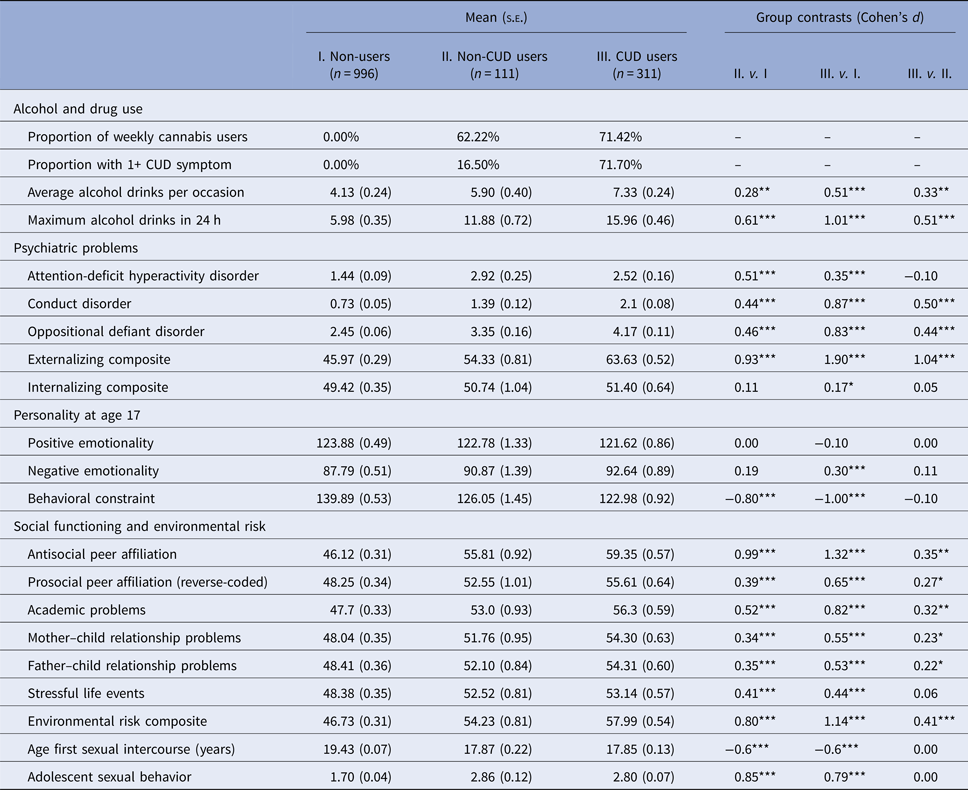
Table 1 presents descriptive statistics and Cohen's ds (p < 0.05 for all reported effect sizes) for group differences on the measures of psychosocial functioning at age 17. A high proportion of CUD (71.4%) and non-CUD (62.2%) users were already using cannabis weekly at age 17. Despite similar rates of weekly use, however, a much higher proportion of CUD users (71.7%) had at least one symptom of CUD at age 17 than non-CUD users (16.5%). CUD and non-CUD users reported a greater average number and maximum number of alcoholic drinks compared with non-users of cannabis, and CUD users consumed significantly more alcohol than non-CUD users.
Group means, standard errors, and group contrast effect sizes for cannabis use groups at age 17

*p < 0.05; **p < 0.01; ***p < 0.001; Psychiatric problems are reported as symptom counts. The externalizing composite was the mean z-score of symptoms of adult antisocial behavior, alcohol use disorder, nicotine use disorder, illicit drug use disorder, and a teacher rating of externalizing behaviors converted to a T-score metric. The internalizing composite was the z-score of symptoms of major depressive disorder, social anxiety disorder, simple phobia, and a teacher rating of internalizing distress converted to a T-score metric. Symptoms measures are for lifetime; substance use measures are for period of heaviest use up to age 17.
Psychiatric problems
For the childhood disruptive disorders, CUD and non-CUD users had more symptoms of ADHD, CD, and ODD than non-users, and CUD users had more symptoms of CD and ODD than non-CUD users. For the composite of adult externalizing disorders, both CUD and non-CUD users reported more symptoms than non-users, and CUD users reported more symptoms than non-CUD users. At the trend level, CUD users also had slightly higher internalizing scores than non-users.
Personality
CUD and non-CUD users had lower behavioral constraint scores than non-users. CUD users also had higher negative emotionality scores than non-users. CUD and non-CUD users did not differ on any personality trait scale.
Social functioning and environmental risk
CUD and non-CUD users reported more academic problems, more parent–child relationship problems, fewer prosocial peers, more antisocial peers, and more stressful life events that non-users with medium to large effect sizes. CUD users had slightly more antisocial peers than non-CUD users. At the trend level, CUD users also had more academic problems, parent–child relationship problems, fewer prosocial peers than non-CUD users, though the effect sizes were small to medium. These patterns were summarized by comparisons on the environmental risk composite with large differences between non-users and both the CUD and non-CUD users, and a medium effect size difference between the CUD and non-CUD users. Both CUD and non-CUD users initiated sexual intercourse significantly earlier than non-users. CUD and non-CUD users also engaged in more sexual behaviors broadly defined (e.g. dating, number of relationships) in adolescence.
Young adult psychosocial impairment across use and CUD groups
Alcohol and drug use
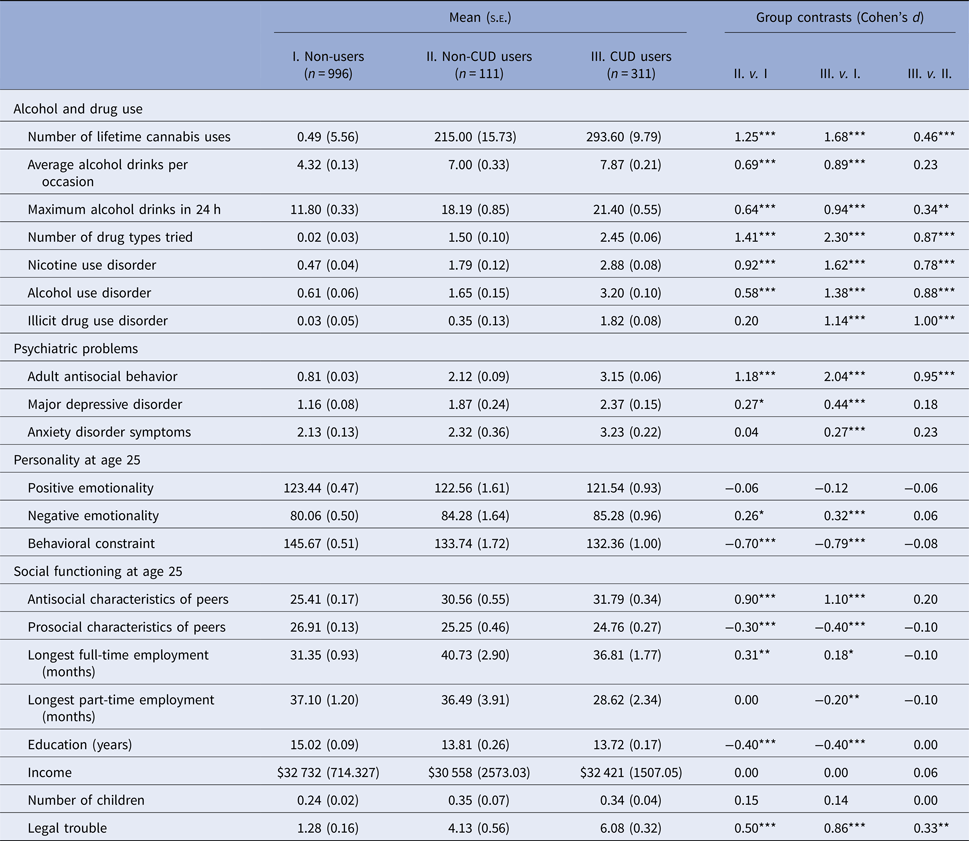
Descriptive statistics and Cohen's d for group differences on the measures of psychosocial functioning from ages 18 to 25 are reported in Table 2. CUD users reported significantly more lifetime cannabis uses than non-CUD users. CUD and non-CUD users reported a greater average number and a maximum number of alcohol drinks compared with non-users, but did not differ from each other. CUD and non-CUD users reported significantly more symptoms of alcohol and nicotine use disorders and number of drug types tried than non-users, and CUD users reported higher rates of each than non-CUD users. CUD users also endorsed more illicit drug use disorder symptoms than non-users and non-CUD users.
Group means, standard errors, and group contrast effect sizes across cannabis use groups for psychosocial problems during young adulthood (ages 18–25)

*p < 0.05; ** p < 0.01; *** p < 0.001; The substance use disorder variables refer to symptom counts as do the adult antisocial behavior and major depressive disorder variables. Values for substance use refer to period of heaviest use from ages 18 to 25; values for symptom counts refer to peak severity from ages 18 to 25.
Psychiatric problems
CUD and non-CUD users reported more AAB than non-users, and CUD users reported more AAB than non-CUD users. CUD users also reported more MDD and anxiety symptoms than non-users; non-CUD users had slightly but not significantly more MDD symptoms than non-users.
Personality
CUD and non-CUD users had lower behavioral constraint scores than non-users. CUD and non-CUD users also had higher negative emotionality scores than non-users. Scores for positive emotionality did not differ across groups.
Social functioning
CUD and non-CUD users reported more antisocial and fewer prosocial characteristics of their peer groups than non-users, but did not differ from each other on either scale. At the trend level, CUD and non-CUD users reported slightly longer full-time employment than non-users. In contrast, longest part-time employment was slightly shorter for CUD users relative to non-users. CUD and non-CUD users had fewer years of education than non-users. Despite differences in education, incomes at age 25 were similar across groups. CUD and non-CUD users had higher rates of legal problems than non-users, and CUD users had slightly more legal problems than non-CUD users.
Self- and co-twin informant agreement on cannabis use and problems
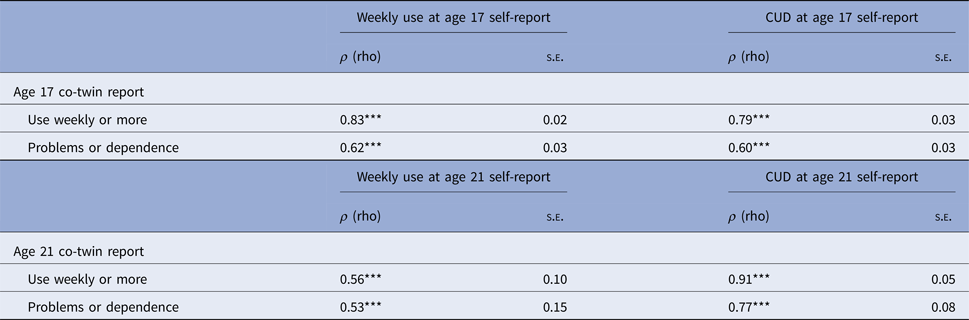
Table 3 displays tetrachoric correlations between self- and co-twin informant reports. Self- and co-twin informant ratings of weekly cannabis use and cannabis use problems were highly concordant at both ages 17 and 21. At age 17, concordance between self-report of weekly use and co-twin informant report of weekly use was significant. Additionally, self-report of CUD at age 17 was strongly related to co-twin informant report of cannabis dependence. Further, self-reported weekly use at age 17 significantly predicted co-twin informant reported cannabis dependence. Additionally, self-reported CUD was also strongly associated with co-twin reported weekly use. At age 21, strong associations between self-report and co-twin informant reports of cannabis use were also detected.
Tetrachoric correlations for co-twin informant and self-report of cannabis use frequency and cannabis use disorder (CUD)

*p < 0.05; **p < 0.01; ***p < 0.001.
Discussion
The present study advanced understanding of regular cannabis users with or without CUD in three ways: (1) extended prior findings for group differences in psychosocial functioning in young adulthood in a prospective, community sample unselected for frequent cannabis use, (2) tested for group differences in psychosocial functioning in adolescence, and (3) used informant reports of cannabis use to validate self-reported cannabis use and CUD symptoms. Consistent with prior studies, relative to non-users, both regular user groups were elevated on externalizing disorders and the CUD users were also elevated on internalizing problems. Interestingly, regular use, CUD, and accompanying profiles of psychosocial deficits were largely present in adolescence, despite large increases in cannabis use in young adulthood. High agreement between self and co-twin reports of cannabis use and problem use further validated empirically derived groups.
Psychosocial impairment common to CUD and non-CUD users
Both regular user groups were consistently elevated on externalizing phenotypes such as substance use and substance use disorder, antisocial behavior, and disinhibited personality traits. Elevations on externalizing disorders were observed in prior studies (van der Pol et al. Reference van der Pol, Liebregts, de Graaf, ten Have, Korf, van den Brink and van Laar2013) and appeared in both adolescence and young adulthood. Both adolescence problem behavior theory (Jessor et al. Reference Jessor, Donovan and Costa1994) and the externalizing spectrum model (Krueger et al. Reference Krueger, Hicks, Patrick, Carlson, Iacono and McGue2002) posit that these elevations stem from a non-specific heritable disposition for disinhibited and norm violating behaviors wherein substance use, antisocial behavior, and adolescent sexual behaviors commonly co-occur. That is, relative to non-users, regular users are especially disinhibited and thus, exhibit elevated levels of externalizing behaviors linked with cannabis use regardless of CUD status.
Prior findings were also extended to adolescence, wherein regular users with and without CUD had higher rates of childhood adversities (van der Pol et al. Reference van der Pol, Liebregts, de Graaf, ten Have, Korf, van den Brink and van Laar2013) as evidenced by deficits in social functioning as evidenced by lower academic achievement, more parent–child relationship problems, fewer prosocial peers, more antisocial peers, and more stressful life events. The cumulative effect was large for both user groups indicating a constellation of risk that may be present at relatively early ages. Regular use was also associated with lower educational attainment in adulthood regardless of CUD status. Notably, the non-user and regular user groups did not differ in income and the user groups had higher rates of full-time employment likely due to non-users continuing to pursue higher education and delay entry into full-time employment.
Differences between CUD and non-CUD users
CUD users exhibited more severe psychosocial impairment than non-CUD users, especially for externalizing phenotypes, and also exhibited consistently poorer social functioning and greater environmental risk exposure in adolescence. CUD users also had small elevations on internalizing phenotypes relative to non-users, though differences between CUD and non-CUD users were not significant. Somewhat inconsistent with van der Pol et al. (Reference van der Pol, Liebregts, de Graaf, ten Have, Korf, van den Brink and van Laar2013), CUD users did not differ from non-CUD users on internalizing problems, though the direction of the effect was the same. The failure to detect significant differences may be due to a lower overall level of psychopathology among the community sample as well as the lower frequency of use for inclusion in the user groups. Other than this difference, the present results are highly consistent with prior studies despite differences in the age range, sampling strategy, nationality, drug laws, and threshold for regular user status. Our extension to an unselected community sample provides increasing evidence that differences in psychosocial problems across non-users, non-CUD users, and CUD users likely generalize to the broader population of cannabis users and non-users.
Co-twin reports of participants’ cannabis use and related problems were strongly associated with self-reports of cannabis use and CUD symptoms. The high concordance between self- and co-twin reports the development of the CUD diagnosis via consensus, and the longitudinal repetition of the collection of diagnostic data (Hamdi & Iacono, Reference Hamdi and Iacono2014) further validates of the empirically derived cannabis groups. In particular, differences between the CUD and non-CUD users do not seem to be due to either an unwillingness to report symptoms or a lack of insight into CUD symptoms in the latter group. Our use of these methodological features notably advances prior studies comparing regular cannabis users with and without CUD and non-users (van der Pol et al. Reference van der Pol, Liebregts, de Graaf, ten Have, Korf, van den Brink and van Laar2013).
Is regular cannabis use without CUD accompanied by psychosocial problems?
The answer seems to be an unqualified yes, though functional impairment is not as extreme for regular cannabis users with CUD. Elevated problems in regular users without CUD is still problematic given its influence on developing biological systems (Meruelo et al. Reference Meruelo, Castro, Cota and Tapert2017), emotion and cognition (Levine et al. Reference Levine, Clemenza, Rynn and Lieberman2017), and achievement (Silins et al. Reference Silins, Fergusson, Patton, Horwood, Olsson, Hutchinson, Degenhardt, Tait, Borschmann, Coffey, Toumbourou, Najman and Mattick2015; Suerken et al. Reference Suerken, Reboussin, Egan, Sutfin, Wagoner, Spangler and Wolfson2016) that potentiate adult psychosocial problems. The accumulation of psychosocial impairment, however, may stem from early risk exposure or originate from a third set of factors (e.g. the interplay of genetic and environmental risk factors) rather than being caused by regular cannabis use per se.
The current study had several limitations. The sample was representative of the predominantly European–American Minnesota population during the target birth years, possibly limiting generalizability across race or ethnicity. Without data at earlier ages, it remains unclear whether impairment across groups is caused by earlier antecedents or cannabis use itself. Finally, frequency is the most commonly used measure of cannabis use but does omits information about quantity, route of administration, or the THC potency of the cannabis used full time all of which are potentially important determinants of cannabis use problems and associated impairments.
Conclusions
Though classified as non-cases, regular cannabis users without CUD exhibit a clear elevation of psychosocial problems – sometimes at levels comparable to those meeting diagnostic criteria for CUD. By extending earlier work on subthreshold problems for other disorders (e.g. depression or binge alcohol drinking) to regular cannabis use, corresponding psychosocial impairment across multiple domains was identified among regular users as early as adolescence and linked to poor outcomes in young adulthood among individuals who may otherwise not be identified as a treatment case. Regular cannabis users without CUD may benefit from treatment to remediate notable psychosocial problems that are not typical of non-users. Future research should continue to examine problems associated with regular cannabis use and CUD. Deploying sophisticated causal modeling techniques for twin data will be particularly helpful for linking cannabis use with corresponding psychosocial impairment.
Acknowledgements
This research was supported by grants F31 AA023121 (Foster), T32 AA007477 (Arterberry), and R01 AA009367 (McGue) from the National Institute on Alcohol Abuse and Alcoholism and grants R37 DA005147 (Iacono), DA013240 (Iacono), and R01 DA034606 (Hicks) from the National Institute on Drug Abuse.