The research on extrasolar planets (or exoplanets) is strongly focused on main sequence (MS) stars similar to our Sun, with the main goal of finding Earth-like planets in the habitable zone. Most of the ~350 exoplanets known orbit MS stars, and MS stars of the FGK spectral type are the main target of the Corot and Kepler space missions. Another aspect of the exoplanet research that is under intensive investigation is the formation of the planetary systems, from protoplanetary disks to young planets. These studies benefit from infrared observations: a great contribution came from the Spitzer satellite, and a new stimulus will come from the Herschel mission in the near future.
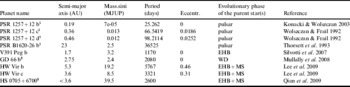
Much less developed is our knowledge of the final stages of the planetary system evolution. Less than a dozen of planets are known that orbit sub-giant stars at the beginning of the red giant phase, which have just exhausted their hydrogen in the core (Döllinger et al. Reference Döllinger, Hatzes and Pasquini2009). And only in the last two years a few planets were found orbiting more evolved stars on the extreme horizontal branch (EHB) (Silvotti et al. Reference Silvotti, Schuh and Janulis2007, Lee et al. Reference Lee, Kim and Kim2009) or on the white dwarf (WD) cooling sequence (Mullally et al. Reference Mullally, Winget and Degennaro2008), following the detection of metal-rich debris disks around 15 white dwarfs (Reach et al. Reference Reach, Kuchner and von Hippel2005, Brinkworth et al. Reference Brinkworth, Gänsicke, Marsh, Hoard and Tappert2009). A list of all the planets (or planet candidates) orbiting post-red giant branch (RGB) stars is given in Table 1. All these planets were detected by analysing the timing of the stellar pulsation (or the eclipse's timing). Functionally, this is equivalent to the timing method used to find pulsar's planets (Wolszczan & Frail Reference Wolszczan and Frail1992, Thorsett et al. Reference Thorsett, Arzoumanian and Taylor1993). For all these compact objects both the radial velocity (RV) and transit methods have a low efficiency, due to their high gravity, which means broad absorption lines that prevent to achieve the high RV precision required to detect planets, and low probability of transits, in particular for the white dwarfs.
Planets orbiting post-red giant branch stars

1 Pulsar's planets are included for completeness, although they were probably formed after the SN explosion.
2 Planet candidate (see Mullally et al. Reference Mullally, Winget and Degennaro2008, Reference Mullally, Reach, Degennaro and Burrows2009 for more details).
3 Minimum mass compatible with a brown dwarf. It has been included in this table because this system is very similar to HW Vir.
What can happen to the inner planets during the most critical phases of the post-MS stellar evolution, RGB expansion, asymptotic giant branch (AGB) expansion, thermal pulses and planetary nebula ejection, is not clear (see for example Villaver & Livio Reference Villaver and Livio2007). It is difficult to model these phenomena as the two main (and opposite) factors which determine the orbital evolution – stellar mass loss and tidal effects – are not well understood. Stellar mass loss rates of evolved stars are weakly constrained by observation. Moreover, the lack of known evolved planetary systems makes it impossible to set a posteriori observational constraints.
When their core hydrogen runs out, main sequence stars undergo a red giant expansion of their envelope (of a factor ≈100 in radius at the tip of the RGB) that modifies the planetary orbits and can easily reach and engulf the inner planets. The same will happen to our solar system in about 7.6 Gyr from now, and the fate of the Earth is under debate (Vila Reference Vila1984, Sackmann et al. Reference Sackmann, Boothroyd and Kraemer1993, Rasio et al. Reference Rasio, Tout, Lubow and Livio1996, Rybicki & Denis Reference Rybicki and Denis2001, Schröder & Connon Smith Reference Schröder and Connon Smith2008). Following Schröder & Connon Smith (Reference Schröder and Connon Smith2008), who used an updated and well-calibrated version of the Reimers mass-loss formula, the maximum radius of the Sun will be reached at the tip of the RGB (and not during the thermal pulses on the AGB, as previously believed) and the Earth will be engulfed by the solar envelope. More generally, Schröder & Connon Smith (Reference Schröder and Connon Smith2008) find that a planet of any mass needs an initial orbital distance of at least 1.15 AU in order to survive to the RGB expansion of a star similar to our Sun. This prediction is not fully compatible with the case of V391 Pegb, whose orbital distance was presumably near 1 AU when its parent star was still on the MS and now, on the EHB, is 1.7 AU (Silvotti et al. Reference Silvotti, Schuh and Janulis2007). This example suggests that many more data from new discoveries covering a wide range of orbital parameters are needed in order to test and improve the models.
We note that only by studying planets orbiting horizontal branch stars it is possible to isolate the effects of the red giant expansion on planets, while WD planets must bear evidence also of the AGB expansion, the thermal pulses and the final planetary nebula ejection.
As mentioned before, planets around evolved compact stars can hardly be detected using transits or RVs. Ongoing large transit surveys like Corot and Kepler will presumably not discover any new planets around post-RGB stars. Instead, the timing method, which led to the first detections of such systems, could produce new discoveries in the future, in particular when applied to pulsating stars. The high quality asteroseismic data collected by Corot and Kepler will be a valuable database to test the real potential of the timing method to find planets around different classes of pulsating stars, provided that the oscillations are coherent in phase.
In the future, when a large sample of post-RGB planetary systems is available together with more detailed models, it will be possible to start considering the effects that the critical phases of the post-MS stellar evolution may have on life, assuming that life might still be present on old evolved planets.