Introduction
Invasive mucormycosis is a rapidly progressive disease associated with angioinvasion and infarction. These fungi are pauciseptate organisms with septations at irregular intervals causing perineural invasion.Reference Frater, Hall and Procop1 In a review of 929 cases of mucormycosis, sinuses were the most commonly affected site, followed by pulmonary and cutaneous forms of mucormycosis. Diabetes mellitus was the most common underlying immunocompromised state leading to mucormycosis.Reference Roden, Zaoutis, Buchanan, Knudsen, Sarkisova and Schaufele2,Reference Pradhan, Shaikh, Mishra, Preetam, Parida and Sarkar3 Mucormycosis is commonly encountered in immunocompromised conditions, such as haematological malignancies, organ transplantation, neutropenia and autoimmune disorders.Reference Reid, Lynch, Fishbein and Clark4 However, many cases are discovered in immunocompetent hosts as well.Reference Patel, Patel, Patel, Gohel and Chakrabarti5 The estimated prevalence of mucormycosis is 70 times higher in India than in global data.Reference Prakash and Chakrabarti6 Globally, Rhizopus arrhizus is the most common cause, and Apophysomyces species rank second in India after Rhizopus species.Reference Prakash and Chakrabarti7,Reference Jeong, Keighley, Wolfe, Lee, Slavin and Kong8
The cell wall, spore germination centre and enzymes related to iron sequestration aid the pathological mechanism of Rhizopus species. These mechanisms are successful due to immunosuppression or favourable conditions in the host. Pathophysiology of diabetes mellitus offers ideal conditions for successful replication of Rhizopus species, especially in uncontrolled hyperglycaemia. Type 2 diabetes mellitus eventually leads to insulin dysfunction. It triggers a proinflammatory state characterised by dysregulated, dysfunctional and unresponsive innate and adaptive immune cells.Reference Morales-Franco, Nava-Villalba, Medina-Guerrero, Sánchez-Nuño, Davila-Villa and Anaya-Ambriz9 The fungus causes a significant inflammatory response resulting in purulent arteritis, thrombosis and tissue necrosis.Reference Hernández and Buckley10
Rhino-orbito-cerebral mucormycosis is a rapidly progressive disease, and definitive guidelines, diagnosis, staging and management have been formulated for coronavirus disease 2019 (Covid-19) associated mucormycosis cases. Broadly, stage 1 includes limited disease with the involvement of nasal mucosa. Stage 2 consists of the involvement of paranasal sinuses. Stage 3 includes involvement of the orbit, whereas stage 4 includes the involvement of the central nervous system.Reference Honavar11
The increasing incidence of rhino-orbito-cerebral mucormycosis in Covid-19 cases in India and globally has become a matter of immediate concern owing to the case fatality rates for rhino-orbito-cerebral mucormycosis.Reference Sen, Honavar, Sharma and Sachdev12 India is one of the worst hit countries for Covid-19 infection, and Covid-19 associated mucormycosis has added to the woes of the country. Rhino-orbito-cerebral mucormycosis has been documented in several cases where steroids were used to treat Covid-19 infection.Reference Ahmadikia, Hashemi, Khodavaisy, Getso, Alijani and Badali13,Reference Veisi, Bagheri, Eshaghi, Rikhtehgar, Rezaei Kanavi and Farjad14 Despite early diagnosis, understanding of its pathology and aggressive treatment, mortality of the disease is significant.Reference Skiada, Lass-Floerl, Klimko, Ibrahim, Roilides and Petrikkos15 Invasive mucormycosis has a fulminant course and has a high mortality rate of about 60 per cent in immunocompromised individuals.Reference Herbrecht, Letscher-Bru, Bowden, Kusne, Anaissie and Graybill16
Covid-19 infection is associated with thrombotic events with a high incidence of venous and arterial thromboembolism.Reference Talasaz, Sadeghipour, Kakavand, Aghakouchakzadeh, Kordzadeh-Kermani and Van17 Viraemia, hypoxia, inflammatory response, increased expression of tissue factor and elevated neutrophil extracellular traps disrupt haemostasis and promote endothelial activation.Reference Libby and Lüscher18,Reference Giustino, Pinney, Lala, Reddy, Johnston-Cox and Mechanick19 This procoagulant state and the reduction in plasminogen activators cause increased platelet activity.Reference Siddiqi, Libby and Ridker20,21 This procoagulant activity and thromboembolic load in patients with Covid-19 associated mucormycosis can be a potential cause of increased mortality apart from the disease per se.
Mucormycosis and Covid-19 infections can both give rise to a procoagulant state. Therefore, low dose aspirin was used to see if there was any change in outcome in Covid-19 associated mucormycosis patients. In this study, we demonstrated the use of low dose aspirin as an anticoagulant agent in patients with Covid-19 associated mucormycosis and its effect on overall outcomes and mortality.
Aims and objectives
This study aimed to analyse mortality rates in patients with Covid-19 associated mucormycosis with the addition of low dose aspirin as an add-on therapy to routine standard of care. The primary objective was to determine the efficacy of low dose aspirin on mortality rates in patients with Covid-19 associated mucormycosis. The secondary objective was to understand the impact of Covid-19 status during surgery and mortality rates in patients of Covid-19 associated mucormycosis and to compare cumulative amphotericin B dose between the deceased groups before and after adding low dose aspirin.
Materials and methods
This was a retrospective observational study with the single-arm study group. The study was performed in the in-patient Department of ENT and Head and Neck Surgery of the All India Institute of Medical Sciences, Bhubaneswar, India. The duration of study was from May 2021 to August 2021.
Study participants
The inclusion criteria were: (1) patients who were either Covid-19 positive on presentation or had been infected with Covid-19 in the past; (2) patients with clinical and radiological features suggestive of mucormycosis; and (3) patients with microbiologically and histopathologically proven cases of mucormycosis. The exclusion criteria were: patients with mixed fungal infections.
Procedure
Patients with suspected Covid-19 associated mucormycosis who were admitted to the in-patient Department of ENT and Head and Neck Surgery of the All India Institute of Medical Sciences, Bhubaneswar, either on an out-patient or emergency basis were included in the study. The provisional diagnosis was made based on clinical and radiological features and was eventually confirmed by diagnostic nasal endoscopy with biopsy for potassium hydroxide mount and histopathological evaluation. Contrast-enhanced magnetic resonance imaging was the preferred radiological investigation for diagnosis, except for cases with renal compromise.
Patients were started on the systemic antifungals liposomal amphotericin B or amphotericin B deoxycholate based on drug availability and patient suitability. All patients underwent surgical debridement in the form of infrastructural, subtotal and total maxillectomy with or without orbital exenteration depending on the rhino-orbito-cerebral mucormycosis stage irrespective of the Covid-19 status within 48 hours of admission. Covid-19 reverse transcriptase polymerase chain reaction reports were considered valid tests to rule on Covid-19 infection on admission or before surgery.
The post-operative cavity was packed with 10 per cent w/w povidone-iodine soaked ribbon gauze, which was removed on post-operative day 2. Saline nasal douching with sodium chloride powder (4 g/200 ml) was given 4–5 times a day in the post-operative period for crust and clots removal. Diagnostic nasal endoscopy was performed on every fifth day post-operatively to look for the response to treatment. Intervention in the form of low dose aspirin as 75 mg once daily was given to all patients from 9 July 2021, including patients already admitted and new admissions until August 2021. Outcomes were measured in the form of mortality rates in patients before and after starting low dose aspirin. Patients were discharged on tablet-form posaconazole (600 mg for one day followed by 300 mg once daily) with follow-up advice every 15 days.
Results
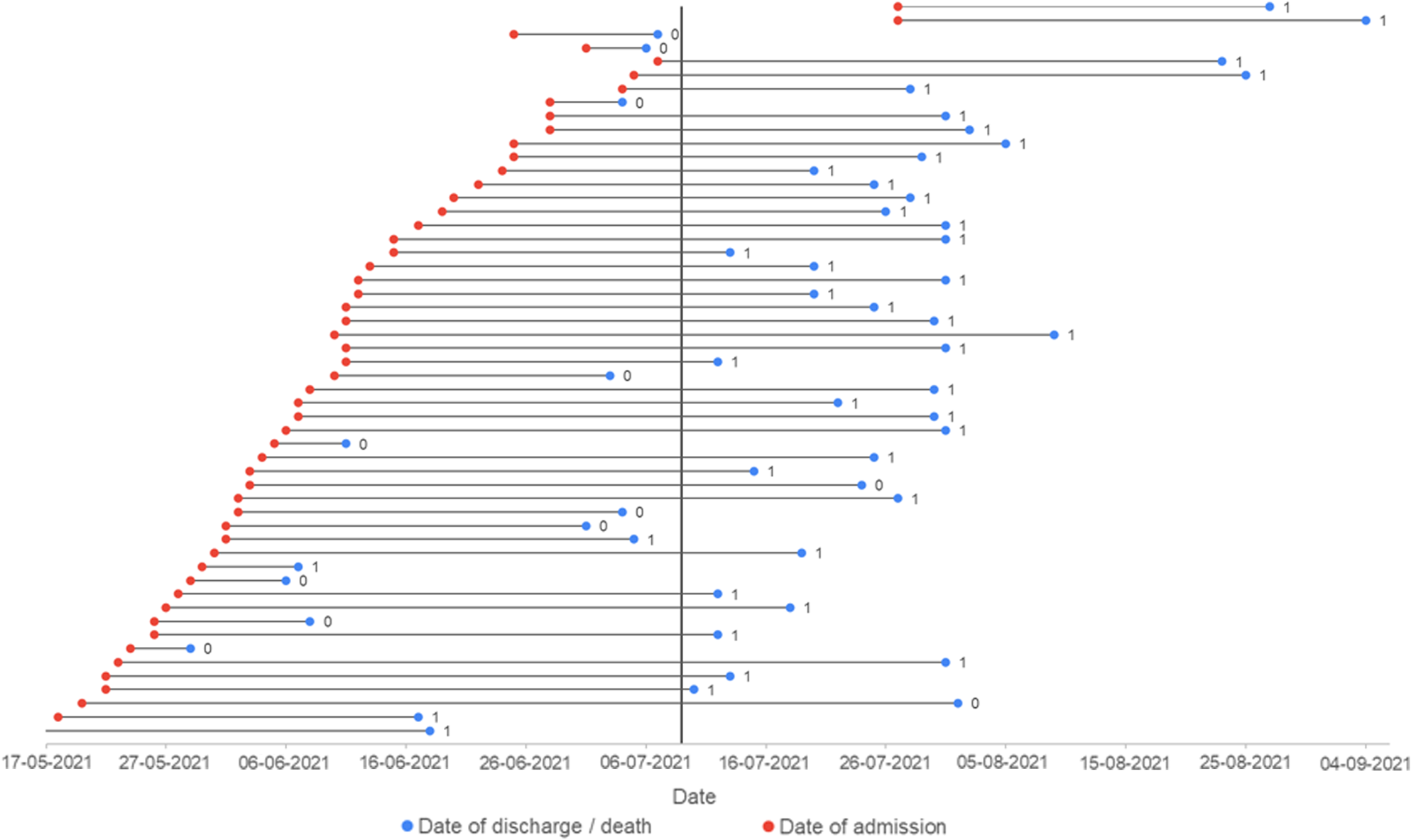
By the end of the study period, 64 participants were recruited. Among them, 15 participants were completely aspirin naïve (i.e. they had either died or had been discharged before we started administering aspirin to the patients from 9 July 2021). Thirty-seven participants had been admitted and recruited before 9 July and subsequently received aspirin as a part of their treatment from the mentioned date. Another 12 participants were recruited after 9 July, and they received aspirin from the very first day. The date of recruitment and duration of stay is summarised in Figure 1
Dumbbell plot of the date when patients were recruited. The red dot marks the date of admission and recruitment of the participant into the study, whereas the blue dot marks either the participant's date of discharge or death. The vertical line marks 9 July 2021, the date when the participants started on aspirin. The outcome is indicated as: 0 = death or 1 = discharged in a stable condition.

As evident from the figure, 49 participants received aspirin as a part of their treatment. We compared their treatment outcome with 52 participants, including 15 completely aspirin naïve patients and the 37 participants before they were started on aspirin from 9 July.
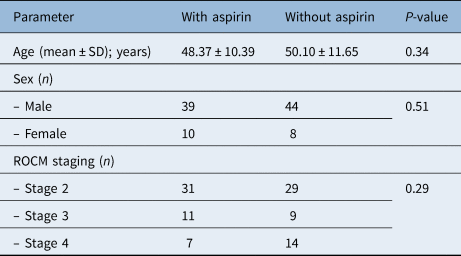
Upon comparing the distribution of age and sex of the participants in the two groups, there seemed to be no significant difference between them. Rhino-orbito-cerebral mucormycosis staging indicates the disease severity and may affect the outcome; however, there appeared to be no significant difference in the rhino-orbito-cerebral mucormycosis staging of the disease between the two groups as well. All the 64 participants suffered from type 2 diabetes mellitus, for which they received medication.
Demographic and clinical characteristics of the two groups

SD = standard deviation; ROCM = rhino-orbito-cerebral mucormycosis
A total of 10 out of 52 participants died before 9 July (i.e. before aspirin had been initiated as a part of treatment). After initiation of aspirin, only two deaths were seen among the 49 consecutively recruited participants. This gave a relative risk of dying of 1.77 (95 per cent confidence interval (CI) = 1.26–2.47) among participants who did not receive aspirin as a part of their treatment. The result is statistically significant using Fisher's exact test (p = 0.029).
The timing of surgery and Covid-19 positive status was compared. Seven out of 10 patients who underwent operation with Covid-19 positive status succumbed to the disease. If we operate on the patient while Covid-19 positive, the odds of dying are 11.11 (95 per cent CI = 2.41–52.63), and the result is statistically significant (p = 0.002).
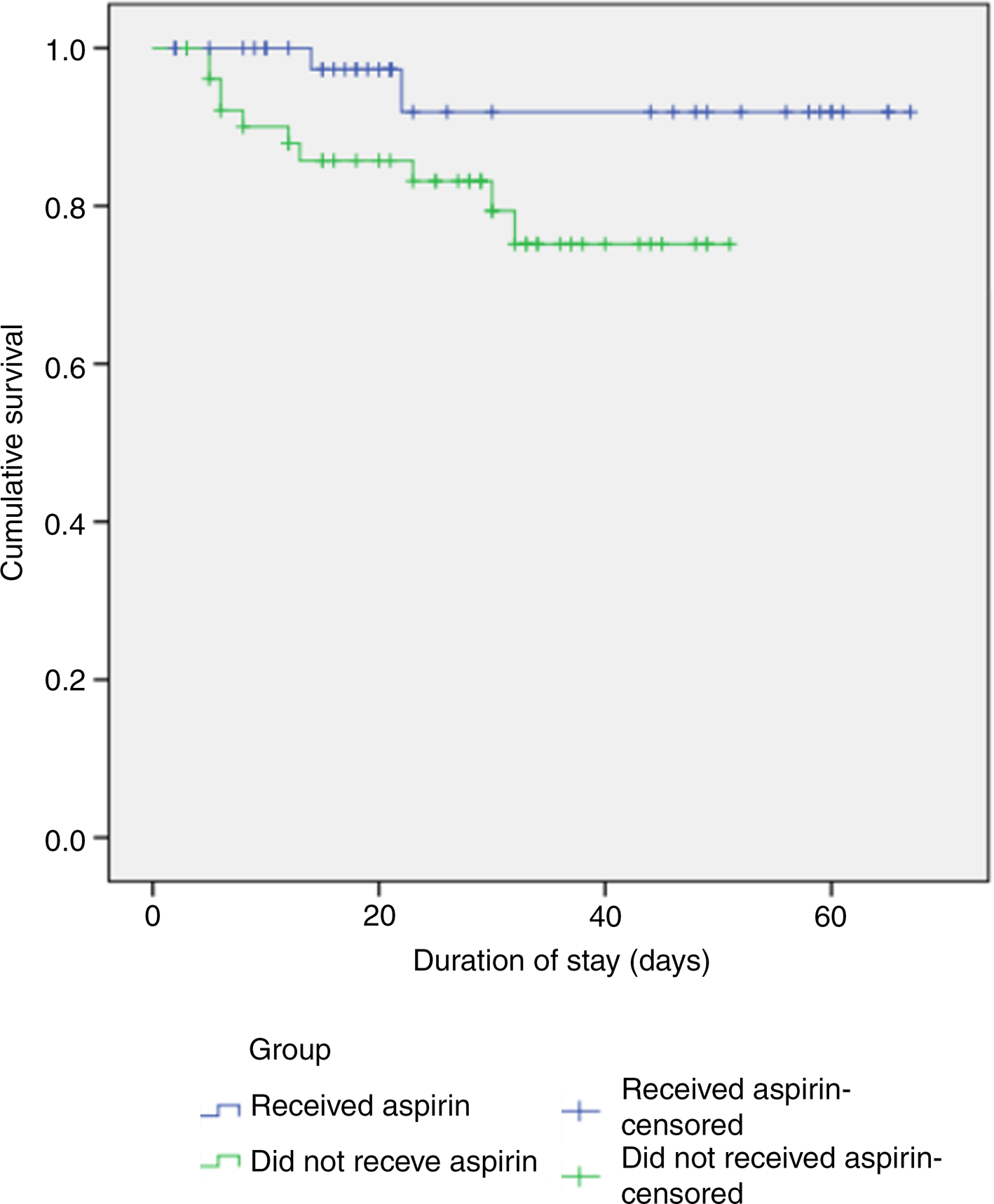
We plotted the duration of stay of the participants in each group against their cumulative survival. The Kaplan–Meier graph showed p = 0.052 with the log-rank test and p = 0.04 with the Breslow test. There was a statistically significant difference in survival rates in these two groups. This indicates that participants in the group that received aspirin had a longer survival duration than those that did not receive it.
Survival analysis of participants in the two groups. In the key, ‘censored’ means the time when the patient was discharged, considering the patient to be clinically stable.

Discussion
The Covid-19 pandemic has posed challenges to clinicians regarding pathogenesis related to thrombosis. It has shown an increased risk of venous and arterial thromboembolic events. Severe acute respiratory syndrome coronavirus-2 (SARS-CoV-2) leading to Covid-19 has higher transmission rates and therefore a higher death rate.Reference Wang, Wang, Chen and Qin22 Thromboembolic complications have been reported in various organs affected by Covid-19, including the lungs and brain.Reference Klok, Kruip, Van der Meer, Arbous, Gommers and Kant23,Reference Oxley, Mocco, Majidi, Kellner, Shoirah and Singh24 Such complications have led to multiorgan failure and high mortality in severe cases.Reference McFadyen, Stevens and Peter25 Renin-angiotensin-aldosterone system augmentation occurs because of downregulation of angiotensin-converting enzyme-2 (ACE-2) and is thought to be an essential factor in associated thrombosis.Reference Vaughan, Lazos and Tong26 Binding of the spike protein of SARS-CoV-2 to the ACE-2 receptor causes downregulation of ACE-2 activity. This augments angiotensin II signalling and the prothrombotic pathway while angiotensin 1–7 signalling increases antithrombotic pathways.Reference Ali and Spinler27
Classic features of mucormycosis include tissue necrosis as a result of vascular invasion and subsequent thrombosis.Reference Fanfair R, Benedict, Bos, Bennett, Lo and Adebanjo28 Neurological complications because of mucormycosis arise from carotid artery occlusion,Reference Al-Otaibi, Albloushi, Alhindi and Timms29 ophthalmic artery occlusionReference Song and Shin30 and cavernous sinus thrombosis.Reference Anand, Alemar and Griswold31 Mucor thrombus also causes an angioinvasion leading to infarction.Reference Scharf, Cloft and Wijdicks32
Aspirin is an antithrombotic agent that is widely prescribed for cardiovascular and cerebrovascular diseases.Reference Lim and Pranata33 Apart from this, it also has antiviral, anti-inflammatory and immunomodulatory actions, which can be helpful in patients affected by Covid-19.Reference Bianconi, Violi, Fallarino, Pignatelli, Sahebkar and Pirro34 At low doses (75 mg/day), aspirin inhibits cyclooxygenase-1 activity irreversibly. Antiviral property is postulated by limiting viral replication by blocking prostaglandin E2 in macrophages and upregulating the generation of type I interferons.35 Antiplatelet therapy is helpful in viral pneumonia as it inhibits platelet-neutrophil aggregation, which helps decrease thrombus formation and subsequent lung damage by increased lipoxin synthesis.Reference Middleton, Weyrich and Zimmerman36 Cytokine storms are responsible for the multi-system inflammatory process in severe Covid-19; aspirin can potentially prevent acute respiratory distress syndrome, coagulopathy and death.Reference Pranata, Huang, Lim, Wahjoepramono and July37 A meta-analysis showed that use of low dose of aspirin is independently associated with reduced mortality in patients with Covid-19.Reference Martha, Pranata, Lim, Wibowo and Akbar38
Mucormycosis is rapidly fatal in 50 to 80 per cent of patients, secondary to the invasion of the orbit and intracranial cavity.Reference Gillespie and O'Malley39 Patients with poor glycaemic control are prone to the rapid spread of disease leading to rhino-cerebral forms of mucormycosis within a week. Therefore, aggressive steps, including debridement and systemic therapy, are warranted to prevent its spread. Following the use of low dose aspirin in our study, we found that the mortality rate was 4.08 per cent, much less than in previous studies.
Considering that aspirin has significant antithrombotic activity, we started prescribing low dose aspirin to all our patients. Patients with Covid-19 and mucormycosis have an increased risk of thromboembolic events. Our study comparing aspirin efficacy in patients with Covid-19 associated mucormycosis and mortality found that low dose aspirin significantly decreases mortality (p = 0.02). This indicates that increased mortality in patients who did not receive aspirin as an add-on therapy may be because of Covid-19 related and mucormycosis sequelae in the form of venous or arterial thromboembolism rather than invasive fungal sinusitis in the form of mucormycosis.
Comparing the Covid-19 status of patients during primary surgery and their mortality in due course, patients who underwent operations with Covid-19 positive status had significant mortality compared with those who were Covid-19 negative during surgery (p = 0.002). This can be attributed to increased surgical stress response in releasing various cytokines and leukocyte migration into inflamed tissuesReference Giannoudis, Dinopoulos, Chlidis and Hall40 on top of cytokine storm and a hypercoagulable state created within the body by Covid-19 infection.Reference Kaur, Bansal, Kollimuttathuillam, Gowda, Singh and Mehta41
• Coronavirus disease 2019 (Covid-19) associated mucormycosis has added to the problems of Covid-19 in the underdeveloped nations of Asia, particularly India
• Despite early diagnosis, a good understanding of the pathology and aggressive surgical treatment, mortality of mucormycosis remains very high
• Mucormycosis and Covid-19 infections both give rise to a procoagulant state
• Use of low dose aspirin in patients with mucormycosis reduces overall mortality and morbidity without significantly increasing treatment cost
• Aspirin should be added to treatment of Covid-19 associated mucormycosis as early as possible
The running survival analysis graph results using the Breslow test are significant, with a p-value of 0.04. This indicates that participants in the aspirin group had higher chances of survival considering decreased thromboembolic events than patients not receiving aspirin. The addition of low dose aspirin does not increase the cost of treatment but significantly increases the survival rates in patients suffering from mucormycosis.
Conclusion
As per the evidence obtained from this study, low dose aspirin improves patient outcomes in mucormycosis. Surgical intervention can be delayed until the patient becomes Covid-19 negative, subsequently increasing the survival rate. Low dose aspirin and amphotericin B should be initiated as soon as the diagnosis is confirmed.
Acknowledgements
The authors would like to acknowledge that the study was conducted in All India Institute of Medical Sciences, Bhubaneswar, in the Department of ENT and Head Neck Surgery.
Competing interests
None declared