Introduction
Brinjal, Solanum melongena, also known as aubergine or eggplant, is an important vegetable crop of central, south and south-east Asia and several African countries (Kalloo, Reference Kalloo1988). It is a good source of minerals and vitamins, in total its nutritional value is comparable to other vegetables, and has several medicinal properties (Khan, Reference Khan, Hawkes, Lester and Skelding1979). The area between India and Indochina is considered to be the centre of brinjal diversity (Vavilov, Reference Vavilov1951; Zeven and Zhukovsky, Reference Zeven and Zhukovsky1975; Lester and Hasan, Reference Lester, Hasan, Hawkes, Lester, Nee and Estrada1991). The important brinjal-growing countries are China, India, Egypt, Turkey, Japan, Italy, Sudan, Indonesia, Philippines and Spain (FAOSTAT, 2006). In India, it is grown over 0.5 Mha with a total production of 8 Mt (Indian Horticulture Database, 2004). The National Bureau of Plant Genetic Resources (NBPGR), New Delhi has the major responsibility of collecting, characterizing and conserving the brinjal diversity in the country, and presently maintains over 2500 accessions. Cultivated types are characterized by variation in their morphology (growth habit and plant vigour, hairiness and prickliness, fruit colour, size and shape), physiology (earliness of flowering, water need and uptake) and quality (fruit bitterness) (Daunay et al., Reference Daunay, Lester, Gebhardt, Hennart, Jahn, Frary, Doganlar, van der Berg, Barendse, van der Weerden and Mariani2001). The morphological diversity of over 600 accessions representing diverse agroecological niches is described here, so that appropriate accessions can be identified for varietal development.
Materials and methods
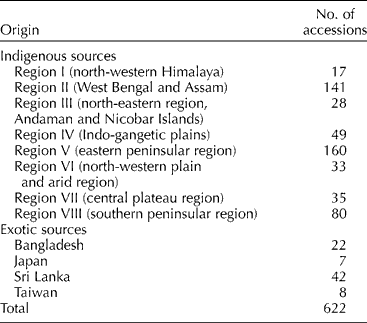
The plant material consisted of 622 brinjal landraces maintained by self-pollination, of which 543 were collected from several different agroecological regions of India and 79 were of exotic origin (Table 1). The accessions were grown in augmented block design (Federer, Reference Federer1956) at NBPGR Experimental Farm, Issapur, New Delhi during Kharif (July–October) 2003. The accessions were grown in 31 blocks containing 20 accessions each, the last block comprising 22 accessions. Twenty plants per accession were grown in two 6 m row plots, with a between-row spacing of 75 cm and a within-row spacing of 60 cm. Six checks were replicated 31 times. Recommended agronomic practices were followed through various stages of crop growth. Data were recorded from eight randomly chosen plants per plot covering 29 descriptors (11 quantitative and 18 qualitative; Supplementary Table 1, available online only at http://journals.cambridge.org). The quantitative data were subjected to statistical analysis for augmented block design (Federer, Reference Federer1956) and the adjusted treatment (accessions) means were computed. Duncan's multiple range test (Duncan, Reference Duncan1955) was used to compare means. Frequency distributions and mean values of the quantitative and qualitative descriptors were computed with INDOSTAT statistical software (INDOSTAT Services, Hyderabad, India). The coefficient of variation (CV%) was given by the ratio of the standard deviation to the mean. The correlation coefficients between the quantitative descriptors were computed following Snedecor and Cochran (Reference Snedecor and Cochran1967). The phenotypic frequencies of both quantitative and qualitative descriptors were analyzed by the Shannon–Weaver information index (H′), as calculated by Negassa (Reference Negassa1985) and Engels (Reference Engels, Engels, Hawkes and Worede1991).
Region/country-wise number of accessions included in the study

Results
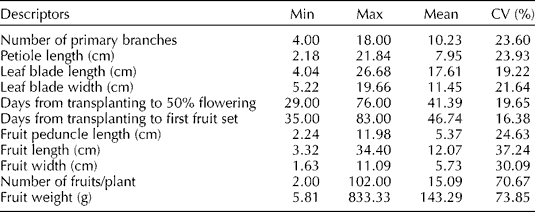
The range of variation for different quantitative descriptors (Table 2) revealed wide variability for all the quantitative descriptors studied. A large coefficient of variation (>20%) applied to the number of primary branches, petiole length, leaf blade width, fruit peduncle length, fruit length, fruit width, number of fruits/plant and fruit weight; the other traits were less variable. Mean values for the quantitative descriptors with their standard deviation are presented in Supplementary Table 2, available online only at http://journals.cambridge.org. Remarkable differences between the regions of origin were found for these descriptors. The accessions with maximum mean value for the number of primary branches were from region I; for fruit peduncle length from region II; for early flowering and fruit set, maximum number of fruits/plant from region III; for maximum petiole length and heavy fruits from region IV; for maximum fruit width from region V; for maximum petiole length, leaf blade length and fruit length from region VI; and for maximum leaf blade width from region VI and Bangladesh. The accessions from regions III, VIII and Sri Lanka were closely related as these were not significantly different for descriptors' petiole length, leaf blade length, leaf blade width, days from transplanting to 50% flowering, fruit peduncle length and fruit length.
Range of variation for important quantitative descriptors in brinjal landraces

Min, minimum value; Max, maximum value; CV, coefficient of variation.
The region/country-wise diversity indices for both quantitative and qualitative descriptors (Supplementary Table 3, available online only at http://journals.cambridge.org) showed that of the former group of traits: leaf blade width was the most diverse, followed by leaf blade length, fruit length and fruit width. The least diverse trait was petiole length. Among the qualitative traits, seediness was the most diverse, followed by calyx colour, fruit length/breadth ratio, leaf blade lobing, fruit shape and fruit colour distribution. The least diverse traits were fruit curvature and plant growth habit. There was a moderate degree of diversity (0.53–0.61) among accessions from any one region, except for Taiwan where the diversity index was only 0.46.
The most diverse accessions for the number of primary branches, leaf blade lobing and fruit apex shape were from region I; for fruit width, number of fruits per plant and calyx colour from region II; for petiole length, fruit peduncle length, fruit weight, fruit colour and fruit colour distribution from region IV; for leaf blade length, prickles on upper leaf surface, calyx spininess and fruit shape from region V; for leaf blade width, days from transplanting to 50% flowering, days from transplanting to first fruit set, fruit length, leaf blade lobing, fruit peduncle prickles and fruit length/breadth ratio from region VI; and for fruit length/breadth ratio, fruit colour and fruit flesh density from region VII. The accessions from Japan were most diverse for plant growth habit, leaf blade tip angle, leaf blade colour and fruit curvature, and the accessions from Sri Lanka were most diverse for petiole colour and seediness. Regions III and VIII showed moderate to high diversity for the number of primary branches, fruit length, fruit width, leaf blade lobing, leaf blade tip angle, prickles on upper leaf surface, calyx colour, fruit length/breadth ratio, fruit shape, fruit colour, fruit colour distribution, fruit flesh density and seediness.
The region-wise distribution for fruit shape, fruit colour and fruit weight (Supplementary Table 4, available online only at http://journals.cambridge.org) showed that small fruits were more frequent than large ones; white fruits were very rare when compared with green or purple fruits, the latter predominating. Roundish (round, oblong or oval) fruits were more frequent than long ones. Oblong types followed by long ones were obtained in regions I–III and VII, Bangladesh and Japan, and round ones in regions IV and V, Sri Lanka and Taiwan. Long types were more common than oblong ones in region VI. In region VIII, oblong types were most frequent, followed by long and round ones with equal frequency. The majority of accessions had purple fruits except in region V, Sri Lanka and Taiwan, where green fruits were predominant. The majority of accessions had low to medium fruit weight ( < 200 g), and proportionately large fruits (>200 g) were represented in regions IV and V.
Correlation coefficients between the quantitative descriptors are presented in Supplementary Table 5, available online only at http://journals.cambridge.org. Positive, highly significant correlations were obtained among petiole length, leaf blade length, leaf blade width, fruit peduncle length and fruit length. All these descriptors, except fruit length, also have positive, highly significant correlations with days from transplanting to 50% flowering and days from transplanting to first fruit set. Fruit width and fruit weight showed positive, highly significant correlations with leaf blade length and leaf blade width.
Discussion
The study revealed a wide range of variation among brinjal landraces for all the quantitative descriptors (Table 2). There were also clear differences in morphological and yield attributes. The number of days from transplanting to flowering, fruit length, fruit width (Sidhu et al., Reference Sidhu, Kalloo and Pandita1980), fruit number per plant and fruit weight (Sidhu et al., Reference Sidhu, Kalloo and Pandita1980; Vadivel and Bapu, Reference Vadivel and Bapu1989; Nainar et al., Reference Nainar, Subbaiah and Irrulappan1991) all have high breeding value. The regional variation for these quantitative descriptors (Supplementary Table 2, available online only at http://journals.cambridge.org) suggests that crop improvement is possible in all the regions. Region VI appears to be more variable for both quantitative and qualitative descriptors, despite being represented by a rather low number (33) of accessions (Table 1). The high level of diversity may be because the region spans an area including both irrigated plain and desert with very diverse soils. Relatively greater diversity indices for most of the quantitative traits were revealed by accessions assembled from region V. The greater diversity in landrace populations from this region may be related to a higher number of accessions or may be due to high environmental heterogeneity ranging from moisture deficit rainfed uplands to moist low lying areas in the region. Regional diversity in brinjal landraces could also be attributed to strong cultural variations, diverse food habits/preferences and method of preparation/recipes. Low diversity in material from certain regions may, however, be the reason of unidirectional selection for a particular trait resulting in uniform phenotypes as reported by Prasad and Singh (Reference Prasad and Singh1998).
Among the exotics accessions, the maximum diversity was recorded for accessions from Sri Lanka, indicating that Sri Lanka also as an important centre of brinjal diversity. Accessions from Sri Lanka are related to regions III and VIII for many descriptors (Supplementary Table 2, available online only at http://journals.cambridge.org). The existing similarity between accessions from regions III and VIII and its neighbouring Sri Lanka for fruit descriptors suggests the migration of brinjal from India to Sri Lanka and subsequent selection pressure for fruit types in Sri Lanka.
Selection of parents based on short petiole length, leaf blade length, leaf blade width and peduncle length may result into early flowering, fruiting and short fruit-bearing genotypes. These characters have significant positive correlations with days from transplanting to 50% flowering, days from transplanting to first fruit set and fruit length. Positive and significant correlations of yield with leaf area and number of branches have also been reported by Khurana et al. (Reference Khurana, Singh, Thakral, Kalloo, Pandita and Pandey1987). It will be of immense help in selection and breeding high-yielding varieties, if high correlation exists between a complex character like yield, that has low heritability, and other inherited component characters. F1 hybrids obtained from crosses between genetically diverse parents are expected to manifest heterosis, and their progenies are expected to exhibit a broad spectrum of genetic variability. This provides a greater scope for the isolation of desirable segregants leading to the development of useful and promising breeding material and cultivars. While selecting widely divergent parents, the yield contributing descriptors such as the number of branches per plant, number of fruits per plant and fruit weight should be taken into account because of their close association with fruit yield. However, some consumer acceptable qualitative descriptors like fruit shape, colour and brightness and fruit calyx prickliness and colour should also be considered while making the selection for wider acceptability. Thus, it is necessary to make detailed assessment of genetic diversity in brinjal landraces and its use in choosing parents for hybridization. The germplasm resources have a wide variability for fruit descriptors and as such there is enough scope for improvement of these descriptors by selection.
A simple classification of brinjal collection into different cultivar groups is necessary for promoting their use in crop improvement. One way to promote their use is to develop a simple classification system based on key morphological descriptors such as fruit shape (long, round, oblong, or oval) and colour (white, green, or purple) that will uncover the pattern of variation in brinjal landraces. In many crops, simple and useful systems of classification have been developed that rely on a few simply inherited and easily observable traits (Riley et al., Reference Riley, Ramanatha Rao, Zhou and Quek1996). Characterizing the entire brinjal germplasm based on two key traits, fruit shape and colour, would allow curators to focus on a greater portion of their collection for these key traits.
The present study highlights the importance of brinjal accessions for research and conservation. The use of quantitative descriptors that were scaled in an arbitrary way seems to be justifiable and useful as the brinjal accessions show considerable variation within and between regions for these descriptors and they are in general of more interest to the plant breeder than the discrete qualitative descriptors. The genetic differences among landraces are relevant to breeding programmes in that the variability created through hybridization of the contrasting forms could be exploited.
Acknowledgements
The authors are thankful to the Director, NBPGR, and Head, Germplasm Evaluation Division, NBPGR, for providing necessary facilities for the present investigation.