Implications
Microbes in the small intestine of the pig may impact amino acids (AA) available for protein synthesis and body maintenance functions. A two-pool model that represents AA metabolism was used to generate estimates of fermentative AA catabolism (FAAC). A substantial amount of AA may be lost to FAAC in the small intestine of pigs and dietary protein, but not fibre, may reduce FAAC. These findings have important implications for establishing dietary AA requirements for pigs, other non-ruminant animals and humans.
Introduction
Fermentative catabolism (FAAC) of dietary and endogenous amino acids (AA) in the small intestine contributes to loss of AA available for protein synthesis and body maintenance functions in pigs. Libao-Mercado et al. (Reference Libao-Mercado, Zhu, Fuller, Rademacher, Seve and de Lange2009) estimated that greater than 70% of ammonia recovered at the terminal ileum was derived from FAAC and was equivalent to a loss of 2.1 g of protein per kg of dry matter (DM) intake, or 1% of protein intake. The extent of FAAC should be accounted for when estimating AA requirements of pigs. Most of the ammonia produced from FAAC will be absorbed by the host animal, converted to urea and excreted in urine (Mosenthin et al., Reference Mosenthin, Sauer and de Lange1992a). However, it has been suggested that non-ruminants fed low protein or low-quality protein diets may be able to salvage non-protein nitrogen (NPN) through recycling of urea into the gastrointestinal tract where the urea will be hydrolysed to ammonia and used for de novo AA synthesis by microbes in the small intestine, providing AA to the host (Torrallardona et al., Reference Torrallardona, Harris and Fuller2003).
The activity and diversity of the microbial population in the digestive tract of pigs can be altered through changes in dietary fibre and protein content. It has been shown that an increase in dietary fibre content of a diet can result in increased endogenous AA losses, impaired nutrient absorption (Dierick et al., Reference Dierick, Vervaeke, Decuypere and Henderickx1986), increased nitrogen incorporation into microbial protein, and increased microbial protein flow at the distal ileum (Mosenthin et al., Reference Mosenthin, Sauer and Ahrens1994). In addition, dietary fibre may provide an alternative substrate to meet the enteric microbial energy requirements, reducing reliance on AA fermentation as an energy source (Metges, Reference Metges2000; Oba and Allen, Reference Oba and Allen2003). A reduction in dietary protein content may compel microbes to utilize de novo AA synthesis to meet microbial protein production demands (Mosenthin et al., Reference Mosenthin, Sauer, Henkel, Ahrens and de Lange1992b). Thus, dietary manipulation has the potential to affect FAAC and thereby to increase the amount of dietary AA available to the animal.
To date, no definite estimates of FAAC are available for pigs and dietary effects on small intestine microbial activity have largely been ignored. It was hypothesized that inclusion of fermentable fibre or reducing the dietary protein content would result in a reduction in AA losses due to FAAC. Therefore, the objectives of this study were to explore approaches to estimate FAAC losses in the small intestine and to determine the impact of dietary fibre and protein content on FAAC in the small intestine of growing pigs.
Material and methods
The experimental protocol was reviewed and approved by the Animal Care Committee of the University of Guelph.
Animals, diets and general experimental design
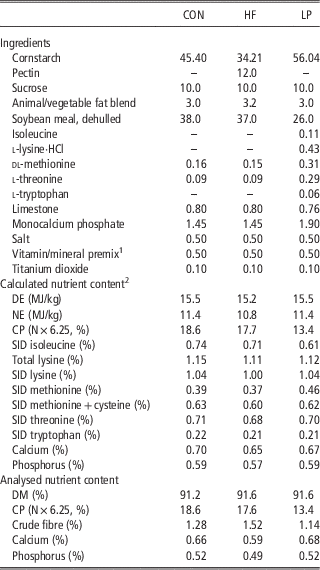
A total of 15 Yorkshire barrows were obtained from the Arkell Swine Research Station at the University of Guelph (Guelph, ON, Canada) and randomly assigned to one of three dietary treatments. The first group (Study 1; two experimental periods, partial-crossover design) consisted of six barrows with an initial BW of 19.9 kg (s.d.=0.99). The second group (Study 2; one experimental period) consisted of nine barrows with an initial BW of 22.4 kg (s.d.=0.90). All pigs were housed in smooth-sided metabolic crates in a temperature controlled room at 21°C (Libao-Mercado et al., Reference Libao-Mercado, Zhu, Fuller, Rademacher, Seve and de Lange2009). The three dietary treatments were (Table 1): a cornstarch–soybean meal-based control diet (CON), a high fibre diet in which 12% pectin was added at the expense of cornstarch (HF) or a low-protein diet in which soybean meal was partially replaced by cornstarch (LP). The diets were formulated to meet or exceed nutrient requirements according to National Research Council (NRC, 1998) and contained titanium dioxide as an indigestible marker (Zhu et al., Reference Zhu, Lapierre, Rademacher and de Lange2003).
Ingredient composition (as-fed, %) as well as calculated and analysed nutrient content (adjusted to 90% DM basis) of experimental diets

DM=dry matter; CON=control diet; HF=high fibre diet; LP=low-protein diet; DE=digestible energy; NE=net energy; CP=crude protein; SID=standardized ileal digestible.
1 Supplied per kg of complete diet: vitamin A, 10,000 IU as retinyl acetate (2.5 mg) and retinylpalmitate (1.7 mg); vitamin D3, 1000 IU as cholecalciferol; vitamin E, 56 IU as dl-α-tocopherol acetate (44 mg); vitamin K, 2.5 mg as menadione; choline, 500 mg; pantothenic acid, 15 mg; riboflavin, 5 mg; folic acid, 2 mg; niacin, 25 mg; thiamine, 1.5 mg; vitamin B6, 1.5 mg; biotin, 0.2 mg; vitamin B12, 0.025 mg; Se, 0.3 mg from Na2SeO3; Cu, 15 mg from CuSO4·5H2O; Zn, 104 mg from ZnO; Fe, 100 mg from FeSO4; Mn, 19 mg from MnO2; and I, 0.3 mg from KI (DSM Nutritional Products Canada Inc., Ayr, ON, Canada).
2 Nutrient contents of diets were estimated based on nutrient contents of feed ingredients according to NRC (1998).
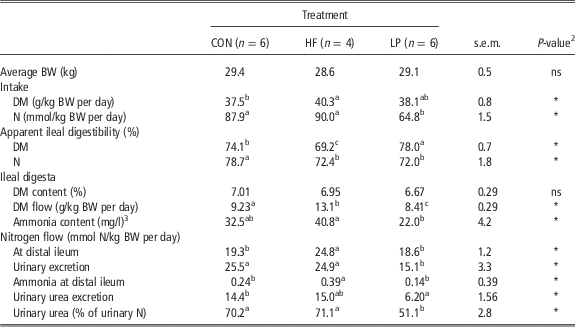
Pigs on CON and LP were fed at 90% of energy intake according to NRC (1998) and based on individual pig BW. Due to the reduced net energy content of the HF diet, daily feed allowance in the HF-fed pigs was increased to maintain daily net energy intake across treatments (Table 2). To maintain isonitrogenous intake between the CON and HF treatments, nutrient content in the HF diet was decreased to account for the increase in total dietary intake (Libao-Mercado et al., Reference Libao-Mercado, Zhu, Fuller, Rademacher, Seve and de Lange2009). Pigs were given their daily ration as a wet mash (water : feed 2 : 1) in two equal meals per day during the adaptation period and eight meals per day (every 3 h starting at 0800 h) during the infusion period in order to maintain metabolic steady state conditions (Libao-Mercado et al., Reference Libao-Mercado, Zhu, Fuller, Rademacher, Seve and de Lange2009). Pigs were allowed to adapt to their diets for at least 1 week before the infusion of isotopes.
BW, nutrient intake and digestibility, ileal digesta characteristics and nitrogen (N) flows in growing pigs after a 4-day continuous infusion of 13C-urea and 15N-ammonium chlorideFootnote 1 , Footnote 2

CON=control diet, HF=high fibre diet, LP=low-protein diet; DM=dry matter.
a,bValues with different letters are significantly different (P<0.05); *P<0.05.
1 Pigs were fed one of three diets: CON, 18.6% CP; HF, 17.7% CP, 12% added pectin; LP, 13.2% CP.
2 Main effect of treatment analysed using PROC MIXED with treatment as a fixed effect and pig within period and period within study as random effects. Pig within period was the experimental unit.
3 Expressed per litre of digesta fluid.
Surgery and isotope infusion
Two weeks before the start of infusion, pigs were fitted with a simple T-cannula at the distal ileum (Libao-Mercado et al., Reference Libao-Mercado, Zhu, Fuller, Rademacher, Seve and de Lange2009) for collection of ileal digesta and a catheter (Microrenathane implantation tubing, 2.4 mm OD and 1.7 mm ID; Braintree Scientific Inc., Braintree, MA, USA) in the stomach for infusion of 15N-ammonium chloride. One week later, pigs were implanted with a jugular catheter (Libao-Mercado et al., Reference Libao-Mercado, Zhu, Fuller, Rademacher, Seve and de Lange2009) to allow for infusion of 13C-urea.
15N-ammonium chloride and 13C-urea were obtained from ACP Chemicals Inc. (Montreal, QC, Canada). A 24-h infusion of saline solution (day 0) was followed by a 4-day infusion of saline solutions containing 15N-ammonium chloride (intragastrically) and 13C-urea (intravenously) infused at a rate of 0.5 ml/min to provide 0.8 and 0.2 mmol/kg BW/day of 15N-ammonium chloride and 13C-urea, respectively.
Sample collection, processing and analysis
Urine was collected quantitatively each day into containers with 15 ml of concentrated sulphuric acid to maintain pH below 3 (Zhu et al., Reference Zhu, Lapierre, Rademacher and de Lange2003). Total urine output was weighed on a daily basis and a subsample stored at 4°C until further processing. Ileal digesta samples were collected into bags attached to the cannula for a 6-h period on days 0, 3 and 4 (0800 to 1400 h) and for a 24-h period on day 4 of the infusion period. The first 6-h digesta collection on day 4 (0800 to 1400 h) was subsampled for comparison to day 3 digesta samples before generating a pooled 24-h collection sample. Bags were changed at least every 2-h and collected digesta was placed on ice until further processing. Pooled digesta samples were divided into several aliquots, acidified with 10% formic acid (1 ml/100 ml digesta), and stored at −20°C until further processing (Libao-Mercado et al., Reference Libao-Mercado, Zhu, Fuller, Rademacher, Seve and de Lange2009). In the first study, isotope infusion was repeated after a 9-day washout period during which pigs were randomly reassigned to different diets according to a crossover design. In the second study, additional digesta samples were taken at the end of the infusion. Pigs were euthanized at the end of the collection period (Euthansol; 340 mg/ml sodium pentobarbital; Schering-Plough Animal Health; Kirkland, QC, Canada) and the entire gastrointestinal tract was removed. Digesta samples were collected from the stomach, proximal duodenum and mid-jejunum (1 m segments) in order to determine rate of disappearance of the labelled ammonia. Samples were immediately frozen.
DM content of digesta was determined by oven drying at 103°C for 24 h. Urinary and ileal digesta nitrogen content were determined using a LECO-FP 428 automatic analyzer (Leco Instruments Ltd, Mississauga, ON, Canada). Titanium dioxide in feed and digesta was determined according to Zhu et al. (Reference Zhu, Lapierre, Rademacher and de Lange2003). Total ammonia concentration was determined in digesta fluid using a commercially available kit (AA0100; Sigma-Aldrich Corporation, St. Louis, MO, USA). Urinary urea concentration was determined using a Roche Urea Reagent kit (UREAL 04460715190) analysed on a Hitachi 911 Chemistry Analyzer (Roche Diagnostics GmbH; Indianapolis, IN, USA).
All isotope enrichment analysis was performed in the laboratory of Metabolic Solutions Inc. (Nashua, NH, USA; Libao-Mercado et al., Reference Libao-Mercado, Zhu, Cant, Lapierre, Thibault, Seve, Fuller and deLange2007). Samples of digesta, plasma and urine from day 0 were used to generate background enrichment values. Digesta samples were processed and analysed according to Libao-Mercado et al. (Reference Libao-Mercado, Zhu, Cant, Lapierre, Thibault, Seve, Fuller and deLange2007). In brief, ammonia from digesta fluid was released by fluid aeration in a sealed tube containing a trapping well of 2% sulphuric acid after adjusting the pH to greater than 12 by adding 5 M NaOH. The 15N enrichment of ammonia sulphate was analysed using a Europa 20/20 Continuous Flow Isotope Ratio Mass Spectrometer (CF-IRMS) interfaced with the Europa ANCA Solid/Liquid Preparation Module (Europa Ltd, Crewe, UK) using Callisto IRMS Software Ver. 5.2.6 (Sercon Ltd, Crewe, UK). Urea in urine and plasma was prepared for enrichment analysis according to the method of Nelson and Ruo (1988). In brief, 15N14N and 15N15N enrichment of urea in urine was determined on an Agilent 5973 Mass Selective Detector (MSD) with Agilent 6890 Gas Chromatograph using MSD Chemstation software Ver. D.01.00 (Agilent Technologies Inc., Palo Alto, CA, USA) using chemical ionization detection with methane gas under SIM mode monitoring ions 293, 294 and 295. The 15N14N urea enrichment was corrected for 13C urea enrichment by subtracting the directly determined 13C urea enrichment from the 15N14N urea enrichment. The 13C enrichment in urinary and plasma urea was performed according to Tuchman et al. (Reference Tuchman, Caldovic, Daikhin, Horyn, Nissim, Nissim, Korson, Burton and Yudkoff2008) using a urea-specific urease to liberate CO2. The liberated CO2 was analysed for 13C enrichment with a Europa 20/20 ABCA isotope ratio mass spectrometer.
Calculations and model development
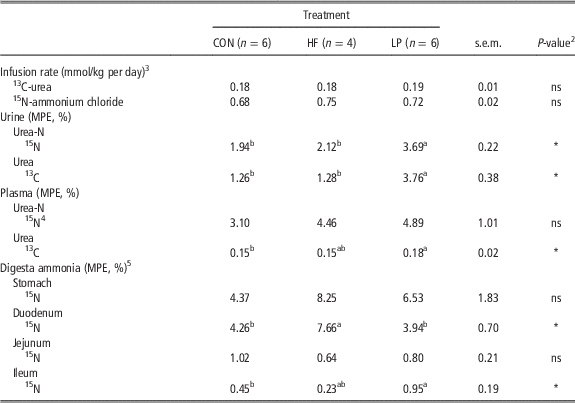
It is generally assumed that the isotopic enrichment of urinary urea is identical to the enrichment of plasma urea and therefore use of enrichment in either pool will yield the same results (Jackson et al., Reference Jackson, Picou and Landman1984) and has been demonstrated using similar infusion and analysis procedures (Columbus et al., Reference Columbus, Lapierre, Htoo and de Lange2014; Mansilla et al., Reference Mansilla, Columbus, Htoo and de Lange2015). However, in the current study there was a discrepancy between plasma and urine urea 13C enrichment (Table 3), for reasons that could not be identified. It was determined that urea kinetics calculated using urinary urea enrichment resulted in more reasonable values based on comparison with previously reported values in pigs (Thacker et al., Reference Thacker, Bowland, Milligan and Weltzien1982; Mosenthin et al., Reference Mosenthin, Sauer and de Lange1992a and 1992Reference Mosenthin, Sauer, Henkel, Ahrens and de Langeb; Zhu et al., Reference Zhu, Lapierre, Rademacher and de Lange2003) and humans (Jackson et al., Reference Jackson, Picou and Landman1984; Mariotti et al., Reference Mariotti, Pueyo, Tome and Benamouzig2001). Therefore, urea isotopic enrichment was used to estimate plasma isotopic enrichment in all calculations.
Infusion rate and isotopic enrichment of urea in plasma and urine and ammonia in digesta in growing pigs after a 4-day continuous infusion of 13C-urea and 15N-ammonium chlorideFootnote 1

CON=control diet; HF=high fibre diet; LP=low-protein diet; MPE=moles per cent excess.
a,bValues with different letters are significantly different (P<0.05); *P<0.05.
1 Pigs were fed one of three diets: CON, 18.6% CP; HF, 17.7% CP, 12% added pectin; LP, 13.2% CP.
2 Main effect of treatment analysed using PROC MIXED with treatment as a fixed effect and pig within period and period within study as random effects. Pig within period was the experimental unit.
3 n=6 for all treatments.
4 Calculated as [(14N15N-urea MPE×1)+(15N15N-urea MPE×2)]/2.
5 CON (n=4), HF (n=2), LP (n=3) for stomach, duodenum and jejunum ammonia isotopic enrichment.
Plasma urea flux was calculated using the conventional isotope dilution equation according to Matthews and Downey (Reference Matthews and Downey1984):
 $${\rm Plasma}\,{\rm urea}\,{\rm flux}\,{\rm (mmol}/{\rm kg}\,{\rm BW}/{\rm day)}={\rm IR}{\times}({\rm EI}/{\rm EU}-{\rm 1})$$
where IR is 13C-urea infusion rate and EI and EU are 13C-urea enrichment in infusate and urinary urea, respectively. Urea recycling was then calculated as the difference between plasma urea flux and urinary urea excretion according to Mosenthin et al. (Reference Mosenthin, Sauer and de Lange1992a and 1992Reference Mosenthin, Sauer, Henkel, Ahrens and de Langeb).
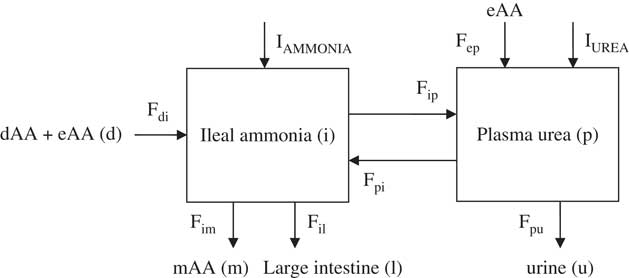
The equations used in the determination of nitrogen and carbon flows through the two-pool model (Figure 1) consisting of a plasma urea pool (p) and an ileal digesta ammonia pool (i) are given below, where F xy is flux of nitrogen or carbon from pool x to pool y, c x is carbon enrichment in pool x, n x is nitrogen enrichment of pool x and I is infusion of isotope-labelled ammonia or urea. The measurements used in these calculations are: (1) urinary urea 15N and 13C enrichment, (2) total urinary urea-nitrogen excretion and (3) ileal digesta ammonia 15N enrichment.
Two-pool model for nitrogen flow. Where F xy is the movement of nitrogen from pool x to pool y, I Ammonia and I Urea are the infusions of 15N-ammonium chloride and 13C-urea, and mAA, dAA and eAA, are microbial, dietary and endogenous amino acids, respectively.

Entry rate of nitrogen and 13C from infusion of urea can be calculated based on the measured infusion rate of the tracer urea:
 $$F_{{Ip}} \,({\rm mmol}\,{\rm N}/{\rm day})=I_{{{\rm Urea}}} $$
 $$F_{{Ip}} ^{{{\rm 13}}} ({\rm mmol}\,^{{{\rm 13}}} {\rm C}/{\rm day})=c_{I} F_{{Ip}} /{\rm 2}$$
Excretion of total urea-nitrogen, 13C- and 15N-urea in urine is measured, therefore:
 $$\eqalign{F_{{pu}} \,({\rm mmol}\,{\rm N}/{\rm day})=\,&{\rm urine}\,{\rm volume}{\times}{\rm urea}{\hbox{-}}{\rm nitrogen}\cr &\,\ {\rm concentration}$$
 $$F_{{pu}} ^{{{\rm 13}}} ({\rm mmol}\,^{{{\rm 13}}} {\rm C}/{\rm day})=c_{u} F_{{pu}} /{\rm 2}$$
 $$F_{{pu}} ^{{^{{{\rm 15}}} }} ({\rm mmol}\,^{{{\rm 15}}} {\rm N}/{\rm day})=n_{p} F_{{pu}} $$
Assuming that infused 13C-urea that is not excreted in the urine enters the small intestine gives:
 $$F_{{pi}} ^{{{\rm 13}}} ({\rm mmol}\,^{{{\rm 13}}} {\rm C}/{\rm day})=F_{{Ip}} ^{{{\rm 13}}} -F_{{pu}} ^{{{\rm 13}}} $$
Assuming that 15N-urea is partitioned between urine and the small intestine by the same proportions as for 13C-urea, then:
 $$F_{{pi}} ^{{{\rm 15}}} ({\rm mmol}\,^{{{\rm 15}}} {\rm N}/{\rm day)}=F_{{pi}} ^{{{\rm 13}}} {\times}{\rm 2}n_{p} /c_{p} $$
Determination of nitrogen flow to the small intestine can be obtained by adjusting for the plasma urea 15N enrichment, which was assumed to be identical to urinary 15N-urea enrichment:
 $$F_{{pi}} ({\rm mmol}\,{\rm N}/{\rm day})=F_{{pi}} ^{{{\rm 15}}} /n_{p} $$
Given that the entry of 15N into the plasma urea-nitrogen pool must equal the amount exiting the pool allows for calculation of 15N entry into the plasma urea-nitrogen pool from the small intestine:
 $$F_{{ip}} ^{{{\rm 15}}} ({\rm mmol}\,^{{{\rm 15}}} {\rm N}/{\rm day})=F_{{pu}} ^{{{\rm 15}}} {\plus}F_{{pi}} ^{{{\rm 15}}} $$
Total nitrogen entry into the small intestine nitrogen pool can be calculated based on the measured infusion rate of tracer ammonia:
 $$F_{{Ii}} ({\rm mmol \,N}/{\rm day})=I_{{{\rm Ammonia}}} $$
Assuming complete absorption of the infused 15N, the difference between 15N absorption and infusion is the amount of label that is reabsorbed from recycled urea:
 $$F_{{ip}} ^{{{\rm 15R}}} ({\rm mmol}\,^{{{\rm 15}}} {\rm N}/{\rm day})=F_{{ip}} ^{{{\rm 15}}} -F_{{Ii}} $$
Given that ammonia flow and ammonia enrichment at the ileum are known, the amount of nitrogen and 15N leaving the small intestine can be calculated:
 $$F_{{il}} ({\rm mmol}\,{\rm N}/{\rm day})={\rm ileal}\,{\rm ammonia}\,{\rm flow} $$
 $$F_{{il}} ^{{{\rm 15}}} ({\rm mmol}\,^{{{\rm 15}}} {\rm N}/{\rm day})=n_{i} {\times}{\rm ileal}\,{\rm ammonia}\,{\rm flow}$$
The remaining 15N disappearance not yet accounted for is assumed to be incorporated into microbial protein production:
 $$F_{{im}} ^{{{\rm 15}}} ({\rm mmol}\,^{{{\rm 15}}} {\rm N}/{\rm day})=F_{{pi}} ^{{{\rm 15}}} -F_{{ip}} ^{{{\rm 15R}}} -F_{{il}} ^{{{\rm 15}}} $$
Rearranging the above equations, with the condition that all nitrogen flows must be greater than or equal to zero, yields minimum and maximum possible nitrogen fluxes out of the ileal pool due to microbial protein production and absorption of ammonia-nitrogen into the plasma urea pool, plasma urea entry due to endogenous AA catabolism and entry of nitrogen into the ileal pool due to FAAC, which are outlined below.
The incorporation of nitrogen into microbial protein production has the following range (mmol N/kg per day):
 $$\openup 4pt\eqalignno{&\left( {[10]{\plus}[8]{\minus}[12]} \right)\left( {1{\minus}{{[7]{\plus}[5]} \over {[10]{\plus}[7]{\plus}[13]}}} \right)\cr &\leq F_{{im}} \leq \left( {[3]{\plus}[8]{\minus}[1]} \right)\left( {{{[10]{\plus}[7]{\plus}[13]} \over {[7]{\plus}[5]}}{\minus}1} \right)$$
Given this range, the amount of ammonia-nitrogen that is absorbed from the upper gut can be calculated (mmol N/kg per day):
 $${{[\min \,15]} \over {\left( \displaystyle{{{[10]{\plus}[7]{\minus}[13]} \over {[7]{\plus}[5]}}{\minus}1} \right)}} \leq F_{{ip}} \leq {{[\max \,15]} \over {\left( \displaystyle{{{[10]{\plus}[7]{\minus}[13]} \over {[7]{\plus}[5]}}{\minus}1} \right)}}$$
The remaining plasma urea-nitrogen production is from endogenous AA catabolism (mmol N/kg per day):
 $$ {{2{\times}[2]} \over {[4]{\minus}[1]{\minus}[\max \,16]}}\leq F_{{ep}} \leq {{2{\times}[2]} \over {[4]{\minus}[1]{\minus}[\min \,16]}}$$
Finally, the minimum and maximum amount of small intestine ammonia-nitrogen production that is due to FAAC (mmol N/kg per day) is determined by
 $$\eqalign{&[{\rm min}\,{\rm 16}]{\plus}[{\rm min}\,{\rm 15}]{\plus}[{\rm 12}]-[{\rm 1}0]-[{\rm 8}]\leq F_{{oi}} \leq \cr &\quad[{\rm max}\,{\rm 16}]{\plus}[{\rm max}\,{\rm 15}]{\plus}[{\rm 12}]-[{\rm 1}0]-[{\rm 8}]$$
Statistical analysis
All data were analysed using the mixed model procedure (PROC MIXED) of the SAS statistical program (SAS 9.1; SAS Institute Inc., Cary, NC, USA). Diet was included in the model as a fixed effect and period within study and pig within period were included as random effects. Pig within period was the experimental unit for all measures. Differences between treatment means were determined using the Tukey test and were considered statistically significant at P⩽0.05.
Results
In the first study, five out of 12 observations were missing due to loss of catheters or cannulas (n=2), poor appetite (n=1) or urinary nitrogen/urea excretion identified as outliers using a box-plot statistical test and determined within treatment (n=2). No observations were lost during the second study. All other catheters remained patent throughout the studies and placement of all catheters was confirmed by visual inspection at the end of the studies. The average BW at the end of the first and second infusion period of the first study was 24.7 kg (s.d.=1.44) and 30.6 kg (s.d.=1.82), respectively, and at the end of the second study was 30.2 kg (s.d.=1.65). Average BW did not differ between treatments (Table 1; P>0.05).
Ileal digesta DM content was not affected by dietary treatment (Table 2; P>0.05). Ileal DM digestibility was decreased with the addition of pectin to the diet and higher for LP (P<0.001) resulting in an increase and decrease in ileal DM flow for HF and LP, respectively, when compared with CON (P<0.001). Apparent ileal digestibility of nitrogen was lower with both the addition of fibre and decrease in dietary protein content (P<0.05) compared with CON, however, daily nitrogen flow at the ileum was greater only on the HF diet (P<0.05). Ileal digesta ammonia concentration was lower for LP compared with HF (P<0.05) and was intermediate for CON (P>0.05). Ileal ammonia flow was increased by feeding additional fibre when compared with the CON (P<0.05) but was not affected by dietary protein. Total urinary nitrogen excretion, urea excretion and the per cent of nitrogen excreted as urea were decreased in pigs fed the LP diet (P<0.05), but were not affected by the inclusion of pectin (P>0.05), when compared with CON.
Isotopic steady state was confirmed by comparing 15N (2.13, 2.07 v. 3.64±0.23 MPE for day 3 and 2.10, 2.14 v. 3.70±0.23 MPE for day 4 for CON, HF and LP, respectively) and 13C (1.29, 1.26 v. 3.52±0.33 MPE for day 3 and 1.43, 1.21 v. 4.04±0.33 MPE for day 4 for CON, HF and LP, respectively) enrichment in urinary urea from days 3 and 4 of the infusion, which were not different. In addition, it has also been shown previously that the infusion protocol used in this study results in isotopic steady state within 2 days of the start of infusion (Libao-Mercado et al., Reference Libao-Mercado, Zhu, Fuller, Rademacher, Seve and de Lange2009). Based on digesta samples obtained from the stomach and small intestine, there was a 90% dilution of the labelled ammonia in the stomach, which had been further diluted to 1% of the original value by the jejunum (Table 3).
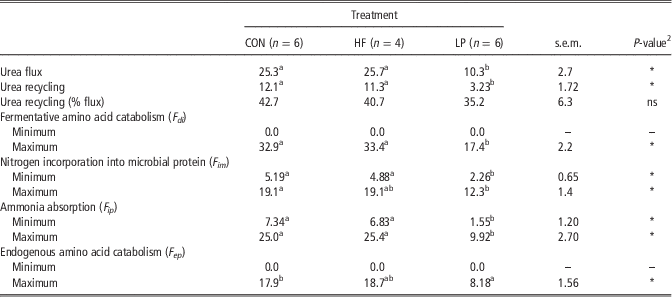
Lowering protein intake reduced urea flux, urinary urea excretion and urea recycling compared with CON (Table 4; P<0.05). The proportion of plasma urea flux that was recycled was not affected by any dietary treatment (P>0.05). Based on the two-pool model (Figure 1), decreasing the dietary protein content resulted in a decrease in estimates for maximum FAAC (P<0.001), minimum incorporation of nitrogen into microbial protein (P<0.05), as well as both minimum (P<0.05) and maximum (P<0.01) estimates of ammonia absorption when compared with both CON and HF diets (Table 4). Estimates of maximum incorporation into microbial protein and endogenous AA catabolism were reduced on the LP diet when compared with the CON diet (P<0.001). The addition of pectin to the diet had no effect on any of the estimated nitrogen fluxes when compared with the CON diet (P>0.05).
Urea kinetics and range of total nitrogen (N) flow (mmol N/kg BW per day) for key ileal N fluxes based on isotopic flows through a two-pool model in growing pigs after a 4-day continuous infusion of 13C-urea and 15N-ammonium chlorideFootnote 1

CON=control diet; HF=high fibre diet; LP=low-protein diet.
a,bValues with different letters are significantly different (P<0.05); *P<0.05.
1 Pigs were fed one of three diets: CON, 18.6% CP; HF, 17.7% CP, 12% added pectin; LP, 13.2% CP.
2 Main effect of treatment analysed using PROC MIXED with treatment as a fixed effect and pig within period and period within study as random effects. Pig within period was the experimental unit.
Discussion
The objectives of this study were to develop methods to determine FAAC in the small intestine of growing pigs and to determine the effect of dietary fibre and dietary protein content on estimates of FAAC. Due to evidence supporting rapid absorption of labelled ammonia and recycling of label into the small intestine resulting in a lack of enrichment uniformity, simple isotope dilution calculations are inappropriate for determining FAAC. Therefore, an alternative two-pool model (Figure 1) was developed in an attempt to estimate various components of nitrogen flux in the small intestine. Calculation of absolute values of nitrogen flux using this model would require measurement of endogenous AA catabolism as well as microbial AA production, which were not determined in this study.
Dietary fibre can alter digestive tract and microbial function through a variety of mechanisms including increasing rate of passage and viscosity of digesta, altering enzyme activities, increasing turnover of intestinal epithelium and intestinal secretions and providing an alternative energy source for the intestinal microbial population (Mosenthin et al., Reference Mosenthin, Sauer and Ahrens1994; Metges, Reference Metges2000; Souffrant, Reference Souffrant2001). In general, nitrogen is not the limiting factor with respect to microbial AA synthesis and, therefore, inclusion of an energy source may result in an increase in incorporation of nitrogen into microbial AA production and increase AA supply to the host (Oba and Allen, Reference Oba and Allen2003).
In the current study, dietary pectin resulted in a decrease in the apparent ileal digestibility of both DM and nitrogen, which is in agreement with previous studies (Dierick et al., Reference Dierick, Vervaeke, Decuypere and Henderickx1986; Souffrant, Reference Souffrant2001) and is likely due to an increase in endogenous secretions such as mucin, a decrease in nutrient absorption (Dierick et al., Reference Dierick, Vervaeke, Decuypere and Henderickx1986), or an increase in incorporation of nitrogen into microbial biomass and subsequent increase in ileal microbial protein flow (Mosenthin et al., Reference Mosenthin, Sauer, Henkel, Ahrens and de Lange1992b; Partanen et al., Reference Partanen, Jalava and Valaja2007).
The effect of dietary fibre on digesta ammonia concentration is consistent with Partanen et al. (Reference Partanen, Jalava and Valaja2007) who reported no effect of fibre on ileal ammonia concentration. However, these results are inconsistent with Bikker et al. (Reference Bikker, Dirkzwager, Fledderus, Trevisi, le Huerou-Luron, Lalles and Awati2006) and Jeaurond et al., (Reference Jeaurond, Rademacher, Pluske, Zhu and de Lange2008) who observed a decrease in ammonia concentration in ileal and colonic digesta, respectively, with the addition of fibre to the diets of growing pigs. In these studies, it was suggested that a decrease in ammonia concentration indicated a reduction in FAAC by gut microbes when a fermentable fibre source was available. However, neither of these studies reported the total daily flow of ammonia at either the ileal or faecal level, which was shown to increase with fibre in the current study. Libao-Mercado et al. (Reference Libao-Mercado, Zhu, Fuller, Rademacher, Seve and de Lange2009) reported a trend for an increase in both the amount of ileal ammonia derived from protein fermentation and ileal ammonia flow in pigs fed a diet with 12% added pectin. Dietary fibre has been shown to increase total digesta flow due to its water-holding capacity and would thus result in an increase in total ammonia flow even if ammonia concentration is reduced. Therefore, it is likely that an increase in total ammonia production would not be evident in measures of ammonia concentration in ileal digesta fluid alone. It is possible that the anticipated reduction in FAAC with the addition of fibre is negated by the increase in endogenous protein excretion into the gastrointestinal tract and reduction in nutrient digestibility, increasing the amount of protein available for microbial fermentation. Reviews on dietary fibre emphasize the importance of physicochemical properties of fibre such as solubility, gel-formation, viscosity, fermentability and water-holding capacity when explaining the effects of different fibres with respect to nutrient utilization and gastrointestinal function (Souffrant, Reference Souffrant2001; Bindelle et al., Reference Bindelle, Leterme and Buldgen2008; Zijlstra et al., Reference Zijlstra, Jha, Woodward, Fouhse and van Kempen2012). The widely different properties of different types and mixtures of dietary fibre and the poor understanding of how these properties interact with the gastrointestinal tract makes comparing the results of different studies difficult.
The addition of pectin to the diet did not impact any of the model-estimated nitrogen fluxes. The impact of dietary fibre on large intestine microbial activity has been demonstrated previously (Wenk, Reference Wenk2001; Bindelle et al., Reference Bindelle, Leterme and Buldgen2008) although the small intestine has largely been ignored based on the assumption of insignificant microbial activity and low fibre degradability. The addition of pectin to the diet was shown to decrease nitrogen digestibility and increase ammonia flow at the ileum, indicating that FAAC and nitrogen incorporation into microbial protein were likely enhanced in pigs fed the HF diet and may have resulted in differences in these fluxes. However, the model presented is insufficiently sensitive to determine these differences.
Reducing dietary protein content has been suggested as a possible method for increasing the efficiency of using dietary protein for body protein synthesis. The reduction in ammonia generation in the gastrointestinal tract with reduced protein is thought to be due to a decrease in the amount of undigested protein available for fermentation by the intestinal microflora (Ball and Aherne, Reference Ball and Aherne1987). The effect of reducing the dietary protein content on urinary excretion of nitrogen is in agreement with previous findings (Thacker et al., Reference Thacker, Bowland, Milligan and Weltzien1982) and is an indication of a decrease in ammonia production. Of interest is the significant decrease in the estimated maximum ammonia generation in the small intestine as a result of FAAC and subsequent decrease in absorption of ammonia in pigs fed the LP diet. Given the estimated FAAC, it is surprising that a significant effect on neither ammonia concentration nor ileal ammonia flow was observed. Substantial numerical differences in these values were observed, however, and the lack of significance is likely due to the variability associated with ammonia measures. The digesta ammonia concentrations reported here are similar to those reported previously in pigs fed high (Htoo et al., Reference Htoo, Araiza, Sauer, Rademacher, Zhang, Cervantes and Zijlstra2007) and low-protein diets (Nyachoti et al., Reference Nyachoti, Omogbenigun, Rademacher and Blank2006). Nyachoti et al. (Reference Nyachoti, Omogbenigun, Rademacher and Blank2006) found that lowering dietary CP in a corn and soybean meal-based diet from 23% to 17% resulted in a decrease in ileal ammonia-nitrogen concentration from 72 to 38 mg/l. Furthermore, a decrease in dietary CP from 16% to 13% in the current study resulted in a decrease in ileal digesta ammonia-nitrogen concentration from 30.4 to 22.7 mg/l and ileal ammonia flow from 0.25 to 0.13 mmol N/kg per day, which would suggest that decreasing dietary CP to a greater extent may result in a decrease in microbial FAAC in the small intestine. In contrast, Htoo et al. (Reference Htoo, Araiza, Sauer, Rademacher, Zhang, Cervantes and Zijlstra2007) observed no change in ileal ammonia concentration when dietary protein was lowered from 24% to 20%, which may indicate inadequate dietary protein restriction in this study to observe an effect on FAAC.
Reducing dietary protein content has also been suggested as a possible method for enhancing the utilization of NPN sources for the production of AA by intestinal microbes. Recycling of urea may be an important nitrogen salvage mechanism in non-ruminants, especially during times of protein deficiency. The model presented here showed a decrease in incorporation of NPN into microbial protein with an LP diet. These findings further indicate that microbes in the small intestine are reliant on pre-formed dietary AA to meet the majority of their needs and the lower incorporation observed is due to the decrease in pre-formed AA available in LP-fed pigs for microbial protein production. This is supported by Libao-Mercado et al. (Reference Libao-Mercado, Zhu, Fuller, Rademacher, Seve and de Lange2009) who found that dietary and endogenous pre-formed AA were the main precursors for microbial AA production in the small intestine. Yang et al. (Reference Yang, Dai and Zhu2014) also demonstrated a significant utilization of AA by luminal intestinal bacteria. The contribution of microbial AA to meeting the AA requirements of non-ruminants may be important during periods of nitrogen restriction but should be weighed against FAAC.
Reducing dietary protein content has also been suggested as a possible method for enhancing the utilization of NPN sources for the production of AA by intestinal microbes. Recycling of urea may be an important nitrogen salvage mechanism in non-ruminants, especially during times of protein deficiency. It has been suggested that the amount of urea that is recycled into the gut responds to dietary protein intake and nitrogen requirements of the animal (Jackson et al., Reference Jackson, Gibson, Bundy, Hounslow, Millward and Wootton2004) or may be simply dependent on urea flux and plasma concentration of urea (Thacker et al., Reference Thacker, Sauer and Jorgensen1984). The current study observations suggest that urea recycling is not a regulated process in pigs since the proportion of urea flux that was recycled remained the same regardless of dietary protein content. The model presented here showed a decrease in incorporation of NPN into microbial protein with an LP diet. These findings further indicate that microbes in the small intestine are reliant on pre-formed dietary AA to meet the majority of their needs and the lower incorporation observed is due to the decrease in pre-formed AA available in LP-fed pigs for microbial protein production. This is supported by Libao-Mercado et al. (Reference Libao-Mercado, Zhu, Fuller, Rademacher, Seve and de Lange2009) who found that dietary and endogenous pre-formed AA were the main precursors for microbial AA production in the small intestine. The contribution of microbial AA to meeting the AA requirements of non-ruminants may be important during periods of nitrogen restriction but should be weighed against FAAC.
Conclusions
Use of conventional isotope dilution is inappropriate for determining ammonia flux and FAAC in the small intestine of pigs, largely due to the non-homogenous nature of the digesta ammonia pool. An alternative two-pool model presented in this paper allows for calculation of a range of values for movement of nitrogen through the ileal ammonia pool. However, due to limitations in this model and experimental observations, absolute values for FAAC could not be determined. Based on estimated nitrogen flows in the two-pool model, reducing dietary protein level has a larger impact on microbial activity and AA economy than increasing dietary fibre. Reported effects of dietary fibre on nitrogen metabolism in the pig are inconsistent and further efforts are required to clarify the effect of different types of fibre. It is recommended that future studies attempt to better quantify FAAC as it may have significant impacts on the AA economy in pigs and other non-ruminant animals, including humans.
Acknowledgements
The authors would like to thank C.L. Zhu, L. Trouten-Radford, M. Quinton, and G. VanderVoort for technical assistance. Funding for this project was provided by the Ontario Ministry of Agriculture, Food and Rural Affairs, the Natural Sciences and Engineering Research Council of Canada, and Evonik Industries AG.