Introduction
Depression and anxiety are common disorders in elderly people, and these are associated with excess mortality and reduced quality of life (Beekman et al., Reference Beekman, Deeg, van Tilburg, Smit, Hooijer and van Tilburg1995, Reference Beekman1998; Blazer, Reference Blazer2003; Alexopoulos, Reference Alexopoulos2005). Elderly people living in residential homes have an even higher risk of developing depressive and anxiety disorders than those living in the community: The rates of clinically relevant symptoms of depression and anxiety in people living in long-term care facilities have been estimated to be as high as 35% (Dozeman et al., Reference Dozeman, van Schaik, van Marwijk, de Wit and Beekman2008; Thakur and Blazer, Reference Thakur and Blazer2008). Chronic illnesses, disability, loneliness, old age, and female gender may all contribute to this risk, and in the residential home settings these risks accumulate (Cole and Dendukuri, Reference Cole and Dendukuri2003; Smit et al., Reference Smit, Ederveen, Cuijpers, Deeg and Beekman2006). Although treatment has improved (Pinquart et al., Reference Pinquart, Duberstein and Lyness2006), older people with depression or anxiety often remain untreated. Given the large number of people who are affected, it is unlikely that even the most resourceful health services will be able to provide adequate treatment for them all. This is an important reason why alternative strategies, such as prevention, are necessary to reduce the adverse impact of late-life depression and anxiety on the health of the population (Andrews et al., Reference Andrews, Issakidis, Sanderson, Corry and Lapsley2004; Chisholm et al., Reference Chisholm, Sanderson, Ayuso-Mateos and Saxena2004; Smit et al., Reference Smit, Beekman, Cuijpers, de Graaf and Vollebergh2004).
The results of recently performed meta-analyses indicate that preventive interventions are effective in reducing the incidence of anxiety and depressive disorders by as much as 25% in adults (Cuijpers et al., Reference Cuijpers, van Straten, Smit, Mihalopoulos and Beekman2008; Beekman et al., Reference Beekman, Smit, Stek, Reynolds and Cuijpers2010; Munoz et al., Reference Munoz, Cuijpers, Smit, Barrera and Leykin2010), and this also applies to older people (Cuijpers et al., Reference Cuijpers, van Straten and Warmerdam2009). In a study in the Netherlands carried out among people aged 75 years and more living in the community, the application of a stepped-care prevention program reduced the risk of developing a depressive or anxiety disorder by 57.9% (Veer-Tazelaar et al., Reference Veer-Tazelaar, Marwijk, Oppen, Horst, Smit and Beekman2009) with effects that were retained over two years (Veer-Tazelaar et al., Reference Veer-Tazelaar, van Marwijk, van Oppen, van Hout, van der Horst and Cuijpers2011) in a cost-effective way (Veer-Tazelaar et al., Reference Veer-Tazelaar, Smit, van Hout, van Oppen, van der and Beekman2010). These promising results suggest that preventive interventions might be very effective when offered in a stepped-care format.
The aim of the stepped-care models is to maximize the effectiveness of available effective interventions while making the best use of available resources. Patients are first offered the least intensive intervention and, when necessary, the intensity of the care is stepped up sequentially. When carried out systematically, the (cost-)effectiveness of the program as a whole is improved (Haaga, Reference Haaga2000; Simon et al., Reference Simon2001; Scogin et al., Reference Scogin, Hanson and Welsh2003). Previous research has suggested that prevention is most likely to be effective when targeted at those with a high a priori risk of developing the disorder (Chisholm et al., Reference Chisholm, Sanderson, Ayuso-Mateos and Saxena2004; Smit et al., Reference Smit, Beekman, Cuijpers, de Graaf and Vollebergh2004). This can be achieved either by focusing on people with established risk factors for a disorder (selective prevention) or by targeting people with early symptoms of the disorder, but who have not yet developed the full-blown disorder (indicated prevention).
In the present study we combined both strategies by focusing on a frail elderly population exposed to multiple risk factors with above average levels of symptoms of depression and anxiety, but not yet meeting the diagnostic criteria for a disorder. We hypothesized that the stepped-care prevention program would be superior to usual care in preventing the onset of depressive and anxiety disorders in residents in homes for the elderly.
Methods
Design
We tested the stepped-care program in a pragmatic randomized controlled trial with two parallel groups. The design of this study has already been described in detail elsewhere (Dozeman et al., Reference Dozeman, van Schaik, Beekman, Stalman, Bosmans and van Marwijk2007). In brief, 14 residential homes in Amsterdam and surroundings were willing to participate in the trial. The 14 participating homes covered several areas in and around the city, including more affluent and deprived areas of Amsterdam. The randomization of consenting residents, stratified according to residential home, took place after the baseline measurements in blocks of four with an equal allocation ratio, carried out by an independent statistician using random number tables.
The central clinical outcome was the cumulative incidence of depressive and anxiety disorders (according to the Diagnostic and Statistical Manual of Mental Disorders, 4th ed. (DSM-IV)) over a period of one year, with planned analyses for each of the distinct outcomes as measured with the Mini International Neuropsychiatric Interview (MINI) (Sheehan et al., Reference Sheehan1998). We measured both disorders at all points in follow-up. Some respondents developed a depressive disorder, some an anxiety disorder, and others both. The study protocol was approved by the Medical Ethics Committee of the VU University Medical Centre.
Participants
In the Netherlands, several types of facilities for sheltered accommodation for the elderly are available, the two most important being residential homes and nursing homes. Residential homes provide assisted living facilities, including daily care (e.g. meals and housecleaning) and, if needed, straightforward demand-led medical care. Nursing homes provide more specialized medical care to dependent people of all ages. The demand for residential care mainly depends on (the lack of) a social network and (in)ability to manage everyday activities (van Bilsen et al., Reference van Bilsen, Hamers, Groot and Spreeuwenberg2006). After a pilot study in one residential home (Dozeman et al., Reference Dozeman, van Schaik, van Marwijk, de Wit and Beekman2008), we found that many residents did not complete the screening questionnaires, mainly because they were not feeling well enough. Furthermore, resources in the residential home were insufficient to screen all the residents. Therefore, we adapted a screening procedure in which interviewers visited every address and asked the resident(s) for permission to screen for depressive symptoms using the Center for Epidemiologic Studies Depression Scale (CES-D) (Radloff, Reference Radloff1977). Respondents with a minimum score of 8, i.e. above average (Bisschop et al., Reference Bisschop, Kriegsman, Deeg, Beekman and van Tilburg2004), were invited for a follow-up interview, in which a diagnostic and cognitive assessment took place. Respondents who met the criteria for MINI/DSM-IV depressive or anxiety disorder were excluded, as were residents with evidence of substantial cognitive impairment, measured with a cut-off score of 21 for the Mini-Mental State Examination (MMSE) (Folstein et al., Reference Folstein, Folstein and McHugh1975). Residents who gave written informed consent and had sufficient command of the Dutch language were eligible for participation in the study.
Stepped-care program
Step-up rules
After one month of watchful waiting, assessments took place in cycles of three months. Participants were invited to step up to the next level of intervention if the level of their symptoms had not improved by at least 5 points on the Center for Epidemiologic Studies Depression Scale (CES-D). We used this definition of improvement because a 5-point change on the CES-D is both clinically relevant and statistically reliable, and has also been used in earlier studies (Kennedy et al., Reference Kennedy, Kelman and Thomas1991; Lipsey and Wilson, Reference Lipsey and Wilson1993; Smit et al., Reference Smit, Ederveen, Cuijpers, Deeg and Beekman2006). If at any measurement point a participant was found to have developed a DSM-IV depressive or anxiety disorder, the preventive intervention was considered to have failed, and this failure was recorded as a clinical end-point. These residents were referred to their general practitioner for possible psychological or pharmacological treatment. Participants with a decrease in symptoms of 5 points or more were not offered further intervention in the stepped-care program, but were monitored for the next three months. The stepped-care program consisted of the following steps:
• Step 1. Watchful waiting: Participants were invited for the first follow-up interview after a period of one month, since frequently (in up to 50% of the cases) symptoms cease to exist without requiring active intervention (Beekman et al., Reference Beekman, Penninx, Deeg, de Beurs, Geerling and van Tilburg2002).
• Step 2. Activity-scheduling: Participants who showed no improvement after one month, were invited for “activity-scheduling,” a module from a previously tested and effective self-help course, “coping with depression” (Cuijpers et al., Reference Cuijpers, van Straten, Smit and Andersson2007). Staff in the residential homes were trained to coach and encourage the residents to complete the course. Only staff members who coached a resident in the intervention group were trained in the self-help course. Also, they only received the self-help materials for their residents in the intervention group. All coaches were instructed to deliver the materials only to the assigned residents in order to avoid contamination between the intervention group and care as usual. This method of treatment is attractive because it is relatively simple and does not require any complex skills from the staff or the residents. During this second step of the protocol, general practitioners were informed about the participation of their patients in the stepped-care program.
• Step 3. Life review and consultation with the general practitioner: If symptoms did not change after the activity-scheduling step, residents were invited to participate in a brief structured personal intervention, i.e. life review. The intervention is tailored for use with the very old because it is short, individual, and positively focused (Bohlmeijer et al., Reference Bohlmeijer, Smit and Cuijpers2003). The adjusted life review protocol that we used is effective for residents in homes for the elderly (Serrano et al., Reference Serrano, Latorre, Gatz and Montanes2004). The intervention is relatively simple to implement by professionals with basic counseling skills, and was delivered by trained and supervised mental health nurses. At the same time, the participants were advised to consult their general practitioner to check for possible somatic causes of depression and anxiety symptoms (thyroid disease, vitamin deficiencies, Parkinson's disease, or side effects of medication).
• Step 4. Visit to the general practitioner for additional treatment: Residents who had a CES-D score ≥ 16 (the level of clinically relevant symptoms of depression) after the third follow-up interview were advised to consult their general practitioner to consider the prescription of antidepressants or referral to a mental health specialist.
Usual care
Residents in the usual care group had unrestricted access to any form of health care that was considered to be appropriate. Their healthcare utilization was recorded, including the prescription of medication.
Measures
Major depressive disorder and anxiety disorders (panic disorder, agoraphobia, social phobia, or generalized anxiety) were assessed with the MINI (Sheehan et al., Reference Sheehan1998), which is a short, structured diagnostic interview to assess DSM-IV mental disorders. We measured both disorders at all points in a follow-up. Some respondents developed a depressive disorder, some an anxiety disorder, and others both.
Symptoms of depression and anxiety were measured with the CES-D, which consists of 20 items, with total scores ranging between 0 and 60. The CES-D not only detects depression but has also been found to be a satisfactory instrument with which to screen for anxiety disorders in this specific setting (Dozeman et al., Reference Dozeman, van Schaik, van Marwijk, Stek, van der Horst and Beekman2011).
Symptoms of anxiety were also measured with the Hospital Anxiety and Depression Scale (HADS-A) (Zigmond and Snaith, Reference Zigmond and Snaith1983), which consists of seven questions to which answers can be given on a 4-point rating scale. A minimum score of 8 on the HADS-A is a validated cut-off point for anxiety disorder (Bjelland et al., Reference Bjelland, Dahl, Haug and Neckelmann2002).
Loneliness was measured with the 11-item loneliness scale (Jong-Gierveld, Reference Jong-Gierveld1987), developed for older people. A cut-off score of 3 distinguishes between lonely and not lonely.
Healthcare utilization was measured with the Trimbos/iMTA Questionnaire for Costs Associated with Psychiatric Illness (Tic-P) (Roijen et al., Reference Roijen, Straten, Tiemens and Donker2002).
The number of chronic illnesses was measured from medical files, and the activity of daily living (ADL) scores were measured with the Groningen Activity Restriction Scale (GARS) (Kempen et al., Reference Kempen, Miedema, Ormel and Molenaar1996); the median score was used as a cut-off score.
Blinding
The interviewers were not informed about the randomization status of the participants. However, in this type of intervention it is not possible to conceal randomization status from the participants.
Statistical analysis
We first investigated possible baseline differences in demographic and clinical characteristics across the conditions (t-test for continuous data, and χ2 test for categorical data). To check for possible selective attrition, we compared the prognostically relevant characteristics of dropouts and completers in the intervention group and in the usual care group. We also compared the reasons for dropout between the groups. To identify statistically significant predictors of incidence and selective dropout, stepwise backward selection regression analysis was performed so that in any subsequent analysis such confounders could be incorporated as covariates.
The main analyses were conducted on an intention-to-treat basis. This approach implies that the analyses are based on all randomized patients, and this requires the imputation of missing end-points. In a randomized trial of a curative intervention, the last observation carried forward (LOCF) is regarded as a conservative approach to data analysis because the baseline scores of the patients are unfavorable, and these unfavorable scores are analyzed as outcomes if there is no observed outcome. Thus, in a curative trial, LOCF strengthens the null-hypothesis of no effect. However, in a prevention trial, LOCF might not be a conservative imputation technique because the purpose of prevention is to reduce the risk of deterioration in health in people who are relatively healthy at baseline. Therefore, the use of LOCF in a prevention trial might bias outcomes toward overly optimistic conclusions. To avoid this bias, it is better to replace missing end-points by their most likely values, such as those obtained with the Little and Rubin expectation maximization (EM) algorithm as implemented in SPSS (15.0). In order to diminish the uncertainty, which is implied with the estimation of missing end-points, we also used another imputation strategy by way of a sensitivity analysis (regression imputation, as implemented in SPSS 15.0) and finally conducted a “completers-only analysis,” based on the data of the participants who completed the interviews.
To estimate the extent to which the intervention reduced the risk of depressive and anxiety disorders compared to usual care, we first performed an unadjusted Poisson regression analysis of the MINI/DSM-IV depressive and anxiety cumulative incidence (1 = developed a disorder, and 0 = remained disorder-free) on the treatment indicator (0 = usual care, and 1 = intervention). In this way, we obtained a crude incidence rate ratio (IRR), which describes the difference between the incidence rate in the intervention group and in the usual care group. The superiority of the intervention would be supported if the IRR falls below 1, and would be significant at p < 0.05, 2-tailed.
As a second step, we wanted to adjust for confounders and selection-bias, so we incorporated all significant confounders as covariates in the analysis and then produced adjusted IRRs. We also obtained the number-needed-to-treat (NNT) as the inverse of the risk difference (RD). The NNT indicates how many people must receive the intervention in order to avoid one new case of depression or anxiety.
Finally, we assessed the IRR for both the disorders separately, first with an unadjusted analysis, and second with the adjusted analysis for confounding.
All analyses were performed with SPSS (version 15.0) and Stata (version 8.2) while taking into account the clustering effect that the multi-site trial (with participants “nested” within each of the 14 residential homes) introduced in the data. We therefore computed robust 95% confidence intervals (CI) and test statistics by applying the first-order Taylor-series liberalization method. The IRR was obtained with Poisson regression (as estimated with a generalized linear model (GLM)). The NNT was calculated as NNT = 1/RD, rounded off to the nearest integer.
Results
Participants
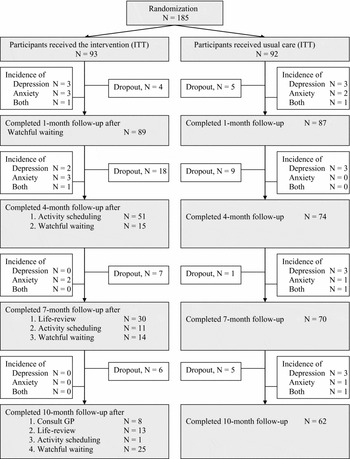
Recruitment took place between April 2007 and December 2008. Of the 1784 residents who were invited for the screening interview, 754 (51%) were able and willing to participate. Of these, 459 (61%) scored higher than the predetermined threshold. A total of 270 (59%) gave informed consent, but 85 were excluded because they were already suffering from a mental disorder, cognitive impairment, or both. This resulted in the randomization of 185 residents for the trial. They were either randomized to the stepped-care program (N = 93) or to the usual care group (N = 92) (Figure 1). Of the 185 participants, 55 (30%) dropped out during the study.
Flowchart of participants in the trial.

Baseline characteristics
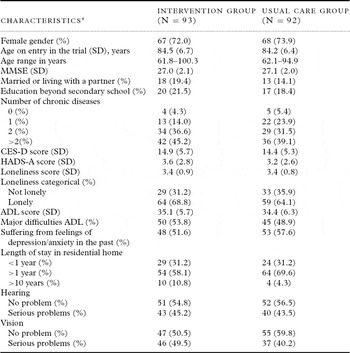
The participants were mainly women (73%) with a mean age of 84.3 years (SD = 6.5), and had chronic diseases and poor daily functioning. Most of the participants (83.2%) were living alone, and felt lonely (70.8%). There were no significant differences between the intervention group and the usual care group at baseline, indicating that randomization had resulted in a balanced distribution of these variables over the two groups (Table 1).
Baseline demographic and clinical characteristics of the participants

* There are no significant differences between groups (t-test/χ2 test). MMSE = Mini-Mental State Examination; CES-D = Center for Epidemiologic Studies Depression Scale; HADS-A = Hospital Anxiety and Depression Scale; ADL = activities of daily living.
Analysis of dropout
We assessed whether dropout was associated with any characteristics of the participants at baseline, and found that it was associated with the randomization status (χ2 = 6.310, df = 1, p = 0.012) and poorer cognitive functioning (t = 3.135, df = 1, p = 0.002). More participants in the intervention group were unwilling to continue their participation (14 out of 93) compared with participants in the usual care group (4 out of 92) (χ2 = 6.035, df = 1, p = 0.014). In the intervention group, 5 of the 93 participants died, compared with 6 of the 92 participants in the usual care group (χ2 = 1.08, df = 1, p = 0.74). One participant in the intervention group moved to another region. Furthermore, 17 of the 93 participants in the intervention group and 9 of the 92 participants in the usual care group dropped out because of physical illness (χ2 = 2.76, df = 1, p = 0.10).
Loneliness (p = 0.01), CES-D score at baseline (p < 0.01), HADS-A score at baseline (p = 0.01), and the number of chronic diseases were predictors (p = 0.04) for the incidence of a major disorder, and MMSE score at baseline (p = 0.01) was a predictor for dropout. We used all five statistically significant predictors for incidence and dropout as covariates in the Poisson regression analysis of the MINI/DSM-IV depressive and anxiety cumulative incidence evaluations while also reporting on the crude (unadjusted) outcomes.
Compliance
To assess compliance with the stepped-care intervention, we investigated the participation rates in each step of the intervention. After the first step, in which no active intervention was applied, the participants were offered a self-help course in the second step. Sixty-three participants were eligible for this intervention, but only 45 participants (71%) reported starting with the intervention. Furthermore, only a minority (11 out of 45, i.e. 24%) finished all exercises in the self-help intervention. In the third step, 43 participants were eligible for the life review intervention, and 31 (72%) of them accepted and completed this intervention. Finally, seven out of eight participants reported that they had contacted their general practitioner after being advised to do so.
Usual care
We found that six out of 92 participants in the usual care group received counseling from a psychiatrist or psychotherapist, compared with eight out of 93 participants in the intervention group (χ2 = 0.29, df = 1, p = 0.59) during the study period; 10 out of 86 participants in the usual care group received antidepressant medication, compared with 16 out of 84 participants in the intervention group (χ2 = 1.81, df = 1, p = 0.18); 36 out of 86 participants in the usual care group received sedative medication compared with 35 out of 84 participants in the intervention group (χ2 = 0.17, df = 1, p = 0.90).
Outcomes
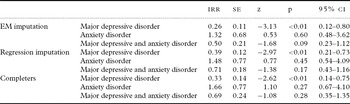
Based on the intention-to-treat analysis with EM imputation, the crude incidence of both the disorders together was 12 out of 93 (12.9%) participants in the intervention group, and 15 out of 92 (16.3%) in the usual care group, resulting in an IRR of 0.79 and a 95% CI = 0.38–1.65. As a second step, we adjusted for five covariates, not only because of the confounding effect introduced by differential dropout rates but also because the incidence rates over a period of one year were lower than anticipated, resulting in a lack of power. The adjusted analysis resulted in an IRR = 0.50 and a 95% CI = 0.23–1.12, which suggested that the incidence rate may have been halved by the intervention, but this effect was not statistically significant (SE = 0.21, z = –1.68, p = 0.09).
Considering the incidence of depressive disorders, six out of 93 (6.5%) participants in the intervention group, and 13 out of 92 (14.1%) in the usual care group developed a major depressive disorder, resulting in an IRR = 0.46 and a 95% CI = 0.17–1.21. The adjusted analysis resulted in an IRR = 0.26 and a 95% CI = 0.12–0.80. Therefore, the adjusted risk of developing a depressive disorder during the stepped-care program was reduced by 74% in the intervention group as compared with the usual care group. This effect was statistically significant (SE = 0.11, z = –3.13, p < 0.01). With an adjusted RD of 0.09, the NNT was 11, implying that the onset of major depression was prevented in one out of every 11 participants who received the intervention instead of usual care.
With regard to the incidence of anxiety disorders, eight out of 93 (8.6%) participants in the intervention group, and four out of 92 (4.4%) participants in the usual care group developed an anxiety disorder, mainly generalized anxiety (crude IRR = 1.98; 95% CI = 0.74–5.28, with an adjusted IRR = 1.32; 95% CI = 0.48–3.62), suggesting that the adjusted risk of developing an anxiety disorder might have increased by 32% in the intervention group compared with the usual care group. However, this effect was not statistically significant (SE = 0.68, z = 0.53, p = 0.60).
To assess the robustness of the outcomes, we performed a sensitivity analysis, and repeated the first intention-to-treat analysis, this time based on regression imputation. This resulted in the adjusted IRR for depression of 0.39 (95% CI = 0.21–0.72), which again was significant (SE = 0.12, z = –3.01, p < 0.01). Finally, in the analysis of the completers, the adjusted IRR for depression was 0.33 (95% CI = 0.14–0.75), which was significant (SE = 0.14, z = –2.62, p < 0.01), thus replicating the previous results. Our former findings with regard to anxiety disorders, and to both disorders together, were also replicated in the sensitivity analysis (Table 2). In summary, our sensitivity analysis indicates a risk reduction of depressive disorder in a range of 61%–74%, but the intervention was not associated with a favorable impact on the onset of anxiety disorder.
Adjusted incidence rate ratio (IRR) for depression, anxiety, and both as per imputation strategy and completers

EM = expectation maximization; IRR = incidence rate ratio; CES-D = Center for Epidemiologic Studies Depression Scale; HADS-A = Hospital Anxiety and Depression Scale; MMSE = Mini-Mental State Examination; SE = standard error.
Adjusted for loneliness, CES-D score at baseline, HADS-A score at baseline, the number of chronic diseases, and MMSE score at baseline.
Discussion
Main findings
We hypothesized that the stepped-care program, based on monitoring and evidence-based interventions, would be more successful in preventing the onset of depressive and anxiety disorders in residents in homes for the elderly, compared to usual care. The stepped-care program did not prove to be effective in reducing the incidence of major depression and anxiety disorders together. However, the program did reduce the incidence of depressive disorders in comparison with the effect on anxiety disorders.
Strengths and limitations
As might be expected in this frail elderly population, there was considerable attrition in various phases of the study, and the self-help part of the intervention in particular was not well received by many of the participants. An important limitation of the study is therefore potential bias due to selective loss of participants. To overcome this problem, we performed a sensitivity analysis, including (i) intention-to-treat analyses based on two different imputation techniques, and (ii) a comparison of the results with a completers-only analysis. In addition, we adjusted the analyses for covariates associated with selective dropout. All our sensitivity analyses produced results that were almost identical, which underscored the robustness of the findings. Another limitation of the study concerns the low proportion of residents that were finally randomized (185 of 1784 (10%)), possibly leading to selection bias. However, there was no obligation to participate in the intervention and people were willing to participate. This involved some amount of self-selection, which is likely to reflect the same sort of selection in clinical (prevention) practice. If this were the case, then the studied sample would be representative of the type of residents that were likely to make use of the intervention. Finally, another limitation of the study was the possibility of unobserved predictors of dropouts. These unobserved covariates might give rise to a violation of the missing-at-random assumption used in imputation procedures.
Strengths of the study included the fact that the study design was a pragmatic trial, with very few a priori exclusion criteria, which enhanced generalization to usual care in residential homes in the Netherlands. Other strong features included the use of structured psychiatric diagnoses to measure outcome and the use of a stepped-care format, including evidence-based interventions.
Methodological considerations
In the data-analysis phase of the study it turned out that our study was underpowered. Therefore, some caution was needed with regard to accepting the effects of the intervention on depressive and anxiety disorders and on both disorders together because the effects were nonsignificant. The intervention was clearly favorable for depression (both clinically and statistically significant). The effect on anxiety, although not significant, was in the opposite direction, with those participating in the intervention reporting about 30% more anxiety disorders than those in the control group. When we designed the study, preventive interventions for depression were more developed and tested than those for anxiety disorders. This is especially true when considering older people. Given similar effects of medication and psychotherapy on depression and anxiety and given similar results on anxiety and depression in the earlier trial among older patients in the community (Veer-Tazelaar et al., Reference Veer-Tazelaar, Marwijk, Oppen, Horst, Smit and Beekman2009), we hypothesized that the intervention would be beneficial for both depression and anxiety. Nevertheless, one might hypothesize that the intervention program induces anxiety in this vulnerable population, and therefore this issue needs careful further study, both in epidemiological studies and in future trials. Another possible explanation of the diverging effects compared with the study in the community population is that the population included in our trial differed from the community trial. Our baseline characteristics showed low scores for anxiety symptoms as measured with the HADS-A, and therefore we might not have included anxious elderly residents who might have profited from our interventions.
The object of our trial was to test whether adding our stepped-care intervention to care was feasible and effective. We conducted a “pragmatic clinical trial,” i.e. an effectiveness study in contrast to an efficacy study. The aim of an effectiveness study was to examine the effects of a treatment under “normal” conditions, and not in standardized (“ideal”) conditions. In order to assess the effects of our intervention in “real life” conditions, we used very few exclusion criteria. At the same time, other treatments were also monitored. This resulted in quite a tough test, as the intervention was not tested against a placebo condition, and also because in both conditions other interventions were allowed. The effect of these two was to weaken distinctions between the two conditions.
Public health significance
A considerable burden of common mental disorders on residents in homes for the elderly, in combination with a lack of resources for treatment, combine to make prevention an interesting option for health promotion in this setting. To our knowledge, this was the first study to provide evidence of effectiveness of a stepped-care prevention program in a residential home setting. However, our program was effective for the prevention of depression and not for anxiety. For the prevention of anxiety, the program would need to be improved, for example by including components that focus more specifically on anxiety disorders. Nevertheless, the preventive effect on depression was encouraging, and suggested that prevention might be a viable option, even in very old frail residents of residential homes.
Conflict of interest
None.
Description of authors’ roles
E. Dozeman collected data for this study, E. Dozeman and F. Smit undertook statistical analysis, and wrote the first draft of the paper. All authors contributed to and approved the final paper.
Acknowledgments
The study was conducted by the Department of General Practice at the VU Medical Centre in Amsterdam, the Netherlands. Financial support was received from the Netherlands Organisation for Health Research and Development (ZonMw). The study was registered in de Dutch Cochrane Centre, No. ISRCTN27540731.