




No CrossRef data available.
Article contents
APPLICATION OF A DIAGNOSTIC DECISION RULE IN CHILDREN WITH MENINGEAL SIGNS: A COST-MINIMIZATION STUDY
Published online by Cambridge University Press: 21 April 2004
Abstract
Objectives: Recently, we developed a diagnostic rule for the diagnosis and treatment of children with meningeal signs. This rule may provide the physician with a rationale to decide on the use of diagnostic and treatment procedures in these children and to improve their care. In this study, we estimated cost savings of the rule compared with current practice.
Methods: Routine care data of 360 children visiting the emergency department of the Sophia Children's Hospital with meningeal signs between 1988 and 1998 were used. Costs of diagnostic tests and treatment were estimated by using financial accounts of an academic and a general pediatric hospital. The number of procedures actually performed and the resulting cost estimates (i.e. unit costs×volume) were compared with the estimated figures after application of the decision rule.
Results: The population of children with meningeal signs comprised 99 with bacterial meningitis (27%), 36 with another serious bacterial infection (10%), and 225 with a self-limiting disease (63%). Application of the rule would reduce lumbar punctures by 12% and hospitalizations for empirical treatment by 15% with the same diagnostic accuracy as current practice. Cost savings were estimated at €292 per patient (relative reduction 10%) and were mainly achieved in the treatment course (€259).
Conclusions: A diagnostic decision rule for children with meningeal signs has the potential to improve the appropriate use of medical resources, to be cost-effective, and to ascertain the absence of bacterial meningitis earlier.
Information
- Type
- RESEARCH NOTES
- Information
- International Journal of Technology Assessment in Health Care , Volume 19 , Issue 4 , December 2003 , pp. 698 - 704
- Copyright
- © 2004 Cambridge University Press
The critical evaluation of diagnostic tests and treatment strategies has led to the development of decision rules. These rules may provide physicians with a more rational basis for decisions on the use of diagnostic and treatment procedures and may improve quality and the cost-effectiveness of medical care.
Because delayed diagnosis and treatment of bacterial meningitis worsens its prognosis, physicians have a low threshold to perform a lumbar puncture in patients with meningeal signs and to start empiric antibiotic treatment in those with an increased cell count in cerebrospinal fluid (CSF) (2;3). Although a safe strategy, this approach results in a large group of patients without bacterial meningitis who unnecessarily undergo a lumbar puncture and are treated with antibiotics. In previous reports, we assessed the value of diagnostic and treatment procedures in the management of children visiting the emergency department with meningeal signs. We developed a diagnostic decision rule for the indication of a lumbar puncture and empirical treatment for bacterial meningitis (9;10). The aim of the present study was to estimate possible cost savings that could be achieved by a rule predicting bacterial meningitis in children with meningeal signs compared with current practice.
METHODS
Patients
This study made use of a database, as developed in a large ongoing diagnostic study in children with meningeal signs (9;10) (children from one month up to fifteen years of age) visiting the emergency department of the Sophia Children's Hospital, Rotterdam, The Netherlands, between 1988 and 1998. In this database, demographic data, signs, and symptoms at admission and data from hospitalization or outpatient follow-up were collected retrospectively from patient records. Data regarding diagnostic procedures such as laboratory tests of CSF, blood, stool, and urine specimens and radiographic tests at admission and in hospital, were retrieved from the computer-documented hospital information system. This system has been proved to be a reliable source for actual resource utilization of patients. Frequencies of the major resource use items were verified with data from the patient record.
Decision Rule
For extensive information on the derivation and validation of the decision rule, we refer to previous publications (9;10). In short, logistic regression analysis identified independent predictors for bacterial meningitis obtained from patient history, physical examination, and blood and CSF laboratory tests. By using the regression coefficients of the variables in the diagnostic models, the regression models were transformed into scoring algorithms.
Clinical Score
Duration of complaints (1 point per day)+vomiting (yes=2/no=0)+ meningeal irritation at examination (yes=7.5/no=0)+disturbed consciousness (yes=8/no=0)+petechiae (yes=4/no=0)+cyanosis (yes=6.5/no=0)+CRP (<50 mg/L=0/50–99=0.5/100–149=1.0/150–199=1.5/>200=2.0).
CSF Score
Polymorphous cell count (0-9 cell/Ìl=0/10–99=1/100–999=2/1000–9999=3/>10000=4)−5×CSF/blood glucose ratio. Under the assumption of correctly diagnosing all cases of bacterial meningitis, threshold values were defined for the algorithm scores to guide decisions on the performance of a lumbar puncture or the use of empirical treatment (9;10).
Resource Use
Resources in the diagnostic course were emergency department visit, lumbar puncture procedure, laboratory tests (including hematology, blood chemistry, urinalysis, CSF cytology, and biochemical analysis and microbiology of blood and urine and CSF), and chest radiography. Resources in the treatment course included hospitalization (days in an intensive care unit, isolation, or pediatric ward), consultations by the pediatric specialist, laboratory and radiographic tests in addition to those performed in the diagnostic phase, and prescription of medication use either in hospital or during outpatient treatment (e.g., antibiotics, anti-epileptics, procedure of intravenous treatment). The actual resource use was based on the resource frequency in current practice as documented in the database. To estimate the expected resource use after applying the diagnostic decision rule, we simulated the consequences of all possible scenarios following the decision rule. Therefore, three groups of diagnoses were distinguished, according to their need of treatment: (i) patients with bacterial meningitis (BM), (ii) patients with serious bacterial infections other than meningitis (SBI; i.e., septicemia, pneumonia, urinary tract infection, or bacterial gastric-enteritis), and (iii) patients with viral or aseptic meningitis or with other self-limiting diseases (SLDs; i.e., upper respiratory tract infections, nonspecified viral infections, myalgia). Applying the decision rule resulted in the following possible scenarios: (i) patients with no indication for lumbar puncture, either ambulatory treated (SBI, n=7; SLD, n=118) or in hospital (SBI, n=4; SLD, n=4); (ii) patients with indication for lumbar puncture but no indication for empirical antibiotic treatment, either ambulatory treated (SBI, n=4; SLD, n=50) or in hospital (SBI, n=8; SLD, n=8); (iii) patients with indication for lumbar puncture and for empirical antibiotic treatment (BM, n=99; SBI, n=13; SLD, n=45).
In this estimation of patient numbers per scenario, we assumed not to miss any child with bacterial meningitis and to treat all patients correctly after applying the decision rule. All patients were assumed to have a similar risk of mortality and morbidity as in current practice. To make the cost estimation of the decision rule more realistic to practice, we made assumptions with regard to volume of diagnostic tests. In patients with BM or SBI, routinely applied laboratory and radiographic tests were assumed to be performed in the same frequency as they had been performed in the preexisting strategy (1). In SBI patients, the lumbar puncture may be saved by the diagnostic strategy if so predicted. In all patients with SLD, we assumed that costs of diagnostic tests other than in the prediction rule indeed were saved. However, because the distinction between SBI and SLD at the start of the evaluation will not always be clear, some additional diagnostic procedures (i.e., to exclude SBI) would be performed anyway in those with SLD. Hence, we assumed that these procedures would be performed in the same frequency in SLD patients as in SBI patients. Finally, in contrast with hospitalizations for empirical treatment in cases of suspicion of bacterial meningitis, we assumed that hospitalizations indicated by illness severity (i.e., hospitalized patients who did not actually undergo a lumbar puncture or who continued treatment when CSF cultures ruled out BM) were not affected by the rule.
Unit Costs
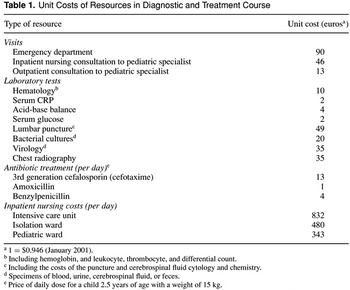
Average unit prices of diagnostic tests and treatment interventions were estimated in euros (€ 1=$0.946, January 2001), by using the internal unitary cost-estimation model of the Sophia Children's Hospital, Rotterdam, of 1996 (13). In this cost-estimation model, all hospital costs (including all general equipment, overhead, buildings, etc.) are exhaustively assigned to departments and their health care services. Unit costs of inpatient days and outpatient visits were directly derived from the cost-estimation model. For other health care services, additional data were collected about the estimated time the pediatrician and nurse spent per service. The time for an emergency department visit was estimated to be forty-five minutes for a pediatrician, forty-five minutes for a resident, and fifteen minutes for a nurse. Time for a lumbar puncture was estimated to be fifteen minutes for a pediatrician and forty-five minutes for a nurse. These estimates included the time for preparation of the patient and administration. Costs of radiographic tests were based on a separate costing study and included the time spent by the radiologist, materials, and radiographic equipment. Costs of medication were based on actual purchase prices plus an allowance for chemists' costs. Because costs of inpatient days were expected to be one of the major cost drivers, estimates of these costs were also obtained from a second hospital (Juliana Children's Hospital, The Hague; a large general pediatric hospital) and varied in a sensitivity analysis.
Analysis
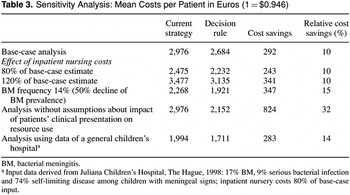
Total costs were estimated in euros per patient by multiplying the unit costs per resource item with the diagnostic and therapeutic resource use as actually performed and as expected when applying the decision rule (given the above assumptions on resource use). In a cost-minimization analysis the possible cost savings due to the introduction of the diagnostic decision rule were compared with current practice. Application of the decision rule could reduce costs by avoiding (i) (unnecessary) diagnostic procedures, (ii) unnecessary administration of empirical antibiotics, and (iii) unnecessary or prolonged hospitalization. If additional tests were performed because of the decision rule, the costs of each scenario were increased with the costs of those procedures. In univariate sensitivity analysis, we assessed the impact of changes in our base-case input variables on the cost savings. Inpatient nursing costs were varied by 20%, which is a plausible variation of inpatient nursing costs between an academic hospital and a general hospital (8). The frequency of bacterial meningitis was reduced by 50%, with a proportional increase of the other two diagnostic categories (SBI and SLD). In a third sensitivity analysis, we assumed that all diagnostic tests and interventions other than indicated by the decision rule (e.g., for a differential diagnosis or for treatment purposes), indeed were saved in all patients. Therefore, in this analysis, we included costs of determining serum CRP and glucose, CSF cell count, glucose, and bacterial cultures, and costs of treatment as indicated by the rule only. Finally, we estimated the possible cost reduction by the rule by using data from a general pediatric hospital with a lower frequency of bacterial meningitis and lower inpatient nursing costs.
RESULTS
The study population included 360 children, of whom 225 (62.5%) were boys, with a median age of 2.4 years. Bacterial meningitis was diagnosed in 99 children (28%); other bacterial infections in 36 (10%) and a self-limiting disease in 225 (62%). A lumbar puncture had actually been performed in 256 children (71%); 217 children had been hospitalized (60%). Table 1 presents the unit costs in euros of the main diagnostic tests and treatment interventions, as used in the cost analysis.

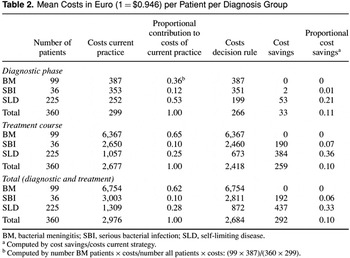
A lumbar puncture was performed in 26 (72%) of the patients with SBI and in 132 (59%) of the patients with SLD. After using the decision rule, these figures were 25 (=69%) and 103 (46%), respectively. Twenty-five (69%) SBI patients and ninety-three (41%) SLD patients had actually been hospitalized. After application of the decision rule these numbers were twenty-five (69%) and fifty-five (24%), respectively.
The costs per diagnostic group as actually observed and as expected by the decision rule are presented in Table 2. The decision rule reduced total costs by €292 per patient (10%); €33 in the diagnostic phase (11% of total reduction) and €259 in the treatment course (89%). The proportional cost savings were highest in patients with SLD (33%). The proportional contribution to the total costs shows that BM patients accounted for 62% of the total costs in current practice.

Table 3 presents the results of the sensitivity analysis. Cost savings were most sensitive for the assumption that the costs of patients with BM or SBI are mainly unaffected by the decision rule. Under the assumption that all diagnostic tests and treatment other than those indicated by the diagnostic decision rule indeed would not be performed anymore, €824 would be saved (relative reduction 32%). Varying the unit costs of inpatient days, the frequency of BM or using data from a general children's hospital affected the estimates of total costs but hardly influenced the estimated cost savings.

DISCUSSION
In this study, we estimated the possible cost reduction following the use of a diagnostic decision rule for bacterial meningitis in children with meningeal signs. Ruling out bacterial meningitis early in the diagnostic phase prevents unnecessary lumbar punctures and hospitalizations for empirical antibiotic treatment. Use of the decision rule to establish the indication of a lumbar puncture and empirical antibiotic treatment will reduce total costs by 10% compared with current practice.
Children with meningeal signs constituted approximately 10% of all children visiting the emergency department of the Sophia Children's hospital with fever and are estimated at 1,100 patients yearly in the Netherlands (11). Extrapolating our results to these figures, the decision rule might save €300,000 in the Netherlands yearly. The magnitude of overall cost savings will vary depending on the number of patients with meningeal signs, the percentage of SLD patients, frequency and length of hospitalization, and cost per hospital day. Interestingly, meningitis vaccination programs will increase the percentage of SLD patients, requiring greater consideration of the appropriate diagnostic strategy for this patient population.
Costs of the emergency department visit, consultations, nursing day, and treatment of one case with bacterial meningitis as estimated in our study fairly correspond with cost estimations of previous publications (5–7). One of the previous publications (7), however, studied children with meningitis only. The others (5;6) focused on the cost-effectiveness of vaccination programs, including the long-term effects of morbidity, which was beyond the scope of this present study.
In this study, we assumed that the decision rule would not lead to a change in costs in BM patients, which accounted for 62% of total costs. Accordingly, the maximum reduction could only be 38% of total costs. With the decision rule, the total cost saving was 10%. To estimate the possible cost savings in each patient, we distinguished three patient groups, according to their true diagnosis, disease severity, and necessity of treatment. In the self-limiting diseases, aseptic and viral meningitis were included, because treatment of these patients is mainly symptomatic (14). This assumption may need modification if, in future, antiviral treatment for enteroviral meningitis becomes available. In our base-case estimate of costs of patient management following the use of our diagnostic decision rule, we took into account that patient management by the physician is influenced by the patients' clinical presentation (1). The assumptions on resource use per scenario were based on current practice and are not evaluated further in this study. Evidence whether all these tests are indeed necessary to establish a differential diagnosis after bacterial meningitis has been ruled out, or for treatment is lacking. Also, apart from the number of lumbar punctures, we assumed that resource use in patients with BM or SBI, who were responsible for approximately 72% of the total costs, were unaffected by the decision rule. If we had neglected these factors, savings would have been grossly overestimated: €824 (32%) in sensitivity analysis 3 versus €292 (10%) in the base-case analysis.
Finally, cost savings by the rule were mainly determined by inpatient nursing costs and hardly affected by cost savings in the diagnostic phase (89% versus 11%, respectively). Therefore, withholding cheap diagnostic tests that may contribute to set a diagnosis is not to be recommended from a cost-effectiveness point of view. However, more diagnostic tests may lead to more false-positive diagnoses of bacterial meningitis, resulting in an increase of unnecessary treatments and, therefore, in decreased cost-effectiveness (4;12). This study stresses the importance to include both the costs of diagnosis and treatment in research directed toward the economic evaluation of diagnostic decision rules.
We thankfully acknowledge Thomas Custers, MSc, for his contribution to the cost assessment. This study has been supported by the Health Care Insurance Council of the Netherlands.
References
Asch DA,
Patton JP,
Hershey JC.
1990
Knowing for the sake of knowing: The value of prognostic information.
Med Decis Making.
10:
47-
57.Google Scholar
Bryant K,
Marshall GS.
1999
Most cerebrospinal fluid cultures in children with bacterial meningitis are positive within two days.
Pediatr Infect Dis J.
18:
732-
733.Google Scholar
Feigin RD,
McCracken GH Jr.
Klein JO.
1992
Diagnosis and management of meningitis.
Pediatr Infect Dis J.
11:
785-
814.Google Scholar
Kassirer JP.
1989
Our stubborn quest for diagnostic certainty. A cause of excessive testing.
N Engl J Med.
320:
1489-
1491.Google Scholar
Lee GM,
Gleisher GR,
Harper MB.
2001
Management of febrile children in the age of the conjugate pneumococcal vaccine: A cost-effectiveness analysis.
Pediatrics.
108:
835-
844.Google Scholar
Lieu TA,
Ray GT,
Black SB et al.
2000
Projected cost-effectiveness of pneumococcal conjugate vaccination of healthy infants and young children.
JAMA.
283:
1460-
1468.Google Scholar
Nigrovic LE,
Chiang VW.
2000
Cost analysis of enteroviral polymerase chain reaction in infants with fever and cerebrospinal fluid pleocytosis.
Arch Pediatr Adolesc Med.
154:
817-
821.Google Scholar
Oostenbrink JB,
Koopmanschap MA,
Rutten FFH.
2000
Manual for cost evaluation, methods, guideline prices for economic evaluation in health care.
[Handleiding voor kostenondezoek, methoden en richtlijnprijzen voor economische evaluaties in de gezondheidszorg].
Amstelveen,
The Netherlands:
College voor zorgverzekeringen
Oostenbrink R,
Moons KGM,
Donders ART,
Grobbee DE,
Moll HA.
2001
Prediction of bacterial meningitis in children with meningeal signs: Reduction of lumbar punctures.
Acta Paediatr.
90:
611-
617.Google Scholar
Oostenbrink R,
Moons KGM,
Twijnstra MJ,
Grobbee DE,
Moll HA.
2002
Children with meningeal signs: Predicting who need empirical antibiotic treatment.
Arch Pediatr Adolesc Med.
156:
1189-
1194.Google Scholar
Oostenbrink R,
Oostenbrink JB,
Moons KGM,
et al.
2002
Cost utility analysis of patient care in children with meningeal signs.
Int J Technol Assess Health Care.
18:
485-
498.Google Scholar
Pauker SG,
Kassirer JP.
1975
Therapeutic decision making: A cost-benefit analysis.
N Eng J Med.
293:
229-
234.Google Scholar
Poley MJ,
Stolk EA,
Langemeijer RATM,
Molenaar JC,
Busschbach JJV.
2001
The cost-effectiveness of neonatal surgery and subsequent treatment for congenital anorectal malformations.
J Pediatr Surg.
36:
1471-
1478.Google Scholar
Rotbart HA.
1995
Enteroviral infections of the central nervous system.
Clin Infect Dis.
20:
971-
81.Google Scholar
Unit Costs of Resources in Diagnostic and Treatment Course
Mean Costs in Euro (1=$0.946) per Patient per Diagnosis Group
Sensitivity Analysis: Mean Costs per Patient in Euros (1=$0.946)
 You have
Access
- 9
- Cited by