Introduction
Direct evidence from prehistoric Europe for violence inflicted on human bodies and material property remains comparatively scarce, especially that involving large-scale, organised hostilities. Despite the discovery of a number of late prehistoric mass graves, which potentially relate to massacres and/or battles (e.g. in the Western and Central European Neolithic: Vegas et al. Reference Vegas, Armendariz, Etxeberria, Fernández and Herrasti2012; Chenal et al. Reference Chenal, Perrin, Barrand-Emam and Boulestin2015; Meyer et al. Reference Meyer, Kürbis, Dresely, Alt, Dolfini, Crellin, Horn and Uckelmann2018), these burials usually yield only relatively small numbers of individuals, and lack associated evidence for the plunder or destruction of settlements. Conversely, several Neolithic enclosures in Britain appear to have been attacked, but associated skeletal evidence is either rare (e.g. Hambledon Hill) or non-existent (e.g. Crickley Hill, Carn Brea) (Mercer Reference Mercer, Carman and Harding1999; Schulting Reference Schulting and Ralph2013). Evidence for violence at other prehistoric enclosures, such as the Middle Bronze Age site of Velim in the Czech Republic, can be ambiguous (Harding et al. Reference Harding, Sumberová, Knüsel and Outram2007). It is not until the Iron Age that we encounter clear indications of attacks on villages and hillforts, involving both the killing of people and the destruction and abandonment of settlements, providing unique testimonies of everyday life and violent death (e.g. Sandby Borg in Sweden; Alfsdotter et al. Reference Alfsdotter, Papmehl-Dufay and Victor2018). Some of these attacks have been attributed to the Roman army where the violence involved was particularly systematic (e.g. Smith Reference Smith2017). More recently, it has become increasingly clear that some cases pre-date the Roman invasions by centuries, and that large-scale warfare played a role among Iron Age European populations (e.g. Ribemont-sur-Acre in France; Brunaux Reference Brunaux2009). Detailed accounts of Iron Age conflict are nevertheless rare (Quesada-Sanz Reference Quesada-Sanz, Carmichael and Maguire2015), particularly in Iberia. Here, cremation was the main funerary practice, and most of the available data for conflict are based on indirect evidence of warfare and ideological indicators of power (Sánchez-Moreno Reference Sánchez-Moreno, Parker Pearson and Thorpe2005), such as fortifications, weapons and images of warriors (e.g. Freire Reference Freire, Pearson and Thorpe2005; Sastre Reference Sastre2008; González-García Reference González-García2009).
The site of La Hoya in north-central Iberia is one of a small but growing number of cases that provide a snapshot of Iron Age violence. Sometime between the mid fourth and late third centuries BC (Iron Age II), La Hoya was violently attacked and set alight. The severity of the attack and the haste of the inhabitants’ flight is attested by the skeletons of people and animals found killed on the streets, houses containing food, craft items and personal objects suddenly abandoned and evidence of widespread burning (Llanos Reference Llanos1983). Although the presence of a number of individuals with indicators of violent attack was noted in the relevant excavation reports, with the two most obvious traumatic injuries briefly described (i.e. a decapitation and an arm amputation; Etxeberria et al. Reference Etxeberria, Herrasti and Bandrés2005), the human remains have not previously been analysed in detail. In order to define the group's demographic profile and identify the nature and extent of the violent injuries seen on the human skeletal remains, we present here the first complete osteological study of the victims of the attack.
La Hoya in its setting
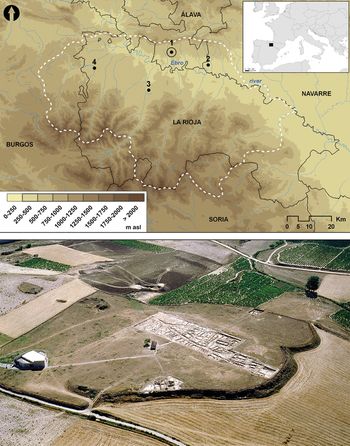
La Hoya (Laguardia, Álava) is located in the Rioja Alavesa region of north-central Iberia (Figure 1). Although the site was discovered in 1935, it was not until 1973 that scientific excavations began (Llanos Reference Llanos1983). These continued until 1990, revealing an impressively well-preserved, multi-period settlement extending over approximately 4ha, of which a small fraction (6230m2 or 15.5 per cent) of the total area has been excavated. Founded in the Middle Bronze Age around the fifteenth century BC, the site was used through the Late Bronze Age, Iron Age I and Iron Age II (late third century BC) (Llanos Reference Llanos2005). During the latter period, the site was within territory controlled by the Berones, who are thought to have occupied present-day Rioja and parts of the Álava (i.e. Rioja Alavesa), Navarre, Burgos and Soria regions (Castro Reference Castro2018).
Top: map showing the location of the Iron Age site of La Hoya (1) (map by J. Ordoño) and other north-central Iberian cities cited in the text that were within the territory presumably controlled by the pre-Roman Berones tribe (dashed white line); 2) Vareia; 3) Tritium Magallum; 4) Libia. Bottom: aerial view of La Hoya taken from the north-east (Llanos Reference Llanos2005).

La Hoya lies in the fertile valley of the River Ebro, close to major communication routes between the Cantabrian, Mediterranean and Inner Plateau regions. This privileged location, favouring the flow of people, objects and ideas, was key for its development and consequently the economic and political growth of the site. During the Iron Age II (represented by layer A3), the settlement reached its greatest size and complexity. The defensive masonry wall that was erected during the Iron Age I was strengthened, and dwellings previously attached to the wall were moved and re-organised into rectilinear blocks. These dwellings were built on masonry footings with wood and adobe walls finished with a layer of clay-plaster or coloured stucco. Living areas were separated by internal partitions. Over time, streets were widened to 5.5m, provided with paved sidewalks (1–1.5m wide) and stone crossings for pedestrians. The number of shops increased, and complex, hybrid buildings that combined commercial and domestic activities appeared. Public squares and communal buildings were created (Llanos Reference Llanos1983). Cremation cemeteries, such as La Costera and Piñuelas (with around 60 Celtiberian reticulated stone cists, in total), were established outside the defensive wall (Llanos Reference Llanos2005). Numerous lines of evidence suggest that the settlement was a major centre of social, economic, commercial and political activities during the Iron Age II. These include: urban development, an estimated population of 1500 inhabitants (Galilea Reference Galilea2003), the existence of a well-established farming economy and large food surpluses (Fernández-Crespo et al. Reference Fernández-Crespo, Ordoño, Bogaard, Llanos and Schulting2019), pottery and metal production, medium- and long-distance exchange of luxury items (including personal adornments and weapons), and burials suggesting the presence of a warrior aristocracy in the Piñuelas cremation cemetery (Llanos Reference Llanos2005).
The site's advantageous setting in the valley lowlands (at 600m asl) was, however, a double-edged sword, as most other contemporaneous fortified settlements in the region were located in more defensible hilltop positions (Llanos Reference Llanos2002). The advantage provided by elevation was particularly important in a natural border area such as this, delimited by the Sierra de Cantabria mountain range to the north and the River Ebro to the south. Here, the Berones may have disputed territorial boundaries with other neighbouring pre-Roman ‘tribes’. Indeed, the material culture and new radiocarbon dates on human bone from La Hoya (layer A3: 2215±20 BP, PSUAMS-3466: 365–204 cal BC and 2195±25 BP, PSUAMS-2078: 361–195 cal BC, both at 95.4% confidence; Olalde et al. Reference Olalde2019) show that it was violently attacked, set on fire and abandoned at some point between the mid fourth and the late third centuries BC. The resulting data provide a unique snapshot of life and violent death in the Iberian Iron Age.
Human remains in non-funerary contexts
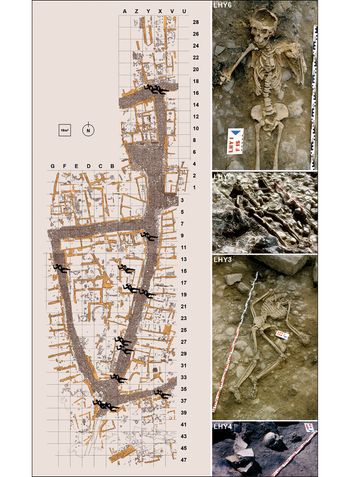
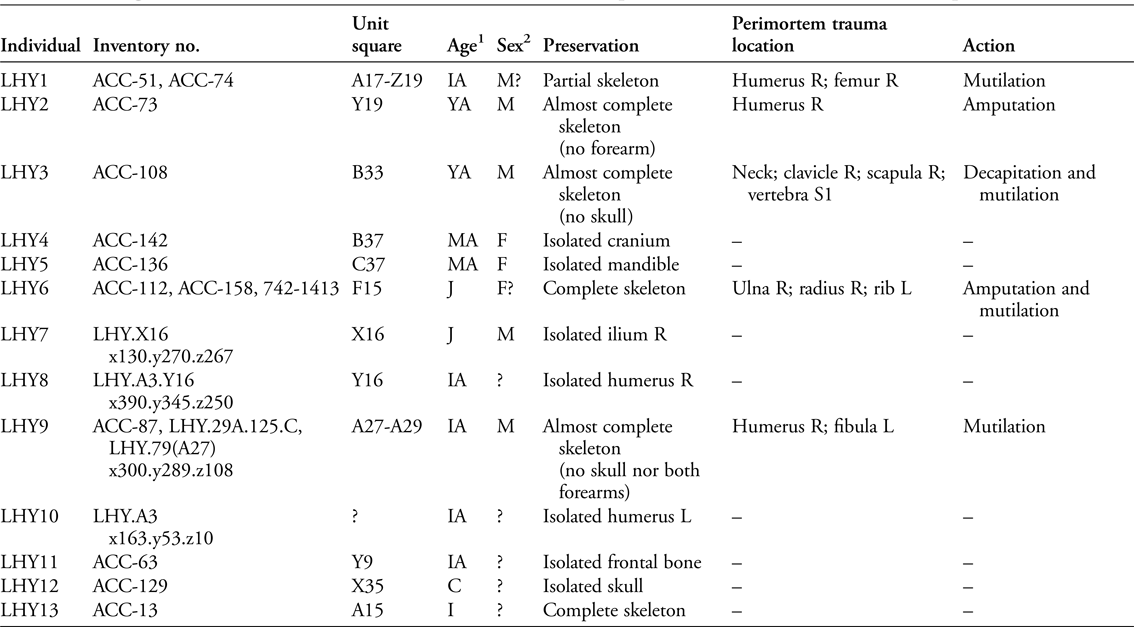
The articulated and disarticulated remains of a minimum of 13 individuals were found on the streets and the household floors of layer A3, sector I (Iron Age II) (Figure 2 & Table 1). They consist of nine adults of both sexes, two adolescents, a child of around three years of age and a six-month-old infant, presented here in the first detailed osteological analysis undertaken on this material (for a description of methods and results, see the online supplementary material (OSM)).
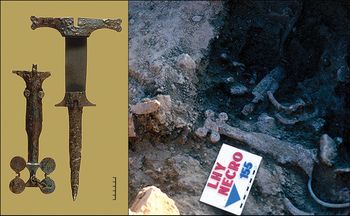
Left: plan of La Hoya sector III, layers A3/A2 (Iron Age II), including the location of the human skeletons and skeletal elements studied (plan by A. Llanos, modified by J. Ordoño), some of which (LHY2, 3–4 & 6) are photographed in situ on the right (Llanos Reference Llanos2005).

Osteological features of the individuals studied and the location of perimortem trauma (for a detailed description, see the OSM).

1 I = infant; C = child; J = adolescent; YA = young adult; MA = mature adult; IA = indeterminate adult.
2 M = male; M? = probable male; F = female; F? = probable female; ?= indeterminate.
Taphonomic features, particularly cracking and cortical exfoliation typical of subaerial weathering and small skeletal movements affecting labile articulations, are consistent with the remains having been left unburied. Individuals recovered from beneath collapsed buildings, however, became skeletonised within filled or partially filled spaces (LHY1, LHY2, LHY9 and LHY13). The presence of disarticulated bones (LHY4, LHY5, LHY7, LHY8, LHY10 and LHY11) and an isolated skull (LHY12) may indicate displacement and scavenging by dogs, although no clear skeletal evidence of canid chewing (e.g. pits, punctures or furrows; e.g. Haglund et al. Reference Haglund, Reay and Swindler1989) has been identified. The destruction and charring of soft tissue caused by fire is likely, as burning is observable on the bones of individuals LHY1, LHY2 and LHY9. Bone colour varying from black to grey, and morphological changes and shrinkage are consistent with exposure to temperatures of 350–650°C, while soft tissue was still extant and bones were fresh (Shipman et al. Reference Shipman, Foster and Schoeninger1984). The patterns of thermal alteration and deposition of skeletal material are inconsistent with funerary cremation—an otherwise common practice during this period—and are interpreted instead as relating to the burning of the settlement, with the bodies in situ.
Evidence for trauma
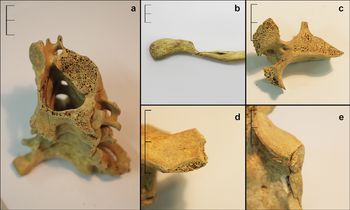
Although the unusual contexts from which the individuals studied here were recovered may suggest a violent cause of death, traumatic perimortem injuries were identified in only five of the 13 individuals (Table 1). A possible explanation for this is that several individuals are only represented by isolated bones unaffected by injuries. Sharp force trauma is the most frequently observed lesion (for a detailed description of these lesions, see the OSM). One adult male (LHY3) shows clear evidence of decapitation (Etxeberria et al. Reference Etxeberria, Herrasti and Bandrés2005): his fourth cervical vertebra is completely bisected by an oblique cut, consistent with a single blow to the neck from left to right, at a downward angle (Figure 3a). Neither the upper vertebrae (C1–C3) nor the skull were recovered. This individual also shows traces of injuries to the right clavicle and scapula, and another sharp force injury that sectioned the first sacral vertebra (Figure 3b–e), suggesting that he was repeatedly struck. Although no clear defensive wounds have been identified, the most plausible explanation for the trauma observed is that it could have been inflicted during a face-to-face encounter in which the victim tried to confront his attacker.
Sharp force trauma on: a) the fourth cervical vertebra; b) the right clavicle; c) the first sacral vertebra; d–e) the acromion and the glenoid fossa of the right scapula of individual LHY3; scale bar lengths are 20mm (photographs by T. Fernández-Crespo).

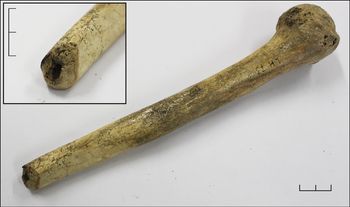
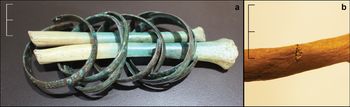
Another adult male (LHY2) and an adolescent female (LHY6) each had their right arms amputated, affecting the humerus (Figure 4), and the ulna and radius (Figure 5a), respectively. In the latter case, the cut starts on the posterior sides of both bones and follows an oblique angle consistent with the forearm being in pronation (i.e. with palm and forearm facing down). The amputated forearm (medial/distal ulna and radius, together with the hand bones), still wearing five copper-alloy bracelets, was found separated from LHY6 but within the same 16m2 excavation square (F15; Figure 1). The distance of approximately 2.8m between the forearm and the rest of the skeleton has been interpreted to suggest that the adolescent female was able to move several metres after sustaining the injury, before presumably either losing consciousness from massive blood loss and shock, or receiving another injury (cf. Etxeberria et al. Reference Etxeberria, Herrasti and Bandrés2005). It may also be that whoever cut the arm off threw it, or that the arm and bracelets were displaced some time after the attack. This individual (i.e. LHY6) also exhibits an unhealed 4mm-long incision on the anterior side of an indeterminate left rib (Figure 5b), which was potentially inflicted by an attacker positioned behind the victim.
Sharp force trauma on the right humerus of individual LHY2; scale bar lengths are 20mm (photographs by T. Fernández-Crespo).

Sharp force trauma on: a) the amputated distal right ulna and radius, wearing five copper-alloy bracelets; b) a left rib of individual LHY6; scale bar lengths are 20mm (photographs by T. Fernández-Crespo).

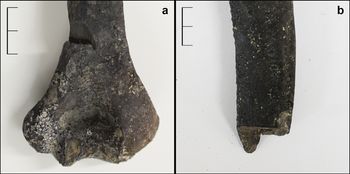
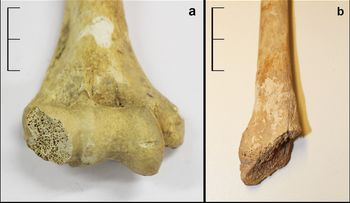
A probable adult male (LHY1) had perimortem fractures and cuts affecting the distal right humerus and the middle shaft of the right femur (Figure 6a–b). As with the adult male LHY 9, his injuries affected the distal right humerus and the distal right fibula (Figure 7a–b) (for a full description, see the OSM). These are also interpreted as sharp force injuries potentially inflicted from behind by bladed weapons (perhaps similar to the swords and daggers recovered from the Piñuelas cemetery (Figure 8; Llanos Reference Llanos2005)).
Sharp force trauma on: a) the distal right humerus; b) the middle shaft of the right femur of individual LHY1; scale bar lengths are 20mm (photographs by T. Fernández-Crespo).

Sharp force trauma identified on: a) the distal right humerus; b) the distal left fibula of individual LHY9; scale bar lengths are 20mm (photographs by T. Fernández-Crespo).

Left: a dagger of Miraveche-Monte Bernorio type recovered from (right) the associated cemetery of Piñuelas (Llanos Reference Llanos2005); scale bar length is 50mm.

The massacre defined
As warriorhood in most societies is restricted to adolescent and adult males (for ethnographic data, see Divale & Harris Reference Divale and Harris1976; Otterbein Reference Otterbein2009; McDonald et al. Reference McDonald, Navarrete and van Vugt2012), the presence at La Hoya of men, women and children—some very young—is consistent with an interpretation of a massacre. Bishop and Knüsel (Reference Bishop, Knüsel, Pearson and Thorpe2005) summarise nine elements relevant to the identification of ancient massacres, not all of which need apply in any given instance:
1) Victims have little capacity to resist.
2) Perpetrators have superior/overwhelming force.
3) A history of mutual hostility.
4) A call to rally immediately prior to the massacre.
5) Surprise attack.
6) A loss of control by the perpetrators.
7) Ethnic or ideological differences.
8) A high level of military activity.
9) Occur after extremely dangerous moments, such as breaching a fortified position.
Many of these elements cannot be known in the case of La Hoya, including the identity of the attackers and any previous history of violence involving this community, although the weaponry found at the Piñuelas cemetery could imply the latter (Llanos Reference Llanos2005). The motivation behind the violence also remains unclear. The archaeological and osteological data, however, support the hypothesis of a surprise attack, resulting in the indiscriminate and brutal killing of helpless or unresisting people, including adult males and females, as well as children. There is no clear evidence of defensive wounds or associated weapons, and many injuries appear to have been inflicted from behind, perhaps as individuals attempted to escape. While it is possible that the attackers took the weapons used by the victims, there is no other evidence of pillaging at the site.
The apparent absence of projectile injuries implies that the encounters were close-range, and that the attackers had breached the site's defences. Stone and clay sling-bullets were, however, found in vessels at La Hoya (Llanos Reference Llanos2002), indicating the use of long-distance weaponry at this time, while hand-thrown spears recovered from the Piñuelas cemetery suggest that close-distance combat was practised. Unfortunately, much of the site remains unexcavated, including the gate(s), the areas surrounding the defensive wall and a large part of the settlement. Further investigations may provide more information about the weaponry used and the nature and extent of the attack.
Causes and timing of the attack
Considerable quantities of material, including metal adornments, tools, animals and cereal grains, were destroyed and abandoned at La Hoya. This suggests that the attack was not intended as a simple act of plunder (Llanos Reference Llanos2007/2008). The fact that bodies were left where they fell and that no one returned to retrieve them or to recover valuable items suggests that many of the inhabitants were killed, abducted or fled, and were unable or unwilling to return. As the Carthaginian army never conquered this region (Olcoz & Medrano Reference Olcoz, Medrano and Andreu2013) and the attack long pre-dates the second- and first-century BC Roman incursions into northern Iberia (Pérez-Rubio Reference Pérez-Rubio, Fernández-Götz and Roymans2017), it has been proposed that the massacre was the result of revenge or punishment by a neighbouring community (Llanos Reference Llanos2005). Regardless of the specific motivation, given the site's location in a natural boundary area, the attack could have been conducted in the context of regional power struggles and territorial ambitions between different communities. Decapitation (e.g. individual LHY3) and amputated arms (e.g. LHY2), might be related to head-hunting (Llanos Reference Llanos2007/2008) or the taking of body parts as trophies, events that are frequently described in relation to inter-group conflict among Iron Age populations (e.g. Armit Reference Armit2012; Smith Reference Smith2017).
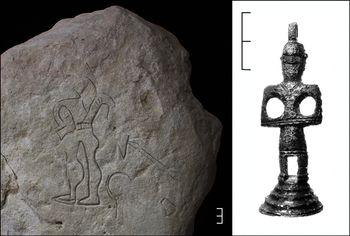
While these phenomena and other ritualised aspects of Iron Age warfare are often emphasised (e.g. Brunaux Reference Brunaux2009; Armit et al. Reference Armit, Schulting, Knüsel and Shepherd2011; Løvschal & Holst Reference Løvschal and Holst2018), La Hoya may be a more mundane instance of conflict, more in keeping with what the earliest written accounts report. These have often extolled the ferocity and bravery of the Iberian protohistoric tribes, particularly the Berones (Aulus Hirtius, Bellum Alexandrinum 53.1; Pelling Reference Pelling2005). Indeed, their very name has been linked to the Welsh (a related Celtic language) word ‘ber’ for spear, and may mean ‘armed men’ (von Humboldt Reference von Humboldt1821: 124). The presence of elaborate masonry defences, the discovery of numerous weapons in the Piñuelas cemetery and, above all, the depictions of warriors on stelae and figurine pendants at La Hoya are consistent with this community belonging to a society that both valourised and engaged in warfare (e.g. Llanos Reference Llanos2002) (Figure 9).
Examples of warriors depicted on: left) a stone stela (figure by J. Ordoño); and right) a bronze figurine pendant (Llanos Reference Llanos2005) from La Hoya; scale bar lengths are 20mm.

Evidence that potentially places the attack as having occurred on a market day in late summer or early autumn includes numerous vessels filled with recently harvested cereal grains, several hobbled pigs (i.e. restrained by ties to the legs) and a number of craft items and tools found on pathways and kerbs immediately outside the entrances to buildings as though to advertise wares for sale (Llanos Reference Llanos2005). Indeed, the timing of the attack could have been intentionally chosen to coincide with a moment of social aggregation, providing an opportunity to cause the highest number of casualties and the greatest impact on the social, economic and political structure of the Berones beyond the immediate locality (Castro Reference Castro2018). Although La Hoya has never been claimed as a primary settlement of the Berones, its size, complexity and urban development suggest that it may have been comparable in socioeconomic and political importance to later cities including Vareia (the known capital of the Berones), Libia and Tritium Magallum, in the first century BC (e.g. Ptolemy, Geography II.6.55; Berggren & Jones Reference Berggren and Jones2002).
Consequences and wider impacts
Before the Roman occupation, the destruction of an economically and politically important regional node such as La Hoya, and the killing, deportation, enslaving or assimilation of its inhabitants, may have had wider implications for the region, by either creating a power vacuum or by consolidating the position of a rival community.
Traditionally, it has been assumed that the surviving inhabitants of La Hoya were re-established in the nearby fortified settlement of Laguardia. Sited on a hilltop 1km to the south, Laguardia became an important settlement during the later Iron Age (Llanos Reference Llanos2002). Yet no genetic continuity has been observed at the haplotype level in the modern local population (Núñez et al. Reference Núñez, Baeta, Cardoso, Palencia-Madrid, García-Romero, Llanos and Martínez de Pancorbo2016), despite the present-day inhabitants of Rioja Alavesa being described as descended from Iron Age populations, without the admixture events that later affected the rest of the Iberian Peninsula (Olalde et al. Reference Olalde2019).
It has also been proposed that the settlement could have continued to exist for a few centuries after the attack, based on some slight evidence in layers A2 and A1 (Llanos Reference Llanos2005). This seems unlikely, however, given the scale of death and destruction revealed by the excavations. It is reasonable to assume that any survivors reoccupying the site would have removed the human and animal remains and spoiled food, retrieved valuable items and stored the remaining resources for future use. Another possibility is that small-scale reoccupation of the site took place decades later, once sediments had obscured the material evidence of the attack.
Limited excavation at La Hoya prevents an estimation of the proportion of its dead in relation to its survivors, and the fate of any potential survivors remains unknown. Nonetheless, an extremely violent episode, consistent with a large-scale destruction and massacre, took place at the site. The abandonment of the settlement—whether temporary or permanent—following the attack suggests that many individuals were affected. Assuming that the available osteological assemblage represents a minimum of 13 victims, and extrapolating from the excavated area to the entire site, the remains of at least 85 individuals may be postulated. This is probably a conservative estimate, as some individuals could have been retrieved for burial or cremation, while others may have been scavenged by animals or lost to the elements, as suggested by some ‘individuals’ being represented by only single skeletal elements. In addition, any survivors that were not captured would have been made homeless and forced to rely on the goodwill of other communities. As they seem to have left behind most of their goods and food stores, they would have arrived destitute.
Assessing the extent of violence beyond La Hoya
Although Iberian and other Western and Northern European Iron Age polities were not fully formed states in the sense of Athens, Sparta or Rome, it is broadly accepted that they were sufficiently cohesive entities to engage in large-scale, organised martial endeavours in proportion to their territorial and demographic resources (e.g. Quesada-Sanz Reference Quesada-Sanz, Carmichael and Maguire2015). But is the degree of violence observed at La Hoya comparable to that elsewhere in Roman Iberia in the last centuries BC?
The violence perpetrated by the Roman army during the conquest of Iberia from 218 BC onwards is described in detail in Classical written sources, but the only direct archaeological evidence for this process consists of two examples of massacres. The first is Cerro de la Cruz (Córdoba, Andalusia), which was attacked and burned in c. 150–130 BC. This took place either during the Lusitanian War between Viriathus, leader of the Lusitani (one of the largest Iberian groups), and Servilianus, the Roman consul of Hispania Ulterior, between 142 and 141 BC, or during the large-scale retaliations that Servilianus carried out once Viriathus returned to Lusitania in 141 BC. Appian (Hispanica 12.68; White Reference White1899) reports that these retaliatory attacks captured and enslaved more than 10 000 prisoners, 500 of whom were beheaded. Excavations at Cerro de la Cruz have uncovered the skeletal remains of at least six individuals on one of the main streets and from beneath collapsed buildings. Some of these skeletons exhibit perimortem sharp-force injuries inflicted by bladed weapons (Quesada-Sanz Reference Quesada-Sanz, Carmichael and Maguire2015). The second example is La Almoina in Valencia, which was burned and its population massacred by the Pompeian army in 75 BC during the Sertorian Wars (fought between a coalition of Iberian and Roman rebels and Sulla's Roman government). Although only a small area of the forum was excavated, 14 unarmed and shackled male adults appear to have been executed here: one was impaled by a pilum (javelin), another was beheaded and others had all four limbs amputated (Ribera Reference Ribera1995).
While the evidence is limited, especially when compared to the written sources, the similarities between these sites and La Hoya suggest that the extent of the violence may have been comparable between Roman and Iron Age communities in the last centuries BC, and that large-scale, politically motivated violence in Iberia was not necessarily introduced by the Romans.
Conclusion
The demographic profile and the nature of perimortem injuries identified in the La Hoya skeletal assemblage are consistent with a massacre. The presence of considerable quantities of goods, such as wealth items, animals and cereal grains that were abandoned instead of looted, combined with the inability or unwillingness of any survivors to return, suggests that the attack was not an act of outright plunder. Indeed, this event could have had a major impact on the population dynamics of the region, as La Hoya was an important social, economic and political centre in the mid fourth and the late third centuries BC. Given the site's location in a natural boundary area, the attack may have been a consequence of power struggles and territorial ambitions between neighbouring pre-Roman polities.
La Hoya is the only known Iron Age Iberian site whose destruction may be attributed to rival local communities, and is one of a small but growing number of such cases within a wider European context. It presents early evidence of organised, large-scale violence, and provides a unique snapshot of protohistoric warfare. Similarities between La Hoya and other massacres in Iberia in the last centuries BC suggest that Iberian Iron Age societies were fully capable of resorting to brutal violence in order to settle disputes between small competing polities. Certainly, the Romans were not alone in being able to “make a desert and call it peace” (Tacitus, Agricola 30; Woodman & Kraus Reference Woodman and Kraus2014: 55).
Acknowledgements
We are grateful to J. Aguirre and J. Fernández-Bordegarai for granting access to the facilities for studying La Hoya's skeletal assemblage. We also thank the anonymous reviewers for their comments. This research was supported by a British Academy Newton International Fellowship (NF170854, 2018).
Supplementary material
To view supplementary material for this article, please visit https://doi.org/10.15184/aqy.2020.161