Colombia is a prototypical case of conservative mobilization against “gender ideology” in Latin America (The Economist 2017). Between 1991 and 2007, Colombian conservatives mobilizing against sexual rights almost never engaged in legal mobilization. They were active in Congress and the streets but seldom participated at the Constitutional Court, despite the court’s lead role in granting lesbian, gay, bisexual, and trans (LGBT) rights since 1998. After 2007, however, conservatives have consistently opposed rights claims made by LGBT people at the Constitutional Court. What accounts for the rise of conservative legal mobilization against LGBT rights in Colombia in 2007? The legal opportunity structure model has sought to specify the conditions under which we would expect social movements to engage in legal mobilization. According to this model, expanding legal opportunities—that is, access to the judiciary, justiciable rights, and judicial receptivity—are key factors for engaging in legal mobilization (Hilson Reference Hilson2002; Wilson and Rodríguez Cordero Reference Wilson and Cordero2006; Andersen Reference Andersen2009; Evans Case and Givens Reference Evans Case and Givens2010; Vanhala Reference Vanhala2012). However, legal opportunities were not expanding for the conservative movement in Colombia in 2007: the formal institutional structure giving access to the judiciary, the available legal stock, and judicial receptivity experienced no significant change before 2007.
This article expands the legal opportunity structure model. It theorizes legal threats and demonstrates that movements can engage in legal mobilization if they perceive threats, even if legal opportunities are not expanding. Specifically, this article argues that conservatives perceived a threat to their concept of the family and to this concept’s connection to the nation when the court ruled to include same-sex couples in its definition of the family. Conservatives began engaging in legal mobilization in 2007 in response to the Constitutional Court’s shift from granting rights to LGBT people as individuals to granting rights to LGBT people as couples and families. The concept of legal threats allows scholars to explicitly consider how the perceived loss of resources or status contributes to the engagement of social movements in legal mobilization.
Conservatives’ perception of legal threats in Colombia was a globally influenced process. However, this global influence did not occur in the ways in which the literature on transnational mobilization or conservative mobilization expected. As will be argued in more detail below, the emergence of conservative legal mobilization in 2007 was not due to transnational social-organizational resources (J. Smith Reference Smith, Snow, Soule and Kriesi2004; Tarrow Reference Tarrow2005) or to global empowerment (Bob Reference Bob2012; Ayoub and Page Reference Ayoub and Page2019; Paternotte and Kuhar Reference Paternotte and Kuhar2017). Instead, the threat perception motivating the legal mobilization was dependent on conservatives’ construction of the nation. Colombian conservatives link the nation to imagined global communities and particularly to Christianity and the civil law tradition.Footnote 1 Moreover, comparative legal developments and global trends in LGBT mobilization contributed to the Constitutional Court’s decision to grant LGBT family rights.
To clarify, individual rights herein refer to those that protect LGBT people as individual human beings (for example, antidiscrimination law), while couple and family rights grant benefits and protections based on LGBT familial and sexual relations (for example, family law, social security benefits). This distinction is not explicitly defined in Colombian law, but this article notes the difference as it is observed by social actors and policy makers. This article contributes to the exploration of the values and beliefs through which conservative legal activists perceive their changing environment and perceive threats that lead them to mobilize. In addition, by conservative, this article refers to moral––as opposed to economic––conservatism and specifically focuses on the position that defends the conception of families in the national context as “naturally” composed of one man and one woman who support each other in a complementary, gender-differentiated way to procreate. Conservative movements, and, in particular, conservative legal mobilization, have been studied primarily in the United States. In this article, the Colombian LGBT movement will be referred to using the terms liberal or progressive. As opposed to moral conservatism, the liberal position rests on a constructivist view of families as open-ended and multiple, a valuation of love and support rather than of procreation, and on a belief in the necessity for LGBT couples to be allowed access to this institution for human equality.
The article proceeds in the following way. First, I provide an overview of the theoretical literature to explain the emergence of legal mobilization and theorize legal threats. Second, I explain the methods and data used to examine the emergence of conservative legal mobilization in Colombia. Third, I contextualize sexual politics in Colombia. Fourth, I analyze LGBT policy making at the Constitutional Court and demonstrate how the conservatives have engaged in legal mobilization since 2007 because of perceived legal threats. Finally, I conclude and discuss the contributions of this article to theorize legal mobilization and conservative politics, particularly moral conservatism.
LEGAL THREATS AND THE EMERGENCE OF LEGAL MOBILIZATION
This article focuses on the conditions under which legal mobilization arises (McCann Reference McCann2006, Reference McCann, Whittington, Keleman and Caldeira2008). Legal mobilization refers to “the use of law in an explicit, self-conscious way through the invocation of a formal institutional mechanism” (Lehoucq and Taylor Reference Lehoucq and Taylor2020, 3; see also McCann Reference McCann1994; Epp Reference Epp1998; Vanhala Reference Vanhala2012). Engaging in legal mobilization can have ambiguous and contradictory effects (Scheingold Reference Scheingold1974; Rosenberg Reference Rosenberg1991; McCann Reference McCann1994), but social movements persist in using it. Given the variety of institutional settings and strategies for social struggles and political participation, what drives movements to engage with the law?
The Emergence of Legal Mobilization
Social movement scholars have explored the role of both opportunities and threats in the emergence of mobilization. According to the political process model, the available political opportunities and extant political threats explain the timing and form of the emergence of collective action (McAdam Reference McAdam1982). An antecedent condition for this process is the preexistence of some mobilizing structures. Political opportunities refer to those dimensions of the political system that increase the probability of collective action leading to success, while threats refer to both “the costs that a social group will incur from protest” and those “that it expects to suffer if it does not take action” (Goldstone and Tilly Reference Goldstone, Tilly and Aminzade2001, 183). Political process theorists have focused more on opportunities than on threats, but the model includes both dimensions as determinants of the timing and form of the emergence of mobilization (Tilly Reference Tilly1978, 135; Maher Reference Maher2010; Tarrow Reference Tarrow2011). The perception of threats can lead to increasing mobilization (Boutcher Reference Boutcher2010) and radicalization (Almeida Reference Almeida2008) and can determine the strength of political countermobilization (Ayoub Reference Ayoub2014, Reference Ayoub2016).
Political process theorists contend that it is not opportunities and threats in themselves that lead to mobilization but, rather, their perception. As Sidney Tarrow (Reference Tarrow2011, 185; emphasis in original) notes, “there is no such thing as ‘objective’ opportunities [or threats]—they must be perceived or attributed to become the source of mobilization.” Perception is the mechanism that adds dynamism to the political process model and, more accurately, locates the impetus for collective actors to mobilize (McAdam, Tarrow, and Tilly Reference McAdam, Tarrow and Tilly2001, 43). Threats that lead to such perception can be material (such as an increase in repression), but they need not be for the model to apply. The anticipation of danger to a set of values can lead to mobilization (Ayoub Reference Ayoub2014, Reference Ayoub2016).
Building on the political process model, sociolegal scholars (exemplified by Hilson Reference Hilson2002; Andersen Reference Andersen2009) have recently developed the legal opportunity structure model to explain the conditions under which social movements engage in legal mobilization. Social movements engage in legal mobilization instead of political strategies when political opportunities are closed and legal opportunities are open (Hilson Reference Hilson2002). There are several dimensions to legal opportunities (Andersen Reference Andersen2009; Evans Case and Givens Reference Evans Case and Givens2010), but most scholars identify access to the judiciary, judicial receptivity, and justiciable rights as the most salient conditions for legal opportunities (De Fazio Reference De Fazio2012). For instance, scholars have explored how access to the judiciary, in the form of low procedural barriers, allows movements to engage in legal mobilization with scarce resources (Wilson and Rodríguez Cordero Reference Wilson and Cordero2006; B. Wilson Reference Wilson2009).
Legal opportunities refer to dimensions of the legal system whose perception increases the chances of movements using litigation. These dimensions include both stable and contingent features, although this distinction has proven hard to sustain (Vanhala Reference Vanhala2012, Reference Vanhala2018). Among the more stable dimensions are access to the judiciary and justiciable rights. Judicial receptivity is usually understood as the main contingent variable. Thus, according to the legal opportunity structure model, movements engage in legal mobilization when they perceive an increase in the accessibility of the judiciary, an increase in the available legal stock backing the movement, or favorable judicial receptivity.
Legal Threats and the Emergence of Mobilization
This article expands on the legal opportunity structure model to theorize legal threats. Legal threats are changes in the legal rules that are perceived to increase the costs of mobilization or the expected costs of not taking action. In contrast to the scholarship focusing only on legal opportunities, the expansion of the legal opportunity structure model theorized in this article posits that movements can engage in legal mobilization if they perceive threats, even if legal opportunities are not expanding. Unlike its counterpart in social movement scholarship, the legal opportunity structure model does not explicitly account for the possibility that legal threats may lead movements toward legal mobilization. Christopher Hilson (Reference Hilson2016) mentions legal threats, but he is referring to legal rules that can lead to political mobilization (and are thus political threats) rather than to legal rules that lead to legal mobilization (and are thus legal threats).
The law’s cultural power makes the distinction between legal and political threats salient. Pierre Bourdieu (Reference Bourdieu1986, 838–39) has best captured the symbolic power of the law:
Law is the quintessential form of the symbolic power of naming that creates the things named, and creates social groups in particular. It confers upon the reality which arises from its classificatory operations the maximum permanence that any social entity has the power to confer upon another, the permanence which we attribute to objects—[t]he law is the quintessential form of “active” discourse, able by its own operation to produce its effects.
The law’s cultural power is pervasive in everyday life (Merry Reference Merry1990; Ewick and Silbey Reference Ewick and Silbey1998; Silbey Reference Silbey2005). It is because of the authority granted to the law and its symbolic power that activists seek to use its symbols in social and political struggles (Pedriana Reference Pedriana2006; Leachman Reference Leachman2013). It is also because of the law’s cultural power that people resent legal threats with particular intensity. Thus, legal threats––as opposed to political threats––are especially powerful in motivating activists to mobilize.
Changes in how the family is institutionalized under the law can lead to threat perception. States have long institutionalized specific notions of sexuality and the family through various policy instruments, including the law (Canaday Reference Canaday2009). New forms of romantic and sexual relationships challenge this history of policies categorizing and repressing nonnormative forms of sexuality, such as homosexuality (Valelly Reference Valelly2012). Threat perception is a function of the legal incorporation of nonnormative forms of sexuality that challenge conservatives’ construction of the nation (Ayoub Reference Ayoub2014, Reference Ayoub2016). Sexuality is often constructed as core to the nation’s survival and to the reproduction of the nation’s population (Binnie Reference Binnie2004). Some forms of sexuality are normative, while others are constructed as being outside the national imaginary (Stychin Reference Stychin1998). Excluded forms of sexuality challenge conservatives’ beliefs about the nation because of their fluidity and, as such, their ability to challenge tradition and reproduction (A. M. Smith Reference Smith1994). But the nation is also fluid. Constructions of the nation not only differ across places but also change over time and are at stake in groups’ symbolic struggles (Calhoun Reference Calhoun1999; Brubaker Reference Brubaker2017). To sum up, a change to how family is institutionalized in the law is especially threatening as it destabilizes the association between sexuality, the nation, and reproduction. Conservatives believe that heterosexual nuclear families are an essential component of the nation and that the concept of families only applies to instances where couples procreate, raise children with normative understandings of gender and sexuality, and support each other in a complementary, gender-differentiated way.
This study explores struggles over sexuality in Colombia, a context where conservative cultural practices pervade and conditions for mobilization are not ideal (Ayoub and Page Reference Ayoub and Page2019). However, legal rules conferring new sexual (Goldberg-Hiller Reference Goldberg-Hiller2009) and reproductive (Post and Siegel Reference Post and Siegel2007; Rosenberg Reference Rosenberg1991) rights have led to threat perception and mobilization across contexts.Footnote 2 Jeffrey Dudas (Reference Dudas2005, Reference Dudas2008) suggests that conservative legal mobilization is motivated by resentment over the increased political participation of subordinate groups and the perception that they are making illegitimate claims. Building on these insights, this article theorizes legal threats, which is the mechanism through which resentment and perceptions of challenge and illegitimacy lead to legal mobilization.
The perception of legal threats is related to movement-countermovement dynamics. Movement-countermovement dynamics refer to the interaction between different movements and particularly to their effects on each other (Meyer and Staggenborg Reference Meyer and Staggenborg1996; Whittier Reference Whittier, Snow, Soule and Kriesi2004). Movements define new adversaries (Ayoub and Chetaille Reference Ayoub and Chetaille2017), frame their claims in response to each other (McCaffrey and Keys Reference McCaffrey and Keys2000; Benford and Hunt Reference Benford, Hunt, Holstein and Miller2003), affect each other’s strategies (Andrews Reference Andrews2002), and impact each other’s political opportunities (Meyer and Staggenborg Reference Meyer and Staggenborg1996). In particular, feminist and LGBT movements set the stage for conservative countermobilization (Rosenberg Reference Rosenberg1991; Post and Siegel Reference Post and Siegel2007; Keck Reference Keck2009), and the anticipation of conservative mobilization brought same-sex marriage to the public arena (Dorf and Tarrow Reference Dorf and Tarrow2014).
While related, movement-countermovement dynamics are analytically distinct from the perception of legal threats. The perception of legal threats refers specifically to the effect of legal changes in sparking legal mobilization by affecting activists’ perceptions of risk. It is important to distinguish between movements’ interactions with each other and their relationship with their legal environment. For example, while a movement can perceive a court as closed off to their claims, this perception has different effects than those of defining other movements or groups as “new adversaries” (Ayoub and Chetaille Reference Ayoub and Chetaille2017). Certainly, it will often be the case that opposing movements will impact each other’s legal environment and thus have the potential to create legal threats. However, the perception of legal threats is a mechanism that leads movements to engage in legal mobilization by reacting to their legal environment, regardless of other movements’ effects on such an environment. In this sense, there can be changes in the legal environment, independent from social movements, that lead to threat perception (for example, changes in legal rules due to the arrival of new justices to office).
Legal threats are also analytically distinct from grievances. Early social movement theories emphasized the severity of grievances as the factor leading to mobilization (Smelser Reference Smelser1963; Davies Reference Davies, Graham and Gurr1969; Gurr Reference Gurr2015). Later social movement theorists argued that grievances are a trivial necessary condition for mobilization, assuming that, while important, they would always be there (McCarthy and Zald Reference McCarthy and Zald1977). More recently, scholars have shown that the relative perception of grievances, which can be influenced by the construction of the nation, help explain the emergence of mobilization (Simmons Reference Simmons2014, Reference Simmons2016). While grievances refer to “the central claims a social movement is making” (Simmons Reference Simmons2014, 515), threats describe how the movement’s external environment negatively affects its capacity to pursue such claims (Goldstone and Tilly Reference Goldstone, Tilly and Aminzade2001, 183). In regard to LGBT family rights, grievances are conservatives’ claims about a society with heterosexual nuclear families where couples procreate, raise children, and support each other. It follows that a policy institutionalizing LGBT couples and families poses a threat to conservative activists by raising the costs they expect to suffer if they do not take action.
Resources, Globalization, and the Emergence of Mobilization
Shifting legal threats is not all there is. As in the case of political and legal opportunities, the perception of threats can only spark mobilization when activists have preexisting mobilizing structures––or organizational vehicles—through which they can engage in mobilization. Resource mobilization theory posits that variation in movements’ resources account for mobilization frequency (McCarthy and Zald Reference McCarthy, Zald and Turner2006). As the availability of material, social-organizational, and human resources increases, the likelihood of mobilization also increases (Edwards and McCarthy Reference Edwards, McCarthy, Snow, Soule and Kriesi2004). The support structure model echoes resource mobilization theory but has mostly been used to explain the conditions under which social movements are able to produce legal changes (Epp Reference Epp1998; Teles Reference Teles2008). The support structure model has not been used to explain the conditions under which movements engage in legal mobilization. However, it is possible that increasing resources leads to the emergence of legal mobilization.
This article thus takes into account two possibilities concerning the relation between resources and the engagement in legal mobilization. First, in expanding the legal opportunity structure model to include legal threats, preexisting mobilizing structures are an antecedent condition for the perception of legal threats to give rise to legal mobilization. However, independent of, or jointly to, opportunities and threats, legal mobilization could emerge because of increasing resources. Different kinds of resources such as money, organizations, and activists or lawyers are important for mobilization (Edwards and McCarthy Reference Edwards, McCarthy, Snow, Soule and Kriesi2004). Progressive mobilization has often emerged before conservative activism, leaving the latter unprepared to respond. If conservative mobilization has been sometimes slow to respond, it is because it has needed to build effective organizational infrastructures from the ground (Skocpol Reference Skocpol, Pierson and Skocpol2007; Teles Reference Teles2008). Because organizations have played an integral role in the emergence and development of conservative mobilization, this article focuses on the effects of social-organizational resources.
More recently, the literature on transnational contention has also postulated that internationalization “provide[s] resources and otherwise facilitate[s] networking among national and even local association” (Tarrow Reference Tarrow2005, 103). This scholarship suggests that transnational diffusion can lead to national and local mobilization by increasing the amount of available resources beyond what can be raised at those levels alone (J. Smith Reference Smith, Snow, Soule and Kriesi2004). Evidence of transnational conservative mobilization, especially in Latin America, supports the possibility that conservative international organizations can open subsidiaries in different countries and that transnational advocacy networks can help activists develop networks of support (Lemaitre Reference Lemaitre2012; Lemaitre and Sieder Reference Lemaitre and Sieder2017). Transnational conservative mobilization can impact domestic activism through other mechanisms (Boyle, Golden, and Liao Reference Boyle, Golden and Liao2017). Specifically, global conservative movements can affect domestic mobilization by (1) shaping activists’ strategies and identities; (2) changing their agenda and frames of reference; and (3) impacting their costs of mobilization (Bob Reference Bob2012; Paternotte and Kuhar Reference Paternotte and Kuhar2017). More generally, global conservative movements can empower domestic activists by enhancing both their perception of unfairness and collective efficacy (McAdam Reference McAdam and Snow2013; Ayoub and Page Reference Ayoub and Page2019).
Theories seeking to explain the emergence of mobilization specify how different conditions impact mobilization independently as well as jointly (Goertz and Mahoney Reference Goertz and Mahoney2012; on conjunctural causation, see Ragin Reference Ragin1987). Since its inception, resource mobilization theory has been sensitive to the fact that social movement sectors are influenced by political factors (Garner and Zald Reference Garner and Zald1983; McCarthy and Zald Reference McCarthy, Zald and Turner2006). Similarly, early works on the political process model include some form of organization as an antecedent condition for political opportunities to facilitate mobilization (McAdam Reference McAdam1982). Later studies have further attempted to integrate both perspectives into a common framework (McAdam, McCarthy, and Zald Reference McAdam, McCarthy and Zald1996; McAdam, Tarrow, and Tilly Reference McAdam, Tarrow and Tilly2001). Two key dimensions must be considered when explaining the rise of legal mobilization: the level of analysis and the temporal frame. This article focuses on one movement (considered between 1991 and 2016) and analyzes a relatively short-term event: the emergence of conservative legal mobilization in 2007. At this level of analysis and in this temporal frame, the expansion of legal opportunities, the perception of threats, and increasing resources led to distinct empirical expectations with different observable implications for conservative mobilization. At the level of a social movement sector (or other levels of analysis) or in explaining the patterns of mobilization over cycles of contention, legal mobilization patterns might suggest alternative or additional relationships between opportunities, threats, and resources. The last section of this article discusses this relation.
In sum, this article expands the legal opportunity structure model to account for the possibility that, even if legal opportunities are not increasing, movements will engage in legal mobilization if they perceive an increase in the costs of mobilization or in the expected costs of not taking action.
METHODS AND DATA
Colombia is ideal to study the emergence of legal mobilization given the existence of marked within-case variation: although the Constitutional Court has been granting rights to LGBT people since 1998, conservatives only started to intervene in opposition beginning in 2007. This periodization allows for maximal variation on the outcome (conservatives’ engagement in legal mobilization), which suggests equally marked variation in the key explanatory conditions (Gerring Reference Gerring2006). Methodologically, the inferences in this article depend on the sequential development of events, which is leveraged to assess the hypotheses about mechanisms (George and Bennett Reference George and Bennett2005; Checkel Reference Checkel, Klotz and Prakash2008; Collier Reference Collier2011; Mahoney Reference Mahoney2012, Reference Mahoney2015; Bennett and Checkel Reference Bennett, Checkel, Bennett and Checkel2015). To explain the emergence of conservative legal mobilization in Colombia, a theory must be consistent with the timing of the outcome (the point in time at which conservative actors started to engage in legal mobilization) and the general sequential development of events in the case (Falleti and Mahoney Reference Falleti, Mahoney, Mahoney and Thelen2015).
This article uses evidence derived from extensive fieldwork, including thirty-one in-depth interviews. The interviewees were selected following typical case sampling, which was according to one or more relevant dimensions of interest (Bryman Reference Bryman2012, 419). The list of conservative interveners in the selected LGBT rulings was used as a sampling frame to assess the patterns among conservative interveners. Two relevant dimensions of variation were identified: whether or not the intervener was a lawyer or a representative of a legal organization and whether the intervener was a lay or a religious actor. I selected interviewees along these two dimensions of variation until I reached saturation. It was relatively easy to attain access to these individuals.Footnote 3 The interviews lasted about an hour. They were semi-structured: I had an interview guide that included the topics I wanted to cover, but I did not enforce the order or phrasing. I asked for information about the individual’s political trajectory, his or her activism or legal or political participation, and his or her mobilizing structures. I additionally asked follow-up questions in response to the interviewees’ answers.
This article also draws from a review of judicial documents. I collected legal briefs submitted by conservative actors at the Constitutional Court to build the sampling frame for the interviews and to triangulate the evidence provided by the interviews. Since there is no comprehensive database of the rulings on LGBT rights in Colombia, I drew on secondary literature to select thirty-three rulings ranging from 1994 to 2016 (D. López Reference López2016). With the help of a research assistant, I collected the conservative legal briefs in all of these rulings to build the sampling frame used to select the interviewees. Further, I coded the legal briefs to crosscheck my findings with the interviews. The codes I used were couple/family, individual, and court/legislative. The findings from the legal briefs aligned with those from the interviews.
Finally, the findings reported in this article are also based on a review of magazine articles. Press findings contextualize the political environment within which these mobilizations occurred. With the help of a research assistant, I used the digital archive of Revista Semana to look for articles one month before and four months after each of the thirty-three selected rulings on LGBT rights issued by the Constitutional Court. This time interval afforded me information on whether public debates about such rulings were happening, whether the actors were participating in such debates, and how they framed their claims. Revista Semana is a well-regarded weekly political magazine with a comprehensive digital archive, which helped in the task of building a manageable press database for context information. There were 174 articles from 1994 to 2016, which I coded using the same codes I used for the conservative legal briefs at the Constitutional Court.
SEXUAL POLITICS IN COLOMBIA
The 1991 Constitution and LGBT Politics in Colombia
The ratification of the 1991 Constitution is a crucial date in the time line of both the expansion of LGBT rights in Colombia and the conservative legal mobilization against them. Before the 1991 Constitution, the 1886 Constitution set out how the Colombian state was organized and deeply linked the state with the Catholic Church (Trujillo Reference Trujillo2003). The 1991 Constitution secularized the state, established a new, long list of justiciable rights, and created a Constitutional Court charged with enforcing them (Arias Reference Arias2011). Its ratification increased secularization and expanded state concern for individual rights. Since 1992, the Constitutional Court has been understood to be very progressive and open to liberal social movements (Lemaitre Reference Lemaitre2009; Maldonado Reference Maldonado2013).
Since the mid-1990s, LGBT legal mobilization has been growing in Colombia (Lemaitre Reference Lemaitre2009). A cause lawyer who has been active in LGBT legal mobilization since that time, Germán H. Rincón, took the first cases litigating for institutional change that were favorable to LGBT people to the recently created Constitutional Court (Sarat and Scheingold Reference Sarat and Scheingold2006). Many of the landmark cases of the court in LGBT rights have been the result of lawsuits brought by Rincón (Redacción El Tiempo Reference El Tiempo2009). During the early 2000s, activists created formal organizations such as Colombia Diversa (Diverse Colombia), building on preexisting networks. Colombia Diversa has been intensively engaged in legal mobilization, promoting the rights of LGBT couples, and has also been influential in the Constitutional Court’s case law (Albarracín Reference Albarracín2011). They have been supported in their work by legal think tanks such as Dejusticia and legal clinics such as the Grupo de Derecho de Interés Público (Group of Public Interest Law) at the Universidad de los Andes (Los Andes University).
1991–2007: Conservative Mobilization in Congress and in the Streets
Catholic and evangelical groups had mobilized prior to 2007. The 1991 Constitution began the process of secularizing the Colombian state, and this development enabled conservative religious actors to organize in new ways. In addition, the decline of Catholics and the increase of the number of evangelicals—although small by regional standards (Somma, Bargsted, and Valenzuela Reference Somma, Bargsted and Valenzuela2017)—also contributed to new dynamics in religious participation in politics. For evangelicals, the Constituent Assembly—and, especially, the prominent liberal politicians within it—provided a political opportunity to organize for religious freedom and ensure their standing.Footnote 4 They relied mostly on the Concejo Evangélico Colombiano (Colombian Evangelical Council), which struggled until recently to guarantee religious freedom and equality for evangelical denominations vis-à-vis the state. After the Constitution was in place, the Concejo Evangélico Colombiano mobilized in Congress for a bill on religious freedom, which was finally passed in 1994. Law 133 of 1994 extended some of the privileges that were exclusive to the Catholic Church to evangelical churches, such as tax exemptions and public law treaties for the regulation of religious marriages and education.Footnote 5
Evangelicals have focused on participating in electoral politics by forming their own political parties, such as the Partido Nacional Cristiano (National Christian Party), Movimiento Unión Cristiana (Christian Union Movement), Compromiso Cívico Cristiano por la Comunidad (Christian Civic Commitment for Community), the Movimiento Independiente de Renovación Absoluta (Independent Movement for Absolute Renewal), and the Frente de Esperanza (Front of Hope), as well as through right-wing political parties, such as Colombia Viva (Live Colombia) or Cambio Radical (Radical Change). To pluralize the political system, the 1991 Constitution lowered the threshold for the creation of political parties, which made it easier for evangelical parties to emerge, and directed the attention of notable pastors toward establishing them. However, an electoral reform in 2003 raised the threshold, forcing most evangelicals to join the mainstream political parties, with the exception of the Movimiento Independiente de Renovación Asboluta, which still exists and is linked to the Iglesia de Dios Ministerial de Jesucristo Internacional (Church of God Ministry of Jesus Christ International). With the exception of issues pertaining to sexual and reproductive rights (where they unite to block progressive or liberal initiatives), evangelicals have been divided in Congress, and their political influence has been minor (Beltrán Cely Reference Beltrán and Mauricio2013).
For Catholics, the secularization of the state in 1991 and the competition introduced by evangelicals posed new challenges and led to novel political tactics. First, the clergy developed a strategy to regain centrality in political debates by providing humanitarian aid and mediation in the middle of the armed conflict (Arias and González Reference Arias, González and Buitrago2006). The clergy did so through the coordination of the Conferencia Episcopal de Colombia (Colombian Episcopal Conference) and its social and pastoral work. Second, lay Catholics who were connected to the episcopate developed a new, lively evangelizing life of their own (Beltrán Cely Reference Beltrán and Mauricio2013). Laicos por Colombia (Lay Catholics for Colombia) has been the most visible organization through which Catholics have mobilized against sexual and reproductive rights. Carlos Corsi, the leader of Laicos por Colombia, received a place on the Constituent Assembly, which ushered in the 1991 Constitution, and was a senator for three consecutive periods between 1991 and 2002. While Corsi lost his place in Congress in 2002, the organization continues to evangelize politics. Laicos por Colombia is connected to the broader lay Catholic community through the Consejo Nacional de Laicos de Colombia (National Council of Lay Catholics of Colombia). The Consejo Nacional de Laicos is recognized by Colombian and canonical laws and is linked to––though relatively autonomous from––the Colombian Episcopal Conference.Footnote 6 It serves as a broker between the episcopate and lay movements to evangelize social and political life. As such, it has mobilized in Congress and government to avoid progressive or liberal changes on sexual and reproductive rights.Footnote 7
LGBT POLICY MAKING AT THE CONSTITUTIONAL COURT
1998 to 2007: The Constitutional Court “Comes Out”
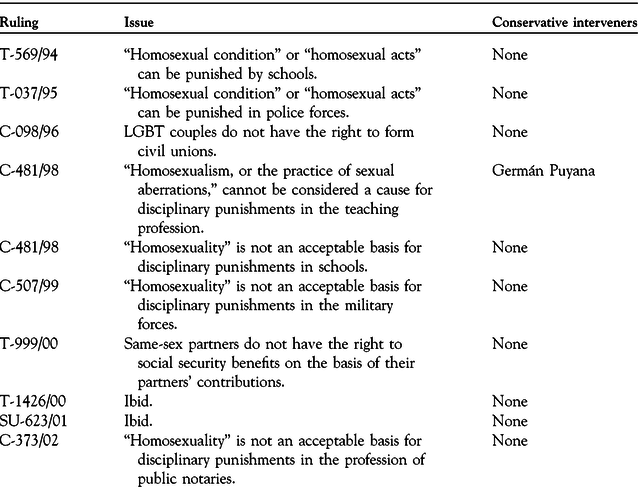
Between 1994 and 1998, the Colombian Constitutional Court condemned “homosexuality.” In a series of rulings, it allowed for the “homosexual condition” or “homosexual acts” to be sanctioned by schoolsFootnote 8 or police forces.Footnote 9 Beginning in 1998, however, the court changed the direction of its case law and started to grant rights to LGBT people as individuals (see Table 1 for a summary of rulings, issues, and conservative interveners). In Ruling C-481 of 1998, the Constitutional Court radically changed its approach to LGBT cases with the expansion of Article 13 of the Colombian Constitution to include a prohibition of discrimination based on sexual orientation. This means that any policy distinction based on sexual orientation is a priori suspected of being discriminatory and subjected to strict scrutiny. Based on such precedent, the court changed its case law and indicated that “homosexuality” was an acceptable basis for disciplinary sanctions in schools,Footnote 10 military forces,Footnote 11 and the profession of public notaries.Footnote 12
Rulings, issues, and conservative interveners before 2007

Even with this fundamental change in the case law of the Constitutional Court in 1998, there was only one conservative legal brief before 2007. The single conservative intervener, Germán Puyana, was not part of the conservative movement’s network that had consistently mobilized at the Constitutional Court since 2007. His early legal brief must be contextualized by its special interest in “homosexuality” and the homophobic remarks that he made outside of the legal briefs at the court and in interviews.Footnote 13 His homophobia is evident in press interviews in which he argued that “the human species cannot follow the paths of beasts” (Zuluaga Reference Zuluaga2012).Footnote 14 In a 1998 legal brief about whether “homosexualism, or the practice of sexual aberrations” could be considered a cause for disciplinary sanctions in teaching, he included statements of explicit homophobia and an opposition to LGBT individuals outside of their private sphere.Footnote 15 In this regard, he is an outlier among the interveners at the Constitutional Court and the activists interviewed. All of my interviewees were cautious, explicitly identifying themselves as not being homophobic, as accepting LGBT individuals and their individual rights, but opposing the legal attempt to define same-sex couples as families.
Before 2007, seven bills that were favorable to LGBT couples were proposed in Congress, and, in every case, they failed. This is likely related to the religious influence on Congress.Footnote 16 When the first bill, proposed in 2001, passed the first debate (the only debate it passed), the Catholic Church announced its opposition to the bill (Revista Semana 2001). When a leftist congresswomen presented a bill to recognize same-sex civil unions in 2002,Footnote 17 religious conservatives opposed this bill, arguing that the congresswoman was trying to dislocate the family.Footnote 18 When proposing a bill in 2005, a congressman mentioned in his speech the opposition by the Catholic Church to the assimilation of same-sex relations to marriage.Footnote 19 In 2007, when four different bills were proposed, religious arguments also played a major role in Congress in blocking each of the four bills that were proposed (Bonilla Reference Bonilla2007). Importantly, religious opposition to LGBT policies during the 1998–2007 period was focused on the legislature, which, as opposed to the Constitutional Court, was proposing bills related to LGBT couples rather than focusing on individual rights.
2007–16: LGBT Couples and Families at the Constitutional Court
In August 2006, a progressive lawyer associated with LGBT rights’ strategic litigation wrote an op-ed observing that the Constitutional Court had only granted rights to LGBT people as individuals. Her op-ed critiqued the court for not going further to grant rights to LGBT people as couples and families. She wrote:
This is not the first time that the Constitutional Court refuses to protect the rights of homosexuals in order to defend a heterosexual view of the family. In fact, the Court has greatly protected the rights of homosexuals as individuals but has restricted the application of such rights to the sphere of the couple and the family…. According to the Court, this is so because these benefits [associated with couples’ rights] are only for heterosexual couples, given that they are the only ones that can constitute families. (Saffon Reference Saffon2006; translation from Spanish by the author).
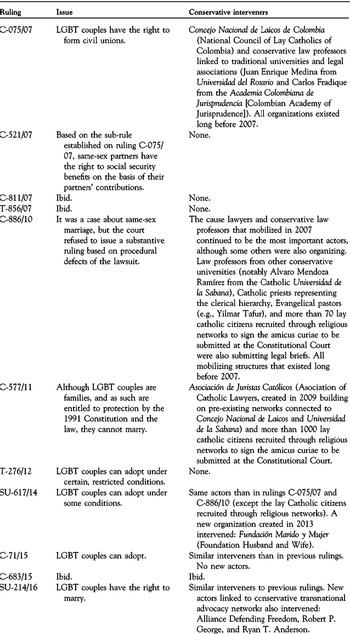
In 2007, the Constitutional Court shifted from granting rights to LGBT people as individuals to granting rights to LGBT people as couples, which is what the LGBT movement and progressive lawyers were advocating for (see Table 2 for a summary of the rulings, issues, and conservative interveners). The court had ruled in 1996 that LGBT couples did not have the right to form civil unions.Footnote 20 In 2007, it changed its case law and established this right.Footnote 21 Though the court had established in previous rulings that same-sex partners did not have the right to social security benefits on the basis of their partners’ contributions,Footnote 22 it changed the case law in 2007 and granted this right.Footnote 23 In later rulings, the court considered LGBT couples to be families (despite initially denying same-sex marriage rights)Footnote 24 and conferred their right to adoptFootnote 25 and to marry.Footnote 26 Thus, 2007 marked an important shift in the case law on LGBT rights. Since 1998, the court had started to grant rights to LGBT individuals, such as the right to nondiscrimination in schools, the military, and other professions, but, in 2007, the court shifted to also granting rights to LGBT people as couples and families.
Rulings, issues, and conservative interveners after 2007

As the literature on LGBT policies in Latin America and elsewhere suggests, the shift in the Constitutional Court’s case law in 2007 is likely due to a combination of domestic and transnational factors (Díez Reference Díez2015; Ayoub Reference Ayoub2016; Encarnación Reference Encarnación2016). By that time, an increasing number of countries worldwide (the Netherlands being the first to approve same-sex marriage in 2001), and particularly in Latin America (Argentina and Mexico approved same-sex civil unions in 2002 and 2006, respectively), were also shifting from individual-focused to couple- and family-focused policies. This transnational wave of diffusion reached Colombia at a point at which it had both a more receptive constitutional framework and a more developed case law as well as LGBT legal mobilization, in alliance with cause lawyers, that had been increasing (and transnationally influenced) since the early 2000s (Lemaitre Reference Lemaitre2009; Albarracín Reference Albarracín2011).
WHY DID THE CONSERVATIVES START TO ENGAGE IN LEGAL MOBILIZATION IN 2007?
Did the Conservatives Engage in Legal Mobilization Because of Shifting Legal Opportunities?
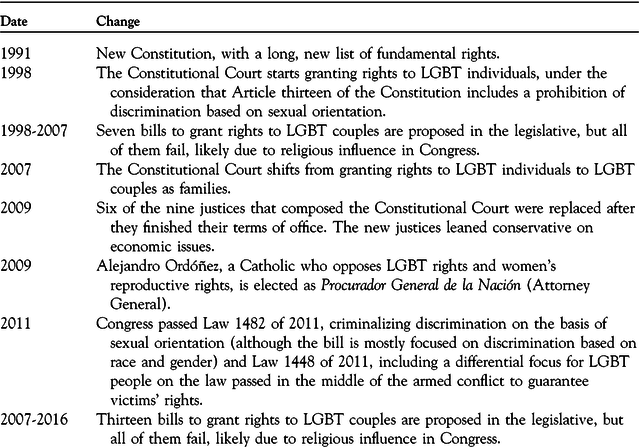
In 2007, the conservatives started to consistently intervene in LGBT cases. This can neither be explained by a shifting legal opportunity structure nor by how conservative actors perceived the opportunity structure. There was no opening in the legal opportunity structure favorable to the conservatives. Specifically, there was no change in their access to the judiciary or to the available legal stock. Also, around 2007, the Constitutional Court seemed to be leaning toward a conservative position on economic issues but toward a progressive position on moral issues (see Table 3 for a summary of changes in the legal opportunity structure). In 2009, six of the nine justices that composed the Constitutional Court were replaced after they finished their terms of office. This replacement took place when the Colombian president was conservative and very popular and when he dominated Congress, which led some analysts to argue that the court was going to become conservative (Graaff Reference Graaff2012). However, this predicted turn toward conservatism was restricted to social and economic rights. The new appointments in 2009 and later can be understood as a reaction to the Constitutional Court’s recognized activism in social and economic rights, which went against the goals of economic development favored by the policy elites (Nunes Reference Nunes2010; Rodríguez-Garavito Reference Rodríguez-Garavito2010; Maldonado Reference Maldonado2013). Even those scholars who argued that the court was becoming conservative acknowledged that judicial receptivity remained progressive on LGBT rights (Gargarella Reference Gargarella2015). Thus, there is no evidence supporting the idea that there was an “objective” conservative shift in judicial receptivity on LGBT rights around 2007.
Changes in the legal opportunity structure

Further, none of the interviewees mentioned this juncture and the possible move toward conservatism by the Constitutional Court. They instead vehemently perceived the court as being inauspicious to their preferences. The statement of one evangelical leader captures the typical narrative:
We don’t have any trust in the Constitutional Court. We believe that unfortunately they lost sight of the principles that should guide them: the rule of law, balance, moderation, good constitutional interpretation. For us, the Constitutional Court has violently attacked constitutional principles, has tried to distort things in its favor or according to its political interests. So, from that perspective, we have always had a feeling of distrust against the Court: What are they going to rule now? How are they going to say it? How are they going to deal with this issue? How are they going to cover it so that things work otherwise than they should?Footnote 27
Hence, there is no evidence to support the argument that the conservatives perceived a shift in the court’s receptivity to their arguments or even a “subjective” shift (Andersen Reference Andersen2009). In addition, the existing secondary literature has focused on the importance of the Procurador General de la Nación, an institution similar to the US Attorney General, for the conservative legal movement (Penen Reference Penen2015; Albarracín and Lemaitre Reference Albarracín, Lemaitre, Sáez and Moran2016). In Colombia, the Procurador General is charged with protecting citizens’ human rights and intervening at the Constitutional Court in every case of abstract judicial review.Footnote 28 The former Procurador General, Alejandro Ordóñez, is a conservative Catholic who opposes sexual and reproductive rights. He organized a campaign to oppose LGBT rights and is linked to the network of lay Catholic activists (Penen Reference Penen2015; Albarracín and Lemaitre Reference Albarracín, Lemaitre, Sáez and Moran2016). Political scientists have shown that, on average, in its rulings of abstract judicial review, the Constitutional Court tends to agree with the arguments presented by the Procurador General (Rodrıguez-Raga Reference Rodrıguez-Raga, Helmke and Rios-Figueroa2011). Therefore, having the Procurador General on one’s side could be construed as increasing judicial receptivity and, thus, expanding legal opportunities. However, the sequential development of events discredits this possibility: Alejandro Ordóñez was only elected in 2009, so his arrival to office cannot account for the emergence of the conservative legal mobilization in 2007.
Finally, none of my interviewees mentioned any foreknowledge or hope that Ordóñez would be elected and would undertake the actions against sexual and reproductive rights that he did. Also, none of the interviewees mentioned the election of Ordóñez as a possible influence on the receptivity of the Constitutional Court in their favor. In fact, social conservatives perceived themselves to be so distant and unfavorable by the court that Ordóñez himself, while in office, criticized the court on several occasions for ruling in ways that he fundamentally disagreed with (Redacción Política 2016). Indeed, the behavior of the Constitutional Court leading up to 2007 had given signals of shifting judicial receptivity, which were favorable to LGBT activists but not to the conservative movement.
In summary, the legal opportunity structure model cannot explain why conservatives started to engage in legal mobilization in 2007. None of the conditions theorized by the legal opportunity structure model were met. The formal institutional structure granting access to the judiciary or the available legal stock did not change in any significant way before 2007. Judicial receptivity was also not changing in 2007 in any way that was favorable to the conservatives.
Did Conservatives Engage in Legal Mobilization Because of Shifting Resources or Empowerment from Global Conservative Movements?
Contrary to what resource mobilization theory (McCarthy and Zald Reference McCarthy and Zald1977, Reference McCarthy, Zald and Turner2006) and scholarship on conservative movements (Skocpol Reference Skocpol, Pierson and Skocpol2007; Teles Reference Teles2008) expect, the emergence of conservative mobilization in Colombia in 2007 was not a response to increasing social-organizational resources. Social-organizational resources for mobilization did not expand in the mid-2000s so that the conservatives could engage in legal mobilization. The first conservative activists who started to engage in legal mobilization were cause lawyers who belonged to the Consejo Nacional de Laicos de Colombia and conservative law professors linked to traditional universities and legal associations (Juan Enrique Medina from Universidad del Rosario and Carlos Fradique from the Academia Colombiana de Jurisprudencia [Colombian Academy of Jurisprudence]).Footnote 29 These organizations were all mobilizing structures that existed long before 2007—the Consejo Nacional de Laicos de Colombia has existed since 1969, the Universidad del Rosario since 1653, and the Academia Colombiana de Jurisprudencia since 1894.
By 2010, the cause lawyers and conservative law professors that had mobilized in 2007 continued to be the most important actors, and others were also beginning to mobilize. Law professors from other conservative universities (notably, the Catholic Universidad de la Sabana), Catholic priests representing the clerical hierarchy, lay Catholic citizens recruited through religious networks to sign the amicus curiae that was to be submitted at the Constitutional Court, and evangelical pastors (for example, Yilmar Tafur) also submitted legal briefs.Footnote 30 These structures for mobilization also existed long before 2007—the Universidad de la Sabana had been founded in 1979, and Yilmar Tafur had been an evangelical pastor for thirty years. A change in social-organizational resources for mobilization can therefore not account for the timing of the emergence of conservative legal mobilization in 2007––again, the sequential development of events in the case provides evidence against this possibility: there was no shift in social-organizational resources around the mid-2000s that could explain the emergence of conservative mobilization.
Increasing material or human resources associated with organizations theoretically could help explain the emergence of legal mobilization, but this was not likely the case. The organizational structures from which conservative legal mobilization was originally launched were large, established organizations with a reliable pool of employees to deploy for mobilization. In the case of the universities (Universidad del Rosario, Universidad de la Sabana) and the Academia Colombiana de Jurisprudencia, in particular, the court regularly heard them on cases in which they wanted to participate through any of their lawyers. Given the nature of these mobilizing structures, their preexistence to the mid-2000s makes it unlikely that increasing resources account for the emergence of conservative legal mobilization in 2007.
A brief comparison with conservative legal mobilization against abortion also provides evidence against the possibility that increasing resources account for the emergence of conservative legal mobilization against LGBT rights in 2007. In a key abortion decision in 2006, the Constitutional Court declared the criminalization of abortion constitutional, except in cases of rape, risk for the woman, or fetal malformation (Jaramillo and Alfonso Reference Jaramillo and Alfonso2008; Ruibal Reference Ruibal2014a).Footnote 31 Some of the same organizations that later mobilized against rights for LGBT couples and families such as the Consejo Nacional de Laicos and the Universidad de la Sabana also mobilized against abortion. This provides evidence that the conservatives already had organizations from which to mobilize in response to shifting opportunities and threats. But the abortion decision was much more salient—it led to 194 amici curiae,Footnote 32 a number that is higher than any of the rulings on LGBT rights. Some of the other notable interveners were the Conferencia Episcopal de Colombia, the Iglesia Cristiana Tabernáculo de la Fe (Church Tabernacle of Faith), the Red Latinoamericana de Abogados Cristianos (Latin American Network of Lawyers), and the Red de Abogados Advocates International (Advocates International Lawyers’ Network). This suggests not only that the conservatives had organizations from which to mobilize but also that the strength of conservative mobilization is a function of their threat perception. Because abortion had traditionally been a salient issue for the conservatives, the possibility of its legalization led them to strongly mobilize.
While increasing social-organizational resources do not explain the emergence of conservative legal mobilization against LGBT rights in 2007, conservative actors have strengthened their mobilizing structures since that time. A newly created conservative organization intervened in 2011 and built upon the networks linked to those intervening in 2007 and 2010. In 2014, when conservative legal mobilization was already a consolidated trend, genuinely new mobilizing structures started to intervene—specifically, a new organization and transnational actors. A new organization to oppose same-sex marriage and adoption, the Fundación Marido y Mujer (Husband and Wife Foundation) was created in 2013 and began intervening in 2014.Footnote 33 Thus, while shifting social-organizational resources do not explain the timing of the emergence of conservative legal mobilization in 2007, they are important for a scholarly endeavor that is seeking to account for its current form. And, as the last part of this article will discuss, they are likely to be important in future patterns.
In 2016, international actors such as the Alliance Defending Freedom, Robert P. George, and Ryan T. Anderson presented an amicus curiae at the Colombian Constitutional Court.Footnote 34 This is consistent with the expectation of the literature on transnational activism that transnational advocacy networks will contribute support for domestic activists (J. Smith Reference Smith, Snow, Soule and Kriesi2004; Tarrow Reference Tarrow2005). However, international actors only began to intervene in 2016. It would contradict the sequential development of events to attribute the emergence of conservative legal mobilization against LGBT rights in 2007 to transnational support. Further, none of my interviewees transmitted a sense of the empowerment or the diffusion of identities, strategies, or frames from conservative global movements in 2007. While recent scholarship has demonstrated the importance of these processes today (Bob Reference Bob2012; Paternotte and Kuhar Reference Paternotte and Kuhar2017; Ayoub and Page Reference Ayoub and Page2019), the context of the mid-2000s was different. The Netherlands had only recently become the first country to approve same-sex marriage in the world (in 2001), and, in Latin America, Argentina was the first country to do so in 2002. Conservative mobilization in response to these developments was barely beginning. Current developments in conservative legal mobilization require taking into account the influence of conservative global movements, but it would be anachronistic to impose the same views to the mid-2000s.
Perceived Legal Threats: LGBT Couples and the Family
Conservatives consistently started to intervene in LGBT cases in 2007 because they perceived the shift from individual rights to the rights of couples as a threat to the family in its connection to the nation, and they intervened at the Constitutional Court in response. This reality would be obscured if we were to focus only on legal opportunities. Legal threat perception motivated both lawyers and non-lawyers as well as secular and Catholic actors. For instance, as one nonreligious lawyer, who was one of the first interveners in 2007 and who has since mobilized against LGBT rights, described:
Among all of this complex behavior by human beings in societies, the family is the kernel, and has always been the kernel, the fundamental basis of society…. So, you have to study and investigate what is a family and whether today’s “families” are satisfying the function of being the fundamental basis of society…. And so, it’s at that point when one starts to interrogate those substantial changes that have happened in Colombia after 2007 with the rulings of the Constitutional Court, whether they are advances, or rather not.Footnote 35
Interestingly, this lawyer also linked normative sexuality to the nation’s survival. He argued that “since time immemorial, … when human beings appeared, men and women joined to guarantee the survival of the human species” and added that “this is what you find in roman law.”Footnote 36 In doing so, he links a heteronormative construction of the nation to the civil law tradition and naturalizes this construction.
Lay Catholic activists also started to mobilize in 2007 as they perceived a threat in the Constitutional Court’s shift in the scope of the rights granted to LGBT people. This can be seen in the statement of a major lay Catholic activist:
Our statements have been around the definition of family in the Constitution. Some people have tried to unlink the concept of family from the relationship between men and women, allowing any relationship to constitute a family. So that’s what we are trying to get at the Constitutional Court…. Regarding homosexuals, you must bear in mind that we … are very respectful of the thinking, feeling, and acting of people within the conception of liberty promoted by our Constitution, and linked to it to our freedom of expression and acting as Catholics. What we oppose is the imposition to the whole society of the feeling or thinking of those communities, or that portion of society, as a generalized law for everyone [through tinkering with the definition of family in the Constitution]…. So, what we oppose is the interpretation, or rather misinterpretation, of the fact of liberty and the fact of citizens’ rights to generalize some issue to the whole society.Footnote 37
This activist’s narrative furthermore makes clear that the perception of legal threats is backed by the law’s symbolic power. What is at stake in “the definition of the family in the Constitution” is “the imposition to the whole society of the feeling or thinking of those communities, or that portion of society, as a generalized law for everyone.” Also, he links sexuality to the nation’s survival, particularly to a naturalized construction of the nation when he adds that their “position is part of a natural state in which family is founded on the union between a man and a woman. It is a fact that it is only the union of a man and a woman that makes life possible.”Footnote 38
The legal brief submitted to the Constitutional Court by someone from a second group of mobilizers, a law professor representing the Catholic Universidad de la Sabana, further shows the perception of threat to LGBT couples:
This union around the mother cannot exist in homosexual unions, given that in them, procreation cannot ordinarily take place between women and it is impossible within men. There is in this issue a natural order, proper to marriage and family, that we cannot assimilate to that which corresponds to homosexual unions. This does not mean repudiating the later reality, but rather treating it within its particular characteristics, without looking for a process of assimilation across the board…. [I thus ask for] the recognition of all of the possible rights for homosexuals, without damaging institutions that have been the foundation of society, of the propagation of the human species and of the education of minors for centuries.Footnote 39
The law professor’s stated intention for the brief in the legal process credits law as a societal foundation. Here, again, not only is the perception of legal threats clear but also its dependence on the law’s symbolic power. In turn, the link between sexuality and the nation’s survival is apparent in the professor’s appeal to a “natural order” and “institutions that have been the foundation of society.” It is also evident in his tracing of Colombian heterosexual marriage to key aspects of the civil law tradition, roman law, and the Civil Code inherited from France. After quoting Herennius Modestinus from the Digest and the Civil Code, he goes on to say that “these criteria (of marriage and family) respond to an inveterate use of the corresponding expressions, which have gained value over the centuries.”Footnote 40
Evangelical pastors’ motivation to engage in legal mobilization is also based on the perceived threat to the family and, thus, to the nation. This is evident in the statement of one of the pastors that intervened in 2010:
I intervened at the Constitutional Court to defend the equilibrium of family, that marriage is between a man and a woman as it is stated in the Civil Code and in tradition, as it is in the Bible. Because we heavily draw on what the Word of God says. That’s what must properly rule men’s life to avoid this terrible mess that we have in society. The world is looking at things completely backwards, everything is being seen backwards, and humanism is dominating over God’s will for men. God’s will for men, limits … the moral ruin in which we are … we are losing our direction as a society. So, there have to be voices that rise as watchtowers and warn people about the forthcoming dangers. So, it was a Christian duty to intervene at the Constitutional Court from my conception as a Christian, and that was my legal brief, that was its interest: the representation of Christian voices at the Constitutional Court. That was the basic intention.Footnote 41
Like the other respondents, this evangelical pastor perceived a threat in the shifting notion of the family institutionalized in the law. This perception is dependent on sexuality’s link to the nation’s survival, a construction of the nation that links it to the civil law tradition and Christianity.
In sum, conservatives started to engage in legal mobilization in 2007 because it was at this time that the Constitutional Court shifted from granting rights to LGBT people as individuals to granting rights to LGBT people as couples and potential families. By doing so, the court hinted at the institutionalization of the notion of family that was being promoted by the Colombian LGBT movement and progressive lawyers, which conservatives perceived as a threat to their vision of the family in its connection to the nation. The perception of legal threats is particularly motivating because of the law’s symbolic power, which raises the stakes in the decoupling between one’s own values and those institutionalized in the law. Thus, only by expanding the legal opportunity structure model to include legal threats can we make sense of the shift in conservative politics in Colombia in 2007.
The pattern of LGBT policy making and conservative opposition in the legislature also suggests the different perception and mobilizing effects between granting rights to LGBT people as individuals and LGBT people as couples and potential families. Colombian Congress has only enacted two policies favorable to LGBT people: a bill criminalizing discrimination on the basis of sexual orientationFootnote 42 and a provision of differential focus for LGBT victims of armed conflict.Footnote 43 Both policies focus on LGBT individuals rather than on LGBT families. All bills focused on LGBT families have failed, both before and after 2007, likely due to religious influence in Congress. After 2007, thirteen bills favorable to LGBT couples were proposed in the legislature, but each failed. Religious influence in Congress was so strong that, in 2010, a group of twenty-three congressmen sent an amicus curiae to the Constitutional Court urging it to recognize the right to same-sex marriage. According to the legislators,
experience has taught us that in the legislative branch majorities have not recognized and are not going to recognize the rights of the LGBT minority, given that in parliamentary debate, arguments about political, religious, and moral convenience have triumphed over and will triumph over legal and scientific discussion. (Revista Semana 2010)
In 2015, another congressman lamented, in proposing his bill, that there is opposition to same-sex marriage based on religious and moral views that are “shared by high officials in the State and sectors of the Church without any serious and probable grounding, who try to argue in favor of a degree of abnormality or contrariness to the human nature of homosexuals, which is clearly against our Constitution.”Footnote 44
DISCUSSION AND CONCLUSIONS
When the Colombian Constitutional Court started to accommodate same-sex couples in its definition of the family in 2007, conservatives perceived a legal threat. Legal changes challenged the notion of nationhood constructed by conservatives based on procreative heterosexual nuclear families. By changing the law, the Constitutional Court had the (perceived) ability to endanger the nation’s survival and the reproduction of the nation’s population, an expected cost that motivated and sustained conservative legal mobilization.
This article suggests that conservative legal mobilization against sexual rights in Latin America lies at the intersection of two major cultural practices. The first is the maintenance of conservative values and beliefs about traditional heteronormative, gender-differentiated families. This practice is based on a Catholic tradition that overlaps well, on this particular subject, with an evangelical resurgence. In other regions and in transnational organizations such as the United Nations, conservative values are also rooted in other traditions, particularly orthodox religions (Ayoub Reference Ayoub2014, Reference Ayoub2016). Comparative and transnational research on the continuities and discontinuities of different religious traditions and their impact on conservative mobilization against sexual rights is required. The second practice that sustains conservative legal mobilization in Latin America is the law’s symbolic power. Despite a historically persistent gap between the law in the books and the law in action, Latin American policy makers and social movements alike refer to the law as having the capacity to change reality (Lemaitre Reference Lemaitre2009; Garcia-Villegas Reference Garcia-Villegas2016, Reference Garcia-Villegas2018).
The birth of sustained mobilization––an economically, emotionally, an existentially costly decision––could not be understood without the overlap of a Christian tradition and the law’s symbolic power. This article thus joins the argument that individuals’ need and orientation to create shared meanings and identity drives social action (Spillman Reference Spillman2020). Rather than being guided solely by power and preferences, individuals seek the cooperation of others for their projects through the creation of identities, coalitions, the repurposing of interests, and the fashioning of shared worlds (Fligstein and McAdam Reference Fligstein and McAdam2015).
The Colombian Constitutional Court has a salient place in global constitutionalism, particularly in the global South (Maldonado Reference Maldonado2013; Gargarella Reference Gargarella2014; Merhof Reference Merhof2015; Rodríguez-Garavito and Rodríguez-Franco Reference Rodríguez-Garavito and Rodríguez-Franco2015; Espinosa and Landau Reference Espinosa and Landau2017). Developments around Colombian constitutionalism have the potential to diffuse to other jurisdictions. Moreover, the perception of legal threats has operated in other countries, sparking legal mobilization. Two of these countries are Mexico and the United States. Likely due to federalism, mobilization has taken different forms. Civil unions for same-sex couples and same-sex marriage were legalized by Mexico City’s legislature in 2007 and 2009, respectively (Díez Reference Díez2015; Encarnación Reference Encarnación2016). Mobilization for same-sex marriage ensued throughout the country, opening the way to both legislative-based and judicially lead legalization. Ultimately, the Supreme Court of Justice of the Nation federally legalized same-sex marriage in 2011 (Alterio and Ortega Reference Alterio and Ortega2017). Throughout this process, conservatives’ threat perception led them to engage in legal mobilization as well as other forms of activism that were available under a more decentralized regime than existed in Colombia (J. López Reference López2018). Similarly, in the United States, the possibility of rulings for same-sex marriage led to threat perception and conservative mobilization (Goldberg-Hiller Reference Goldberg-Hiller2009; Dorf and Tarrow Reference Dorf and Tarrow2014). However, conservatives not only engaged in legal mobilization but also attempted to ban same-sex marriage at the state level (Soule Reference Soule2004). The comparison with Mexico and the United States suggests the centrality of legal threat perception as well as the importance of studying the interaction of opportunities and threats across different political contexts (Hilson Reference Hilson2002).
This article contributes to the literature on legal mobilization by expanding the legal opportunity structure model to include the perception of legal threats. The concept of legal threats allows scholars to consider the perceived loss of resources or status due to changes in the legal system in their understanding of the emergence of legal mobilization. The perception of legal threats has been crucial in powering conservative legal mobilization against abortion in Colombia (Ruibal Reference Ruibal2014a), Mexico (Ruibal Reference Ruibal2014b), and the United States (Post and Siegel Reference Post and Siegel2007). Further, legal threats are likely applicable to social movements beyond the context of social and reproductive rights. In the case of disability movements, for instance, political actors mobilize when opportunities increase as well as in reaction to certain events (Vanhala Reference Vanhala2010). This may also be true of environmental movements when they face what they perceive as regressive legal changes.
Legal threats refer to changes in legal rules that increase the expected costs of not taking action as well as the costs of mobilization. This article has focused on the former. Future studies should explore legal mobilization emerging in response to activists’ perception of increasing costs of mobilization. An example of this could be mobilization for privacy, where activists engage in legal mobilization against legal rules that limit access to data and thus increase the costs of mobilization (Lehoucq and Tarrow Reference Lehoucq and Tarrow2020). In addition, this article has specified the relation between opportunities, threats, and resources in the development of legal mobilization. As previously mentioned, the support structure model only considers how resources impact the production of legal changes, not how they affect the emergence of legal mobilization (Epp Reference Epp1998; Teles Reference Teles2008). This article has made explicit the possibility that engagement in legal mobilization is a function of increasing resources. Further, it has suggests a reciprocal relation between structural conditions and resources in longer trends of legal mobilization. Social movement scholars have generally considered the effect of resources on mobilization rather than the converse (McCarthy and Zald Reference McCarthy and Zald1977; Morris Reference Morris1986). Increasing social-organizational resources did not explain the emergence of conservative legal mobilization in 2007. However, the development of such mobilization led to the creation of new organizations and networks because of the perception of legal threats. This suggests that some preexisting resources are necessary for mobilization but that the dynamics of mobilization can lead to a strengthening of resources.
The emergence of mobilization can lead actors to become aware of each other, raising their sense of collective unfairness and potential efficacy (McAdam Reference McAdam and Snow2013). This can lead to the creation of new mobilizing structures, which can enhance the effectiveness of movements. A broader societal reach through new organizations and networks can increase the number of elite allies or alter group boundaries, creating tensions among elites. In these and other ways, the strengthening of mobilizing structures can lead movements to reshape their opportunity structure (McAdam Reference McAdam, McAdam, McCarthy and Zald1996; Skocpol Reference Skocpol, Pierson and Skocpol2007; Teles Reference Teles2008). Future studies adopting a longue durée approach should further explore these insights (Mahoney and Rueschemeyer Reference Mahoney and Rueschemeyer2003; Pierson Reference Pierson2004; Pierson and Skocpol Reference Pierson, Skocpol, Pierson and Skocpol2007; Thelen and Mahoney Reference Thelen, Mahoney, Mahoney and Thelen2015).
This article also contributes to the literature on conservative legal politics. Political scientists have explored the transformations within the state, the structures through which activists approach it, and the factors that have turned the US Supreme Court to the right (Pierson and Skocpol Reference Pierson, Skocpol, Pierson and Skocpol2007; Teles Reference Teles2008; Keck Reference Keck2010). Other scholars have explored the lawyers driving such conservative legal mobilization––who they are, where they come from, their professional identities, how they relate and organize, their ideologies, and their legal consciousness (Heinz, Paik, and Southworth Reference Heinz, Anthony and Southworth2003; Southworth Reference Southworth2009; Hollis-Brusky Reference Hollis-Brusky2011; Wilson Reference Wilson2011; Wilson and Hollis-Brusky Reference Wilson and Hollis-Brusky2014). This article has explored the values and beliefs through which conservative legal activists perceive their changing environment and perceive threats that lead them to mobilize.
Finally, this article has distinguished between the global influences on domestic mobilization. The literature on transnational mobilization expects transnational advocacy networks to help activists develop networks of support (J. Smith Reference Smith, Snow, Soule and Kriesi2004; Tarrow Reference Tarrow2005). Scholarship on global conservative movements further considers the possibility that they empower activists, shape their identities and strategies, transform their agenda and frames, and change the costs for mobilization (Bob Reference Bob2012; Paternotte and Kuhar Reference Paternotte and Kuhar2017; Ayoub and Page Reference Ayoub and Page2019). However, none of these expectations were met in Colombia in 2007. While, currently, Colombian conservative mobilization is empowered and influenced by transnational mobilization, this was not the case for the emerging conservative legal mobilization against LGBT rights in 2007. However, this process was globally influenced. This article has suggested two such global influences. First, the Constitutional Court’s shift to grant rights to LGBT people as couples and families sparked the conservatives’ perception of a threat, which was linked to comparative legal developments and transnational LGBT mobilization. Second, the conservatives’ threat perception was dependent on their construction of the nation related to global communities, specifically Christianity and the civil law tradition. As global conservative mobilization grows more pervasive, future research should keep an eye on analytical differentiation and specify the different ways in which global and domestic events relate.