Andy Warhol was being an asshole. At least Ron Whyte thought so when the two artists crossed paths at a Soho gallery opening in the early 1970s. It's unclear what offense Warhol committed, another incident whose details have been lost to the historical record. But if Warhol had not behaved badly that fateful evening, Whyte—a queer and disabled playwright—might never have removed the “cosmetic glove” covering his “withered” left arm and hurled it at the visual artist, enabling the glove to make its own “contribution to modern art.”Footnote 1 The famed artist, Whyte claimed, would go on to copy this assault by prosthesis in Andy Warhol's Frankenstein (1973).Footnote 2
However laughable, Whyte's attack on Warhol was hardly original. An ardent disciple of Valerie Solanas and her SCUM Manifesto, Whyte found himself in a complex chain of citation.Footnote 3 His assault evoked Solanas's shooting of Warhol at point-blank range in 1968, even if the rubbery faux flesh of his cosmetic hand proved a poor surrogate for her bullets.Footnote 4 It would be a stretch to accord Whyte's assault a place in radical disability activism analogous to what Sara Warner has called the “ludicrous” possibility that “had [Solanas] not shot Warhol there might not have been a radical feminist movement.”Footnote 5 But this awkward assault became foundational to Whyte's own understanding of the political and theatrical projects for which prosthetics might be mobilized, even if those projects did not always necessitate prostheses going airborne.
Whyte relayed the story of his assault on Warhol in the middle of a presentation he was invited to deliver at a 1984 conference on lower-extremity prosthetics sponsored by SUNY Stony Brook and the Nassau County Medical Center. This essay considers Whyte's lecture and the everyday social performances it purports to archive. I read this lecture alongside writings on and representations of “the uncanny valley” by Masahiro Mori, the Japanese roboticist who invented the term,Footnote 6 and graphs of “the uncanny valley” that Whyte inserted into publicity materials for the National Task Force for Disability and the Arts. Reading these texts together elucidates how Whyte mobilized his cosmetic prosthesis to stage disemployment.
I appropriate the term disemployment to describe the theatre and performance practices that have come to mediate disabled Americans’ access to, and experience with, work and welfare in the late twentieth and early twenty-first centuries.Footnote 7 In my usage, the conjunction of “dis” and “employment” signifies doubly. Disemployment describes both performance practices that have proven central to efforts to usher disabled Americans toward the labor market and those proven central to efforts to negate or otherwise contest employment as the prevailing goal of disability politics.
Concerns with theatrical labor, and with acting in particular, have suffused national conversations about disabled people's relationship to the American workforce since the 1970s. Disability, long understood as the inability to work, has during the past half-century been redefined in terms of the capacity to perform.Footnote 8 In the 1970s, government agencies, disability communities, and individual artists began foregrounding theatre and performance labor as key sites for creating job opportunities for disabled Americans. For example, in 1977, Rick Curry founded the National Theatre Workshop of the Handicapped (NTWH), a professional training program for blind and physically disabled actors that flourished and established multiple campuses in Manhattan and Maine.Footnote 9 Before its dissolution in the early twenty-first century, NTWH trained thousands of disabled actors for commercial theatre, film, and television.Footnote 10 Then, in 1978, Whyte founded the National Task Force for Disability and the Arts (NTFDA), which established the blueprints for (unfortunately unrealized) resources meant to support, protect, and distribute the labor of disabled artists. These resources included legal services, a publishing house, a cultural center, a community library, disability consciousness-raising workshops, and an artistic “supermarket” where disabled artists could hawk their wares.Footnote 11 Also in 1978, the Department of Health, Education, and Welfare (HEW) Region II office convened vocational rehabilitation workers and commercial theatre professionals so they could help “State rehabilitation counselors” improve their “ability to evaluate talent and to determine what would be the best resources for such talent—formalized educational training, specialized tutoring, specialized equipment, etc.”Footnote 12
In tandem with these developments, disabled artists and activists, including Ron Whyte, have mobilized performance practices that contest the idea that compulsory participation in the labor market offers the most desirable horizon for disability politics and activism. Efforts to put disabled Americans to work via theatre and performance do not represent a political trajectory entirely distinct from efforts to critique employment as the prevailing goal of disability politics. Rather, these are twin elements of a broader shift in which theatre and performance emerged as the critical nexus of disability politics and work in the late twentieth and early twenty-first centuries. We need look no further than Ron Whyte's own career to understand this. Whyte developed provocative antiwork performance practices, but he also lent his expertise to government agencies in order to push disabled people toward the arts marketplace.Footnote 13 He refused to occupy a consistent political position regarding the importance of work for disabled Americans. Instead, he mobilized theatre and performance practices in a desperate scramble to understand how disabled people's lives would be reconfigured in the wake of a troublesome confluence of developments. The cultural and political shift toward regarding disabled people as “employable” emerged in part from gains made by the disability rights movement, to be sure, but it also accompanied a crumbling welfare state and the withdrawal of sustaining social institutions.
Whyte is a helpful figure through whom to consider the history of disemployment because, from the 1970s until his death in 1989, he was at the vanguard of national conversations at the intersection of disability, theatre, and work. Educated at San Francisco State College and the Yale School of Drama (and later at Union Theological Seminary), Whyte was a prolific queer and disabled artist whose plays and musicals were produced nationally at venues that included Cherry Lane Theatre (New York), Arena Stage (Washington, DC), and American Conservatory Theatre (San Francisco) and internationally in Chile and Denmark. Many of these works—including Welcome to Andromeda, Funeral March for a One-Man Band, and The Extinction of Alexander Pope—thematized disability. In addition to writing for theatre, Whyte authored screenplays, video art, and criticism, and he worked in a number of editorial capacities, including a two-year stint in the 1970s as Arts Editor for the Soho Weekly News. Whyte's administrative accomplishments match his creative output. He served as a disability arts consultant for the HEW Region II office and collaborated with the National Endowment for the Arts to ensure that the agency complied with Section 504, the nondiscrimination clause of the 1973 Rehabilitation Act, which was the first major piece of civil rights legislation for disabled Americans. Perhaps most important, he founded the NTFDA and served as the organization's executive director from 1978 until its dissolution sometime before 1981.
Whyte's talk at the 1984 conference warrants attention not only because it participates in the genealogy of disability performance practices I include under the rubric of disemployment, but also because it enacts the dual edges of disemployment: it models performance as both a form of work and as a resource for contesting compulsory labor. It further deserves attention because of the professional context in which Whyte performed it. Whyte lived in a chronic state of precarity throughout his career, scrambling for economic security through a combination of writing, consulting, administration, sex work, disability benefits, and emergency relief from both private philanthropy and professional organizations. This scramble intensified in the early 1980s. On the surface, the early years of the new decade appeared promising enough for Whyte. He received a 1980 Rockefeller Foundation Grant alongside some (now) recognizable luminaries including Lee Breuer, Elizabeth LeCompte, and Spalding Gray.Footnote 14 Arena Stage mounted Whyte's Disability, A Comedy in 1981, and his stage adaptation of Victor Hugo's The Hunchback of Notre Dame was in preproduction at the New York Shakespeare Festival the next year. During this time, he also enjoyed a three-and-a-half year appointment as coordinator of the tumultuous Playwrights Unit at the Actors Studio (then with Lee Strasberg at the helm), a position previously occupied by the likes of Clifford Odets and Edward Albee.Footnote 15
But the 1980s were also a period of tremendous loss for Whyte. His collaborator, neighbor, and friend, the art critic Gregory Battcock, was murdered in December 1980, and the NTFDA dissolved around the same time, likely for financial reasons. He experienced chronic health problems (including muscular atrophy and tissue damage) as a result of ill-fitting leg prosthetics. By fall 1984, Whyte—who had been ambulatory with the use of crutches—anticipated that he would need to use a wheelchair full-time for the next three years.Footnote 16 In the context of New York City's inaccessible terrain, these health problems and changes in mobility exhausted his stamina, compromising his ability to participate in the physically grueling rehearsal processes for his plays. In light of this, he attempted to move from New York to the comparatively more accessible Washington, DC, “a community where it's more convenient for me to get around,” where he hoped to begin a residency at Arena Stage and to pursue consulting opportunities.Footnote 17
The move to DC did not work out, but Whyte began splitting his time between New York and New Haven, where he had attended the Yale School of Drama and where the family of his partner, Paul William Bradley, lived. He continued to write plays, but he also embarked on a diverse array of other writing projects, including the initial phases of editing a nineteenth-century American theatre history “sourcebook” that he imagined as a more specialized companion volume to A. M. Nagler's A Source Book in Theatrical History.Footnote 18 Whyte also consulted for Profiles in the Arts, a collaborative publication venture between the National Endowment for the Arts and the President's Committee on Employment of the Handicapped.Footnote 19 The goal of the publication was to “cause people with disabilities to be more aware of the career opportunities in the arts; and make arts administrators more aware of the accomplishments of [disabled] artists and arts administrators.”Footnote 20 In collaboration with his partner, Bradley, Whyte also began plotting what he hoped would be more lucrative ventures, including publishing children's books and religious texts, literature that “stays in Print.”Footnote 21 Whyte's creative and critical production remained prolific during this period. But in an effort to secure access to nondebilitating prosthetics and to catch up on his perpetually overdue rent payments, a significant amount of his writing time was absorbed by crafting letters to medical professionals, government agencies, philanthropic foundations, professional associations, and other sources of emergency relief funding. It is in this professional and economic context that Whyte delivered his lecture at the prosthetics conference in 1984. Just weeks later, he wrote to the Connecticut Division of Vocational Rehabilitation contesting their denial of his request for an accessible van for work purposes and documented the fact that he was still awaiting a decision about his request for accessible word-processing equipment.Footnote 22
My analysis addresses how Whyte mobilized his prosthetic embodiment to perform disemployment: he enthusiastically embraced, rather than dismissed, the state-resourced cosmetic glove on account of its aesthetic and functional failure. In so doing, he contested a political milieu that was increasingly concerned with weaning people with disabilities off welfare benefits and putting them to work. To develop this argument, I begin by contextualizing Whyte's cosmetic glove within his own understanding of the theatricality of disabled embodiment and the history of prosthetic design. The cosmetic glove included some features that aspired to mimic a “real” hand and other features that were uninterested—to say the least—in faithfully replicating the real. These contradictory design qualities troubled the glove's position in the mutually imbricated projects of designing “lifelike” prosthetics and efforts to render physically disabled people employable through prosthetic intervention. I demonstrate how Whyte celebrated his prosthetic hand in terms of the resolute artifice that made it appear both “fake” and “dead” (PLS, 6).Footnote 23 NTFDA publicity materials featured roboticist Mori's “uncanny valley” graphs, images that, like the encounters Whyte discusses in his lecture, betray phobic responses to prosthetics.Footnote 24 But whereas his lecture documents encounters in which such phobia emerges because the “fake” hand appeared “dead,” Mori's aversion to prosthetics derived from a discomfort with the possibility for prosthetics to appear “almost but not quite” real, almost but not quite “live.”Footnote 25 Whyte's reasons for including Mori's graphs in a flyer for his organization are unclear. But through a close reading of Mori's graphs and writings about “the uncanny valley,” I argue that Whyte derived from Mori an interest in the complicated intersections of disability, prosthetics, representation, theatricality, and liveness. During his 1984 lecture, Whyte elaborated an affective and political attachment to his prosthetic on the basis of its fakeness and deadness, rather than on the basis of its potential reality and liveness. In so doing, he theatrically staged the prosthetic's indeterminate animacy to contest the push toward employment in disability policy, while also staging it as a resource for his own work as a writer and performer in the context of the intensified social and economic precarity he experienced throughout the 1980s. With his cosmetic hand, then, Whyte staged disemployment.
Prosthetic Designs
The cosmetic glove was not Whyte's only prosthesis. He had used lower-leg prosthetics since a double below-knee amputation during his senior year at San Francisco State College. But the glove was unusual. Unlike the prosthetic legs that—in combination with crutches or a wheelchair—facilitated Whyte's mobility, the glove did not approximate the functional capacity of an unimpaired “organic” arm. It did not enable Whyte to grasp a pencil or type on a typewriter, for instance. Its purpose was to mask his foreshortened left arm, which featured two (formerly webbed) digits, and to imbue him with an ostensibly “normal” appearance. Whyte's own experience led him to understand prosthetics as imbuing disabled embodiment with a “theatrical” quality: “Disability itself has its theatrical aspects. … Artificial limbs are props, and yet no one really cares what they look like or whether their owners have been taught how to use them. For instance, my artificial legs are kind of a pink color—the color that in the crayon boxes is called flesh. Why? It's an unexamined esthetic choice.”Footnote 26 Whyte was on to something.
Scholar and curator Katherine Ott has provocatively declared that “histories of prosthetics are probably better written by playwrights than historians.”Footnote 27 Ott traces back to the Victorian period the emergence of verisimilitudinous prosthetics, artificial limbs designed to pass as believable surrogates for the limbs they replaced.Footnote 28 Ott's historicization works against narratives of technological determinism. She attributes the priority commonly allotted to “cosmetically acceptable” limbs over their functional but potentially unbecoming antecedents, such as split hooks, to a new “cultural dynamic of mimicry.”Footnote 29 Stephen Mihm similarly locates the birth of “‘life-like’” prosthetics in the mid- to late nineteenth century, ascribing this shift to the burdens of self-representation in “a society of strangers” initiated by urbanization and industrialization.Footnote 30 But Mihm clarifies that lifelike limbs were not reducible to a transformation in visual appearance and that “manufacturers spared no expense in producing artificial limbs that actually moved like real arms and legs.”Footnote 31 Middle-class consumers of prostheses may have been primarily concerned with the “concealment” of bodily difference, but companies regularly marketed artificial limbs by representing people at work with their prostheses prominently displayed: prostheses, Mihm argues, “functioned not as a means to conceal, but rather, as a means to ensure continued employment.”Footnote 32 Yet the possibility of producing prosthetics of unprecedented verisimilitude did not inaugurate a linear trajectory in which increasing aesthetic and functional lifelikeness would be held in mutual esteem. For Ott, the trajectory of prosthetic design since the nineteenth century is better understood in terms of oscillation than of development, arguing that it moved “from mimicry to modification and then to disassociation with the original.”Footnote 33 She continues: “Many prosthesis makers in the late twentieth century took a turn into visionary engineering, where parts replicated neither form nor function of the human body.”Footnote 34
The cosmetic glove with which Whyte assaulted Warhol participated curiously in the history of prosthetic design as it concerned the intersecting issues of social passing and workforce participation. Whyte had received the glove, paid for by the Connecticut Division of Vocational Rehabilitation (DVR), as the result of “a routine amputee clinic checkup” during his time as a graduate student in playwriting at the Yale School of Drama (PLS, 3). He had no desire to wear the glove—“they showed me one and I didn't like it”—but he felt compelled to accept it nonetheless (3). As Whyte informed the audience at the prosthetics conference, “If I did not want a cosmetic hand it was a sign that I did not want to be rehabilitated, and also that I was not coming to terms with my disability” (3). When Whyte accepted the glove he neither needed nor wanted, he played the role of the good patient, effectively positioning himself to make further claims upon the state agency. But he also forged an opportunity to eschew normative regimes of prosthetic intervention. He accepted the glove only on the condition that “they would prescribe that my set of legs raise me to six foot one,” a height he had been working toward incrementally increasing, since his “original heig[ht] had been about 5 foot seven” (3). That Whyte proved successful in negotiating such a trade-off is evidence of his developing acumen for negotiating with medical authorities and state bureaucracies; but it also suggests that an inconsistent set of goals governed the distribution of prostheses. At the same time that physicians and rehabilitation professionals collaborated to provide Whyte with the cosmetic glove that was imagined to restore him to a corporeal norm he had never inhabited, they provided height-enhancing prosthetics committed to optimizing, rather than normalizing, his body.
Whyte recounts that his initial “negative reaction” subsided when he considered “the idea of finally having a left arm that was like my right arm” (3). His “misgivings” returned, however, when the arm was delivered (4). He describes the design choices that failed to invest the glove with its cosmetic promise: “It did not extend my arm to a length equal to my right arm, though the hand itself was as large as my right hand. So there I was with this shortened arm and this big hand with a zipper from the palm up to my elbow” (4). He later reveals a number of additional design elements that rendered the glove's artifice obvious. Beyond being of insufficient length and having a visible zipper along the forearm, the glove was also yellowish in hue and rubbery in texture. Further bemusing, the glove, though largely uninterested in replicating the real, featured occasional bursts of verisimilitude (including “veins” and “finger[n]ails”) in its design (5). Most notably, the yellow, rubber, foreshortened, and zippered glove was outfitted with a series of contoured grooves that suggested fingerprints.
By including fingerprints (and by extension, the capacity to produce them), the glove suggests an aspiration toward lifelike status. This particular aspiration indicates how the glove was entangled in a web of theatricality even before Whyte wore it. Disability theorist Ellen Samuels has described fingerprinting as a “fantasy of identification” imbued with the “imagined power to mark and control racial and disability identities.”Footnote 35 Fingerprinting received its “first institutional claims to truth” not through scientific laboratories or courts of law, but in literature.Footnote 36 Michael Taussig also emphasizes the fingerprint in his efforts to unmake the imitation–contagion binary in James George Frazer's elaboration of “‘sympathetic magic.’”Footnote 37 Taussig remarks:
Through contact (contagion) the finger makes the print (a copy). But the print is not only a copy. It is also testimony to the fact that contact was made—and it is the combination of both facts that is essential to the use of fingerprinting by the police in detection and by the State in certifying identities.Footnote 38
Reading Samuels and Taussig together proves the inclusion of fingerprints on Whyte's glove both predictable and perplexing. The grooves allowed the glove to appear to have the capacity to produce individualizing, identificatory traces. But the glove's grooves had no indexical relationship to Whyte's own fingerprints. In order for Whyte to use the cosmetic glove, he actually had to mask his own fingerprints with synthetically produced ones; that is, he had to cover his two digits with a mask mimicking a five-fingered faux hand he had never possessed. In so doing, the glove disclosed the artificial, even theatrical, construction of fingerprinting's “truth” at least as much as it colluded in occluding the production of that truth. The glove's gesture toward lifelike design through the provision of fingerprints—a technology of identification that emerges from the fictive and troubles the decidability of original and copy—becomes theatrical by further decoupling the fingerprint from its individuating and identificatory function. To what use, then, did the DVR want the glove to be put, and how did Whyte mobilize it otherwise?
Hopelessly Cosmetic
In 1984, Dr. Lawrence Friedman, Chair of the Department of Physical Medicine and Rehabilitation at SUNY Stony Brook, invited Whyte to deliver two “20 or 30 minute” talks addressing “the social implications of the amputee state and the importance of dress for the legless.”Footnote 39 The textual remains of the talk considered here seem to indicate that Whyte responded to Friedman's first suggestion (if, indeed, he followed Friedman's guidelines at all). An abrupt conclusion and numerous editorial markings, including supplementary text typed between lines and in the margins, suggests that this text may well represent a preliminary draft.Footnote 40 Even still, this provisional document proves a helpful resource for gleaning what—at least at one point during his process—Whyte felt it was prudent to share at the prosthetics conference.
The lecture featured a linear, biographical narrative, although Whyte occasionally interrupted this structure with asides that directly addressed his audience. Whyte began the lecture by identifying himself as “a BK [below-knee] double amputee” (PLS, 1). He told his audience that he had been born with multiple “congenital deformities” in “a predominantly Italian speaking” enclave of Black Eagle, Montana, and he provided an account of the various rehabilitative practices to which he had been subject in childhood, including homemade leg braces constructed by his father, a railroad machinist (1). Whyte swiftly integrated rehabilitative biography with educational biography, beginning with his experience in dance classes that led him to perform in recitals, invariably “dressed like a cowboy because the cow-boy chaps concealed the braces” (1). By the time he was a teenager, Whyte “walk[ed] without the braces,” but at sixteen, a bus “ran over both [his] ankles,” which led to him using a wheelchair for a year (2). Next, Whyte addressed his senior year at San Francisco State College, during which time he received his double below-knee amputation while living in the Moffitt Hospital of the University of California as an “experimental patient, that is to say, a charity patient” (2). That same year, he was admitted to the Yale School of Drama to study playwriting, where he showed up “with thirty dollars to [his] name,” having—he slyly admitted—not disclosed to the school that he now used a wheelchair (2). At this point in the lecture, Whyte introduced the subject of the cosmetic glove, which was the thematic focus of the rest of the talk.
Whyte addressed his receipt of the glove and his shifting attitudes toward it. Additionally, he recounted and sometimes reenacted scenarios in which he staged the alienating effects of the cosmetic glove's undecidable animacy.Footnote 41 The two primary scenarios Whyte performed were a heterosexual date and interviews with three job placement agencies. In light of observations by Robert McRuer, Julie Passanante Elman, and others regarding the mutually constitutive histories of compulsory able-bodiedness and compulsory heterosexuality, Whyte's staging of both a date and a job interview in this narrative is perhaps unsurprising.Footnote 42 For this article, I am less interested in how Whyte, who primarily enjoyed affectionate and sexual relationships with men, staged these intersecting histories than in how he experimented with the prosthetic's indeterminate animacy in these scenarios in order to corroborate the cosmetic glove's availability for staging disemployment.
The (initially unwitting) audience for Whyte's experiments with the glove was “a girl in the [Yale] art school”: renowned feminist visual artist-to-be Judith Bernstein (PLS, 3–4). Whyte began this section of his talk by addressing the design choices he made for the date, which included “wearing a long sleeved shirt” and selecting a “dark[ly] lighted restaurant” in order to obscure the glove's cosmetic shortcomings (4). He wanted to “pass for normal” for Bernstein (3). Upon meeting Whyte at the restaurant, Bernstein immediately asked about “that thing on [his] hand” (5). She subsequently grasped the hand, in Whyte's telling, and remarked that “it feels like rubber,” prompting her to inquire if the glove is a joke and to declare that “it's awful” (5). Bernstein proved persistent in expressing her contempt for the glove, but she also imagined the glove as a resource: “Give it here. I could [get a] bunch of these and use them in my sculpting class” (5).
Bernstein articulated her criticism of Whyte's glove in aesthetic and economic as well as medical terms, critical perspectives that sometimes intersected in her discussion and that she sometimes mobilized independently of one another. Initially, she appeared to be outraged that Whyte might have “wast[ed] [his] money on junk like this,” before learning that the Connecticut DVR had paid—in Whyte's estimation, “maybe four hundred” dollars—for the glove (5). She redirected her outrage toward vocational rehabilitation counselors and diagnosed the situation accordingly: “Those people are crazy. It's a joke. I'm sorry. They're crazy. Don't tell them that, but they're really crazy” (6). The glove's aesthetic failures propelled Bernstein's incredulity about the state agency's misguided spending. She declared, “It feels creepy. It's a fake. It feels like it's dead. It looks like it's dead” (6). She found the glove's visual appearance so disconcerting that when Whyte removed the glove, she stuffed the prosthetic in her “big leather hand-bag” to hide it from the restaurant's waitstaff and other patrons (6). Whyte's removal of the glove allowed Bernstein to connect her aesthetic and economic critiques of the glove and to observe what she described as the glove's “dangerous” effects on Whyte's body. In response to an inquiry from Bernstein, Whyte reported that “the skin on my left hand and up my arm was unnaturall[y] puckered/pal[ish] white, wrinkled” (6). He explained to her subsequently that the glove had this effect after he had worn it for only thirty minutes.
Whyte and Bernstein experienced affective vacillations over the course of their exchange, which unfolded rapidly in a brief segment (less than three minutes) of the lecture. Bernstein entered the scene with “a small scream,” which then became laughter as she began to catalog the flaws of the “ugly” and “expensive” glove, her incredulity for which she found herself constantly apologizing (5). Whyte initially seemed surprised that Bernstein did not like the glove and then was “moved from being hurt to being angry” as she rehearsed her voluminous criticisms of the prosthetic, although it is not clear with whom he was angry (6). The scene concluded with Whyte eventually confessing that he agreed with Bernstein's perspectives on the glove: “It's awful” (5).
It is difficult to discern Whyte's tone in this scene, much less his reliability as a narrator. These difficulties are further compounded by the debatable sincerity of Whyte's efforts to “pass for normal” when wearing the glove on his date with Bernstein (3). Whyte's performance of the lecture would have thrown this already debatable sincerity further into doubt. By this point in the lecture, Whyte had already disclosed his own “negative reaction” to the glove because of its ludicrously unlifelike design. In so doing, he suggested the glove's incompatibility with the project of passing. Furthermore, he identified the range of staging practices—“wearing a long sleeved shirt,” sitting in a dimly lit restaurant—required in order to distract attention from the glove itself (4). If passing with the glove was possible, it was so in certain highly calculated contexts: passing was not necessarily repeatable in other quotidian environments in which he might expect to encounter Bernstein. Given that Whyte also experienced physical disability in terms of his dual below-knee amputations, for which he used lower-extremity prostheses, the idea that a cosmetic glove would facilitate Whyte's “pass[ing] for normal” seems like a compromised endeavor from the outset (3). It was a project in which Whyte would have been unlikely to have an earnest investment. And yet, time and again, Whyte insisted upon his desire to pass.
Whyte's use of leg prostheses may not have been visibly apparent to Bernstein during their date or to the audience for the 1984 lecture in which the date was recounted. Whyte frequently dressed in a combination of leather and denim, the materials best able to withstand the daily wear and tear of his prosthetic embodiment. But he signified his physical disablement through the use of mobility aids such as crutches or a wheelchair. He preferred to be ambulatory through his use of crutches, but he used a wheelchair throughout at least part of his time at Yale, when his date with Bernstein purportedly transpired. A letter written the month after the prosthetics conference suggests that Whyte likely used a wheelchair at the time he delivered the lecture (a lecture that, remember, opens with Whyte discussing his amputation and his subsequent use of prosthetic legs). During the date, Whyte's wheelchair would have thwarted the project of passing, thereby tempering any hint of sincere interest in “pass[ing] for normal” (3). In terms of textual content, Whyte's lecture was only peripherally concerned with the question of his leg prostheses and mobility, a thematically appropriate subject for a conference dedicated to the subject of lower-extremity prosthetics. But Whyte's performance of the lecture would have visually signified his mobility impairment, as did his performance on the date he represents in the lecture. This contrast between the textual content of the lecture and Whyte's embodiment at the time of its delivery amplifies the pointedness of his perhaps unanticipated choice to focus on the cosmetic glove. This choice proves even more pointed in retrospect, given the bout of debilitating health problems he experienced as a result of ill-fitting leg prosthetics.
Whyte's ambivalent sincerity about his cosmetic glove's utility for the project of passing complicates efforts to discern the extent to which he wanted to document Bernstein's phobic responses to the prosthetic. But irrespective of Whyte's interest in indicting Bernstein's potential ableism, this scene rehearses Whyte's discovery of the different facets of the cosmetic glove that rendered it amenable for performing disemployment. For Whyte, the glove was not only a disciplinary mechanism that sought to normalize his embodiment and render him more employable; it was also a resource that allowed him to contest the imperative that he be employable. The cosmetic glove proved available for this type of political mobilization for at least two reasons. First, its aesthetic and functional failure: through his narration of his date with Bernstein, Whyte identifies this failure as a crisis of animacy, a failure not only to appear real but also to appear “live.” Second, there was the potential utility of removing the glove to reveal the side effects of wearing it: sweat, wrinkling, discoloration. Such disclosure exposed the glove's harm to Whyte's “real” body. It also announced the glove's capacity to alienate both by being worn and by being removed. Whyte mobilized the glove accordingly, both in the lecture and in the quotidian performances that the lecture archived. He did so in order to perform disemployment—that is, to evade the performance of compulsory labor while nevertheless creating work opportunities that included the lecture itself.
The Uncanny Prosthetic
Bernstein's phobic response to Whyte's prosthetic hand anticipated Masahiro Mori's theory of “the uncanny valley.” But whereas the artist's anxiety about Whyte's prosthetic stemmed from the glove's appearance as both “fake” and “dead,” Mori's anxiety about prosthetics in general came from those that almost passed as real and “live.” Whyte maintained some interest in Mori's theory. In the late 1970s, the National Task Force for Disability and the Arts featured Mori's graphic representations of “the uncanny valley” in its publicity materials.Footnote 43 The flyer featuring the graphs includes contact information for the NTFDA but nothing else about the organization. One side includes Mori's graphs, titled “Human reactions to imitation humans, or Masahiro Mori's Uncanny Valley” without annotation; the reverse includes images (with minimal commentary) of prosthetic technology from the sixteenth and twentieth centuries.Footnote 44 Viewed on its own, this piece of publicity does not readily suggest how the theory might pertain to issues of disability and work. Read alongside Whyte's lecture, however, Mori's idea of “the uncanny valley” provides valuable insight into how prosthetics became a resource for performing disemployment.
Media and technology theorist Jennifer Rhee identifies Mori's goal as promoting the design of “humanoid machines with which humans will want to interact[,] … robots that will not repel humans or cause them to feel uncomfortable.”Footnote 45 First articulated during a roundtable in 1970 and later published in multiple venues throughout the decade, Mori's work, she argues, “has had significant influence in U.S. humanoid robotics; and recently … in discussions of human ‘realism’ in computer graphics and film and video game animation.”Footnote 46 She attributes this revitalization of Mori's theory to new translations of his essay on the uncanny valley in 2005 and 2012, the latter of which, “translated by [roboticist Karl] MacDorman and technology writer Norri Kageki, is the first translation authorized by Mori.”Footnote 47 In this essay, I work from the 2012 translation, but I attend to a key difference between this translation and earlier versions to which Whyte would have had access.
Rhee usefully highlights how Mori's theory enacts a normativizing project that legislates narrow boundaries of the human. Mori obfuscates the historical, cultural, and otherwise contextual specificity through which those boundaries of the human are drawn. Rhee discusses the centrality of prosthetics and ideas of health and illness in that boundary-making practice that limits Mori's conception of the human. Yet Rhee eventually develops an optimistic interpretation of Mori's work, “offer[ing] an alternative reading of the uncanny valley as a site of entanglement—one that highlights and challenges constructed boundaries between human and nonhuman, as well as opens up these boundary-constructions for critical engagement and historicization.”Footnote 48 I suspect that Whyte shared—by way of anticipation—some of Rhee's optimism; his turn to Mori's anxiety about prosthetics informed his understanding of the political projects for which the cosmetic glove might be mobilized.
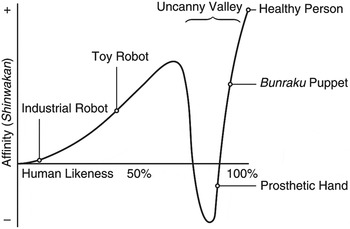
Mori's theory of the uncanny valley proposes a positive correlation between spectators’ affinity for a “human likeness” and the magnitude of that likeness's human likeness.Footnote 49 This correlation suddenly and drastically drops when that likeness's humanness breeches a certain threshold, with the resemblance to the human becoming disconcertingly lifelike, or uncanny, in appearance. Mori represented this theory visually, through a pair of graphs that charted the spectator's affinity for a likeness relative to the perceived humanness of that likeness. For example, the likenesses in the first of Mori's two graphs (Fig. 1) include, in ascending order of human likeness: industrial robot, toy robot, prosthetic hand, bunraku puppet, and healthy person. Spectators’ affinities for those likenesses exist in positive correlation with each likenesses’ proximity to the human. But there is one noticeable exception: the prosthetic hand that appears near the gulf of the aforementioned uncanny valley. The accompanying text clarifies that the prosthetic hand to which the graph refers (and that proves uncanny) is “a realistic prosthetic hand,” not the rubbery, yellowish, zippered variety that Whyte received.Footnote 50
Masahiro Mori's uncanny valley (static). Source: Masahiro Mori, “The Uncanny Valley,” trans. Karl F. MacDorman and Norri Kageki, IEEE Spectrum, 12 June 2012 (doi:10.1109/MRA.2012.2192811; original work published 1970), http://spectrum.ieee.org/automaton/robotics/humanoids/the-uncanny-valley.

Mori's attention to the prosthetic hand did not invent the centrality of disability to understandings of the uncanny. Disability already figured squarely in accounts of the uncanny by Ernst Jentsch and Sigmund Freud earlier in the twentieth century, accounts upon which Mori unevenly (if implicitly) draws in his writing. Jentsch discussed “the uncanny effect of epileptic fits, and of manifestations of insanity.”Footnote 51 Freud's corrective to Jentsch's reading of the uncanny focused on the threat of blindness.Footnote 52 In general, Mori's take on the uncanny approximates Jentsch's concept more closely than it does Freud's. Jentsch, like Mori, identified the uncanny as a crisis of animacy, of “‘doubts whether an apparently animate being is really alive; or conversely, whether a lifeless object might not be in fact animate.’”Footnote 53 Also like Jentsch, and in contrast to Freud, Mori appears uninterested in legislating the distinction between uncanny effects in everyday life and uncanny effects in representational practices such as literature (Jentsch) or bunraku puppet theatre (Mori).
But Mori's understanding of the uncanny departed from both of these antecedents in its normativizing and universalizing assumptions about the encounter between the spectator and the likeness. For example, both Jentsch and Freud account for potential differences among spectators encountering the uncanny. In Freud's understanding, Jentsch emphasized that “people vary so very greatly in their sensitivity to this quality of feeling” (the uncanny).Footnote 54 And Freud acknowledged that the uncanny was not an inherent property of a double but instead was relationally produced through an encounter between the double and a spectator at a particular stage of development. Rhee critiques Mori's assumptions about what figures as uncanny (and for whom it does so) by pointing out how his ideas decouple encounters with the uncanny from history. She highlights, for instance, how that which initially seems uncanny might become less uncanny through familiarity achieved through repeated exposure. The term shinwakan, translated as “affinity” in the 2012 translation of the uncanny valley essay Mori approved, had previously been translated to mean “familiarity.”Footnote 55 The graphs Whyte reproduced on the NTFDA's publicity materials adhere to this earlier translation.Footnote 56 As translations and representations of Mori's graph were circulated in the 1970s, they articulated a narrow vision of what constituted the human. They did so by depicting familiarity with the prosthetic hand as static and predetermined, and the spectator as unable to anticipate a moment in the future in which she might enjoy greater familiarity with disability.Footnote 57 Perhaps unsurprisingly, “handicapped people” also appear in the uncanny valley of earlier iterations of the graph, albeit with greater distance from the valley's basin than the prosthetic hand.Footnote 58
Mori's theory does more than extend associations of the uncanny with physical, intellectual, and psychosocial difference. It instantiates a peculiar manifestation of ableism, here represented by the assumption that ill, disabled, and prosthetic bodies are to be regarded as inferior to and less desirable than their healthy, nondisabled, and “organic” counterparts. Consider, for example, how Mori's graph accords the prosthetic hand a high degree of human likeness but a low level of affinity (locating it in the valley), whereas the “healthy person” enjoys the highest degree of human likeness and the greatest level of affinity. The “healthy person” is the human likeness that transgresses “likeness” and becomes the human rather than resembling the human or being proximal to it. Here, Mori reproduces ableist assumptions about the proximities of health and life, evoking not only Jentsch's identification of the discernment of animacy as the problem of the uncanny, but also Mel Chen's more recent assertion that “humans stereotyped as passive, such as people with cognitive or physical disabilities,” have been among those imagined outside of “the calculus of animacy.”Footnote 59
Mori's theory of the uncanny valley both assumes a universalizing spectatorial norm that erases differences among spectators and depends upon indifference toward the likeness's relationship to representation. This flattens out differences between likenesses that stand in for the human and likenesses that are human. Yet in light of the place of the prosthetic hand in Mori's graph, this indifference toward the likeness's representational status might more aptly be described as a kind of ambivalent theatricalism. Let me explain.
Mori's graphs seek to describe the disconcerting eeriness produced by nonhuman likenesses that too closely mimic the human without exactly dissolving the human–likeness divide. But these graphs also attempt to illuminate the pleasures produced when nonhuman likenesses, such as the toy robot, substitute for the human. These graphs are completely uninterested in legislating between uncanny effects in the everyday (a child's encounter with a seemingly animate doll) and uncanny effects in cultural production (the seemingly animate puppet in theatrical performance). The likenesses that figure in Mori's graphs include not only “nonhuman” human likenesses (the toy robot) but also “human” human likenesses (the healthy person). I have no interest in reinscribing the divide between the representational and the real that Mori erases, but I do wish to highlight how this indifference toward distinguishing between human likeness understood to be human and human likeness understood to be playing human frustrates efforts to think about the likenesses that populate his graphs in terms of representation.
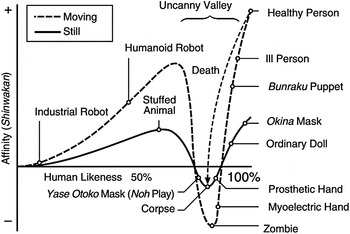
Turning to the second graph (Fig. 2) clarifies the relationship between disability and Mori's indifference toward the status of representation in his written and visual accounts of the uncanny valley. This graph depicts the differences between the uncanny effects of static likenesses and likenesses in motion. Like the first graph, this one includes some likenesses that are given to be playing at the human (the toy robot, the bunraku puppet), whereas other likenesses are given to be human. But even more so than its antecedent, this graph legislates the distinction between likenesses that represent the human and likenesses that are human primarily with regard to health and ability status. For example, it includes the likeness “ill person,” which achieves greater human likeness and greater spectatorial affinity than the prosthetic hand but fails in both counts when compared to the “healthy person.” Even if we concede Mori's claim that health status necessarily impacts spectators’ perceptions of human likenesses (and, by extension, their affinity for them), the question of representation remains. Mori's graph is unable to account for the distinction between an ill person and an ill character represented by an actor, much less the distinctions among an ill character represented by a “healthy” actor, an ill character represented by an ill actor, or a healthy character represented by an ill actor whose health status signifies in excess of that of her character.
Masahiro Mori's uncanny valley (with movement). Source: Masahiro Mori, “The Uncanny Valley,” trans. Karl F. MacDorman and Norri Kageki, IEEE Spectrum, 12 June 2012 (doi:10.1109/MRA.2012.2192811; original work published 1970), http://spectrum.ieee.org/automaton/robotics/humanoids/the-uncanny-valley.

The graphs mobilize health and ability in order to articulate the boundaries of the human. They also convene likenesses from different representational registers and, for many of the likenesses, obfuscate the conventions that enable spectators to apprehend a given likeness as human (or not). For example, Mori assumes that spectators’ encounters with bunraku puppets happen “in the theater” when “we are seated at a certain distance from the stage.”Footnote 60 He continues, “The puppet's absolute size is ignored, and its total appearance, including hand and eye movements, is close to that of a human being. So, given our tendency as an audience to become absorbed in this form of art, we might feel a high level of affinity for the puppet.”Footnote 61 We might approach this description of bunraku performance and spectatorial conventions with some trepidation. But for Mori, the puppet's proximity to humanness and spectators’ attendant experiences of absorption and feelings of “affinity” occur despite the fact that the puppet's “realism in terms of size, skin texture, and so on, does not even reach that of a realistic prosthetic hand.”Footnote 62 This affinity is enabled, his remarks suggest, by repeated, conventionalized exposure to the puppet in the context of theatre spectatorship. Yet when Mori asserts that “many of our readers have experience interacting with persons with physical disabilities, and all must have felt sympathy for those missing a hand or leg and wearing a prosthetic limb,” he does not similarly situate the prosthetic in a particular context or relative to a particular spectatorial convention.Footnote 63 Furthermore, he writes that people experience an “eerie sensation” upon discovering the artificiality of prosthetics with a “degree of resemblance” to organic body parts.Footnote 64 The former statement assumes that Mori's readers and, by extension, the spectators he imagines, are nondisabled. The latter statement assumes that encounters with prosthetic embodiment are isolated occurrences, that the “eerie sensation” never dissipates through repeated acquaintance with or even intimacy with the prosthetic. As Rhee notes, “Neither Mori's uncanny valley theory nor his recommendations to roboticists differentiates between initial encounters with humanoid figures and prolonged interactions with them.”Footnote 65 By evacuating the encounter with the prosthetic hand of any specific spatial, temporal, historical, or cultural framework, Mori represents his normative construction of the prosthetic's affect as merely descriptive of an enduring ontological truth. Wherever spectators encounter the prosthetic hand, it is certainly not onstage, and it is inevitably alienating in effect.
The prosthetic hand's indeterminate representational status thwarts Mori's attempt to use health and ability as viable orientations for legislating the distinction between the human and the nonhuman. The prosthetic hand is both a hand and material that purports to be a hand other than the hand that it is. The ambiguity of the prosthetic's representational status might seem less exceptional when we return to the question of theatre and performance. Might the prosthetic hand be like any other hand “in the theater,” where “a [hand] is a [hand] pretending to be another [hand]”?Footnote 66
The uncanny valley's revulsion toward signs of disability and its inability to account for the labor of representation—disabled or otherwise—makes it a curious artifact for the NTFDA to include in its publicity materials.Footnote 67 Perhaps the earlier translation of shinwakan as “familiarity” prompted Whyte to embrace theatrical representation as a method for extending humanity to disabled people. Perhaps in their efforts to develop work opportunities for artists with disabilities, Whyte and his colleagues identified Mori and his writings as political targets. Perhaps they hoped to denaturalize some of Mori's assumptions through their programming and activism concerning disabled artists in history. Whyte's hopelessly cosmetic glove was a far cry from the realistic prosthetics that informed Mori's theorization of the uncanny valley. What, then, of the prosthetic hand that makes no attempt to pass, even visually and texturally insisting upon its status as prosthetic? Reading the uncanny valley in tandem with the 1984 lecture suggests how Whyte mobilized anxieties about the prosthetic's animacy in order to perform disemployment.
Disemploying Prosthetics
Whyte addressed his cosmetic hand more explicitly in terms of work in the second half of his lecture, when he discusses his use of the glove to mine unnerving spectatorial encounters. He regarded such encounters not as problems that interfered with his ability to work, but as opportunities through which he might strategically resist the new tethering of disability to the labor market. When he accepted the DVR's glove, he agreed to wear it occasionally as instructed, “for … business, when I have to look normal” (PLS, 8). In recounting his date with Judith Bernstein, Whyte had already established the glove's failure to imbue him with anything approximating a “normal” corporeality. Thus, the professional scenario in which it would behoove Whyte to don the glove would be a peculiar one indeed, wherein “one simply did want to look disabled, but it was guaranteed no one would be likely to grab your hand” (9).
Unable to identify such a scenario, Whyte embarked upon an improvisatory research project approximately one month prior to his delivery of the lecture. Part ethnography, part performance art, part Boalian invisible theatre, he “dug out [his] cosmetic hand, put on a clean shirt … and a tie, and hit the streets” so that he could “run a few little surveys” (9). Whyte costumed himself not just as a job seeker but as a government administrator responsible for conducting similar surveys. Dressed to deliver a protean performance, he attended a series of interviews at job placement agencies, where he represented himself as “seeking employment in publishing as a copy editor” (10). As his description of these experiences proceeds, Whyte slips from first-person narration to scripted dialogue with “Miss X,” the name he assigns to the composite figure of the women with whom he interviewed (10). During his lecture, Whyte theatrically represents his interview experience across his own body, which was visually marked as disabled through his use of mobility aids: playing himself playing the DVR administrator playing the interviewer, a palimpsest of cross-class, cross-gender, and ostensibly cross-ability representation.
These interviews would begin pleasantly enough. But when things were “going along just fine,” Whyte would pause to “level with” the interviewer and disclose that he had an “artificial hand” (10). Then he would prompt the interviewer with a question: “It looks almost real, doesn't it?” (10). Miss X would assure him that “it won't interfere with [his] job performance” (11). At this point, Whyte would disclose his need to “take off the cosmetic hand and let my real hand and arm dry out” on account of the sweat that wearing the glove produced (11). In so doing, Whyte both rendered apparent the damaging effects of the prosthetic upon the real (something that he had represented earlier in the lecture as having driven Bernstein's own frustrations with the glove) and introduced the glove's ability to spark anxiety about prosthetic hygiene as exceeding the limits of accommodations for disabled workers.
Whyte senses that the composite Miss X is uncomfortable with his need periodically to remove the cosmetic glove from his withered arm. Her discomfort derives both from the visibility and the duration of the prosthetic undress—Whyte needs to “let it air out for about ten minutes” (12). He responds by promising discretion, offering to perform this task “in the bathroom” and, when possible, to have this act of self-care coincide with his scheduled coffee and lunch breaks (12). Miss X pauses and “makes some calculations on a piece of paper,” apparently concerned about the hour per day of work time that he would lose when away from his desk (12). Whyte volunteers his willingness to perform the task at his workstation. Miss X responds simply, “Umm, no” (13). She refocuses the conversation on the issue of precedent, inquiring about how he has negotiated these needs in prior workplace environments. Whyte reminds her that there is no precedent to speak of because he has “never worked in an office before” and proceeds to discuss his commitment to “wear[ing] the hand” (13). “It will improve my chances of getting a job,” Whyte informs her, on account of the fact that “my real hand is somewhat unpleasant” (13).
When Miss X continues to express her concerns about Whyte “being away from [his] desk a full hour every day,” he offers another alternative: “I really have to wear something, you know, some sort of prosthetic device. I could get a hook” (13). Whyte knew, of course, that his interviewer would find the prospect of him switching from a cosmetic hand to a functional hook even more alienating (and thus, even less viable) than the accommodations he had already suggested. Miss X ignores Whyte's suggestion about the hook and instead asks if he could “put air-holes or something in that hand” (13). Her recommendation highlights the inadequacy of the DVR-supplied prosthetic while at the same time suggesting that it was Whyte's responsibility to intervene upon its profoundly unlifelike design in order to make his bodily difference palatable to his coworkers. Miss X never mentions the possibility that a nonfunctional prosthetic might be superfluous, or that the DVR should be responsible for providing better prosthetics, or that the onus for acclimating to the withered arm be placed on his potential coworkers instead of on Whyte himself. Whyte concludes by feigning surprise that he had not heard back from any of the jobs to which he applied.
Whyte's lecture evidenced the expansive network of discourses and practices—from vocational rehabilitation to prosthetic design to banal workplace ableism—that colluded to make prosthetic embodiment both compulsory and impossible. But the lecture's significance goes beyond exposing the incommensurability of efforts to usher disabled Americans into the labor market and the resources allocated to support these efforts. Whyte's lecture contested compulsory labor as disability's political horizon, paradoxically through his work as a playwright and performer. His theatrical staging of the cosmetic glove both to avoid work and to enact work is a performance of disemployment.
Whyte pursued disemployment through theatrical performance, which was both the medium of his lecture and its subject matter. He played multiple characters, including Judith Bernstein, Miss X, and various iterations of himself. By inhabiting these roles, he recounted and reenacted scenes purporting to reflect “real” biographical experiences, the veracity of which we might approach with some skepticism. He also staged tension between how his body signified disability (through his use of mobility aids) and the site of disabled embodiment upon which the text of his lecture was focused (his cosmetic glove). Furthermore, the cosmetic glove was theatrical in its own right. It was resolute in its artifice, both visually and haptically, complete with fingerprints no more likely to index the identity of Whyte, to whom it belonged, than anyone else who might elect to wear it. Importantly for Whyte (and disconcertingly for Bernstein, Miss X, and others whom he encountered), the glove's artifice made it appear not only “fake” but also “dead.”
By embracing the glove's dubious representational status as well as its crisis of animacy, Whyte ensured that he would be interpreted as unhireable. In so doing, he highlighted the glove's inadequacy for fulfilling the DVR's goal of facilitating access to employment. Through Whyte's theatrical manipulation of its aesthetic and functional shortcomings, the cosmetic glove not only failed to facilitate his employability, it actively impeded it. Whyte's commitment to the glove's artifice and its debatable animacy was not limited to interviews with job placement agencies. He took the cosmetic glove's failure to facilitate employment and put it to work. His performance of the lecture amplified and otherwise extended the unseemly qualities already inherent to the glove. In so doing, Whyte entrepreneurialized his prosthetic embodiment and his rejection of work through that very prosthetic embodiment.
It is unclear whether Whyte received a fee for his delivery of the lecture at the conference, though a modest stipend would not have been unusual for such a talk.Footnote 68 The lecture depended upon Whyte's labor as a playwright and a performer, to be sure, but it also represented a new stage in his career arc as an expert of disability experience; that is, as a professional disabled person. Whyte had previously served in similar capacities through his administrative labor for the National Endowment for the Arts and HEW (to say nothing of his own NTFDA). Notably, this development unfolded during a point in his career when he experienced an intensification of his already chronic economic and social precarity. His ability to attend rehearsals and keep up with script rewrites was compromised by the leg prosthetics that were intended to facilitate his mobility. His 1984 lecture was not exceptional, but one of the many writing/performance practices to which he turned in order to negotiate this new reality.
Through his performance of the lecture, Whyte both documented his rejection of work and entrepreneurialized this refusal. This is the performance of disemployment. He also marked performance as disemployment, perhaps anticipating (with a particularly crip inflection) a suspicion that Nicholas Ridout and Rebecca Schneider share: that “the ‘not not’ work of theatre and its production of subjectivities [might] offer productive (or unproductive) ways of thinking about changes in the nature of work, its place in the life of the present, and its relation to futurity.”Footnote 69 Whyte's performance of disemployment similarly anticipates recent inquiries in queer and feminist disability studies that have approached with trepidation the reduction of disability politics to a concern with access to employment opportunities. Robert McRuer and Anna Mollow challenge modes of activism that are contingent upon disabled people affirming their desire to “work if only reasonable accommodations were granted.”Footnote 70 Instead, they champion a disability politics that contests the economic violence disabled people are subject to in times of state austerity: “Fuck employability.”Footnote 71 Whyte's performance of disemployment falls short of this more radical activist sentiment. Indeed, his simultaneous disavowal and embrace of work offers a paradoxical synthesis of the activist discourses McRuer and Mollow identify. Performances of disemployment nevertheless afforded Whyte an opportunity to survive and contest the precarity to which disabled Americans in the late twentieth century were increasingly subject.