Introduction
On clinical grounds, the diagnosis of mild cognitive impairment (MCI) as defined by Mayo Clinic criteria (Petersen et al., Reference Petersen, Smith, Waring, Ivnik, Tangalos and Kokmen1999) is an attempt to identify older individuals at risk of developing Alzheimer's disease (AD), given the characterization of cognitive symptoms compatible with those observed in pre-clinical stages of the disease. In MCI individuals, the presence of subjective memory complaints, preferably corroborated by an informant, are documented by an abnormal performance on cognitive tests adjusted for age and education. These deficits must have no, or minimal, impact on global intellectual functioning and on the ability to perform activities of daily living, and the patient must not display any evidence of dementia. A recent meta-analysis showed that patients with MCI evolve to dementia at rates of approximately 10% per year (Bruscoli and Lovestone, Reference Bruscoli and Lovestone2004). Boyle and colleagues (Reference Boyle, Wilson, Aggarwal, Tang and Bennett2006) showed that individuals with MCI have a 6.7 times higher risk of progressing to dementia compared to age-matched subjects from the general population. Such estimates are supported by other studies on the early predictors of dementia (Daly et al., Reference Daly, Zaitchik, Copeland, Schmahmann, Gunther and Albert2000). Nevertheless, these estimates show a great variability of conversion rates to dementia, from 5% to 40% per year (Bruscoli and Lovestone, Reference Bruscoli and Lovestone2004), depending primarily upon the setting in which the studies were carried out (clinical versus population-based studies).
In spite of the higher risk of developing dementia, a significant proportion of patients with MCI resume apparently normal cognitive function upon follow-up (Bennett et al., Reference Bennett2002). Single-domain MCI (either amnestic or non-amnestic) may represent an “unstable” diagnosis as a high proportion of these subjects will present with other cognitive states, ranging from normal cognitive performance to another MCI subtype, upon short-term follow-up (e.g. one year) (Diniz et al., Reference Diniz, Nunes, Yassuda and Forlenza2009a). On the other hand, multiple-domain MCI represents a more stable diagnosis upon short-term follow-up, being more predictive of dementia in clinical settings (Rozzini et al., Reference Rozzini2007).
Most of the studies that have addressed conversion rates from MCI to dementia used a last observation carried forward (LOCF) model. This analytical strategy does not take into account the transitions of cognitive states that take place between the first and the last assessment, in which case the sensitivity to track the pattern of transitional states of individual subjects prior to dementia is underestimated. The aim of the present study was to assess the pattern of diagnostic transitions of cognitive states in a sample of elderly subjects with varying degrees and types of cognitive impairment, ranging from normal (unimpaired) function to distinct MCI subtypes, prior to conversion to dementia.
Methods
Participants
The subjects of the present study were derived from a clinical cohort of older adults who are being reassessed annually in an outpatient psychogeriatric unit at the Institute of Psychiatry, Faculty of Medicine, University of São Paulo. Detailed information about patient recruitment, inclusion-exclusion criteria can be found elsewhere (Diniz et al., Reference Diniz2008a). Participants were originally recruited from community sources (community centers, newspapers and radio announcements), when a study on memory and aging was advertised. The sample also included participants who spontaneously sought medical attention related to memory complaints, or who were referred from other hospital units for assessment of suspected cognitive decline. A small number of participants (less than 5%) were volunteers who wanted to donate their time for a research study, mainly relatives who had accompanied a family member with memory concerns. Most of this clinical sample was therefore composed of older adults who were concerned about possible cognitive decline. In the present analysis, we included subjects who showed no sign of dementia at baseline and had at least one re-assessment with the same cognitive screening tests and neuropsychological instruments. A total of 139 community-dwelling subjects were included in this study (78% women, mean age, 68.5 ± 6.1 years; mean educational level, 11.7 ± 5.4 years). A subsample of subjects in this study was also included in a previous publication (Diniz et al., Reference Diniz, Nunes, Yassuda and Forlenza2009a). The study was approved by the Local Ethical Committee and was performed in accordance with the Helsinki Declaration.
Clinical and cognitive assessment
Patients and controls were examined by an expert multidisciplinary team, including geriatric psychiatrists, neurologists, geriatricians and neuropsychologists. Laboratory tests were carried out on every patient to rule out potentially reversible causes of cognitive impairment. These tests examined thyroid function, complete blood count, blood chemistry, folic acid and vitamin B12, blood lipid profile, and syphilis). Neuroimaging studies (CT scans or MRI) were completed according to clinical judgment to rule out cases with relevant underlying cerebrovascular disease. Baseline cognitive assessments were carried out using the Brazilian version of the Cambridge Examination for Mental Disorders in the Elderly (CAMDEX) semi-structured interview (Roth et al., Reference Roth1986), which yields scores for the Cambridge Cognitive Test (CAMCOG) (Nunes et al., Reference Nunes2008), the Mini-mental State Examination (MMSE; Folstein et al., Reference Folstein, Folstein and McHugh1975) and the animal Verbal Fluency test. The Clock Drawing Test, which is also part of the CAMCOG schedule, was additionally scored according to Sunderland's guidelines (Sunderland et al., Reference Sunderland1989). The 21-item Hamilton Depression Scale was administered to assess for depressive symptoms and patients with scores higher than 7 were excluded from further analysis.
A comprehensive neuropsychological evaluation was carried out by trained neuropsychologists and included the Rivermead Behavioral Memory Test (RBMT; Wilson et al., Reference Wilson, Cockburn and Baddeley1985), the Fuld Object-Memory Evaluation (FOME; Fuld, Reference Fuld1980), Verbal Fluency (category: fruit), the Trail Making Test (TMT) A and B (Army Individual Test Battery, 1945), the Short Cognitive Test (SKT; Flaks et al., Reference Flaks2006) and the Wechsler Adult Intelligence Scale-Revised (WAIS-R) Vocabulary and Block Design tests (Wechsler Reference Wechsler1981). Cognitive impairment was defined according to the Mayo Clinic diagnostic criteria for MCI (Petersen et al., Reference Petersen, Smith, Waring, Ivnik, Tangalos and Kokmen1999), which subsume the characterization of abnormal performance on cognitive tests (below -1.5 standard deviation from age- and education-corrected population norms), in this case adjusted the Brazilian population (Yassuda et al., Reference Yassuda2009). Evidence of functional decline was based on the scores of the Informant Questionnaire of Cognitive Disorders of the Elderly (IQCODE; Jorm and Jacomb, Reference Jorm and Jacomb1989) and on all available evidence of difficulties in the performance of basic and instrumental activities of daily living, as reported by a close relative or caregiver, and on the patient's self-report.
Follow-up assessments were undertaken at one-year intervals (mean duration of follow-up 2.7 ± 1.1 years), regardless of the patient's baseline diagnosis. The same clinical, cognitive and neuropsychological assessment protocols were administered on each follow-up visit. For the sake of conciseness, only the baseline scores on the CAMCOG and on the MMSE are reported in this paper.
Clinical diagnosis
Consensus diagnoses were reached at expert multidisciplinary meetings, where all available information about current medical history and assessment instruments was taken into account. The definition of the current cognitive status was based on the performance on the neuropsychological evaluation. Diagnosis of MCI was made according to the following criteria: (1) subjective cognitive complaint, preferably corroborated by an informant; (2) objective cognitive impairment in the neuropsychological assessment; (3) preserved global intellectual function; (4) preserved or minimal impairments in activities of daily living; and (5) no dementia. MCI patients were further allocated to three different sub-categories according to the pattern of impairment on neuropsychological evaluation: (a) amnestic (aMCI), (b) non-amnestic (naMCI), and (c) multiple-domain (mdMCI). Individuals without any objective evidence of cognitive impairment were regarded as controls. ADe was diagnosed according to the NINCDS-ADRDA criteria (McKhann et al., Reference McKhann, Drachman, Folstein, Katzman, Price and Stadlam1984). The diagnoses of the patients in the follow-up assessments were done independently of the previous diagnosis, and took into account only data obtained in the current assessment.
Statistical analysis
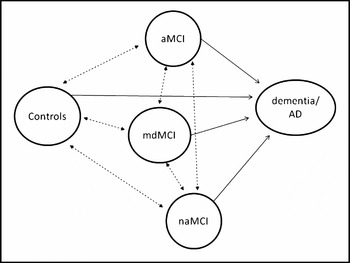
The distribution of categorical variables across the diagnostic groups at baseline was assessed using χ2 analyses. Analyses of variance were carried out to assess for mean differences among the diagnostic groups for age, educational level, scores on the CAMCOG and on the MMSE, follow-up length, and number of transitions. We further modeled the diagnostic transitions with the aid of the Markov chain (Neumann et al., Reference Neumann2001). In this analysis, the conditional distribution of the status of an individual participant at an arbitrary examination, given the subject's status at previous examinations, was assumed to have the Markov property (i.e. that his or her status at this examination depended on the status at only the most recent previous examination and was independent of status at other previous examinations). In this analysis, normal cognitive function and distinct MCI subtypes (amnestic, non-amnestic, and multiple domain) were considered transient states, whereas dementia/AD was the absorbing state (Figure 1). All statistical analyses were performed with the Statistical Package for Social Sciences v. 14 for Windows (SPSS Inc., Chicago, IL) and the software R: A Language and Environment for Statistical Computing version 2.4.1 (R Foundation for Statistical Computing, Vienna, Austria).
Pattern of possible transitions (absorbing and non-absorbing) from control and mild cognitive impairment subtype subjects.
aMCI = amnestic mild cognitive impairment; naMCI = non-amnestic mild cognitive impairment; mdMCI = multiple-domain mild cognitive impairment; AD = Alzheimer's disease.
Dashed and double-direction arrows indicate possible transitions amid non-absorbing states; solid and one-direction arrows indicate possible transitions to the absorbing state.

Results
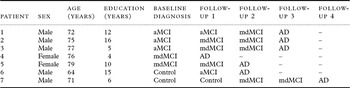
At baseline assessment, 67 subjects showed no evidence of cognitive impairment (controls), 17 were diagnosed as having amnestic MCI, 8 as having non-amnestic MCI, and 47 as having multiple-domain MCI. Mean duration of follow-up in this cohort was 2.7 ± 1.1 years. Multiple-domain MCI subjects had fewer years of education and lower CAMCOG and MMSE scores compared to the other diagnostic groups (Table 1). There were no statistical differences in age, length of follow-up, and number of diagnostic transitions among the diagnostic groups. From the initial cohort, seven patients progressed to Alzheimer's disease (AD) upon follow-up. Three of these had baseline diagnosis of single-domain amnestic MCI, two of multiple-domain amnestic MCI, and two had been allocated as controls. The annualized rate of conversion to AD in this cohort was 1% among controls and 3% in the MCI group as a whole.
Baseline data and scores on MMSE and CAMCOG according to diagnostic group

aMCI = amnestic MCI; naMCI = non-amnestic MCI; mdMCI = multiple-domain amnestic MCI; MMSE = Mini-mental State Examination.
ANOVA unadjusted model: *p<0.001; **p = 0.002; ***p = 0.267; † p = 0.224; ‡ p = 0.349.
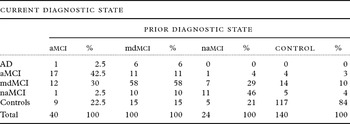
Table 2 displays the pattern of diagnostic transitions within each diagnostic category according to Markov chain analysis. This analysis shows that prior to conversion to AD, the most common diagnosis was multiple-domain MCI (six cases), followed by amnestic MCI (one case). Progression to AD was not observed when the immediately previous diagnosis was of non-amnestic MCI or of unimpaired cognition (controls). Table 3 shows the trajectory of cognitive impairment in patients who progressed to AD.
Transition patterns of mild cognitive impairment and controls subjects as showed by the Markov chain

AD = Alzheimer's disease; aMCI – amnestic mild cognitive impairment; mdMCI = multiple-domain mild cognitive impairment; naMCI = non-amnestic mild cognitive impairment.
Diagnostic trajectories towards Alzheimer's disease in individual patients

AD = Alzheimer's disease; aMCI = amnestic mild cognitive impairment; mdMCI = multiple-domain mild cognitive impairment; naMCI = non-amnestic mild cognitive impairment.
Subjects with amnestic and non-amnestic MCI most commonly retained the same diagnosis in a consecutive assessment (42.5% and 46%, respectively) or progressed to multiple-domain MCI (29% in both cases). For those with multiple-domain MCI and for cognitively unimpaired subjects, the same cognitive state was reinforced in a subsequent assessment in 58% and 84% of cases, respectively. Nevertheless, a high proportion of amnestic and non-amnestic MCI subjects (22.5% and 21%, respectively) resumed normal cognitive function in the subsequent assessment. This proportion was lower among the multiple-domain MCI subjects (15%).
Discussion
The annualized conversion rate from MCI to AD in the present sample (3%) was lower than that reported by earlier studies, ranging from 10% to 12%, or up to 50% within four years (Petersen et al., Reference Petersen, Smith, Waring, Ivnik, Tangalos and Kokmen1999; Bruscoli and Lovestone, Reference Bruscoli and Lovestone2004), but similar to the rates of 4–5% found in more recent and conservative estimates, including intervention trials with large patient groups (Feldman et al., Reference Feldman2007). Conversion rates may vary considerably according to demographic, biological and clinical variables, such as the mean age of the cohort, the presence of other known risk factors (e.g. the apolipoprotein E (APOE) ɛ4 allele), and the magnitude of cognitive deficits at the moment of inclusion (Forlenza and Chiu, Reference Forlenza and Chiu2008). In the present study, we found that multiple-domain MCI most often anticipates the conversion to AD, and that this outcome was not observed within one year of follow-up among subjects who had either normal cognitive function or non-amnestic MCI at baseline. A high proportion of subjects previously diagnosed with MCI resumed normal cognitive function in the subsequent assessment, mainly those with single-domain MCI, both amnestic and non-amnestic subtypes (Diniz et al., Reference Diniz, Nunes, Yassuda and Forlenza2009a).
Our results raise relevant issues concerning the transitions from normal cognitive aging to dementia. First, subjects who progress to dementia may experience a stepwise decline, starting from normal cognitive function and evolving through subtle formal cognitive impairment (e.g. single-domain amnestic MCI) to a more widespread and relevant dysfunction (e.g. multiple-domain amnestic MCI) and finally to dementia/AD. Subjects with milder deficits, either amnestic or non-amnestic, are more prone to shift to other cognitive states, which are frequently characterized by less severe forms of impairment, as opposed to subjects with normal cognitive function who usually retain that diagnosis over time (i.e. keep the same classification of cognitive state in a subsequent evaluation). MCI patients with more severe or multimodal deficits, as observed in multiple-domain MCI, tend to remain in the same category or to progress to dementia in subsequent assessments. In other words, in early stages of cognitive impairment (e.g. single-domain amnestic or non-amnestic MCI) there is a great heterogeneity in the patterns of transition between cognitive states. Outcomes may include either “forward” (worsening of symptoms) or “backward” (partial or full recovery) cognitive shifts. Along with the aging process, a subset of these patients develops more widespread cognitive deficits, which tend to be more stable over time and to move “forward” in the direction of the dementia threshold.
Our results are supported by similar findings presented by Tyas and colleagues (Reference Tyas2007). They used a similar approach in an epidemiological study and showed that, within the MCI spectrum, the more severe the cognitive impairment, the more stable the deficits and the greater the risk of progression to dementia. An important clinical implication related to the present finding is the notion that the longitudinal evaluation of cognitive signs and symptoms provides more reliable diagnostic information than the cross-sectional characterization of MCI. As a consequence, estimating the prognosis of MCI based on a single assessment is inaccurate in the absence of a clear-cut cognitive syndrome, compatible with the prodromal stages of AD, or if the supportive evidence of the AD pathology drawn from biomarkers is not available (Diniz et al., Reference Diniz, Pinto and Forlenza2008b). In the absence of such technologies the best approach to diagnostic refinement is indeed the longitudinal reassessment on a regular basis. This obviously affects the decision of whether or not to treat MCI patients with the currently available medications (Diniz et al., Reference Diniz, Pinto, Gonzaga, Guimarães, Gattaz and Forlenza2009b).
The development of therapeutic strategies with disease-modifying properties will require that the diagnosis of AD be made in the early stages of the disease, when these approaches may be more efficacious in arresting the disease process. Randomized clinical trials of cholinesterase inhibitors in MCI failed to demonstrate significant benefits affecting the primary outcome variable, i.e. delaying the conversion from MCI to AD (Petersen, Reference Petersen2007). One of the main reasons put forward to explain the negative results of these trials is that the inclusion of MCI subjects based solely on the clinical diagnosis of MCI yields a heterogeneous sample of patients in which a significant number of subjects may not have pre-clinical AD (Petersen, Reference Petersen2007). Therefore, randomized trials assessing the disease-modifying properties of a drug to be prescribed at pre-dementia stages should ideally recruit patients who are positive to AD biomarkers (e.g. using cerebrospinal fluid analysis, genetic or imaging), or who have been identified through the longitudinal characterization of their cognitive state. In the latter case, only those presenting with stable or worsening amnestic deficits should be randomized, in order to yield a test group of subjects with a higher probability to progress to AD. Given the fact that the putative disease-modifying properties of any anti-dementia drug will result in supposedly small clinical and cognitive effects, the identification of high-risk individuals is necessary to recruit subjects who are more likely to benefit from the intervention (Vellas et al., Reference Vellas2008). Based on the present findings, we further suggest that the target sample for such trials should comprise patients with multiple-domain amnestic MCI, as these subjects represent a condition closer to pre-dementia AD.
This study has some limitations. One of the most important weaknesses is that Markov chain analysis does not allow controlling for the known risk factors for AD, such as age, education and the presence of the APOEɛ4 allele, in the modeling of individual patterns of diagnostic transitions. In view of this limitation, the lower educational status and worse baseline cognitive performance in patients with multiple-domain MCI might have biased the present pattern of diagnostic transitions. Also, the low incidence of AD, the unbalanced distribution of MCI subtypes and the younger age of MCI patients in this cohort might limit the power of this modeling strategy. Nevertheless, this modeling strategy may reflect with higher accuracy what is observed in the “clinical real world,” giving a better picture of individual patterns of clinical evolution. As patients with multiple-domain MCI had lower scores on the cognitive battery, one might conclude that some of them in fact had minimal dementia, and thus be likely to receive a diagnosis of dementia/AD in the next follow-up assessment. Nevertheless, these subjects underwent comprehensive clinical, neuropsychiatric and neuropsychological evaluations which did not reveal significant functional impairment. Therefore, the diagnosis of dementia could not be warranted, despite their worse cognitive performance. Given these factors, the present results should be viewed as preliminary and should be replicated in other settings. Recent studies from our group indicate that, in patients with MCI, executive dysfunction correlates with functional impairment, which can be present in mild degrees in patients without dementia (Pereira et al., Reference Pereira, Yassuda, Oliveira and Forlenza2008).
In conclusion, subjects with MCI depict a heterogeneous pattern of transitions between cognitive states. Nevertheless, subjects with more severe and widespread cognitive deficits, namely multiple-domain MCI, tend to have more stable cognitive deficits which better predict the diagnosis of AD. Future re-analyses of the present sample, with extended follow-up and a larger number of conversions to AD will hopefully enable us to provide a critical review of the current findings, and to integrate clinical and biological (neuroimaging, CSF) markers of the disease process.
Conflict of interest
None.
Description of authors' roles
O.V. Forlenza formulated the research question, designed the study, supervised the data collection and wrote the final version of the manuscript. B.S. Diniz participated in data collection, conducted the analysis and wrote the first draft of the paper. P.V. Nunes, C.M. Memória and M.S. Yassuda participated in data collection. W.F. Gattaz revised the final version of the manuscript and coordinated the whole team.
Acknowledgments
We thank Jony Arrais Pinto Jr. for assisting with the statistical analysis. This work was funded by grants from Fundação de Amparo à Pesquisa do Estado de São Paulo (FAPESP, grant number 02/12633–7), Associação Beneficente Alzira Denise Hertzog da Silva (ABADHS). Dr. Breno Satler Diniz received research financial support from the CAPES, Brazil.