Introduction
Educational attainment is an important factor in understanding the changes in demographic behaviour of individuals, and its association with changes in the fertility behaviour of women is of particular interest in social science research. Research in different parts of the world, and spanning a long period, has mostly reported a negative relationship between education of women and family formation (Hoem, Reference Hoem1986; Blossfeld & Huinink, Reference Blossfeld and Huinink1991; Rindfuss et al., Reference Rindfuss, Bumpass and St John1980; Liefbroer et al., Reference Liefbroer and Corijn1999; Kreyenfeld, Reference Kreyenfeld2000; Kravdal, Reference Kravdal2004). Increase in educational level may be multidimensional in its effect on different aspects of society, and changes in nuptiality is one among many (UNDP, 2002). Although it is most likely that women of different socioeconomic status react differently to education changes (Zeman, Reference Zeman2007), one obvious finding is that an increase in the level of a woman's schooling affects the timing of her marriage and fertility (Maralani & Mare, Reference Maralani and Mare2008). It has been documented in earlier research that marital and student roles are incompatible, thus with an increase in levels of school enrolment, marriage among school-going girls may decline (Blossfeld & Huinink, Reference Blossfeld and Huinink1991; Raymo, Reference Raymo1998, Reference Raymo2003). In addition, getting married at an early age has significant opportunity costs, resulting in the postponement of marriage (Thornton et al., Reference Thornton, Axinn and Teachman1995; Gustafsson, Reference Gustafsson2001). Further, schooling exposes girls to new ideas, attitudes and aspirations bringing about ideational changes (Kritz & Gurak, Reference Kritz and Gurak1989; Caldwell, Reference Caldwell2005). Studies in India have also reported a delay in marriage due to schooling (Bloom & Reddy, Reference Bloom and Reddy1986; Dharmalingam, Reference Dharmalingam1994; Das & Dey, Reference Das and Dey1998).
Earlier studies have found a range of possible links between female education and changes in aspects of family formation. The improvement in female education will not only influence the age at marriage, but also choice of partner and hence the pattern of family formation. These factors decide the number of children the couple will have, family resources available to each child and eventually the educational attainment of children in the family. In India, family is the major social unit, and all the important decisions in the family are made by the head of the household. Therefore, it is important to know how the education of women affects family-related issues. Research shows that, over time, there has been a significant change in the pattern of union formation across the world, with an increase in educational homogamy, and the changes are not limited to developed countries (Mare, Reference Mare1991; Qian & Preston, Reference Qian and Preston1993; Kremer, Reference Kremer1997; Smits et al., Reference Smits, Ultee and Lammers1998; Fernandez et al., Reference Fernandez, Guner and Knowles2005; Esteve & Cortina, Reference Esteve and Cortina2006; Hou & John, Reference Hou and John2007). Aspects of marriage have changed in Asian countries over the last decade (Jones, Reference Jones2010). Dalmia & Lawrence (Reference Dalmia and Lawrence2001) reported an increase in positive assortative mating in India, with significant regional variations within the country. They reported that the probability of assortative mating was higher in southern India than in northern India. The improvement in female literacy may be an important factor behind the changes in the pattern of marital unions in India.
In India, female education has improved significantly over time. According to the decennial census of India, female literacy was only around 9% in 1951, but increased to 54% in 2001 and 66% in 2011. Age at marriage has also shifted in India for both males and females (Goyal, Reference Goyal1988). At the same time, India has experienced a decline in fertility since 1971, even though this has been at a much slower pace than expected. In addition, the fertility rate of uneducated woman has been found to be higher than that of educated women (IIPS & Macro International, 2007). Demographic studies have considered the improvement in female literacy as a significant factor for fertility decline (Diamond et al., Reference Diamond, Newby, Varle, Bledsoe, Casterline, Johnson and Haaga1999; Dreze & Murthi, Reference Dreze and Murthi2001). Female education has been said to have both fertility depressing and fertility increasing effects, but the net effect is a reduction in fertility (Reddy, Reference Reddy2003). With an improvement in education, women get the opportunity to decide about employment- and marriage-related issues. Also, as they become aware of the biology of reproduction they will take better care of their children's health and education (Kasarda et al., Reference Kasarda, Billy and West1986). In addition, increase in the years of schooling of a mother improves her basic skills, knowledge and thinking, which in turn will enable her to create better learning environments at home for her children than less educated women (Alexander et al., Reference Alexander, Entwisle and Bedinger1994; Halle et al., Reference Halle, Kurtz and Mahoney1997; Corwyn & Bradley, Reference Corwyn, Bradley, Bengtson, Acock, Allen, Anderson and Klein2003; Davis et al., Reference Davis2005). On the other hand, earlier research has observed that illiterate women had the highest contribution to fertility decline in India through increased use of contraception (Bhat, Reference Bhat2002b; Arokiasamy, Reference Arokiasamy2009).
Thus, earlier research suggests that the improvement in female literacy is accompanied by changes in patterns of marital unions, which will affect the next generation as well. The effect of parental education and socioeconomic condition can be seen through the educational attainment of their offspring (Mukherjee & Das, Reference Mukherjee and Das2008). There is a difference in opinion regarding the association of parental education with children's educational attainment. Some researchers suggest that mother's education has a positive and direct influence on children's education (Butcher & Case, Reference Butcher and Case1994); contrary to this, some argue that mother's education has little effect on the educational attainment of children, holding other factors constant (Behrman & Rosenzweig, Reference Behrman and Rosenzweig2002). Others have the opinion that a mother's schooling improves her child's schooling indirectly through her marriage partner (Plug, Reference Plug2002). Highly educated parents may increase the likelihood of attaining higher educational degrees for their children compared with less educated parents (Tansel, Reference Tansel1997; Farré et al. Reference Farré, Roger and Vella2009; Pereira, Reference Pereira2010). Feinstein & Duckworth (Reference Feinstein and Duckworth2006) suggested that mothers with post-compulsory education may provide better home environments for their children to acquire a better education. Thus, the increase in schooling at the individual level may be influenced by family background. Some researchers argue that the effect of maternal education is large for daughters, while paternal education matters for son's educational decisions, suggesting a role model effect (Chevalier, Reference Chevalier2004). Pronzato (Reference Pronzato2010), on the other hand, reported a positive effect of education of both the parents on children's education, with a comparatively smaller impact of the mother's than the father's education.
It is also important to know whether improvement in female education is reducing fertility, or if a decline in fertility helps to provide better educational facilities for children (Bhat, Reference Bhat2002a). In developing countries, fewer children would provide employment opportunities to women, thereby contributing to family income (Tayfur et al., Reference Tayfur, Kirdar and Koc2008). A lower fertility rate would also influence other economic decisions in the family, such as a child's marriage, family labour supply, inter-generational transfers and household living arrangements (Schultz, Reference Schultz, Schultz and Strauss2008). The views of researchers differ on the relationship between fertility decline and educational attainment of children. Several concluded that fertility and children's schooling are jointly determined (Wolfe & Behrman, Reference Wolfe and Behrman1984; Caldwell et al., Reference Caldwell, Reddy and Caldwell1985; Axinn, Reference Axinn1993), while others recommended that fertility and child outcomes have no meaningful association (Black et al., Reference Black, Devereux and Salvanes2005; Angrist et al., Reference Angrist, Lavy and Schlosser2006). Qian (Reference Qian2005), in contrast, found that an increase from zero to one sibling has a positive effect on children's schooling, while an increase from one to two siblings has a negative effect.
On the backdrop of the above discussions and findings from earlier research, it is clear that changes in the demographic behaviour of women can't be examined in isolation from improvement in levels of female literacy. In addition, studies have revealed that marriages determine the family backgrounds for their offspring and thus affect the social characteristics of the next generation (Mare, Reference Mare2000). Therefore, it may be said that education of parents alone doesn't determine the education of their offspring. So this study focused on a series of events that occur in sequence, starting with the educational attainment of women, differentials in mate selection, age at marriage, number of children ever born and then educational attainment of their offspring, to examine the association of changes in demographic bebaviour of women with the changes in their education. Given the cultural diversity of India, and the role of family in decision-making, this study will be useful in bringing out the association of female education with different aspects of family formation.
Data and Methods
This study used data from the third round of the District Level Household and Facility Survey (DLHS-3) conducted during 2007–08 (IIPS, 2010). The earlier rounds of the survey were carried out in 1998–99 (DLHS-1) and 2002–04 (DLHS-2). Financial assistance for DLHS-3 was provided by the Union Ministry of Health and Family Welfare, United Nations Population Fund (UNFPA) and United Nations Children's Fund (UNICEF). The DLHS is one of the largest ever demographic and health surveys carried out in India at the district level.
The DLHS-3 survey collected data from more than 720,320 households from 601 districts of India covering 3,784,031 persons of all ages (1,932,070 males and 1,851,804 females). Both married (15–49 years) and unmarried women (15–24 years) were interviewed. Information was collected on years of schooling and the educational level of those who had ever attended school. Information was also collected on the status of current school/college attendance for usual members in the household in the 6–17 year age group. Information on the demographic and socioeconomic profile of women is also available through a separate questionnaire for ever-married women. The main advantage of using this data set is that it provides individual-level information on the educational attainment of each member of the household.
The study used information on the relationship of the respondent to the head of the household, number of children ever born and the educational attainment of the respondent and other family members. The family was identified from the information on the relation to the head of the household. The ever-married women sample used in the study was extracted from households with only one ever-married woman aged 35 years or above and having children in the 5–20 year age group. Based on these selection criteria, the total sample size for the study was 344,164 ever-married women. This ever-married women sample was then used to examine the number of children ever born and the congruence in educational attainment of the children. Incongruence in educational attainment was examined by identifying the gap between the expected and actual years of schooling for children who were enrolled in school at the time of the survey and studying at a grade below the expected grade for their age. Poisson regression was used to estimate the average number of children born to couples with different levels of education. Further, the Cox Proportional Hazard model was used to examine the incongruence in children's educational attainment and discontinuation from school. The educational attainment of husband and wife was categorized as: no education, primary, middle & high school, higher secondary and graduate & above. The educational attainment of couples was further classified into 25 categories based on the education of husband and wife. The average number of children born to couples was examined first, by controlling husband's education for different levels of wife's education. Second, estimation was done for different levels of husband's education by controlling wife's education from low to high levels, in order to identify whether the education of husband or wife has a greater association with the number of children ever born.
The socioeconomic and demographic indicators included in the analysis were: age at marriage for mother (less than 18, 18–24, 25 & above), education of mother (no education, primary, middle & high school, higher secondary, graduate & above), number of children ever born (1 or 2, 3, 4+), sex composition of siblings, place of residence (rural, urban), religion of the household (Hindu, Muslim, Christian, other), caste of the household (Scheduled Caste, Scheduled Tribe, Other Backward Classes, Other) and wealth index (poorest, second, middle, fourth, richest). In order to examine the incongruence in education, the study examined the gap between the expected and actual years of schooling for children according to their age. Further, the study applied the Cox Proportional Hazard model to examine the factors associated with incongruence and school discontinuation, for children of different socioeconomic backgrounds. Event failure is defined for those children who could not attain a grade according to their age.
Results
Association of education and other variables with age at marriage
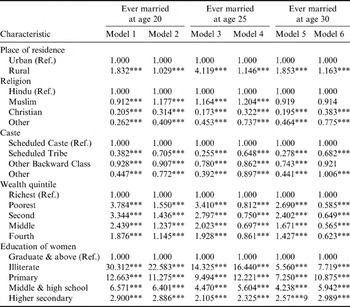
In India, age at marriage does not depend on women's education alone, and a range of social, cultural and economic factors work together to decide the age and partner for marriage. Therefore, the study first examined the association of different factors with women's age at marriage, and the results are presented in Table 1. Model 1, Model 3 and Model 5 give the unadjusted odds ratios of the variables on age at marriage for those women who were married at the ages of 20, 25 and 30, respectively. Model 2, Model 4 and Model 6 give the odds ratio for age at marriage after adjusting for household-level variables. The results show that all the variables have significant associations with age at marriage of women, whether it is taken as an independent predictor for age at marriage or adjusted for all the household-level variables. Of the five selected variables, the economic condition of the household and educational attainment of women has the highest association for all three selected cut-off points of age at marriage. It is also observed that with an increase in age, the effect of wealth quintile and education of women declines slightly, but still the education of women remains the most significant predictor for age at marriage. On the basis of these results, the association of education of women with other indicators of change in demographic behaviour was examined.
Logistic regression to show the association of education and other factors with age at marriage, DLHS-3 (2007–08), India

Model 1: unadjusted effect of household factors for those married at age 20; Model 2: adjusted effect of household factors for those married at age 20; Model 3: unadjusted effect of household factors for those married at age 25; Model 4: adjusted effect of household factors for those married at age 25; Model 5: unadjusted effect of household factors for those married at age 30; Model 6: Adjusted effect of household factors for those married at age 30.
Educational attainment of women and differences in age at family formation
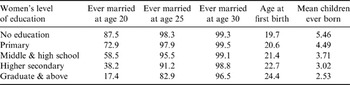
Table 2 shows the demographic profile of women, i.e. age at marriage, age at first birth and number of children ever born, by their educational level. Only women aged 35 and above with at least one child aged between 5 and 20 years of age at the time of the survey were included. It is seen that the percentage of women married at younger ages declines with increase in each level of education. For example, 87% of uneducated women got married by age 20, declining to 73%, 59% and 17% respectively for women with primary, high school and graduate and above levels of education. Women with high levels of education catch up with their less educated counterparts in terms of percentage ever married by age 30. Subsequent differences in age at first birth and average number of children ever born to women with different levels of education are also visible in the study sample. Age at first birth increases from 20 years for uneducated women to above 24 years for graduate women. The results also depict a gradual decline in the number of children ever born from 5.5 children for uneducated women to 2.5 children for women with graduate and above level of education.
Percentage distribution of sample women by education level and other demographic characteristics, DLHS-3 (2007–08), India

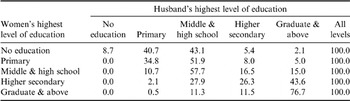
In addition to age at marriage and number of children ever born, improvement in female education will also influence the educational distribution of couples. Later, the educational attainment of parents will create the household environment in which children grow up. Therefore, the distribution of the educational attainment of husband and wife was examined (see Table 3). It is seen that women were married to men with either the same or higher level of education than themselves. In the case of illiterate women, less than 10% were married to illiterate men, and there were no marriages between illiterate men and higher educated women. The distribution of educational attainment of husband and wife indicates the presence of educational hypergamy (i.e. less educated women getting married to higher educated men) and a fairly high degree of educational homogamy (i.e. marriage between individuals with the same level of education).
Percentage distribution of educational attainment of husbands and wives, DLHS-3 (2007–08), India

Differential impact of education on number of children ever born to couples
Marriage may affect the educational reproduction process. The increase in women's educational attainment increases the probability that a woman will marry someone with a higher level of education than her own, which further increases the advantages that accrue to the couple's children. At the population level, marriage alters the education distribution of the next generation, both directly through changes in the joint distribution of mothers' and fathers' schooling and indirectly through its effect on levels and differentials in fertility (Mare & Maralani, Reference Mare and Maralani2006). Therefore, it is important to know whether the education of the husband or wife has a stronger association with the number of children born. Therefore, the study examined the average number of children born to parents with all possible combinations of education.
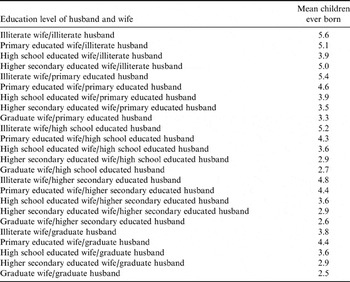
The average number of children ever born to parents with different levels of schooling was estimated to examine the effect of educational level of either parent on the number of children born (Table 4). In order to examine the effect of women's education on children ever born, first the education of husband was controlled at one level and the number of children for different levels of wife's education was estimated. Again, estimation was done for different levels of husband's education by controlling wife's education. There was no significant association of husband's education with number of children ever born while controlling wife's education. Therefore, Table 4 gives the results on the average number of children born for changes in levels of wife's education, controlling husband's education. There was no consistent pattern of decline in number of children ever born when the husband was illiterate but the wife was educated. Since there was no observation in the category of illiterate husband and graduate wife, this category is not shown in the table. With husband's education held constant at primary level, mean children ever born decreased substantially from 5.4 children for illiterate women to 3.9 children for high school educated and 3.3 children for graduate women. Thus, with an increase in the education of wife from illiterate to graduate, there was a decline of 2.1 children, on average, for a couple. Similarly, when education of husband was controlled at high school, the average number of children born declined from 5.2 for when the wife was illiterate to 2.7 children when the wife was a graduate. In this case, there is a decline of 2.5 children for a couple. A similar decline in number of children ever born was noticed with an increase in levels of wife's education while controlling husband's education at higher secondary or graduate level.
Average number of children ever born to parents with different level of education, DLHS-3 (2007–08), India

Note: estimation from Poisson regression.
The findings from the study show that, with an increase in the education of the wife, the number of children born to couples has declined, even after controlling husband's education. On the basis of these results, it may be said that wife's education has a greater association with number of children born than husband's education. On the basis of the observations from Table 4, the study further focused on the education of women, to examine the gap between actual and expected years of schooling, incongruence in educational attainment and discontinuation from school, for children.
Incongruence in years of schooling of children based on education of mother
Given the cross-sectional nature of the data, information on the educational attainment of children was available only up to the survey period, which may not be the highest education for children, who were of school-going ages. In view of the limitation of the data, the study tried to examine the existing gap between actual and expected years of schooling for children who were enrolled in school at the time of the survey, and the percentage of children who discontinued before completing school education. It is assumed that, once there is a gap in the expected and actual years of schooling, it will be difficult to cover that gap with the increase in age. For children who discontinue before completing the few years of compulsory schooling, they are less likely to return to school and take up education again.
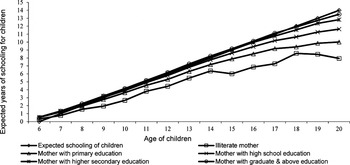
The actual and expected years of schooling for children by the educational attainment of mothers are presented in Fig. 1. The straight line gives the expected years of schooling for children by their age, and the other lines show the actual years of schooling according to the educational attainment of mothers. It is seen that the lines for expected and actual years of schooling almost overlap for children with graduate mothers. Slowly, there emerges a gap between actual and expected years of schooling for children whose mothers are comparatively less educated. The highest gap is identified for children whose mothers are uneducated. The graph also shows that children are enrolled in school at exact ages, and up to age 10 only negligible differences appear between actual and expected years of schooling for all children, except for children with uneducated mothers. The gap appears with an increase in age, when children are expected to attain upper grades.
Actual and expected years of schooling for children by mother's educational attainment, DLHS-3 (2007–08), India.

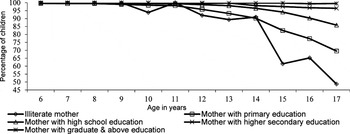
Figure 1 shows that the gap between actual and expected years of schooling for children increases with age, if mothers have low levels of education. On the basis of this finding, the paper further analysed the pattern of school continuation for children by education of the mother, and this is presented in Fig. 2. The graph reveals that the percentage of children continuing school declines from the age of 9 years. The sharpest decline is observed for children of illiterate women, and by the age of 17 years less than 50% of children continue school. It is also seen that even a few years of schooling of the mother makes a visible difference to school continuation of children. For example, the percentage of children continuing school increased by 20% when the mother had primary education, compared with the children whose mother was illiterate. Similarly, one additional level of education of the mother, from primary to high school, adds another 15% to children who continue school till the age of 17 years. Further, the school continuation for children of graduate mothers remains almost uniform throughout the period from enrolment till 17 years of age.
Pattern of school continuation for children by educational attainment of mother, DLHS-3 (2007–08), India.

Factors associated with incongruence and school drop-out of children
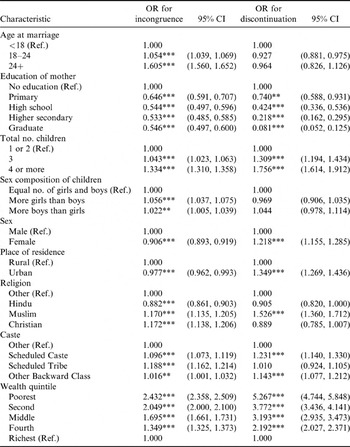
The analysis on actual and expected years of schooling shows that, with an increase in age and grade, there emerges a gap in actual and expected years of schooling, and some of the children also drop out of school. Therefore, the study further examined the factors associated with incongruence in educational attainment and discontinuation from school. Survival analysis was applied to examine the probability that children will remain in a lower grade given their age (odds for incongruence), and also the probability of discontinuation (odds for discontinuation) from school. The results of survival analysis are presented in Table 5. It was recognized that age at marriage and level of education of women are associated with incongruence in schooling for their children. It is evident from the results that an increase in age at marriage of women also increases the likelihood of their children remaining in a lower grade. Further, children of educated women are less likely to be in a lower grade than children of uneducated women. It may be possible that educated women are more concerned about enrolling their children in school at the right age so that they may achieve a proper education according to age. The number of children in the family and their sex composition is also significantly associated with grade attainment. It is seen that in a family with more than four children, there is an increased likelihood that children will reach upper grades with some age gap. Again, if the sex composition of children in the family is not balanced, then also the children may be in a lower grade than the expected one. Maralani (Reference Maralani2008) found that children with fewer brothers and sisters obtained more schooling than those with more siblings. Interestingly, the results show that females are less likely to be in a lower grade than their male counterparts. Children in the lowest wealth quintile are 2.5 times more likely to continue school with an age gap compared with children from the richest wealth quintile. The likelihood for incongruence declined steadily with the improvement in economic condition of the household.
Cox Proportional Hazard model showing odds ratios for incongruence and discontinuation of school for children aged 6–20 years, DLHS-3, 2007–08, India

***p<0.001; **p<0.05.
In order to examine the factors associated with school discontinuation for children, the study considered children who discontinued school before the age of 20 years as non-survivors. The odds ratio for discontinuation shows that education of the mother significantly lowers the risk of school drop-out for her children. One level of increase in education of the mother from primary to high school results in a 32% decline in risk of discontinuation. Similarly, children of graduate mothers have a 13% reduced risk of discontinuation than children of women who have higher secondary level of education. Additionally, the total number of children in the family increases the chances of school discontinuation. The results show that in a family of four or more children, the risk of discontinuation is 1.7 times higher compared with a family with two children. Also, a girl child has a 1.2 times higher risk of discontinuation compared with boys. Another finding is that children in urban areas have a higher risk for school discontinuation than their rural counterparts. Also, Muslims, Scheduled Caste and Other Backward classes show a relatively high risk of school drop-out, and children from poorer economic backgrounds are more likely to discontinue school than those from economically better-off households. The study found that the poorest people had a five times higher risk of school discontinuation, and children in the second and third category of economic condition had a more than three times higher risk of school discontinuation compared with children from the richest category.
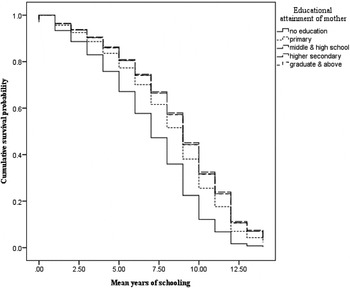
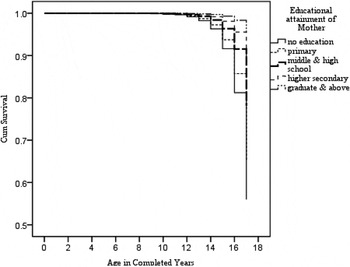
The pattern of incongruence for children, according to the educational attainment of mothers, is presented in Fig. 3. Incongruence towards the upper grades increases sharply if the mothers have low levels of education. At the same time, there is a difference in the age of the children when these inconsistencies between age and grade appear. For children with uneducated mothers, the probabilities that children will attain upper grades in expected ages decline only after one year of schooling. As discussed earlier, the discrepancies in grade attainment increase with an increase in mean years of schooling of children. The probability of age-appropriate progress seems to decline for all, but children of educated mothers are at an advantageous position over children of uneducated mothers. In addition to the pattern of incongruence, the pattern of school discontinuation by age of children and educational attainment of mother was also examined (Fig. 4). The figure shows that the children of uneducated mothers have higher probabilities of discontinuation compared with the children whose mothers are educated. For the children of uneducated women, discontinuation of school starts after the age of 10 years, and by the age of 17 years there is a 50% less chance that children will continue their education further. Even the children of graduate or higher educated women shows sign of discontinuation before age 17.
Pattern of incongruence for children aged 6–20 years by education of mother.

Pattern of discontinuation for children aged 6–20 years by education of mother.

Discussion
This study of the association of women's education with the changes in their demographic behaviour was based on women aged 35–49 years, who presumably had fairly good exposure to education when they were at school-going age. Age at first marriage and age at first birth may be important indicators of level of social development. According to the constitution of India, the legal age for marriage is 21 years for boys and 18 years for girls. Marriage at an early age and subsequent low age at first birth may have adverse consequences for the health of both mother and child. The results show an increase in age at marriage for women, with improvement in each level of education from illiterate to graduate. Consequently, the age at first birth is high, and the average number of children born is low for educated women compared with uneducated women. Earlier research has suggest a positive association between women's years of schooling and age at marriage and age at first birth, with more highly educated women having fewer children than those with less education (Brien & Lillard, Reference Brien and Lillard1994; Singh & Samara, Reference Singh and Samara1996; Nath et al.. Reference Nath, Kenneth and Goswami1999; Gangadharan & Maitra, Reference Gangadharan and Maitra2003; Klasen & Launov, Reference Klasen and Launov2006; Tayfur et al., Reference Tayfur, Kirdar and Koc2008; Isen & Stevenson, Reference Isen, Stevenson and Shoven2010). Women with high education may enjoy greater autonomy to decide when and whom they want to marry. It may be possible that educated women give more importance to quality of children than quantity since they will be aware of the benefits of having fewer children.
One finding of the study is that women prefer to ‘marry up’ in terms of the educational attainment, i.e. marry men with higher levels of education than themselves (educational hypergamy). Barbara Miller (Reference Miller1981), on the basis of a study in India, claimed that higher levels of hypergamy implied a lack of suitable husbands for high caste girls. Rose (Reference Rose2005), on the other hand, pointed out hypergamy as a disadvantage for women, since women with higher levels of education will have limited options, and will have to ‘marry down’.
The study then examined the association of education of parents with the number of children born and their educational attainment. The results of the analysis imply that the education of women has a more significant association than the education of men with the number of children born to the couple.
The results on the association of educational attainment of women and children gives mixed results. The study shows that the proportion of children enrolled in school doesn't differ much by educational attainment of the mother, but the progress towards upper grades is not smooth for all children. Children may be enrolled in school at the prescribed age, but inconsistencies arise in age and grade attainment, particularly for the children of less educated mothers. An earlier study in a similar context suggested that the gap in age and grade attainment may occur either due to late enrolment or grade repetition (Hossain, Reference Hossain2010). It may be possible that educated mothers are more concerned about coherence between age and grade attainment of their children than uneducated mothers. If such a gap emerges, it will be difficult to reduce the gap with the increase in age of children. In this study, the highest gap between expected and actual years of schooling is noticed for children whose mothers are illiterate. In addition, school drop-out also starts at younger ages for children of less educated women. Thus it may be said that, although children are enrolled in school on time, there is a clear disadvantage in attaining higher education for children whose mothers are less educated. These findings raise questions such as whether children who are studying at a grade lower than their age will end up as school drop-outs, or continue with a few years' gap. On the basis of these findings, the use of enrolment indicators like the Gross Enrolment Rate (GER) and Net Enrolment Rate (NER) are unable to capture the over-age and under age entry into school and discrepancy in progress towards upper grades.
Having observed that, even after enrolment on time, some students drop out of school, the study further examined the possible factors associated with incongruence and school discontinuation. The results show that of the different socio-demographic factors examined, education of mother, number of children in the family, sex of the child, place of residence and economic condition of the household are factors that have a significant association with both incongruence in schooling and discontinuation from school. It may be possible that these factors first cause the gap in years of schooling, and in the long run result in discontinuation from school. Among all the factors, education of the mother was the most significant predictor for child's schooling. With an increase in the level of education of the mother, there is a significant decline in the likelihood of both incongruence and discontinuation. All these findings point towards the possibility that, with an increase in household size, children have to share the available resources with their siblings. Another potential cause may be that, when the parents are not able to carry the burden of schooling, the only alternative is to discontinue schooling of their children and engage them in earning livelihood for the family. Earlier studies also agreed that age of the child and size and income of the household are important factors influencing the decision of whether the child will continue school or will be engaged in income-generating activities (Nangia, Reference Nangia and Myers1991; Heady, Reference Heady2000; Delap, Reference Delap2001). Earlier research suggests that the distribution of educational resources among children depends on the family decisions in which families try to balance between equity and efficacy issues; also, girls have to compete with their brothers for education (Behrman et al., Reference Behrman, Robert and Paul1982).
Another interesting observation from the study is that incongruence was high for boys but discontinuation from school was high among girls. It may happen that, once enrolled in school, girls will make steady progress towards upper grades until they have to discontinue school due to some external factors. It may also indicate gender disparity, where parents decide to continue the education of their son by putting an end to their daughter's education. Another finding proposes that children from urban areas report less incongruence but are more likely to discontinue than their rural counterparts. It is an established fact that the cost of living is higher in urban areas than rural areas. Therefore, to meet the basic requirements of daily life, some families may cut educational spending on their children, leading to high discontinuation rates in urban areas. Maralani (Reference Maralani2008) also made similar observations on school discontinuation of children from rural and urban areas. The finding on the association of economic condition of the family and schooling of children shows that poor households face greater difficulties in providing education to their children. Along with the common predictors of incongruence and discontinuation, age at marriage and sex composition of siblings are the other two factors that affect incongruence. Butcher et al. (Reference Butcher and Case1994) also concluded that sibling sex composition is associated with schooling of the girl child. Therefore, promoting a small family norm and providing affordable education to all may be some of the possible initiatives that will help in achieving better educational attainment goals in the country.
After examining the association of women's education with different aspects of family formation, the study concludes that the improvement in education of women results in positive changes in their demographic behaviour. The general observations are that women with higher education marry late, have higher age at first birth and fewer children compared with their less educated counterparts. In addition, the findings imply hypergamy with respect to the education of women. It is also seen that the education of women has a significant association with the number of children born to couples with different combination of educational attainment. At the same time, education of women also affects incongruence and school drop-out of children, since incongruence and discontinuation are both high for children of uneducated women. Some additional findings of the study are that incongruence is low for children living in urban areas but more likely to discontinue school at younger ages. Further, in a family with three or more children, a girl child has to sacrifice her education first from among the siblings if the family faces an economic crisis (Butcher & Case, Reference Butcher and Case1994). The findings thus recommend that, in order to reduce school drop-out in urban areas, initiatives should be taken to provide affordable and quality education for people living in these areas. Therefore, it may be concluded that providing education to girls will not only improve the overall literacy of the country, but help in shaping a better future for the next generation by reducing family size, providing better education to their children and contributing to family income.