Philosophers and politicians have long been concerned with the harmful effects of inequality on democratic systems. Aristotle considered democracy a deviant form of government because of the potential for conflict between the poor and the wealthy (Aristotle 1998, 1304a 38; 1304b 5). Over a thousand years later, inequality continued to concern the writers of the Constitution of the United States. In Federalist 10, Madison writes, ‘… the most common and durable source of factions has been the various and unequal distribution of property. Those who hold and those who are without property have ever formed distinct interests in society’ (Madison Reference Madison and Rossiter1961: 74). If the distribution of resources and the human tendency to divide into competing groups were not constrained by institutional design, Madison feared that the young nation could collapse under the weight of internal conflict.
Despite these long-held concerns, recent scholarship has failed to reach a consensus on the relationship between inequality and polarization. Inequality may radicalize political parties, driving parties of the left to demand more redistribution while parties of the right seek to entrench the skewed distribution of resources (Meltzer and Richard Reference Meltzer and Richard1981; Pontusson and Rueda Reference Pontusson, Rueda, Beramendi and Anderson2008; Han Reference Han2015). If this is the case, rising inequality results in a divergence between parties' ideological positions on economic issues, which increases polarization in the party system. However, the mainstream parties of Western Europe have been losing vote share to challenger parties that blur their economic position to emphasize other dimensions despite rising levels of inequality (Hobolt and Tilley Reference Hobolt and Tilley2016; Rovny Reference Rovny2013; Piketty Reference Piketty2014). Furthermore, income inequality may drive down the political participation of the poor, inducing the left to moderate their policy positions to maintain their competitiveness (Beramendi Reference Beramendi, Beramendi, Hausermann, Kitschelt and Kriesi2015; Solt Reference Solt2008; Solt Reference Solt2010; Fenzl Reference Fenzl2018). Consequently, ideological conflict between parties over the economy could decrease as society becomes increasingly inegalitarian. These conflicting results suggest that scholars of polarization need to more explicitly theorize the contextual conditions that moderate inequality's effect on party behavior.
To this end, I argue that the connection between party polarization on economic issues and income inequality depends on political context. The presence and strength of the positive relationship between income inequality and party polarization on economic issues is contingent on the degree of partisan sorting by income and the salience of economic issues. There are a number of bases upon which partisan divides may be constructed (Lipset and Rokkan Reference Lipset, Rokkan, Lipset and Rokkan1967). I argue that party systems polarize in response to increasing income inequality when party bases are sorted by income. When this is the case, parties have more to gain by taking extreme stances in the face of rising income inequality. Parties taking polarized positions without supporters of a distinctive economic profile, however, face the risk of alienating their own partisans.
The importance of economic issues in an election also has a substantial conditioning effect. Even in states with high income inequality and party bases clearly sorted by income, the salience of economic issues in national elections varies. Polarization should be more tightly linked to inequality when economic issues are more salient (Alvarez and Nagler Reference Alvarez and Nagler2004). In elections dominated by economic concerns, parties are incentivized by their base and the focus of the campaign to stand apart from one another rather than cluster together on economic policy. I test this argument using eighty-one national elections in twenty-two European countries from 1996 to 2016. The results indicate that income inequality's positive relationship with party polarization is strengthened when party bases are sorted by income and the economy is salient. When these two factors are weak, however, I find no evidence that income inequality translates into party polarization.
This article contributes to our understanding of party systems by highlighting the role of political context in the translation of income inequality into political outcomes. What matters for polarization is how changing inequality interacts with the foundations of domestic political factions and the salience of issues in elections. From a broader perspective, political parties are not mere reflections of social divisions at the political level. They are strategic actors seeking votes and office under constraints that vary across space and over time. Failing to consider the contours of the environment inhibits our ability to predict and understand the decisions parties make and the outcomes that follow.
Inequality and Party Competition
The typical point of departure in the literature relating inequality to party polarization is the Meltzer-Richard model for the size of government (Meltzer and Richard Reference Meltzer and Richard1981). Their argument rests on the relationship between the mean income voter and the median income voter. Assuming that individual attitudes toward redistribution are the product of a voter's position in the income distribution (Finseraas Reference Finseraas2008), the median voter stands to benefit from redistribution, and the intensity of this preference increases with the gap between the median and mean income. Hence, the demand for redistribution and state involvement in the economy should be more intense in states with inegalitarian income distributions. Parties in highly unequal societies responding to increasing income inequality should take more extreme positions than those in more equal societies to better represent their voters. Therefore, party systems with higher levels of income inequality should have a higher degree of party polarization than states with more egalitarian income distributions.
Evidence from the United States appears to support this argument (McCarty, Poole and Rosenthal Reference McCarty, Poole and Rosenthal2006; Garand Reference Garand2010). Income inequality and elite polarization were both relatively low in the post-war period before beginning to increase in the 1970s.Footnote 1 Similar findings in a comparative framework suggest scope conditions and deviations from the restrictive and often unrealistic assumptions of the Meltzer-Richard model (Pontusson and Rueda Reference Pontusson, Rueda, Beramendi and Anderson2008). For example, income inequality may only lead to polarization in proportional electoral systems (Han Reference Han2015). In these systems, parties are less incentivized to compete for the median voter, so parties can move further from the center when income inequality increases. Individual-level data on the probability of voting for extreme parties under different levels of income inequality also indicate a relationship between the distribution of income and the degree of party polarization (Winkler Reference Winkler2019). When inequality is high, the probability of voting for a party of the radical left or radical right increases.
The mobilization of low-income voters may also impact party reactions to inequality. Rising income inequality may suppress electoral participation, particularly at the lower end of the income distribution (Anderson and Beramendi Reference Anderson, Beramendi, Anderson and Beramendi2008; Solt Reference Solt2008; Solt Reference Solt2010). Therefore, when income inequality is high, parties of the left may have to moderate their positions to maintain their vote share. Although income inequality's turnout suppressing effect may push left parties to take moderate positions, right parties may also be constrained (Fenzl Reference Fenzl2018). Parties do not operate in a vacuum. If inequality does suppress turnout among the poor, right parties moving further to the right may lose their own moderate voters to a left party moving to the center (Adams Reference Adams2001). Parties of the right may also have an incentive to emphasize value-based issues rather than economic issues in states with high income inequality (Tavits and Potter Reference Tavits and Potter2015). Despite increasing scholarly focus on the connection between income inequality and party polarization, prior studies have failed to come to a consensus on this issue.
Partisanship and Issue Salience as Crucial Contextual Factors
I argue that political context acts as a crucial moderating variable that determines the influence of rising income inequality on party systems. Existing studies relating income inequality to political polarization assume that political parties are sorted by income, with low-income individuals and workers forming the key constituency of the left and the middle-class and business owners forming the core constituency of the right. Historical evidence shows that the connection between income level and party choice should not be assumed (Bartolini Reference Bartolini2000). Even though an individual's income might be below that of the median voter, they may be a partisan of the right because they oppose redistribution or because there is some other factor driving party selection like positions on other dimensions or other relevant social identities (Greene Reference Greene2004; Huddy, Bankert and Davies Reference Huddy, Bankert and Davies2018). Critically, the social construction of partisanship is absent from Meltzer-Richard's framework, which assumes political behavior is driven only by economic rationality.
While this assumption about the sorting of voters by income may have been acceptable following the Second World War, subsequent developments provide sufficient reason to explicitly theorize the implications of varying degrees of partisan sorting by income. The tie between working-class voting and left parties began to weaken in the late 1960s and early 1970s with the mobilization of new social movements focused on environmental and self-expression values (Inglehart Reference Inglehart1977). More generally, the tie between economic position and voting behavior appears to have weakened across developed democracies over the past thirty years (Franklin Reference Franklin, Franklin, Mackie and Valen1992; Knutsen Reference Knutsen2006). Radical right parties have also begun targeting blue collar workers, shifting the working class from a core constituency of the left to a contested demographic (Oesch and Rennwald Reference Oesch and Rennwald2018).
The importance of considering the nature of partisan sorting is evident in Lipset's (Reference Lipset1981) Political Man. When parties draw on a diverse set of individuals along an axis of political contestation, they are able to work together because their ideological and social positions are not so divergent and their constituents share some common priorities. As parties begin to gain support from individuals who represent divergent sociological positions, the incentive for moderation diminishes. When parties have clearly sorted economic bases, ideological conflict is likely to be particularly intense.
I make a critical addition to this argument. The degree of polarization should reflect the difference between the sociological positions from which the parties receive their support. If parties are highly differentiated with respect to their supporters’ income but the groups of supporters are not that divergent from one another (for example, the upper middle class vs. lower middle class), then I would expect party polarization to be lower than when the groups of supporters are highly divergent (bottom 10 per cent vs. top 1 per cent).
To make the intuition behind this theory more concrete, imagine two party systems with two parties each. In system A, the mean income of supporters of one party is substantially below the mean income of supporters of the other party. In system B, individuals are randomly selected such that the average incomes within each group of party supporters are equivalent. Between an initial period, t 1, and a later period, t 2, the level of income inequality has increased in both fictional party systems to a noticeable extent. How would we expect the parties to respond? In party system A, where parties are distinct with respect to income, the economic position of the left party's supporters has declined while the supporters of the right party have, on average, become better off. The left party has an incentive to take a more extreme position in favor of redistribution, while the right party should do the opposite or at least remain in place, particularly if economic concerns are critical in political discourse during t 2. In party system B, which does not sort by income, increasing inequality affects the two parties' bases similarly, and there is no reason to believe that the parties will move apart from one another. Perhaps the party system as a whole will shift, but the distance between parties should stay the same.
In addition to party sorting by income, the salience of economic issues should also condition the translation of income inequality into polarization. Not all elections emphasize economic issues to the same extent, even in countries where parties are clearly sorted on income. When non-economic issues dominate national elections, voter attention is likely to be drawn away from the economic axis of competition (Alvarez and Nagler Reference Alvarez and Nagler2004). Parties in this case have little to gain from staking out polarizing positions, even if inequality is rising. When economic issues are critical in elections and inequality is increasing, parties should shift further from the center, particularly when partisan bases are clearly sorted by income.
As a result, rising inequality translates into increased party polarization on economic issues when parties are sorted by income and economic issues are electorally salient. I also expect these two effects to work together: income inequality should have a particularly strong effect when both partisan sorting by income and the salience of socioeconomic issues are high. The following sections outline the data and methods I use to test the following two hypotheses.
Hypothesis 1: The effect of income inequality on party polarization on economic issues becomes positive as partisan sorting by income increases.
Hypothesis 2: The effect of income inequality on party polarization on economic issues becomes positive as the salience of economic issues increases.
Data and Model Specification
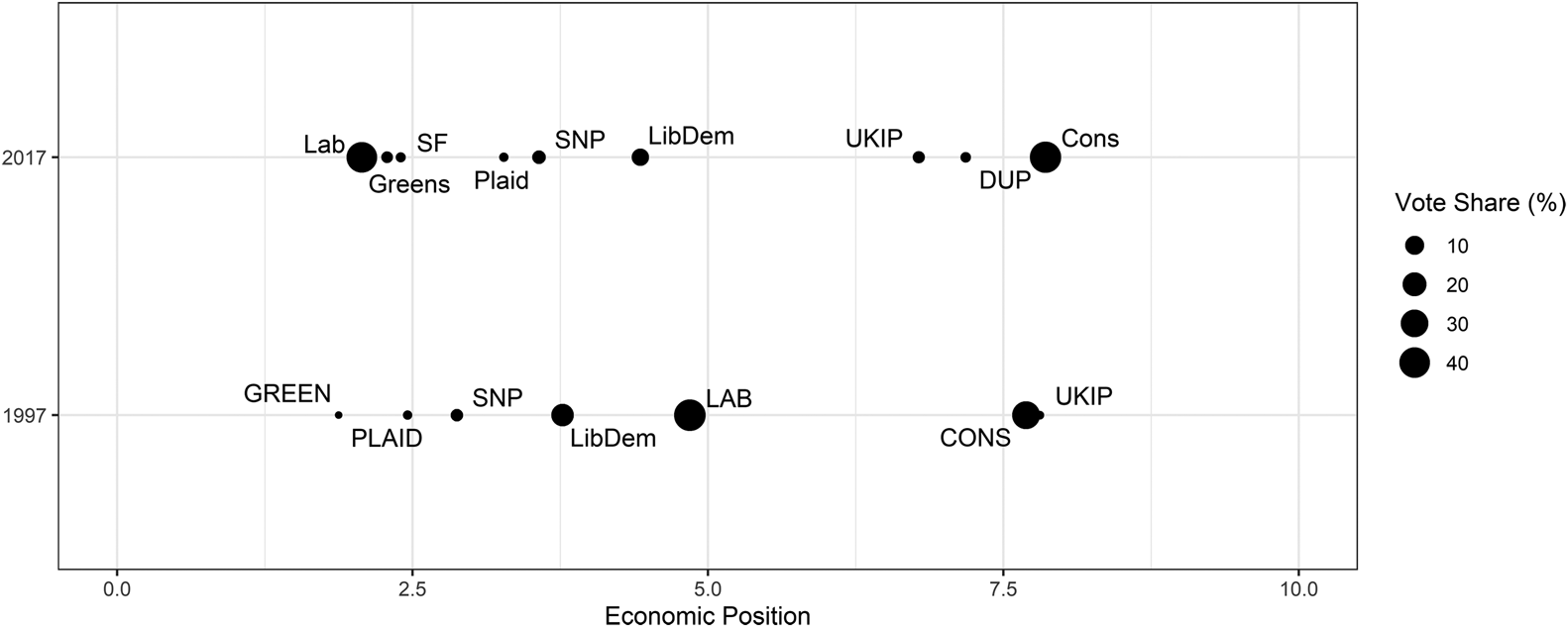
The dependent variable of this study is party polarization, which I define as the degree to which parties take positions far from the ideological center in an election. I operationalize party polarization as the standard deviation of parties' positions on a given dimension of contestation weighted by their vote share.Footnote 2 This operationalization is in accordance with Sartori's (Reference Sartori1976) focus on two key facets of polarization: the distances between parties and the ‘… enfeeblement of the centre, a persistent loss of votes to one of the extreme ends (or even to both)’ (120, emphasis in original). Large distances between parties in ideological space indicate more disagreement. The vote share received by each party reflects the centrifugal tendency Sartori (Reference Sartori1976) discusses. Incorporating a party's support is also important because it prevents small fringe parties from drastically increasing polarization. The importance of this weighting becomes clear when comparing the 1997 and 2017 elections in the United Kingdom. Party placements and vote shares are indicated in Figure 1. Using the unweighted standard deviation, the 1997 election is more polarized on economic issues than the 2017 election, with standard deviations of 2.432 and 2.270, respectively. Given that Tony Blair pulled the second-largest party in the UK (the Labour Party) to the center in 1997 and Jeremy Corbyn did the reverse by 2017, the unweighted operationalization strains credulity. Weighting for vote share, however, gives much more plausible values: the 2017 election has a weighted standard deviation of 3.393, which is much higher than in 1997 (when it was 1.984).Footnote 3
Economic positions of parties in the 1997 and 2017 UK elections according to the Chapel Hill Expert Survey
Note: the size of the circles indicates vote share.

In particular, I focus on party polarization on economic issues. Other studies in this area have used the general left–right dimension, assuming that the general dimension of conflict corresponds to the classic economic left–right (Pontusson and Rueda Reference Pontusson and Rueda2010; Han Reference Han2015). In contemporary democracies, however, the dominant line of conflict is not always the economy. Parties emphasizing non-economic issues, like the environment and (sub)national identity, are becoming increasingly important (Kitschelt Reference Kitschelt1995; Kriesi et al. Reference Kriesi2008), so the degree to which the economic dimension dominates party competition has likely changed over time. Furthermore, the relationship between economic and non-economic dimensions is related to the strength of cleavages that preceded the Industrial Revolution, resulting in systematic cross-national differences (Rovny and Polk Reference Rovny and Polk2019). Operationalizing my dependent variable exclusively with economic policy position is thus a more accurate representation of the underlying concept and a closer match to my argument than the general left–right scale.
I take party positions on economic issues from the Chapel Hill Expert Survey (CHES) and attach them to the most recent previous election (Bakker et al. Reference Bakker2015; Polk et al. Reference Polk2017).Footnote 4 This data source uses expert surveys to place political parties on a number of issue dimensions. I use data from twenty-two European countries from 1996 to 2016 for a total of eighty-one national elections.Footnote 5 Expert surveys have several advantageous features. Experts are able to take into account both what parties say and what they actually do in assessing their position. This increases the validity of expert positions as they have more observations on which to draw than other estimates of party positions that depend on a single data source. Additionally, because experts directly place parties on a quantitative scale, the method of aggregation is less problematic than that used in other methodologies (Gemenis Reference Gemenis2013).
Although CHES is widely used for party positions, one concern is the black box of expert judgment (Budge Reference Budge2000). Because experts can consider a number of criteria including manifestos, party rhetoric and behavior in parliament, they may base their judgments on widely varying inputs. Additionally, the very notion of a party's position can itself be unclear. CHES accounts for this latter concern through careful questionnaire design by specifying that the survey is about party leaders (Bakker et al. Reference Bakker2015).Footnote 6 To deal with the further concerns, Steenbergen and Marks (Reference Steenbergen and Marks2007) demonstrate a high degree of agreement between experts and convergent validity with other measures of party positions such as mass surveys and manifesto-based measures.
An additional concern with the use of expert surveys is whether the experts view the dimensions as relative or absolute. If experts view the dimensions as relative, experts in one country might view a 3 as more extreme than those in another country; the distances between parties would therefore not be comparable between countries. To evaluate this possibility, Bakker et al. (Reference Bakker2014) included identical vignettes in the 2014 CHES wave and had experts place these hypothetical parties. These placements were extremely similar across countries, suggesting that experts consider the issue space as absolute. The weighted standard deviation of party positions in one country can therefore be validly compared to the same measurement in other countries.
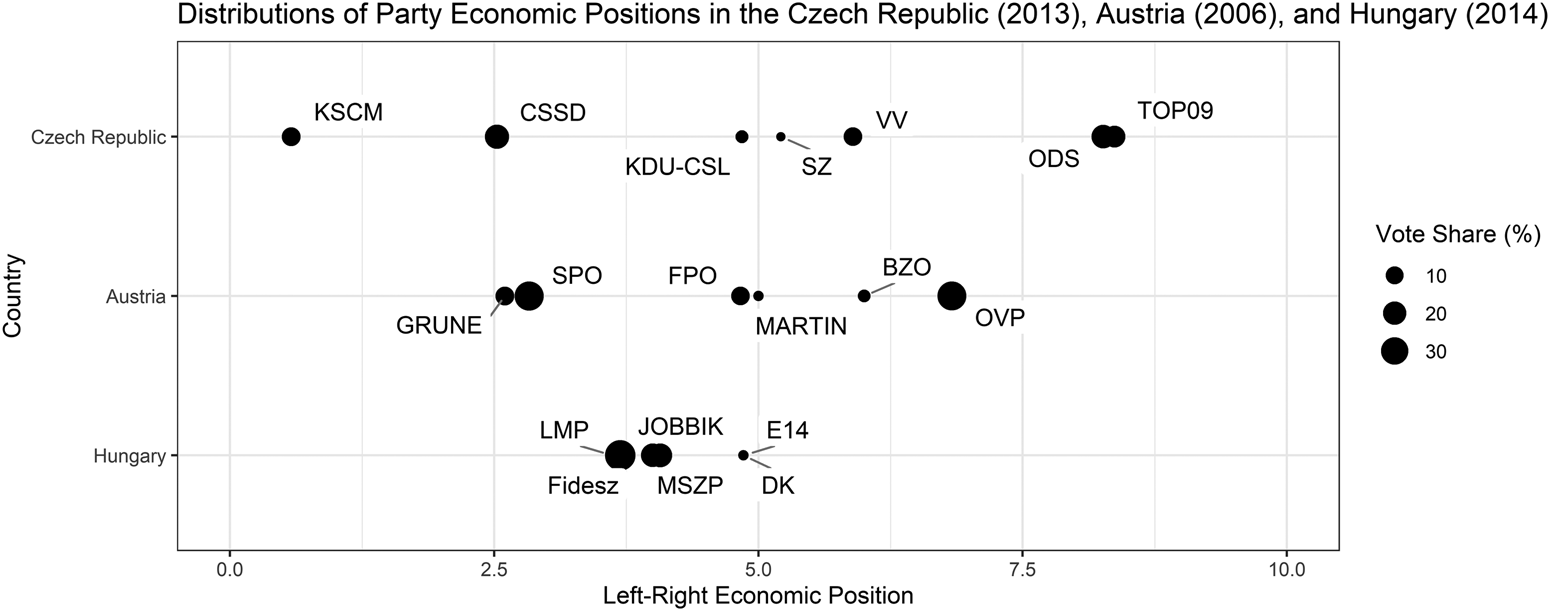
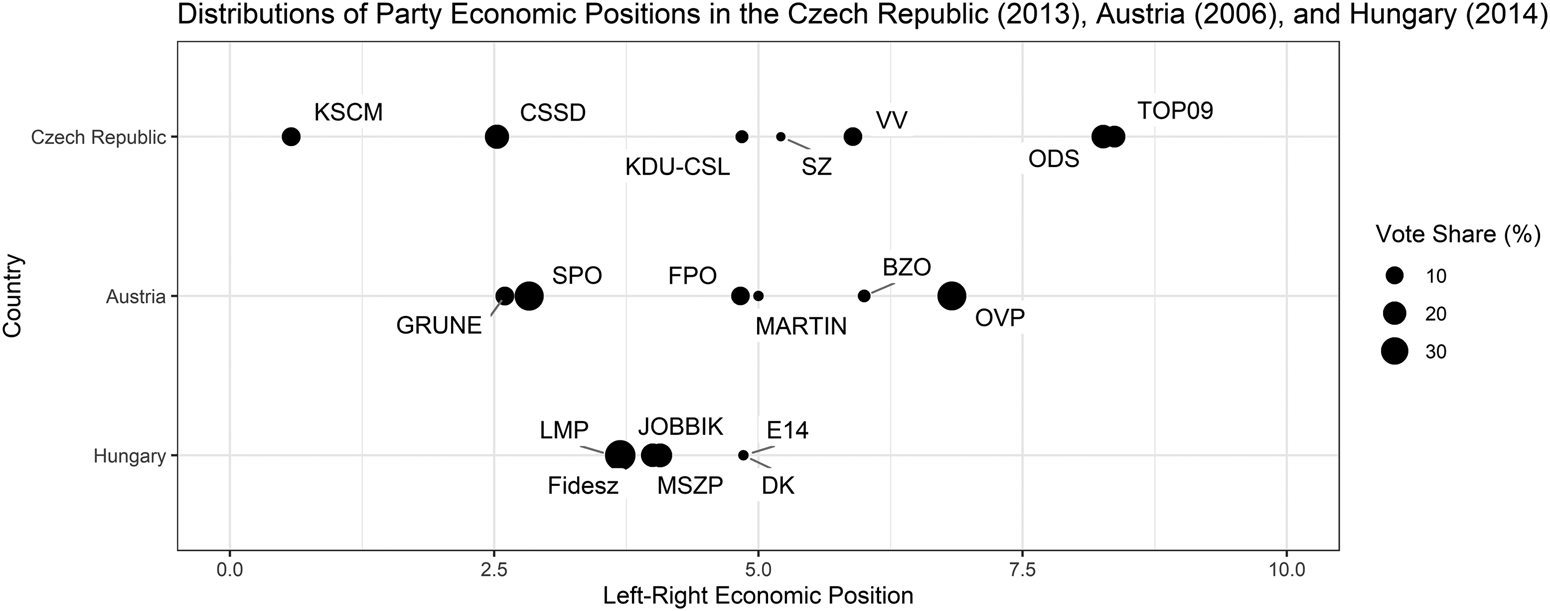
Figure 2 displays the placement of three separate party systems in the sample to demonstrate what party systems with different levels of polarization using my operationalization look like. The size of each point indicates the proportion of votes received by each party in the election, and the position reflects the assessment of each party by CHES experts on economic issues. The Czech Republic's 2014 election, at the top, has a weighted standard deviation of 2.766, which is above the 75th percentile of observed values. This is not surprising, given that some parties are receiving large shares of the vote on the fringes of the political space, which is congruent with Sartori's (Reference Sartori1976) emphasis on interparty distance and weak center parties. The Austrian election in 2006 is very close to the average degree of polarization in my sample with a weighted standard deviation of 2.166. There are still large parties on the edge of the party system, but they are not as far from the political center as in the Czech case. Lastly, Hungary's 2014 election has a very low level of polarization (0.342, the lowest in the sample). Here, the largest parties are all centrally located and close to one another.
Economic positions of parties in the Czech Republic (2013), Austria (2006) and Hungary (2014) according to the Chapel Hill Expert Survey
Note: the size of the circles indicates vote share.
One concern is the possibility of endogeneity. I argue that party systems with partisan bases sorted by income should respond to rising inequality by taking polarized positions, but it may also be the case that party systems in which parties take more polarized positions develop more clearly sorted partisans by income. This dialogue between voters and parties is an ongoing debate in political science. Some findings suggest that voters follow parties (Lenz Reference Lenz2012), but other evidence using social media data suggests the reverse – that politicians follow voters with a particular focus on their partisans (Barberá et al. Reference Barberá2019). I attach CHES waves to previous elections to maintain temporal distance between partisan sorting and polarization, so the potential for endogeneity should be minimized. As the independent variables are measured temporally prior to the dependent variable, this is akin to lagging the independent variables.
Independent Variables
My first independent variable of interest is the degree of partisan sorting by income. I draw on research in international relations to operationalize the differentiation between partisan bases (Østby Reference Østby2008; Stewart, Brown and Mancini Reference Stewart, Brown and Mancini2010). I use the following equation for the group Gini coefficient (Stewart Reference Stewart2008):
 $${\rm GGINI} = \displaystyle{1 \over {2{\bar y}}}\sum\limits_r^R {\sum\limits_s^S {\,p_rp_s} \vert } {\bar y}_r-{\bar y}_s\vert $$
For my purpose,  ${\bar y}$ is the overall mean income quintile, R and S are counters of the total number of parties in a party system,
 ${\bar y}_r$ is the mean income quintile of party r,
 ${\bar y}_s$ is the mean income quintile of party s, and p r and p s are the share of partisans in party r and party s. This measure essentially determines the absolute value of the pairwise differences in mean income between all parties in the system weighted by the proportion of partisans in each party dyad. Then, these absolute differences are summed and multiplied by a standardizing coefficient.Footnote 7 I determine
 ${\bar y}$,
 ${\bar y}_r$, and
 ${\bar y}_s$ using the mean reported income quintile of party members from the Comparative Study of Electoral Systems (CSES) and the European Social Survey (ESS) (CSES multiple years, ESS 2016). Both studies include items asking individuals to place themselves in income categories and which party, if any, they feel close to. I require two data sources as neither completely covers all cases in the CHES. In order to combine the two data sources and account for any systematic differences that may be present, I predict the level of partisan income sorting in the CSES data using the ESS data. I then use this model to create five sets of plausible values, run my models five times with a different set of plausible values in each iteration, and then average the results from all five models together.Footnote 8
I operationalize income inequality using data from the Standardized World Income Inequality Database (SWIID) (Solt Reference Solt2016). The SWIID uses Luxembourg Income Study (LIS) data as a benchmark against which to standardize income data from a number of other sources. This source is ideal for my tests as it expands the number of possible observations by providing data annually and including data for countries not participating in LIS waves.Footnote 9 Specifically, I focus on income inequality after taxes and transfers (disposable income inequality). Redistribution and taxes can play a substantial role in determining individuals’ income levels and the distribution of resources within a society, so income inequality measured using income after taxes and transfers reflects economic reality. Pensioners are a particularly good example of this as they may receive substantial government transfers but no market income.Footnote 10
I operationalize the salience of economic issues in national elections from the Comparative Manifesto Project (CMP) using Stoll's (Reference Stoll2010) socioeconomic salience category. I use the sum of quasi-sentences relating to economic issues divided by the total number of quasi-sentences in each party's manifesto, essentially the proportion of the manifesto that is devoted to economic issues. I then take the average for all parties in a given election year.Footnote 11 I list the relevant categories in the CMP data in Appendix Tables A1 and A2.
One may be concerned that partisan sorting and the salience of economic issues are endogenous to one another. It could also be argued that inequality and economic salience are endogenous to each other (Tavits and Potter Reference Tavits and Potter2015). In my data, however, the correlation between partisan sorting by income and the salience of economic issues is extremely low and not significant (full correlations in Table A7). This makes intuitive sense, as external factors that shape economic circumstances vary much more over time than partisan allegiances. Furthermore, while a party that puts little emphasis on economic positions would not usually be expected to take an extreme position, one focused on the economy may still take a moderate stance (see Figure A1). In this sense, high salience of an issue is a necessary but insufficient condition for individual parties to position themselves far from the political center. Abou-Chadi, Green-Pedersen and Mortensen (Reference Abou-Chadi, Green-Pedersen and Mortensen2020) additionally find that parties do not seem to change their position on the welfare state when it becomes more salient, indicating that an increase in salience does not require a change in position. The correlations between disposable income inequality and partisan sorting by income and the salience of the economy are also quite small and not statistically significant.
Controls
I also consider potential alternative explanations for varying levels of polarization. One such explanation is the increasingly multi-dimensional political space in Western Europe (Stoll Reference Stoll2010). The economic left–right division has been critical to politics since the Industrial Revolution, which is often treated as a critical juncture in the development of party systems (Lipset and Rokkan Reference Lipset, Rokkan, Lipset and Rokkan1967). The GALTAN or transnational cleavage is a more recent development that is often linked to the rise of post-modern value systems, the increasing influence of the European Union on the lives of European citizens, and increased immigration flows from North Africa and the Middle East (Hooghe and Marks Reference Hooghe and Marks2009, Reference Hooghe and Marks2018). There is the possibility that polarization on one dimension will influence polarization on the other. Because I am interested in polarization on economic issues here, I include polarization on the GALTAN dimension as a control.
In addition to the hypotheses above, I also acknowledge that additional factors likely play a strong role in determining the degree to which parties are able to polarize. I include the effective number of electoral parties (ENEP). More parties in a system should lead to more extreme party positions, although more recent evidence has suggested that there are centripetal pressures even in high-ENEP party systems (Cox Reference Cox1990; Ezrow Reference Ezrow2008). I take this variable from the Democratic Systems around the World Dataset (Bormann and Golder Reference Bormann and Golder2013). Appendix Table A5 presents summary statistics of my salience measures and controls.
Finally, I include a measure of economic performance as a control. Due to my relatively small number of cases, I only include one such variable, the unemployment rate, drawn from the Comparative Political Dataset (Armingeon et al. Reference Armingeon2018).Footnote 12
Model
Because my data are observations of European national elections, I have time-series cross-sectional data comprised of eighty-one complete observations in twenty-two countries, for an average of just under four observations per country. I use a fixed-effects model with heteroskedastic robust standard errors clustered by country to isolate the within-country variation from the cross-sectional variation.Footnote 13 Country fixed effects are appropriate as they control for any time-invariant omitted variables. Even among cases from the same region (East vs. West), there are unique country histories, institutions and long-standing political traditions that may influence the degree of polarization. Controlling for these effects through a fixed-effects approach helps isolate the conditional effect of inequality on polarization from other potential causes.Footnote 14 Furthermore, by absorbing the between-country variation, the fixed effects isolate the within-country variation, so the results of my models can be interpreted as the effect of my independent variables on party polarization over time. One shortcoming of the fixed-effects approach, however, is that institutional variables that are constant within countries are dropped. Given the danger of critical, time-invariant omitted variables in a model that incorporates both within- and between-case variation, the fixed-effects approach is more appropriate.Footnote 15 Therefore, my fully specified model takes the form:
 $$\eqalign{{\rm Polarizatio}{\rm n}_{{\rm ct}} & = \alpha _c + \beta _1{\rm Sortin}{\rm g}_{{\rm ct}} \cr & \quad + \beta _2{\rm Salienc}{\rm e}_{{\rm ct}} \cr & \quad + \beta _3{\rm Gin}{\rm i}_{{\rm ct}} \cr & \quad + \beta _4{\rm Sortin}{\rm g}_{{\rm ct}} \times {\rm Salienc}{\rm e}_{{\rm ct}} \cr & \quad + \beta _5{\rm Sortin}{\rm g}_{{\rm ct}} \times {\rm Gin}{\rm i}_{{\rm ct}} \cr & \quad + \beta _6{\rm Salienc}{\rm e}_{{\rm ct}} \times {\rm Gin}{\rm i}_{{\rm ct}} \cr & \quad + \beta _7{\rm Sortin}{\rm g}_{{\rm ct}} \times {\rm Salienc}{\rm e}_{{\rm ct}} \times {\rm Gin}{\rm i}_{{\rm ct}} \cr & \quad + \beta _{{\rm controls}}{\rm X}_{{\rm controls}} + \varepsilon _{ct}} $$
where c indicates a country and t indicates an election year.
Because my theory suggests interactions between partisan income sorting and disposable income inequality, and between economic salience and disposable income inequality, I must also include an interaction including all three terms and an interaction between partisan income sorting and the salience of economic issues (Braumoeller Reference Braumoeller2004). If I did not include these interactions, I would be implicitly assuming that a joint increase in partisan sorting by income, economic salience and disposable income inequality has no relationship with party polarization on economic issues. On the contrary, I expect partisan sorting by income and the salience of economic issues to act as complements, so income inequality's effect should be strongest when both are elevated. Omitting the interaction between sorting and salience, as well as the triple interaction, fixes the coefficients of the included interactions to only indicate how the effect of income inequality changes as sorting varies with salience held at its mean and vice versa, which would bias the coefficient estimates if this assumption is not met (Braumoeller Reference Braumoeller2004, 81).
The variables in this study are on very different scales, so I standardize all continuous variables to have mean of 0 and a standard deviation of 1, so the βs in the following results can be interpreted as the effect of a one-standard-deviation increase in the predictor on party polarization in standard deviations.
Results
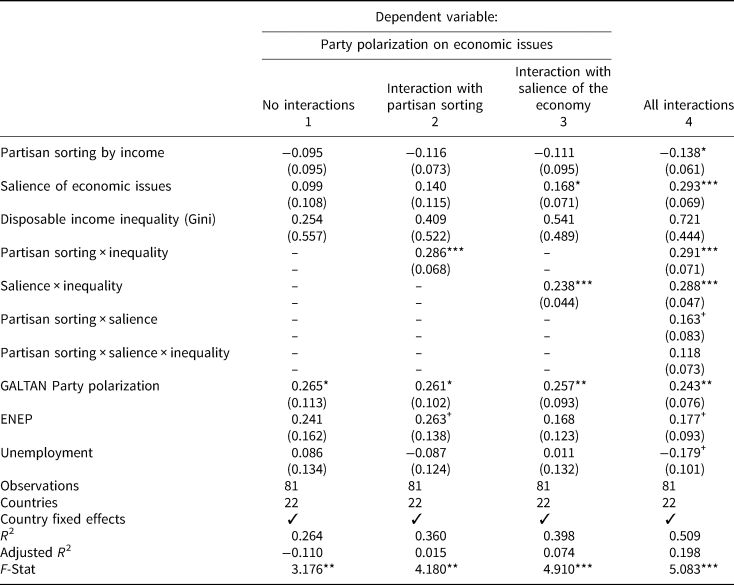
To test my hypotheses, I run four fixed-effects models, presented in Table 1.Footnote 16 The first model omits the interaction terms that I argue moderate the effect of income inequality on party polarization on economic issues. In the second and third models, I introduce individual interactions between disposable income inequality and partisan income sorting and between disposable income inequality and the salience of economic issues, respectively.Footnote 17 The final model includes both of these interactions and additional interactions as discussed in the previous section.
Effect of income inequality on party polarization on economic issues

Note: table entries are OLS fixed effects coefficients with heteroskedastic robust clustered standard errors in parentheses. +p < 0.10; *p < 0.05; **p < 0.01; ***p < 0.001
While it is difficult to assess the implications of these models for my argument solely based on the tabular output, Table 1 does offer valuable insights with respect to model fit (Braumoeller Reference Braumoeller2004). The F statistics, R 2 and adjusted R 2 indicate that the models including the interactions provide a better fit to the data than the first model. The adjusted R 2, in particular, increases as the interactions are added to the model. This is noteworthy as the adjusted R 2 calculation penalizes additional predictors, so the fourth model improves the fit of the model despite the addition of four more predictors.
Additionally, as the first model in Table 1 lacks interactions, the coefficients can be directly interpreted. Notably, none of the variables of interest – disposable income inequality, the salience of economic issues, or the degree of partisan sorting by income – is significantly related to party polarization on economic issues. The only significant coefficient in this model is polarization on the non-economic dimension of competition. Taking this model as a baseline, there is no evidence to support an unconditional relationship between income inequality and party polarization. The coefficients in this model are analogous to an average treatment effect. The hypotheses described above, however, anticipate heterogeneity of effects based on the degree of partisan sorting by income and the salience of economic issues. The remainder of the article investigates this heterogeneity.
The results presented in Table 1 generally support the importance of considering political context as moderating the relationship between inequality and party polarization, but because Model 4 includes interaction terms, table coefficients alone are insufficient to draw conclusions. The key to interpreting interaction terms is to determine for which values of the conditioning factor the variable of interest's effect is significantly different from zero.
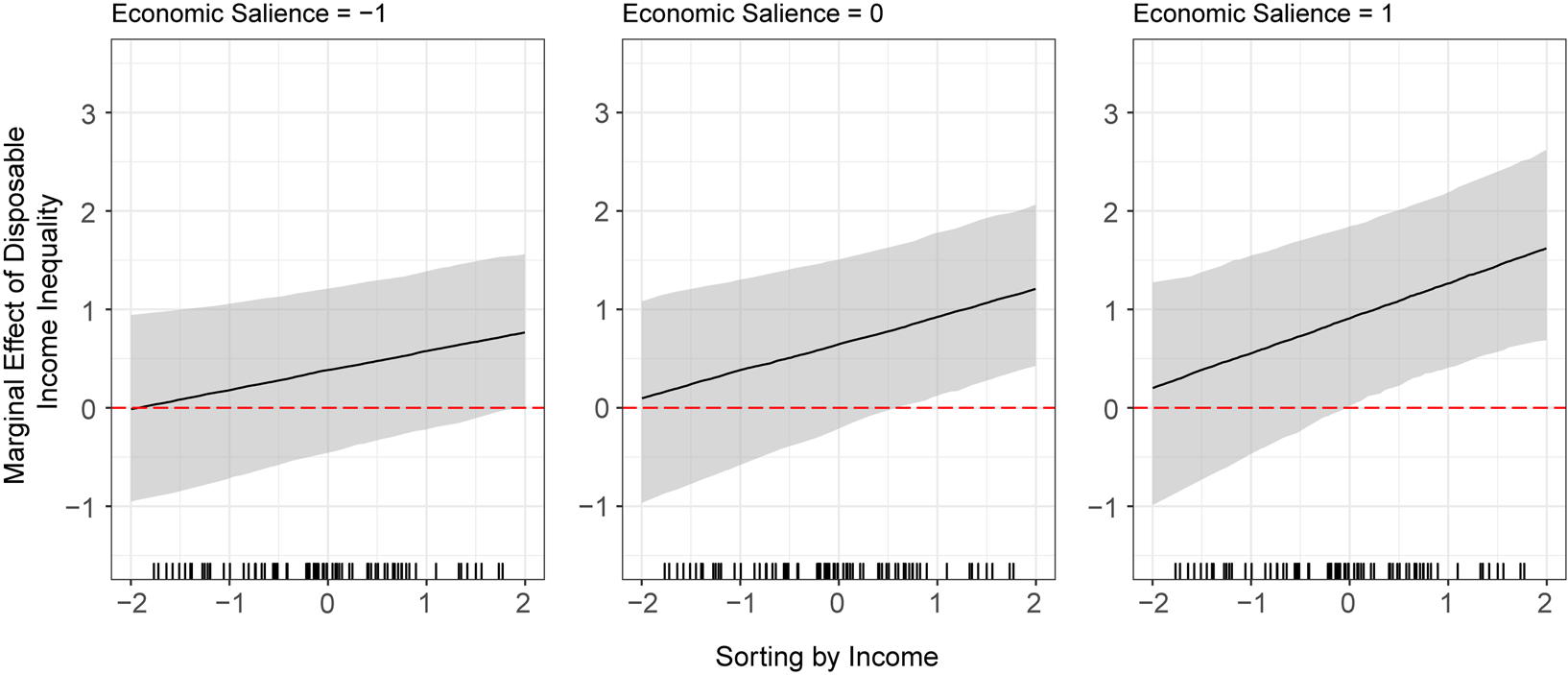
To display meaningful representations of the results, I present figures containing panels of three marginal effect plots. In each of these figures, the marginal effect of disposable income inequality on party polarization is on the y-axis. The x-axis is the variable expected to interact with income inequality, and the third variable is fixed at a constant value in each panel of the figure. I fix the constant value at one standard deviation below the mean in the leftmost panel, the mean in the middle panel, and one standard deviation above the mean in the rightmost panel. I choose these values to give a sense of the effect of changing the third variable without relying on extreme values. The key observation in each panel of these figures is at what point does the 95 per cent confidence interval around the marginal effect (indicated by the shaded grey region) not include 0 (denoted by a dashed horizontal line). When this is the case, disposable income inequality has a marginal effect on party polarization on economic issues that is statistically different from zero.
Figure 3 depicts the marginal effect of disposable income inequality on party polarization. The degree of partisan sorting by income varies from two standard deviations below its mean to two standard deviations above its mean along the x-axis. In all three panels, the marginal effect of disposable income inequality increases with party income differentiation. Critically, this positive slope lifts the marginal effect of income inequality from statistical insignificance in the center panel, when party income differentiation is very low, to significant and positive as partisan sorting increases. In the center panel, the marginal effect becomes significant when partisan sorting by income is slightly less than one standard deviation above its mean. In the rightmost panel (where the salience of economic issues is fixed at one standard deviation above its mean), income inequality has a significant effect beginning at about partisan income sorting's mean value. Even in the rightmost panel, however, there is still a substantial range of partisan sorting where the marginal effect of disposable income inequality is statistically indistinguishable from zero. Even when the importance of economic issues is elevated, party systems in which partisans are barely sorted by income should not be expected to polarize as a result of rising income inequality, but where party bases are differentiated by income, increasing inequality should lead parties to take polarized positions on economic issues. This result supports my argument in Hypothesis 1.
Marginal effect of income inequality on party polarization on economic issues by degree of income sorting
Marginal effect of disposable income inequality, Economic salience (x 3), Sorting by income
Note: marginal effect of disposable income inequality on party polarization on economic issues is displayed on the vertical axis while the degree of partisan sorting by income varies from two standard deviations above and below its mean on the horizontal axis. The black line indicates the predicted marginal effect of income inequality at the given levels of economic salience and partisan sorting by income with the gray shaded region indicating a 95 per cent confidence interval around the predicted value. Tick marks indicate observed values of partisan sorting by income.

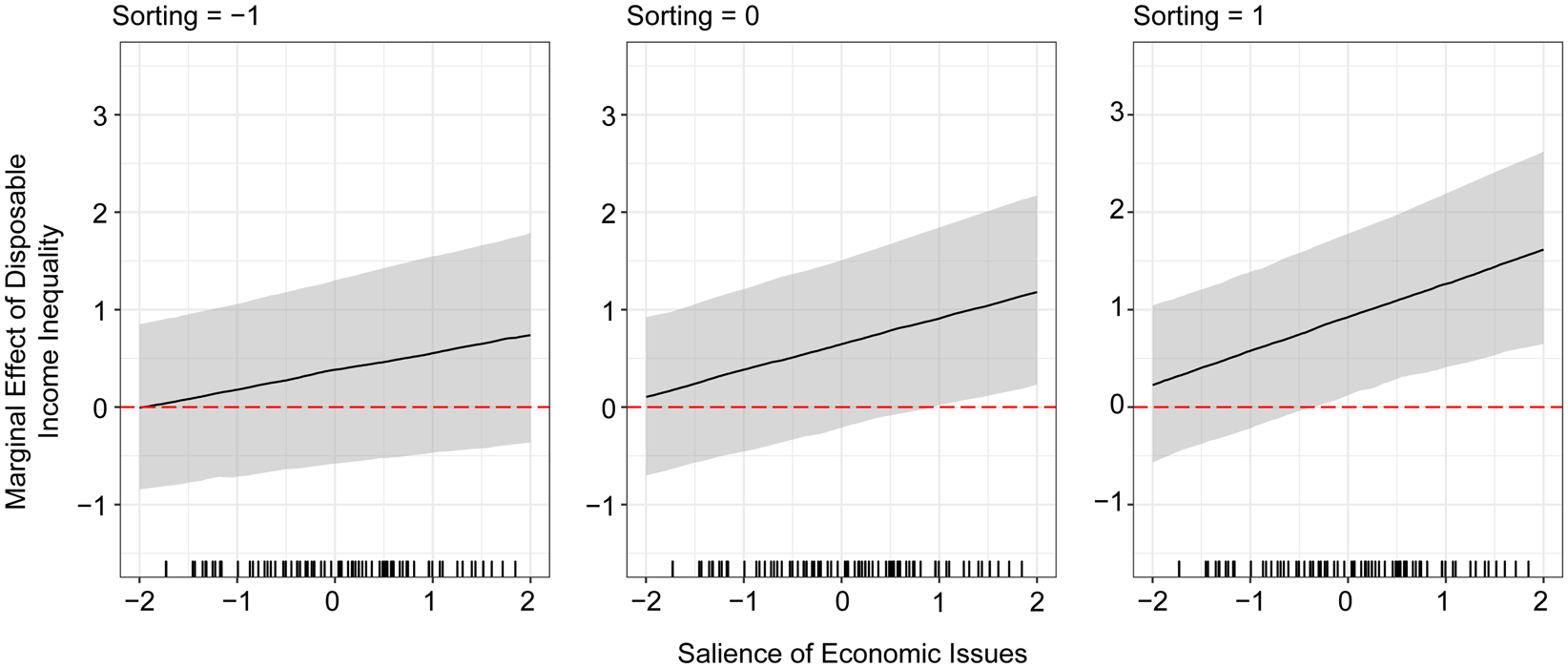
In Figure 4, I switch the salience of economic issues with party income differentiation to more clearly show the degree to which the salience of economic issues conditions the effect of income inequality. In the leftmost panel, where partisan income sorting is held at one standard deviation below its mean, no observed level of economic salience results in a statistically significant effect. In the center panel, disposable income inequality reaches statistical significance when the salience of economic issues is approximately one standard deviation above the mean. The critical level of salience drops to about a quarter of a standard deviation below its mean in the rightmost panel. As in Figure 3, the main takeaway here is that inequality has a significant effect on party polarization on economic issues, but this relationship is only present under specific conditions. In accordance with Hypothesis 2, elevated levels of economic salience increase the effect of disposable income inequality, and when coupled with average or above average levels of partisan sorting by income, inequality's effect on party polarization is statistically significant and positive.
Marginal effect of disposable income inequality on party polarization on economic issues by salience of economic issues
Note: marginal effect of disposable income inequality on party polarization on economic issues is displayed on the vertical axis while the salience of economic issues varies from two standard deviations above and below its mean on the horizontal axis. The black line indicates the predicted marginal effect of income inequality at the given levels of economic salience and partisan sorting by income with the gray shaded region indicating a 95 per cent confidence interval around the predicted value. Tick marks indicate observed values of economic salience.

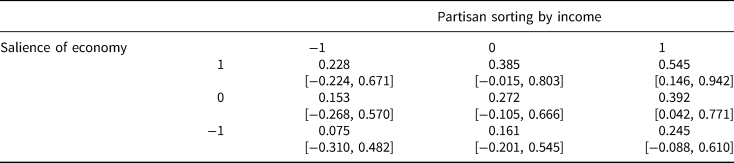
While the standardization of all variables simplifies the interpretation of the tabular model results and marginal effect plots, it does not necessarily indicate the anticipated effect of a reasonable within-country change in disposable income inequality. Table 2 displays the predicted change in party polarization resulting from an increase of 1.595 in the Gini coefficient for disposable income, the average within-country range over the study period. While the magnitude of the changes is modest, the substantive result is the same. Notably, this effect is only significant when partisan sorting by income is elevated above its mean, and this effect is particularly strong when the salience of economic issues is also above its mean. In comparison to the average within-country range of polarization (1.74 standard deviations), Table 2 indicates that income inequality can account for a substantively meaningful change in polarization, but only when both the salience of the economic issues and partisan sorting by income are both elevated.
Predicted increase in polarization as a result of an average increase in inequality
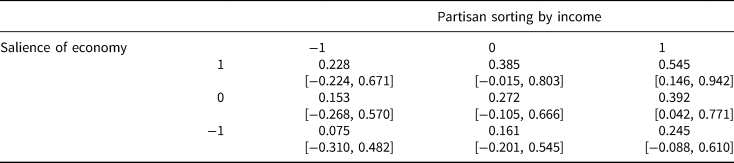
Note: predicted effect of 1.595 increase in Gini. 95 per cent confidence interval in brackets.
Together, these two results provide strong support for this article's argument. In both cases, the effect of income inequality varies by the value of the contextual factors. Income inequality's effect on party polarization increases with higher degrees of partisan sorting or the heightened salience of economic issues. When party bases are poorly sorted or economic issues are pushed off the election agenda by other considerations, there is no clear relationship between party polarization and income inequality.
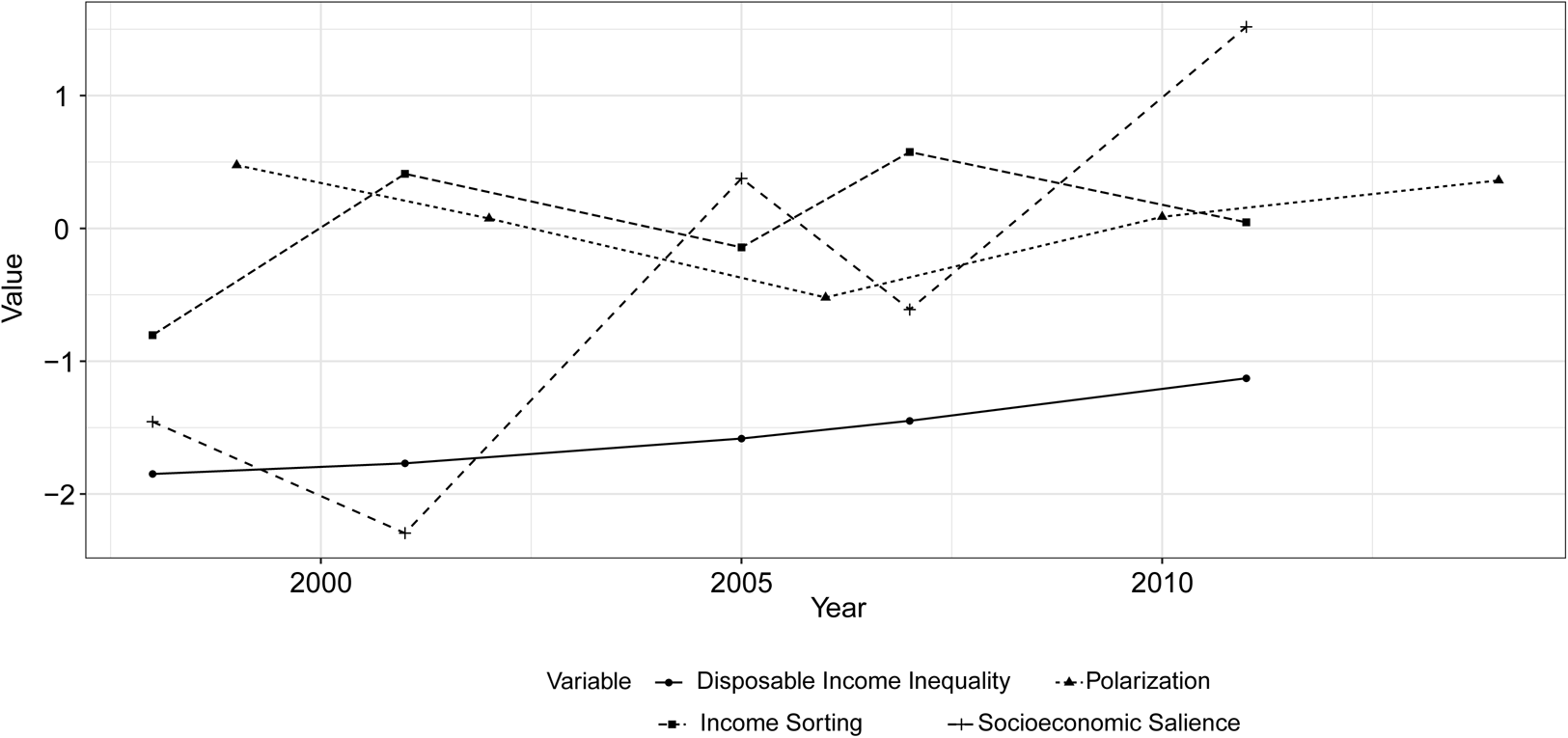
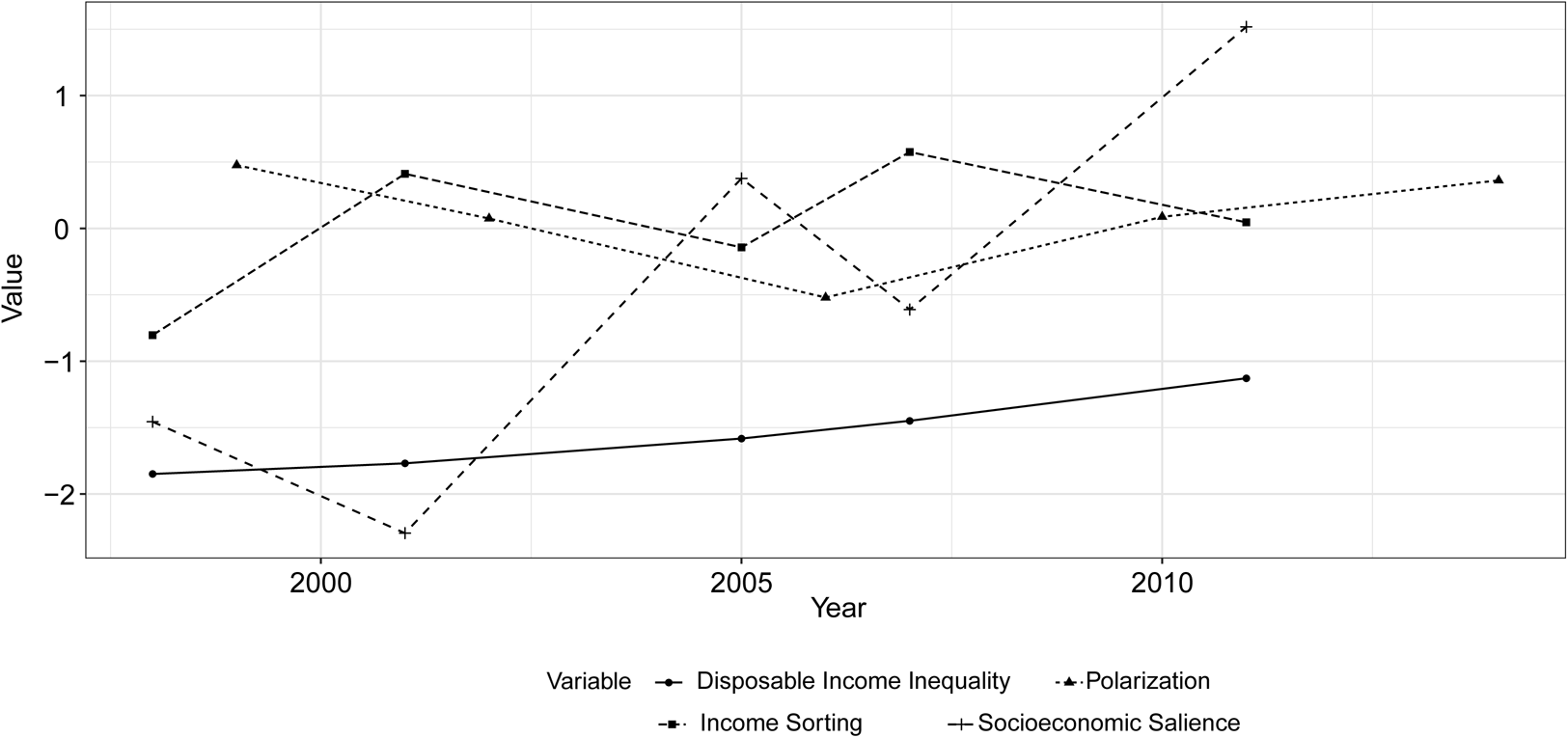
Although highly interactive results can be difficult to visualize at the level of an individual case, Figure 5 uses Denmark to demonstrate that income inequality's effect on polarization is moderated by the salience of economic issues and the degree to which partisans are sorted by income as the cross-national results indicate. Throughout the study period, income inequality in Denmark increased steadily. The conventional wisdom suggests that polarization on economic issues should have therefore also increased throughout this period. However, the party system actually depolarizes until 2006. Polarization only begins to increase in response to rising income inequality once sorting by income and socioeconomic salience are both relatively elevated. At this point, increasing income inequality appears to result in increased polarization. Notably, polarization falls prior to increases in the contextual variables interacting with income inequality, which suggests that these variables are not driven primarily by polarization itself.
Disposable income inequality, polarization sorting by income, and socioeconomic salience for Denmark, over time.
Note: all of these variables have been scaled with mean 0 and standard deviation 1, so the y-axis is their scaled value. All points are plotted at the year of measurement.
Robustness Checks
The results of the previous section support my argument that the effect of income inequality is moderated by the degree of partisan sorting by income and the importance of economic issues in national elections. In this section, I discuss two potential sources of variation that may be influencing my results due to of case selection. My sample of country-elections includes cases from both Western and Eastern Europe. These two regions have distinct political histories, which may cause differential effects. In particular, Eastern Europe countries have younger political parties and more volatile party systems (Powell and Tucker Reference Powell and Tucker2014). This relatively less structured political environment may intervene in the proposed connection between polarization and partisan sorting as supporters change parties more frequently. I rerun the fully specified model in Table 1 using only cases from Western Europe, as there are insufficient cases from Eastern Europe to perform an independent analysis. The results from that model are displayed as the first model in Table A13.
I present marginal effects plots in Figures A7 and A8 to provide more interpretable displays of the interactive findings; Figure A7 corresponds to Figure 3 and Figure A8 corresponds to Figure 4. The substantive findings using all available data are unchanged. Therefore, the incorporation of cases from Central and Eastern Europe does not substantively weaken my results.
Given the relatively small number of countries and observations within each country, it may also be the case that one country is driving my results. To account for this possibility, I refit the fully specified model each time dropping one country. The t-statistics from these models are displayed in Figure A2 with a horizontal dotted line indicating a t-statistic of 2. It does not appear that any individual case is driving my results, as the interactive terms remain significant across cases and the t-statistic on disposable income inequality itself stays relatively close to the dotted line.
Discussion
The results presented above provide robust evidence that rising economic inequality in a country can lead to increased party polarization on economic issues, but this relationship depends on the characteristics of the political system. One such contextual factor is the degree to which party bases are sorted on income. Previous research has assumed that parties of the left and right differ in the composition of their partisan base, with left party supporters having a lower economic position than right parties (Pontusson and Rueda Reference Pontusson, Rueda, Beramendi and Anderson2008; Fenzl Reference Fenzl2018). However, the proletarianization of the radical right and the rise of post-material social movements are just two trends that suggest well-sorted partisan bases by income may be increasingly uncommon. Whether party bases are sorted matters, because rising inequality should only cause party divergence if parties are actually responding to distinct interests from their bases. If all parties have similar partisans with respect to income, then we should not expect an increase in inequality to propel parties away from the center of the political space.
The importance of economic issues in elections also conditions inequality's connection with polarization. Even in states that have clearly sorted partisan bases, the importance of the economy can vary substantially across elections. This is particularly true in recent decades as issues of Europeanization, identity and immigration have become increasingly salient (Hooghe and Marks Reference Hooghe and Marks2018). When the economy is key in elections, I expect parties to take polarized positions in an effort to clarify the choice to voters (Alvarez and Nagler Reference Alvarez and Nagler2004). Parties competing in elections in which the economy is relatively unimportant lack a strong incentive to take such divergent positions.
My results support these claims across models including only single interactions with disposable income inequality, a full slate of interactions and various relevant subsets of the data. When partisan sorting by income and the salience of the economy are elevated, a robust positive relationship between income inequality and party polarization on economic issues emerges. These findings contribute to our understanding of contemporary party politics through this emphasis on the conditional translation of economic conditions into party behaviors. In particular, this study demonstrates that political factors apart from formal institutions can shift the opportunities and constraints faced by parties in the context of changing economic circumstances.
This study also suggests several areas for future research. One obvious example would be the underlying causes of partisan income sorting itself. Prior research on partisan sorting in the US context has focused on sorting with respect to the growing ideological homogeneity of the Democratic and Republican parties (Levendusky Reference Levendusky2010). More should be done on the conditions under which this sorting also leads to sorting on important demographic characteristics like income.
The connection between polarization on different axes of competition should also be explored more thoroughly. Tables 1 and A13 demonstrate a consistent, significant, and positive relationship between polarization on the GALTAN dimension of competition and the economic dimension. The relationship between party positions on these two dimensions is somewhat unclear. Radical right parties often do not take clear positions on economic issues in order to focus on their dominant axis of competition of national identity and sovereignty, but at the party system level, the results presented here suggest that polarization on these dimensions operates as a complement rather than a substitute (Rovny Reference Rovny2013). Party systems apparently need not depolarize on one axis of competition in order to polarize on another.
Additional research should also consider that political factors such as partisan sorting and issue salience interact with other macroeconomic phenomena to affect party systems. This study has shown that we should not assume that economic stresses like inequality have unconditional effects on parties and party systems. Considering which elements of political systems might act as moderating variables between economic conditions and political reactions should allow researchers to better understand the diversity and evolution of party systems in increasingly inegalitarian and globally integrated democracies.
Supplementary material
Online appendices are available at https://doi.org/10.1017/S0007123421000053.
Data availability statement
Data replication sets are available in Harvard Dataverse at https://doi.org/10.7910/DVN/SXLSXE.
Acknowledgements
I would like to thank Gary Marks, Evelyne Huber and John D. Stephens for their advice, feedback, and support in addition to the participants of the Comparative Working Group at UNC-CH during the Fall of 2019, participants in the May 2019 Partisan Divides conference, and three anonymous reviewers, all of whose comments greatly improved this article.