Introduction
The global prevalence of dementia will rise dramatically over the next 20 years due to increased longevity and falling birth rates in many countries (Ferri et al., Reference Ferri2005; Christensen et al., Reference Christensen, Doblhammer, Rau and Vaupel2009). The World Health Organization (1995) defines quality of life as “an individual's perception of their position in life in the context of the culture and value systems in which they live and in relation to their goals, standards and concerns.” Because quality of life is multifactorial, its measurement is challenging. Judgments and perceptions about the quality of a range of aspects of life will contribute to evaluations, and the importance attached to these will vary among individuals.
A further difficulty is the lack of consensus about how to define quality of life in dementia. Narrower definitions focusing on affect and participating in and enjoying activities (Albert et al., Reference Albert1996) inform some quality of life measures, for example Dementia Care Mapping (DCM), an observer-rated instrument measuring activity, engagement with the environment, and affect. Rabins et al. (Reference Rabins, Kasper and Kleinman1999) noted that social functioning and perceived emotional well-being or distress were the two domains consistently included in health-related quality of life instruments. Most dementia-specific quality of life instruments exclude cognitive and physical functioning (Rabins et al., Reference Rabins, Kasper and Kleinman1999), although the DEMQOL measures cognitive functioning, as well as daily activities and looking after yourself, health and well-being, social relationships, and self-concept (Banerjee et al., Reference Banerjee, Smith, Lamping, Foley, Smith and Murray2004). The Alzheimer's Disease Quality-Related Life Scale (ADQRL) includes awareness of a person's own identity and close relationships and response to surroundings, items that are related to cognitive functioning (Rabins et al., Reference Rabins, Kasper and Kleinman1999). It also measures social interaction, feelings, and mood. The Quality of Life – Alzheimer's Disease (QOL-AD) scale has perhaps the broadest definition, which encompasses physical health, relationships, and financial status (Logsdon et al., Reference Logsdon, Gibbons and McCurry1996). Nonetheless, as quality of life is consistently cited by older adults as more important than disease-specific outcomes, many dementia trials are now including it as an outcome. Clearly the definition of quality of life employed in studies must be considered carefully when interpreting how interventions affect it.
The nature of dementia brings into question the validity of ratings particularly by those with moderate and severe illness; but the concept of quality of life as an individual's own perception suggests that the rater should be the person with the illness where possible. Quality of life measures have therefore been developed to be rated by the person with dementia, by the carer (ADQRL), by both or either (QOL-AD; DEMQOL), or by direct observation (DCM). The QOL-AD was developed by asking patients, family, and professional carers about what is important in quality of life; the ADQRL by asking panels of professional and family carers; and the DEMQOL by interviewing patients and family carers. The DCM was developed from a theoretical person centered model.
Hoe and colleagues demonstrated that the QOL-AD is valid and reliable when completed by people with dementia, except those with the most profound dementia (Mini-Mental State Examination (MMSE) score <3; Hoe et al., Reference Hoe, Katona, Roch and Livingston2005; Reference Hoe, Katona, Orrell and Livingston2007). Carer proxy reports and self-reports of quality of life are highly correlated, although people with dementia rate their own quality of life more highly than carers rate it by proxy (Hoe et al., Reference Hoe, Hancock, Livingston and Orrell2006). As there is a strong subjective element to quality of life, it is unsurprising that there is variation in how it is rated by the people with dementia themselves, family, and professional carers and independent observers.
People with dementia reported lower quality of life than people without dementia in a recent national English survey, and this was explained by their higher levels of physical and mental health problems (Cooper et al., Reference Cooper, Bebbington, Katona and Livingston2009). We know little – according to a recent review “almost nothing” – about what interventions promote or inhibit their quality of life (Cooper et al., Reference Cooper, Bebbington, Katona and Livingston2009). Poorer quality of life has been associated with depression and less satisfactory relationships but not with greater activity limitation in dementia (Livingston et al., Reference Livingston, Cooper, Woods, Milne and Katona2008). Some studies have reported a relationship with worse cognition (Cordner et al., Reference Cordner, Blass, Rabins and Black2010), while others have not (Livingston et al., Reference Livingston, Cooper, Woods, Milne and Katona2008). These differences may be due to varying dementia severity of populations studied or to methodology, with staff ratings more likely than patients’ own ratings to correlate with higher cognition (Hoe et al., Reference Hoe, Hancock, Livingston and Orrell2006; Black and Rabins, Reference Black, Rabins, Ames, O'Brien and Burns2010).
This is, to our knowledge, the first systematic review of the effectiveness of non-pharmacological interventions to focus on quality of life or well-being of people with dementia. Quality of life was included as an outcome in one previous systematic review of non-pharmacological interventions for people with Alzheimer's disease or mixed dementia (Olazaran et al., Reference Olazaran2010), although only two studies measuring quality of life were included (Graff et al., Reference Graff, Vernooij-Dassen, Thijssen, Dekker, Hoefnagels and Olderikkert2007; Gitlin et al., Reference Gitlin, Winter, Burke, Chernett, Dennis and Hauck2008). We considered whether interventions were effective immediately and if this effect was sustained, and divided interventions into those for people with dementia living at home and those in full-time care. This is part of a series of systematic reviews by the Old Age Task Force of the World Federation of Biological Psychiatry (Livingston et al., Reference Livingston, Johnston, Katona, Paton and Lyketsos2005; Selwood et al., Reference Selwood, Johnston, Katona, Lyketsos and Livingston2007; Cooper et al., Reference Cooper2011).
Methods
Search strategy
We searched PubMed, Web of Science, and Cochrane systematic reviews databases through January 2011 using the keywords “Dementia” or “Alzheimer;” “Quality of life” or “well-being;” and “treatment” or “intervention.” We searched references of included papers and relevant systematic reviews. We asked experts in the field if they knew of other papers meeting inclusion criteria.
Inclusion and exclusion criteria
We included primary research in people with dementia evaluating non-pharmacological interventions in randomized controlled trials (RCTs), which included quality of life or well-being as a quantitative outcome. We restricted our search to studies published in English and excluded single case reports, dissertations, meeting abstracts, and studies that only used quality of life measure subscales, if we judged that these did not measure overall quality of life.
Data extraction
Two authors independently evaluated study validity using a checklist for appraising RCTs adapted from the Critical Appraisal Skills Programme (http://www.sph.nhs.uk/sph-files/rct%20appraisal%20tool.pdf). They resolved differences in discussion with a third author. We allocated a point for each positive response to the questions:
1. Were participants appropriately randomized by an independent person?
2. Were participants, staff, and study personnel as far as possible “blind” to study group?
3. Were all those who entered the trial accounted for at its conclusion, and was an intention to treat analysis used?
4. Was the measure of quality of life valid and reliable?
5. Were the participants in all groups followed up and data collected in the same way?
6. Was sufficient power (>80%) to detect a significant difference in our outcome of interest demonstrated?
We judged papers where the answers to questions 2 and 4 above were yes to be of higher quality.
Analysis
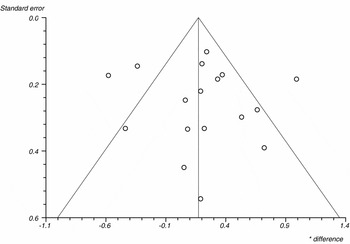
We reported the unadjusted standardized mean differences (SMD) between control and intervention groups at follow-up for the quality of life outcome, and their 95% confidence intervals (CI). Where the unadjusted SMD was not reported, we used StatsDirect software, version 2.6.6 (StatsDirect, 2008) to calculate it from the means, standard deviations (SD), and sample sizes (n) of the study groups. We contacted the authors to request this information if it was not available in the paper. We combined study findings where appropriate, and reported pooled standardized effect sizes (SES). These were calculated using direct weights defined as the inverse of the variance of the mean for each study. We performed a funnel plot (Figure 1) to examine publication bias and reported the Egger statistic. This tests for asymmetry of the plot, with a significant result indicating significant asymmetry and therefore bias (Egger et al., Reference Egger, Smith, Schneider and Minder1997).
Funnel plot demonstrating symmetrical plot indicating low risk of publication bias.

Results
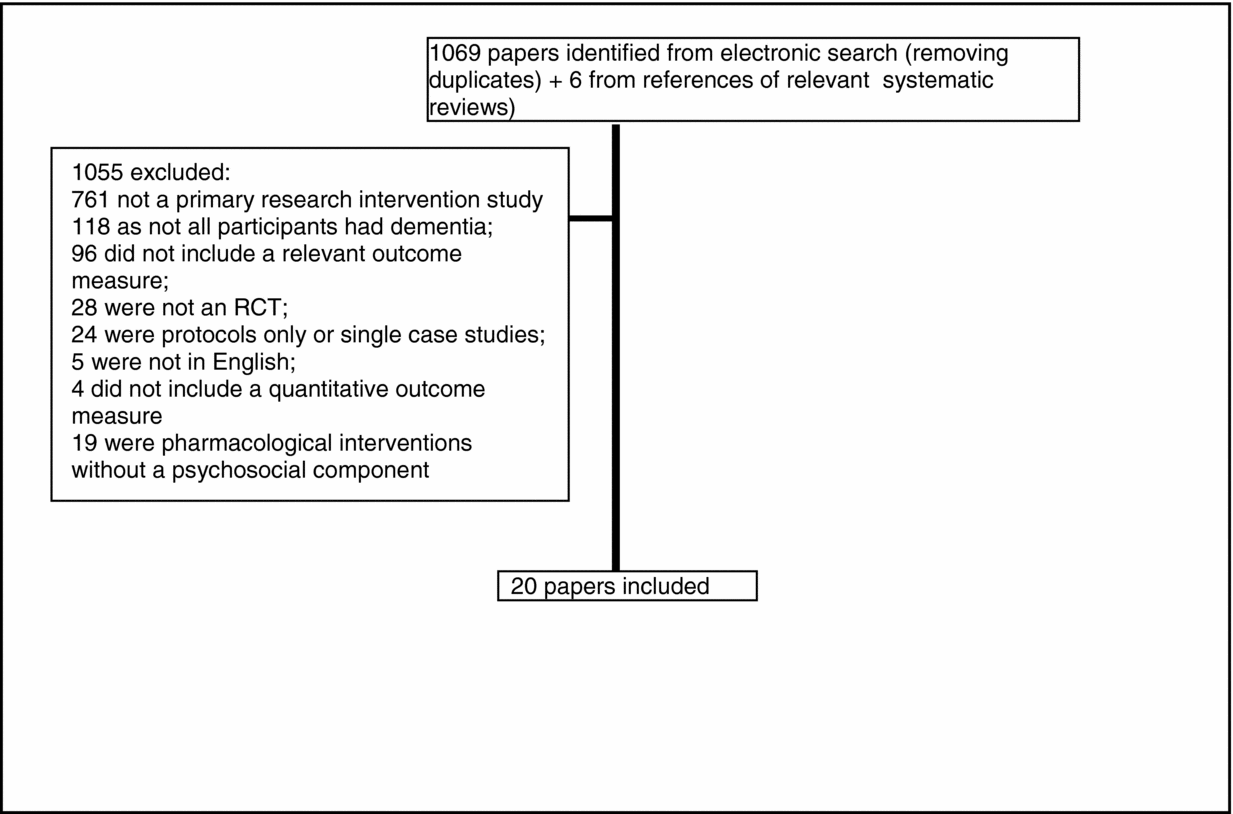
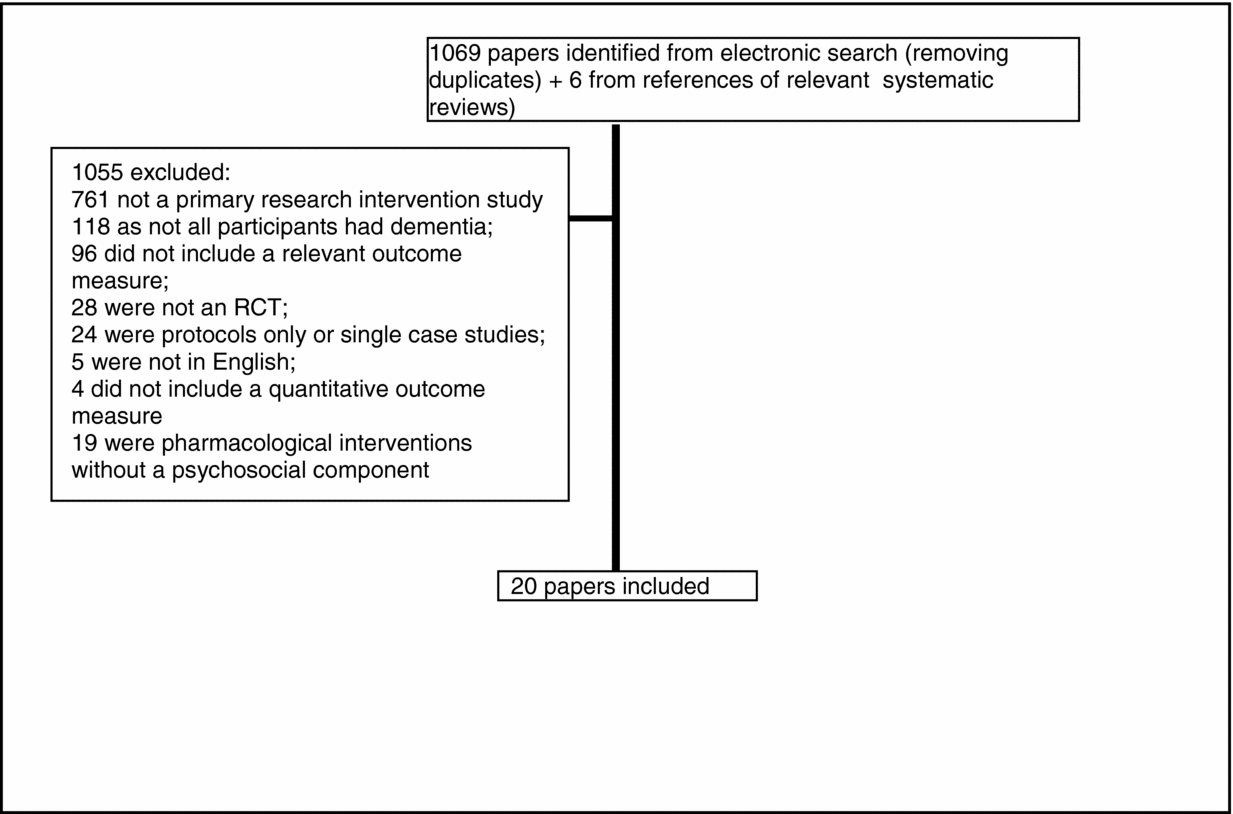
We included 20 studies. Figure 2 describes the search strategy and results, and the reasons for excluding studies. We did not find evidence of significant publication bias (Egger statistic = 0.41, p = 0.74; Figure 1).
Flow diagram of search results.
Study validity
We scored 16/20 studies that used a valid and reliable measure of quality of life or well-being and in which raters were blind to group allocation. We defined these as higher quality studies, and gave these priority when interpreting results.
Measures used
All but one study (Davis et al., Reference Davis, Massman and Doody2001) used a measure known to be valid and reliable in this population. All the studies measured quality of life. Most used a self-report measure, completed by the person with dementia, a carer on their behalf, or both. The measures used were: the QOL-AD (Spector et al., Reference Spector2003; Chapman et al., Reference Chapman, Weiner, Rackley, Hynan and Zientz2004; Teri et al., Reference Teri, McCurry, Logsdon and Gibbons2005; Orrell et al., Reference Orrell, Hancock, Hoe, Woods, Livingston and Challis2007; Gitlin et al., Reference Gitlin, Winter, Burke, Chernett, Dennis and Hauck2008; Meguro et al., Reference Meguro, Kasai, Akanuma, Ishii, Yamaguchi and Meguro2008; Clare et al., Reference Clare2010; Gitlin et al., Reference Gitlin, Winter, Dennis, Hodgson and Hauck2010; Logsdon et al., Reference Logsdon2010), the ADQRL (Politis et al., Reference Politis, Vozzella, Mayer, Onyike, Baker and Lyketsos2004; Visser et al., Reference Visser, McCabe, Hudgson, Buchanan, Davison and George2008; Steinberg et al., Reference Steinberg, Leoutsakos, Podewils and Lyketsos2009), the Dementia Quality of Life Instrument (Graff et al., Reference Graff, Vernooij-Dassen, Thijssen, Dekker, Hoefnagels and Olderikkert2007), the Quality of Life assessment (Davis et al., Reference Davis, Massman and Doody2001), DEMQOL (Gavrilova et al., Reference Gavrilova, Ferri, Mikhaylova, Sokolova, Banerjee and Prince2009; Guerra et al., Reference Guerra, Ferri, Fonseca, Banerjee and Prince2010), and the Health Utilities Index Mark 3 (HUI-3; Vickrey et al., Reference Vickrey2006). Three studies used observer-rated measures: Ballard et al. (Reference Ballard, O'Brien, Reichelt and Perry2002) and Lai et al. (Reference Lai, Chi and Kayser-Jones2004) used DCM while Chenoweth et al. (Reference Chenoweth2009) used the Quality of Life in Late-Stage Dementia Scale (QUALID).
Primary outcomes
Thirteen studies identified one or more primary outcome. In three of these, quality of life was either the sole primary outcome (Logsdon et al., Reference Logsdon2010) or one of more than four primary outcomes (Chapman et al., Reference Chapman, Weiner, Rackley, Hynan and Zientz2004; Gitlin et al., Reference Gitlin, Winter, Dennis, Hodgson and Hauck2010). None of the included studies was specifically designed to detect a significant difference in the quality of life outcome. Eight studies reported significant effects on other primary outcomes, which were: patient agitation (Ballard et al., Reference Ballard, O'Brien, Reichelt and Perry2002; Chenoweth et al., Reference Chenoweth2009), goal satisfaction and performance (Clare et al., Reference Clare2010), patient daily functioning and caregiver sense of competence (Graff et al., Reference Graff, Vernooij-Dassen, Thijssen, Dekker, Hoefnagels and Olderikkert2007), patient challenging behaviors (Gitlin et al., Reference Gitlin, Winter, Burke, Chernett, Dennis and Hauck2008), cognition (Spector et al., Reference Spector2003), functional performance (Steinberg et al., Reference Steinberg, Leoutsakos, Podewils and Lyketsos2009), and clinician adherence to guideline recommendations (Vickrey et al., Reference Vickrey2006). Two studies did not report a significant effect on their primary outcomes of patient needs (Orrell et al., Reference Orrell, Hancock, Hoe, Woods, Livingston and Challis2007) and apathy (Politis et al., Reference Politis, Vozzella, Mayer, Onyike, Baker and Lyketsos2004).
Findings
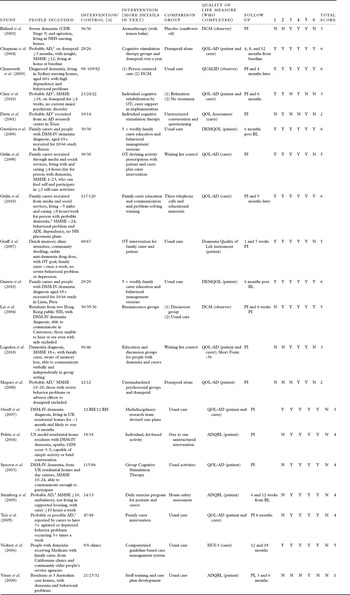
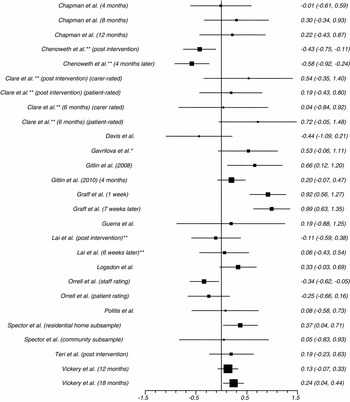
Table 1 describes the studies, including validity ratings. The SMD between control and follow-up groups was reported by two studies (Gavrilova et al., Reference Gavrilova, Ferri, Mikhaylova, Sokolova, Banerjee and Prince2009; Guerra et al., Reference Guerra, Ferri, Fonseca, Banerjee and Prince2010) and we calculated it for a further 14 studies (Figure 3). We could not report SMD for one study because data were non-parametric (Ballard et al., Reference Ballard, O'Brien, Reichelt and Perry2002); from another because it did not provide a summary score for quality of life, reporting on the five subscales instead (Visser et al., Reference Visser, McCabe, Hudgson, Buchanan, Davison and George2008); and in two studies because the data were not available (Meguro et al., Reference Meguro, Kasai, Akanuma, Ishii, Yamaguchi and Meguro2008; Steinberg et al., Reference Steinberg, Leoutsakos, Podewils and Lyketsos2009). We divided interventions into those for people with dementia living at home and those for residents of full-time care.
Characteristics and validity of intervention studies involving people with dementia living in their own homes (the numbers 1–6 in the column head refer to the validity questions as cited in the method)

1 As defined by National Institute of Neurological and Communicative Disorders and Stroke (NINCDS) guidelines. ADQRL = Alzheimer's Disease Quality-Related Life Scale; BL = baseline; CDR = Clinical Dementia Rating Scale; DCM = Dementia Care Mapping; HUI-3 = Health Utilities Index Mark 3; NH = Nursing Home; OT = Occupational Therapist; PGCMS = Philadelphia Geriatric Center Affect/Morale Scale; PI = Post-intervention; QOL = Quality of Life; RH = Residential Home. Validity score gives a rating of validity of studies, with higher scores indicating more valid studies.
Forest plot of standardized mean differences and 95% confidence intervals. *Adjusted for baseline differences in need for care. **Comparisons are for control and intervention groups; no significant differences observed between active comparison arm and either group.

Interventions for people with dementia living at home
Family carer interventions
Four studies, all judged to be of higher quality, tested mainly coping strategy-based interventions for family carers of people with dementia living at home (Teri et al., Reference Teri, McCurry, Logsdon and Gibbons2005; Gavrilova et al., Reference Gavrilova, Ferri, Mikhaylova, Sokolova, Banerjee and Prince2009; Gitlin et al., Reference Gitlin, Winter, Dennis, Hodgson and Hauck2010; Guerra et al., Reference Guerra, Ferri, Fonseca, Banerjee and Prince2010). These included psychological strategies such as promoting helpful coping, behavioral management, effective communication, and scheduling pleasant events.
Two studies, in Russia and Peru respectively, evaluated a manualized family carer intervention of education and behavioral management developed for the 10/66 study. It comprised five, half-hour sessions. In Russia, it was delivered by newly qualified doctors to people who had been diagnosed with dementia on average 4.5 years previously (in 2009). In Peru, it was delivered by junior psychologists and social workers (in 2010) to a population half of whom had mild dementia. Neither study reported a statistically significant difference in quality of life between the intervention and usual care groups.
Gitlin et al. (Reference Gitlin, Winter, Dennis, Hodgson and Hauck2010) described a ten-session intervention focused on the carer, in which occupational therapists (OTs) interviewed carers and people with dementia. It included up to 12 OTs or nurses, home or telephone contacts in four months. The intervention was tailored to individual needs, but encompassed carer education, and trained carers to modify the home environment, engage patients in activities, and simplify tasks, and in problem-solving, communication training, and stress reduction. The mean MMSE score of care recipients was 13.4 (SD = 8.1). Compared to a control group receiving up to three 20-minute phone calls from trained research staff, there was no significant improvement in quality of life in the intervention group at four months.
Teri et al. (Reference Teri, McCurry, Logsdon and Gibbons2005) trained health professionals to deliver a manualized intervention to family carers based on behavioral management, communication, and increasing pleasant events. It involved eight weekly sessions and four telephone calls and this was compared with usual care. The mean MMSE score of care recipients was 14.0 (SD = 7.0). There was no significant difference in the SMD in quality of life scores between groups at two or six months post-intervention (Figure 3). A significant difference in the mean change of scores between baseline and two months in favor of the intervention was reported (n = 0.049, n = 83).
Summary and analysis: The pooled SES for the post-intervention follow-up assessments of these four high-quality studies was 0.24 (range 0.03–0.45; n = 420), suggesting that carer coping strategy-based support is effective at improving quality of life in people with dementia living in the community. The quality of life measures included in this analysis were self-rated (Gavrilova et al., Reference Gavrilova, Ferri, Mikhaylova, Sokolova, Banerjee and Prince2009; Guerra et al., Reference Guerra, Ferri, Fonseca, Banerjee and Prince2010), carer proxy-rated (Gitlin et al., Reference Gitlin, Winter, Burke, Chernett, Dennis and Hauck2008), or both (Teri et al., Reference Teri, McCurry, Logsdon and Gibbons2005). None of the studies individually showed a significant effect and the interventions were not the same, so this pooled analysis must be interpreted cautiously.
Activity programs for people with dementia and family carer coping strategy combined interventions
Two high-quality studies evaluated individual tailored activity interventions delivered by OTs to people with dementia and their family carers, which involved goal setting and environmental assessment, together with family carer coping strategy modification components. Graff et al. (Reference Graff, Vernooij-Dassen, Thijssen, Dekker, Hoefnagels and Olderikkert2007) evaluated a program of ten, one-hour home sessions conducted by an OT over five weeks. These involved goal setting and environmental modification. Patients (mean MMSE score 19.0) were taught to optimize compensatory and environmental strategies to help with daily tasks. Carers were trained in effective supervision, problem-solving, and coping strategies. People with dementia in the intervention group had higher quality of life compared to the usual care group, one and seven weeks after the end of the intervention.
In the study by Gitlin et al. (Reference Gitlin, Winter, Burke, Chernett, Dennis and Hauck2008), an OT made six 1.5-hour home visits and two telephone calls; they devised 2–3 activity prescriptions for identified goals (e.g. playing catch with grandchildren) and taught the family carer relaxation. The intervention was delivered mainly to the family carer but they included the person with dementia (mean MMSE score of 11.6; SD 8.1) as much as possible. As carers mastered these activities, the interventionist generalized the strategies to managing care problems. The authors reported that the mean difference, adjusted for baseline values, care recipient MMSE score, activities of daily living (ADL) dependency, caregiver age, gender, education, and relationship to care recipient, between experimental and waiting list control groups in carer-rated quality of life scores post-intervention was not significant (p = 0.095), but we found that the unadjusted SMD for this comparison was significant in favor of the intervention (Figure 3).
Summary: In two high-quality studies, quality of life (self-rated: Graff et al., Reference Graff, Vernooij-Dassen, Thijssen, Dekker, Hoefnagels and Olderikkert2007; carer proxy-rated: Gitlin et al., Reference Gitlin, Winter, Burke, Chernett, Dennis and Hauck2008) was higher in a group receiving an activity and family carer coping strategy combined intervention than in comparison groups (pooled SES 0.84 (range 0.54–1.14); n = 191).
Cognitive Stimulation Therapy (CST)
Three studies evaluated Cognitive Stimulation Therapy (CST); none required participants to involve their carer. Two studies, both rated as high quality, evaluated group CST (Spector et al., Reference Spector2003; Chapman et al., Reference Chapman, Weiner, Rackley, Hynan and Zientz2004). Spector et al. (Reference Spector2003) evaluated 14 45-minute sessions of reality orientation and CST over seven weeks. Sessions focused on themes (such as childhood and food) that allowed natural reminiscence but had an additional focus on the current day, encouraged the use of information processing rather than factual knowledge, and included multisensory stimulation. Participants were recruited from five day centers and from 18 residential homes. The mean participant MMSE score was 14.4 (SD = 3.8). In the original analysis that included people living at home and in care homes, quality of life was higher in the intervention than “usual activities” group post-intervention. Using data kindly provided by the authors, we calculated the SMD for community dwelling residents and those in care homes separately, and these are shown in Figure 3.
Chapman et al. (Reference Chapman, Weiner, Rackley, Hynan and Zientz2004) recruited from the community (mean MMSE 20.9; SD 3.6). Group sessions lasted 1.5 hours, and were held weekly for eight weeks then monthly for the remainder of one year. They were led by a speech and language pathologist with three trained students. The groups included discussions requiring homework, interactive sessions about Alzheimer's disease, and discussions using salient life stories. There was no significant difference between the intervention and usual care control groups at four, eight, or 12 months after baseline.
A trial that we rated as lower quality compared five one-hour sessions of individual CST with an attention control, and found no significant effect (Davis et al., Reference Davis, Massman and Doody2001).
Summary: There is insufficient evidence from two high-quality trials that group CST improves quality of life in people with dementia living at home immediately post-intervention on self-rated (Spector et al., Reference Spector2003) or self- and carer-rated (Chapman et al., Reference Chapman, Weiner, Rackley, Hynan and Zientz2004) QOL-AD scores (pooled SES 0.16; 95%CI –0.36–0.68; n = 57). Also, individual CST did not improve quality of life in people with dementia in one lower-quality trial.
Care management
A study that we rated as higher quality evaluated an internet-based care management software program that generated care plan actions and recommendations from a structured assessment (Vickrey et al., Reference Vickrey2006). Care managers regularly assessed patients and carers, and used the system to coordinate guideline-recommended health and community care. The mean duration since dementia diagnosis in participants was 2.7 years. Only those with an informal carer also willing to participate were included.
Summary: Compared to those receiving usual care, carer-rated quality of life had improved among participants receiving the intervention 18 months after its introduction.
Discussion groups
In a study that we rated as lower quality, Logsdon et al. (Reference Logsdon2010) evaluated nine weekly 1.5 hour manualized, structured groups provided by local Alzheimer's Association volunteer facilitators for people with dementia with an informal carer who was also willing to participate. Carers and people with dementia (mean MMSE score 23.5) met together and separately to discuss dementia, social and family relationships, and planning for the future. In an analysis that controlled for baseline scores, MMSE, age, and sex, the intervention group carer-rated quality of life scores significantly improved, while those for the waiting list control group deteriorated. We found that the SMD for carer-rated quality of life between groups post-intervention, unadjusted for baseline scores, was not significant. There were no significant differences on the SF-36 or on the patient-rated quality of life scores between groups post-intervention.
Summary: In a lower-quality study, there was conflicting evidence about whether a discussion-based group program for people with dementia and their family carers improved quality of life.
Individual cognitive rehabilitation
A study we rated as higher quality tested a program of eight weekly one-hour sessions described as cognitive rehabilitation, delivered by an experienced OT (Clare et al., Reference Clare2010) to people with or without an informal carer. The OT agreed goals with participants (mean MMSE score 23; SD 3.0), and sought to meet these through practical aids and strategies, including cognitive strategies such as practice in maintaining concentration and stress management. Where available, carers were invited to join the last 15 minutes of sessions to support implementation. The intervention was compared to individual relaxation, delivered by the same therapist, and to usual care.
Summary and analysis: Cognitive rehabilitation did not improve patient or carer-rated quality of life in one higher-quality study.
Exercise
A higher-quality trial randomized people with dementia who had an informal carer (mean MMSE 17.5; SD 5.3) and their carers to an exercise intervention or a control group who were visited twice at home to discuss home safety (Steinberg et al., Reference Steinberg, Leoutsakos, Podewils and Lyketsos2009). The intervention involved three, two-hour sessions to introduce a daily exercise program, encompassing aerobic, strength and balance, and flexibility training.
Summary: Exercise therapy did not improve self-rated quality of life for people with dementia living at home in one study.
Interventions for people with dementia living in care homes
Group CST
Spector et al. (Reference Spector2003) included people with dementia in care homes in their trial of group CST (see earlier for more details of this study). In our reanalysis, which included only those people with dementia living in care homes, there was a significant difference between mean self-rated quality of life scores of intervention and usual care groups immediately post-intervention (Figure 3).
Summary: Group CST improved self-rated quality of life for people with dementia living in care homes in one study.
Staff training and individualized resident care plans
We found three studies in this category (Orrell et al., Reference Orrell, Hancock, Hoe, Woods, Livingston and Challis2007; Visser et al., Reference Visser, McCabe, Hudgson, Buchanan, Davison and George2008; Chenoweth et al., Reference Chenoweth2009), and rated two as higher quality (Orrell et al., Reference Orrell, Hancock, Hoe, Woods, Livingston and Challis2007; Chenoweth et al., Reference Chenoweth2009). Orrell et al. (Reference Orrell, Hancock, Hoe, Woods, Livingston and Challis2007) describe a 20-week intervention in which researchers visited care homes to discuss the home environment, procedures, and residents’ unmet needs. The unmet needs of residents were summarized and fed back to the homes in the intervention group as individualized care plans, and the researcher visited for two hours a fortnight to review the plans. Quality of life did not improve in residents in the intervention group compared to the usual care control group.
Chenoweth et al. (Reference Chenoweth2009) taught care staff the principles of person-centered care. This teaches that feelings persist despite cognitive impairment, and should be acknowledged during social interactions to help preserve personhood and build meaningful relationships. Training included a two-day initial course, two site visits, and regular telephone contact during the four-month intervention. In a second intervention group, two of the authors carried out DCM, then developed person-centered care plans with home staff for residents. DCM is an observational tool that examines the care of people with dementia from their viewpoint. There were no significant differences between these intervention groups and a third, usual care group in resident quality of life immediately after the intervention or eight months later.
In a study we judged as lower quality, Visser et al. (Reference Visser, McCabe, Hudgson, Buchanan, Davison and George2008) evaluated an education program of eight, twice-weekly sessions, for nursing home staff. These included information about dementia, behavioral management, and workshops where staff developed individualized care plans. A second intervention group received this training and a half-hour peer support session after each teaching session. No difference in quality of life was reported between these groups and the usual care control group.
Summary: There is no evidence that interventions that guide the development of individualized care plans by care home staff increase the quality of life of residents with dementia. The pooled SES for the post-intervention quality of life ratings of the two higher-quality studies suggested that quality of life of residents (observer: Chenoweth et al., Reference Chenoweth2009; or staff-rated: Orrell et al., Reference Orrell, Hancock, Hoe, Woods, Livingston and Challis2007) was more likely to improve with usual care (–0.38: range –0.59 to –0.17; n = 350).
Other interventions
Higher-quality studies have evaluated kit-based activities (Politis et al., Reference Politis, Vozzella, Mayer, Onyike, Baker and Lyketsos2004) and reminiscence groups (Lai et al., Reference Lai, Chi and Kayser-Jones2004). Neither reported a significant difference between control and intervention groups in quality of life at follow-up. Politis et al. (Reference Politis, Vozzella, Mayer, Onyike, Baker and Lyketsos2004) evaluated a standardized, individual kit-based activity in a care home. In three 30-minute sessions per week for four weeks, patients chose from five activities, each of which involved naming, counting, and quiz questions based on a chosen topic. The control group received individual time of an equivalent duration. Lai et al. (Reference Lai, Chi and Kayser-Jones2004) compared six half-hour reminiscence groups, which used a life story approach, to a general discussion comparison group, in two nursing homes.
In a lower-quality study, Ballard et al. (Reference Ballard, O'Brien, Reichelt and Perry2002) compared aromatherapy with lemon balm and placebo oil, applied by a care assistant twice daily for four weeks, in people with dementia and agitation living in nursing homes. They reported that the change in median percentage time that participants spent engaged in constructive activities increased significantly and time spent socially withdrawn decreased significantly in the active treatment group compared with the placebo group. The raters were not blind as they could smell the oil (unlike in a subsequent trial by the same authors in which the raters wore nose clips; Burns et al., Reference Burns2011).
In a second lower-quality study, Meguro et al. (Reference Meguro, Kasai, Akanuma, Ishii, Yamaguchi and Meguro2008) took account of previous interests when allocating psychosocial interventions, which included flower arranging, cooking, calligraphy, as well as reminiscence and reality orientation, delivered over a year. Quality of life was significantly higher in the intervention group than the usual care control group at follow-up.
Summary: In low-quality studies, aromatherapy with lemon balm and an unstandardized psychosocial intervention program were associated with improved self-rated quality of life immediately post-intervention. Also, high-quality studies have evaluated the impact of reminiscence groups and kit-based activities. Neither reported a significant effect.
Discussion
We found preliminary evidence that coping strategy-based support for family carers with or without a tailored activity component directed at the person with dementia improved the quality of life of people with dementia living at home. While the individual studies of the carer coping-based support alone did not indicate significant benefits to quality of life, the pooled results of four studies suggested a beneficial but small effect size immediately after the intervention. This type of intervention is effective at improving carer mental health (Gallagher-Thompson et al., Reference Gallagher-Thompson, Arean, Rivera and Thompson2001) and it is encouraging that it might also help in improving quality of life of people with dementia. The two studies that included a tailored activity component reported higher effect sizes suggesting that the combination of tailored activities for people with dementia and carer coping strategy-based support may be the most effective intervention for people with dementia living at home, based on existing evidence. In one higher-quality study, a care management system that helped professionals to deliver evidence-based care consistently to people with dementia living at home reported better quality of life 18 months after its introduction (Vickrey et al., Reference Vickrey2006). Most of the interventions we found to be effective could only be accessed by people with dementia with a family carer, suggesting that the development and evaluation of interventions to improve the quality of life of people with dementia without a family carer are needed.
Group CST, evaluated in one high-quality study, and an unstandardized psychosocial intervention program evaluated in one lower-quality study were the only effective interventions in promoting quality of life of people with dementia living in care homes. Both studies only evaluated patients immediately post-intervention. We suggest a trial of the longer-term effects of group CST for care home residents is now warranted. Two studies that evaluated interventions to help care home staff develop individualized care plans found that quality of life was higher in the usual care compared with intervention groups. In neither study were results unequivocally negative – Orrell et al. (Reference Orrell, Hancock, Hoe, Woods, Livingston and Challis2007) found this for carer but not patient-rated quality of life, while Chenoweth et al. (Reference Chenoweth2009) found that the intervention decreased patient agitation – but nonetheless our review would suggest that trials of interventions to improve quality of life of people with dementia in care homes should bear in mind the possibility of harm as well as benefit. As in drug treatment, an intervention might not only improve or have no effect on one domain but also harm overall quality of life.
Coping strategy-based support for family carers that included training in behavioral management, problem-solving, and communication together with tailored activities programs for people with dementia appeared to be effective at improving the quality of life of people with dementia living at home with a family carer. Therefore, a similar approach might help those looked after by paid carers both in the community and in care homes, although the high staff turnover and the distinct nature of the relationship between a paid carer and a person with dementia would necessitate substantial modifications to intervention content and delivery. Adapting these interventions specifically to target quality of life might increase their effectiveness. We recommend a trial of a modified coping strategy and activities-based intervention for paid carers, to determine whether the benefits of this approach can be extended to people with dementia looked after by paid carers in care homes or the community.
All but three of the interventions we reviewed (Lai et al., Reference Lai, Chi and Kayser-Jones2004; Politis et al., Reference Politis, Vozzella, Mayer, Onyike, Baker and Lyketsos2004; Orrell et al., Reference Orrell, Hancock, Hoe, Woods, Livingston and Challis2007) demonstrated positive effects on outcomes other than quality of life. It might be that effects on quality of life take longer to manifest. Quality of life tended to improve over time in the intervention compared to the comparison groups in the studies that measured this more than once (Vickrey et al., Reference Vickrey2006; Graff et al., Reference Graff, Vernooij-Dassen, Thijssen, Dekker, Hoefnagels and Olderikkert2007; Clare et al., Reference Clare2010). These interventions involved a carer where available and gave strategies for coping with the effects of dementia. If these interventions are successful, the quality of life of the people who received them might therefore continue to diverge over time from those who did not.
Limitations
We only included papers in English. We meta-analyzed studies with similar interventions but inevitably there was heterogeneity in the studies combined. Some studies asked the person with dementia about quality of life, others asked family or professional carers, some asked both, and some observed it directly. Where results allowed, we only combined quality of life scores measured in the same way and where there was heterogeneity in the source of quality of life ratings combined in our analyses we stated this explicitly. Different instruments were used to measure quality of life, introducing further heterogeneity.
All of the higher-quality studies used a quality of life measure with established validity and reliability. Quality of life measures can be sensitive to change (Hoe et al., Reference Hoe, Hancock, Livingston, Woods, Challis and Orrell2009), although they may not detect small changes that are meaningful to the person with dementia. Responses of family carers, people with dementia, and health professionals diverged in the included studies. Development of quality of life instruments with established psychometric properties, and growing appreciation of the importance of measuring it have been major recent advances. Greater consensus about how to define quality of life and who should rate it in dementia would, in our view, be an important next step.
Effect sizes were generally small; although our meta-analyses for coping strategy-based family carer interventions with or without activity programs for the person with dementia demonstrated significant effects, few of the individual studies did so. It is possible that with larger sample sizes, we might have found evidence of efficacy for other interventions on meta-analysis. We did not find any information about cost effectiveness, and this may be relatively low given the small effect sizes and the complexity of the interventions. We did not investigate pharmacological interventions. Low quality of life has frequently been associated with depression and, in some studies, with lower cognition, so cognitive enhancers or antidepressant medication might improve quality of life.
Participants in the interventions for people living at home mostly had mild or moderate dementia (mean MMSE scores from 11.6 to 23.9). Among the studies reporting interventions for people living in care homes, one did not report dementia severity (Visser et al., Reference Visser, McCabe, Hudgson, Buchanan, Davison and George2008), two excluded people with severe dementia (MMSE <10; Spector et al., Reference Spector2003; Meguro et al., Reference Meguro, Kasai, Akanuma, Ishii, Yamaguchi and Meguro2008), and in the remainder participants had, on average, severe dementia. We separated results into those for people living in care homes and those for people living at home, but we did not report results for stages of dementia separately and it is possible that quality of life may be conceptually different in mild, moderate, and severe dementia. None of the papers selected participants on the basis of their quality of life scores before the interventions, so there may have been floor or ceiling effects. Some studies have reported a relationship between lower quality of life and worse cognition (Cordner et al., Reference Cordner, Blass, Rabins and Black2010); this would suggest that quality of life might decrease over time, although as we compared intervention groups with controls over the same time periods this would not have affected our results.
Conclusions
There is a lack of definitive evidence for any intervention that increases quality of life or well-being of people with dementia. Nonetheless, lack of evidence of efficacy is not evidence of lack of efficacy. Coping strategy-based family carer interventions and tailored activities for the person with dementia and their family carers, and a system of care management, may improve quality of life of people with dementia living at home. In contrast the only high-quality evidence we found that improved quality of life among care home residents with dementia was a single study of group CST. Further research is needed, to develop and test interventions to increase quality of life among people with dementia and to test their cost effectiveness.
Conflict of interest
DB has received grant funding from NIDA and NIMH, National Institutes of Health, USA. GL and LT are each co-authors of one of the reviewed papers. GL has received funding from Lundbeck. HB is grant support/sponsored speaker or advisory board member of NHMRC, Australian Commonwealth Department of Health and Ageing, Pfizer, Eisai, Janssen, Novartis, Lundbeck, Lilly, Medivation, Sanofi, Prana (none relevant to this paper). CGL has received grant support (research or continuing education) from NIMH, NIA, Associated Jewish Federation of Baltimore, Weinberg Foundation, Forest, Glaxo-Smith-Kline, Eisai, Pfizer, Astra-Zeneca, Lilly, Ortho-McNeil, Bristol-Myers, Novartis, National Football League, and Elan; consultant/advisor for Astra-Zeneca, Glaxo-Smith Kline, Eisai, Novartis, Forest, Supernus, Adlyfe, Takeda, Wyeth, Lundbeck, Merz, Lilly, Pfizer, Genentech, Elan, NFL Players Association, NFL Benefits Office; honorarium or travel support from Pfizer, Forest, Glaxo-Smith Kline, Health Monitor. CK has undertaken paid lectures, advisory board membership, and received consultancy fees from several pharmaceutical companies including Lilly Lundbeck and Pfizer Eisai; grant funding from Lundbeck; expert testimony on behalf of GSK. PR has provided legal testimony for Janssen Pharmaceutica, and received grant support from NIMH and NIA.
Description of authors' roles
CC and GL conceived and designed the study; CC analyzed the data and prepared the first draft; all authors were involved in the interpretation of data and preparation of the paper.
Acknowledgments
We thank the authors of included studies who provided additional data.