Introduction
The rapid proliferation of artificial intelligence (AI) has triggered a profound transformation in the modern workplace, prompting organizations to increasingly integrate AI into daily operations and strategic decision-making processes (Choudhary, Marchetti, Shrestha, & Puranam, Reference Choudhary, Marchetti, Shrestha and Puranam2023; Wilson & Daugherty, Reference Wilson and Daugherty2018). Existing research has extensively explored the organizational implications of AI, highlighting its dual potential to enhance productivity and innovation on one hand, while raising concerns about automation-induced displacement and algorithmic bias on the other (Balasubramanian, Ye, & Xu, Reference Balasubramanian, Ye and Xu2022; Boussioux, Lane, Zhang, Jacimovic, & Lakhani, Reference Boussioux, Lane, Zhang, Jacimovic and Lakhani2024; Liu, Yuan, & Jiang, Reference Liu, Yuan and Jiang2024). For example, empirical evidence suggests that human–AI collaboration can foster employee creativity and improve task efficiency, provided that human capabilities align with technological affordances (Jia, Luo, Fang, & Liao, Reference Jia, Luo, Fang and Liao2024; Lou & Wu, Reference Lou and Wu2021). However, this growing body of research often adopts a tool-centric perspective, treating AI primarily as an instrument that supports – but does not fundamentally alter – managerial cognition or intraorganizational relationships (Chowdhury, Budhwar, Dey, Joel-Edgar, & Abadie, Reference Chowdhury, Budhwar, Dey, Joel-Edgar and Abadie2022).
Yet such a perspective may understate the strategic and ethical ramifications of AI adoption, especially when considering how managers engage with employees as internal stakeholders. As firms embrace more sophisticated AI applications, employee roles, working conditions, and performance expectations undergo significant shifts (Man Tang et al., Reference Man Tang, Koopman, McClean, Zhang, Li, De Cremer, Lu and Ng2022), raising the question of whether managerial attention and responsibility toward human employees remain stable in this evolving context. In particular, employee-related corporate social responsibility (ECSR) – defined as managerial practices that enhance employee welfare through job security, fair compensation, and supportive working environments (González-De-la-Rosa, Armas-Cruz, Dorta-Afonso, & García-Rodríguez, Reference González-De-la-Rosa, Armas-Cruz, Dorta-Afonso and García-Rodríguez2023) – serves as a meaningful proxy for understanding this evolution. However, scholarly attention to ECSR has been surprisingly limited in AI research, with most studies focusing either on employee outcomes (e.g., resistance, skill adaptation) or the technical effectiveness of AI rather than on managerial willingness to sustain human-centric values under technological disruption.
To address this gap, we draw on the attention-based view (ABV) of the firm (Joseph & Wilson, Reference Joseph and Wilson2018; Ocasio, Reference Ocasio1997), which conceptualizes managerial attention as a limited and selective cognitive resource that governs how managers interpret organizational stimuli and allocate strategic focus. According to ABV, managerial behavior is shaped not only by deliberate prioritization but also by structurally embedded routines, organizational norms, and evolving perceptions of salience. Building on this perspective, we argue that AI adoption fundamentally reshapes how managers allocate attention between human employees and technological systems – particularly when AI is no longer perceived solely as a technical tool but increasingly as an alternative working agent within the organization (Vanneste & Puranam, Reference Vanneste and Puranam2024).
We propose that the growing perception of AI as a working agent signals a cognitive transition toward a dual-agent environment, in which managerial attention is redistributed between human and artificial actors. As AI adoption intensifies, this reallocation process activates two concurrent but opposing mechanisms with nonlinear effects on ECSR. On one hand, at early stages of AI implementation, human–AI collaboration heightens managerial recognition of employee contributions, thereby strengthening attention to the human workforce and increasing ECSR engagement. On the other hand, as AI systems become deeply embedded and evoke stronger agentic perceptions, managerial attention may shift away from employees, resulting in diminished ECSR efforts. The net effect of these mechanisms follows an inverted U-shaped pattern: at lower levels of AI adoption, collaboration benefits and human salience outweigh the costs of managerial attention shift toward AI, thus ECSR increases. However, at higher levels of adoption, the intensified managerial focus on the AI agent comes at the expense of attention to employees, leading to a decline in ECSR.
To further elaborate on this relationship, we introduce three boundary conditions that shape the attention-shift process. First, industry AI substitutability risk (IASR) influences the external context in which AI is perceived as a viable alternative to human workers, thereby accelerating the reallocation of attention and shifting the inflection point leftward. Second, the top management team (TMT)’s functional diversity moderates the internal capacity to distribute attention more evenly across dual agents, flattening and delaying the curve by weakening uniform shifts of attention toward AI. Third, employee stock ownership (ESO) moderates the attention shift by enhancing employee involvement in AI applications and strengthening the alignment between employee and organizational interests, which also delays and weakens the managerial shift of attention toward AI. Our study employs data from Chinese publicly listed firms spanning from 2013 to 2023, a period marked by rapid AI technological advancements and increasing adoption among these firms.
We believe that our research makes significant contributions to the existing literature, particularly in the fields of human–AI interactions and the ethical implications of AI adoption. First, we challenge the conventional view of AI as a purely instrumental tool by examining how managerial engagement with ECSR shifts across different levels of AI adoption. While prior studies focus on AI as a means to enhance employee performance (Chowdhury et al., Reference Chowdhury, Budhwar, Dey, Joel-Edgar and Abadie2022; Sjödin, Parida, Palmié, & Wincent, Reference Sjödin, Parida, Palmié and Wincent2021), we adopt an ABV perspective to reveal how AI, once perceived as an alternative working agent, fundamentally reshapes managerial attention and alters the manager–employee dynamic.
Second, we extend the intersection of AI and CSR research by directing attention to ECSR – a specific and underexplored stakeholder domain in the context of AI adoption. While recent studies have begun to examine AI’s broader ethical and social consequences (Bankins & Formosa, Reference Bankins and Formosa2023), few have analyzed how AI influences managerial responsibility toward employees as a distinct stakeholder group. By doing so, our study introduces a stakeholder-specific lens to the AI–CSR nexus, offering a more granular understanding of how firms can sustain ethical commitments to human workers amid rising AI integration.
Third, we contribute to the managerial attention literature by theorizing how industry-level AI substitutability risk, internal TMT functional diversity, and ESO condition the allocation of managerial attention between human and AI agents. By integrating external technological environments, internal cognitive heterogeneity, and employee involvement, we provide a more nuanced understanding of when and why AI adoption shifts managerial focus toward or away from employees, thereby enhancing the contingent framework of attention dynamics in AI-enabled contexts.
Theoretical Background and Hypotheses Development
AI Adoption and Transition Toward a Dual Agent Model
As one of the most transformative technological advancements in contemporary organizations, AI refers to computational systems capable of performing tasks that traditionally require human intelligence – such as learning, reasoning, and decision-making – through algorithmic modeling, data integration, and autonomous adaptation (Legg & Hutter, Reference Legg and Hutter2007). Beyond its technical sophistication, AI has redefined how organizations process information, assign responsibilities, and evaluate performance (Ramaul, Ritala, Kostis, & Aaltonen, Reference Ramaul, Ritala, Kostis and Aaltonen2025).
Recent years have witnessed an explosion of scholarly and practical interest in how AI technologies are embedded into organizational routines and structures. Research has shown that AI can improve decision speed and accuracy (Gaczek, Leszczynski, & Mouakher, Reference Gaczek, Leszczynski and Mouakher2023), stimulate innovation-oriented managerial behavior (Cimino, Felicetti, Corvello, Ndou, & Longo, Reference Cimino, Felicetti, Corvello, Ndou and Longo2024), and augment employee creativity through human–AI collaboration (Jia et al., Reference Jia, Luo, Fang and Liao2024). These studies have significantly advanced our understanding of the functional benefits of AI integration. However, much of this literature remains anchored in a technology-centric assumption, whereby AI is primarily viewed as a supportive tool. As a result, less attention has been paid to how AI adoption might reconfigure managerial attention or alter the perceived salience of human employees within organizational dynamics.
We adopt the ABV of the firm (Joseph & Wilson, Reference Joseph and Wilson2018; Ocasio, Reference Ocasio1997) to explain how managers adjust their attention when AI is perceived as an alternative working agent. ABV posits that managerial attention is a scarce and selective cognitive resource that directs how decision-makers interpret organizational stimuli and choose among competing strategic actions. Crucially, attention is not allocated randomly but is patterned by three interrelated forces: individual focus of attention, situated attention shaped by the immediate context, and structural distribution embedded in organizational roles, routines, and hierarchies (Ocasio, Reference Ocasio1997). From this perspective, what managers do fundamentally depends on whom and what they pay attention to – attention serves as a cognitive conduit through which strategic priorities are filtered, interpreted, and enacted (Brielmaier & Friesl, Reference Brielmaier and Friesl2023). Notably, managerial attention is not merely reactive; it is shaped by evolving assessments of salience, credibility, and accountability across organizational actors (Ocasio, Laamanen, & Vaara, Reference Ocasio, Laamanen and Vaara2018).
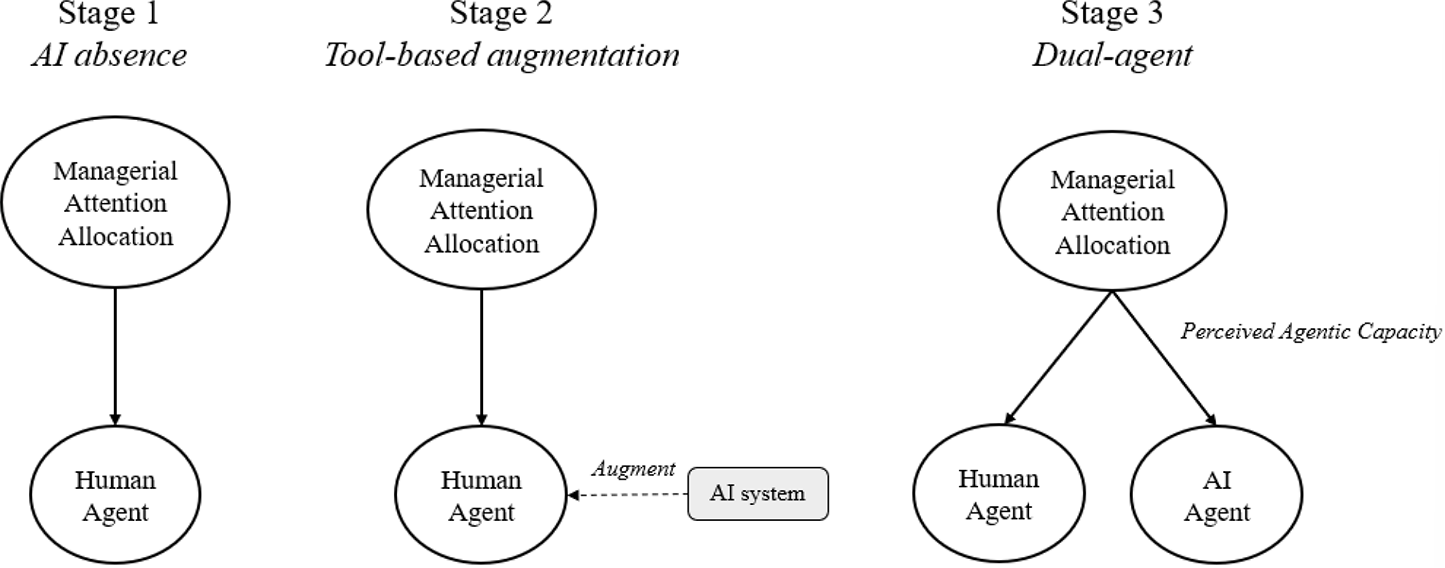
Building on this foundation, we conceptualize the evolution of managerial attention in the context of AI adoption as proceeding through three analytically distinct stages (see Fig. 1). In Stage 1, where AI is absent, managerial attention centers solely on human employees as the primary locus of operational and strategic agency. In Stage 2, AI is introduced as a technical tool – its presence augments human work but does not fundamentally alter attention dynamics. Managerial focus on employees remains dominant, consistent with the instrumental view of technology. However, in Stage 3, we propose a fundamental shift: managers increasingly begin to perceive advanced AI systems as alternative working agents (Vanneste & Puranam, Reference Vanneste and Puranam2024) – capable of independent learning, decision-making, and organizational influence. This reclassification of AI from tool to agent alters the architecture of attention, compelling managers to allocate cognitive resources not only toward human employees but also toward AI systems.
Transition toward a dual-agent model

This transition is underpinned by three key attributes of modern AI that distinguish it from earlier technologies and from human workers. First, AI systems exhibit autonomous action. Through machine learning and generative modeling, AI can process data, detect patterns, and execute tasks with limited human intervention (Jarrahi, Reference Jarrahi2018; Vanneste & Puranam, Reference Vanneste and Puranam2024). This autonomy evokes the very definition of agency – the system that ‘exercises control over its own actions’ (Franklin & Graesser, Reference Franklin and Graesser1999) – prompting managers to monitor and evaluate AI systems as they would human agents.
Second, AI systems are epistemically opaque, meaning their internal logic is difficult to interpret (Vanneste & Puranam, Reference Vanneste and Puranam2024). This opacity introduces uncertainty into managerial decision-making and compels managers to expend cognitive resources validating, supervising, and contextualizing AI outputs – especially when these systems operate in tandem with human employees (Lebovitz, Lifshitz-Assaf, & Levina, Reference Lebovitz, Lifshitz-Assaf and Levina2022). Third, AI systems possess cognitive and predictive capabilities that resemble human agency, such as pattern recognition, scenario learning, and adaptive responses. Yet, these capabilities are derived from data-driven models rather than human-like experiences or social contexts (Ramaul et al., Reference Ramaul, Ritala, Kostis and Aaltonen2025). This divergence makes AI both intelligible and alien to managers – intensifying their need to track, understand, and control AI behaviors alongside human ones. Together, these technological characteristics redefine AI as a working agent, with managerial attention increasingly split across two focal points: human workers and intelligent systems.
This theoretical proposition is also consistent with emerging empirical studies. For example, based on survey data from Italian innovation managers, Cimino et al. (Reference Cimino, Felicetti, Corvello, Ndou and Longo2024) found that managers with a stronger orientation toward innovation and creativity are more proactive in utilizing generative AI technology to gain valuable insights into innovation strategies. Similar conclusions are echoed in Berthon, Yalcin, Pehlivan, and Rabinovich’s (Reference Berthon, Yalcin, Pehlivan and Rabinovich2024) work, a review article examining how generative AI enhances managerial behavior. Furthermore, Rizzo, Bagna, and Tucek (Reference Rizzo, Bagna and Tucek2024) reveal that managers with a lower level of social comparison are more likely to trust advice from AI than from human employees, indicating a shift in decision-making dynamics beyond purely economic considerations. Collectively, these findings reinforce the assumption that AI can be cognitively elevated to the status of an organizational agent, which competes with human employees for managerial attention.
Employee-Related Corporate Social Responsibility
Corporate social responsibility broadly encompasses the voluntary initiatives undertaken by firms to address the expectations and well-being of diverse stakeholder groups beyond the pursuit of financial performance (Aguilera, Rupp, Williams, & Ganapathi, Reference Aguilera, Rupp, Williams and Ganapathi2007). These stakeholders include governmental actors, customers, suppliers, investors, environmental advocates, and internal members such as employees (Bhattacharya, Korschun, & Sen, Reference Bhattacharya, Korschun and Sen2009; Mason & Simmons, Reference Mason and Simmons2014). While existing CSR research has yielded a robust understanding of its antecedents and consequences, much of this work has tended to treat stakeholder groups as uniform and interchangeable (Johnson, Connolly, & Carter, Reference Johnson, Connolly and Carter2011). Recent scholarship has increasingly called for more disaggregated analyses of CSR, particularly those that focus on the unique dynamics of firm engagement with specific stakeholder groups (Akremi, Gond, Swaen, De Roeck, & Igalens, Reference Akremi, Gond, Swaen, De Roeck and Igalens2018; Schons & Steinmeier, Reference Schons and Steinmeier2016). Such inquiries are especially pertinent in the context of technological disruption, where stakeholder expectations – and the managerial attention they command – may be fundamentally reshaped.
This study focuses specifically on employee-related CSR – organizational actions that safeguard and promote employee well-being, such as equitable compensation, job security, work-life support, and opportunities for growth (González-De-la-Rosa et al., Reference González-De-la-Rosa, Armas-Cruz, Dorta-Afonso and García-Rodríguez2023; Remisová & Búciová, Reference Remisová and Búciová2012). This focus is both conceptually warranted and contextually urgent. Conceptually, employees represent an internal stakeholder group whose roles are deeply embedded in the firm’s operational routines. Their welfare is therefore not only an ethical imperative but also a key determinant of firm capability, especially in knowledge-intensive and innovation-driven environments (González-De-la-Rosa et al., Reference González-De-la-Rosa, Armas-Cruz, Dorta-Afonso and García-Rodríguez2023). Contextually, the rapid proliferation of AI technologies has introduced fundamental shifts in how work is designed and executed, raising questions about employee value, role clarity, and job security (Mikalef, Conboy, Lundström, & Popovic, Reference Mikalef, Conboy, Lundström and Popovic2022). These uncertainties elevate ECSR as a critical domain for managerial engagement.
Moreover, ECSR decisions are inherently discretionary and attention-sensitive, meaning they hinge on how managers allocate finite cognitive and material resources. Prior research has demonstrated that managerial characteristics – such as political ideology (Liu & Luo, Reference Liu and Luo2022) or social class orientation (Ma, Liu, An, Wang, & Abdi, Reference Ma, Liu, An, Wang and Abdi2024) – significantly influence the degree to which managers prioritize ECSR. However, these traits primarily explain managerial preferences in organizational contexts where the employee group is composed solely of human agents. When the composition of the organizational workforce undergoes a fundamental shift – such as the increasing integration of AI systems that exhibit agent-like properties – the dynamics of managerial attention and the resulting commitment to ECSR may also be transformed.
Hypotheses Development
The relationship between AI adoption and ECSR is shaped by two concurrent yet opposing forces, reflecting a dynamic process in which managerial attention is redistributed between human and AI agents. We propose that AI adoption simultaneously influences managers’ attentional focus toward human employees and their cognitive shift toward AI systems as alternative agents. These two attentional dynamics exert contrasting effects on ECSR outcomes.
On the one hand, effective AI deployment requires active collaboration and adaptive support from human employees, thereby motivating greater investment in ECSR. On the other hand, as AI technologies become more autonomous, opaque, and capable of contextual learning, managers increasingly perceive them as agentic entities – prompting a reallocation of attention away from human employees and diminishing the willingness to maintain ECSR initiatives.
We argue that the net effect of AI adoption on ECSR is nonlinear. At low to moderate levels of AI adoption, the benefits derived from strengthened human engagement tend to outweigh the attentional cost of integrating AI, resulting in a positive relationship with ECSR. However, as AI adoption expands and becomes deeply embedded in organizational processes, the cost of attentional shift begins to surpass its initial benefits, leading to a negative relationship.
Human attention gain
As AI technologies become gradually embedded within organizational operations, managers exhibit heightened attention toward human employees – an effect we define as the human attention gain mechanism. First, AI deployment does not eliminate the need for human labor; rather, it frequently relies on human employees for critical support in system training, ongoing operation, and cross-functional coordination. For instance, data input, real-time feedback, and interdepartmental communication remain essential for effective human–AI collaboration (Jia et al., Reference Jia, Luo, Fang and Liao2024). This interdependence increases managerial recognition of employees’ instrumental role in enabling AI performance, thereby motivating investment in ECSR (e.g., training programs, job security, and welfare benefits) to ensure alignment and cooperation. Second, despite technical advances, AI systems remain limited in addressing tasks that are complex, ambiguous, or context-dependent – such as client service, strategic evaluation, and nonroutine operations (Boussioux et al., Reference Boussioux, Lane, Zhang, Jacimovic and Lakhani2024; Choudhary et al., Reference Choudhary, Marchetti, Shrestha and Puranam2023). Managers thus continue to value the judgment and discretion that human employees contribute in such domains, and use CSR engagement as a vehicle to maintain their capabilities and commitment. Collectively, these dynamics foster a renewed appreciation of human agency within AI-enabled organizations, leading to sustained and increasing managerial attention toward ECSR.
AI attention shift
Conversely, AI adoption also activates a counteracting process, which we refer to as the AI attention shift mechanism – a gradual reallocation of managerial attention away from human employees and toward AI systems, with suppressive effects on ECSR engagement. This mechanism is driven by two reasons. First, AI systems increasingly demonstrate consistent, efficient, and accurate performance across business processes, prompting managers to perceive them as reliable actors (e.g., for decision support, process control, and predictive analytics) (Boussioux et al., Reference Boussioux, Lane, Zhang, Jacimovic and Lakhani2024; Lai & Rau, Reference Lai and Rau2024; Ruan & Mezei, Reference Ruan and Mezei2022; Strich, Mayer, & Fiedler, Reference Strich, Mayer and Fiedler2021). This agentic perception fosters trust in AI’s capabilities (Vanneste & Puranam, Reference Vanneste and Puranam2024), and reinforces a cognitive shift in attention allocation, whereby managerial focus centers on optimizing AI systems rather than supporting human employees. Second, as AI systems continuously operate and interact with multiple organizational processes, they accumulate internal behavioral data and contextual knowledge. Through this ‘learning–adaptation–integration’ cycle, AI becomes more deeply embedded in organizational routines, transforming from a technical instrument into a quasiagent within the firm (Ramaul et al., Reference Ramaul, Ritala, Kostis and Aaltonen2025; Vanneste & Puranam, Reference Vanneste and Puranam2024). This perception strengthens the managerial inclination to treat AI as an essential organizational member – thus diverting strategic and cognitive attention away from the human workforce. Distinct from the linear nature of the gain mechanism, the negative effect accumulates as AI systems become increasingly embedded and contextually adaptive, thereby progressively diverting managerial attention from human employees and amplifying the suppression of ECSR.
Taken together, the relationship between AI adoption and ECSR follows an inverted U-shaped pattern, reflecting the shifting dominance of these two mechanisms across adoption levels. At lower levels of AI adoption, the positive dominates, as AI remains heavily dependent on human collaboration, prompting managers to reinforce employee support through ECSR initiatives. At higher levels of AI adoption, the negative becomes more salient, as AI systems gain organizational embeddedness and are perceived as increasingly agentic. This shift in attention leads to a decline in ECSR investment. Given the linear trajectory of the gain mechanism and the nonlinear, escalating nature of the shift mechanism, their combined effects yield an inverted U-shaped curve (Haans, Pieters, & He, Reference Haans, Pieters and He2016), as illustrated in Panel A of Figure 2. We predict that:
Hypothesis 1 (H1): The relationship between AI adoption and ECSR is characterized by an inverted U-shape, whereby AI adoption positively influences ECSR levels at lower levels of adoption, but exerts a negative impact at higher levels.
Illustration of the hypotheses on the inverted U-shaped effects

Moderating Factors on Attention Shifting Process
To further elucidate how AI adoption affects ECSR through attention allocation mechanisms, we introduce three moderators: industry AI substitution risk, TMT functional diversity, and ESO. Prior research suggests that managerial attention is not only shaped by external task environments but also constrained by internal cognitive capacities and organizational structures (Levy, Reference Levy2005; Ocasio, Reference Ocasio1997; Wang, Zhang, & Shang, Reference Wang, Zhang and Shang2022). Moreover, because employees represent the direct target of managerial attention in this context, their collective characteristics can also influence how attention is distributed between human and AI agents. Accordingly, these moderators capture three essential dimensions of the attention allocation process in AI adoption – the contextual conditions of the external environment, the structural attentional capacity within the TMT, and the target-level characteristics of human employees that determine how managerial attention is maintained or diverted.
Moderating Effect of Industry AI Substitution Risk
Although AI is widely acknowledged as a general-purpose technology, its adoption trajectory and organizational impact differ substantially across industries due to variation in task structures, labor compositions, and cognitive demands (Felten, Raj, & Seamans, Reference Felten, Raj and Seamans2021; Gurjar, Jangra, Baber, Islam, & Sheikh, Reference Gurjar, Jangra, Baber, Islam and Sheikh2024). We define industry-level AI substitution risk as the extent to which the typical occupational roles within a given industry are susceptible to automation by AI technologies. This variation is associated with differences in workforce characteristics – for example, the average level of employee education and the prevalence of routine-based tasks (Zhang, Peng, Yao, & Browning, Reference Zhang, Peng, Yao and Browning2024; Zhou, Chu, Li, & Meng, Reference Zhou, Chu, Li and Meng2020). In industries characterized by higher substitution risk, AI systems are more likely to displace human involvement in tasks, such as data entry, scheduling, process optimization, and transactional decision-making – functions that require limited contextual sensitivity or discretionary judgment. We argue that this context critically shapes how managers interpret the organizational implications of AI adoption and how they allocate attention between human and AI agents.
With respect to the positive attentional mechanism – whereby AI adoption initially enhances managerial attention to human employees – higher levels of AI substitution risk tend to weaken this effect. In such industries, AI systems are adopted to operate with high task autonomy and decision accuracy, thereby reducing their reliance on human assistance or real-time oversight. For instance, in the manufacturing sector, AI-driven warehouse automation systems – such as autonomous mobile robots (AMRs), robotic arms, and automated guided vehicles (AGVs) – have been shown to optimize inventory management, route planning, and order fulfillment with minimal human intervention (Sodiya, Umoga, Amoo, & Atadoga, Reference Sodiya, Umoga, Amoo and Atadoga2024). This diminished human–AI interdependence lowers the managerial impetus to strengthen employee engagement, training, or well-being via CSR practices. As a result, the attention managers allocate to human agents in the early stages of AI adoption is less likely to rise. In contrast, sectors with lower AI substitution risk, such as those where core tasks rely heavily on human creativity and intelligence, still require substantial human input for contextual interpretation, nuanced judgment, and adaptive decision-making. These dependency conditions reinforce the strategic significance of human agents, leading managers to allocate greater attention and CSR resources toward employee support when integrating AI technologies at early and moderate levels.
Conversely, the negative attentional mechanism – which reflects a structural reallocation of managerial attention from human employees to AI agents – becomes more salient under conditions of high AI substitution risk. Industries where AI technologies are widely perceived as credible substitutes for human labor, managers are more likely to develop heightened agentic perceptions of AI systems (Vanneste & Puranam, Reference Vanneste and Puranam2024) – that is, to regard them not simply as technical tools, but as capable organizational actors. This perception reinforces trust in AI’s functional autonomy and decision-making capacity, making attention shifts toward AI agents more cognitively justified and normatively acceptable. Moreover, AI systems are typically embedded in routine operational processes that expose them to structured data flows and consistent feedback. This embeddedness increases their contextual learning potential and strengthens the perceived alignment between AI agents and core organizational functions (Murray, Rhymer, & Sirmon, Reference Murray, Rhymer and Sirmon2021). These perceptual and functional conditions jointly intensify the managerial inclination to shift attention away from human employees – thus strengthening the negative mechanism through which AI adoption suppresses investment in employee-related CSR.
According to Haans et al. (Reference Haans, Pieters and He2016), shifts in the relative strength of the underlying linear and cumulative mechanisms jointly determine both the turning point and the curvature of an inverted U-shaped relationship (see Panel B of Fig. 2). Based on this logic, we propose the following hypothesis:
Hypothesis 2 (H2): Industry AI substitution risk moderates the curvilinear relationship between AI adoption and ECSR, such that higher substitution risk leads to a leftward shift in the turning point and a steeper curvature of the inverted U-shaped pattern.
Moderating Effect of TMT Functional Diversity
As the central decision-making body of the firm, the TMT plays a pivotal role in shaping the allocation of organizational attention. We introduce TMT functional diversity as the second moderator in our framework. This construct refers to the degree of heterogeneity in the organizational functions represented by TMT members (e.g., finance, human resources, operations, marketing, and IT; Carpenter & Fredrickson, Reference Carpenter and Fredrickson2001; Zhou, Huang, Chen, & Tian, Reference Zhou, Huang, Chen and Tian2023). Prior research has shown that TMTs with greater functional diversity are more likely to achieve superior organizational performance (Zhou et al., Reference Zhou, Huang, Chen and Tian2023), environmental outcomes (Wang, Rispens, & Demerouti, Reference Wang, Rispens and Demerouti2024), and coopetitive behavior (Krieweth, Guragata-Balasa, Greven, & Brettel, Reference Krieweth, Guragata-Balasa, Greven and Brettel2024). From the ABV perspective, functional diversity reflects a form of structural attentional capacity, enabling TMTs to allocate and integrate attention across multiple organizational domains during complex decision-making processes (Hambrick & Mason, Reference Hambrick and Mason1984; Lee, Reference Lee2021; Wang et al., Reference Wang, Rispens and Demerouti2024). This attentional capacity comprises both breadth – awareness of diverse functional priorities – and depth – specialized understanding of how AI deployment may impact domain-specific tasks, resources, and risks.
On the one hand, TMT functional diversity enhances the team’s structural cognitive capacity to recognize the human resource dependencies embedded in AI adoption, thereby reinforcing the positive attentional mechanism. A functionally diverse team is more likely to identify, from multiple organizational standpoints, the collaborative demands inherent in human–AI interaction. For instance, executives with a marketing background may be attuned to the interpersonal and communicative challenges that AI systems pose in customer-facing roles (Koponen, Julkunen, Laajalahti, Turunen, & Spitzberg, Reference Koponen, Julkunen, Laajalahti, Turunen and Spitzberg2025); IT leaders may highlight the importance of accurate human input to ensure algorithmic reliability; and HR, compliance, or operations executives may emphasize the organizational need for employee skill transition, institutional adaptation, and behavioral coordination. This multidimensional recognition increases the likelihood that the TMT perceives human involvement as critical – particularly in the early and intermediate stages of AI deployment – thus directing more managerial attention toward human employees and reinforcing ECSR investment to support sustainable human–AI collaboration.
On the other hand, TMT functional diversity weakens the negative attentional mechanism by fostering a structurally decentralized attention configuration grounded in differentiated task logic comprehension. As AI systems expand across organizational functions and become increasingly embedded in decision-making processes, managers are often required to engage with algorithmic outputs and automated recommendations. However, in teams characterized by functional heterogeneity, members draw on deep domain expertise to critically assess the deep usage of AI across different operational contexts. This domain-specific discernment acts as a counterbalance to uncritical, organization-wide shifts of attention toward AI agents. For example, recent research has shown that managers from human resource management functions perceive significantly greater risks associated with AI adoption and exhibit more conservative investment attitudes compared to those from finance or marketing backgrounds (Gieselmann, Erdsiek, Rost, & Sassenberg, Reference Gieselmann, Erdsiek, Rost and Sassenberg2025). These diverse professional vantage points collectively temper the formation of a unified, anthropomorphized perception of AI systems, thereby mitigating wholesale managerial attention shifts away from human employees. Thus, we predict that (see Panel C in Fig. 2):
Hypothesis 3 (H3): TMT functional diversity moderates the curvilinear relationship between AI adoption and ECSR, such that higher functional diversity leads to a rightward shift in the turning point and a flatter curvature of the inverted U-shaped pattern.
Moderating Effect of Employee Stock Ownership
Since human employees are the central target of managerial attention in this context, it is crucial to understand how employee-related factors influence the way attention is allocated between human workers and AI systems. To explore this, we focus on ESO as a critical boundary condition. ESO refers to the ownership of company shares by nonmanagerial employees, and it serves as a mechanism that enhances employee involvement in decision-making, strengthens organizational commitment, and aligns employee interests with those of the firm (Pendleton & Robinson, Reference Pendleton and Robinson2010; Pierce, Rubenfeld, & Morgan, Reference Pierce, Rubenfeld and Morgan1991). The effects of ESO on firm performance and other organizational outcomes have been well-established in developed economies (e.g., Kim & Patel, Reference Kim and Patel2017). Since 2012, with the active promotion of ESO plans by the China Securities Regulatory Commission, ESO has gained considerable traction among Chinese publicly listed companies, and its effects on organizational behavior and performance have increasingly drawn scholarly attention (Dasilas, Reference Dasilas2024). We argue that ESO serves as a significant moderating factor in the relationship between AI adoption and ECSR, influencing both the positive and negative mechanisms.
First, in firms with higher levels of ESO, employees tend to exhibit greater decision-making involvement and stronger organizational commitment, which, in turn, intensifies managerial attention to the collaborative demands between human employees and AI systems. Extensive literature has demonstrated that ESO fosters increased employee engagement and a heightened sense of responsibility toward the firm’s long-term success (Kim, Patel, & Devaraj, Reference Kim, Patel and Devaraj2025; Zhong & Zhang, Reference Zhong and Zhang2025). Employees in ESO firms are more likely to actively engage with and respond to critical issues surrounding technological transformation and the long-term sustainability of the firm (Zeng, Reference Zeng2024). As AI becomes increasingly embedded in organizational workflows, the heightened participation and feedback from employees allow management to gain more accurate insights into the practical needs and potential risks associated with AI adoption, prompting greater managerial attention to optimizing human-AI collaboration. In essence, ESO heightens the alignment between employee interests and organizational goals (Zeng, Reference Zeng2024; Zhong & Zhang, Reference Zhong and Zhang2025), which strengthens management’s recognition of the necessity for effective human-AI collaboration. This increased focus on collaboration, in turn, drives management to enhance its commitment to ECSR, ensuring that the implementation of AI is balanced with a strong focus on employee welfare throughout the technological transition.
Second, ESO also plays a moderating role in attenuating the negative nonlinear attention shift mechanism, reducing the tendency for managerial focus to shift disproportionately toward AI as its adoption becomes more extensive. As discussed in the main effects, the increasing deployment of AI often induces managerial perceptions of AI as an ‘agent’, resulting in greater trust and reliance on AI systems, which may ultimately detract from attention to human employees. However, in firms with higher levels of ESO, management is more likely to have a stronger sense of alignment with employees, as the financial and professional well-being of employees are more directly tied to the firm’s performance (Dasilas, Reference Dasilas2024). This enhanced alignment between employee and organizational interests diminishes the likelihood that management will place excessive trust in AI as a superior substitute for human labor. Instead, management is more likely to recognize that employees, whose interests are aligned with the firm, remain indispensable to organizational success. Therefore, ESO moderates the tendency for managerial attention to shift entirely toward AI, helping to preserve focus on human employees and mitigating the negative impact on ECSR. Thus, we predict that (see Panel D in Fig. 2):
Hypothesis 4 (H4): ESO moderates the curvilinear relationship between AI adoption and ECSR, such that higher ESO leads to a rightward shift in the turning point and a flatter curvature of the inverted U-shaped pattern.
Methods
Data and Sample
Our empirical analysis is based on a panel dataset of Chinese publicly listed firms spanning from 2013 to 2023 – a period marked by increasing exposure to and engagement with AI technologies (Zu, Ni, & Hu, Reference Zu, Ni and Hu2025). To measure firm-level AI adoption, we follow recent studies (e.g., Babina, Fedyk, He, & Hodson, Reference Babina, Fedyk, He and Hodson2024; Wu, Lou, & Hitt, Reference Wu, Lou and Hitt2025) that leverage job posting data as a forward-looking indicator of technological investment and transformation. Specifically, we collected a total of 1,502,594 job postings from leading Chinese recruitment platforms, including 51Job, BOSS, Zhilian, Liepin, Lagou, and Kanzhun. These postings were then processed to identify and code AI-related positions based on a multistage screening procedure. Firm-level financial and organizational variables were retrieved from the China Stock Market and Accounting Research (CSMAR) database, a widely used and reputable source in Chinese firm-level studies (He, Huang, Liu, & Wang, Reference He, Huang, Liu and Wang2024). Additionally, textual data from annual reports were manually collected to support subsequent text-based variable construction. We excluded firms designated as ST or *ST (special treatment) due to abnormal financial conditions or delisting risks. After eliminating observations with missing data, our final balanced panel consists of 2575 unique firms and 13,925 firm-year observations.
Measurements
Dependent variable
Employee-related corporate social responsibility (ECSR). Our dependent variable is the level of ECSR. To assess the comprehensive extent of social responsibility initiatives directed at employees, we utilized the entropy weighting technique for computation. This approach consisted of three main stages: Initially, we extracted and compiled 10 distinct metrics associated with employment, remuneration, and security, based on previous research (Ma et al., Reference Ma, Liu, An, Wang and Abdi2024). Subsequently, we classified these metrics into positive and negative groups and normalized them as appropriate. Finally, we employed entropy weighting to determine the relative significance of each indicator (The specific indicators selected, along with their corresponding positive and negative directions, are presented in Table A in the Appendix). These were then aggregated using a weighted sum to calculate the annual overall ECSR score for companies.
Independent variable
AI adoption. Following recent advances in the literature (Babina et al., Reference Babina, Fedyk, He and Hodson2024; Wu et al., Reference Wu, Lou and Hitt2025), we measure firm-level AI adoption using job posting data – a forward-looking indicator that captures organizational demand for AI-related capabilities. This approach offers two main advantages. First, job postings reflect firms’ actual needs for AI talent across diverse functions, avoiding over-reliance on any single domain. Second, recruitment-based measures are less susceptible to strategic impression management or symbolic adoption compared to self-reported or narrative-based disclosures.
To construct our AI adoption variable, we undertook a multistep procedure. First, we collected a total of 1,502,594 job postings issued by public firms between 2013 and 2023. These postings, sourced from major Chinese online recruitment platforms, contain detailed descriptions of position requirements, including required skills and responsibilities, which serve as the textual basis for identifying AI-related roles.
Second, we employed a computational text analysis approach to classify job postings as AI-related. Drawing on a curated list of 73 AI-related keywords derived from technical documentation and prior research (see Appendix Table B; Yao, Zhang, Guo, & Feng, Reference Yao, Zhang, Guo and Feng2024), a job posting was coded as AI-related if any of the listed terms appeared in the skills requirements section. To address potential duplication, we removed repeated postings of the same AI-related position by the same firm across different job platforms within the same year. This process resulted in a final set of 20,041 AI-related postings, accounting for 1.9% of all collected job advertisements.
Third, we matched job postings to listed firms based on company names, stock codes, and historical aliases. Using this linkage, we aggregated AI-related job postings at the firm-year level. Finally, we normalized the number of AI-related job postings by the number of employees and multiplied the result by 100 to construct our AI adoption variable. As a robustness check, we also constructed an alternative measure of AI adoption based on AI-related patent counts, following the methodology proposed in Zu et al. (Reference Zu, Ni and Hu2025).
Moderating variables
Industry AI substitution risk (IASR). Following prior studies (Zhang et al., Reference Zhang, Peng, Yao and Browning2024), we proxy industry-level AI substitution risk using the average educational attainment of the workforce, given the widely observed inverse relationship between educational level and susceptibility to AI-driven task automation (Zhou et al., Reference Zhou, Chu, Li and Meng2020). Specifically, we collected firm-level disclosures on the educational composition of employees, distinguishing between high-education (bachelor’s degree and above) and low-education (below bachelor’s degree) categories. To construct an industry-level measure while addressing variation in firm size, we calculated a weighted average based on the number of employees in each firm. The Industry AI Substitution Risk for industry j in year t is computed as follows:
 \begin{equation*}Industry\,AI\,Substitution\,Ris{k_{jt}} = \frac{{\sum {{(\frac{{LowEd{u_{it}}}}{{TotalEm{p_{it}}}} \times TotalEm{p_{it}})}_{i \in j}}}}{{\mathop \sum \nolimits TotalEm{p_{it}}_{i \in j}}}\end{equation*}
where  $LowEd{u_{it}}\,$is the number of employees without a bachelor’s degree in firm i at year t, and
 ${\text{TotalEm}}{{\text{p}}_{it}}$ is the total number of employees in firm i at year t. The resulting value reflects the industry-level proportion of lower-educated labor, with a higher value indicating a higher degree of AI substitution risk in that industry-year. In our sample, industries such as hospitality (0.600) and leather manufacturing (0.179) exhibit relatively high levels of substitution risk, whereas sectors like information technology and pharmaceutical manufacturing demonstrate considerably lower risk levels (both at 0.003). A detailed summary is provided in Appendix Table C.
TMT functional diversity (TFD). We measured TMT functional diversity following the widely adopted method by Carpenter and Fredrickson (Reference Carpenter and Fredrickson2001) and Zhou et al. (Reference Zhou, Huang, Chen and Tian2023), with modifications to reflect a more granular classification of executive functions. Specifically, we categorized TMT members into nine distinct functional areas based on their professional backgrounds: production, R&D, design, human resources, general management, marketing, finance, accounting, and law. Each executive was assigned to a primary functional domain according to publicly disclosed biographical data.
To quantify diversity, we applied the Herfindahl–Hirschman Index (HHI) to the distribution of TMT members across the nine categories and calculated functional diversity as one minus the HHI:
 \begin{equation*}TMT\,Functional\,Diversity = 1 - \mathop \sum \limits_{i = 1}^n S_i^2\end{equation*}
where  ${S_i}\,$denotes the proportion of TMT members affiliated with functional category i. The resulting index ranges from 0 to 1, with higher values indicating greater heterogeneity in functional backgrounds. A score closer to 1 implies that TMT members are more evenly distributed across multiple functions, while a score approaching 0 suggests functional homogeneity concentrated in one area.
Employee stock ownership (ESO). Consistent with prior research (Dasilas, Reference Dasilas2024), we define ESO as the proportion of total shares held by nonexecutive employees. To measure this, we first collected detailed information on the ESO plans disclosed by the firm, including the implementation date, the number of shares subscribed by employees, and the specific holders involved. In total, we identified 3708 ESO plans over the sample period. In the second step, we matched the holder data with the company’s executive and board member records. We excluded shares held by individuals in executive roles to focus solely on the stock ownership of nonexecutive employees.
Controls
We included control variables that affect ECSR (ECSR). We control for firm size (Size), measured as the logarithm of total assets, as it has been shown to influence CSR engagement (Chang, Oh, Jung, & Lee, Reference Chang, Oh, Jung and Lee2012). The debt-to-asset ratio (Lev) is included, as leverage can affect a company’s willingness and ability to invest in CSR initiatives (Johnson & Greening, Reference Johnson and Greening1999). Firm performance, operationalized as return on assets (ROA), plays a critical role in shaping a company’s capacity to engage in CSR (Waddock & Graves, Reference Waddock and Graves1997). Cash flow dynamics, represented by the cash flow ratio (Cash), significantly impact a firm’s ability to fund CSR programs (Sun & Ding, Reference Sun and Ding2020). Firm age, operationalized as the logarithm of the years since the firm’s listing, is controlled for, recognizing that start-up firms may demonstrate a higher inclination toward CSR compared to more established companies (Johnson & Greening, Reference Johnson and Greening1999). We also controlled for growth, measured by Tobin’s Q, to account for differences in firms’ investment opportunities and strategic orientations.
At the governance level, we control for board characteristics, including board size (Board), measured as the logarithm of the number of directors, board independence, and duality, represented by whether the positions of chairman and CEO are held by the same individual. These factors are pivotal in the CSR process (Bear, Rahman, & Post, Reference Bear, Rahman and Post2010). Additionally, we control for executive incentive structures that may influence CSR engagement, including managerial ownership and TMT pay (Fabrizi, Mallin, & Michelon, Reference Fabrizi, Mallin and Michelon2014). We also account for female representation at the top (Hoch, Seyberth, Faherty, Clinton, & Sharma, Reference Hoch, Seyberth, Faherty, Clinton and Sharma2025), measured by the proportion of female executives within the TMT. We also account for shareholder influence by controlling for the stake of the largest shareholder, institutional ownership, and the firm’s equity structure, as shareholder interests are a key determinant of corporate CSR behavior (Johnson & Greening, Reference Johnson and Greening1999).
Finally, we accounted for external factors that may influence firms’ ECSR. First, analyst coverage may shape firms’ perceived legitimacy expectations regarding CSR (Qian, Lu, & Yu, Reference Qian, Lu and Yu2019). We thus controlled for the natural logarithm of the number of analysts covering the firm. Second, regional institutional pressures, particularly those emanating from local governments, may also affect firms’ ECSR engagement (Wang, Ma, Chang, & Wang, Reference Wang, Ma, Chang and Wang2025). To capture this, we employed a computational text analysis of annual provincial government work reports. Specifically, we calculated the regional CSR intensity variable by measuring the frequency of the keywords ‘employee responsibility’ and ‘social responsibility’ in each report, normalized by the total word count, and multiplied by 100. Industry and region were controlled for using the China Securities Regulatory Commission’s 2012 industry classification and provincial data, respectively.
Analysis
To address potential unobserved effects, we utilized company-level panel data to investigate the link between AI adoption and ECSR. We applied firm and year fixed effects to control for unobserved, temporally stable firm and year differences in ECSR at the company and year levels. We constructed the following equation with ECSR as the dependent variable:
 \begin{align}
ECS{R_{i,t + 1}} &= {\beta _0} + {\beta _1}AI\ adoption{s^2}_{i,t} + {\beta _2}AI\ adoptio{n_{i,t}} + {\beta _3}AI\ adoptio{n^2}_{i,t} \nonumber\\
&\quad \times {\beta _4}Industry\,AI\,substitution\,risk _{i,t} + {\beta _5}AI\,adoptio{n_{i,t}} \nonumber\\
&\quad\times {\beta _6}Industry\,AI\,substitution\,risk _{i,t} + {\beta _7}Industry\,AI\,substitutionrisk _{i,t} \nonumber\\
&\quad + {\beta _8}AI\,adoptio{n^2}_{i,t} \times {\beta _9}TMT\,functional\,diversit{y_{i,t}} + {\beta _{10}}AI\,adoptio{n_{i,t}}\nonumber\\
&\quad \times {\beta _{11}}TMT\,functional\,diversit{y_{i,t}} + {\beta _{12}}\,TMT\,functional\,diversit{y_{i,t}} \nonumber\\
&\quad + {\beta _{13}}AI\,adoptio{n^2}_{i,t} \times {\beta _{14}}Employee\,stock\,ownershi{p_{i,t}} + {\beta _{15}}AI\,adoptio{n_{i,t}} \nonumber\\
&\quad \times {\beta _{16}}Employee\,stock\,ownershi{p_{i,t}} + {\beta _{17}}Employee\,stock\,ownershi{p_{i,t}} \nonumber\\
&\quad + \sum Control{s_{i,t}} +
{\delta _i} + {\theta _t} + {\varepsilon _{i,t}}
\end{align}
where ECSR is our dependent variable, and AI adoption is the independent variable. Additionally, we include three moderating variables – industry AI substitution risk, TMT functional diversity, and ESO – along with their interaction terms with the linear and square terms of AI adoption.  ${\delta _i}$ denotes the firm-fixed effect,
 ${\theta _t}$ represents the year-fixed effect, and
 ${\varepsilon _{i,t}}$ is the error term. The explanatory, moderating, and control variables are each lagged by one period to mitigate potential endogeneity issues.
Results
Main Results
Descriptive statistics and correlation analysis
Table 1 presents the descriptive statistics and correlation coefficients for the variables under investigation. Further diagnostic analysis indicates that all variance inflation factors (VIFs) are well below the conventional threshold of 5, with an average of 1.74 and a maximum value of 3.60, suggesting that multicollinearity is not a concern in our models.
Descriptive statistics and correlations, N = 13,925

Note: Correlations with an absolute value greater than 0.02 were considered statistically significant.
The inverted-U relationship
Table 2 presents the results from a fixed-effects panel regression analysis, with the firm’s ECSR score as the dependent variable. Model 1 includes only the control variables, establishing a baseline for comparison with the subsequent models. Model 2 introduces the linear term for AI adoption, while Model 3 adds both the linear and squared terms. In Model 3, the coefficients for the linear and squared terms are 10.278 and −5.545, respectively, and both are statistically significant at the 1% level. These findings provide preliminary evidence of an inverted U-shaped relationship between AI adoption and ECSR.
Fixed-effect panel regression on ECSR

Notes: This table presents the results of a fixed-effect panel regression in which a firm’s ECSR score is the dependent variable. Model 1 includes control variables only. Models 2 to 7 are our main specification testing H1 to H4. Robust standard errors clusters by firm appear in parentheses.
* P < 0.1, **P < 0.05, ***P < 0.01.
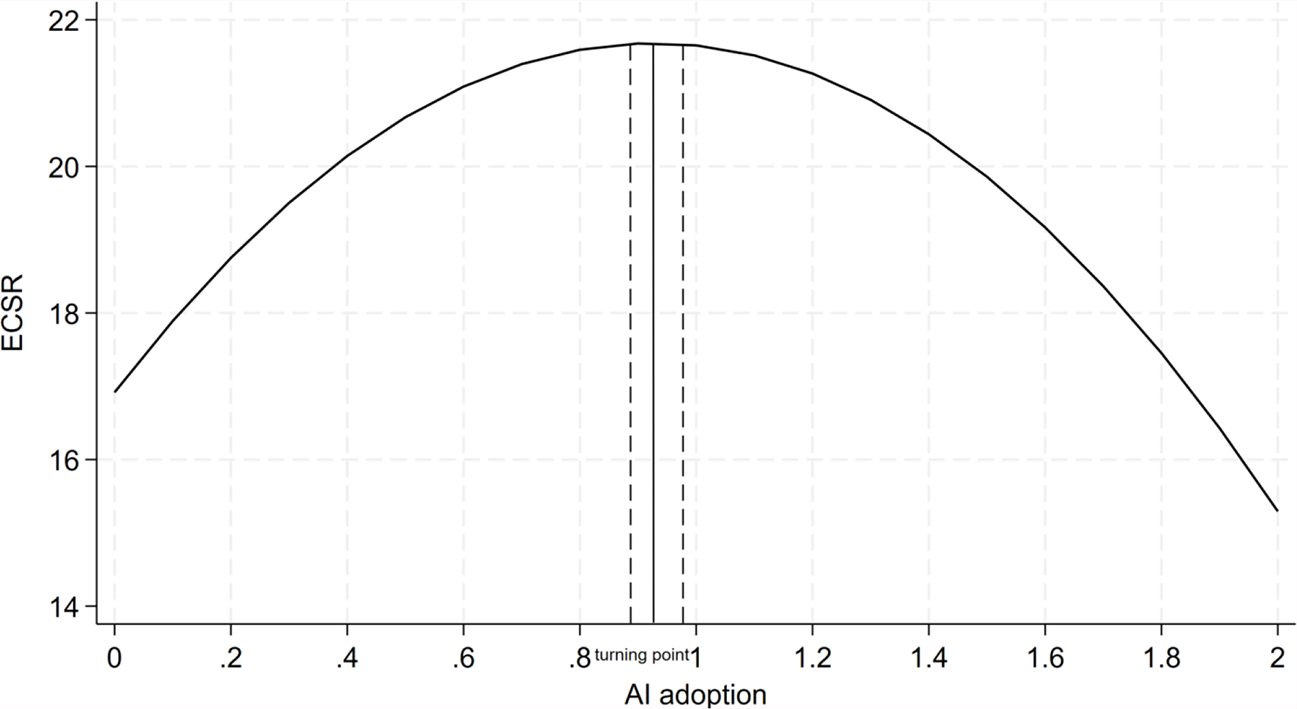
To further validate the curvilinear association, we follow the procedure outlined by Haans et al. (Reference Haans, Pieters and He2016). First, we apply the U-test command to formally assess the presence of a U-shaped relationship and estimate the confidence interval of the turning point. Lind and Mehlum (Reference Lind and Mehlum2010) argue that the U-test should be employed to prevent a convex monotonic model from being mistakenly interpreted as an inverted U-shaped relationship. The results indicate that the 95% Fieller confidence interval for the turning point is (0.887, 0.978), which falls well within the observed range of AI adoption. The inverted U-shape is statistically significant (P = 0.001). Second, we test the slope of the relationship at the two tails of the AI adoption distribution. At the low end, the marginal effect of AI adoption is significantly positive ( ${b_{low}} = {\beta _{AI\,adoption}} + {\beta _{AI\,adoptio{n^2}}} \times {X_{AI\,adoption\_low}} = 9.169$, P < 0.001). At the high end, the slope turns significantly negative (
 $b_{high}=\beta_{AI\,adoption}+\beta_{AI\,adoption^2}\times X_{AI\,adoption\_high}=-11.902$, P < 0.001). Third, to rule out the possibility of an S-shaped relationship, we include a cubic term for AI adoption. The coefficient of the cubic term is statistically insignificant, suggesting that the relationship is not better captured by a higher-order polynomial. Figure 3 illustrates the inverted U-shaped relationship between AI adoption and ECSR.
Inverted-U relationship between AI adoption and ECSR

Mechanisms of the inverted U-shape relationship
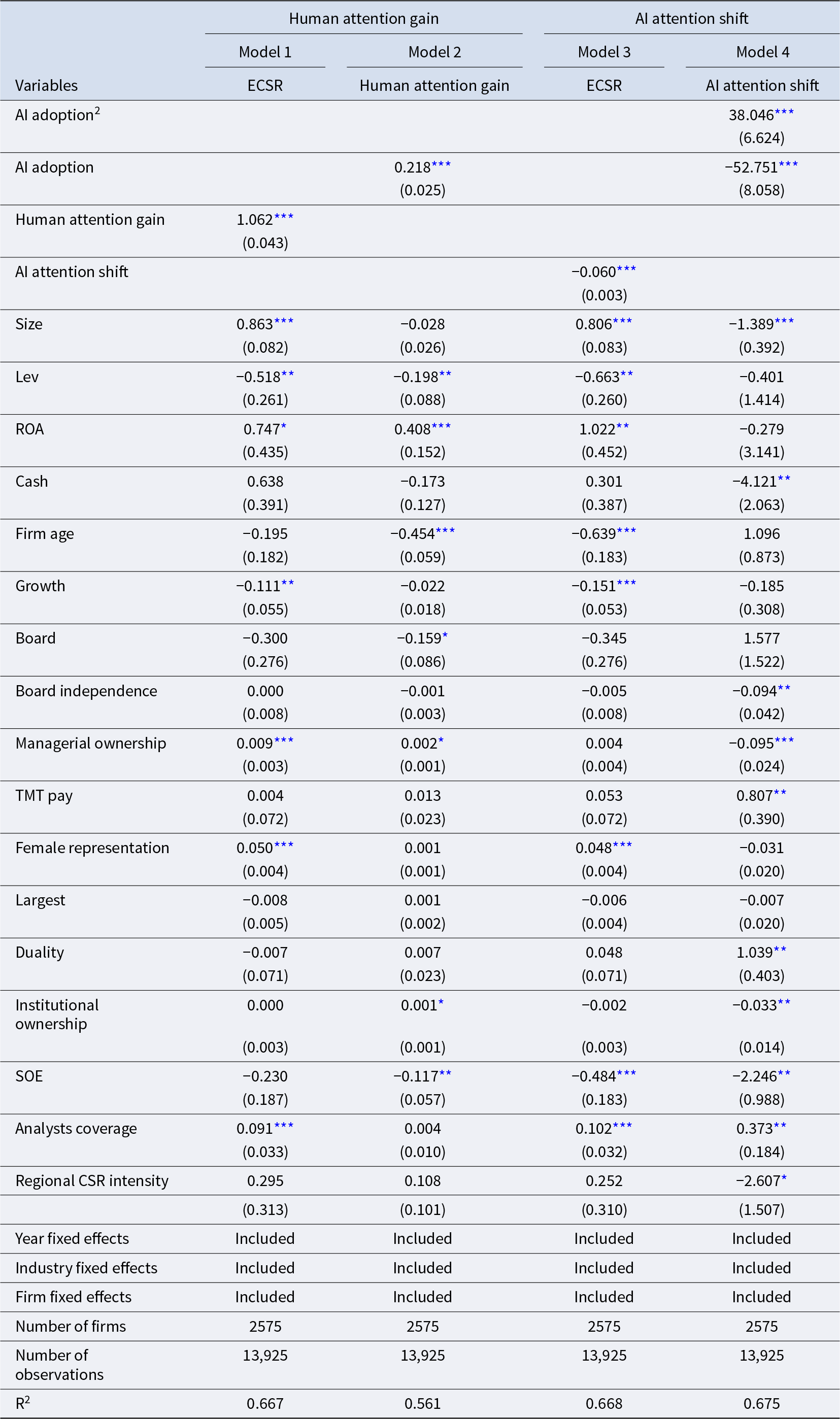
Following Haans et al. (Reference Haans, Pieters and He2016) and Vomberg, Homburg, and Gwinner (Reference Vomberg, Homburg and Gwinner2020), we further probe the two opposing mechanisms underlying the observed inverted U-shaped relationship (see Appendix Table D for detailed results). To test the human attention gain mechanism, which posits that AI adoption initially enhances managerial attention to human employees, we constructed a proxy variable for human attention gain. Specifically, we calculated the frequency of employee-related keywords in each firm’s annual report and normalized it by the total word count of the MD&A (Management Discussion and Analysis) section. Regressing this measure on AI adoption revealed a significant positive linear effect ( ${\beta _{AI\,adoption}}$ = 0.218, P < 0.001), indicating that firms with greater AI adoption tend to exhibit more attention to human employees. Moreover, we found that human agent attention is positively associated with ECSR (
 ${\beta _{human\,attention\,gain}}$ = 1.062, P < 0.001), providing further evidence for a linear, human-attentive mechanism.
To test the AI attention shift mechanism, we constructed an AI attention shift variable by extracting the frequency of AI-related keywords in annual reports, again normalized by the MD&A word count. Results show that AI adoption exhibits a significant nonlinear association with AI agent attention ( ${\beta _{AI\,adoptio{n^2}}}$=38.046, P < 0.001), suggesting that managerial attention increasingly shifts toward AI systems as adoption scales. Importantly, AI agent attention is negatively associated with ECSR (
 ${\beta _{AI\,attention\,shift}}$ = −0.060, P < 0.001), lending support to the proposed attention shift mechanism that suppresses ECSR at higher levels of AI adoption.
Moderating effects
Models 4 through 7 in Table 2 sequentially test the hypothesized moderating effects. Model 4 introduces the interaction terms between IASR and both the linear and squared terms of AI adoption. Model 5 includes the interaction terms between TFD and the AI adoption terms. Model 6 incorporates the interaction terms between ESO and AI adoption. Model 7 incorporates all interaction terms involving all moderators. H2 predicts that higher levels of IASR will shift the turning point of the inverted U-shaped relationship leftward and increase the curvature, making the inverted U-shape more pronounced. To empirically assess this shift in the turning point, we follow Haans et al. (Reference Haans, Pieters and He2016) and perform partial derivatives on the moderated curvilinear model. First, we derive Equation (1) with respect to AI adoption, as shown in Equation (2), which determines the location of the turning point:
 \begin{equation}AI\,adoptio{n^*} = \frac{{ - {\beta _{AI\,adoption}} - {\beta _{AI\,adoption \times {M_{1,2,3}}}} \times {M_{1,2,3}}}}{{2{\beta _{AI\,adoptio{n^2}}} + 2{\beta _{AI\,adoptio{n^2} \times {M_{1,2,3}}}} \times {M_{1,2,3}}}}\end{equation}
where  ${M_{1,2,3}}$ denote the three moderating variables examined in this study, respectively. In the second step, because Equation (2) is conditional on the levels of the moderating variables, we further differentiate Equation (2) with respect to each moderator to determine the direction of the turning point’s shift. This yields Equation (3):
 \begin{equation}\frac{{\partial AI\,adoptio{n^*}}}{{\partial {M_{1,2,3}}}} = \frac{{\left( {{\beta _{AI\,adoption}}{\beta _{AI\,adoptio{n^2} \times {M_{1,2,3}}}} - {\beta _{AI\,adoptio{n^2}}}{\beta _{AI\,adoption \times {M_{1,2,3}}}}} \right)}}{{\left( {2{{\left( {{\beta _{AI\,adoptio{n^2}}} + {\beta _{AI\,adoptio{n^2} \times {M_{1,2,3}}}} \times {M_{1,2,3}}} \right)}^2}} \right)}}\end{equation}
Since the denominator of Equation (3) is strictly positive, the direction of the turning point shift is determined solely by the sign of the numerator. Specifically, a positive numerator indicates a rightward shift in the turning point, while a negative numerator indicates a leftward shift. Based on Model 4 in Table 2, we find strong evidence of a leftward shift in the turning point( ${\beta _{AI\,adoption}}{\beta _{AI\,adoptio{n^2} \times IASR}} - {\beta _{AI\,adoptio{n^2}}}{\beta _{AI\,adoption \times IASR}}$= −108.94, P < 0.001). To formally assess the significance of this shift, we compute Equation (3) under different values of the moderator. The results confirm that the partial derivatives of the turning point with respect to IASR are significantly different from zero at both high and low levels (P < 0.001). Furthermore, we calculate the turning points of the inverted U-shaped relationship at three representative levels of IASR: high, medium, and low. The results reveal a clear and significant leftward shift(
 $turning\,poin{t_{IASR\_low}}$=0.937, P < 0.001;
 $turning\,poin{t_{IASR\_medium}}$=0.875, P < 0.001;
 $turning\,poin{t_{IASR\_high}}$=0.831, P < 0.001). The difference in turning points between high and low IASR is statistically significant (
 $\Delta ({t_{{\text{IASR\_high}}}} - {t_{{\text{IASR\_low}}}}) = $ −0.106, P < 0.001), which provides strong support for H2.
H2 further predicts that higher levels of IASR make the curve more pronounced. Following Haans et al. (Reference Haans, Pieters and He2016), this pattern can be validated by examining the sign and significance of the interaction term between the squared term of the focal predictor and the moderator. Model 4 shows that the interaction between  $AI\,adoptio{n^2}$ and IASR is significantly negative (
 ${\beta _{AI\,adoptio{n^2} \times IASR}} = $−28.162) at 1% level, indicating increased curvature of the inverted U-shaped relationship. To further validate this convexity effect, we examine the slope differences at the upper end of AI adoption under high and low IASR conditions. The results show that the slope becomes significantly more negative under high IASR compared to low IASR
 $\left( {\Delta ({\beta _{{\text{IASR\_high}}}} - {\beta _{{\text{IAS}}{{\text{R}}_{{\text{low}}}}}}} \right)$= −1.903, P < 0.001). Figure 4 illustrates this moderation effect. As IASR increases, the inverted U-shaped curve becomes more pronounced, with the turning point shifting leftward (from P1 to P3) and the decline in ECSR becoming more rapid after the peak.
Moderating effect of IASR

Model 5 in Table 2 examines the moderating effect of TFD on the curvilinear relationship between AI adoption and ECSR. H3 predicts that higher levels of TFD will result in a rightward shift and a flatter curvature of the inverted U-shaped relationship. Following Equation (3), we find a significant rightward movement of the turning point ( ${\beta _{AI\,adoption}}{\beta _{AI\,adoptio{n^2} \times TFD}} - {\beta _{AI\,adoptio{n^2}}}{\beta _{AI\,adoption \times TFD}}$ = 106.853, P < 0.001). Moreover, Equation (3) remains statistically significant across high and low values of TFD (both P < 0.001). The calculated turning points further support this result(
 $turning\,poin{t_{TFD\_low}}$=0.679, P < 0.001;
 $turning\,poin{t_{TFD\_medium}}$=0.784, P < 0.001;
 $turning\,poin{t_{TFD\_high}}$=1.010, P < 0.001;
 $\Delta ({t_{{\text{TFD\_high}}}} - {t_{{\text{TFD\_low}}}}) = $ 0.331, P < 0.001). These results confirm the hypothesized rightward shift in the turning point.
Furthermore, Model 5 of Table 2 shows that the interaction term between TFD and the squared term of AI adoption is significantly positive ( ${\beta _{AI\,adoptio{n^2} \times TFD}} = $19.821, P < 0.001), indicating a flatter curvature of the inverted U-shape. Slope comparisons at the high end of AI adoption reveal that higher TFD levels are associated with a less steep decline in ECSR, and the difference is statistically significant
 $\left( {\Delta ({b_{{\text{TFD\_high}}}} - {b_{{\text{TFD\_low}}}}} \right)$=4.534, P < 0.001). As shown in Figure 5, when TMT functional diversity is high (solid bold line), the turning point of the AI–ECSR curve shifts rightward (from P1 to P3), and the downward slope becomes less steep, confirming the flattening effect.
Moderating effect of TFD

Model 6 in Table 2 investigates the moderating effect of ESO on the curvilinear relationship between AI adoption and ECSR. H4 posits that higher levels of ESO will lead to a rightward shift and a reduction in the steepness of the inverted U-shaped curve. As shown in Equation (3), the turning point significantly shifts rightward ( ${\beta _{AI\,adoption}}{\beta _{AI\,adoptio{n^2} \times ESO}} - {\beta _{AI\,adoptio{n^2}}}{\beta _{AI\,adoption \times ESO}}$= 7.192, P < 0.001). This shift remains statistically significant for both high and low levels of ESO (both P < 0.001). The turning points further support this shift (
 $turning\,poin{t_{ESO\_low}}$=0.889, P < 0.001;
 $turning\,poin{t_{ESO\_medium}}$=0.925, P < 0.001;
 $turning\,poin{t_{ESO\_high}}$=0.972, P < 0.001;
 $\Delta ({t_{{\text{ESO\_high}}}} - {t_{{\text{ESO\_low}}}}) = $ 0.083, P < 0.05), confirming the expected rightward movement.
Additionally, the interaction term between ESO and the squared term of AI adoption is significantly positive in Model 6 ( ${\beta _{AI\,adoptio{n^2} \times ESO}} = $2.034, P < 0.001), suggesting that the curvature of the relationship between AI adoption and ECSR becomes more gradual at higher levels of ESO. Slope comparisons at the higher end of AI adoption indicate that stronger ESO is associated with a less pronounced decline in ECSR, with the difference being statistically significant (
 $\Delta ({b_{{\text{ESO\_high}}}} - {b_{{\text{ESO\_low}}}})$=0.319, P < 0.001). As illustrated in Figure 6, when ESO is high (represented by the solid bold line), the turning point of the AI–ECSR curve shifts to the right (from P1 to P3), and the downward slope flattens, providing confirmation of the moderating effect.
Moderating effect of ESO

Endogeneity and Robustness Checks
Endogeneity
To address potential endogeneity concerns, we conducted tests. First, we employed propensity score matching (PSM) to address this issue. The PSM approach was conducted based on the sort of differences in AI adoption levels, with a 1:4 matching ratio. The covariates used in the matching process included all control variables from this study, as well as year and industry effects, ensuring that the matched samples were comparable in terms of observable characteristics. Subsequent balance tests confirmed that there were no significant differences between the matched samples, indicating that the matching was successful in creating balanced groups. A total of 2035 matched pairs were retained for subsequent analysis, accounting for 79.03% of the treated firms. The regression results following PSM, presented in Table 3, align closely with our primary findings, providing robust evidence for the relationship between AI adoption and ECSR.
PSM results

Notes: This table presents the results of a fixed-effect panel regression in which a firm’s ECSR score is the dependent variable after PSM procedure. Models 1 to 5 are our main specification testing H1 to H4. Robust standard errors clusters by firm appear in parentheses.
* P < 0.1, **P < 0.05, ***P < 0.01.
Second, to address potential selection bias in AI adoption, we applied the Heckman two-stage method. In the first stage, we estimated a probit model where the dependent variable equals 1 if a firm’s ECSR score exceeds the industry-year average, and 0 otherwise. Industry-level ECSR was used as an exclusion restriction, as it influences a firm’s relative ECSR standing but is unlikely to directly affect its AI adoption behavior. The first-stage results confirmed the instrument’s relevance. In the second stage, we included the inverse Mills ratio (IMR) to correct for selection bias. As shown in Table 4, the main findings remain robust, supporting the validity of our baseline results.
Heckman results

Notes: This table presents the results of the two-stage of Heckman methods in which a firm’s ECSR score is the dependent variable. In the first stage, we divide the sample into two groups based on their level of ECSR and construct a binary dependent variable, HIGH_ECSR, indicating whether a firm’s ECSR level is above the industry average. We then employ a Probit regression using the industry-level average ECSR as an instrumental variable to account for potential endogeneity. Models 1 through 5 in Table 4 present the results of the second-stage regressions used to test our main hypotheses. Robust standard errors clusters by firm appear in parentheses.
* P < 0.1, **P < 0.05, ***P < 0.01.
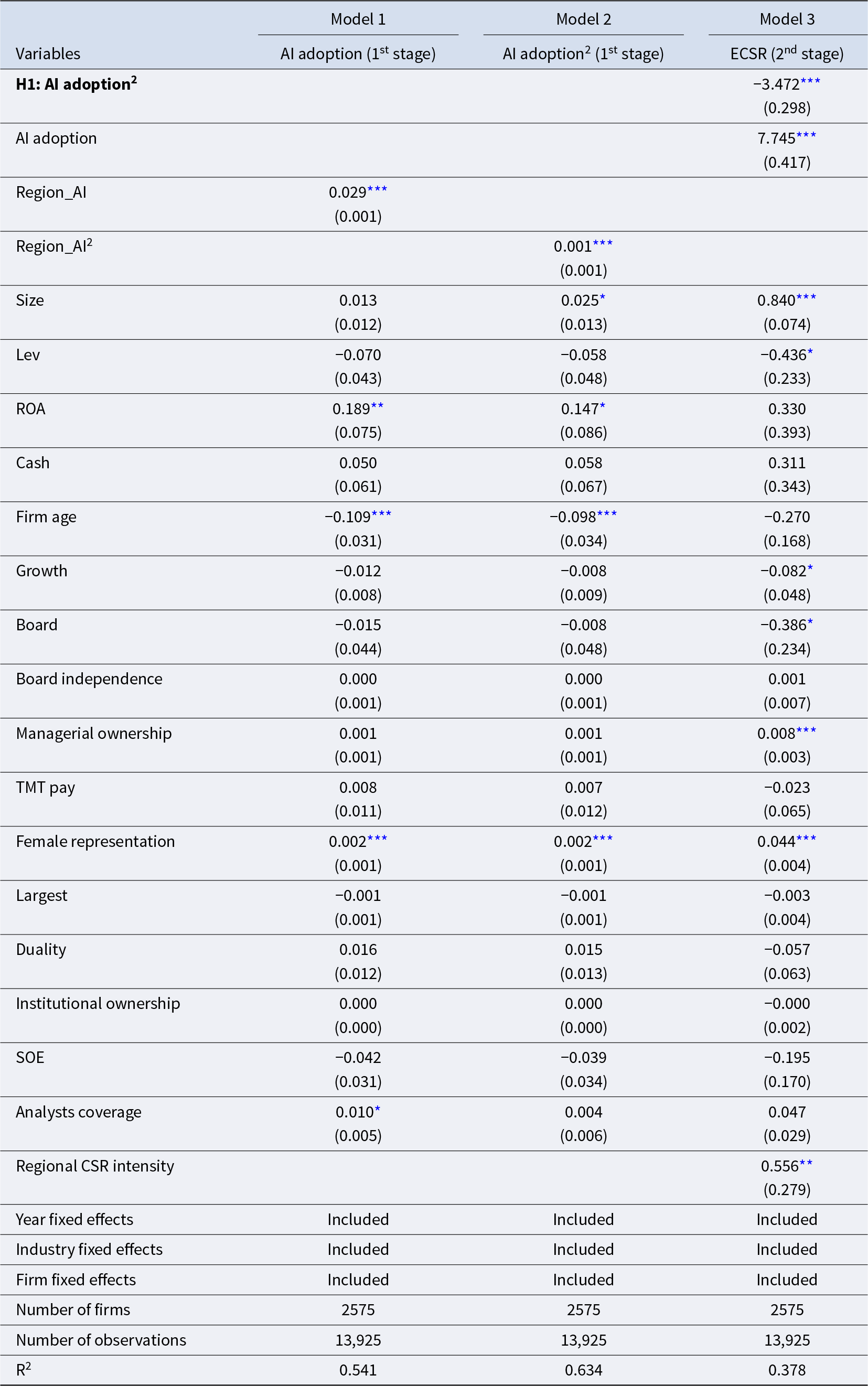
Third, to address potential endogeneity arising from firm-level characteristics that may influence AI adoption, we employed a two-stage instrumental variable approach. As the instrument, we used the logged number of AI-related firms registered in each Chinese province (iv_RegionAI), obtained from Tianyancha, a national database of business registrations. This variable satisfies the relevance criterion, as regional AI development reflects local infrastructure and policy incentives that plausibly influence firms’ likelihood of adopting AI. It also meets the exogeneity condition, as the number of regional AI firms is unlikely to directly affect a focal firm’s ECSR engagement. Following the recommendation of Haans et al. (Reference Haans, Pieters and He2016: 1183), we separately estimated the linear and squared terms of AI adoption in the first stage, rather than instrumenting the squared term mechanically from the predicted value of the linear term. Table 5 reports the results. The Kleibergen–Paap Wald F statistic is 236.6 – well above the conventional threshold of 7.03 – confirming the strength of the instrument. The second-stage estimates continue to support a robust inverted U-shaped relationship between AI adoption and ECSR.
Results of two-stage model with instrumental variable

Notes: This table presents the regression results based on the instrumental variable approach, comprising both the first-stage and second-stage estimations. In the first stage, AI adoption and AI adoption2 serve as the dependent variables separately, while in the second stage, ECSR is the dependent variable. Robust standard errors clusters by firm appear in parentheses.
* P < 0.1, **P < 0.05, ***P < 0.01.
Robustness checks
We conduct several robustness checks. First, we employed an alternative specification of the dependent variable to address potential concerns regarding construct validity. While our primary measure of ECSR was constructed from three dimensions – employment, salary, and social security – there is a possibility that salary-related indicators may be driven more by individual employee characteristics than by shifts in managerial attention. To mitigate this concern, we excluded the salary dimension and constructed a new variable, Sub_ECSR, based solely on employment and guarantee-related indicators. As reported in Table E of the Appendix, regression results using this alternative specification remain consistent with our main findings, reinforcing the robustness and internal validity of our empirical conclusions.
Second, to further ensure the robustness of our findings, we employed an alternative measure of AI adoption based on firms’ innovation outputs. Given AI’s increasing role as a foundational technology in corporate R&D and knowledge generation, patent data provide a complementary perspective on firms’ substantive AI engagement. Following established practices in the literature (Zu et al., Reference Zu, Ni and Hu2025), we collected invention patent application texts filed by listed firms during the sample period and applied a keyword-based identification strategy to detect AI-related patents. We then constructed an alternative measure, Alt_AIadoption, defined as the ratio of AI-related patents to the total number of invention patents filed by a firm in a given year. The results remained consistent with our primary analyses: AI adoption continued to exhibit a statistically significant inverted U-shaped relationship with ECSR, and the moderating effects were also robust under this alternative specification (see Table F in the Appendix).
Third, we further tested the generalizability of our theoretical framework across different categories of AI technologies. While AI is widely conceptualized as a general-purpose technology, prior research has emphasized the heterogeneity of its underlying technical logics and applications (Townsend, Hunt, Rady, Manocha, & Jin, Reference Townsend, Hunt, Rady, Manocha and Jin2025). In particular, AI can be broadly classified into logic-based AI – including symbolic reasoning, expert systems, and rule-based architectures – and learning-based AI, such as machine learning, deep learning, and neural networks. We thus categorized our AI keyword lexicon accordingly and re-estimated the core models using two disaggregated measures of AI adoption. The results indicate that both logic-based and learning-based AI technologies demonstrate a significant inverted U-shaped effect on ECSR (P < 0.001), and the hypothesized moderating effects remain significant across both categories (see Table G in the Appendix). These findings reinforce the theoretical validity and empirical robustness of our model, suggesting that the dual-attention mechanisms and their conditional dynamics hold across varied AI technological forms.
Discussion
The adoption of AI represents one of the most profound transformations in contemporary organizations, reshaping how firms make decisions, coordinate work, and enact responsibility. Prior research has predominantly portrayed AI as a performance-oriented technology that augments human capabilities and enhances organizational functioning (e.g., Cimino et al., Reference Cimino, Felicetti, Corvello, Ndou and Longo2024; Gaczek et al., Reference Gaczek, Leszczynski and Mouakher2023; Jia et al., Reference Jia, Luo, Fang and Liao2024). Yet, as AI systems grow more autonomous, opaque, and deeply embedded in organizational processes, scholars increasingly recognize that their implications extend beyond technical or economic efficiency to broader ethical and social domains (Budhwar et al., Reference Budhwar, Chowdhury, Wood, Aguinis, Bamber, Beltran, Boselie, Lee Cooke, Decker, DeNisi, Dey, Guest, Knoblich, Malik, Paauwe, Papagiannidis, Patel, Pereira, Ren, Rogelberg, Saunders, Tung and Varma2023). This recognition brings AI research into closer dialogue with the CSR literature, which examines how firms fulfill moral obligations to diverse stakeholders and sustain legitimacy amid institutional change (Aguilera et al., Reference Aguilera, Rupp, Williams and Ganapathi2007; Bhattacharya et al., Reference Bhattacharya, Korschun and Sen2009). Recent CSR studies further suggest that technological transformations can influence the extent of firms’ responsibility toward different stakeholder groups (Zhang, Chin, & Al-Wazer, Reference Zhang, Chin and Al-Wazer2025).
Despite these advances, two theoretical gaps remain. First, research on AI adoption largely retains a tool-centric framing and rarely examines what happens when managers perceive AI as an autonomous and cognitively capable agent that itself attracts managerial attention (Vanneste & Puranam, Reference Vanneste and Puranam2024). We thus know much about AI’s functional benefits but little about its deeper cognitive consequences – particularly how its embeddedness reshapes managerial attention and the moral architecture of decision-making. Second, while CSR scholarship richly examines firms’ obligations to multiple stakeholders, it has seldom addressed how technological disruption – especially AI-driven work redesign – affects responsibility toward employees, the group most exposed to automation, task ambiguity, and declining managerial salience (Akremi et al., Reference Akremi, Gond, Swaen, De Roeck and Igalens2018; Liu et al., Reference Liu, Yuan and Jiang2024). As a result, we still lack an integrated understanding of how AI adoption transforms the attentional foundations on which ECSR decisions rest.
The present study addresses these gaps by integrating AI adoption research with the ABV to explain why its influence on ECSR follows an inverted U-shaped pattern. Moving beyond the traditional tool-centric framing, we conceptualize AI as agents that compete with human employees for managerial attention. From this standpoint, we theorize that AI adoption reshapes the managerial attentional field through two opposing processes: a human-attention-gain mechanism at moderate levels of adoption that strengthens managerial engagement with employee welfare, and an AI-attention-shift mechanism at higher levels that diverts focus toward technological agents. This theorization advances understanding of how bounded managerial cognition mediates the social consequences of technological change. By demonstrating that fluctuations in attention allocation – rather than technological capability alone – govern the ethical outcomes of AI integration, our study extends the ABV into a socio-technological domain and illuminates how the rise of nonhuman agents reconfigures the cognitive and moral architecture of managerial responsibility (Lee, Reference Lee2021).
Moreover, we enrich research on AI’s organizational consequences by foregrounding its ethical implications, particularly its influence on ECSR. While prior AI literature has predominantly emphasized efficiency, innovation, or decision accuracy, it has paid limited attention to the moral and social externalities that AI adoption introduces within firms (Budhwar et al., Reference Budhwar, Chowdhury, Wood, Aguinis, Bamber, Beltran, Boselie, Lee Cooke, Decker, DeNisi, Dey, Guest, Knoblich, Malik, Paauwe, Papagiannidis, Patel, Pereira, Ren, Rogelberg, Saunders, Tung and Varma2023). By focusing on ECSR – a core dimension of internal stakeholder responsibility (Liu & Luo, Reference Liu and Luo2022) – our study uncovers how AI adoption disrupts or recalibrates managerial commitments to employees, offering a technology-contingent view of CSR. In doing so, we not only deepen understanding of AI’s ethical ramifications but also contribute to CSR scholarship by mapping how digital transformation reshapes social responsibility practices toward vulnerable internal stakeholders, thereby opening a finer-grained research pathway at the intersection of AI and CSR.
Further, the study theorizes three boundary conditions that operate at different levels of the attention system. Industry AI substitution risk captures the external task environment and makes AI a more legitimate competitor to human labor, thereby accelerating the leftward movement and steepening the curve. TMT functional diversity captures the structural attentional capacity of the decision-making body and enables a broader distribution of attention across dual agents, flattening and delaying the curve. ESO, in turn, captures the characteristics of the attention target itself: when employees are more tightly aligned with the firm through ownership, they are more defensible addressees of managerial attention, which delays and weakens the shift away from them. Taken together, these three moderators show that attention allocation in AI-enabled contexts is conditioned simultaneously by environmental pressures, internal cognitive heterogeneity, and target-level alignment. This multilayered account adds contingency and scope conditions to ABV in the context of technological disruption (Levy, Reference Levy2005; Ocasio et al., Reference Ocasio, Laamanen and Vaara2018).
Managerial Implications
This study offers several managerial implications for organizations navigating AI-driven transformation. The inverted U-shaped relationship between AI adoption and ECSR indicates that the social impact of AI integration depends not only on whether firms adopt AI but also on how far they progress along the adoption path. Our estimates suggest that the inflection point occurs when AI-related hiring reaches about 0.8–1.0% of total employment, or roughly 80–100 AI positions per 10,000 employees. Within this range, organizations can achieve a balanced configuration between technological efficiency and employee welfare, as human–AI collaboration still relies on substantial managerial attention to the workforce. Beyond this threshold, however, managerial focus tends to drift toward AI systems, reducing attention to employees and weakening ECSR engagement. Firms at advanced stages of AI adoption should therefore shift their emphasis from expansion to attention governance – preventing excessive reliance on AI by institutionalizing human-centered safeguards. Integrating employee well-being metrics into AI project assessments, linking executive incentives to internal stakeholder outcomes, and maintaining transparent communication with employees can help preserve ECSR as AI becomes deeply embedded in organizational routines.
The moderating effects further reveal that attention governance depends on both context and structure. In industries with high AI substitutability risk, firms should anticipate an earlier and sharper shift of attention toward AI and implement complementary measures, such as employment transition programs or joint oversight systems that evaluate both technological and human outcomes. Functionally diverse TMTs can mitigate overconcentration on AI by distributing cognitive attention more evenly across human and artificial agents, suggesting that firms should cultivate leadership teams combining technological, operational, and human resource expertise. Moreover, ESO serves as an endogenous stabilizer of managerial attention by aligning employee and firm interests, sustaining ECSR even under intensive AI deployment. Collectively, these insights highlight that responsible AI adoption is less about controlling technology itself and more about managing the evolving field of attention it reshapes – across contexts, structures, and the human core of the organization.
Limations and Future Research Directions
This study is not without limitations, which also provide promising directions for future inquiry. First, although our measure of AI adoption captures firms’ recruitment demand for AI-related capabilities, it primarily reflects external hiring needs and may not fully account for internal redeployment or process-level integration of AI. Future research could integrate internal HR or operational data to construct more fine-grained indicators of AI assimilation and its temporal evolution. We also encourage scholars to extend this research using cross-national and multimodal datasets, which would enable comparative analyses of how institutional environments and data modalities jointly shape the organizational consequences of AI adoption.
Beyond these methodological refinements, several conceptual avenues merit further exploration. Future studies could expand the scope from employee-related CSR to other stakeholder domains – such as customers, suppliers, and communities (Mason & Simmons, Reference Mason and Simmons2014) – to investigate whether the attention dynamics observed here generalize across relational boundaries. Another promising direction is to explore how organizational governance systems, such as board committees or AI ethics offices, institutionalize mechanisms that balance efficiency-driven AI deployment with sustained human-centered accountability.
Moreover, drawing from diversity, equity, and inclusion (DEI) research (e.g., Rao & Tilt, Reference Rao and Tilt2016), future studies could examine how leadership diversity not only influences ethical preferences but also actively reconfigures the cognitive architecture through which attention to AI and human agents is distributed. Our findings – showing that, beyond the role of TMT functional diversity, female representation in top management is strongly associated with higher ECSR – suggest that diverse teams may foster pluralistic moral attention, enabling organizations to maintain human-centered priorities amid technological intensification. Future research could therefore investigate how gender-diverse leadership groups institutionalize ethical vigilance and collective reflection in AI governance, revealing how demographic and cognitive heterogeneity jointly shape the moral infrastructure of decision-making in dual-agent contexts.
Conclusion
In sum, this study advances understanding of how AI adoption shapes firms’ ECSR by reframing AI not merely as a performance-enhancing tool but as a dual organizational agent competing for managerial attention. Grounded in the ABV, we demonstrate that AI adoption exerts two countervailing forces – enhancing managerial focus on employees at early stages and displacing it at higher levels – thereby producing an inverted U-shaped relationship with ECSR. Our analysis further reveals that this dynamic is contingent upon environmental, structural, and target-level factors that govern how attention is distributed across human and artificial agents. Together, these insights highlight that the ethical consequences of AI integration depend less on technology itself and more on how managerial attention is governed within dual-agent organizations. By integrating cognitive, ethical, and structural perspectives, this research offers a foundation for future studies on responsible AI adoption and the evolving human–AI social contract in organizations.
Data availability
The data materials and statistical code related to the findings of this study is available in Open Science Framework at DOI 10.17605/OSF.IO/57BJM
Acknowledgements
We sincerely thank Senior Editor Weiting Zheng and the two anonymous reviewers for their insightful and constructive comments that greatly improved this article.
Funding statement
This research was supported by the Shandong Provincial Natural Science Foundation, Grant No. ZR2024QG193.
Appendix
Indicators and directions for the construction of the E-CSR entropy weighting approach

AI-related technology terms identified after the word frequency approach

Average industry-level AI substitution risk

Testing the inverted U-shaped theoretical mechanism

Notes: This table examines the two theoretical mechanisms underlying the inverted U-shaped relationship: Human attention gain and AI attention shift. The former refers to the linear positive effect of AI adoption on managerial attention directed toward human agents, while the latter captures the nonlinear positive effect of AI adoption on the shift of attention toward AI agents. Robust standard errors clusters by firm appear in parentheses.
* P < 0.1, **P < 0.05, ***P < 0.01.
Results of alternative measurement of ECSR

Notes: This table reports the regression results for ECSR when using employment and security as its subdimensions. Robust standard errors clusters by firm appear in parentheses.
* P < 0.1, **P < 0.05, ***P < 0.01.
Results of alternative measurement of AI adoption

Notes: This table constructs an alternative measure of AI adoption based on the annual proportion of AI-related patents within a firm’s total patent applications. Patents are classified as AI-related if their application texts include references to AI technologies. Robust standard errors clusters by firm appear in parentheses.
* P < 0.1, **P < 0.05, ***P < 0.01.
Effects of logic-based and learning-based AI adoption on ECSR

Notes: This table presents the effects of AI adoption on ECSR after categorizing AI technologies into logic-based and learning-based types. Robust standard errors clusters by firm appear in parentheses.
* P < 0.1, **P < 0.05, ***P < 0.01.
Jie Lyu (jielyu@sdu.edu.cn) is a postdoctoral researcher at the School of Management, Shandong University. He received his PhD from the School of Management, Huazhong University of Science and Technology. His research interests include AI and value cocreation in enterprises, as well as AI-driven employee service strategies.
Shiyue Wang (shiyue_w1010@163.com) is a graduate student at the School of Public Administration, Zhejiang University. Her research focuses on public policy and corporate AI strategy, as well as AI adoption compliance from an institutional theory perspective.
Chenhao Hu (huchenhao@sdu.edu.cn) is an assistant professor at the School of Business, Shandong University. She holds a PhD from the School of Management, Huazhong University of Science and Technology. Her research interests include AI strategy implementation in enterprises, corporate social responsibility (CSR), and sustainable development in the AI era. Her research has been published in Management and Organization Review, Nankai Business Review, and other journals.