INTRODUCTION
One way that Americans have been known to handle the difficult times in their lives is through humor. When it becomes difficult to cope, tears and laughter are both cathartic. As part of a senior level Honors Course at the University of Oklahoma the authors collaborated to explore whether there was a correlation between societal events related to dying and death and the overall percent of death-related cartoons in The New Yorker. The authors analyzed cartoons from which contemporary notions of death are expressed. Determinations can be made concerning the connections between societal events and death.
Historical Context
The evolving views of death throughout the 20th century presented a dramatic upheaval of traditional conceptions and a challenge to the medical sciences. Through the first half of the century death was viewed as a sudden event resulting from an acute and unexpected happening. This apprehension began to change throughout the second half of the 20th century, as people started to live longer lives and died from more degenerative diseases. This was due in part to dramatic advances in the sphere of medical technology, which sought to prolong life by artificial means. Although the result of these advances was a longer life span, the experience of death for humans often changed from an unanticipated circumstance to a long and declining course of health.
Coupled with the reversal in the meaning and conceptions of death, technologies that sustain life by artificial means have also raised many moral, ethical, and legal dilemmas. Some bioethicists contend that the real political struggles of the 20th century have not been over legal rights, but over control in the way individuals live their lives. Supreme Court rulings regarding the right to abortion, die, cause death, make family decisions, live, control one's own body, health care, refuse hydration, and self-determination are examples of health care issues brought forth in the last few decades (Annas, Reference Annas1993).
Since the 1970s, there have been notable events that have shaped a new conceptualization and legal system related to the end of life and causing or assisting death. The activities of Dr. Jack Kevorkian, a nonlicensed pathologist who admitted to assisting over 130 people to commit suicide, fueled the media and heightened public awareness about euthanasia and assisted death. One example of media coverage was a broadcast in which Dr. Kevorkian administered a lethal injection to a 42-year-old man with Lou Gehrig's disease on the 60 Minutes television series (November 22, 1998). Although he was found guilty in 1999 of second-degree murder and sentenced to 10–25 years of imprisonment, many Americans still view assisted dying as a “responsible alternative” to their fear of dying a lonely, undignified, prolonged, painful, or institutionalized death (Annas, Reference Annas1993).
Two major studies within the last decade have identified priority areas for end-of-life care: the SUPPORT study (The SUPPORT Principal Investigators, 1995) and the Institute of Medicine (IOM) Report (Field & Cassel, Reference Field and Cassel1997). Few clinical research projects have generated as much public interest or as many published articles as the SUPPORT study. This $29 million multiyear research project (funded by the Robert Wood Johnson Foundation) was the first to reveal the failure of the American health care system to provide effective and compassionate care to seriously ill and dying patients (Bookbinder et al., Reference Bookbinder, Kiss, Matzo, Matzo and Sherman2006). Two reports that followed, Improving Palliative Care for Cancer (Foley & Gelband, Reference Foley and Gelband2002) and When Children Die: Improving Palliative and End-of-Life Care for Children and Their Families (Field & Behrman, Reference Field and Behrman2002), continued the arguments that medical and other support for people with fatal or potentially fatal conditions often falls short of what is reasonably if not simply attainable. The IOM reports (Field & Behrman, Reference Field and Behrman2002; Foley & Gelband, Reference Foley and Gelband2002) highlighted the inadequacy of knowledge to guide the practice of clinicians in end-of-life care and the need for support from policy makers (Bookbinder et al., Reference Bookbinder, Kiss, Matzo, Matzo and Sherman2006).
Oregon became the first state to legalize assisted suicide (but not euthanasia) in 1997, via the “Death with Dignity Act” (State of Oregon, n.d.). This legislation allowed physicians to prescribe lethal dosages of medication to competent, terminally ill patients who request them. Ganzini et al. (Reference Ganzini, Nelson and Schmidt2000) documented that physicians granted approximately 1 in 6 requests for a prescription for a lethal dose of medication, and 1 in 10 requests actually resulted in suicide. The authors reported that effective palliative care interventions led most patients to change their minds about committing suicide (Bookbinder et al., Reference Bookbinder, Kiss, Matzo, Matzo and Sherman2006).
Factors that have contributed to the palliative care movement in the United States include the growing aging population, the assisted suicide debate, reduced patient autonomy, and inappropriate end-of-life care (i.e., overtreatment of medical care and undertreatment of pain and depression; Bookbinder et al., Reference Bookbinder, Kiss, Matzo, Matzo and Sherman2006). Quality outcomes of good palliative care ensure that patients' values and decisions are respected, comfort is a priority, psychosocial, spiritual, and practical needs will be addressed, and opportunities will be encouraged for growth and completion of unfinished business (National Consensus Project for Quality Polliative Care, 2009).
Theoretical Framework
Humor, in the form of either jokes or cartoons, is a way of portraying a profound truth in a medium which appears to be “nonsensical” (Levine, Reference Levine1969). By promoting this aura of triviality one is able to convert very serious and solemn material into a form that is socially tolerable and accepted. The release from the general limitations of civilization, coinciding with a reduction in the Freudian base drives of aggression and sex, produces a satisfying individual experience.
These drives are unconscious and are perpetually striving for liberation, which can be found in the form of comedy. Aggression is found in cartoon humor “insofar as it makes a dig at authority, robs a character of pretensions, pokes fun at an aspect of the human condition, or hits one with a punch line,” (Rosenwald, Reference Rosenwald and Levine1969, p. 54) while the sexual drive is fulfilled through the pleasure one receives from the discharge of these desires. According to Drive Reduction Theory, humor is defined in a narrow context as a mitigation or balance between the release of hedonistic pleasure and the barriers of societal constraints. Humor is used as a coping mechanism to help us deal with our fears (Adamle & Ludwick, Reference Adamle and Ludwick2005).
It was hypothesized that there was a positive relationship between societal events related to death and dying and the number of death-related cartoons in The New Yorker. The magazine editors want to sell magazines, attract new readers, and ensure that the images and cartoons that they use serve these ends. They must decide from issue to issue where and how often graphics and cartoons will be utilized and whether to include or exclude any race, age group, gender, or topic in the cartoon theme.
METHODS
To analyze the relationship between societal events related to death and dying, the number and percent of total cartoons published, and the overall theme represented in them, death-related cartoons published in The New Yorker magazine between 1986 and the February 2, 2006, issue were examined. The New Yorker is a magazine that was started in 1925 and publishes the news, commentary, criticism, essays, fiction, satire, cartoons (starting in 1956), and poetry. The magazine focuses on the cultural life of New York City, but has wide readership throughout the world. The magazine was marketed for those with metropolitan interests and not for mainstream Americans (Fox, Sund & Altman, 2008).
Every issue of The New Yorker between the years 1986 and 2006 was examined. All cartoons were counted from this period to determine the raw number of cartoons published, and copies were made of the death-related cartoons. We used the following (admittedly subjective) criteria to determine that a cartoon was death related. These were if the cartoon copy contained the words death, dying, or funeral or if the cartoon art depicted heaven, hell, funerals, or dying/dead people or animals. Once death-related cartoons were identified we discussed the cartoon until consensus was reached regarding the theme that each cartoon represented. We had to reach agreement about how the cartoon was to be interpreted in the analysis.
RESULTS
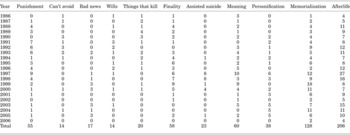
In the years under consideration (1986–2006) a total of 19,039 cartoons were published in The New Yorker; of those 634 (3%) had death-related themes. A review of these cartoons resulted in 11 primary death-related themes and 7 subthemes. The primary themes are “punishment,” “something you can't avoid,” “bad news,” “wills,” “things that kill,” “finality,” “assisted suicide,” “meaning of death,” “personification of death,” “memorialization,” and “the afterlife.”
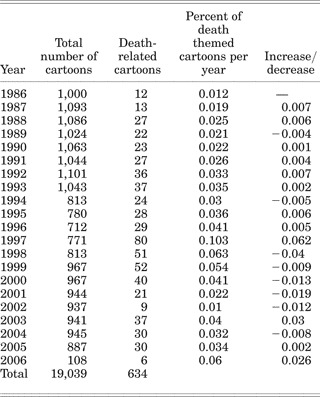
The range of percent of death-related cartoons (Table 1) in relation to the total number of cartoons per year was 1% (2002) to 10% (1997). The general trend was an increase in death-related cartoons from one year to the next with the exception of the years 1999–2002. The most frequently presented theme (Table 2) was “the afterlife” (n = 206) and the least frequent themes were “something you can't avoid” (n = 14) and “wills” (n = 14).
Death related cartoons by year

Death related themes by year

As a whole, from 1986 to 2006 the number of death-related cartoons increased, reaching its peak in 1997. In 1986, there were 12 death-themed cartoons out of a total of 1,000; as of February 2, 2006, there were 6 out of a total of 108 cartoons. Sharp declines in death-related themes occurred from 1999 to 2002, with the most dramatic decline taking place in 2001. The decline in 2001–2002 was most likely related to the September 11 tragedy. Death, in this period, could not be considered funny to New Yorkers. Since 2002 there has been a relatively steady increase in death-related cartoons each year.
Themes
“Things you can't avoid” (n = 14) depicted multiple iterations on the saying that “the two things you can't avoid are death and taxes.” For example, one cartoon showed the Grim Reaper and an IRS tax man crouched at the starting line of a race. Another depicted the devil meeting with a politician with the caption, “Congressman, our people would look upon it favorably if you were to oppose any additional sin taxes” (from 1994; Mankoff, Reference Mankoff2006, p. 23). The grouping also involved aspects relating tempest fugit (Latin for “time flies”).
“Wills” (n = 14) peaked in 1991, the year after the passage of the Patient Self-Determination Act of 1990 (which is an ammendment of the Omnibus Budget Reconciliation Act of 1990 [OBRA 90] combined depictions of Advance Health Directives, such as living wills, and also involved aspects of greed relating to insurance claims.
“Bad News” (n = 17) depicted informing loved ones of a recently deceased individual or letting people know that they were terminally ill; for example, an egg (carrying a purse) walks into a busy emergency room. The doctor says, “You might want to sit down, Mrs. Dumpty” (from 1993; Mankoff, 2006, p. 278).
“Things That Will Kill You” (n = 20) depicted activities that could affect life expectancy, including diets, alcohol and tobacco, and exercise. The grouping also included hobbies and examples of human traits (e.g., A cat lies on the autopsy table. Cause of death? Curiosity).
“Assisted Suicide” (n = 23) peaked between 1997 and 1998 and included all cartoons relating to Jack Kevorkian and the debate about self-determination and the right to die. One shows a Boy Scout helping an old woman across the street with the caption “I also do suicides” (from 1998; Mankoff, Reference Mankoff2006, p. 310). Another shows an elderly couple buying gas with the caption, “Yes, Oregon's lovely, but we're just here for the suicide” (from 1998; Mankoff, Reference Mankoff2006, p. 163). Lastly, a doctor is fielding phone calls in his office; the caption is, “Before we try assisted suicide, Mrs. Rose, let's give the aspirin a chance” (from 1997; Mankoff, Reference Mankoff2006, p. 647).
“Personification of Death” (n = 38) included a subtheme of “Bargaining with Death.” The main theme included representations of death with human attributes, such as the Grim Reaper. Examples are the Grim Reaper sitting in a bar talking to another man; the caption reads, “Sometimes I give myself the creeps” (from 2005; Mankoff, Reference Mankoff2006, p. 28). The subtheme involved people negotiating for more time to live. Many of the cartoons in this theme show the Grim Reaper standing at someone's door as he or she tries to negotiate his or her way out of dying. For example, one such caption read, “Couldn't I do a couple of hundred hours of community service instead?” (from 1990; Mankoff, Reference Mankoff2006, p. 46). This can be seen as the legacy of death (Elgee, Reference Elgee2003), that we are all its slaves.
“Punishment” (n = 55) included the subtheme of “Aggression.” Cartoons placed under the main category contained aspects related to suffering, such as people in Hell agonizing over pain. Many themes related to Hell included lawyers and writers. One cartoon shows people entering Hell with a sign by the entrance that reads, “Authors must be with their agents!” (from 1991; Mankoff, Reference Mankoff2006, p. 736). The subtheme included depictions of murder, suicide, and domestic violence resulting in death. One shows movers moving a piano, a man dead on the floor, and a woman saying “I liked it better on top of my husband” (from 1995; Mankoff, Reference Mankoff2006, p. 347).
“Finality” (n = 58) peaked during the period 1994–2000 and encompassed cartoons related to the final moments of life, including last words, actions, and confessions. Many of these cartoons show deathbed scenes where the family is gathered (typically with clergy present) and final thoughts are shared. For example, captions associated with this picture include, “Promise me, son, that you'll never have anything to do with publishing” (from 1996; Mankoff, Reference Mankoff2006, p. 368) and “And don't go auctioning off my stuff” (from 1996; Mankoff, Reference Mankoff2006, p. 157).
“Meaning of Life and Death” (n = 60) included a subtheme of the “Triviality of Life or Death.” Cartoons placed under the main theme contained depictions of philosophical statements, the circle of life, and an acceptance of death. One cartoon shows a man working on his computer and talking to his wife. He says, “If we take a late retirement and an early death, we'll just squeak by” (from 2003; Mankoff, Reference Mankoff2006, p. 459). Cartoons placed under the subtheme made light of deadly situations and included inconsistent statements and actions. For example, two doctors stand at a dying man's bedside as one doctor says to the man, “So, could we have all your stuff after you die?” with the caption “Doctors without Boundaries” (from 2003; Mankoff, 2006, p. 321). Another shows a man in hospital admissions and the clerk says “Fill out this tag and attach it to your big toe” (from 2001; Mankoff, Reference Mankoff2006, p. 544).
“Memorialization” (n = 128) included a subtheme of “Funerals.” The main theme involved cartoons depicting tombstones, the scattering of ashes, and obituaries, whereas the subtheme included graveyard humor and funeral gatherings; for example, two tattooed and pierced men with Mohawks are looking into a casket and visible at the head of the casket is a spiky Mohawk and the caption reads, “You've got to admit, he looks good” (from 1994; Mankoff, 2006, p. 364).
“Afterlife” (n = 206) included three subthemes: “Judgment,” “Postdeath,” and “Taking It with You.” The main theme involved cartoons relating to Heaven—such as one showing two people in heaven wearing black robes, wings, and sunglasses talking to an angel in white; the caption: “We're from Manhattan” (from 2001; Mankoff, 2006, p. 396). The subtheme of “Judgment” contained depictions of entry into heaven or initiation into hell. All of these cartoons depicted either St. Peter at the gates of heaven or the devil at the gates of hell. One shows a man at the gates of hell standing at a podium with the devil and the devil is saying, “And, if you don't have an attorney, we have millions of them” (from 2003; Mankoff, Reference Mankoff2006, p. 11). Another shows a man being greeted at the gates of heaven with St. Peter saying, “I'd like to congratulate you on dying with dignity” (from 1997; Mankoff, Reference Mankoff2006, p. 446). The subtheme of “Postdeath” included representations of human life carried into the afterlife. For example, a group of angels are talking and one says, “Does anyone else's robe say ‘Hyatt’?” (from 2005; Mankoff, Reference Mankoff2006, p. 636). Cartoons representing the theme “Taking It with You” involved earthly pleasures and objects in relation to life after death. One cartoon shows a man on his deathbed with the caption, “True, I can't take it with me, but I can take the access codes to it” (from 1998; Mankoff, Reference Mankoff2006, p. 418).
DISCUSSION
Three conclusions emerge from these analyses. First, humor is used to process and raise the level of discourse regarding one of human beings' greatest fears: death. The fairly stable expansion in the number of death-related cartoons, when juxtaposed against the historical review of seminal events related to dying and death, confirms the hypothesis of a positive relationship between the two variables. The most dramatic association can be seen in the period from 1995 to 1998, in which the SUPPORT study, the Institute of Medicine Report, the Oregon Death with Dignity Act, and Jack Kevorkian's televised assisted suicide took place. When measured against the initial year of study (1986), this period corresponds to an approximate per-year average increase of 5.08% in The New Yorker's death-related cartoons. This is evidence of a direct correlation between the public's awareness of death (and perhaps their increased anxiety about it) and the number of death-related cartoons.
Second, as Will Rogers said, “Everything is funny as long as it is happening to someone else” (BrainyQuote, 2009), which appears to be the case for a magazine based in New York City following the events of 9/11. After 1988 there were no years with as low a rate of death—related jokes as the years 2001 and 2002. There were no cartoons that referenced the World Trade Center collapse, and, in 2002, there were only nine death-related cartoons published that entire year. In the face of this tremendous tragedy, not even humor could be used to free ourselves from the fear and sadness.
Attributed to numerous comedians is the saying that “tragedy plus time equals comedy.” This appears to be the case for death-related cartoons in The New Yorker after 9/11; while the total number of cartoons did not change, the number with death-related themes did. Loss of a sense of humor is one of the first signs of depression (Gibson, Reference Gibson2004). The movement away from jokes about dying and death may have been symptomatic of the depression and grief Americans were experiencing at that time.
Third, a review of the most prevalent themes of the cartoons gives us insight into which themes about death provoke the most anxiety. Fear of the unknown creates anxiety (Carleton et al., Reference Carleton, Norton and Asmundson2007); what is more unknown than what occurs after we die? Themes related to the afterlife (n = 206) and memorialization (n = 128) were the dominant themes of the analyses. Numerous cartoons regarding the afterlife expressed the idea that life after death is much the same as life on Earth. There are still concerns about work, the effect of past deeds, and socializing with important people. It would appear that the comfort comes in thinking that little will change when we get to the afterlife; for example, two angels are reading the newspaper, with the caption, “Finished with the Living Section?” (from 1993; Mankoff, 2006, p. 498).
Death is an unfamiliar and uncontrollable event and, as such, raises individual anxiety. Death anxiety is a principal motivator that underlies our belief systems (Elgee, Reference Elgee2003). Humor (according to the Drive-Reduction Model; Rosenwald, Reference Rosenwald and Levine1969) is initiated first by an “arousal jag,” which provides an individual with a feeling of uncertainty, and is followed by a “factor that signifies safety, readjustment, clarification, or release” (Levine, Reference Levine1969, p. 6). This release, though, is paired with a feeling of self-triumph for the mastery of a complicated and foreign relationship.
Death is the great unknown, a realm from which no one returns. In essence, to depict the subject humorously is an unconscious desire to come to grips, or cope, with the most intimidating, mysterious, and anxiety-provoking event in life. Therefore, as historical events pushed notions of death to the forefront of popular culture, some artists' attempted to make sense of or alleviate societal concerns by depicting death in the form of cartoons.
As palliative care health care practitioners, we can utilize humor in the form of cartoons with our patients. Unpalatable truths can begin to become acceptable for our patients when humor is utilized (Richman, Reference Richman2006). The nature of humor is its “ability to touch upon universal truths” (Richman, Reference Richman2006, p. 42) and, as such, becomes a source of understanding and comfort to the palliative care patient and to ourselves.