INTRODUCTION
A long-term survey on the ecology, behaviour and biology of the Caribbean manatee Trichechus manatus manatus Linnaeus, 1758, an endangered species, is presently being developed by researchers of El Colegio de la Frontera Sur, in south-east Mexico (Morales-Vela et al., Reference Morales-Vela, Padilla-Saldívar and Mignucci-Giannoni2003). The project includes a survey of the manatee parasites and epibiotic fauna. There are several studies accounting for the endoparasites of the Caribbean manatee, mainly helminths (Beck & Forrester, Reference Beck and Forrester1998; Mignucci-Gianonni et al., 1999); parasites are presumed to have an effect on the lifespan and ecological performance of the manatee (Mignucci-Gianonni et al., Reference Mignucci-Gianonni, Hoberg, Siegel-Causey and Williams1998). The ectoparasites and epibionts of the manatee have received less attention. There are only a few records of crustaceans associated to these mammals, and most include barnacles, which are the most conspicuous and frequent fouling organisms of marine animals (Cintrón-de Jesús, Reference Cintrón-de Jesús2000; Cintrón-de Jesús et al., Reference Cintrón-de Jesús, Williams, Mignucci-Gianonni, Coyne and Clark2005). Aside from the barnacles, there are isolated records of copepods whose association with the manatee remains uncertain (Humes, Reference Humes1964; Ortíz et al., Reference Ortíz, Lalana and Torres-Fundora1992).
Tanaidaceans are benthic microcrustaceans that dwell in different types of marine environments; many species can live in transitional and estuarine habitats. Because of their relative abundance (Kneib, Reference Kneib1992), tanaidaceans appear to represent an important food source for benthic marine invertebrates and vertebrates. In the western Caribbean, studies on and records of tanaidaceans are relatively recent and sporadic (see García-Madrigal et al., 2004). Tanaidaceans are generally considered free-living forms, but some species have been found to be loosely associated with different taxa of invertebrates and vertebrates, including corals, bryozoans, molluscs, barnacles, and sea turtles (Larsen, Reference Larsen2005). The collettid tanaidacean Exspina typica Lang, 1968 is possibly a parasite of deep-sea holothurians (Thurston et al., Reference Thurston, Billett and Hassack1987). Hitherto, there have been no published records of symbiotic associations of tanaidaceans with aquatic mammals.
During the development of this research, many specimens of the Caribbean manatee, captured for tagging, were examined in order to obtain samples of and to identify their epibionts. In this study we present our results on the observations of a tanaidacean found associated to the skin surface of the manatee; these data are based on field collections carried out in two different bay environments along the Mexican coast of the western Caribbean Sea.
MATERIALS AND METHODS
The biological material analysed herein was obtained from 47 live individuals (26 males, 21 females) of the Caribbean manatee Trichechus manatus manatus; these were captured for tagging during a three-year period (March 2004–March 2007) from two bay systems (Chetumal and Ascensión) of the Mexican Caribbean (Figure 1). The epibiont samples were obtained by scratching the surface of the skin of infected animals with a blunt spatula; specimens were immediately fixed in a formalin solution and then transferred to 70% ethanol for long-term preservation. The preparation of the crustacean epibionts for taxonomic examination followed Sieg (1988). Some specimens were processed for scanning electron microscopy (SEM) analysis using a JEOL LV-5900 microscope at the ECOSUR facility in Tapachula City, Mexico. Tanaid specimens and the tubes in which they were collected are deposited in three vials held in the collection of zooplankton of El Colegio de la Frontera Sur (ECO-CHZ 002761). Additional reference material from the Mexican Caribbean was also examined for comparison (ECO-CHZ 001514).
Surveyed bay systems along the coast of the Mexican Caribbean. Chetumal Bay (CHB) and Ascensión Bay (AB).

We followed the morphological terminology proposed by Larsen (Reference Larsen2005), and the key by Sieg (Reference Sieg1980) for the family Tanaidae. The geographical positions of the collection sites are given in units of the Universal Transverse Mercator System (UTM).
RESULTS
Material examined: 29 adult ♂♂, 11 adult ♀♀, several mancae and neuters from manatees captured at two sites: northern sector of Chetumal Bay, southern coast of the Mexican Caribbean (381205; 2076474 UTM) and off Vigia Grande in Ascensión Bay, on the central coast (430094; 2169237 UTM). Three additional specimens (male, neutrumand female) were used for SEM analysis.
Morphological and distributional remarks
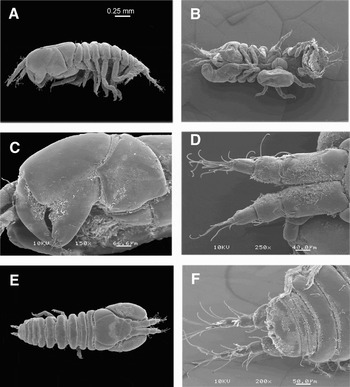
This tanaid species can be recognized by a unique combination of characters, including: (i) the presence of a protuberance on the coxa of the pereopod 1; (ii) the pereonites 1–3 combined are not longer than broad; (iii) the pleon comprises five pleonites (tergites) visible dorsally, plus the pleotelson; (iv) the terminal lobe of the outer lobe of labium is not well separated; and (v) the terminal uropodal segment is not reduced. Particularly, the chelae of the male are greatly enlarged; therefore, the cephalothorax of males in cross-section is nearly triangular (see Figure 2). Occurrence of H. robusta includes the Mediterranean, the Atlantic coasts of Africa, North and South America, Pacific Ocean, Galapagos Islands, and a world-wide occurrence was stated as possible (Sieg, Reference Sieg, Gruner and Holthuis1983). The terminal male represents one of the largest members of the family Tanaidae.
Morphology of Hexapleomera robusta from the skin of Trichechus manatus in the Caribbean coasts of Mexico. (A) Primary male, lateral view; (B) mature female I showing marsupium, ventral view; (C) male chela, lateral view; (D) antennules of neutrum I; (E) habitus of male, dorsal view; and (F) detail of the pleon and the 4-segmented uropods of a mature female, dorsal view.

Manatee infestation with Hexapleomera
Of 47 manatees examined, 8 (17%, 3 males, 5 females) were infested by Hexapleomera robusta. A comparative analysis of the localities in which this association was recorded, showed interesting differences between the two bay systems surveyed, Chetumal Bay (CHB) and Ascensión Bay (AB). In the latter, out of 14 manatees captured, 6 (43%) had tanaids vs only 2 (6%) out of 33 in CHB. Infestation between the two systems was significantly different (χ2 test, 7.0, P < 0.01). The incidence of tanaids was low and not significant in CHB manatees (χ2 test, 11.87, ρ = 1, P < 0.005) vs higher and significant in AB (χ2 test, 0.07, ρ = 1, P < 0.25). CHB manatees included one female and one male vs two males and four females in AB, but sex-related differences were not statistically significant.
Hexapleomera as an ectosymbiont
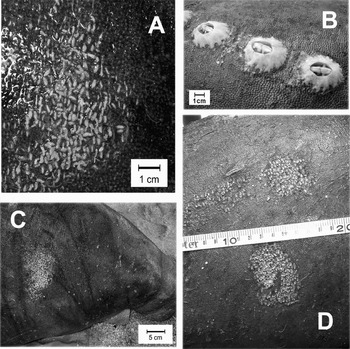
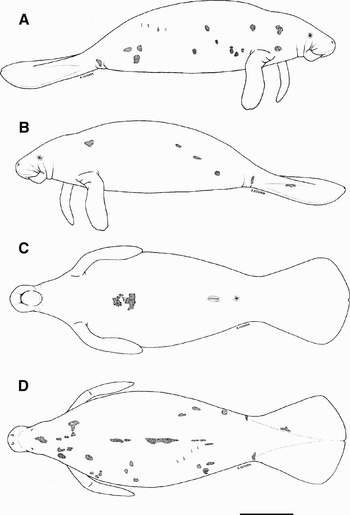
It is not possible to observe the tube patches of Hexapleomera robusta while the manatee is in the water, they become visible only when the manatee skin starts to dry out, during the tagging process. The patches of tanaids were of different sizes and densities, most between 2–3 cm, but many with a diameter of up to 10 cm (Figure 3D); they were formed by clusters of many tubes formed by a yellowish, compact secretion firmly adhered to the skin surface (Figure 3A&C). In some cases, clusters of H. robusta were related to groups of barnacles (Figure 3B) and algae patches. All tanaid patches were related to body areas of the manatee with relatively low friction and also to body depressions. The main areas are: (a) along dorsal surface on medial and posterior body, on the backbone depression, including also the caudal fin; (b) lateral surface of body, on the crevices and skin ridges between the head and the body, along the lateral surface of body from the middle part of the body starting at the tappered section to the caudal part, where they were particularly frequent; and (c) ventral surface, mainly around the skin ridges, the navel hollow, and around the umbilical area. Clusters of H. robusta were not observed around the anus or the genitalia (Figure 4). Besides a slight decoloration of the skin, there was no other visible effect of the presence of clusters of H. robusta on the manatee.
In situ observations of tubes and patches of Hexapleomera robusta from the manatee Trichechus manatus in the Mexican Caribbean. (A) Detail of a cluster of H. robusta on the skin surface of a manatee from Ascensión Bay (AB); (B) row of barnacles with adjacent tubes of H. robusta; (C) patch of tubes of H. robusta settled close to the neck area of a manatee from AB; and (D) patches of tanaid tubes with distinct densities.

Summarized distribution of patches of Hexpleomera robusta on the skin surface of the manatee in the Mexican Caribbean. (A) Tanaid patches on skin surface of right lateral margin of body; (B) same, left lateral margin; (C) same, ventral surface; and (D) dorsal surface. Some patches in A also shown in D. Scale bar = 0.5 m.

DISCUSSION
The finding of a tanaidacean associated to a mammal species has not been hitherto recorded in the literature. There is, however, an unpublished record of another tanaid species, Sinelobus stanfordi (Richardson, 1905) found on a manatee in Belize; it was accounted for as an amphipod (see Bonde et al., Reference Bonde, Lewis, Samuelson, Self-Sullivan, Auil and Powell2005). This record may refer to H. robusta; however, if the specimens came from fresh or near freshwater conditions, the possibility of S. stanfordi as the epibiont should not be ruled out. Superficially, S. standfordi, which belongs to the same family, resembles H. robusta; however, the latter has a pleon with four distinct pleonites visible dorsally (S. stanfordi has three). The outer lobe of the labium has no terminal lobe, a character which is present in H. robusta. The fourth article of the antenna does not have a circle of setae, but a few distal setae only; most importantly, the male chela of S. stanfordi is noticeably smaller and has a distinctly different dentition (see Sieg, Reference Sieg1980; García-Madrigal et al., 2005).
Other widely distributed tanaids such as S. stanfordi are found in different types of environments (Gardiner, Reference Gardiner1975); this is true also for H. robusta, known from coastal, estuarine, and transitional habitats, all these related to the sites preferred by the Caribbean manatee. The manatees were captured from two shallow bay systems with different salinity averages and ranges (average: 11‰ (2–26‰) in CHB vs 31‰ (17–37‰) in AB) (Gasca et al., Reference Gasca, Suárez-Morales and Vásquez-Yeomans1994). The infestation rate of the tanaid was significantly higher in AB. Hitherto, H. robusta has not been recorded from AB or CHB (García-Madrigal et al., Reference García-Madrigal, Heard and Suárez-Morales2004); hence, it is not possible to define if the different infestation rates between both bays are a result of local variations of density. Because of its wide environmental range, we presume that this tanaid occurs in both coastal systems and that the higher infestation rate of H. robusta in AB could be related to the contrasting environmental conditions of these bays. Apparently, the higher salinity and its relatively weaker gradient in AB favoured the infestation, and the lower incidence of H. robusta in CHB could be related to a lower salinity and a sharper local gradient. When manatees from high-salinity coastal environments outside CHB arrive to this system, they are usually infested with barnacles which tend to fall off after some time dwelling in CHB (Morales-Vela, personal observation). The same effect of gradual loss of barnacles has been reported in the Florida manatees when they migrate to low-salinity environments (Hartman, Reference Hartman1979). It is suggested that Hexapleomera could be affected in a similar way by low salinity and a strong saline gradient.
Another important difference beween these two embayments is the local sediment type and the hydrodynamism; in AB the littoral zones in which manatees were captured had a consistent condition of high tidal energy, increased turbidity and suspended sediment (Gasca et al., Reference Gasca, Suárez-Morales and Vásquez-Yeomans1994; Morales-Vela, personal observation). According to the results of Kitsos & Koukoras (Reference Kitsos and Koukoras2003) from a coastal system with a strong tidal gradient, conditions of physical disturbance and a high tidal energy favour the occurrence and abundance of benthic suspension feeders such as H. robusta. A survey to evaluate the abundance and distribution of this and other tanaidaceans in AB and CHB should be developed in order to evaluate the infestation process in more detail.
Most tanaidaceans utilize different feeding mechanisms that involve manipulation of food by the mouthparts and the pereopods; some are raptorial forms and others are suspension feeders. The morphology and reductions of the mouthparts of H. robusta suggest that it is a detritivorous form that remains in the tube with a protruding part of their anterior body prepared to capture the suspended particles. During its food selection and feeding activity, the manatee usually creates a clowd of detritus and sediments around its body; hence, this process would become a food source for its epibionts, barnacles and tanaids.
The barnacle epibionts hitherto recorded from the manatee include Chelonibia manati, a taxonomic complex with many subspecies (Pilsbry, Reference Pilsbry1916), and species of Platylepas and Balanus (Ross & Newman, Reference Ross and Newman1967; Cintrón-de Jesús et al., Reference Cintrón-de Jesús, Williams, Mignucci-Gianonni, Coyne and Clark2005). Some patches of Hexapleomera robusta were associated to crevices related to the clusters of barnacles in three of the manatees examined (Figure 4B); apparently, the barnacle clusters represent both a refuge and a suitable substratum for the tanaids. This microenvironment has also adaptive and reproductive implications for the barnacles associated with sea turtles (see Zardus & Hadfield, Reference Zardus and Hadfield2004).
Originally, Hexapleomera robusta was collected as an ectosymbiont of sea turtles (Moore, Reference Moore1894), living between the carapace scales (Gramentz, Reference Gramentz1988; Frick et al., Reference Frick, Williams and Robinson1998; Miltiadis-Spyridon et al., Reference Miltiadis-Spyridon, Christodoulou, Arvanitidis, Mavidis, Kirmitzoglou and Koukouras2005); there is no evidence that they damage or feed upon the turtle skin. As far as we could observe, the tanaid clusters were all settled on healthy skin areas; there is no evidence to support that the presence of H. robusta causes skin damage to the manatee or that it behaves as a scavenger feeding on sloughed skin. The tanaid is probably a commensal epibiont that obtains both a substrate to settle a colony and a consistent access to suspended particles produced when the manatee feeds.
Other crustacean ectosymbionts appear to have different association strategies. Barnacles have been considered as parasites rather than commensals in some turtle species (Seigel, Reference Seig1983) as they can cause severe erosion of the carapace and some interference with movement, nesting, or mating. Lazo-Wasem et al. (Reference Lazo-Wasem, Pinou, Peña De Niz, Salgado and Schenker2007) inferred that the presence and activity of balaenophilid copepods–barnacles causes at least some harm to the turtle skin and could have health consequences in these marine reptiles. No evidence of this kind of interference with reproduction or behaviour has been observed during this survey (i.e. there are no tanaid patches on or near the genital areas).
Other records of non-barnacle crustaceans as possible epibionts of the manatee include the harpacticid copepod Harpacticus pulex Humes, Reference Humes1964, reported by Humes (Reference Humes1964) from specimens collected from a porpoise and on skin lesions of a manatee kept in the Seaquarium, in Florida. Humes (Reference Humes1964) pointed out that the copepod is an opportunistic scavenger and not a true ectosymbiont because: (i) only adults and no copepodites were found; and (ii) it was found in two different species in the same conditions of captivity and only in relation to damaged, sloughed skin.
The other copepod presumably associated to the manatee is a species originally described as Harpactichechus manatorum Ortíz, Lalana & Torres, 1992; it was obtained from the skin of a single manatee from Cuba (Ortíz et al., Reference Ortíz, Lalana and Torres-Fundora1992). Suárez-Morales (Reference Suárez-Morales2007) determined that this species belongs to Balaenophilus Aurivillus, 1879 (Balaenophilidae Sars, 1908); he synonymized B. umimegacolus Ogawa, Matzusaki & Misaki, 1997 to B. manatorum; the former has been reported as a parasite of sea turtles in different geographical areas (Ogawa et al., Reference Ogawa, Matsuzaki and Misaki1997; Badillo et al., Reference Badillo, Puig, Montero, Raga and Aznar2007; Lazo-Wasem et al., Reference Lazo-Wasem, Pinou, Peña De Niz, Salgado and Schenker2007). Apparently, Ortíz et al. (Reference Ortíz, Lalana and Torres-Fundora1992) recorded many specimens (more than 100) of the copepod, but they did not specify if different developmental stages were collected. The exact nature of the association with the manatee remains to be determined. There is evidence suggesting that B. manatorum is a parasite of the sea turtles; the copepod feeds on the tissues of the host (Badillo et al., Reference Badillo, Puig, Montero, Raga and Aznar2007). Ogawa et al. (Reference Ogawa, Matsuzaki and Misaki1997) found all copepodite stages of the copepod on the sea turtle, thus suggesting that this is a well-established parasitic association. Other ectoparasitic copepods on marine mammals (cetaceans only) are Pennella balaenoptera Korea & Danielson 1877 (Boxshall & Hasley, 2004) and Balaenophilus unisetus Aurivillius, 1879.
ACKNOWLEDGEMENTS
We are grateful to Guadalupe Nieto, ECOSUR-Tapachula, for guiding our SEM observations of this tanaid. Iván Castellanos prepared the specimens for this analysis, Rosa Ma. Hernández deposited and catalogued the specimens in the collection of ECOSUR. In situ photographs of tanaids on manatees were provided by Humberto Bahena-Basave, ECOSUR-Chetumal. Rafael Estrada-Anaya prepared the line drawings of the manatee profiles, and, together with Daniel Robelo-Martínez and Gerardo Rodríguez-Martínez captured manatees in the field. Marco Benítez-García from Africam Safari clinically evaluated the manatees captured and obtained samples of tanaids. This research was supported by the projects: SEMARNAT–CONACYT 2002-C01-1128, and by the Dolphin Discovery Group. Sampling permits supporting our collections were provided by the Dirección General de Vida Silvestre: NUM.SGPA/DGVS/03144 (21 April 2004–30 April 2005); NUM. SGPA/DGVS/04513 (6 May 2005–10 May 2006); NUM.SGPA/DGVS/03670/06 (9 June 2006–30 June 2007).