

Loneliness is now considered to be one of the main epidemiological challenges facing many nations around the world (Lim, Eres, & Vasan, Reference Lim, Eres and Vasan2020). For example, a recent report found one in four Australians report high levels of loneliness (Ending Loneliness Together, 2020). Loneliness poses a significant threat to public health because of its pervasive negative impact on the health and well-being of individuals and communities (Alberti, Reference Alberti2019; Holt-Lunstad, Smith, & Layton, Reference Holt-Lunstad, Smith and Layton2010). Research has begun studying the risk factors of loneliness, as well as trying to determine the causal mechanisms explaining why these factors engender greater risk. One risk factor found to leave people particularly vulnerable to loneliness is major life transitions, such as starting university (e.g. Cruwys, Ng, Haslam, & Haslam, Reference Cruwys, Ng, Haslam and Haslam2021; Praharso, Tear, & Cruwys, Reference Praharso, Tear and Cruwys2017), retiring (Haslam et al., Reference Haslam, Steffens, Branscombe, Haslam, Cruwys, Lam and Yang2019), or becoming a parent (Seymour-Smith, Cruwys, & Haslam, Reference Seymour-Smith, Cruwys and Haslam2021). In particular, highly isolating life transitions may lead to greater loneliness.
Social isolation is characterised by an objective lack of social contacts and having few regular social interactions (Mann et al., Reference Mann, Bone, Lloyd-Evans, Frerichs, Pinfold, Ma and Johnson2017). Social isolation and loneliness are highly related, with social isolation being one of the key risk factors for loneliness. However, they are also separate concepts, because it is possible for someone to be objectively socially isolated without feeling lonely and vice versa. Isolation has been a growing concern in the last decade, due to social changes including more people living alone, the prominence of online interactions, and increases in mental health issues closely linked to social isolation (e.g. depression; Glover, Reference Glover2018). The impact of isolation, particularly physical isolation from other people, on our mental and physical health has drawn even greater attention in the last few years. This is in large part due to the COVID-19 pandemic, which has at various times required people to be isolated from their friends and family, either due to formal restrictions or informal choices to reduce risk to oneself and loved ones (Matias et al., Reference Matias, Dominski and Marks2020).
A degree of social isolation (lasting or transient) is a feature of most major life transitions because they typically involve transitioning away from one or more groups — and respective identities — and the potential gain of new one(s). This is explicated in the Social Identity Model of Identity Change (SIMIC; Jetten, Haslam, Iyer, & Haslam, Reference Jetten, Haslam, Iyer, Haslam, Sturmer and Snyder2009), which posits that the impact of life transitions on stress and wellbeing can be explained by the impact that such events have on one's social identities — that is, our subjective sense of affiliation to social groups (as a New Yorker, a nurse, or as part of a valued friendship group). In the present research, we propose that isolating life transitions are particularly harmful in terms of loneliness because they cut off people from previous groups/identities and prevent the creation of new connections. Although most life transitions entail some degree of isolation, not all entail the same degree of loss of existing networks, and similarly, not all life transitions allow for the same degree of opportunity to engage with new groups and potential identities. For example, a university student who must move several hours away from their hometown will experience a significantly more isolating transition than a student who stays in their hometown to study. Moreover, a student commencing studies remotely is significantly more isolated from their new peers than a student studying on campus. Thus, in terms of being a risk factor for loneliness, it is likely that isolating life transitions are inherently riskier.
As outlined in SIMIC, when life transitions lead to the loss of meaningful social identities, this increases the risk of poor mental health, including clinical depressive disorders and psychological distress (Praharso et al., Reference Praharso, Tear and Cruwys2017). By contrast, the continuity of existing group memberships during these difficult transitions can provide a sense of identity continuity (Haslam, Haslam, Jetten, Cruwys, & Steffens, Reference Haslam, Haslam, Jetten, Cruwys and Steffens2021), protecting one's mental health. Additionally, nurturing new meaningful group memberships, and embodying new social identities related to the transitional change can fill gaps left by the loss of previous identities; providing the psychological resources needed to cope with the stressors of these transitions (Haslam et al., Reference Haslam, Steffens, Branscombe, Haslam, Cruwys, Lam and Yang2019). Thus, identity continuity and the formation of new social identities can both lower the risks to health and wellbeing. We propose that isolating life transitions play a key role in these pathways.
The present research explores different forms of isolations during life transitions and their effects on loneliness. We examine whether isolating transitions are related to loneliness due to their impact on social identification processes, consistent with the Social Identity Model of Identity Change. The current research advances our understanding by proposing that isolation will act as a barrier to the continuity of old identities and the adoption of new ones. When individuals are unable to connect with their old networks or remain sequestered from new ones, they cannot draw upon the protective resources that come from these group memberships — and their respective identities. Specifically, we propose that individuals in highly isolating life transitions (a) have less continuity of group memberships, (b) are less likely to form new group memberships, and (c) are less likely to internalise and identify with the new social groups associated with the novel life context in which they find themselves.
Across two experiments and a longitudinal panel study, we first expected to find that degree of social isolationFootnote 1 positively predicted the degree of loneliness experienced (H1). Further, we expected this effect to be mediated through social identification pathways (H2). Specifically, we expected to find that higher isolation would lead to greater loneliness because of less continuity of group memberships (H2a), formation of fewer new group memberships (H2b), and lower social identification with the new social group specific to the life transition context (H2c).
Study 1
Study 1 tested the proposition that transitions in which individuals are physically isolated from their new group memberships are more disruptive for identity formation processes and lead to more loneliness. This study used the transitional context of commencing studies at university, and the isolating nature of studying online compared to studying in person. Compared to on-campus students, students who attend university exclusively online are isolated from their peers and are unable to physically enact the student identity. Consequently, starting university represents a significant life transition, but this transition is more isolating for online students, particularly when this learning involves no live contact with other people (i.e. asynchronous online learning). Additionally, the significant time demands of university study make it difficult to maintain group memberships outside of the university bubble (Ali & Smith, Reference Ali and Smith2015; Finn, Reference Finn2018).
In the present study, participants (undergraduate students) were told to envision attending a university with varying levels of isolation. We expected to find that participants assigned to the most isolated condition (i.e. online, asynchronous) would report the highest levels of loneliness (H1), and this would be mediated by their lower continuity of existing group memberships (H2a), a lack of newly formed group memberships (H2b), and inability to fully adopt the new social identity of being a university student (H2c).
Method
Participants
A sample of 210 participants was recruited through an Australian undergraduate psychology participant pool and received course credit. Of these participants, 60.7% (n = 130) identified as female and 36% (n = 77) identified as male. One participant identified as non-binary and two participants declined to provide their gender. Participants ranged in age from 18 to 33 years with a mean of 20.50 years (SD = 2.53). There was minimal missing data within this sample (<2% missing data for all individual items) and thus any missing data were deleted listwise for analyses. The sample size was based on a power analysis that determined we needed at least 200 participants to detect a small effect of d = .4 with 80% power.
Data for Study 1 were collected in Semester 1 of 2021 in Australia. The university where data were collected was engaging in a hybrid model of learning at this time, with classes taking place both online and in-person. At this point in time, Australia had a relatively low level of COVID transmission and no state or territory was under lockdown conditions at the time and had not been for several months.
Procedure
The immersive Bimboola paradigm (Fong, Cruwys, Haslam, & Haslam, Reference Fong, Cruwys, Haslam and Haslam2019; Jetten, Mols, & Postmes, Reference Jetten, Mols and Postmes2015) was adapted for this study to make the life transition scenario as engaging and ‘real’ for participants as possible. Participants were told to imagine they were starting a degree at “The University of Bimboola” and then were randomly assigned to one of three conditions: (1) the low isolation condition, where all lectures, classes, and socialising were in person, (2) the moderate isolation condition, where all lectures, classes, and socialising were online and synchronous (i.e. lecture and lab classes run with video conferencing, and online infrastructure for connecting remotely with staff and students), and (3) the high isolation condition, where all lectures, classes, and socialising were online and asynchronous (i.e. lecture and lab classes pre-recorded and interactions with students and staff take place over email and forums). Like the original Bimboola paradigm, all three conditions were accompanied by images to enrich the scenarios. Stimuli from this vignette can be found in the supplementary material.
Measures
For all questions, participants were prompted with the following text: “The following statements describe experiences you may have been through before and after starting at the University of Bimboola.” For all scales, responses were on a 7-point scale from strongly disagree (1) to strongly agree (7).
Loneliness was measured using the UCLA-20 (Russell, Peplau, & Cutrona, Reference Russell, Peplau and Cutrona1980; e.g. “I did not feel alone”), α = .94. Continuity of pre-transition group memberships was measured using the corresponding four-item subscale from the Exeter Identity Transition Scales (Haslam et al., Reference Haslam, Holme, Haslam, Iyer, Jetten and Williams2008; e.g. “I continue to have strong ties to the same groups”), α = .84. New group memberships were measured using the corresponding four-item subscale from the Exeter Identity Transition Scales (Haslam et al., Reference Haslam, Holme, Haslam, Iyer, Jetten and Williams2008; e.g. “I have joined one or more new groups”), α = .87. Social identification with the University of Bimboola was measured using the Four-Item Social Identification scale (Postmes, Haslam, & Jans, Reference Postmes, Haslam and Jans2013; e.g. “I identify with other University of Bimboola students”), α = .94.
Results
H1: Isolating Transitions Cause Loneliness
For Study 1, H1 was tested using a one-way ANOVA. Consistent with H1, the omnibus analysis was significant, F(2, 206) = 7.05, p = .001. Tukey's HSD Test for multiple comparisons found the mean value of loneliness was significantly different between the in-person condition (M = 3.26, SD = 0.86) and both the synchronous (M = 3.79, SD = 1.13; p = .005) and asynchronous conditions (M = 3.82, SD = 0.94; p = .003). There was no statistically significant difference in loneliness scores between the synchronous and asynchronous conditions (p = .987).
H2: Social Identification Processes Explain the Link Between Isolating Transitions and Loneliness
Hayes (Reference Hayes2018) PROCESS analysis, Model 4, was used to test for the indirect effects of continuity of group memberships (H2a), new group memberships (H2b), and social identification (H2c), with a bias-corrected bootstrapping method set to a confidence interval of .95 and a resampling size of 5000. The different levels of isolation were coded as an ordinal categorical variable with the in-person condition representing the least isolating and online asynchronous condition representing the most isolating.
H2a. The direct effect of isolation condition on loneliness was significant, b = .22, SE = .08, p = .007, 95% CI [.06, .38], the total effect was significant, b = .28, SE = .08, p = .001, 95% CI [.12, .45], and the indirect effect of membership continuity was significant, b = .06, SE = .03, 95% CI [.01, .12]. The completely standardised indirect effect of group membership continuity was .05, indicating a small-medium effect of continuity (Kenny, Reference Kenny2014). Thus, consistent with H2a, there was a significant indirect effect of group membership continuity in the relationship between isolation level during life transition and loneliness.
H2b. The direct effect of isolation condition on loneliness was significant, b = .16, SE = .07, p = .025, 95% CI [.02, .31], the total effect was significant, b = .28, SE = .08, p = .001, 95% CI [.12, .45], and the indirect effect of new group memberships was significant, b = .12, SE = .05, 95% CI [.03, .22]. The completely standardised indirect effect of new group memberships was .09, indicating a medium effect of new groups (Kenny, Reference Kenny2014). In line with H2b, new group memberships significantly mediated the relationship between isolation level during life transition and loneliness.
H2c. The direct effect of isolation condition on loneliness was not significant, b = .12, SE = .07, p = .076, 95% CI [−.01, .25], the total effect was significant, b = .28, SE = .08, p = .001, 95% CI [.12, .45], and the indirect effect of social identification was significant, b = .16, SE = .05, 95% CI [.07, .27]. The completely standardised indirect effect of new social identification was .13, indicating a medium-large effect of identification as a university student (Kenny, Reference Kenny2014). Thus, consistent with H2c, there was a significant indirect effect of identification as a university student in the relationship between isolation level during a life transition and loneliness.
Sensitivity Analyses
The above analyses were also conducted in parallel, with all mediators included at once. In this parallel analysis, H2a was no longer supported. Further analyses revealed it was the inclusion of social identification as a university student in the model that nullified the significant effect of group membership continuity. Full details of these analyses can be found in the supplementary materials.
The above analyses were re-run under the following conditions (1) excluding univariate outliers, (2) covariates (age, gender, ethnic minority/majority, and socio-economic status), and (3) excluding participants who failed more than one attention check. The pattern of significant results did not change.
Discussion
Study 1 provided evidence in support of our hypotheses. In particular, the results indicate that life transitions that leave a person isolated from opportunities to engage in their new social context increased feelings of loneliness (H1), this effect was mediated through three social identification processes: reduced continuity of group memberships (H2a), fewer new groups (H2b), and, especially, reduced social identification with their new community (H2c). Interestingly, we did not find a difference between the synchronous and asynchronous conditions — participants anticipated that both online study contexts would make them feel equally lonely. Given the unprecedented closing of campuses and mass switch to online learning across the globe during different stages of the pandemic, future research should take the opportunity to investigate these processes using the real-life experiences of students (e.g. autobiographical recall about the move to online learning during COVID).
Although the present study manipulated participants’ level of isolation, it focused specifically on isolation from new groups. As discussed, life transitions quite often involve individuals becoming unmoored from their existing group memberships.
Study 2
Study 2 tested whether transitions in which individuals are isolated from their pre-transition group memberships disrupt identity formation processes and lead to more loneliness. This study used the common life transition of moving house to explore these interactions. People tend to develop place-based attachments to their communities (Fong et al., Reference Fong, Cruwys, Haslam and Haslam2019) that become disrupted when they move. At the same time, relocation involves the opportunity to adopt a new place-based identity and form new associated connections. The level of isolation experienced during a relocation is highly variable, however. For example, moving within the same neighbourhood is a very different experience to moving interstate. In the present study, we manipulated the level of physical isolation/distance from place of origin during a fictitious relocation.
In comparison to Study 1, participants in each scenario had the same opportunities for connecting in their new social context and enacting relevant new identities. The key difference between conditions in this study was the degree of isolation from pre-transition group memberships and associated identities. As in Study 1, we expected to find that participants in the more isolated condition (i.e. moving interstate compared to within the same suburb) would report higher levels of loneliness (H1), and this would be mediated via the various identity pathways (H2a to H2c).
Method
Participants
Two-hundred and ten participants were recruited through the same method and at the same period of time as in Study 1. Of these, 64.7% (n = 139) identified as female and 30.7% (n = 66) identified as male. Five participants declined to provide their gender. Participants ranged in age from 18 to 33 years, with the mean age of 20.60 years (SD = 2.58). There was minimal missing data within this sample (<1.5% missing data across all individual items). The same missing data procedure and power calculation as used in Study 1 were applied for Study 2.
Procedure
Study 2 used a vignette experimental design to manipulate the level of isolation of participants during an imaginary life transition. A modified version of the Bimboola paradigm was used (Fong et al., Reference Fong, Cruwys, Haslam and Haslam2019; Jetten et al., Reference Jetten, Mols and Postmes2015), in which participants were told to imagine they were moving to a new neighbourhood in the fictitious society of Bimboola. Participants were then randomly assigned to two conditions: the less isolating condition, in which they were already a resident of Bimboola, moving to a close-by neighbourhood, or the highly isolating condition, where they were moving to Bimboola from interstate. This paradigm was designed to be as valence-free as possible, with both scenarios being identical except for the distance/geography of the move, to allow participants to infuse the scenario with their own imaginings about the move. To make the scenario more immersive, participants of all experimental conditions were presented with a series of choices relating to the house they would live in, car they would drive, and holidays they would take as a new resident of Bimboola. These choices were accompanied by the same stimulus images as used in the original Bimboola paradigm. Stimuli from this vignette can be found in the supplementary material.
Measures
The same measures of loneliness, group membership continuity, new group memberships, and social identity from Study 1 were used in Study 2. All questions included this text prompt: “The following statements refer to feelings of loneliness and social connection that you may have experienced while settling in to your new neighbourhood.” The social identity items reflected the target group membership for this study, e.g. “I identify with other Bimboola residents”. All scales had acceptable internal reliability (αlonliness = .93; αgroup membership continuity = .88; αnew groups = .88; αsocial identification = .91).
Results
H1: Isolating Transitions Cause Loneliness
As expected, participants who were in the more isolated condition (i.e. moving interstate) reported greater loneliness (M = 3.77, SD = 0.95) than participants who were in the less isolated condition (i.e. moving one suburb over; M = 3.54, SD = 0.91; however, this difference was not significant, t(207) = 1.74, p = .084. Thus, H1 was not supported.
H2: Social Identification Processes Explain the Link Between Isolating Transitions and Loneliness
The same approach to mediation analyses used in Study 1 was applied again in Study 2. Level of isolation was coded as a dichotomous variable.
H2a. The direct effect of the isolation condition on loneliness was not significant, b = .01, SE = .12, p = .978, 95% CI [−.24, .24], the total effect was not significant, b = .22, SE = .03, p = .084, 95% CI [−.03, .48], and the indirect effect was significant, b = .22, SE = .07, 95% CI [.10, .37]. The completely standardised indirect effect of group membership continuity was .24, indicating a medium effect of group membership continuity (Kenny, Reference Kenny2014). Thus, consistent with H2a, group membership continuity mediated the relationship between isolating life transitions and loneliness.
H2b. The direct effect of the isolation condition on loneliness was not significant, b = .20, SE = .12, p = .073, 95% CI [−.02, .41] and the total effect was marginal, b = .22, SE = .13, p = .084, 95% CI [−.03, .48]. However, inconsistent with H2b, there was no significant indirect effect of new group memberships in the relationship between isolation level during life transition and loneliness, b = .03, SE = .07, 95% CI [−.11, .17].
H2c. The direct effect of the isolation condition on loneliness was not significant b = −.09, SE = .11, p = .417, 95% CI [−.31, .13], the total effect was not significant, b = .22, SE = .13, p = .084, 95% CI [−.03, .48], and the indirect effect of social identification with one's new neighbourhood was significant b = .31, SE = .09, 95% CI [.16, .50]. The completely standardised indirect effect of social identification was .34, indicating a medium-large effect of social identification (Kenny, Reference Kenny2014). Thus, consistent with H2c, social identification with the new social group mediated the relationship between isolating life transitions and loneliness.
Sensitivity Analyses
As in Study 1, the above mediation analyses were also conducted in parallel and the results did not change. The same sensitivity analyses described in Study 1 were also conducted for Study 2, and the pattern of significant results did not change.
Discussion
Overall, Study 2 provided some evidence in support of the hypotheses. Although the effect was in the expected direction, the relationship between isolation and loneliness was not significant, thus H1 was not supported. Given this was the first time this variation of the Bimboola paradigm has been used, we suspect the manipulation may not have been strong enough. Further tweaking of the interstate versus inter-suburb manipulation may yield stronger results. It should also be acknowledged that moving is rarely a valence-free transition, with factors like the alignment of the new neighbourhood with one's identity, experiences of previous moves and whether the move was forced or chosen having an impact on the difficulty associated with the move. Future iterations of this paradigm may need to take further steps to ensure all individuals are imagining and experiencing similar conditions associated with the Bimboola move. Nevertheless, the mediation analyses provided tentative support for the hypothesised mechanisms. Specifically, results indicated that life transitions that leave a person isolated from their old groups, in this case, by moving interstate compared to within the same suburb, were related to higher levels of loneliness partly because they undermined the formation of a social identification with the new neighbourhood and continuity of old group memberships. Interestingly, the formation of new group memberships did not play a mediating role in this context.
Studies 1 and 2 provided some evidence in support of our core hypotheses, and their experimental design provided confidence that the effect of isolating transitions was causal. However, a weakness of their design was their limited ecological validity, because participants are only imagining the life transition and associated loneliness.
Study 3
While Studies 1 and 2 provide experimental evidence of the processes being investigated, Study 3Footnote 2 explores the impact of being totally physically isolated, from groups both old and new, on loneliness through our key social identification pathways using a more grounded quasi-experimental longitudinal design. Specifically, we examined the experience of participants living in the state of Victoria, Australia, which experienced one of the longest and strictest COVID-19 lockdowns worldwide in 2020 (with 111 continuous days of lockdown from July to October in the city of Melbourne). Victorian residents had to transition from living a life of relative freedom to being restrained to staying in their own home. This lockdown emulates the isolation and changes that take place during many other more typical life transitions (e.g. becoming unemployed, moving to a new area, sustaining an injury or illness) as individuals are physically cut from old and new groups, and thus we expect the findings to generalise to other life transitions with similar degrees of isolation and upheaval. Moreover, during this same time period, the rest of Australia was not subject to lockdown, and in fact, had very few COVID-19 restrictions given the very low level of COVID-19 in the community. The unprecedented public health event in Victoria provided the opportunity to evaluate the effect of a sudden and extraordinarily high level of enforced isolation, against a ‘control group’ of people from the same country experiencing a similar stressful life event (a global pandemic) in the absence of enforced isolation.
In the current study, we make use of longitudinal data collected immediately before the Victorian lockdown (Wave 1), and again shortly before lockdown restrictions were lifted (Wave 2; see Figure SS1 for mobility graphs of Victoria and Australia during this period). We expected participants residing in Victoria — that is, those who experienced the highly isolating event of lockdown — would experience an increase in loneliness at Wave 2 relative to residents of other regions (H1) and this would be mediated via decreased continuity of existing group memberships (H2a), decreased new group memberships (H2b), and by decreased social identification with their neighbourhoods and states (H2c). Importantly, we controlled for these measures at Wave 1 (i.e. before lockdown) which enabled us to assess potential changes in loneliness and group identity and memberships from Wave 1 to Wave 2.
Method
Participants and Procedure
These data are part of a larger data collection in which 3030 Australian adults were sampled, with data collected in May, in June/July, and in September/October 2020. Since the goal is to study the effects of lockdown, participants who provided answers immediately before (between 16 June and 6 July; Wave 1) and/or during lockdown (16 September–9 October, 2020; Wave 2) were kept in these analyses (N = 2346; n Victoria = 542; n rest of Australia = 1804). In total, 59.1% responded in Waves 1 and 2; 26.9% responded only to Wave 1; 13.9% responded only to Wave 2. Roughly a quarter of the sample lived in the Victoria (23.1%), similar to the population distribution (25%).
Participants were recruited using the Qualtrics Service, which employs several double-opt-in market-research panels and blends them to reach individuals across the country, while also minimising panel bias. Qualtrics Service contacted participants using their email or participation portal and those interested in participating in the research had access to the survey.
The mean age of participants was 50.02 (SD = 16.95), ranging from 18 to 87, with participants in Victoria being slightly yet significantly younger (M = 48.09, SD = 16.92) than participants in the rest of Australia (M = 50.60, SD = 16.92; t(2344) = 3.03. p = .002). A total of 52.6% of participants reported their sex as female (47.4% male), with a similar proportion of gender distribution in Victoria as in the rest of Australia (χ2(1) = 0.39, p = .535). Weekly individual income (which was included as a covariate) ranged from negative income to 3000 AUD or more, with the largest income category being $500–$649 (11.6% of the sample). The income distribution was similar across participants in Victoria and in the rest of Australia (χ2(14) = 21.22, p = .096).
Measures
A dummy code was created to assess the impact of the Victorian lockdown on loneliness (0 = participants not in Victoria; 1 = participants in Victoria).
Loneliness was measured using the three-item Loneliness Scale (Hughes, Waite, Hawkley, & Cacioppo, Reference Hughes, Waite, Hawkley and Cacioppo2004). It includes items such as “How often do you feel that you lack companionship?”, measured on a scale from never (1) to often (4). Together, these items had acceptable internal consistency in Waves 1 and 2 (α = .92 at both waves)Footnote 3.
Continuity of group memberships and new group memberships were measured in the same manner as Studies 1 and 2. Items in this study asked about participants’ group memberships “Since COVID-19 … ” and participants answered using a Likert-Scale ranging from strongly disagree (1) to strongly agree (7). The alpha was acceptable for group membership continuity at Wave 1 (α = .85) and at Wave 2 (α = .80), and for new group memberships (Wave 1 α = .96; Wave 2 α = .92). The items for loneliness, continuity of group membership, and new group membership can be found in Supplementary Table 1. Participant's identification with their neighbourhood and state was assessed using the validated Single Item Social Identification Scale (Postmes et al., Reference Postmes, Haslam and Jans2013). Participants responded to the question “I identify as a member of my [neighbourhood/state]”on a scale from strongly disagree (1) to strongly agree (7).
Analysis plan
Structural equation modelling (SEM) was employed to test whether participants in Victoria experienced greater loneliness in Wave 2 (H1), and if this is mediated by their hindered ability to maintain existing group memberships (H2a), form new ones (H2b), and identify with their neighbourhood and state (H2c) in Wave 2. We also controlled for these variables at Wave 1, which enabled us to assess potential changes in group identity processes and loneliness. In line with recommendations (e.g. Hu & Bentler, Reference Hu and Bentler1999; MacCallum, Browne, & Sugawara, Reference MacCallum, Browne and Sugawara1996), the CFA and SEM models were judged as acceptable if the Comparative Fit Index (CFI) was >.90, the Standardised Root Mean Square Residual (SRMR) was <.05 (or <.08 for marginal fit), and the Root Mean Squared Error of Approximation (RMSEA) was <.08 (or <.10 for marginal fit). The χ 2 value tends to remain significant even for models with a very good fit in large samples such as ours, and so χ 2 difference was used to compare models such that smaller values were indicative of better fit (Hu & Bentler, Reference Hu and Bentler1999). Age, sex (0 = male; 1 = female), weekly income, and how often in the past two weeks they had interacted with friends, family, or colleagues via the internet (e.g. Zoom, Skype, online platforms; from 0 to 30 times were included as covariates. The items for these control variables can be found in Supplementary Material for Study 3.
Results
To test for potential patterns in missing data, Little's MCAR analysis was conducted. This showed the data were not missing completely at random, χ2(384) = 504.12, p < .001. Given these patterns of missing data, and based on recommendations designed to include the maximum number of respondents and thus maintain the sample's representativeness (Newman, Reference Newman2014), we used maximisation estimation (Full Information Maximum Likelihood) in MPLUS.
H1 and H2: Isolating Transitions Predict Loneliness and Social Identification Processes Explain the Link Between Isolating Transitions and Loneliness
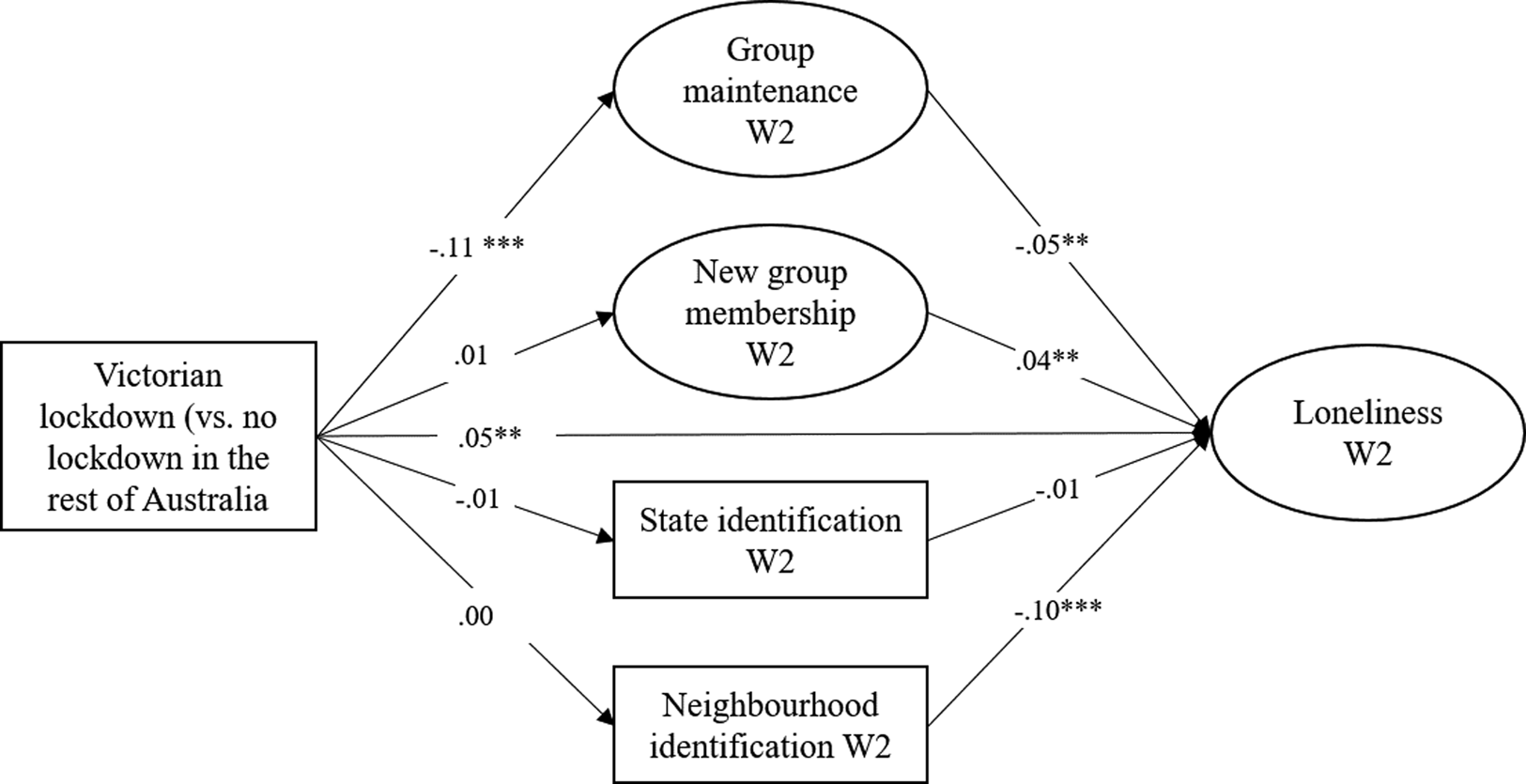
The SEM model tests whether the Victorian lockdown predicts lower loneliness at Wave 2 via group continuity, group creation, and social identification (with both state and neighbourhood), all at Wave 2. All control variables load on loneliness at Wave 2 and on their respective variable at Wave 1 (e.g. group continuity Wave 1 on group continuity Wave 2). The model illustrated in Figure 1 had acceptable fit (χ2 (266) = 2,043.77, p < .001, CFI = .95, RMSEA = .053 (.051 to .056), SRMR = .53; the detailed model can be found in Figure SS1 in supplementary material). Consistent with H1, the Victorian lockdown significantly predicted greater loneliness at Wave 2 (total effect = .12, SE = .01; p = .017, 95% CI [.053, .193]; Consistent with H2a, this effect was mediated by (lack of) continuity of group memberships, such that lockdown reduced individuals’ group continuity, which in turn predicted lower loneliness (standardised indirect effect = .01, 95% CI [.001, 0.016]). None of the other variables mediated the effect of the Victorian lockdown (standardised indirect effect of new group memberships = .00, 95% CI [−.003, .004]; standardised indirect effect of neighbourhood identification = .00, 95% CI [−.004, .004]; standardised indirect effect of state identification = .00, 95% CI [−.001, .002]). In line with previous research (e.g. Fong et al., Reference Fong, Cruwys, Robinson, Haslam, Haslam, Mance and Fisher2021), neighbourhood identification was also associated with reduced loneliness at Wave 2. Contrary to our expectations, however, new group memberships were associated with greater loneliness. Thus, we found support for the mediating role of group continuity, but not new groups or social identification, in mitigating the loneliness associated with COVID-19 lockdown.
SEM model testing whether the Victorian lockdown predicts lower loneliness at Wave 2 via group continuity, group creation and social identification (with both state and neighbourhood), all at Wave 2.

Discussion
Study 3 built upon the previous studies by testing our hypotheses in an ecologically valid context with a large longitudinal sample. Consistent with H1, Australians in Victoria experiencing isolation due to prolonged lockdown experienced increased loneliness compared to Australians in other parts of the country. Consistent with H2a, this was mediated through (lack of) continuity of group memberships. The finding that lockdowns increase loneliness is consistent with emerging research from around the world (Killgore, Cloonan, Taylor, & Dailey, Reference Killgore, Cloonan, Taylor and Dailey2020; Rumas, Shamblaw, Jagtap, & Best, Reference Rumas, Shamblaw, Jagtap and Best2021). However, our research demonstrates for the first time that isolation had this effect, in part, due to social identification processes. Contrary to H2b and H2c, there was no evidence that new group memberships or social identification were directly affected by a highly isolating lockdown. Unexpectedly, new group memberships were positively associated with loneliness. In seeking to understand this unexpected finding, we posit that creating new groups during the Victorian lockdown may have been a compensatory behaviour among those who were struggling the most, with those feeling lonelier also seeking greater new group memberships. Further, the new groups formed in this period may have been mostly related to shared negative experiences (e.g. a support group for people suffering from long COVID symptoms) which may have reinforced negative emotions related to this experience, including loneliness.
General Discussion
The goal of this research was to demonstrate that life transitions are particularly risky for loneliness when they entail isolation and that this occurs primarily through a series of social identification processes: group continuity, new group formation, and social identification. We employed two experimental studies and one naturalistic quasi-experiment, and generally found support for our hypotheses.
Consistent with H1, we found individuals experiencing isolating transitions reported higher levels of loneliness across three studies. While previous research has demonstrated that life transitions are associated with greater loneliness (Haslam et al., Reference Haslam, Haslam, Cruwys, Jetten, Bentley, Fong and Steffens2022), our research demonstrated it is isolation from new groups (Study 1), from existing groups (Study 2), and from all groups (Study 3) that is particularly harmful when experiencing transitions. Future work in this area needs to recognise it is not just upheaval and change driving loneliness, but also level of isolation, in order to develop strategies and address this isolation.
Our research also contributes to a better understanding of how isolating transitions increase loneliness. The results of three studies demonstrated that isolating life transitions disrupted social identification processes — our psychological connection with our groups — which, in turn, decreased loneliness. Across all the three studies, continuity of existing group memberships mediated the effect of life transition on loneliness (confirming H2a). A similar pattern emerged for H2c (in Studies 1 and 2), with social identification with new groups mediating the relationship between isolation and loneliness, though social identification with established groups (identification with the neighbourhood and with the state) did not significantly mediate in Study 3. These results indicate isolating transitions may be responsible for loneliness primarily because these make it difficult to maintain crucial group memberships and form a sense of identification with relevant new groups, though isolating transitions may not necessarily hinder our ability to identify with previously held groups.
Finally, mixed results were found for the mediating role of new group memberships (H2b), with some support in Study 1, no effect in Study 2, and unexpected results in Study 3, in which new group memberships were associated with greater loneliness. The mixed pattern of results we obtained is in line with some extant research evaluating SIMIC, and, specifically, the role of new group memberships. A cross-sectional study among postpartum mothers (Seymour-Smith et al., Reference Seymour-Smith, Cruwys and Haslam2021) and a longitudinal study among international students (Cruwys et al., Reference Cruwys, Ng, Haslam and Haslam2021) both found no evidence for the beneficial effect of new group memberships. In contrast, among retirees, creating new group memberships predicted greater psychological wellbeing (three studies, Haslam et al., Reference Haslam, Lam, Branscombe, Steffens, Haslam, Cruwys and Ball2018; in Chinese retired athletes, Haslam, Lam, et al., Reference Haslam, Lam, Yang, Steffens, Haslam, Cruwys and Fransen2021). One explanation for this may be that new group memberships may be superficial in the beginning and need resources (time, energy, money) to develop into fully supportive connections (Cruwys et al., Reference Cruwys, Haslam, Steffens, Haslam, Fong and Lam2019). As these new groups become established, they may then become effective in protecting against loneliness. This may explain why new group memberships have consistently predicted better outcomes among retirees, as they have more time (and potentially other resources) to invest in their new groups. This is also in line with our current findings that identification with the new groups predicted less loneliness; it is once these new groups become incorporated into our identity that we can reap their benefits. These findings also highlight that it is not merely the existence or quantity of group memberships, but rather the quality of the connections with these groups, that is important for alleviating or protecting against loneliness. This is in line with the principles of SIMIC, which focuses on groups with which we identify (i.e. meaningful groups), rather than just groups people are involved with (Cruwys et al., Reference Cruwys, Ng, Haslam and Haslam2021).
Given the omnipresence of life transitions in individuals’ lives, our research highlights one specific aspect of these transitions that can worsen loneliness (isolation), while also offering possible pathways for assisting people at risk of experiencing loneliness. The results suggest support through transitions may be most effective when it enables people to maintain connections to their existing valued networks, but also that forging strong social identities with groups relevant to the post-transition context may be a solution as well. There exist some structured interventions do this (e.g. Groups 4 Health; Haslam, Cruwys, Haslam, Dingle, & Chang, Reference Haslam, Cruwys, Haslam, Dingle and Chang2016) but less formalised strategies also have a role to play (e.g. Dingle et al., Reference Dingle, Clift, Finn, Gilbert, Groarke, Irons and Williams2019; Fong et al., Reference Fong, Cruwys, Robinson, Haslam, Haslam, Mance and Fisher2021; O'Donell, Cárdenas, Orazani, Evans and Reynolds, Reference O'Donell, Cárdenas, Orazani, Evans and Reynolds2022). This is also an area where “wise interventions” (Walton, Reference Walton2014), designed to address the complex and multifaceted contexts that lead to loneliness, might be effective in producing meaningful improvement in outcomes. Both formal and informal strategies may be of particular importance in the COVID era, as people with complex health issues will continue to self-isolate for the foreseeable future. There is an urgent need to invest in supporting people in these and other highly isolating contexts (e.g. prisons, mental health institutes).
Limitations and Future Research
There are multiple strengths in this research, including the use of multiple rigorous methodologies and diverse contexts (new university, a relocation; COVID-19 lockdown) showing relatively consistent pattern of findings. Nevertheless, there are certain limitations that need to be highlighted. First, we used hypothetical scenarios in Studies 1 and 2. Even though these vignettes were immersive (through images, descriptions, etc.), the relatively small effect sizes found in these studies may be the result of relying on participants’ imagination rather than on their experience of real-life events. Nonetheless, with the impossibility of randomly assigning participants to real-life isolating transitions, vignettes were necessary to conduct experimental evaluations. Moreover, Study 3 provides a robust complement by using a naturalistic quasi-experimental design of a real-world isolating transition. However, Study 3 lacked appropriate equivalent measures of social identification as measured in Studies 1 and 2, that is, a relevant new group to identify with. The lack of support for H2c in Study 3 thus suggests that lockdown did not disrupt identification with previous groups, but we do not know if, in line with Studies 1 and 2, it disrupted identification with new groups. Future research should therefore measure social identification with both previous and new groups in a naturalistic context to better understand the role of new and existing groups during life transitions.
Although the present research provides some initial evidence that social identification processes play some role in loneliness during life transitions, further research is needed to unpack the complex social mechanisms that take place during life transitions and loneliness to better understand this link. For example, emerging research on loneliness suggests loneliness is contextual and is multidimensional, where loneliness can be experienced in one domain of life but not others (van Tilburg, Reference van Tilburg2021). In the present research, we used a generalised approach to loneliness that measured the overall discrepancy between realised and desired connections with others. These nuances related to domain-specific experiences of loneliness and the multiple facets which make up loneliness were beyond the scope of the paper. Nonetheless, social identity principles could be useful in shedding light on these complexities in future work, for example, by exploring the differing impacts of identity across different domains of loneliness. Another consideration for future research is the intersection between social demographic characteristics and life transitions. Marginalised groups (e.g. ethnic minorities, low socio-economic status) generally have a harder time adapting and coping with life change (e.g. Holman & Walker, Reference Holman and Walker2021) due to structural and social barriers. That is, the subjective experience of loneliness is much more likely when one experiences objective social exclusion and lacks resources. Although including ethnicity and socio-economic status as covariates did not alter the findings of the present research, future research should investigate how different stigmatised categories experience loneliness and transition processes. Mixed methods research may be particularly useful in this regard to help disentangle some of the nuance and complexities surrounding life transitions and loneliness (Ballentyne, Drury, Barrett, & Marsden, Reference Ballentyne, Drury, Barrett and Marsden2021; Ng, Haslam, & Haslam, Reference Ng, Haslam and Haslam2018; Seppälä, Riikonen, Paajanen, Stevenson, & Finell, Reference Seppälä, Riikonen, Paajanen, Stevenson and Finell2021).
Conclusions
The significant impact of loneliness on individuals and communities has come to light over the last few years. Our research advances our understanding in demonstrating that isolating life transitions place people at particular risk for loneliness. Our research also highlights potential solutions, specifically through strengthening social identification processes during life transitions. Thus, this research provides exciting insight into novel points of leverage where loneliness may be tackled.
Supplementary material
The supplementary material for this article can be found at https://doi.org/10.1017/bec.2022.15.
Funding
Funding for part of this research was provided by the ANU College of Health and Medicine Crisis Seed Funding Grant, the Australian Social Cohesion: Exploring New Directions Grand Challenge scheme and this project was supported by funding from the National Health and Medical Research Council (#1173270).
Declaration of interest
The authors have no conflicts of interest to declare. The authors assert that all procedures contributing to this work comply with the ethical standards of the relevant national and institutional committees on human experimentation and with the Helsinki Declaration of 1975, as revised in 2008.