Introduction
OxG hybrids result from the cross between the American palm (Elaeis oleifera) and the African palm (Elaeis guineensis). These interspecific hybrids are a valued alternative to produce oil due to their characteristics: resistance to pest and diseases, acceptable bunch production, oil extraction performance in beneficiation plants (Zambrano, Reference Zambrano2004), high-quality unsaturated oil (oleic 55% – linoleic 11%), and significant contents of vitamin E (Mondragon and Pinilla, Reference Mondragón and Pinilla2015; Mozzon et al., Reference Mozzon, Pacetti, Lucci, Balzano and Giuseppe Frega2013) along with carotenes (Choo and Nesaretnam, Reference Choo and Nesaretnam2014; Rivera et al., Reference Rivera, Cayón and López2013).
OxG hybrids present some peculiarities that affect their natural pollination, such as low production of male inflorescences, low viability of pollen and lack of attractive odours and colours towards pollinating insects (Alvarado et al., Reference Alvarado, Bulgarelli and Moya2000), the presence of morphological barriers, such as the peduncular bracts or spathes of the female inflorescence (Corley and Tinker, Reference Corley and Tinker2016), and a prolonged and irregular anthesis phase that extends pollination times in the same inflorescence. This low pollination rate produces few normal fruits (NF) per bunch and a greater number of aborted flowers. These are variables of utmost importance in oil yield per ha. For these reasons, it is necessary to carry out the practice of assisted pollination. The aim is to ensure that female flowers in anthesis receive sufficient pollen to stimulate the development of most of the fruits and to obtain high oil/bunch and extraction rates (Barcelos et al., Reference Barcelos, Rios, Cunha, Lopes, Motoike, Babiychuk, Skirycz and Kushnir2015; Rosero et al., Reference Rosero, Santacruz, Rios and Carvajal2017).
OxG hybrids are characterised by parthenocarpy, a process by which seedless fruits are developed in the presence or absence of pollination and fertilisation (Mesejo, Reference Mesejo2012; Vardi et al., Reference Vardi, Levin and Carmi2008). Mature bunches had redder and whiter parthenocarpic fruits (PF) compared to the NF. The oil content in the red PF is similar to that of the NF, while the white or aborted PF contain no oil (González et al., Reference González, Cayón, López and Alarcón2013; Yáñez et al., Reference Yáñez, García, Fernández and Rueda2006). The advantage of red PF from the OxG hybrid is that they develop and ripe like the NF, but due to their higher proportion of mesocarp (up to 98%) they contain more oil (Bastidas et al., Reference Bastidas, Peña, Reyes, Pérez and Tolosa2007; Preciado et al., Reference Preciado, Bastidas, Betancourth, Peña and Reyes2011a). Furthermore, the contribution of red PF to the total percentage of oil in the bunch is greater (20–50%) than of NF (Preciado et al., Reference Preciado, Bastidas, Betancourth, Peña and Reyes2011b).
Parthenocarpy and increased fruit growth can be induced in many species through the application of auxins and gibberellins; the latter can induce an increase in the content of endogenous auxins in the ovary of a non-pollinated flower and cause the growth of fruits in the absence of fertilisation (Azcón-Bieto and Talón, Reference Azcón–Bieto and Talón2013).
Studies on the effect of the application of hormones for fruit formation in oil palm are scarce. The first works on the subject indicated that auxin 2,4,5-TP (2,4,5-trichlorophenoxyacetic acid) was effective for inducing parthenocarpy in the inflorescences of pisifera palms, usually sterile (Sparnaaij, Reference Sparnaaij1960). Subsequently, Thomas et al. (Reference Thomas, Seth, Chan and Ooi1973) reported parthenocarpy induction with exogenous applications of α-naphthaleneacetic acid (NAA) and gibberellic acid (GA3). Furthermore, Corley and Breure (Reference Corley and Breure1992) observed that NAA favoured the emission of female inflorescences in tenera palms, even though this effect only appeared 24 months after treatment. In more recent research on hybrids of different origin, Prieto et al. (Reference Prieto, Ochoa and Cayón2015) observed that spraying of NAA and GA3 to inflorescences during anthesis induced parthenocarpy and increased fruit size. Treatments with GA3 (100 mg L-1) and hormone application with pollen (GA3 + assisted pollination) were more effective. Prieto et al. (Reference Prieto, Ochoa and Cayón2015) also pointed out that hormonal treatments increased their effectiveness in older palms.
Hormone spraying during flowering or post-flowering, mainly GA3 and NAA, could be an option to increase the number and quality of PF in the OxG hybrid. This will reduce costs and frequency of assisted pollination making plantations more profitable and sustainable. On that basis, the objective of this study was to compare the effect of controlled sprays of GA3 and NAA in the induction, growth, and development of bunch PF and NF, the fatty acid profile (FAP), and the oil potential (OP) in the high oleic OxG hybrid.
Materials and Methods
Location and plant material
The experiment was carried out from December 2016 to June 2017 in the Guaicaramo commercial plantation located in Barranca de Upía, Meta, Colombia (7°14'52.40'' N, 73°48'15.56'' W). Climatic conditions during the experiment were 2,713 mm/year (208 mm/month), 78% relative air humidity, 27.2 °C average temperature, 32.9 maximum temperature and 22.4 °C minimum temperature, and average annual solar brightness of 1,700 h. Six-year-old interspecific OxG hybrid product of the cross between American palm Coari (Brazil) and African palm La Mé (Ivory Coast) was used. The palms were planted at a density of 116 trees per ha in an experimental field with sandy clay loam soil, characterised with pH 4.7, CEC 12.3 cmol kg-1 and 2.6% organic matter.
Experiment design and treatments
The experiment design was completely randomised (CRD) with eight treatments: (1) NAA 300 mg L-1; (2) NAA 600 mg L-1; (3) GA3 150 mg L-1; (4) NAA + GA3 300 + 150 mg L-1; (5) NAA + GA3 600 + 100 mg L-1; (6) commercial pollen: 0.9 g talc + 0.1 g pollen; (7) pure pollen: 3 g/inflorescence; and (8) natural pollination; all treatment with four replicates, four palms per replicate and four inflorescences per palm. As hormonal sources, the products Hormonagro® (NAA 17.2 g L-1) and Progibb® (GA3 10%) were used. A single experiment was performed as this research searched to elucidate whether this new methodology of the hormone application would be effective on oil palm.
Isolation of inflorescences and treatment applications
The female inflorescences were previously isolated in the phenological stage 601 or pre-anthesis 1 (Rosero et al., Reference Rosero, Santacruz, Rios and Carvajal2017) and cautiously enfolded to avoid the entry of external pollen and guarantee that the later development of the fruits was an exclusive consequence of the application of each hormonal treatment. For the enfolding process, the peduncular bracts that surround bunches were removed. White polyester isolation Green Putumayo® bags were placed and firmly tied to the floral peduncle, ensuring that they were hermetic to avoid contamination from surrounding natural pollen or the entry of pollinating insects. The commercial pollen used in this experiment was collected from selected African Tenera palms, in which the male inflorescences were cut in anthesis stage 607. The finger-like spines were separated and dried in a forced convection oven for 12 h at 39 °C until 6% humidity; then they were shaken carefully to release the pollen from the anthers, and its germination quality was determined with the germination test described by Turner and Gilbanks (1974); only pollen with at least 76% germination was used.
The treatments were applied when the inflorescences reached the phenological stage 607 of anthesis stage, this is when 80% of the flowers had beige receptive stigmas (Hormaza et al., Reference Hormaza, Fuquen and Romero2012). The application was made through a spray inserted in the window of the bag, spraying uniformly each inflorescence with a 60-ml solution of the corresponding dose. The hole was sealed afterwards using electrical tape. The isolation bags were removed 10 days after spraying the treatments.
Harvest and bunch analysis
Bunches were harvested following the criteria of harvesting when the first fruits were detached or showed cracking signs (González et al., Reference González, Cayón, López and Alarcón2013). Bunch analyses (García and Yáñez, Reference García and Yáñez2000) were performed to determine bunch weight (BW), rachis weight (RW), fruit/bunch (NF, PF and aborted fruits (AF)), contribution of the NF and PF to bunch oil, and OP.
Fatty acid profile (FAP)
The FAP of the NF and PF mesocarp oil was performed using the analytical procedure of the AOCS (1994). The fatty acid methyl esters were determined by gas chromatography (GC) with flame ionisation detector (FID). The oil sample was saponified using KOH/MeOH. The fatty acids were derived into esters, using a solution of BF3-methanol. The esters were removed, and 1 µL was injected into the chromatographic system. The equipment used was a 7890 A gas chromatograph (Agilent Technologies, Wilmington, USA) along with a DB-23 (JandW Scientific, Cat. 122-2362) 60m x 0.25 mm ID x 0.25 µm, for example, column for the analysis. The injection was performed at the split mode (50:1). Hydrogen was used as stripping gas at a constant flow of 33 cm s-1. A mixture of SupelcoTM 37 component and FAME (Supelco, Bellefonte, PA, Cat No. 47 885-U) was employed as the reference standard for retention times. The fatty acid methyl esters were identified by comparison with the retention times of the standard mixture analysed under the same chromatographic conditions. The quantification was performed using the area normalisation method. The results were expressed in percentage mass to mass (m/m) in accordance with the AOCS standard official method Ce 1-62 (AOCS, 1997).
Statistical analysis
The generated data that did not present homogeneity of variance were transformed by means of
 $\sqrt {x\,+\,0,5\;} $
, and an analysis of variance was performed. Duncan´s test (p ≤ 0.05) was used to analyse differences between treatments. The statistical program SAS® 9.0 was employed.
Results
Bunch components
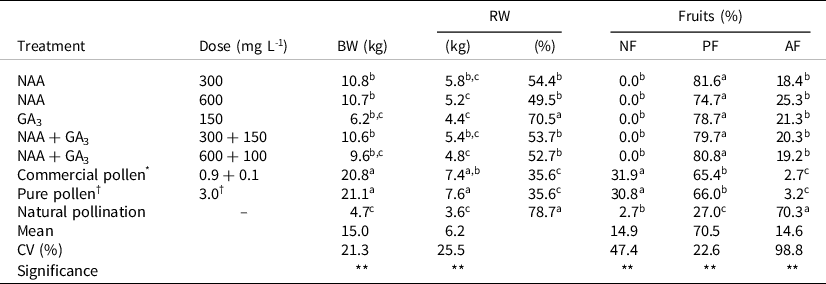
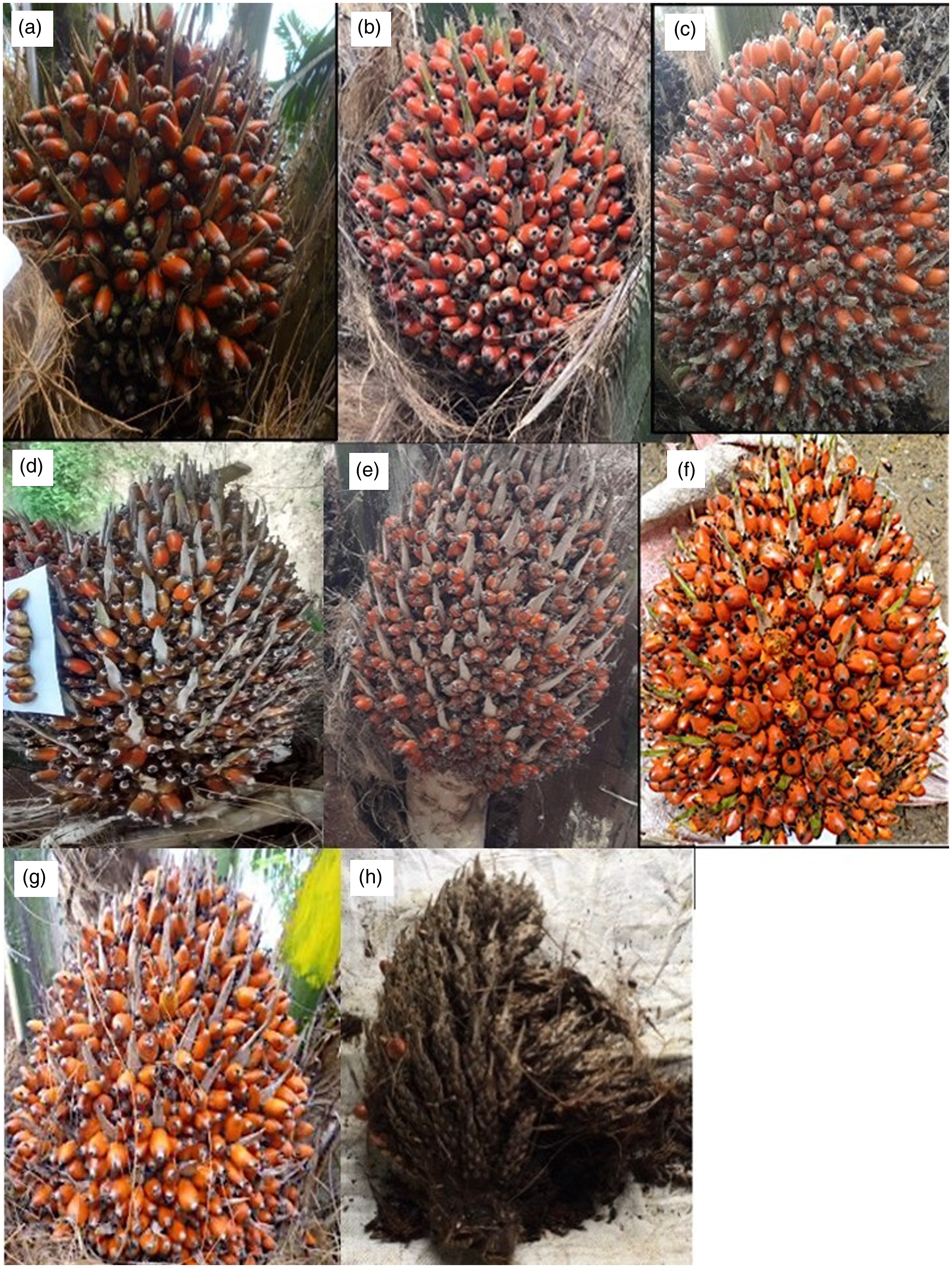
The BW was defined as the sum of the weights of spikelets with fruits and rachis (peduncle) of the bunch. Table 1 shows that, among the doses of hormones applied, the BW was higher for the NAA doses (300 and 600 mg L-1) and the NAA + GA3 mixtures than for the GA3 dose (150 mg L-1), which was also reflected in the general conformation of the bunches (Figure 1a–e). The BW was significantly higher in the pollen treatments (commercial pollination and pure pollen) compared with the hormone treatments (NAA and GA3) and natural pollination, which was reflected in better development and size of these bunches (Figure 1f–g). This is explained by the exogenous spraying of pollen that increased the number of pollen grains reaching the stigma of the female flowers. Subsequent germination favoured the formation of most of NF of the bunch. Conversely, this did not occur in the hormone treatments where pollen did not enter the inflorescences during anthesis as these were completely isolated by the bags. In natural pollen treatment, the lowest BW was, probably, due to insufficient amount of viable pollen and/or low activity of pollinating insects, which did not allow for the normal formation of the fruits (Figure 1h). The lowest BW was obtained in the natural pollen treatment. In fact, natural pollination is fluctuating and uncertain because it depends on the availability, viability, and germination of pollen, climatic variations of rainfall, dry seasons, temperature, and relative humidity.
Effect of hormone doses on the components of the bunch

Note: BW – bunch weight, RW – rachis weight, NF – normal fruits, PF – parthenocarpic fruits, AF – aborted fruits. *g talc + g pollen; †g/inflorescence; **Significant F-test (p < 0.01).
Effect of hormone doses on bunch development. (a) NAA 300 mg L-1, (b) NAA 600 mg L-1, (c) GA3 150 mg L-1, (d) NAA 300 mg L-1 + GA3 150 mg L-1, (e) NAA 600 mg L-1 + GA3 100 mg L-1, (f) commercial pollen (0.9 g talc + 0.1 g pollen), (g) pure pollen (3 g/inflorescence) and (h) natural pollination.
The RW was significantly higher for the pollen treatments than for the NAA and GA3 applications. This, probably, indicates that, while the pollen favoured the flow of the assimilates towards the rachis increasing the RW, the hormones might have reduced it favouring the filling of the PF of the bunch.
The percentage of NF/bunch was significantly higher for the treatments with commercial pollen (31.9%) and pure pollen (30.8%), low for natural pollination (2.7%); and there was no formation of NF in hormone treatments. The non-formation of NF in the treatments with NAA and GA3 was due to the previous isolation of the inflorescences that prevented the entry of any external pollen. On the contrary, in the pollen treatments (natural, commercial and pure), the NF and PF were indeed formed simultaneously.
In all hormone treatments, the percentage of PF/bunch was higher than in the other treatments and there was no formation of NF. Although there were no significant statistical differences between the doses of hormones, the percentages of PF were higher with the doses of NAA (300 and 600 mg L-1) and NAA 600 mg L-1 + GA3. A combined effect of NAA and GA3 was evident in the induction and development of bunch PF. In the enfolded treatments that only received pollen (commercial pollen and pure pollen) and in the free pollination treatment (natural pollen), the percentage of PF was significantly lower, but NF were formed because of the pollen-induced parthenocarpy. However, the percentages of PF and NF were the lowest in the control treatment (natural pollination), indicating little availability and circulation of pollen in the experimental field, which did not guarantee the formation of the fruits (Figure 1).
All AF determined in this study include those that were not formed due to lack or shortage of pollen and adverse environmental conditions during its initial development. Fruit abortion/bunch (AF) was low for commercial pollination (2.7%) and for pure pollen (3.2%), intermediate in hormone treatments (18.4 to 25.3%) and high (70.3%) in natural pollination. Although these percentages of abortion were relatively high, the fact that the inflorescences remained isolated for 15 days might have generated atypically high temperatures inside the bags. Since natural pollination depends on the availability of pollen in the environment and the activity of pollinating insects, it is strongly influenced by the environmental conditions of temperature and relative humidity (Syed, Reference Syed1979; Tandon et al., Reference Tandon, Manohara, Nijalingappa and Shivanna2001).
Bunch oil content
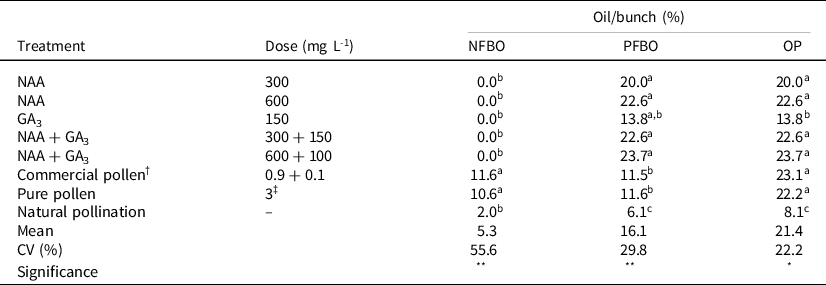
The total oil/bunch content was the sum of the mesocarp oil of NF and PF. The contribution of the NF to the bunch oil (NFBO) was 11.6% for the commercial pollen treatment and 10.6% for the pure pollen treatment, but it was low (2.0%) in the natural pollination treatment. In hormonal treatments, this contribution was 0.0% as a reasonable consequence of the non-formation of NF in those inflorescences that did not receive pollen (Table 2). In contrast, the PF contributed more than NF to the oil of the bunch because its formation and development was induced by NAA and GA3.
Effect of hormone doses on the bunch oil potential (OP), and contribution of normal fruits (NFBO) and parthenocarpic fruits (PFBO) to bunch oil

Note: OP = NFBO + PFBO.
† g talc + g pollen.
‡ g/inflorescence.
* Significant F-test (p < 0.05).
** Significant F-test (p < 0.01).
The OP is a theoretical value of the oil content in the harvested bunches that reach the extraction plant. The oil extraction rate (OER) is the estimated quantity of oil extraction/bunch at the extraction plant (OER = OP × 0.85). The OP and OER were significantly lower in natural pollination and in GA3 (150 mg L-1) treatments, as compared to pollen treatments (commercial pollination and pure pollen) and other doses of NAA and GA3.
Fatty acid profile (FAP)
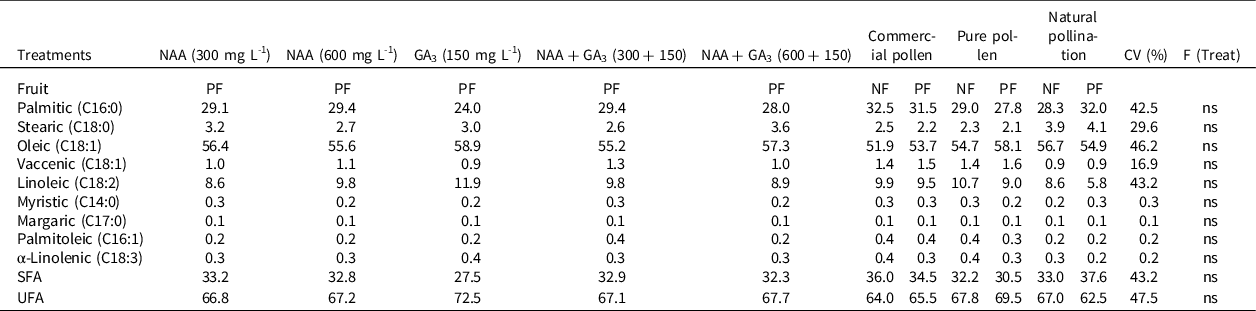
The main fatty acids found in the mesocarp of mature fruit (Table 3) were the oleic (C18:1), linoleic (C18:2), and vaccenic (C18:1) unsaturated fatty acids (UFA), and the palmitic (C16:0) and stearic (C18:0) saturated fatty acids (SFA). Other UFA and SFA were found in negligible amounts (<1%). No significant differences were found among the treatments for the FAP (p < 0.05), but these were found between the NF and PF.
Effect of NAA and GA3 on the fatty acids profile (% m/m) of normal fruits (NF) and parthenocarpic fruits (PF)

Note: SFA – saturated fatty acids; UFA – unsaturated fatty acids.
ns – Non-significant F-test (p < 0.05).
The effect of NAA and GA3 treatments on the composition of fatty acids (SFA and UFA) shows that UFA of the PF were significantly higher than SFA. In the pollen treatments (natural pollination, commercial pollen and pure pollen), the UFA of NF and PF were similar, but significantly higher than their SFA. Likewise, the UFA of the PF formed in hormone-treated plants were similar to the NF of the pollen treatments. It is important to mention that no NF was formed with hormones because, as it was explained earlier, no pollen entered the enfolded inflorescence of those treatments. The NAA and GA3 doses (single or mixed) did not alter the FAP of the fruit (NF and PF) mesocarp oil.
Discussion
Bunch components
The BW was the sum of the weights of spikelets with fruits and peduncle or rachis of the bunch. The low BW obtained in the natural pollen treatment was, probably, due to the shortage of viable pollen in the experimental field. In addition, natural pollination of hybrids is scarce due to the reduced emission of male inflorescences that produce little amount of low viability pollen (Hormaza et al., Reference Hormaza, Fuquen and Romero2012). The significant increase of BW in hormonal treatments that included NAA when compared with GA3 was, probably, due to the known effect of NAA and GA3 on the induction of fruit parthenocarpy (Bishop et al., Reference Bishop, Sakakibara, Seo, Yamaguchi, Buchanan, Gruissem and Jones2015; Engels et al., Reference Engels, Kirkby, White and Marschner2012) and on their effects on cell division and elongation (Bennett and Leyser, Reference Bennett, Leyser, Zazímalová, Petrásek and Benková2014), considering that the OxG hybrids have a higher percentage of PF per bunch. In date palms, El-Kosary (Reference El–Kosary2009) and Awad and Al-Qurashi (Reference Awad and Al–Qurashi2012) also found significant increases in bunch and fruit weight when using GA3.
In oil palm, the RW, which includes the peduncle and the fruitless spikelets (Breure and Menendez, Reference Breure and Menendez1990), represents 22 to 25% of the BW (Redshaw, Reference Redshaw, Fairhurst and Härdter2012) and increases simultaneously and proportionally to the increase in BW (Corley and Breure, Reference Corley and Breure1992). In this study, the RW (kg) was lower in the hormonal treatments, but the RW (%) in the hormonal treatments was higher than that in the assisted pollination treatments (Table 1). This is a promising result, since the oil losses increase with an increased percentage of RW during sterilisation when the rachis become impregnated with oil that normally is lost in the rachis discharge (Redshaw Reference Redshaw, Fairhurst and Härdter2012); this would, probably, happen in bunches obtained from the hormonal treatments.
The highest percentage of NF/bunch in pollen treatments and the absence of NF in the NAA and GA3 treatments can be explained on account of pollen application for enfolded inflorescences. The increase in the amount of pollen grains that contact and germinated in the receptive stigma of female flowers favoured the development of most of bunch NF; this did not occur in the NAA and GA3 treatments since no pollen entered because the inflorescences remained completely isolated by bags.
Since the percentage of PF/bunch was higher in the hormone treatments than in the other treatments, it was evident that NAA and GA3 stimulated parthenocarpy for most bunch fruits and favoured their development. Pollen-induced parthenocarpy explains the simultaneous formation of NF and PF in pollen treatments (natural, commercial and pure pollen), because the NF formation required pollen grains to contact the flower receptive stigma during anthesis; this did not happen in the hormone treatments due to the previous isolation of the inflorescences.
In some species, parthenocarpy and fruit growth can be induced by NAA and GA3, since GA3 increases the content of endogenous auxins in the ovary of non-pollinated flowers and generates fruit growth without fertilisation (Mesejo, Reference Mesejo2012). Endogenous auxins and GA3 reach their highest concentrations in fruits when the dry mass build-up rate is the highest, that is, when the fruit sink activity and phloem discharge are the highest (Engels et al., Reference Engels, Kirkby, White and Marschner2012). Also, Prieto et al. (Reference Prieto, Ochoa and Cayón2015) observed increased growth rates in fruits from OxG inflorescences sprayed with NAA and GA3. A recent study indicated that 600 and 1200 mg L-1 NAA produced bunch formation comparable to that obtained with assisted pollination (Romero et al., Reference Romero, Daza, Ayala–Díaz and Ruiz–Romero2021). Corley and Tinker (Reference Corley and Tinker2016) affirmed that the OxG quality of having more PF per bunch is inherited from the mother E. oleifera, which can be 49 or 56% PF per bunch depending on its genetic origin (Rosero et al., Reference Rosero, Santacruz, Rios and Carvajal2017; Zambrano, Reference Zambrano2004).
The high percentage of fruit abortions (FA) (between 18.4 and 25.3%) in the NAA and GA3 treatments apparently results from the lack of pollen and high temperatures within the isolation bags, whereas, in natural pollination treatment, FA (70.3%) could be due to a shortage of pollen and high air temperature during the fruit formation, which indeed occurred during the experimental period. In relation to this, Lagos et al. (Reference Lagos, Bacca, Herrera and Delgado2015) stated that temperature is one of the climatic factors that influences the most in physiological processes of plants, whereas Hedhly (Reference Hedhly2011) indicated that its effect is more harmful during the formation of floral primordia. Other authors stated that premature FA might be a consequence of incorrect pollination, lack of assimilates, water stress, or extreme temperatures during the fruit development (Combres et al., Reference Combres, Pallas, Rouan, Mialet–Serra, Caliman, Braconnier, Soulie and Dingkuhn2013; Corley and Breure, Reference Corley and Breure1992; Corley and Tinker, Reference Corley and Tinker2016). According to Binder and Patterson (Reference Binder and Patterson2009), increased fruit abscission during periods of high temperature is a consequence of the increased internal concentrations of abscisic acid and ethylene in the fruit tissues. The doses of hormones (Daza et al., Reference Daza, Ayala-Díaz, Ruiz-Romero and Romero2021) and the number of hormone applications (Romero et al., Reference Romero, Daza, Ayala–Díaz and Ruiz–Romero2021) were also considered as causes for FA in oil palm.
Inflorescence abortions tend to appear 2 to 5 months prior to anthesis (Sparnaaij, Reference Sparnaaij1960) or 10 months before harvest (Corley and Tinker, Reference Corley and Tinker2016); the harvest usually occurs 5 months after anthesis. Female inflorescences are more likely to abort than male ones (Breure and Menendez, Reference Breure and Menendez1990; Corley and Breure, Reference Corley and Breure1992). Unexpected flower and FA that occur during dry seasons, even in pollination-assisted palms, are a direct physiological consequence of high temperatures that reduce carbohydrate reserves in pollen grains and stigma cells; this alters the distribution of assimilates by changing the balance between the phloem simplastic and apoplastic load (Taiz and Zeiger, Reference Taiz, Zeiger, Taiz and Zeiger2006). Also, Sakata et al. (Reference Sakata, Oshino, Miura, Tomabechi, Tsunaga and Higashitani2010) suggested that pollen infertility is related to an alteration of the auxin biosynthesis during the anther development, and this reduces the possibilities for the female flowers to be fertilised and increases the fruit premature abortion.
Bunch oil
In the OxG plants, the PF contribute the most to the bunch oil because they are greater in number, and their mesocarp, of up to 98% of the fruit, contributes more oil than the one from the NF (Bastidas et al., Reference Bastidas, Peña, Reyes, Pérez and Tolosa2007; Preciado et al., Reference Preciado, Bastidas, Betancourth, Peña and Reyes2011a, Reference Preciado, Bastidas, Betancourth, Peña and Reyes2011b). The NAA and GA3 doses (single or mixed) provoked parthenocarpy induction in most bunch fruits, causing oil potential (OP and OER) to be higher in those treatments. The OP indicates the amount of oil that is possible to extract per unit of fresh fruit bunch (Moreno et al., Reference Moreno, García, Díaz and Ramírez2017). The plants differed in OP and OER because OER was calculated from OP (OER = OP × 0.85), and these two variables depended on the contribution of oil from normal (NFBO) and parthenocarpic fruits (PFBO). Corley and Tinker (Reference Corley and Tinker2016) stated that the variations in OP and OER depend on the proportion of NF and PF in the bunch which are the ones that contain oil.
Fatty acid profile (FAP)
The UFA are chemical molecules with double bonds in their chain, while SFA do not possess them (Cassiday, Reference Cassiday2016). The UFA are essential in human nutrition and have cardioprotective properties due to their ability to reduce low-density lipoprotein (LDL) cholesterol, commonly known as ‘bad cholesterol’, and to increase high-density lipoprotein (HDL) cholesterol, considered as ‘good cholesterol’ (Khosla, Reference Khosla2014). For many years, E. guineensis palm’s raw oil was discredited because its content of SFA represented a risk for heart disease (Cassiday, Reference Cassiday2016) but today this oil is considered to be balanced since it contains approximately 50% of SFA (mainly palmitic) and 50% of UFA (mainly oleic) (Basri et al., Reference Basri, Siti Nor Akmar and Henson2005). The hybrid palm oil contains 33% of SFA –mainly palmitic – and 66% of UFA – mainly oleic and linoleic (Mozzon et al., Reference Mozzon, Pacetti, Lucci, Balzano and Giuseppe Frega2013), where oleic acid has cardioprotective properties due to its ability to reduce LDL cholesterol and increase HDL cholesterol (Khosla, Reference Khosla2014). The FAP of the hybrid palm oil in this study coincides with that reported in the literature for the OxG hybrids (Montoya et al., Reference Montoya, Lopes, Flori, Cros, Cuéllar, Summo, Speout, Rivallan, Risterucci, Bittencourt, Zambrano, Alarcón, Villeneuve, Pina, Nouy, Amblard, Ritter, Leroy and Billotte2013; Tan et al., Reference Tan, Ong, Rajanaidu and Rao1985).
Conclusion
The NAA (300 and 600 mg L-1) doses are effective and promising to increase BW and oil yield in the oil palms without altering the FAP of mesocarp oil and can be considered as complementary alternatives in the assisted pollination of the OxG hybrids.
Acknowledgements
We acknowledge the support from the Universidad Nacional de Colombia in the development of this research. The views expressed in this article cannot be taken to reflect the official opinions of these institutions. The authors thank Dr. Mario Augusto García Dávila for his guidance and advice on the statistical design and Marzory Andrade for the general consolidation of data and statistical processing.
Financial Support
This study was funded by the Guaicaramo SAS plantation (Colombia).
Disclosure Statement
The authors declare no conflict of interest.