Introduction
Tomato (Lycopersicon esculentum Miller; Solanaceae) is an important vegetable grown in many parts of the world including Iran. Its production is constrained by both abiotic and biotic factors. One of the most important biotic constraint of tomato production is the damage inflicted by golden twin-spot moth or tomato looper, Chrysodeixis chalcites (Esper) (Lepidoptera: Noctuidae). It is a polyphagous and polyvoltine insect that attacks more than 30 different plant species, including fodder crops, vegetables, fruit trees, and ornamental plants in the field and greenhouse. This insect is native to the Mediterranean and tropical regions (Rashid et al. Reference Rashid, Hammad and Hassan1971; Murillo et al. Reference Murillo, Hunt and Van Laerhoven2013). It is one of the most important noctuid pests of fodder crops (such as alfalfa, clover, and maize) and soybean in Spain (Avidov and Harpaz Reference Avidov and Harpaz1969; Amate et al. Reference Amate, Barranco and Cabello1998), and on soybean in northern Italy (Zandigiacomo Reference Zandigiacomo1990). It is an important pest of tomato in Israel, inflicting serious damage to the leaves and vegetative parts of the plant, although it does not bore into the fruit (Harakly and Farag Reference Harakly and Farag1975; Broza and Sneh Reference Broza and Sneh1994; European and Mediterranean Plant Protection Organization 2004). This insect is a serious pest of greenhouses crops in Europe (Cabello et al. Reference Cabello, González, Justicia and Belda1996; van Oers et al. Reference van Oers, Herniou, Usmany, Messelink and Vlak2004). In recent years it has been inflicting economic damage to tomato in many tomato-growing areas of Iran.
Chrysodeixis chalcites has developed resistance to several pesticides (Alonso Reference Alonso2009; Del Pino et al. Reference Del Pino, Carnero, Cabello and Hernández2011). Therefore, other control methods need to be investigated for effective control of this pest. The use of resistant cultivar is an environmentally safe method of insect control and is also less expensive for growers (Liu et al. Reference Liu, Li, Gong and Wu2004). Resistance of host plants against herbivore insects may be due to antibiosis (Painter Reference Painter1951; Arimura et al. Reference Arimura, Kost and Boland2005). The antibiosis properties of host plant can reduce the amount of feeding, fecundity, and size of insect. They also can lengthen development period, and increase mortality rate (Tabashnik and Slansky Reference Tabashnik and Slansky1987).
The comparison of fertility life table parameters of a given pest on different cultivars of the host plants is a common method of delineating resistant cultivar(s). Life history traits and life table parameters are important indicators of population growth capacity of a given species under specified conditions on different host cultivars (Carey Reference Carey1995; Southwood and Henderson Reference Southwood and Henderson2000). Methods for analysis of the life tables of animal populations have been described by Deevey (Reference Deevey1947), Birch (Reference Birch1948), Southwood (Reference Southwood1978), and Carey (Reference Carey1993), and examples of practical use of female-based fertility life tables are abundant in the host-plant resistance related literature (Tisdale and Sappington Reference Tisdale and Sappington2001; Liu et al. Reference Liu, Li, Gong and Wu2004; Mardani-Talaee et al. Reference Mardani-Talaei, Nouri-Ganbalani, Naseri and Hassanpour2012). Istock (Reference Istock1981) noted that the development rates often differ between the sexes and among the individuals of a species. Also, Chi (Reference Chi1988) concluded that ignoring the sex of individuals in estimating life table parameters could result in errors. Therefore, Chi and Liu (Reference Chi and Liu1985), and Chi (Reference Chi1988) have developed a model for age-stage, two-sex life table based on variable development rates of both sexes (male and female). Several recent papers have calculated the life history and life table parameters of insects by using the age-stage, two-sex model (Yadav and Chang Reference Yadav and Chang2012; Huang and Chi Reference Huang and Chi2013; Marouf et al. Reference Marouf, Amir-Maafi and Shayesteh2013; Safuraie-Parizi et al. Reference Safuraie-Parizi, Fathipour and Talebi2014).
Harakly and Farag (Reference Harakly and Farag1975) and Gasim and Younis (Reference Gasim and Younis1989) studied the natural history of C. chalcites. However, despite its economic importance on tomato, there is no published information concerning the life history traits of this pest on tomato in Iran. The purpose of this study was to determine the effects of six tomato cultivars that are commonly grown in Iran on the life history traits of this pest under laboratory conditions, and to delineate the most unsuitable cultivar to the pest that could be used in its integrated management.
Materials and methods
Plant and insect sources
The seeds of six commercial tomato cultivars (Cal.JN3, Hed Rio Grande, Rio Grande UG, SUN 6108 f1, Super crystal, and Super strain B) were obtained from the Seed and Plant Improvement Institute in Karaj, Iran. They were grown in 3 L pots in the greenhouse of University of Mohaghegh Ardabili, Iran in May 2013, set at 25±5 °C, 60±5% relative humidity, and 14:10 (light:dark hours). The golden twin-spot moths were collected as larvae from a tomato field in the Moghan region, Iran. The larvae were reared on a local tomato cultivar (Meshkin) for three generations in the greenhouse to eliminate previous host effects. Then, the larvae were reared on the leaves of six commercial cultivars of tomato until the adult stage.
Life history traits
Adult moths emerged from the larvae reared on leaves of different tomato cultivars were used in the experiments. In order to obtain the same age eggs, 15 pairs of both sexes of the moth reared on each tomato cultivar were kept inside a plastic oviposition container (14 cm diameter, 19 cm height), which was sealed at the top with a fine mesh net. After 72 hours, the eggs laid were collected from the container and used in the experiments. Each cultivar of tomato was considered as a treatment and each treatment was replicated 50 times in a completely randomised design experiment. Newly hatched larvae were transferred into Petri dishes (8 cm diameter, 1 cm depth with a hole covered by a fine mesh net for ventilation). The experiments was carried out in a growth chamber (Binder KBWF, model 240, Tuttlingen, Germany) that was set at 25±1 °C, 65±5% relative humidity, and 16:8 (light:dark hours). When the tomato cultivars reached six to eight leaves stages in the greenhouse, the second fully expanded leaf from the top of the plants was cut and used in the experiments to feed the larvae in the growth chamber. Fresh leaves were provided for larval feeding every other day. Moulting was determined by observation of the head capsule. Fifth instars were kept in small plastic tubes (2 cm diameter, 5 cm depth) for pre-pupation and pupation. During the experiment, duration of each larval stadium and pupal periods, percentage of pupation and percentage of the moths emerged from pupae were recorded.
After emergence of the adults, a pair of female and male moths reared on each tomato cultivar, were introduced into a plastic oviposition container (10 cm diameter, 15 cm depth), which was sealed at the top with a fine mesh net for ventilation. Each container was supplied with a 10% honey solution for moth feeding. This experiment was conducted in a completely randomised design with 15 replications for each cultivar. The number of eggs laid, adult longevity, adult pre-oviposition period (APOP) and total pre-oviposition period (TPOP) were recorded daily until the death of the last adult. The egg laying containers were equipped with window screen as oviposition substrate to prevent eggs being laid on the container wall. Eggs laid from each adult pair within the same day were monitored to determine the incubation period. During hatching, these eggs were checked every day, and the number of newly hatched larvae was recorded. In this study, larval growth index (LGI) and pupal growth index (PGI) was calculated by dividing the survival rate of the immature by development time (Setamou et al. Reference Setamou, Schulthess, Bosque-Perez, Poehling and Borgemeister1999).
Statistical analysis
The survival rate of all females and males (including those that died before the adult stage), and the daily fecundity rate of females were analysed using the age-stage, two-sex life table (Chi and Liu Reference Chi and Liu1985; Chi Reference Chi1988). The age-stage specific survival rate (S xj ) (where x=age in days and j=stage (stage 1=egg, stage 2=larva, stage 3=pupa, stage 4=adult female, stage 5=adult male)); the age-stage specific fecundity (f xj ) (daily number of eggs produced per female of age x); the age-specific survival rate (l x ); and the age-specific fecundity (m x ) (daily number of eggs produced per individual i.e., this number is divided by all individuals (males and females) of age x) were calculated using the iterative bisection method described by Chi and Liu (Reference Chi and Liu1985).
Before analysis, all data were tested for normality. Data concerning development time, longevity, and fecundity on different tomato cultivars were compared by one-way analysis of variance followed by Tukey–Kramer procedure at α=0.05 using statistical software SPSS 16.0 (Stata Corp., College Station, Texas, United States of America).
Results
Development time
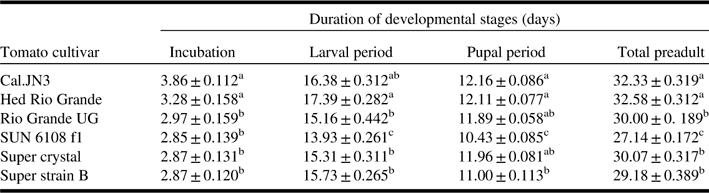
The data of the total preadult period of immature stages of C. chalcites reared on six different tomato cultivars are given in Table 1. There were significant differences among the tomato cultivars in the incubation period, developmental time of larval and pupal stages as well as total preadult period of C. chalcites. The longest incubation period of eggs were observed on cultivars Cal.JN3 and Hed Rio Grande (3.86±0.112 and 3.28±0.158 days, respectively), and the shortest (2.85±0.139 days) on SUN 6108 f1 cultivar. The larvae reared on Hed Rio Grande and SUN 6108 f1 had the longest (17.39±0.282 days) and the shortest (13.93±0.261 days) larval period compared with the other cultivars. The longest pupal period was observed on Cal.JN3 (12.16±0.086 days) and Hed Rio Grande (12.11±0.077 days), respectively, and the shortest one was recorded on cultivar SUN 6108 f1 (10.43±0.085 days). The longest total preadult periods were recorded on Hed Rio Grande (32.58±0.312 days) and Cal.JN3 (32.33±0.319 days), and the shortest one on SUN 6108 f1 cultivar (27.14±0.172 days, respectively).
The mean (±SE) duration of egg incubation time, larva and pupa developmental times, and total preadult period of the Chrysodeixis chalcites on six different tomato cultivars under the laboratory conditions.

The means followed by different letters in the same columns are significantly different (P<0.05, Tukey test).
Adult longevity, APOP and TPOP
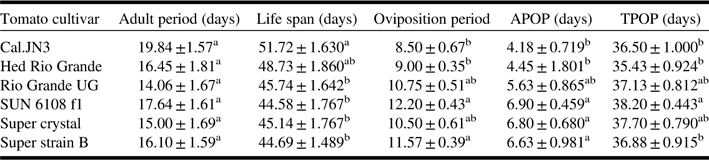
Adult life span, the mean APOP, and TPOP of C. chalcites reared on different tomato cultivars are presented in Table 2. Significant difference was observed among the tomato cultivars in life span, oviposition period, APOP period, and TPOP period of C. chalcites on various tomato cultivars, however no significant differences were found on adult period of C. chalcites. The longest life span was recorded on Cal.JN3 (51.72±1.630 days) compared with the other tomato cultivars. The shortest oviposition period recorded on cultivars Hed Rio Grande (9.00±0.35 days) and Cal.JN3 (8.50±0.67 days) cultivars. The females reared on SUN 6108 f1 had the longest TPOP period (38.20±0.443 days) compared with the other cultivars.
The mean (±SE) adult period, life span, oviposition period, adult pre-oviposition period (APOP), and total pre-oviposition period (TPOP) of female Chrysodeixis chalcites reared on six different tomato cultivars under the laboratory conditions.

The means followed by different letters in the same columns are significantly different (P<0.05, Tukey test).
Adult longevity, preadult period, and total longevity
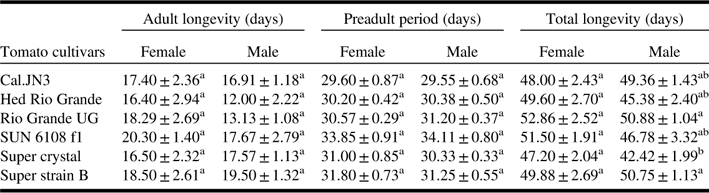
The mean adult, preadult, and total longevity period for female and male C. chalcites on six different tomato cultivars are presented in Table 3. No significant differences were observed in the adult (female and male), preadult (female and male), and total longevity of female C. chalcites developed from larvae fed on different tomato cultivars. However, significant differences were found among different cultivars regarding the longevity of male moths. The shortest total longevity of male moth (42.42±1.99 days) was observed on Super crystal cultivar.
The mean (±SE) adult longevity, preadult period (days), and total longevity of Chrysodeixis chalcites reared on six different tomato cultivars under the laboratory conditions.

The means followed by different letters in the same columns are significantly different (P<0.05, Tukey test).
Larval growth index, pupa growth index, rate of larvel mortality, and percentage of ovipositon days
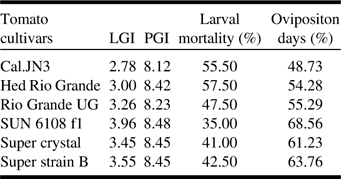
The LGI and PGI, larval mortality rate and percentage of ovipositon days of C. chalcites on six different tomato cultivars are shown in Table 4. The larvae reared on SUN 6108 f1 cultivar had the highest amount of LGI (3.96), the highest amount of PGI (8.48), the lowest rate of larval mortality (35.00%), and the highest percent of ovipositon days (68.56). The highest rate of larval mortality rate (57.50%) was observed on Hed Rio Grande cultivar. The lowest amount of LGI (2.78), the lowest amount of PGI (8.12) and the lowest per cent of ovipositon days (48.73%) were observed on Cal.JN3 cultivar.
The larval growth index (LGI), pupa growth index (PGI), larval mortality rate, and percentage of ovipositon days of Chrysodeixis chalcites on six different tomato cultivars under the laboratory conditions.

Survival rate and age-specific mortality
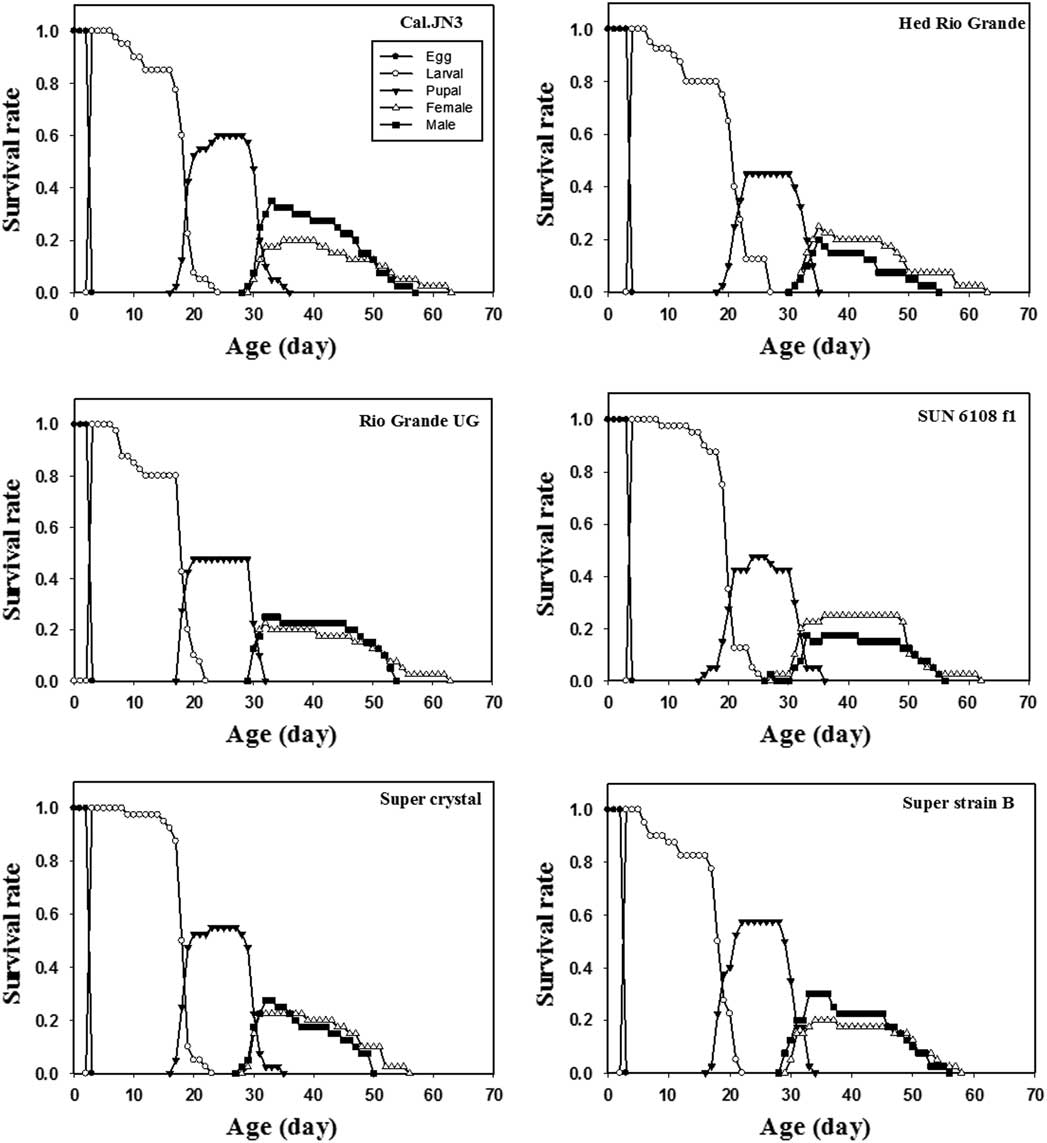
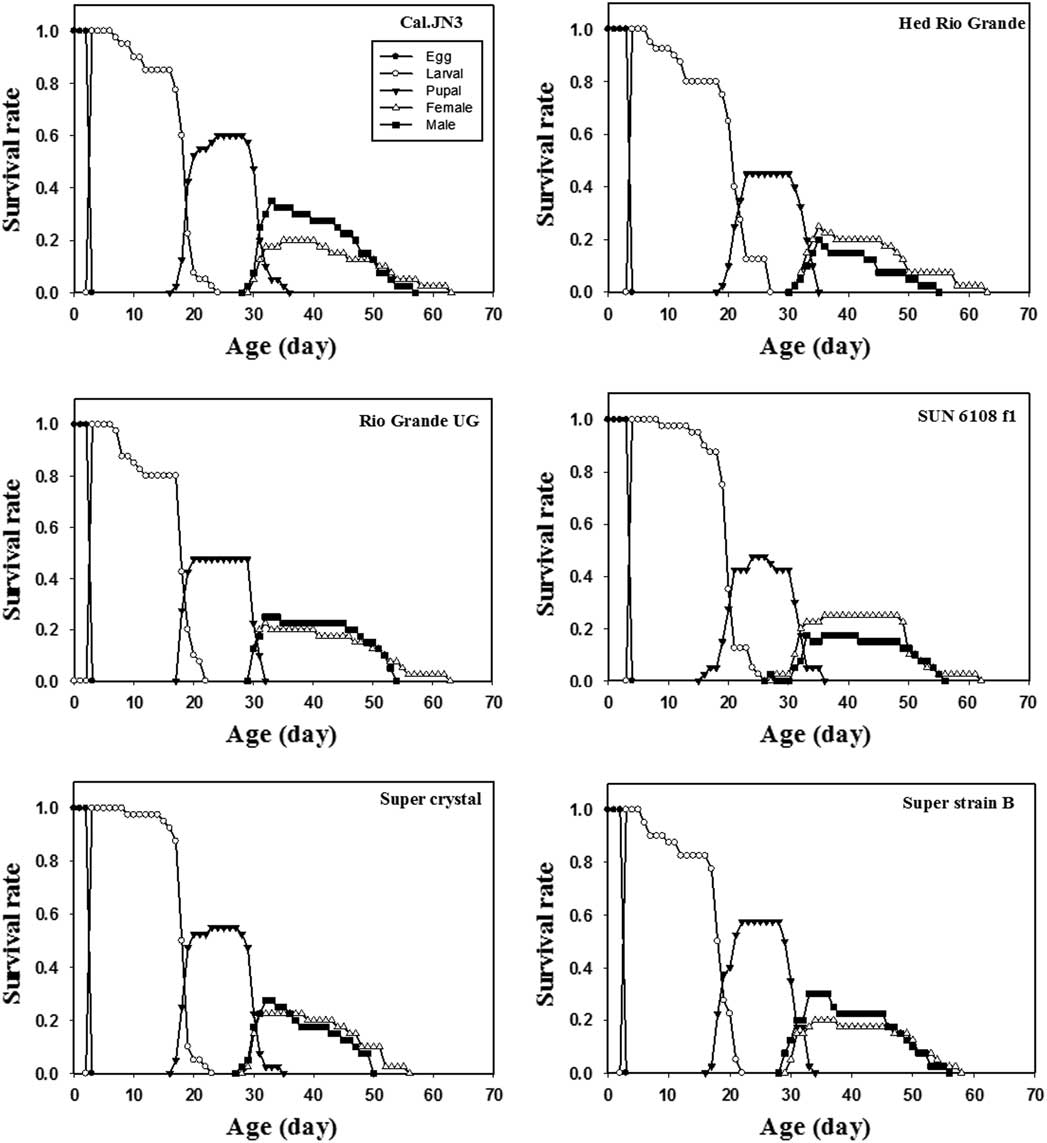
The age-stage survival rate (S xj ) of C. chalcites reared on six tomato cultivars are presented in Fig. 1. The highest S xj for the egg (0.60) and the highest S xj for larval stages (0.25) were recorded on cultivar SUN 6108 f1. The lowest S xj for the pupal and adult female stage were 0.48 and 0.18 on cultivars Cal.JN3 and Hed Rio Grande, respectively. Also the highest (0.35) and the lowest (0.25), age-stage specific survival rate for the adult male stage were observed on SUN 6108 f1 and on Cal.JN3 cultivars, respectively.
Age-stage specific survival rates (S xj ) of the golden twin spot, Chrysodeixis chalcites on six different tomato cultivars under the laboratory conditions.
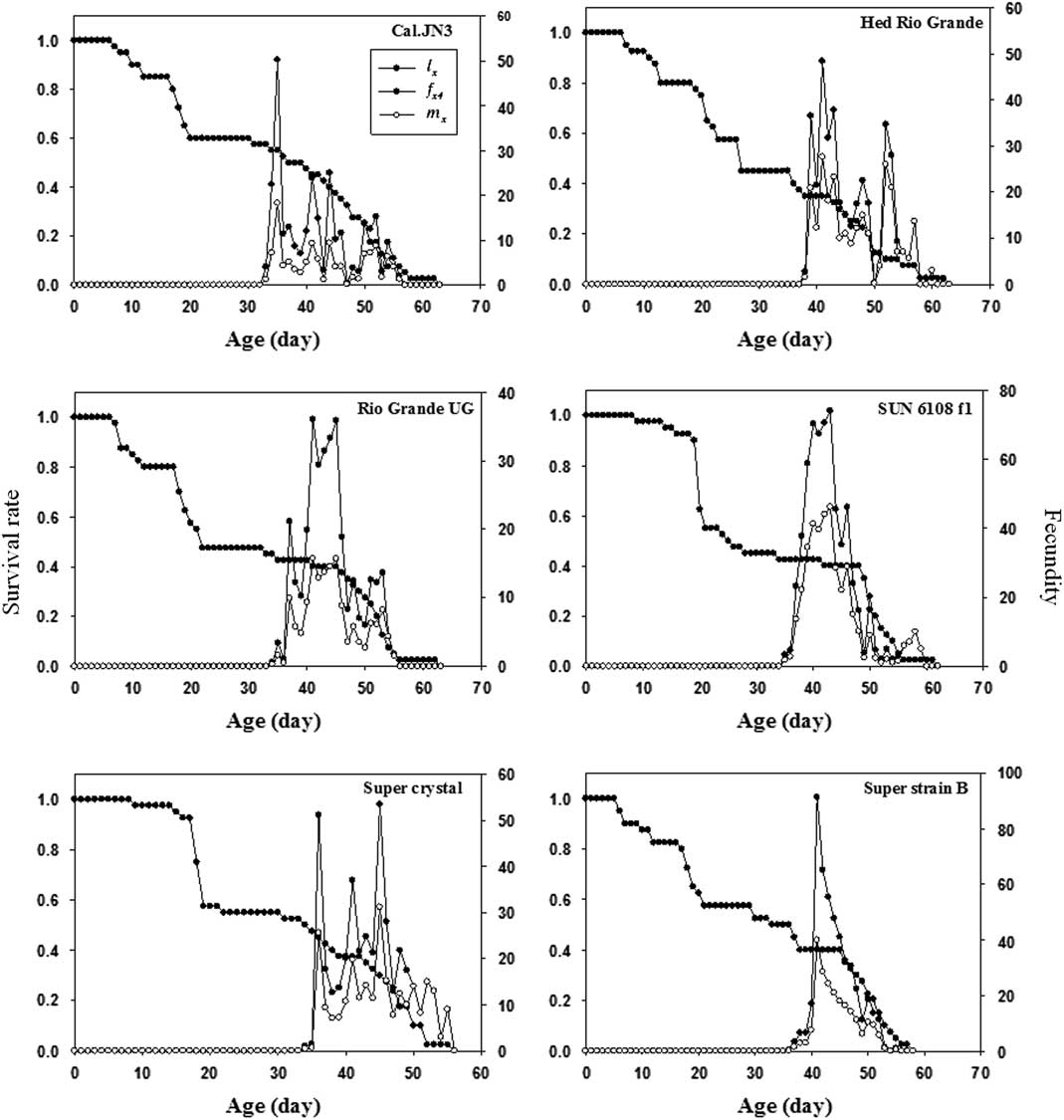
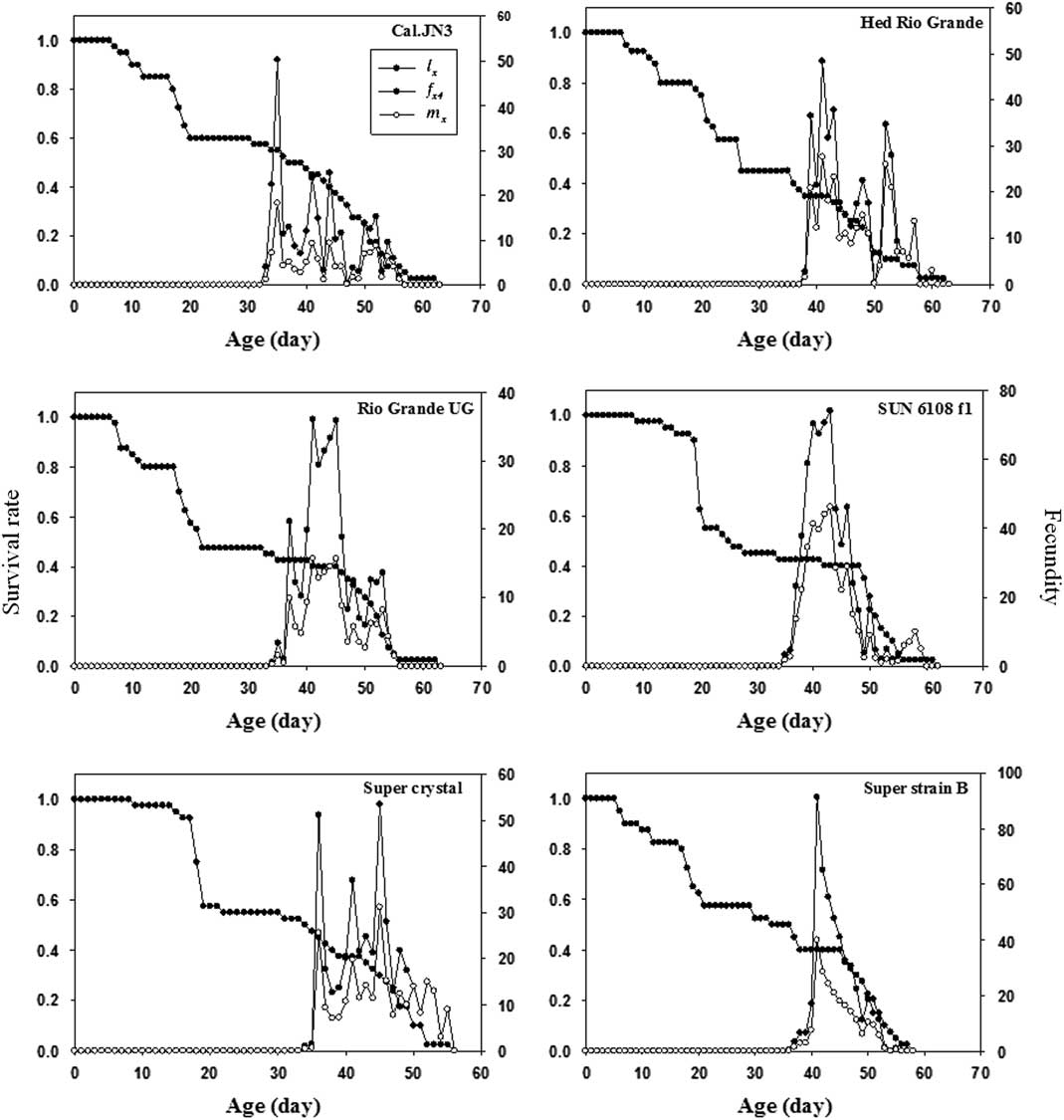
The age-specific survival rates (l x ) of C. chalcites on six tomato cultivars are depicted in Fig. 2. Since only female adults (the 4th stage) produce offspring, only a single curve of the female age-stage specific fecundity (f x4 ) is shown. Tomato cultivars were significantly different on the highest number of eggs laid/day on them and the days after emergence of adult female that the highest laid the number of eggs. The highest number of eggs laid/day were 53.43 on Super crystal at day 45, 74.00 on SUN 6108 f1 at day 43, 91.29 on Super strain B at day 41, 36.00 on Rio Grande UG at day 41, 48.30 on Hed Rio Grande at day 41, and 50.25 at day 35 on Cal.JN3 (Fig. 2). The highest m x (the age-specific fecundity of the total population) of C. chalcites was 31.17 on Super crystal (at day 45), 46.25 on SUN 6108 f1 (at day 43), 39.94 on Super strain B (at day 41), 18.28 on Rio Grande UG (at day 41), 27.65 on Hed Rio Grande (at day 41), and 15.75 on Cal.JN3 (at day 35) eggs/female/days, respectively (Fig. 2).
Age-specific survival rate (l x ), age-stage specific fecundity (f x4), and age-specific fecundity (m x ) of Chrysodeixis chalcites reared on six different tomato cultivars under the laboratory conditions.
Discussion
According to the results, six different tomato cultivars that were studied varied in their effect on the life history traits of C. chalcites. Many researchers have demonstrated that different cultivars of a given host-plant species might have different effects on the life history traits of herbivorous species (Liu et al. Reference Liu, Li, Gong and Wu2004; Soleimannejad et al. Reference Soleimannejad, Fathipour, Moharramipour and Zalucki2010; Safuraie-Parizi et al. Reference Safuraie-Parizi, Fathipour and Talebi2014). These differences have been used in identify the resistant cultivars to many insect pests, which is an environmentally friendly approach to reduce insect damages (Painter Reference Painter1951; Kogan and Ortman Reference Kogan and Ortman1978; Umbanhowar and Hastings Reference Umbanhowar and Hasting2002).
Our study indicated that the mean egg incubation period of C. chalcites varied between 2.85 and 3.86 days on different tomato cultivars under 25±1 °C, 65±5%, and 16:8 (light:dark hours). Gasim and Younis (Reference Gasim and Younis1989) found that the incubation period of C. chalcites at 25 °C was three days, which is in agreement with our results. The longest incubation period of C. chalcites eggs in our study at 25±1 °C were 3.86 and 3.28 days, which were observed on cultivars Cal.JN3 and Hed Rio Grande, respectively, perhaps indicating the unsuitable effect of this cultivars. Jallow and Matsumura (Reference Jallow and Matsumura2001) and Safuraie-Parizi et al. (Reference Safuraie-Parizi, Fathipour and Talebi2014) reported that the egg incubation period of Helicoverpa armigera (Hübner) (Lepidoptera: Noctuidae) was not significantly affected on host plants. Inconsistencies that were observed between our results and the result obtained by Jallow and Matsumura (Reference Jallow and Matsumura2001) and Safuraie-Parizi et al. (Reference Safuraie-Parizi, Fathipour and Talebi2014) may have resulted from difference in the insect pests that were studied.
In our studies C. chalcites had five instars on all six tomato cultivars tested, but according to Harakly and Farag (Reference Harakly and Farag1975) C. chalcites has six larval instars on tomato plants. Goodey (Reference Goodey1991) has reported that this insect may have four to seven instars on tomato. When fed on nutritious, rich food the larvae of Lepidoptera develop at a faster rate, which reduces the number of instars (Hwang et al. Reference Hwang, Liu and Shen2008). The lack of observed variation of the number of larval instars among to tomato cultivars studied in this research indicates that the nutritional difference among these cultivars for C. chalcites was not significant.
The larval developmental period of the pest in this study varied from 13.93 days on SUN 6108 f1 cultivar to 17.39 days on cultivar of Hed Rio Grande cultivar. The longer developmental period of C. chalcites on Hed Rio Grande indicated that this cultivar is nutritionally less suitable for the larval development compared with the other cultivar (Sharma et al. Reference Sharma, Agarwal and Singh1982; Samraj and David Reference Samraj and David1988; Bernays and Chapman Reference Bernays and Chapman1994). Nutritional quality of a host plants can have positive or negative effects on growth, reproduction, and survival of phytophagous insect (Browne and Raubenheimer Reference Browne and Raubenheimer2003).
In the present study, the pupal development period of C. chalcites ranged from 12.16 days on Cal.JN3 to 10.43 days on SUN 6108 f1 cultivar. Rashid et al. (Reference Rashid, Hammad and Hassan1971) found that the mean pupal development time of C. chalcites was 8.8 days at 25 °C. The difference in pupal development period between our results and Rashid et al. (Reference Rashid, Hammad and Hassan1971) may be the result of the difference in the nutrient content and chemical compounds of different tomato cultivars that were studied in these two studies (Liu et al. Reference Liu, Li, Gong and Wu2004).
In our studies the longest total preadult period of the pest was observed on cultivars Cal.JN3 (32.33 days) and Hed Rio Grande (32.58 days). Nemati Kalkhoran et al. (Reference Nemati Kalkhoran, Naseri, Rahimi Namin and Kouhi2013) also concluded that the longest preadult period of H. armigera (51.67 days) was on Hed Rio Grande cultivar. The highest mortality rate, the longest development time and the longest larval stage of C. chalcites were observed on Hed Rio Grande cultivar. These findings suggest that Hed Rio Grande and Cal.JN3 might have some properties that have deleterious effect on the growth and development of the pest insect. Van Lenteren and Noldus (Reference van Lenteren and Noldus1990) noted that the longer preadult period (development time) and the lower fecundity of an insect on a host plant indicate that it is an unsuitable host for the insect. Growth rate of an insect is influenced by its food quality (Jansen and de Groot Reference Jansen and de Groot2004).
The growth index depicts the effect of food quality on both survival rate and development time of an insect (Setamou et al. Reference Setamou, Schulthess, Bosque-Perez, Poehling and Borgemeister1999). In our studies, the lowest value of larval growth index was observed on Cal.JN3, which may be due to lower suitability of this cultivar to C. chalcites that can have negative effects on growth and survival, as well as the rate of ovipositon days of C. chalcites
The curve of l x (the age-specific survival rate of all individuals) showed a similar pattern on all six tomato cultivars; mortality was high in incubation period, first, second, and third instars then it declined slowly until the death of last adult. Our finding is similar to those reported in other studies (Bhonwong et al. Reference Bhonwong, Stout, Attajarusit and Tantasawat2009; Safuraie-Parizi et al. Reference Safuraie-Parizi, Fathipour and Talebi2014). The high densities of trichomes and polyphenol oxidase on tomato leaves can due to increasing high mortality and decline of quality nutritive, digestibility of plant tissues for insects (Simmons et al. Reference Simmons, Gurr, Mcgrath, Martin and Nicol2004).
The survival rates (S xj ) illustrates the advantageous potency of the age-stage, two-sex life table that reveal substantially more details of the life table including the overlaps between stages due to incorporation of the variable developmental rates among individuals into the age-stage, two-sex life table. The survival rate of C. chalcites to adult stage (females) was lowest on Cal.JN3 compared with the other cultivars. Lack of knowledge of the variable developmental rate among the individuals of a population and the use of the adult age inevitably will generate errors in the life table parameters estimation (Yu et al. Reference Yu, Chi and Chen2005) and the overlapping in the stage-specific survival curves could not be properly shown (Chi Reference Chi1988). Thus, difference between the life history traits of C. chalcites on various tomato cultivars could be attributed to chemical properties (such as toxins and nutrient balance) and/or physical characteristics (such as trichomes and tissue hardiness) of the plant needs further investigations that are being conducted in our laboratory.
The present study revealed that Cal.JN3 and Hed Rio Grande cultivars were the most unsuitable cultivars to C. chalcites in compared to the other experimented. If these cultivars prove to be the least suitable tomato cultivar under the field conditions to C. chalcites, they could then be included in the integrated pest management programme of this pest. Further experiments under field conditions will be needed to validate these findings. The study on chemical components of these cultivars, which is unsuitable in our laboratory, may further reveal the chemical base of the unsuitability of cultivars Cal.JN3 and Hed Rio Grande.
Acknowledgements
This research is financially supported by the University of Mohaghegh Ardabili, (Ardabil, Iran), which is greatly appreciated. The authors gratefully acknowledge Dr. David Jenkins from University of Georgia for the reviewing and improving the manuscript.